INTRODUCTION
Chitosan is a deacetylated form of chitin, a polymer of heteropolysaccharide and composed of N-acetyl glucosamine and 70 % or more N-glucosamine. Chitooligosaccharides, obtained from chitosan by hydrolysis with chitosanase, have various potential applications in biomedicines, pharmaceuticals, agriculture and food1. Chitosanase (EC 3.2.1.132) occurs in a variety of microorganisms, including bacteria and fungi2.
Chitosanase (EC 3.2.1.132) is a glycoside hydrolase which catalyzes the hydrolysis of β-1,4-linkages between N-acetyl-D-glucosamine and D-glucosamine residues in a partly acetylated chitosan. This enzyme has specific hydrolysis pattern which depens on the source of microorganisms and the degree of acetylation of the substrates3.
In an effort of obtaining indigenous chitosanase produc-ing bacteria, bacterial isolates were collected from Indralaya swamp, South Sumatera. The extracellular chitosanase-pro-duction capacity of 14 bacterial isolates taken from Indralaya Swamp South Sumatera, was evaluated in liquid cultures. The GB2 isolate was selected due to its high chitosanase activity. Therefore, the objective of this study was to characterization chitosanase from bacteria Indralaya swam, South Sumatera.
EXPERIMENTAL
GB2 isolate used in this experiment was isolated from swamp in Indralaya South Sumatera. Media production : 0.5 % colloidal citin; 0.1 % K2HPO4; 0.01 % MgSO4.7H2O; 0.05 % yeast extract; 0.1 % NaCl and 0.7 % (NH4)2SO4.
Characterization of Chitosanase from Indralaya Swamp Bacteria, South Sumatera, Indonesia
ACE BAEHAKI* and HERPANDI
Study Program of Fisheries Product Technology, Faculty of Agriculture, Sriwijaya University, Jln. Raya Palembang-Prabumulih Km. 32 Indralaya, OI, Sumatera Selatan 30662, Indonesia
*Corresponding author: Tel: +62 711 580934; E-mail: [email protected]
(Received: 7 February 2012; Accepted: 14 December 2012) AJC-12538
The extracellular chitosanase-production capacity of 14 bacterial isolates taken from Indralaya Swamp South Sumatera, was evaluated in liquid cultures. The GB2 isolate was selected due to its high chitosanase activity. The optimum pH and temperature of chitosanase produced by GB2 were 8 and 30 ºC, respectively. Ca2+
and Fe2+
increased GB2 chitosanase whereas Na+
and K+
inhibited the enzyme. Study on the effect of metals ion indicated that chitosanase GB2 was metaloenzyme. Moleculer weights were determined by using SDS-PAGE and zymogram technique. Moleculer weight of chitosanase isolate GB2 was 36-110 kD.
Key Words: Chitosanase, Characterization, Bacteria, Indralaya swamp.
Asian Journal of Chemistry; Vol. 25, No. 6 (2013), 3154-3156
Enzyme production: Enzyme production was determined based on daily analyses of cell free broth, for chitosanase activity. Incubation was conducted at 37 ºC with agitation 120 rpm.
Chitosanase activity: Chitosanase assay was conducted according to Yoon et al.4
, with modification. The reaction mixture consisting of 100 µL of 1 % soluble colloidal chitosan, 100 µL phosphate buffer 0.05 M (pH 6) and 100 µL of the enzyme solution was incubated at 37 ºC or at optimum tempe-rature for 30 min with shaking. The reaction was stopped by incubating the mixture at -10 ºC for 15 min. The amount of reducing sugar in the mixture was determined by a modified method of Schales with glucosamine as a refernce product5
. An amount of 200 µL of the mixture solution was further mixed with 1 mL Schales reagent and 800 µL aquadest. After covered wit alumunium foil, the tubes were heated in boiling water for 15 min, centrifuged for 10 min at 3000 g and the absorbance was read at λ = 420 nm. A blank was prepared using aquadest instead of sample solution. One (1) unit of chitosanase activity was defined as the amount of the enzyme which produces 1 µmol of reducing sugar (glucosamine) per minute.
Protein determination: Protein content was determined based on Bradford method using bovine serum albumin as the standar at 0.2-1.2 mg protein/mL stock bovine serum albumin. Following Guttenberger6
Effcet of pH and temperature on enzyme activity: Optimum pH was determined by assaying in buffer with pH values of 6-9 using 0.05 M universal buffer composed of citric acid, KH2PO4, diethylbarbituric acid and 0.2 N NaOH, in the presence of soluble chitosan substrate.
Effect of metal Ions on enzyme activity: To determinate the effect of metal ions, various cation monovalent such as Na+
, K+
and cation divalent such as Ca2+
and Fe2+
at concen-tration of 1 mM were added and incubated for 10 min. At 37 ºC before assay the enzyme activity. The residual activity was presented as % relative activity based on control (enzyme activity without addition of metal ions).
Molecular weight determination: Molecular weight was measured by electrophoresis under denaturing polyacrylamide-SDS. Standar protein of low molecular weight marker was used for molecular weight determination7
. Enzymes activity insitu was determined by zymogram following previous reports8,9
modifications. SDS-PAGE was performed in 10 % acrylamide. For zymogram analysis, soluble chitosan at 0.1 % was incorporated into the gel.
RESULTS AND DISCUSSION
Enzyme production: GB2 isolate grew well in the modified medium of Park et al.10
containing 0.5 % colloidal citin; 0.1 % K2HPO4; 0.01 % MgSO4.7H2O; 0.05 % yeast extract; 0.1 % NaCl and 0.7 % (NH4)2SO4. Fig. 1 show the optimum fermentation time. The optimum production of GB2 chitosanases was 3 day incubation.
0
Fig. 1. Optimum fermentation time of GB2 chitosanase. Chitosanase activity was determined in buffer phosphate with 1 % coloidal chitosan. Each value represents the mean ± SE of three independent experiments
Effect of temperature on enzyme activity: The optimum temperature of GB2 chitosanase was 30 ºC. Fig. 2 show the effect of temperature on chitosanase activity from swamp bacteria.
Fig. 2. Effect of pH on GB2 chitosanase activity. Buffer used was 0.05 M universal buffer. Chitosanase activity was measured at 37 ºC in the presence 1 % coloidal chitosan. Each value represents the mean ± SE of three independent experiments
Effect of pH on enzyme activity: The effect of pH on was measured in a range from pH 6 to 9. Fig. 3 show the effect of pH on chitosanase activity. The enzyme exhibited greatest activity in 6 and 8, with an optimum pH of 8. Conse-quently, this chitosanase belongs to the group of alkaline enzyme.
Fig. 3. Effect of temperature on GB2 chitosanase activity. Chitosanase activity was determined in buffer phosphate pH 8.0 with 1 % coloidal chitosan at each temperature after incubation 30 min. Each value represents the mean ± SE of three independent experiments
Effect of metal Ions on enzyme activity: Effect of metal ions, Ca2+
and Fe2+
were the activator whereas K+
and Na+ inhibited GB2 chitosanase. Fig. 4 showed effect of metal ions on chitosanase activity.
Control CaCl2 KCl NaCl FeCl2
Metal Ions
Fig. 4. Effect of metal ions on GB2 chitosanase activity. The enzymes were incubated with ion metals at 37 ºC, 1 % colloidal chitosan and buffer phosphate pH 8.0. Each value represents the mean ± SE of three independent experiments
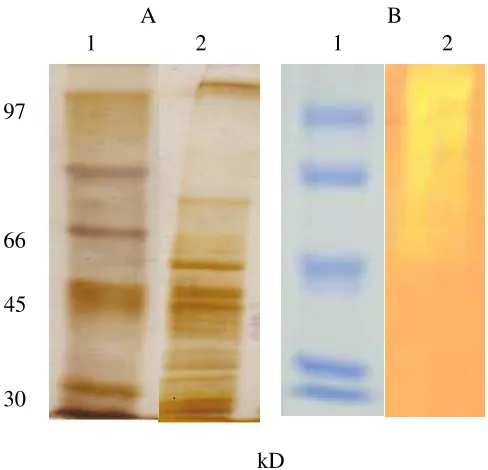
Molecular weight determination: Moleculer weights were determinited by using SDS-PAGE and zymogram tech-nique. Moleculer weight chitosanase isolate GB2 was 36-110 kD (Fig. 5).
97
A
kD
1
2
1
2
B
66
45
30
Fig. 5. SDS PAGE and zymogram chitosanase GB2. 8 % polyacrylamide gel as used for analysis. A, SDS-PAGE stained with silver: line 1, relative molecular mass standars: phosporylase b (97 kD), bovine serum albumin (66.0 kDa), ovalbumin (45 kD) carbonic anhydrous (29.0 kDa), soybean trypsin inhibitor (20 kDa), lysozime (14.4 kD). line 2, chitosanase GB2. B, Zymogram: 1ine 1, relative molecular mass standars. line 2, chitosanase GB2
GB2 isolate grew well in the modified medium of Park et al.10 containing 0.5 % colloidal citin; 0.1 % K
2HPO4; 0.01 % MgSO4.7H2O; 0.05 % yeast extract; 0.1 % NaCl and 0.7 % (NH4)2SO4. The optimum enzyme production was 3 day of incubation (Fig. 3). This findings was rather different with prevous study on production of chitosanase from isolate 96, 97, 99, 100 and Matsuebacter chitosanotabidus 3001. The optimum production of chitosanase from isolate 97, 99, 100 and Matsuebacter chitosanotabidus 3001 were 5 day incu-bation and isolate 96 was 4 day incuincu-bation11.
The optimum pH of chitosanase under assay condition was 8 (Fig. 2). Optimum pH of chitosanase from bacteria and fungi were in range 4-83 and that optimum pH from isolate GB2 was within in the range. Chitosanase molecule is cationic, therefore electrostatic interactions is believed to contribute in the subst rat binding significantly. Study on many chitosanase reported that aspartate was important in substrate binding, while glutamate, in addition to aspartate, were involved in catalysis reaction12,13. Optimum temperature for GB2 chitosanase was 30 ºC. A chitosanase which is active in 30 ºC has also been reported by Park et al.10 for enzyme produced by Matsuebacter chitosanotabidus 3001.
Fig. 4 showed Ca2+ and Fe2+ as activator whereas Na+ and K+ inhibited chitosanase GB2. Positively charged ions such as metal ions generally bind to carboxylate, imidazole and sulfhydril groups of the side chains of the amino acids14. This might imply the important of negatively charged amio acid
such as aspartat and glutamate for catalytic activity. The presence of metal cations is needed to obtain local charge balance of the catalytic site. In general, metal ions can fungction as part of the enzyme catalytic mechanism and or stabilizer of the active site of the protein enzyme. When parti-cipating in the catalytic mechanism, metal cation can bring specific functional group together in the appropriate orientation for reaction. The different effect of cation upon catalytic action of the enzyme may be due to their ability to adopt different geometrics in the same site in the absence of substrate.
SDS-PAGE and zimogram analysis was performed to estimate the molecular weight. SDS-PAGE analysis of chitosanase GB2 was in the range of 14.1-110 kD. The moleculer weight of chitosanase GB2 was estimated 36-110 kD as indicated by the clear bands (Fig. 5).
Conclusion
The GB2 isolate was selected due to its high chitosanase activity. The optimum pH and temperature of chitosanase from GB2 were 8 and 30 ºC, respectively. Effect of metal ions study, showed that Ca2+
and Fe2+
were activator whereas Na+ and K+ were acted as inhibitor to chitosanase GB2. Study on the effect of metals ion indicated that chitosanase GB2 was meta-loenzyme. Moleculer weights were determinited by using SDS-PAGE and zymogram technique. Moleculer weight chitosanase isolate GB2 was estimated around 36-110 kD.
ACKNOWLEDGEMENTS
This research was support by Competitive Grant on “Exploration of bacteria producing Chitosanase from Swam in South Sumatera” from Directorate General of Higher Education (DIKTI), Ministry of National Education Republic Indonesia.
REFERENCES
1. C.L. Chiang, C.T. Chang and H.Y. Sung, Enzyme Microb. Tech., 32, 260 (2003).
2. W.J. Jung, J.H. Kuk, K.Y. Kim, K.C. Jung and R.D. Park, Protein Expr. Purif.,45, 125 (2006).
3. D. Somashekar and R. Joseph, Bioresour. Technol., 55, 35 (1996). 4. H.G. Yoon, H.Y. Kim, H.K. Kim, D.H. Shin, B.S. Hong and H.Y. Cho,
Appl. Environ. Microbiol., 66, 3727 (2000).
5. Y. Uchida and A. Ohtakara, Methods Enzymol., 161, 501 (1998). 6. M. Guttenberger, in ed.: J.E. Celis, Protein Determination, Cell Biology:
A Laboratory Manual, Academic Press, vol. 3 (1994).
7. D.M. Bollag and Edelstein, Protein Methods, New York: Wiley-Liss (1991).
8. J. Grenier, J. Trudel and A. Asselin, in eds.: R.A.A. Muzzarelli and M.G. Peter, Gel Electroforetic Analysis of Chitinase, Chitosanase and Chitin Deacetylase, Chitin Handbook. Italy: Atec, Grottammare (1997). 9. K.D. Splinder and C. Rapp, in eds.: R.A.A. Muzzarelli and M.G. Peter, Detection of Chitin Degradating Enzyme on Gels, Chitin Handbook. Italy: Atec, Grottammare (1997).
10. J.K. Park, K. Shimono, N. Ochiai, K. Shigeru, M. Kurita, Y. Ohta, K. Tanaka, H. Matsuda and M. Kawamukai, J. Bacteriol., 181, 6642 (1999). 11. M.E. Mahata, Y.C. Soo, A. Dharma, I. Ryanto, Y. Rizal and M. Kawamukai,
J. Mikrobiol. Indones, 10, 21 (2005).
12. H. Kimoto, H. Kusaoke, I. Yamamoto, Y. Fujii, T. Onodera and A. Taketo, J. Biol. Chem., 277, 14695 (2002).
13. K. Shimono, K. Shigeru, A. Tsuchiya, N. Itou, Y. Ohta, K. Tanaka, T. Nakagawa, H. Matsuda and M. Kawamukai, J. Biochem., 131, 87 (2002). 14. J.P. Glusker, in ed.: G. Allen, The Binding of Ions to Proteins. Protein:
A Comprehensive Treatise, Stanford: JAI Press, vol. 2 (1999).