• Tidak ada hasil yang ditemukan

Welcome to ePrints Sriwijaya University - UNSRI Online Institutional Repository

N/A
N/A
Protected

Academic year: 2017

Membagikan "Welcome to ePrints Sriwijaya University - UNSRI Online Institutional Repository"

Copied!
14
0
0

Teks penuh

(1)

OWNERSHIP STRUCTURE AND FIRM VALUES:

EMPIRICAL STUDY ON INDONESIA MANUFACTURING

LISTED COMPANIES

Abukosim,

Accounting Department, Economics Faculty,

Sriwijaya University, Palembang, Indonesia.

Mukhtaruddin,

Accounting Department,

Economics Faculty, Sriwijaya University,

Palembang, Indonesia.

Ika Sasti Ferina and Claudya Nurcahaya,

Accounting Department,

Economics Faculty, Sriwijaya University,

Palembang, Indonesia.

ABSTRACT

The companies listed in Indonesia Stock Exchange generally have an

organizational structure that separates owners and management. This situation may

create a confalict between the owners and the management. However if they share

a common goal, it can increase the companies’ values. This research is aimed at

identifying the influence of ownership structure (managerial, institutional, foreign,

and central) on the prices to book values (PBV). Understanding of the ownership

structure is important for the control of a company operation.

This research uses secondary data; it is based on the annual financial reports of

Indonesia Stock Exchange in 2009 – 2011. A purposive sampling technique is

applied, and 32 companies are selected as the sample. The data are analyzed using

multiple linear regression and descriptive statistics.

The research results show that the ownership structure significantly influences the

firms values: (1) the managerial ownership does not have a positive influence on

firm value, (2) the institutional ownership has a positive and significant influence

on firm vlue, (3) the foreign ownership has a positive and significant influence on

firm value, (4) the concentrated ownership does not have a positive influence on

firm value. This research is limited to only the ownership structure as the factors

influence of firm value.

(2)

INTRODUCTION:

The main purpose of a company is to increase the value of the company or its shareholders. To realize this purpose the shareholders or owners of its management handed over to agents. High value of the company can also increase prosperity for our shareholders. Maximize its value significantly wider than maximizing profits, based on several reasons, namely maximizing value means considering the effect of the time value of money, it also means maximizing the value of considering the various risks to the company's revenue stream and quality of the expected flow of funds received in the future (Haruman, 2008). The increased value of the company can attract investors to invest their capital. For investors who are interested to invest certainly return rate or benefits to be derived from the investment in the form of embedded capital gains and dividends, being a part of the profit is given to the shareholders. In this case the manager must decide whether the profits from the company during the period will be distributed fully or partly distributed as dividends and the remainder being held companies or so-called retained earnings. Increase in the value of the company can be reached if there is cooperation between the management company and other parties that include shareholder and stakeholders in making financial decisions with the goal of maximizing working capital owned. Indonesia experienced a prolonged crisis since 1998, many people said that the length of the repair process after the crisis caused by the weak application of corporate governance in companies in Indonesia. The emergence of the issue of corporate governance is also caused by the separation between the ownership controls of the company. It is also an important and controversial issues regarding corporate governance is the shareholding structure associated with an increase in the value of the company. Likelihood of a company is in a position of financial stress is also heavily influenced by the ownership structure of the company. The ownership structure explains the commitment of the owner to save the company (Ward, 2006).

Ownership structure according to some researchers believed to affect the running of the company, which in turn affect the company's performance in achieving corporate objectives, namely maximizing firm value. This is caused by the presence of the control they have (Wahyudi and Pawestri, 2005). Rise and fall of the value of the company is influenced by the ownership structure. Ownership structure is very important in determining the value of the company. Two aspects need to be considered are (1) the concentration of corporate ownership by outsiders (outsider ownership concentration) and (2) ownership by the management company (management ownership concentration). Owners of different companies from outside parties with the manager because the owners are less likely than outsiders involved in the affairs of the company day-to-day operating (Abdullah, 2001). Shareholding structure is considered important to a company and is believed to affect the company's performance in achieving the maximization of corporate value because it deals with the control they have and also it is able to explain the commitment of the owner to save the company. Therefore, ownership structure has an important role in determining the value of the company.

(3)

company by way of maximizing shareholder wealth. It required an external control of where the role of a good monitoring and supervision will direct as it should. There are several alternatives to reduce agency cost, including the presence of share ownership by management and ownership of shares by institutional (Haruman, 2008)

By managerial share ownership, managers are expected to act in accordance with the wishes of the principals as managers will be motivated to improve the performance and will be able to increase the value of the company (Siallagan and Machfoedz, 2006). According to Ross et al (quoted from Siallagan and Machfoedz, 2006) states that the greater the Management ownership in the management company will tend to try to improve its performance for the benefit of shareholders and for their own interests. Management stock ownership is the proportion of ordinary shares held by the management. There are studies that found that managerial ownership has no effect on firm value. Relationship between managerial ownership with firm value is no monotonic relationships that arise because of the incentives that are owned by the manager, and they trying to do an alignment of interests with outsider ownership by increasing their shareholding if the value of the company increases (Wahyudi and Pawestri, 2005).

Other ownership structures i.e. institutional ownership, which generally can act as parties to monitor company. Large institutional ownership indicates its ability to monitor management. The greater institutional ownership, the more efficient utilization of assets and the company is also expected to act as a deterrent against waste made by management. Institutional ownership is the proportion of shares owned at the end of the year by institutions, such as insurance, bank or other institution (Tarjo, 2008). Research conducted Sudarma (2004) concluded that the ownership structure (managerial ownership and institutional ownership) shares a significant negative effect on firm value. This means that measurements of the composition of managerial ownership and institutional ownership determined the value of the company. The decreasing amount of the composition of managerial ownership and institutional ownership and increased public ownership will affect the rising value of the company. Partially, this study concluded that managerial ownership is not a significant positive effect on firm value and institutional ownership a significant negative effect on firm value. This result means that the increase in the value of institutional ownership will affect the company's decline in value.

Foreign ownership is part of the ownership structure will affect the value of the company. Research conducted by Douma et al (2003), which explains how the ownership structure, the different roles played by foreign individual investors and shareholders of foreign firms affects firm performance, using firm-level data for India in 2002. They find foreign firms have a positive effect on firm performance, which would certainly affect the value of the company.

Another ownership structure which can reduce the conflict between management and shareholders may be reduced so that the agency cost of ownership is concentrated. Concentration of ownership describes how and who is in control of the whole or most of the above as well as overall corporate ownership or majority shareholders control over the company's business activities.

Ownership is said to be concentrated if to achieve majority control of dominance or merger takes fewer investors. The absence of control in a company that can be held by the less investor will be easier to control the run. Compared with the mechanism of large shareholders, concentrated ownership has a lower power control because they still have to coordinate to run the control right. But on the other hand concentrated ownership mechanism also has a smaller possibility for the emergence of opportunities for a concentrated group of investors to take actions that harm other investors. Concentration of ownership (shareholder control) in a company can influence the implementation of organizational strategy if the company majority of its capital coming from stock or other securities, so the company's controlling shareholders can affect the quality of the implementation of corporate governance at the company through the design and implementation of their policies.

(4)

ownership structure commonly used managerial ownership and institutional ownership on firm value are inconsistent or have a different outcome.

Dependent variable is firm value because the firm value is investor perception of the company, which is often associated with the stock price. High stock price made a higher value of the company as well. Maximize the value of the company is very important for a company, because by maximizing the value of the company means also maximizing shareholder wealth is the main goal of the company. Value of the company can provide maximum shareholder wealth if the stock price increases. The higher the stock price, the higher the wealth distributed to shareholders. To reach the general enterprise value investors handed over its management to the professionals who are positioned as a manager or commissioner. Thus, it can be concluded that the value of the company is an important concept for investors, because it is an indicator for assessing the company's overall market.

In a study conducted by Sudarma (2004) managerial ownership has no significant positive effect on firm value, is in line with the results conducted by Wahyudi and Pawestri (2005) that managerial ownership has no effect on firm value. However, these findings are not consistent with research conducted by Sillagan and Machfoedz (2006) that managerial ownership has a negative influence on the value of the company in accordance with Sujoko and Soebiantoro (2007) managerial ownership also negatively affect the value of the company. Research conducted by Wahyudi and Pawesti (2006) that the negative affect of institutional ownership on firm value. This study is also in line with Haruman (2008) that there is a negative effect of institutional ownership on firm value. These results are not consistent with the study conducted Wening that institutional ownership has a positive effect on firm value is also consistent with studies conducted by Wang and Bjuggren (in Tarjo, 2008) that institutional ownership has a positive effect on firm value. Based on the inconsistency of the results of these studies researchers interested in studying the effect of ownership structure on firm value and also add foreign ownership in this study. Researchers interested in using the population for this study is manufacturing companies listed in Indonesia Stock Exchange 2009-2011. Manufacturing company is a type of company in their actions to try to manage the raw materials into finished goods. Labor-intensive manufacturing firms are relatively more than the type of company services and general trading company. Manufacturing company is the largest number of issuers other than the number of issuers listed on the Indonesia Stock Exchange (IDX). In the manufacturing sector, there are many companies that their work continues to evolve. There was no denying this sector has spawned a flagship company whose products consume some communities in Indonesia. Most investors get involved in the manufacturing company. Therefore, manufacturing companies selected to be studied in this research. Based on the background of the author intends to conduct a study to analyze the effect of managerial ownership, institutional ownership, foreign ownership and concentrated ownership in a company to the value of the company in Indonesia, in particular sector companies listed on the Indonesia Stock Exchange in the period 2009 to , 2011. Where the value of the company as the dependent variable using assessment measures price to book value, while the indicators used to measure the performance of companies that managerial ownership, institutional ownership, foreign ownership and concentrated ownership as the dependent variable. Issues to be discussed in this article are: 1) Is the managerial ownership effect on firm value, 2) Does institutional ownership affects on firm value, 3) Does foreign ownership affect corporate values and 4) Does concentrated ownership affect firm value.

BASIS THEORY AND HYPOTHESIS DEVELOPMENT: AGENCY THEORY:

(5)

of the other party. As the principal shareholder or owner of the company assumed just interested to financial results or increase their investment in the company. Because of differences in the interests of each party trying to be maximize profits for themselves. Principal wants maximum return on investment as soon as possible and one of which is reflected by the increase in the dividend portion of each share held. Agent wants its interests to be accommodated with the compensation is adequate and numbers for its performance. Principal Agent assesses performance based on their ability to maximize profits allocated to the distribution of dividends. The higher the income, the greater the share price and the dividend, then the agent is considered successful performers so it deserves a high incentive. Instead Principal Agent also meet the demands of a high order to get compensation, so that if there is no adequate supervision then the agent can play several companies that condition as if the target is reached. The game could be on the initiative of the principal or agent of his own initiative. Doing so may lead to the occurrence of Creative Accounting that violates the rules, for example, the existence of which would be uncollected receivables that are not eliminated, capitalizes undue expense, improper revenue recognition that all affect the value of assets in the balance sheet "beautify" the financial statements, although not actual values. Other measures can also be done by smoothing income (profit split to another period) so that each year seem to benefit the company when in fact losing money or profits down. The agency problems arise because of a conflict or difference of interest between principal and agent. Agency theory attempts to explain the determination of the most efficient contracts that can limit conflict or agency problems (Jensen and Meckling, 1976). Agency theory is also instrumental in providing accounting information so that feedback in addition to predictive value. Agency theory states that the company is facing cost and contract supervision cost are low tend to report lower earnings or in other words, will put out the costs for management purposes. One of the costs that can improve a company's reputation in the eyes of society is the costs associated with corporate social responsibility.

HYPOTHESIS DEVELOPMENT:

(6)

Research conducted by Jensen and Meckling (1976) found that the greater the share ownership by management of the reduced tendency of management to optimize the use of resources so that the resulting increase in the value of the company. In contrast to research Siallagan and Machfoedz (2003) states that by using OLS and 2SLS find the relationship between managerial ownership and firm value

is negative and linear so it is concluded that the high management ownership will decrease the firm’s

value and the hypothesis in this study it can be concluded that: H1: Managerial Ownership has affected on the firm Value

Institutional ownership acts as a monitoring party companies in general and managers so that managers of firms in particular. Institutional investors will be monitoring the progress professionally invested in the company and have a high degree of control of the management action. This minimizes the potential for management to commit fraud, and thus can align the interests of management and the interests of other stakeholders to improve the performance of the company. The greater institutional ownership, the more efficient utilization of assets and the company is also expected to act as a deterrent against waste by management (Faizal, 2004). Similarly, according to Tarjo (2008) found that the greater ownership by financial institutions, the greater the power and the drive to optimize the value of the company. Shleifer and Vishny (in Haruman, 2007) states the large numbers of shareholders have significance in monitoring the behavior of managers within the company. The presence of institutional ownership will be able to effectively monitor the management team and to enhance shareholder value. According to Xu and Wang, et al. and Bjuggren et al., (in Tarjo, 2008) found that the positive effect of institutional ownership on firm value and performance of the company. This means showing that institutional ownership to be a reliable mechanism so as to motivate managers to improve their performance, which in turn can increase the value of the company. However, in contrast to the above, studies Herawaty (2008) shows that institutional ownership is not successful in increasing the value of the company, because institutional ownership reduce corporate value. This is due to the majority of institutional investors are not the owner is unable to properly monitor the performance of managers. The existence of institutional ownership will reduce public confidence in the company. As a result, the stock market reacted negatively in the form of decline in stock trading volume and stock prices, thereby reducing shareholder value. Therefore, the hypothesis in this study is:

H2: Institutional Ownership has affected on the firm value.

Many companies in Indonesia that their shares are owned by foreign investors. This positive outlook assumes that sales will improve performance as well as to create a more healthy competition in Indonesia. Foreign-based companies have sufficient technology, good employee skills, extensive information network, allowing for widespread disclosure. Through these factors, foreign companies will try to increase the value of a company formed by the foreign investor in the operations in which the subsidiary or affiliate established. Many countries that can serve as the operating target foreign companies, such as Indonesia. Salvatore (2005) states that a portfolio containing stocks of domestic and foreign offer lower risk and higher returns for investors than a portfolio containing only domestic stocks. Relating to foreign ownership, in research Setiawan (2006) concluded that foreign ownership in the company has a significant effect on firm value.

H3: Foreign Ownership has affected on Firm Value

(7)

company, the shareholders and the company will increasingly dominate the decision-making influence (negative impact).

H4: Concentrated Ownership has affected on firm Value

THEORITICAL FRAMEWORK:

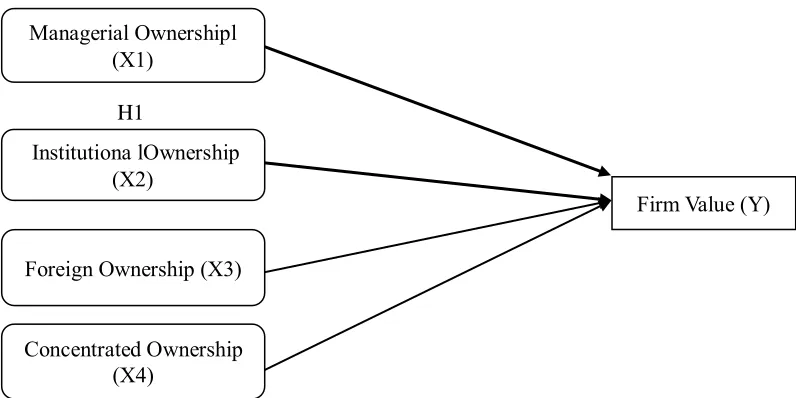
Based on the literature review, the theoretical basis of the managerial ownership variables, institutional ownership, foreign ownership, concentrated ownership and firm value as mentioned above, it can be made the following framework:

Theoritical Framework

H1 H2

H4

Figure 1: Theritical Framework

RESERCH METHODOLOGY: TYPES AND SOURCES OF DATA:

Data are used in this study is secondary data is data the annual financial statements of manufacturing companies listed in Indonesia Stock Exchange 2009-2011. Form of data used in this study is the ratio of the data. The data used is the data that can be obtained from the Indonesian Capital Market Directory or www.idx.co.id, journals and other references. Techniques of data collection in the study is the documentation of the method of data collection is done by recording and writing of data to identify issues related to the research obtained from Indonesian Capital Market Directory and www.idx.co.id. In this study the documentation in the form of an annual report 2009-2011.

POPULATION AND SAMPLE:

The population in this study is a manufacturing company whose shares are listed and actively traded on the Indonesia Stock Exchange 2009-2011. Total population is 214 companies. The selection of the sample in this study with purposive sampling method, with the some criterias such as a) Manufacturing companies listed on the Stock Exchange in the period 2009-2011, b) The company does not issue annual financial statements of 3 years, and c) if the companies do not have the managerial ownership, institutional ownership, and foreign ownership and loss companies were delisted as sample. Based on this criterias, the samples to be 32 companies.

OPERATIONAL DEFINITION AND MEASUREMENT OF VARIABLES:

The independent variable is the structure of ownership such asa managerial ownership, institutional ownership, foreign ownership, and ownership is concentrated and the dependent variable is firm value.

Managerial Ownershipl (X1)

Institutiona lOwnership (X2)

Foreign Ownership (X3)

Firm Value (Y)

(8)

1. Managerial ownership was measured by the proportion of shareholders that management is actively involved in the decision making of the company (directors and commissioners) (Diyah and Erman, 2009)

2. Institutional ownership is the proportion of shares held by the holders of institutional owners such as insurance companies, banks, investment companies and other holdings except its subsidiaries and other institutions that have a special relationship. (Indahningrum and Ratih, 2009)

3. Foreign ownership is ownership of company shares by foreign investors who are defined as individuals, legal entities, and governments as well as the status of their parts overseas. Foreign ownership is measured by the percentage of foreign shareholdings are viewed from the annual financial statements of the company. (Machmud and Chaerul, 2008)

3. Concentration of ownership describes how and who is in control of the whole or most of the above as well as overall corporate ownership or majority shareholders control over the company's business activities. Ownership concentration is measured by the level of ownership by a party of more than 51% indicate a right of control by majority shareholders. In this study, concentrated ownership is a dummy variable, 1 = 0 = firm concentrated and unconcentrated firms (Nuryaman, 2009).

4. Firm value is the value of a company's share price is seen from (Hougen in Utomo, 2000). Firm value measured by Price to Book Value (PBV). Price to book value ratio is measured by stock price divided by book value. The book value of the company is produced by market price of the stock.

ANALYSIS THECNIQUE:

Multiple linear regression analysis is the study of the dependence of the dependent variable with more than one independent variable. The goal is to estimate or predict and the population mean or average value of the dependent variable based on the value of the independent variables that are known by the Ghozali (2005). This analysis to examine the influence of the dependent variable (Y) is the firm value on independent variable (X) that managerial ownership, institutional ownership, foreign ownership and concentrated aownership. The formula is:

PVB = a + b1MO + b2IO + b3 FO + b4 CO + e

FINDING AND DISCUSS: FINDING:

The equation shows that the firm value is influenced by the ownership structure managerial ownership, institutional ownership, foreign ownership, and concentrated ownership. These results can be explained as follows:

PBV = 0,840 – 0,004MO + 0,015IO – 0,012FO – 0,264CO

a. Value of constant positive value of 0.840 indicates that if the ownership structure consisting of managerial ownership, institutional ownership, foreign ownership, and ownership is concentrated constant, then the enterprise value (PBV) of 0.840 stated.

b. Coefficient of managerial ownership of -0004 indicates that any increase in managerial ownership in the company will be followed by 1% decline in the firm value) of 0.004, assuming other variables remain;

c. Institutional ownership coefficient value of 0.015 indicates that each increase of 1% institutional ownership will be followed by an increase in firm value of 0.015, assuming other variables remain; d. Foreign ownership coefficient of -0012 indicates that any increase in foreign ownership of 1% will

be followed by a decrease firm value of 0.012, assuming other variables remain;

e. Concentrated ownership coefficient of -0264 indicates that any increase in the company's institutional ownership will be followed by 1% decline in the firm value for 0264 assuming other variables remain.

(9)

(managerial ownership, institutional ownership Foreign ownership and concentrated ownership) effect on firm value in companies listed on the Stock Exchange 2009-2011.

THERE IS EFFECTTING OF OWNERSHIP STRUCTURE ON FIRM VALUE (PBV):

Management companies are increasingly separated from the ownership of the company is one of the characteristics of the modern economy, which is in line with agency theory which wants owners of the company (principal) handed over to the company management professionals (agents) that a better understanding of running a business. Separation destination management and corporate ownership is that owners get maximum benefit in a cost efficient. Ownership structure is well reflected through the equity instruments or debt instruments so that the structure can be analyzed through the possible forms of agency problems that will occur. Based on the results of data processing shows that the independent variables of ownership structure (consisting of managerial ownership, institutional ownership, foreign ownership, and ownership is concentrated) has the significance F value of 3.360 with a probability of 0.013. Because the probability is much smaller than 0.05, it can be concluded that the managerial ownership variables, institutional ownership, foreign ownership and ownership concentration jointly affect firm value (PBV). F-table value obtained by test 2.4178 shows that the F-count < F-table (2.4178 < 3.360), it is meaning that simultaneous ownership structure (managerial ownership, institutional ownership, foreign ownership and concentrated ownership) effect on firm value (PBV) in companies listed on the Stock Exchange 2009-2011. This result supports simultaneous testing of theory used is agency theory which states that the ownership structure is able to reduce the agency problem in which the problem will cause a decrease in the value of the company. Managerial ownership affects on the tendency to increase the value of shareholders other than to increase the value of the company alone. Improve managerial ownership can be used as a way to overcome this agency problem according to the research conducted by Christiyanti (2008). Furthermore, the ownership of the institution have an active role in enhancing the value of the company, since the institution is entitled to supervise the performance of the managers, thereby reducing the level of fraud that would lower the value of the company. Ownership of foreign or foreign investors will provide motivation for both management and the institution to improve its performance which will lead to increased value of the company. Concentrated ownership would provide incentives to shareholders to participate actively in the company. Research conducted by Wahyudi & Pawesti (2006) states that the ownership structure is believed to affect the running of the company, which in turn affect the company's performance in achieving corporate objectives, namely maximizing firm value. This is caused by the presence of the control they have. Thus, the ownership structure considered as crucial to overcome the agency problem because the ownership structure of both companies realized a decent performance as a manager as competent authorities in the management of the company has enough authority to carry out their duties.

THERE IS EFFECTING OF MANAGERIAL OWNERSHIP ON FIRM VALUE (PBV):

(10)

ownership will decrease the value of the company. Research conducted by Sujoko and Soebiantoro (2003) also has the same result as negative effect of managerial ownership on firm value. Based on these results can be explained that things may have happened is because the management company does not have control of the company. The management has been mostly controlled by its majority owner so that management simply run its own interests and not trying to maximize the value of the company. Results of this study reject the hypothesis that managerial ownership significant positive effect on firm value.

THERE IS EFFECTING OF INSTITUTIONAL OWNERSHIP ON FIRM VALUE:

The test results among variables of institutional ownership on firm value showed a significant influence of institutional ownership on firm value. Institutional ownership and a significant positive effect on firm value, which can be seen from the significant value well below 0:05 in the amount of 0,041, and the value of t which is positive, so the hypothesis (H2 acceptable). It means that the size of the institutional ownership was able to affect firm value. Results make it clear that the increase in institutional ownership in the firm, the greater the power of sound and boost the institution to oversee the management and would consequently give greater impetus to optimize the performance of the company so that the company's value will also increase. Institutional ownership represents a source of power that can be used to promote a more optimal control on the performance of management in order to anticipate the actions of managers that are not in accordance with the wishes of the owner. The results are consistent with the underlying theory that ownership by institutional investors such as securities firms, banks, insurance companies, pension funds and other institutional ownership will encourage a more optimal control on the performance of management so that the performance of the company will also increase. Level of institutional ownership also serves as a monitor agent to solve the agency problem. Corporate ownership by institutions will encourage more effective oversight, because the institution is a professional who has the ability to evaluate the performance of the company which will ultimately increase the value of the company. This result is consistent with research conducted by Xu and Wang, et al. and Bjuggren et al. (in Tarjo, 2008), that the positive effect of institutional ownership on firm value and performance of the company. This means showing that institutional ownership to be a reliable mechanism so as to motivate managers to improve their performance, which in turn can increase the value of the company. Shleifer and Vishny (cited by Haruman, 2007) states the large number of shareholders have significance in monitoring the actions of managers within the company. The presence of institutional ownership will be able to effectively monitor the management team and to enhance shareholder value. Reasons that could explain the results of these studies because of institutional ownership is one of the factors that may affect the company's performance. With the ownership by institutional investors may encourage optimal control over the performance of management, because the shares represent a source of power that can be used to support or even worsen performance? The greater ownership by financial institutions, the greater the power of the voice and urge financial institutions to oversee the management and would consequently give greater impetus to optimize the value of the company. Accept the results of this study the hypothesis that significant institutional ownership has a positive effect on firm value.

THERE IS EFFECTING OF FOREIGN OWNERSHIP ON FIRM VALUE:

(11)

company to enhance shareholder value. In a study conducted by Salvatore (2005) states that a portfolio containing stocks of domestic and foreign offer lower risk and higher returns for investors than a portfolio containing only domestic stocks. Relating to foreign ownership, in research Setiawan (2006), the results support the conclusion that foreign ownership in the company has a significant effect on firm value. Reasons that can be used to explain the results of these studies are likely due to the percentage of foreign ownership in domestic firms large enough. More 50 percent foreign investors invested in Indonesia companies. Therefore, firms with foreign ownership are trying to increase the value of the company because of the motivation provided by foreign parties. Foreign investors also provide oversight of the performance of companies they invest their capital in the company. This suggests that the hypothesis is accepted that the positive effect of foreign ownership on firm value.

THERE IS EFFECTING OF CONCENTRATED OWNERSHIP ON FIRM VALUE:

(12)

CONCLUSIONS AND RECOMMENDATIONS: CONCLUSION:

Based on the analysis of the results of research that has been conducted on the effect of ownership structure on firm value, it can be concluded that:

1. The result showed that the managerial stock ownership in the company and no significant negative effect on firm value. The greater the share ownership by management it will lower the value of the company.

2. The result showed that institutional ownership and a significant positive effect on firm value (PBV). Institutional ownership is a reliable mechanism to motivate managers to improve their performance and than it can increase the value of the company.

3. The result showed that foreign ownership significantly and negatively related to firm value (PBV). Foreign ownership has significant effect on firm value.

4. The result showed that the concentrated ownership and no significant negative effect on firm value. Majority shareholder and the company will increasingly dominate the decision-making influence (negative impact).

LIMITATIONS OF RESEARCH:

This research has limitations as follows.

1. This study only observed on one of the indicators of corporate governance mechanisms, resulting in only limited conclusions regarding the effect of ownership structure to firm value.

2. The research was limited to companies listed on the stock exchanges of Indonesia and the observation period for 3 years ie in the year 2009 to 2011.

IMPLICATION:

1. To increase the value of the company can be done with the use of debt adjustment and alignment to corporate goals such as increasing the proportion of managerial ownership so there is no conflict between the insider and the investor.

2. Researchers should further add variables that affect the value of the company other than the ownership structure for example, dividend policy, leverage, firm characteristics, and others.

3. Subsequent researchers should use the observation period of more than three years old and used to expand the sample by adding another industry in Indonesia Stock Exchange.

REFERENCES:

[1] Abdullah, Syukriy. (2001). Hubungan antara Kepemilikan Manajerial, Struktur Modal, dan Kebijakan Deviden.Jurnal Manajemen dan Bisnis, Vol.3, No.2, Mei, h. 159-176.

[2] Anggraini, Fransisca Reni Retno, Yavida Nurim dan Nung Harjanto, (2010), Pengujian Peran Perlindungan Investor dan Kultur terhadap Perilaku Managemen Laba pada Perusahaan Keluarga: Studi Internasional, Simposium Nasional Akuntansi XIII, Purwokerto, 13-15 Oktober. [3] Christianty Dewi, Sisca. (2008). Pengaruh Kepemilikan Manajerial, Kepemilikan Institusional,

Kebijakan Hutang, profitabilitas dan Ukuran Perusahaan terhadap Kebijakan Dividen. Jurnal

Bisnis dan Akuntansi. Vol. 10. No.1, 47-58.

[4] Damayanti, Isrina. (2006). Analisa Free Cash Flow dan Struktur Kepemilikan Saham terhadap Kebijakan Hutang pada Perusahaan Manufaktur di Indonesia. Universitas Islam Indonesia. Yogyakarta.

[5] Darmawati, Deni Khomsiyah dan Rika G. (2005). Hubungan Corporate Governance dan Kinerja Perusahaan. Jurnal Riset Akuntansi Indonesia. Vol 8 no. 1. pp 65-81.

[6] Diyah, Pujiati and Erman Widanar. (2009). Pengaruh Struktur Kepemilikan Terhadap Nilai Perusahaan: Keputusan Keuangan sebagai Variabel Intervening. Jurnal Ekonomi Bisnis dan

(13)

[7] Douma, Sytse, Rejie George, dan Rezaul Kabir. (2003). Foreign and Domestic Ownership Business Groups and Firm Performance: Evidence from A Large Emerging Market. Strategic

Management Journal, Vol. 27, 2003, pp. 637-657.

[8] Faizal. (2004). Analisis Agency Costs, Struktur Kepemilikan dan Mekanisme Corporate Governance. Simposium Nasional Akuntansi VII. Denpasar Bali, 2-3 Desember.

[9] Ghozali, Imam. (2005). Aplikasi Analisis Multivariate Dengan Program SPSS, Cetakan IV. Semarang: Badan Penerbit Universitas Diponegoro.

[10] Hamonangan, Siallagan dan Mas’ud Machfoedz. (2006). Mekanisme Corporate, Kualitas Laba dan Nilai Perusahaan. Simposium Nasional Akuntansi IX. Padang.

[11] Haruman, Tendy. (2008). Pengaruh Struktur kepemilikan terhadap Keputusan Keuangan dan Nilai perusahaan (Survei pada perusahaan Manufaktur di Bursa Efek Indonesia). Simposium

Nasional Akuntansi IX. Pontianak.

[12] Herawaty, Vinolla. (2008). Peran Praktek Corporate Governance Sebagai Moderating Variable dari Pengaruh Earnings Management Terhadap Nilai Perusahaan, Jurnal Akuntansi dan

Keuangan, Vol. 10. No. 2. hal. 97-108.

[13] Imanda dan Moh. Nasir. (2006). Analisis Persamaan Simultan Kepemilikan Manajerial, Kepemilikan Institusional, Risiko, Kebijakan Hutang dan Kebijakan Dividen dalam Persepektif Teori Keagenan. Simposium Nasional Akuntansi IX. Padang.

[14] Indahningrum, Putri Rizka dan Ratih Handayani. (2009). Pengaruh Kepemilikan Manajerial, Kepemilikan Institusional, Dividen, Pertumbuhan Perusahaan, Free Cash Flow, Profitabilitas terhadap Kebijakan Hutang Perusahaan. Jurnal Bisnis dan Akuntansi. Vol.11. No. 3. pp. 189-207. [15] Isshaq, Zangina. (2009). Corporate Governance Governance, Ownership Structure, Cash

Holding, and Firm Value on The Ghana Stock Exchange. The Journal of Risk Finance, Vol.10 No.5, pp. 488-499.

[16] Ismiyanti, Fitri dan Mahmud M. Hanafi. (2003). Kepemilikan Manajerial, Kepemilikan Institusional, Risiko, Kebijakan Utang dan kebijakan Dividen: Analisis Persamaan Simultan.

Simposium Nasional Akuntansi VI. Surabaya.

[17] Jensen, Michael C dan William H Meckling. (1976). Theory of the Firm: Managerial Behavior, Agency Costs and Ownership Structure, Journal of Financial Economics,Vol. 3, pp. 305-60. [18] Keown, et al. (2004). Manajemen Keuangan. Edisi 9. Diterjemahkan oleh Djakman dan

Sulistyorini. Jakarta: Salemba Empat.

[19] Larasati, Eva. (2011). Pengaruh Kepemilikan Manajerial, Kepemilikan Institusional dan Kebijakan Dividen terhadap Kebijakan Hutang Perusahaan, Jurnal Ekonomi Bisnis, Th. 16, No.2. [20] Machmud, Novita dan Chaerul D. Djakman. (2008). Pengaruh Struktur Kepemilikan Terhadap Luas Pengungkapan Tanggung Jawab Sosial (CSR Disclosure) Pada Laporan Tahunan Perusahaan: Studi Empiris Pada Perusahaan Publik Yang Tercatat Di Bursa Efek Indonesia Tahun 2006.Simposium Nasional Akuntansi 11. Pontianak

[21] Muslich, M. (2000). Manajemen Keuangan Modern. Jakarta: Bumi Aksara.

[22] Nasution, M dan Setiawan D. (2007). Pengaruh Corporate Governance terhadap Manajemen Laba di Industri Perbankan Indonesia. Simposium Nasional Akuntansi X. Makasar.

[23] Nuringsih, Kartika. (2010). Pengaruh Profitabilitas, Kebijakan Hutang dan Kepemilikan Institusional Terhadap Kepemilikan Manajerial dan Pengaruhnya Terhadap Risiko. Jurnal Bisnis

dan Akuntansi, Vol.12, No.1, pp. 17-28.

[24] Nurlela, Rika dan Ishlahuddin. (2008). Pengaruh Corporate Social Responsibility Terhadap Nilai Perusahaan dengan Prosentase Kepemilikan Manajemen sebagai Variabel Moderating”.

Simposium Nasioanal Akuntansi XI.Pontianak.

[25] Nuryaman. (2008). Pengaruh Konsentrasi Kepemilikan, Ukuran Perusahaan dan Mekanisme Corporate Governance terhadap Manajemen Laba. Simposium Nasional Akuntansi XI. Pontianak. [26] Ratna Wardhani. (2006). Mekanisme GCG dalam perusahaan yang mengalami Permasalahan

Keuangan (Financially Distressed Firms). Simposium NasionalAkuntansi IX. Padang.

[27] Salvatore, Dominick, (2005). Managerial Economic: Ekonomi Manajerial dalam Perekonomian

(14)

[28] Saputro, Aga Nugroho dan Syafruddin Muchamad. (2012). Pengaruh Struktur Kepemilikan dan Mekanisme Corporate Governance Terhadap Biaya Keagenan. Jurnal Fakultas Ekonomi

Universitas Diponegoro. Semarang.

[29] Setiawan, M. (2006). Pengaruh Struktur Kepemilikan, Karakteristik Perusahaan dan Karakteristik Tata Kelola Korporasi Terhadap Kinerja Perusahaan: Studi Kasus Pada Perusahaan yang Terdaftar di Bursa Efek Jakarta, Laporan Penelitian Sumber Dana DIPA Fakultas Ekonomi Studi

Pembangunan Universitas Padjajaran, Tidak Dipublikasikan.

[30] Shleifer, A. dan R.W. Vishny. 1997. A Survey of Corporate Governance. Journal of Finance LII (2), 737-783.

[31] Siallagan, Hamonangan and Mas’ud Machfoedz. (2006). Mekanisme Good Corporate Governance, Kualitas Laba dan Nilai Perusahaan, Simposium Nasional Akuntansi IX, Padang [32] Siregar, Sylvia Veronika N.P dan Siddharta Utama. (2005). Pengaruh Struktur Kepemilikan,

Ukuran Perusahaan dan Praktik GCG terhadap Pengelolaan Laba (Eanings Management).

Simposium Nasional Akuntansi VIII. Solo.

[33] Soesetio, Yuli. (2008). Kepemilikan Manajerial dan Institusional, Kebijakan Dividen, Ukuran Perusahaan, Struktur Aktiva, dan Profitabilitas Terhadap Kebijakan Hutang, Jurnal Keuangan

dan Perbankan, Vol.12, No.3,pp. 384-398.

[34] Soliha, Euis & Taswan. (2002). Pengaruh Kebijakan Hutang Terhadap Nilai Perusahaan serta Beberapa Faktor yang Mempengaruhinya. Jurnal Bisnis dan Ekonomi, Vol. 9, 149-163, STIE STIKUBANK, Semarang.

[35] Sujoko dan Ugy Soebiantoro. (2007). Pengaruh Struktur Kepemilikan Saham, Leverage, Faktor Intern dan Faktor Ekstern Terhadap Nilai Perusahaan. Jurnal Manajemen dan Kewirausahaan, Vol. 9. No. 1. Universitas KristenPetra, Surabaya.

[36] Sukamuja, Sukmawati. (2004). Good Corporate Governance di Sektor Keuangan: Dampak GCG Terhadap Kinerja Perusahaan (Kasus di Bursa Efek Jakarta). BENEFIT. Vol.8, No. 1, h. 1-25. [37] Sudarma, Made, (2004). Pengaruh Struktur Kepemilikan Saham, Faktor Intern dan Faktor

Ekstern terhadap Struktur Modal dan Nilai Perusahaan. Ringkasan Disertasi. Program Pascasarjana. Universitas Brawijaya: Malang.

[38] Suranta, Eddy dan Pranata Puspa M. (2003). Analisis Hubungan Struktur Kepemilikan Manajerial, nilai Perusahaan dan Investasi dengan Model Persamaan Linear Simultan. Jurnal

Riset Akuntansi Indonesia. Vol. 6, No. 1. Januari 2003. hal 54-68.

[39] Tarjo. (2008). Pengaruh Konsentrasi Kepemilikan Institusional dan Leverage Terhadap Manajemen Laba, Nilai Pemegang saham serta Cost of Equity Capital. Simposium Nasioanal

Akuntansi XI. Pontianak.

[40] Taswan. (2008). Analisis Pengaruh Insider Ownership, Kebijakan Hutang Dan Dividen Terhadap Nilai Perusahaan Serta Faktor-Faktor Yang Mempengaruhinya. Jurnal Bisnis Dan Ekonomi, September 2003. STIEStikubank, Semarang.

[41] Utomo, M. Muslim, (2000). Praktek Pengungkapan Sosial pada Laporan Tahunan Perusahaan di Indonesia (Studi Perbandingan Antara Perusahaan High Profile dan Low Profile). Simposium

Nasional Akuntansi III. Jakarta.

[42] Van Horne, James (2005) . Financial Management. Jakarta: Salemba Empat.

[43] Wahidawati. (2002). Pengaruh Kepemilikan Manajerial dan Kepemilikan Institusional pada Kebijakan Hutang Perusahaan: Sebuah Perspektif Theory Agency. Jurnal Riset Akuntansi

Indonesia, Vol. 5, No. 1, 1-16.

[44] Wahyudi, Untung Prasetyaning dan Hartini Pawestri. (2005). Implikasi Struktur Kepemilikan Terhadap Nilai Perusahaan : Dengan Keputusan Keuangan Sebagai Variabel Intervening.

Simposium Nasional Akuntansi IX. Padang 23-26 Agustus.

[45] Ward, Andrew. (2006). Is The „Bottom Line“ The Bottom Line? The Determinant of CEO Forced Exit, Journal Corporate Ownership & Control, Vol. 4, Issues 1, 91-105

[46]Yulius, Jogi Christiawan dan Josua Marigan. (2007). Kepemilikan Manajerial: Hutang, Kinerja dan Nilai Perusahaan. Jurnal Akuntansi dan Keuangan, Vol. 9, No.1.

Gambar

Figure 1: Theritical Framework

Referensi

Dokumen terkait

■ ETL tools can extract information not only from OLTP databases, but also from different relational databases, web services, file systems, or various other data sources.. You

Results of the Online Discussion on Gender Equality, Environmental Management and Natural Disaster Mitigation from the online conference conducted by the United Nations Division for

Persalinan normal adalah peristiwa lahirnya bayi hidup dan plasenta dari dalam uterus dengan presentasi belakang kepala melalui vagina tanpa mengunakan alat pertolongan pada

Dalam Bab I pasal 1 angka 4 Undang-Undang Ketenagakerjaan Tahun 2003, yang dinamakan pemberian kerja adalah perorang- an, pengusaha, badan hukum atau badan-badan lainnya yang

This study aims to determine the effect of operating cash flow and company growth on stock prices in food and beverage sub-sector manufacturing companies listed on the Indonesia

Prosedur Penerimaan Kas: Penerimaan kas dilakukan oleh bagian kassa bersamaan setelah menerima faktur penjualan tunai dari bagian order penjualan tunai dari pembeli

Dividend policy partially does not significantly affect the financial performance of manufacturing companies in the food and beverage sub-sector listed on the Indonesia

The population in this study is a manufacturing company listed in Indonesia Stock Exchange (IDX) in 2014-2016 to predict the condition of financial distress based on