*Corresponding author. Tel.:#39-02-2399-2733; fax: #39-02-2399-2700.
E-mail address: [email protected] (A. Portioli-Staudacher).
A multi-agent approach for the capacity allocation problem
Armando Brandolese, Alessandro Brun, Alberto Portioli-Staudacher
*
Dipartimento di Economia e Produzione, Politecnico di Milano, Piazza Leonardo da Vinci 32, 20133 Milan, Italy
Received 5 February 1999; accepted 20 December 1999
Abstract
This paper proposes a new approach for the problem of allocating production capacity to multiple requirements, based on the Multi-Agents paradigm. The proposed system is a distributed, decentralised system that presents many advantages over the traditional centralised algorithms. Among the others it is more#exible, more reactive, and easily understandable. Moreover, a prototype of personal digital assistant is described. Such an assistant is able to support distributed decision-making in companies where several product lines compete for the same resources, in a contest of swiftly changing and scarcely foreseeable demand. ( 2000 Elsevier Science B.V. All rights reserved.
Keywords: Capacity allocation; Multi-agent systems; Distributed systems; Negotiation
1. Overview
This paper focuses on organisational and mana-gerial issues related to production capacity management in the middle term. For this work, capacity is regarded as given, being the result of long-run corporate decisions except for little adjustments as, for instance, overtime.
The low degree of#exibility characterising pro-duction capacity in the middle term leads almost inevitably to criticality when turbulent markets are concerned. Problems in managing turbulent mar-kets are not due to the far-from-steady demand pro"les, since in seasonal markets even stronger #uctuations are usually easy to manage; rather,
what is troublesome is the fact that quite normally signi"cant variations in the demand rate arise suddenly and in an unpredictable way.
In recent years the search for increased#exibility brought improvement in production systems in terms of set-up times and costs reductions, more accurate demand forecasts and more sophisticated capacity allocation algorithms. Nonetheless, the capacity allocation systems available so far seem not completely satisfactory.
This paper will introduce a new approach in the realm of capacity allocation methodologies, where no new algorithm is presented, but a managerial and organisational tool is proposed with the aim of supporting the human decision making, rather than substituting it.
The second and third sections of this paper are dedicated, respectively, to a deeper analysis of the problem, and to a better de"nition of the con-sidered industrial environment. In Section 4 a brief survey of Multi-Agent Systems (MAS) is presented,
1Marked speed could be regarded as the inverse of the time lag between signi"cant variations in the demand pro"le para-meters, as mean value, variance, trend, seasonality, and so on.
while Section 5 constitutes the proposal of a new architecture, which builds upon the MAS paradigm. Section 6 contains additional consider-ations regarding a perspective industrial implemen-tation of the proposed architecture. Simulation results are commented upon in Section 7; while more general comments, arising looking at the architecture from a managerial perspective, are provided in Section 8. Conclusions are given in Section 9.
2. Problem relevance
The number of markets presenting a signi"cant level ofturbulenceis increasing every year. Behind the concept of turbulence gathers a wide set of characteristics typical of contemporary markets, among which speed and change are those more relevant. A high degree of turbulence implies demand unsteadiness } following from the very de"nition of market speed1}and unpredictability of future trends on the basis of historical data}as a consequence of market structural changes.
Anyway, this de"nition of turbulence does not just mean unexpected threats. Turbulence means changes, unforeseen events, as well as opportuni-ties, therefore a new strategy is emerging: the ability to exploit these opportunities.
There are several approaches to satisfy sudden variations in the end products' demand, among which are the following most common:
f allowing an extra amount of production capa-city. In this case, the gap between the production capacity and the average demand, a capacity bu!er, will remain unused for most of the time, a waste of resource following. The bu!er size will be the greater, the lower the degree of demand predictability and the higher the gap between its maximum and medium values.
f improving the production management system, in order to reduce as much as possible, or even
to eliminate, each kind of ine$ciency, and to improve resource allocation.
f recurring to stock. Production will therefore take place in advance with respect to the period in which demand is to be satis"ed, thus reducing the probability of shortages even in case of sud-den demand leaps.
Let us focus on the case of end-items showing high-variance, yet not-correlated demand patterns: in many cases it is reasonable to regard the total demand as somewhat steady. As a consequence, it would be de"nitely cheaper to keep some spare capacity related to the most critical resources, shared by the whole of product lines, rather than keeping in stock a certain amount of"nite product for each product line. This disadvantage of the stock approach sharpens as the uncertainty increases, eventually bringing to unbearable inventory carrying costs. Moreover, in some cases recurring to stock is not even a feasible solution. Typical examples are those of products related with rapidly evolving technologies, with fashion indus-try, presenting too short a life cycle to create stocks, or with perishable products. Even more relevant is the case of services: the production is compelled to take place at the same time the demand does. As a consequence, demand satisfaction requires spare capacity.
Anyway extra capacity costs, so managers want to keep the extra capacity to a minimum. Improv-ing the capacity allocation process is the main way to reduce the capacity bu!er needed.
Therefore, the main aim of this paper is to devel-op a framework supporting the capacity allocation process, tailored to achieve both e!ectiveness } leading to allocations consistent with overall business goals } and e$ciency, in terms of low response times}thus reducing to a minimum the amount of overcapacity necessary to cope with demand#uctuations and uncertainty.
3. A sample scenario
It is at this point convenient to set a reference scenario for the rest of the paper, so to make it easier to focus problems, issues and solutions.
Let us consider the general case of a company producing several product lines, characterised by idiosyncratic demand pro"les, and competing for the same resources. If the company is large enough it is usually organised in commercial divisions operating with a high degree of autonomy. We may consider, for example, the case of the textile indus-try for the fashion market: very often a big enter-prise controls a fewproduction unitswhose capacity is shared by several product lines (in the silk indus-try there are common fabrics that are then used for ties, foulards, women's clothes, and so on). The production units have to satisfy the requirements of the product lines; yet in many cases the overall capacity is not enough to satisfy all requirements, therefore choices have to be made.
In particular, the capacity allocation process has to deliberate about how much of the sales budget of each commercial line has to be produced in each production unit.
Traditional capacity allocation systems normally solve the capacity allocation problem by means of a process, which usually consists of two main steps:
1. a periodic meeting where managers of commer-cial divisions provide capacity requirement budgets, and managers of production units report the expected available capacity of the plants. Normally, some sort of rough cut capa-city check is performed and, whenever evident inconsistencies are highlighted (this is most often the case), managers try to attenuate the con#ict, planning overtime, and/or reallocating the re-quirements of the various divisions. It is a long process, where managers utter sentences like: `I'll wait two more weeks for these 2.000 meters, provided that you deliver me those other 3.000 meters with no delay at alla; `My production unit could allow some overtime this month, so to satisfy your requirements, but next month overtime is up to another unita. Moreover, divis-ions managers base their requirements on fore-casts, and forecasts are uncertain. Managers
tend to reserve capacity also for sales that are far from sure: nobody wants to miss a sale just because he or she did not reserve enough capa-city. This increases the requirements and makes the capacity allocation more di$cult.
2. a planning system (such as the Aucamp LP model [1], or the Karni-Roll algorithm [2]), which elaborates data assessed during last meet-ing and searches for a feasible answer.
The main problems of the above-described process are the following:
1. the decision-making process is a rather cumber-some procedure, involving subjective judgement, personal feelings, harsh negotiations. The personality of the managers and their relative position inside the company play a relevant role in this process. Changes in the agreed allocation are normally seen as harassment, and therefore avoided; this leads to ine$cient resources alloca-tion and rigidity to changes in the requirements; 2. in order to diminish the ine!ectiveness and inef-"ciency of the above-described process, a branch of the research community is developing more and more powerful algorithms, trying to include as many elements as possible: the algorithm sets the overtime levels, allocates capacity to the divisions, decides what requirements cannot be satis"ed, etc. Apparently, it is not possible to argue against the solution provided by such an algorithm. The problem is that these centralised algorithms cannot help overlooking most of the locally relevant information, because of their bounded computation capacity. Thus, for example, how can they take into consideration the di!erent degrees of uncertainty in the sales (and therefore in the requirements)? Moreover, how can they take into consideration very speci-"c issues as, for example, that (only for the next period) production unit A cannot work overtime if production unit C also has overtime?
2A pro"t centre is `a unit for which the manager has the authority to make decisions on sources of supply and choice of marketsa[27].
4. Multi-agent systems
A Multi-Agent System (MAS) could be de"ned as `a loosely-coupled network of [asynchronous] problem solvers that work together to solve prob-lems that are beyond their individual capabilitiesa [3]. The adjective asynchronous indicates that problem solvers operate in parallel;loosely coupled
means that individual problem solvers spend a great percentage of their time in computation rather than in communication. The problem solv-ing performed by agents in MAS is referred to as Distributed Problem Solving [4}6]. Distributed
means that both control and data are logically and often geographically scattered among di!erent units.
In order for a MAS to solve problems coherently, the agents must communicate with each other,
co-ordinatetheir activities, andnegotiateonce they "nd themselves in con#ict. [7]
A Multi-Agent System could be considered as an evolution of theobject-orientedparadigm [8].
MAS provides a series of advantages, in that [7]:
f MAS constitutes a natural way to handle logi-cally and physilogi-cally distributed problems; f they need neither global control nor global data
storage;
f they enhance the overallreliability(capability to recover from the failure of individual compo-nents, with graceful degradation in performance) androbustness(tolerance to uncertainties in data and knowledge);
f the modularity of such systems allows their extensibility;
f even complicated problems can be solved rapidly;
f their architecture is simple and the way they work is transparent.
In production management, the relevance of these advantages is witnessed by the development of sev-eral multi-agent control architectures for manufac-turing systems that took place in recent years. They have been referred to as co-operative-distributed control systems [9], fractal systems [10,11], heterarchies [12] and, lately, holarchies [13]. The
co-operativenomenclature was"rstly introduced in
the distributed data processing "eld [14]; fractals
constitute the kernel of Mandelbrot's fractal geometry [15]; the idea of heterarchy comes from neurophysiology [16]; the word holon was proposed in the late 1960s as an attempt to model social organisations [17].
Basically, MAS architectures developed and tes-ted in production management deal, on the one hand, with short-term real-time scheduling and control [18}23] and, on the other hand, with stra-tegic decision making [24}26]. On the contrary, very little research work has been oriented toward the development of middle-term planning MAS. Nevertheless, we reckon that such issues as middle-term capacity allocation constitute a very favourable"eld of application for MAS, mainly due to MAS robustness, simplicity of design and capa-bility to solve distributed problems. Therefore, in the next section, a middle-term capacity allocation system based on the Multi-Agent approach is proposed.
5. The proposed approach
5.1. The capacity allocation process
The proposed approach is based on the splitting of the"rm into highly autonomousproxt centres;2
the autonomy of these pro"t centres concerns short-to-middle-term decisions.
A distinction will be made betweencommercial divisionsacting in di!erent market segments, usu-ally with di!erent product lines characterised by idiosyncratic demand pro"les andproduction units, gathering under a common management various types of resources (raw materials, man-power, ma-chines, transport and stocking facilities).
3See [28,29] for the"rst applications of contracting in distrib-uted computing systems and [4}6] for the "rst negotiation protocol.
4Type of resource, amount of production capacity, price, and so on.
5See Appendix A for these and other theorems and principles related to e$ciency.
6A certain characteristic is said to beemergentwhenever (i) none of the elementary particles constituting the system, if taken singularly, presents the same characteristic, and (ii) the charac-teristic is not added to the systemfrom above, as a law ruling interactions among particles. It is said that the characteristic emergesfrom the bottom. Auto-organising complex systems built up by simple entities, and variable-sum-games are two among the most common examples of emergence [35}37].
Production capacity allocation takes place by means ofnegotiations,3in a market-based auction framework, where price levels move toward the demand}supply equilibrium: managers can o!er or require production capacity broadcasting their bids.
According to [30], the term negotiation indicates `a process by which a joint decision is made by two or more parties. The parties"rst verbalise contra-dictory demands, and then move towards an agree-ment by a process of concession making or search for new alternatives.aThis de"nition perfectly suits our model, in that the parties are the managers willing to sell or buy production capacity; contra-dictory demandsmeans that they are not able to"nd a counterpart; and, "nally, new alternatives are generated whenever managers modify the condi-tions4of their bids. Once an agreement is achieved, the parties draw up a contract, in which the sup-plier, having received a sum called transfer price, pledges itself to make over, within a certain time span, a declared amount of production capacity to the customer.
From the basic situation in which production units sell capacity to commercial divisions, the scenario could evolve freely into a competitive mar-ket in which even commercial divisions can o!er to each other the previously bought capacity. Com-mercial divisions can therefore play dynamically the role of resources purchaser or supplier, alterna-tively asking and o!ering production capacity to the other units.
5.2. Achieving co-ordination
As stated in Section 5.1, the core of the proposed architecture is a market-based auction framework in which the decision-making process is distributed and negotiation-driven.
Since the decision making is carried out by man-agers of autonomous divisions, one might well wonder how such a framework could result in local
solutions being coherent both with each other and with the business overall objectives. In particular, there seems to be a need for an explicit co-ordina-tion mechanism, since (i) there are dependencies between actions of di!erent divisions; (ii) there is a need to meet global constraints and goals; and (iii) no one manager has su$cient competence, re-source or information to solve the entire problem [31]. To answer such an objection we can refer to Coase's Theorem. In fact, Coase's Theorem states that the market-based negotiation mechanism, if regulated by a protocol allowing ezcient bargaining, leads to global ezciency[32,33], and, according to the value maximisation principle,to the maximisa-tion of business economicvalue[34]. The"nal deci-sion does not depend on the bargaining power of the parties or on what assets each owned when the bargaining began: those factors can a!ect only deci-sions about how the costs and bene"ts are to be shared [32,33].5
As a result, we could argue that a market-based auction framework in which the decision making process is distributed and negotiation-driven, could well be coherent with the business overall objec-tives: the search for local optimum leads to a globally optimal solution.
In other words, in case of a hierarchical enter-prise, co-ordination is the result of the CEO's e!orts; while bringing the market paradigm into the "rm, co-ordination emerges6 thanks to the market-like mechanism.
could be allocated in an e$cient way, only if the right information is exchanged. Such an exchange of information is costly.
It is not the objective of this paper to contribute to the never-ending debate about whether the cost of a central co-ordinator is higher or lower than the cost related with the identi"cation of the relevant price set in a market-like framework. Rather to propose a new and feasible distributed architecture, allowing to exploit the many advantages of a distributed system.
At any rate, a communication mechanism should be designed, which allows to reduce the above-mentioned transaction costs to a minimum, with-out compromising the goodness of the"nal alloca-tion. Auction is `a demand revealing mechanisma [23]: within the auction framework it is therefore possible to drive prices toward the relevant levels, with minimum exchange of information, provided that negotiations are ruled by an e$cient negoti-ation protocol.
5.3. The negotiation protocol
The reader should be aware that the protocol which will be proposed in this section constitutes just an example, among the many architectures supporting a negotiation mechanism; in order to get a more versatile solution, several design para-meters will be analysed separately, in the next sec-tion those parameters that cannot be set leaving out of consideration the actual environment in which the model isgrounded.
We shall therefore proceed with a detailed de-scription of the proposed negotiation protocol.
f Production capacity negotiations take place within restricted time-intervals, called negoti-ation sessions. We will split the calendar into even periods, each of them lasting (say) a fort-night to a month. There will be one, and only one, negotiation session in each period.
f Within a session it is possible to forbid those negotiation concerning production capacity available in the next period}or, more in general, in one of the next N periods. The set of these Nperiods will be referred to as thefrozen period.
f It is possible to negotiate capacity available in one of the M periods immediately following the frozen period. The totality of these N#M periods is the planning horizon.
f Sessions are divided intorounds. In every round, managers can both sell their production capacity (putting in an ower), and ask for capacity (sub-mitting a bid).
f An o!er is the binding promise to sell a certain amount of a given critical resource's capacity, in a given period, to the best bid, among those exceeding the stated reservation price.
f A bid is an o!er to buy the stated amount of a given resource's capacity, in a given period, from the cheapest o!er, provided that the asso-ciated reservation price is lower than, or equal to, the stated reservationvalue.
f Besides these standard bids and o!ers, managers can submitexchange bidsandowers, thus stating their willingness to pay, or to be paid, for a
swap of available production capacity. The main advantage of swaps is the reduction of
deadlocks risk (a deadlock is a situation in which, for instance, though having some spare capacity and no immediate need, the manager of a commercial division does not submit any o!er and uses the available capacity in advance, just to avoid the risk of running short of that resource sometime in the future; in the same company there could be a manager delay-ing some deliveries due to a temporary lack of capacity, with no means to anticipate the avail-ability date of the capacity his or her division owns).
f Bids and o!ers are submitted to a co-ordination entity (as, for instance, a mainframe linked via LAN with every division and production unit); after a correctness and completeness check, bids and o!ers are broadcast. When a certain time span passes without the submission of any o!er or bid, say, two minutes, the co-ordination entity declares the end-of-the-round.
7The surplus is the di!erence between the price set in a bid and the transfer price"xed for that speci"c bid by the matching algorithm. In particular, when bids are concerned the surplus equals the reservation value minus the transfer price, while when o!ers are concerned the surplus equals the transfer price minus the reservation price. Note that, for a capacity transfer to take place, the surpluses of the matched bid and o!er both have to be non-negative.
minimises the variance of surplus7 among matchable bids and o!ers. At the end of the matching algorithm run, results are broadcast, so that every manager could reckon the amount of resources he or she managed to buy or sell. Every bid or o!er was a binding promise. There-fore, managers can only acknowledge the results broadcast by the co-ordination entity.
f It could be the case that a manager is unsatis"ed with the amount of resources he or she bought or sold within a round. He or she can therefore ask for another round, that will take place immedi-ately. The negotiation session ends when, at the end of a round, each manager is satis"ed, that is the case if the co-ordination entity does not receive any request for another round within a time of, say, two or three minutes, after the end of the last round. Note that there is a limit to the session duration (about one hour) that, in any case, cannot be exceeded.
The negotiation protocol presented in this section is derived from the Contract Net Protocol (CNP) originally proposed by [4]. Even if it is not possible to formally prove the optimality of CNP, its ability to support e$cient information transfer is wit-nessed by scores of applications adopting protocols derived from the CNP itself.
5.4. Advantages of the proposed approach
After this brief overview of the model, several advantages could be highlighted.
1. Let us ponder the following points:
f the manager of a division does not have to consider factors that pertain to other areas and does not know well, just because the algorithm logic considers them. On the
con-trary, he or she can consider all factors impacting on his or her division's results. f negotiation-based decision-making allows
the manager to consider with great accu-racy local information.
f managers' e!orts when negotiating are di-rected towards the achievement of the max-imum valued alternative, from his or her division point of view.
f in every moment of the session each man-ager can easily evaluate the capacity alloca-tion achieved, and how to change it.
The decision process of a manager is oriented toward local e$ciency. In the case of a company split into several small-sized divisions, so that every manager could have an almost complete know-ledge regarding his or her division, this mechanism allows local e$ciency for every division.
2. The presence of local agents makes the system highly sensitive and reactive to weak signals. It is therefore possible, when performing long-term planning, to reduce the amount of overcapacity.
3. No global information is required. No local information}i.e. information that relates to a single division}is publicly available; nonetheless, the bulk of the"rm knowledge is mirrored, thanks to the work of the managers, in the only globally available information: the market prices of the criti-cal resources.
4. Advantages arising from the model's concep-tual clarity and simplicity of design go far beyond e!ortless adoption and a trivial use:
f the proposed mechanism provides strong motivation, in that it fosters a more active participation to the decision-making pro-cess, making actors aware that the "nal solution is strictly related to their e!orts, and is not imposed by the executives; f the mechanism transparency, enforced by
f the simplicity of the allocation process dras-tically reduces the inertia toward changes. This does not mean that the agreements are unstable, due to a di!use euphoria toward changes. Rather, the actors will perform an objective evaluation of changes proposals, the element of prejudice toward changes being eliminated.
5. Capacity bu!er has an evident cost. And the cost changes from period to period according to the utilisation level of the resource. Each manager can trade o!between over requiring capacity for uncer-tain sales (taking the risk not to be capable of releasing it at a good price), and to wait and buy the capacity later, if the sale is less uncertain.
6. Personal in#uence in the meeting is less rel-evant, because the process is more formalised. Moreover, all transactions can be monitored and performances of the managers evaluated from this point of view also.
7. System modularity allows easily the extension of the mechanism to one or more new commercial divisions, production units and suppliers.
8. Within the proposed framework, it is straightfor-ward to monitor several indicators, such as transfer-price levels, convergence-times in negotiations, or even classical indicators such as resources saturation, sup-porting short-term parameters tuning and providing insights even to long-run decision processes. For in-stance, the case of a critical resource price falling sev-eral times}or, even, being steady}outside the price range within which it is sensible to exchange capacity, could be regarded as a valid warning. The top manage-ment should }by mean of long-term planning } in-crease the available capacity, were the price too high, or reduce the capacity, were the price too low.
While designing the negotiation protocol, max-imum attention was paid to the just-mentioned aspects, in order to exploit as much as possible distributed approach advantages.
5.5. PC'S APRON
In order to carry out the resources allocation process as it was described above, division man-agers are to perform quite a few actions and deal with several sources of information simultaneously.
Even though each single action could be regarded as extremely simple, the whole process tends to be complex.
As for most business practices, better process performances could be achieved by providing man-agers with apt software. In our case, the following software functionalities appear most useful:
f user friendly interface, f information"ltering,
f information retrieval (e.g. BargainFinder, at Shttp://bf.cstar.ac.com/bf/T, and Jango, at
Shttp://jango.excite.com/cf/index.htmlT), f personal digital assistant (representing buyers
and sellers in a virtual market-place, as MAGMA [38], and KASBAH [39]).
For this reason, we developed a software architec-ture called PC'S APRON (Passive Con"gurable Screen, Active and PRO-active Negotiator). The following sub-sections describe PC'S APRON functionality.
5.5.1. User friendly interface
As soon as a negotiation session begins, PC'S APRON starts running, supporting managers work with its basic functionality: a friendly user interface. Managers can easily put in o!ers and bids,"lling an entry box.
Besides automatically performing a bid com-pleteness and correctness check, PC'S APRON warns the user in case formally correct but` suspi-ciousadata were entered (e.g. were an o!er reserva-tion price about one tenth of the past average, the software reckoned that the user dropped a digit, and printed a warning message, waiting for the user's con"rmation before submitting the o!er).
8If, for instance, the manager of a production unit had only two resources left}say, lathe and drill}and was not willing to sell the former for less than 20$per machine-hour and the latter for less than 15$per machine-hour, he or she should set the following boolean expression:
((Type-of-message,BID)AND(((Type-of-resource,LATHE) AND(Reservation-value-price*20))OR((Type-of-resource, DRILL)AND(Reservation-value-price*15))))
Note that a valid boolean expression could contain nested expressions; therefore within a single expression the manager can set as many conditions as he or she wants.
9Two rather naive tactics are:
(1) ask for (o!er) a"xed percentage of the total amount to buy (sell), at the maximum (minimum) reservation price (value). Once bought (sold) the quantity asked for (o!ered) wait for a speci"ed time interval. Ask (o!er) again, until the task is accomplished;
(2) ask for (o!er) directly the total amount to buy (sell), but at a reservation price (value) lower (higher) than the maximum (min-imum) allowed. After a while, raise (lower) the reservation price (value) by some percentage points, until the task is accomplished. It is possible to implement scores of more elaborated tactics.
of a certain resource for the next month, given current customers orders and an additional unex-pected demand of, say, 100 units).
5.5.2. Passive informationxltering
In the default con"guration, whenever a bid or an o!er is broadcast by the co-ordination entity, PC'S APRON prints on the screen a dialog box.
The dialog box contains the bid/o!er relevant in-formation (type of resource, quantity, period of avail-ability, reservation value/price, name of the bidder).
To con"gure the"lter, the user must set a boolean expression concerning bids/o!ers characteristics;8
from that moment on, bids and o!ers are printed, if and only if, the value of the expression is TRUE.
By setting the right expression, the user could avoid wasting time examining bids/o!ers not deemed interesting.
5.5.3. Active information retrieval
PC'S APRON "ltering functionality could be switched to the active mode. Once set in the active mode, PC'S APRON autonomously elaborates avail-able information. In the case of a commercial division, for instance, it computes, and keeps updated, the net requirements to face demand in the most likely sales scenarios. It can also forecast future demand trends on the basis of past data. These data serve two purposes: "rstly, the software issues warnings when the gap between the capacity requirements and the available capacity turns out to be too big.
PC'S APRON also uses the data to decide which bids/o!ers to show to the user. It prints every bid concerning a resource for which the available capa-city is greater than the requirements; and every o!er concerning a resource for which there is a
pos-itive net requirement. It might also print o!ers concerning resources for which no net requirement exists, in case it deemed the reservation price to be so low that the purchase of overcapacity is likely to yield positive returns, also taking into account data such as the probability of unexpected sales, or the cost of commercial actions aimed to increase cus-tomer orders. On the other hand, it might print bids concerning resources for which no overcapacity is owned, deeming it safer to sell capacity rather than to keep it to face far-in-time or risky orders. It is important to note that, although being actually active, PC'S APRON keeps on being just a"lter: it provides the user with a set of information, but it cannot take any decision.
Filters parameters are expert: the"rst time that the software is set in the active mode, the user is required to input the initial values. Thereinafter, PC'S APRON modi"es the parameters exponentially smoothing the initial parameters and, period after period, the parameters which"t best the user's habit.
5.5.4. Pro-active negotiation
It is possible to authorise PC'S APRON to ac-complish a speci"c task. It will act autonomously, and print a report once it has completed the task. PC'S APRON can perform two main kinds of task: speci"c brokerage actions or generic bargaining. When allowing the software to perform speci"c brokerage actions, the manager must specify:
f which kind of action the software is to perform (purchase or sale);
f which quantity of which resource the software is to buy (to sell);
f which is the maximum (minimum) amount to pay (to receive);
10The following example was designed to advocate the sim-plicity of introduction of the proposed allocation protocol. Any-way, it constitutes just one amongst the several ways in which it is possible to e!ectively introduce the mechanism.
If the software is allowed to generic bargaining, it can issue exchange bids and o!ers. Exchange bids and o!ers are placed on a message board. The message board is the way in which several speci-mens of PC'S APRON, each of those running locally at one division's site, can exchange informa-tion. Each specimen of PC'S APRON executed a multi-sided-matching heuristic algorithm, aimed to "nd feasible capacity swaps. As soon as PC'S APRON spots a feasible set of exchanges, it con-tacts directly the counterparts, so that they may execute the swaps, without the user intervention. At the end of a session, PC'S APRON might warn the user that another session is desirable. It is anyway up to the user to decide whether to ask for another session.
6. Additional considerations for industry implementation
It is rather clear that, to yield good results, an adequate cultural background is required. Such a background could in some cases be even more important than technical skills about Production Planning and Control (PP&C). Oddly enough, the development of the management's skills and cul-ture depends, in turn, upon the protocol's very innermost structure.
Thereby, it is not sensible to expect that the introduction of such a mechanism could "nd at once the right playground. Rather, the develop-ment of an adequate environdevelop-ment will follow a successful protocol implementation.
One could, on the other hand,"nd on the spot scores of cases in which the introduction of a sound PP&C system did not bring the expected results, because of a badly conducted transient, causing in some cases very long transient times, in some cases #aws in the systems steady state, and in some other cases the utter system rejection.
The proposed mechanism could be implemented gradually, while keeping on running the old PP&C system, thus strongly reducing the risk of failures. Managers could be educated on "eld about the system working, and the Accounting department could perform a "ne parameters tuning without jeopardising the"rm results during the whole
tran-sient. Thanks to the mechanism transparency, the system could be understood and, as a natural con-sequence, accepted.
Let us consider, as an example, the following approach to the introduction problem:10
f the management should keep on running the old capacity allocation process (e.g. quarterly meet-ing).
f the output of the traditional allocation process will constitute the actual plan. The newly intro-duced negotiation sessions will be regarded as training sessions and no change in the plan will be actually implemented.
f in the following months the traditional negoti-ation process will provide the new process with a rough cut plan. Shifts from the rough cut plan will be allowed to some extent. It could be pos-sible to limit negotiation to, say, 5% of the total capacity, and to bound reservation prices/values within a range of, say, $15% of the standard transfer price.
f during this period the Accounting department will perform a parameter tuning, monitoring the dynamics of such constrained negotiations. f the bounds will be incrementally loosened and,
eventually, negotiation will become virtually boundless. The old allocation procedure will be hence discarded.
6.1. Design parameters
We deem useful to devote a paragraph to some considerations regarding the choice of those design parameters that are strongly context dependent. We shall therefore analyse the choice of broadcast-ing bids and o!ers durbroadcast-ing the negotiation sessions, and that of using transfer prices.
11Let the negotiation session transient be the period of time, starting at the beginning of the session, during which bids reservation prices and o!ers reservation values di!er signi" cat-ively.
12Residual Income}i.e. a division's net income before taxes reduced by a business capital charge} was"rst used in the Matsushita Corporation of Japan in the 30's, to evaluate the work of the division managers [41].
o!ers are broadcast. The reason for this choice lies behind the boundedness of managers time; the broadcast of bids and o!ers signi"catively shortens negotiation session transient times.11
Were data not broadcast, after putting a bid (o!er) in, a manager had been waiting for the end of the session, to ascertain whether his or her bid (o!er) matched with some other o!ers (bids) with higher (lower) reservation values/prices. Deadlocks are likely, with every manager wait-ing for some other manager to make the "rst move.
Data broadcasting allows real-time feedback; as a consequence, every manager could change his or her price policy many times within the very same session, and transients might be as short as one single round.
2. Transfer pricing is another critical issue of the proposed architecture. This choice allows the accounting department to evaluate each pro"t centre's economic performance separately.
Anyway, one should take into account that transfer pricing is not always possible. In some big-size enterprises, the introduction of such a process for the allocation ofsomeproduction units to some commercial lines might generate inconsistencies with the overall budget}decided at the corporate level and, thus, no more negoti-able. In that case, transactions among units could be settled with the payment of "ctitious
currency units. The manager performance evalu-ation process will therefore consider each divis-ion accounting units balance.
The speci"c case choice will depend upon addi-tional context-related considerations and, in turn, upon the speci"c implementation site characteristics.
7. Simulations
From the beginning of our analysis, the need emerged clearly for a sound empirical tool to
sup-port theoretical considerations, in order to validate the general model and to discriminate among several likely architectures.
Traditional simulations approach was not apt to satisfy our requirements, not taking into account human behaviour. We deemed role playing ap-proach to be the most suitable to simulate an enter-prise decision process. In role playing games every player plays (acts) the part of a main character within the action to be represented. Every manager therefore, abiding by the canons of acting, behaves
as ifhe or she truly were the impersonated charac-ter, getting script and reality mixed up.
We developed a role playing support software tool, called`Emul&97a[40]. Emul&97 integrates the two main requirements of role playing simulations: "rstly, the software simulates the behaviour of sev-eral customers of the commercial lines; secondly, supported by a friendly user interface, it performs the role of the co-ordination entity.
Simulations were run with the aid of several MEng students of the Politecnico di Milano. A "c-titious enterprise manufacturing and selling guitars and bass-guitars constituted the scenario during the simulation. The case was designed to check, by means of simulation results analysis, whether the proposed model satis"ed three basic conditions:
1. The allocation mechanism must work properly in steady-state situations: During simulations reservation prices and values converged toward an equilibrium level and all the resources were allocated, proving the mechanism's ability to cope with routine situations.
2. The allocation mechanism must be #exible to-ward#uctuations in capacity requirements: Also, in this case the protocol worked properly. During the high demand sessions, prices tended to rise above standard ranges. Rounds become longer, but no session lasted more than a whole hour. 3. The proposed mechanism should not penalise
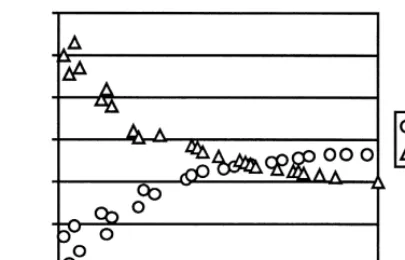
Fig. 1. A sample negotiation run.
di!erent divisions have been compared. Relative di!erences among RI were acceptable.
We performed three kinds of comparisons:
f di!erences amongst commercial lines RI were proportionate to the di!erences in the demand; this result perfectly aligned with the requirement of having strong dependencies among commer-cial lines pro"ts and market shares;
f di!erences among production units RI were al-most insigni"cant, but in the case of a serious tactical error of one of the players (this was the case of inexperienced players); therefore, once managers are trained to the protocol's working (the mechanism cannot work if managers are not su$ciently skilled), any di!erence in production units RI will not depend upon the negotiating ability of the managers;
f di!erences between the sum of the commercial lines RI and the sum of the production units RI o!set in the middle term, but shown in the short-term peaks of about 10 to 20% of the enterprise RI. Any long-term disequilibrium should therefore constitute a warning signal in-dicating an uneven balance between require-ments and available capacity.
In order to better explain the typical behaviour of players, a sample negotiation run is presented in Fig. 1.
Fig. 1 shows the reservation values and prices of the various bids and o!ers, related to a certain resource R, submitted within a typical negotiation run. The reader could notice that:
f at the beginning the reservation values are lower than the reservation prices }as a consequence, the capacity allocation cannot take place; f recognising the above situation, managers of
production lines submit o!ers with lower reser-vation prices; similarly, commercial managers increase their reservation values;
f moreover, the spread among the various reserva-tion prices is big at the beginning, and tends to decrease as production lines managers receive the information regarding other o!ers; the same holds true for the reservation values;
f when a bid is submitted, whose reservation value is higher than the reservation price of at least one o!er, the capacity allocation can take place; from that point on, reservation prices decrease monotonically, and reservation values increase monotonically, as in`traditionalaauctions.
It should be also noted that the level of a certain demand is not always higher than the available capacity. As a consequence, the price at which the o!er and the demand curve could be lower in low demand period, and higher in high demand period.
8. Control and management of the capacity allocation system
From this presentation, one could infer that the proposed mechanism was designed to work as a stand-alone system, without any external con-straint. To avoid this serious mistake, it is necessary to place the model within the hierarchy of the enterprise decision processes. The units considered in the model are all at the same hierarchical level. Nonetheless, a control hierarchy does exist within every business. The medium-term planning lies below the strategic planning}also called long-range planning; the output of the strategic planning process constitutes an unshakeable constraint for the capacity allocation process.
does it bound the models e!ectiveness. As a matter of fact, the proposed negotiation protocol could remarkably improve allocation e$ciency in fairly uncertain periods; in steady state periods it bears the same results of the traditional allocation mechanisms, with the clear advantage of lowering high-level managers workloads; rather, high-level managers should operate in those periods in which the negotiation protocol cannot e!ectively deal with uncertainty.
More speci"cally, high-level managers could take action in several ways:
f bounding some commercial units to buy a min-imum amount of resource. In case of manifest disequilibrium, the supervisor could force a capacity reallocation among two or more units. This allows the top management to keep strategically important, but economically weak divisions from dying out.
f deliberating about managers rewards. Normally, rewards are performance-related, though in some cases rewards falling below, or rising above, the limit of fairness could not be applied; f "xing maximum and minimum price levels for one or more resources. If the cost of one resource is always close to the maximum price allowed, either the upper threshold has been set to a too low value, or the resource is scarce, and capacity should be added to the system.
In order to have the whole system working proper-ly, division managers should be aware of the exact arrangement of the capacity allocation process, within the control hierarchy; moreover, it is para-mount the general acceptance of a basic rule: top-management intervention and high-level decisions, adding constraints to our model, constitutes the `naturalaworking of the enterprise.
9. Conclusions
In this paper, the authors present a medium-term capacity allocation mechanism, based on negoti-ations among the managers of di!erent divisions. The proposed mechanism, which is not intended to be an algorithm, but a managerial decision support
tool, allows to overcome disadvantages of tradi-tional capacity allocation systems exploiting the advantages of Distributed Problem Solving tech-niques without losing e$ciency.
In addition to the proposed architecture, a proto-type of Personal Digital Assistant, able to support negotiations among divisions, has been proposed.
Appendix A. E7ciency
Each human being is provided with a certain measure of his or her welfare}economists call it
utility function}and he or she likes one situation better than another if and only if the former gives greater utility than the latter. As a consequence, the economic goal of each individual is to maximise his or her measure of satisfaction,;
i, depending upon the set of decisions taken in the considered eco-nomic system,D, and upon the wealth of individual ith,E
i, expressed in money units. In a formal nota-tion;
i";i(Ei,D). Since people often have con-#icting interests, a universally accepted optimum solution doesnot exist. It is therefore necessary to de"ne a criteron to distinguish`badaand `gooda options. An optionSHis e$cient if and only if there is no available alternativeSthat is universally pre-ferred in terms of the goals and preferences of the people involved.
Formally
SHe$cientQxSfeasible: (xi:;
i(S)(;i(SH))' (&j:;
j(S)';j(SH))
On the other hand, a choice is ine$cient when there is an alternative feasible choice for which at least an individual would be better o!without harming any other.
Formally
S*ine$cientQ &Sfeasible:
(&i:;
i(S)';i(SH))'(∀j:;j(S)*;j(SH))
A.1. The ezciency principle
the outcomes of economic activity will tend to be e$cient (at least for the parties to the bargain).
For an informal proof, see [34].
A.2. Local ezciency vs. global ezciency
Those options that are e$cient for a sub-group of the decision makers, are said to be locally ez -cient; an option is globally ezcient only if it is locally e$cient, whichever the sub-group. There-fore, local e$ciency is a necessary condition for global e$ciency.
A.3. No wealth ewect
There are no wealth e!ects for a certain decision maker with respect to a set of possible decisions whenever the following conditions hold:
1. given any two alternative decisions, D
1 and
D
2, there is a de"nite amount of money,Ci(D1,D2),
that would be su$cient to compensate the decision maker for switching fromD
1 toD2.
In formal notation
;
i(Ei,D1)";i(Ei#Ci(D1,D2),D2,).
2. were the decision maker given any amount of wealth,C
i would be una!ected.
3. the decision maker's wealth is greater than any C
i(D1,D2).
A.4. Thevalue maximisation principle
An allocation among a group of people whose preferences display no wealth e!ects is e$cient only if it maximises the total value of the a!ected parties. Moreover, for any ine$cient allocation, there exists another (total value maximising) allocation thatall
of the partiesstrictlyprefer. For a formal proof, see [34].
A.5. The Coase theorem
Linking the e$ciency and the value maximisa-tion principles, it follows that: if managers in a busi-ness are able to bargain together e!ectively and can e!ectively implement and enforce their decisions, if their preferences display no wealth e!ect, and if all the wealth generated by their decisions is
distrib-uted among the represented divisions, then the out-comes of the economic activity tend to maximize the"rm total value.
The Coase Theorem expresses in a slightly di!er-ent way the very same result: if the parties bargain to an e$cient agreement (for themselves) and if their preferences display no wealth e!ects, then the value-creating activities that they will agree upon do not depend on the bargaining power of the parties or on what assets each owned when the bargaining began. Rather, e$ciency alone deter-mines the activity choice. The other factors can a!ect only decisions about how the costs and bene"ts are to be shared [33].
This theorem conciliates the value maximisation goal of every"rm and the e$ciency goal pursued by the negotiation mechanism proposed in this paper.
Appendix B. The matching algorithm
B.1. Objective
LetO(r) be a set of o!ers, andB(r) a set of bids, each concerning one unit of the rth critical resource. LetO
i(r) be theith o!er inO(r), andBj(r) be the jth bid in B(r). Let P[O
i(r)] and <[Bj(r)], respectively, be the the reservation price of the ith o!er, and the reservation value of thejth bid.
LetC
kl be the contract drawn up matching the kth o!er, and the lth bid. For C
kl to be valid, P[O
k(r)])<[Bl(r)]. Once committed in a con-tract, a bid is satis"ed, and is therefore removed fromB(r). The same happens for o!ers.
The goal of the matching algorithm is to"nd the maximum possible number of matches, thus maxi-mising the number of o!ers and bids satis"ed.
B.2. Constraints
f An o!er is not to be matched untill all o!ers with a lower reservation price have been satis"ed. In case of several o!ers with the same reservation price, the algorithm must operate according to a FIFO rule.
13The actually implemented algorithm does not execute step (l), since it computesd}BID}NM solving the following equa-tion:
d}BID}TOT!d}BID}NM "d}OFF}TOT!d}OFF}NM (matched bids"matched o!ers).
Moreover, notice that the algorithm could perform the match-ing even without knowmatch-ingd}BID}NM.
several bids with equal reservation value, the algorithm must operate according to a FIFO rule.
B.3. Input
The input is LIST}0, the set of bids and o!ers accepted by the co-ordination entity during a nego-tiation session, in the very order in which they were submitted.
B.4. Data Pre-processing
The algorithm starts splitting each bid into
atomic bids, i.e. bids and o!ers related to a single unit of a critical resource. For instance, the o!er O
i(r), concerningnunits of therth critical resource, will be substituted bynidentical bidsO
i.j(r)}with 1)j)n}each of which concerns one unit of the rth critical resource, and with a reservation value of p[O
i(r)].
Algorithm steps
(1) If LIST}0 is empty, the algorithm ends. (2) Set the counter COUNT to ZERO
(3) Repeat the following cycle, until COUNT reachesR, whereRis the total number of criti-cal resources:
(a) COUNT##
(b) Create the two lists O(COUNT) and B(COUNT).
(c) Scan the"rst element of LIST}0. (d) Consider the last scanned element of
LIST}0:
f case END}OF}LIST: go to (h). f caseO
i(r), withr"COUNT: go to (e). f caseB
j(r), wherer"COUNT: go to (f). f default: go to (g).
(e) Append the last scanned element of LIST}0 to O(COUNT); then go to (g). (f) Append the last scanned element of
LIST}0 to B(COUNT); then go to (g). (g) Scan the next element of LIST}0, then
go to (d).
(h) If either O(COUNT) is empty or B(COUNT) is empty, go to (q).
(i) Order all the o!ers in O(COUNT) with increasing reservation price.
(j) Order all the bids in B(COUNT) with decreasing reservation values.
(k) Sub-procedure which counts how many o!ers cannot be matched. Returns the integerd}OFF}NM.
(l) Sub-procedure which counts how many bids cannot be matched. Calculates the integerd}BID}NM.13
(m) Remove the last d}OFF}NM o!ers from O(COUNT), and the last
d}BID}NM bids from B(COUNT). (n) Invert O(COUNT).
(o) Match the "rst element in O(COUNT) with the"rst element in B(COUNT), then remove the two elements from the lists. (p) If O(COUNT) has not yet been emptied,
go to (o).
(q) End of cycle. Go to (2).
Sub-procedure (k)
(i) Create a pointer POINT}BID, and set it to the"rst element in B(COUNT).
(ii) Create a pointer POINT}OFF, and set it to the last element in O(COUNT). (iii) Set the counter BID}CUM to zero. (iv) Set the counter OFF}CUM to zero.
(v) Setd}OFF}NM to zero.
(vi) VALUE"max[P(POINT}OFF), V(POINT} BID)].
(vii) If P(POINT}OFF)*VALUE
f move POINT}OFF to the preceeding element;
f OFF}CUM##; f go to (vii).
(viii) If V(POINT}BID)*VALUE
f move POINT}BID to the next element; f BID}CUM##;
(ix)d}O F F}N M"m a x (d}O F F}N M , BID}CUM!OFF}CUM).
(x) If either POINT}OFF is not set to the"rst element of O(COUNT), or POINT}BID is not set to the last element of B(COUNT), go to (vi).
(xi) Returnd}OFF}NM.
References
[1] D.C. Aucamp, A lot-sizing policy for production planning with applications in MRP, International Journal of Pro-duction Research 25 (8) (1987).
[2] R. Karni, Y. Roll, A heuristic algorithm for the multi-items lot-sizing problem with capacity constraints, IIE Transac-tions 14 (4) (1982).
[3] G. O'Hare, N. Jennings (Eds.), Foundations of Distributed Arti"cial Intelligence, Wiley, New York, 1996.
[4] R.G. Smith, The contract net protocol: High-level com-munication and control in a distributed problem solver, IEEE Transactions on Computers, C-29 (12) (1980). [5] R.G. Smith, R. Davis, Frameworks for co-operation
in distributed problem solving, IEEE Transactions on Systems, Man, and Cybernetics SMC-11 (1) (1981). [6] R. Davis, R.G. Smith, Negotiation as a metaphor for
distributed problem solving, Arti"cial Intelligence 20 (1983).
[7] S. Green, L. Hurst, B. Nangle, P. Cunningham, F. Somers, R. Evans, Software agents: A review, Intelligent agents group report, http://www.cs.tcd.ie/researchgroups/aig/iag/ pubreview.zip (1997).
[8] J. Rumbaugh, M. Blaha, W. Premerlani, F. Eddy, W. Lorensen, Object-Oriented Modeling and Design, Pren-tice}Hall, Englewood Cli!s, NJ, 1991.
[9] M.J.P. Shaw, The design of a distributed knowledge-based approach for the intelligent manufacturing information system, Ph.D. Dissertation, Purdue University, West Lafayette, IN, 1984.
[10] H.V.D. Parunak, Workshop report: Implementing manu-facturing agents. In Proceedings of PAAM'96, 1996. [11] H.V.D. Parunak, B.W. Irish, J. Kendrick, P.W. Lozo,
Fractal actors for distributed manufacturing control, Pro-ceedings of the Second IEEE Conference on Arti"cial Intelligence Applications, Miami, FL, 1985.
[12] D.M. Dilts, N.P. Boyd, H.H. Whorms, The evolution of control architectures for automated manufacturing systems Journal of Manufacturing Systems, 10 (1) (1991). [13] P. Valkenaers, H. Van Brussel, L. Bongaerts, J. Wins, Holonic manufacturing systems, Integrated Computer Aided Engineering, 4 (3) (1997).
[14] P.H. Enslow, What does distributed processing mean, Distributed Systems, Infotech state of the art report, Maidenhead, UK, 1976.
[15] B.B. Mandelbrot, The Fractal Geometry of Nature, Free-man, New York, 1982.
[16] W.S. McCulloch, A heterarchy of values determined by the topology of nervous nets, Bulletin of Mathematics Biophisics 11 (1949).
[17] A. Koestler, The Ghost in the Machine, Arkana Books, Reading, UK, 1991.
[18] J.J. Ting, A co-operative shop-#oor control model for computer integrated manufacturing, Proceedings of CIM-CON 90, Gaithersburg, MD, 1990.
[19] G.Y.-J. Lin, An opportunistic price-based multiple-re-source and part scheduling, Ph.D. Dissertation, Purdue University, West Lafayette, IN, 1992.
[20] G.Y.-J. Lin, J.J. Solberg, Integrated shop-#oor control using autonomous agents, IIE Transactions 24 (3) (1992). [21] R.J. Rabelo, L.M. Camarinha-Matos, Negotiation in multi-agent based dynamic scheduling, Robotics and Computer Integrated Manufacturing 11 (4) (1994). [22] F.P. Maturana, D.H. Norrie, A generic mediator for
multi-agent coordination in a distributed manufacturing system, http://ksi.cpsc.ucalgary.ca/DME/Generic.html (1995). [23] P.T. Harker, L.H. Ungar, A market based approach to
work#ow automation, http://lsdis.cs.uga.edu/activities/ NSF-work#ow/paper1.html (1996).
[24] N.R. Jennings, P. Faratin, M.J. Johnson, T.J. Norman, P. O'Brien, M.E. Wiegand, Agent-based business process management, International Journal of Cooperative In-formation Systems 5 (2}3) (1996).
[25] N.R. Jennings, A.J. Jackson, Agent-based meeting schedul-ing: a design implementation, Electronic letters, the Insti-tution of Electrical Engineering 31 (5) (1995).
[26] S.K. Das, J. Fox, D. Eldson, P. Hammond, Decision making and plan management by autonomous agents: Theory, im-plementation and applications, Proceedings from Agents &97 International Conference, Marina del Rey, CA, 1997 [27] R.S. Kaplan, A.A. Atkinson, Advanced Management
Ac-counting, Prentice-Hall International Ltd., London, 1989. [28] D.J. Farber, K.C. Larson, The structure of the distributed computing system}software, in: J. Fox (Ed.), Proceedings of the Symposium on Computation-communication Networks and Teletra$c, Polytechnic Press, Polytechnic Institute of Brooklyn, Brooklyn, NY, 1972.
[29] D.J. Farber, J. Feldman, F.R. Heinrich, M.D. Hopwood, K.C. Larson, D.C. Loomis, L.A. Rowe, The Distributed Computing System, IEEE COMPCON, Irwin, Home-wood, IL, 1973.
[30] P. Faratin, C. Sierra, N.R. Jennings, Negotiation decision functions for Autonomous Agents, Preprint submitted to Elsevier Science, 1997.
[31] N.R. Jennings, Co-ordination techniques for distributed arti"cial intelligence, in: G. O'Hare, N.R. Jennings (Eds.), Foundations of Distributed Arti"cial Intelligence, Wiley, New York, 1996.
[32] R. Coase, The nature of the"rm, Economica 4 (1937). [33] R. Coase, The Problem of Social Cost, Journal of Law and
Economics 3 (1960).
[35] P.W. Anderson, More is di!erent, Science 4047 (1972). [36] J.H. Holland, Adaptation in Natural and Arti"cial
Systems. An Introductory Analysis with Applications to Biology, Control and Arti"cial Intelligence, University of Michigan Press, Ann Arbor, 1975.
[37] R. Axelrod, The Evolution of Co-operation, Basic Books, New York, 1984.
[38] B. Tsvetovatyy, M. Gini, Towards a virtual marketplace, Proceedings of the First International Conference on the Practical Application of Intelligent Agents and Multi-Agent Technology, 1996.
[39] A. Chavez, P. Maes, Kasbah: An agent marketplace for buying and selling goods, PAAM 96 Proceedings, http://jeeves.media.mit.edu/papers/paam96.ps (1996). [40] A. Brun, Gestione della Capacita` Produttiva nel Medio
Termine mediante Contrattazioni tra Agenti Autonomi, M.Eng. Thesis Work, Politecnico di Milano, Milan, Italy, 1997.