222 Rismawati1
Syiah Kuala University, Banda Aceh
ABSTRACT
This research aims to investigate the impact of using authentic videos as audio-visual aids for teaching listening for ESL. It was conducted from October 15, 2015 up to November 19, 2015. The population of this study was the second grade students of State Senior High School 4 (SMAN 4) Banda Aceh, and from this population, two classes were selected as the sample. This research employed true experimental research method with two groups, an experimental group (EG) and a control group (CG). The EG was taught by using authentic video, while the CG used audio Compact Disc (CD) as the teaching aid most often used by ESL teachers in teaching listening. In collecting the data, the writer used tests as the instrument, and in analyzing the data collected, Analysis of Variance (ANOVA) computer software was employed. The mean score of the results from the postests from the EG at 75 was higher than that of the control group at 64. Moreover, the t-test for the EG was higher than that for the CG (11.51>4.06) which meant that the improvement in the EG was significantly higher than the listening achievements of the CG. The EG students taught by using authentic video achieved higher results in listening than the CG ones taught by audio compact disc (CD). As a result, the alternative hypothesis was accepted and null hypothesis was rejected which meant that there was a significant improvement in terms of listening achievements after the use of authentic videos treatment.
Keywords: Teaching Listening, Authentic Video, Comprehension.
INTRODUCTION
In recent times, the teaching of listening skills has sparked more interest than in the past. A number of studies (Schmidt-Rinehart, 1994; Abdal, 2012) have shown that listening skills are essential to develop effective class interaction between students and their teachers. Thomson et al. (2004) have written that successful English as Second Language (ESL) interaction between school teachers and their students primarily depends on effective interactive listening skills because students are required to be able to catch, process, and negotiate meanings using the target language. They need to be able to listen carefully to explanations by teachers and lecturers and also to class discussions in order to understand the information and to participate in the conversations. According to Brown (2006), students with good listening skills have better ability to participate effectively in class because they understand the explanations from their teacher better than the other students.
1
223
The current Indonesian 2013 Curriculum sets one of the objectives for teaching English in Senior High Schools that the students will be able to understand, apply and analyze factual, conceptual and procedural information based on their curiosity. As a result, a great amount of attention should be devoted in order to achieve this teaching objective.
This research was started because the writer was concerned about the poor results of teaching listening to English to Senior High School students, particularly to second grade (year 11) students. One of the basic competencies (3.1) in the 2013 Curriculum (Depdikbud, 2013) that these students have to learn is to be able to understand spoken and written texts expressing hopes and prayers, suggestions, offers, opinions/thoughts and their responses. These students are expected to be able to communicate their feelings in interpersonal conversations accurately and fluently. They also have to be able to respond
to other people’s feelings and expressions appropriately. The next basic competency (3.2) for these students is to be able to construct spoken and written texts for expressing hopes and prayers, suggestions, offers, opinions, thoughts and their responses (Depdikbud, ibid). These students are also required to be able to respond appropriately to the meanings within the previous spoken and written texts, accurately and fluently.
Generally, these basic competencies cannot be achieved easily by the students. The listening standards are particularly difficult for the ESL learners where their exposure to English is limited. In order to cope with these challenges, teachers have to properly organize their listening lessons prior to the class. They need to carefully design their teaching strategies in order to successfully transfer the listening materials and skills to their ESL listening students.
The researcher conducted preliminary class observations at SMAN 4 Banda Aceh to find out what problems the students had in listening to ESL materials. Data about the listening difficulties of these second grade students was obtained from observations on August 24th, 2014. In order to pass the minimum completion standards (KKM), the students had to get 75 as their minimum score for each of the ESL skills viz: listening, speaking, reading and writing. The observations showed that many students were active in speaking and reading and performed them well when communicating in English even though they faced some problems with understanding.
However, based on the school assessment results, it was found that many students had difficulty with listening comprehension when listening to English recorded materials. Only 50% of the students reached the minimum standard (75) while the rest had to take remedial classes. Moreover, based on the observations although the students tried to focus and listen to the English recordings at first they seemed to lose their concentration after a few minutes. After the recording was played, they stalled when asked to retell what they had heard. They seemed to switch off their listening. From the discussions, the students acknowledged that they did not understand the English in the recording which led them to stop listening. According to Schmidt-Rinehart (1994), this problem may occur because they were not familiar with listening to English at the normal rates of spoken English.
This study aims to optimize the use of authentic videos to try to overcome some of the listening difficulties encountered by the students. Based on an interview with the English teacher at SMAN 4 Banda Aceh, it was found that she had tried several methods to deal with this problem. For example, she had already tried a direct method to enhance
224
practices in terms of short and long conversations with the students. Even though these approaches had enhanced the students’ speaking abilities, it seemed that the students still had difficulties in understanding the conversations or recordings if the information was not familiar to them. As a result, this led to an information gap between the recordings and the students. In order to enhance the students’ listening skills, the author decided to concentrate on the use of authentic videos as audio visual aids to help the students learn to listen and understand spoken English better.
The use of audio-visual aids in language teaching has gained much importance nowadays. Ahmad (2013) mentions several learning resources that can be considered as audio-visual aids viz: television programs, video films, motion pictures, synchronized audio-slide projectors, computers and computer-assisted instructions. Asokhia (2009) has written that the term audio-visual is a compound word from audio and visual. Audio materials refer to those that can be heard and that are recorded in digital audio files, tapes or CDs. Every recorded dialogue, speech or song in English can be audio material for an ESL classroom. Then, visuals are materials that can be seen like pictures, posters, graphics, videos, charts, flash cards and of course films.
This study emphasized the use of video as an audio-visual aid for improving students’ listening skills especially the use of authentic videos. This medium was selected to enhance the students’ familiarity with normal rates of speaking English by native speakers. Nunan (1999) makes the point that learners should be fed as rich a diet of authentic data as possible. He asserts that if they only ever encounter contrived dialogues and listening texts, their learning tasks will be made more difficult in real life. Therefore, it is important for learners to listen to and to read authentic materials, indeed as many different kinds as possible. More importantly, this study was not only done to investigate the efficiency of using authentic videos for teaching listening, but also to see the students’ achievements for each aspect or sub-skill of listening after being taught by using authentic videos.
RESEARCH QUESTION
Based on the problems found at State Senior High School (SMAN) 4 Banda Aceh, the following question was formulated: “Will there be any significant difference in listening achievements between students taught listening using authentic videos and those who are taught using audio-compact discs (CDs)?”
RESEARCH OBJECTIVE
According to the research question, the objective of this study was to discover if there will be any significant difference in listening achievements between students taught listening using authentic videos from those taught using audio - compact discs (CDs).
LITERATURE REVIEW
Listening
225
to interpret it in the context or setting (Underwood, 1989). There are two distinct processes or strategies involved in listening; the top-down process and the bottom-up process. Benet (2012) has written that listening is a combination or dual process. The two processes occur simultaneously and thus they are interrelated. Listeners use 'bottom-up' processing when they use linguistic knowledge to understand the meaning of a message. They build meaning from lower level sounds to words to grammatical relationships to lexical meanings in order to arrive at the final message. Bottom-up processing helps students recognize lexical and pronunciation features to understand the text. Because of their direct focus on language forms at the word and sentence levels, bottom-up exercises are particularly beneficial for lower level students who need to expand their language repertoire. Morley (1991, in Celce-Murcia, 1991) has said that when students become more aware of linguistic features of the input, then the speed and accuracy of perceiving and processing aural input will increase. In order to develop bottom-up processing, students can be asked to distinguish individual sounds, word boundaries, and stressed syllables, identify thought groups, listen for intonation patterns in utterances, identify grammatical forms and functions, recognize contractions and connected speech and recognize linking words.
Listening Position in Language Teaching
English listening comprehension has been included in the National Examinations in Indonesia, particularly at junior and high school levels. This means English teachers must spend time teaching listening comprehension to their students. The importance of listening should not be underestimated; neither should it be treated trivially in teaching-learning a second-language.
In language teaching, (Rost, 1991) has written about teaching listening to develop the listening skills of learners. In particularly, he focused on principles for developing listening ability for four (4) different learning styles viz:
1. Listening ability developed through face-to-face interaction. By interacting in English, learners have the chance to get new language input and the chance to check their own listening ability.
2. Listening developed through focusing on meaning and trying to learn new and important content in the target language. By focusing on meaning and reasons for listening in English, learners can mobilize both their linguistic and non-linguistic abilities.
3. Listening ability developed through work on comprehension activities. By focusing on specific goals for listening, learners can evaluate their efforts and abilities.
4. Listening developed through attention to accuracy and and analysis of form. By learning to perceive sounds and words accurately as they work on meaning oriented activities, learners can make steady progress.
Listening for the Main Idea
226
common for the listening section in the National Final Examination (Ujian Akhir Nasional) to have questions about the overall idea in the listening material. Such questions may be worded in a variety of ways, for example, the students can be asked to identify the topic, the subject, the primary idea, or the main idea. These questions are really asking the primary point the speaker is trying to get across in what he is saying in the recording.
Listening for General Understanding (Listening for Gist)
Listening for such 'general' comprehension means not stopping for every word, nor analysing everything that the speaker includes in the text (Brown, 2006). By encouraging students to have a quick listen to the recording before plunging into it for detail, teachers help them to get a general understanding of what it is all about. This will help them when and if they listen for more specific information. Gist reading and listening, to get the
“gist” of something is not a lazy option. The reader or listener has made a choice not to attend to every detail at first, but to use their processing powers to get the gist, i.e. more of a top-down view, of what is being said.
Listening for Specific Information
This sub-skill is applied when the students listen to something because they want to discover a particular piece of information. They know in advance, what kind of thing they are hoping to find out so they can ignore other information that does not interest them. Example, listening to a weather report to find out about the weather in your part of the country.
In contrast to listening for gist, students frequently go to the spoken text when they want specific details (Brown, 2006). They may listen to the news, only concentrating when the particular item that interests them comes up. In the case of reading, they may quickly look through a film review to find the name of the director or the star. In both cases,the students ignores almost all the other information until they start to hear about the specific item that they are listening for.
Listening in Detail
In this listening sub-skill, the students listen very closely, paying attention to all the words and trying to understand as much information as possible. According to Brown (2006), sometimes they listen in order to understand everything they are listening to in detail. This is usually the case with instructions or directions, or with the description of scientific procedures; it happens when someone gives their address and telephone number and the students need to write down all the details or if they’re in an airport and an announcement starts with ‘Here is an announcement for passengers on flight AA671 to London’, i.e. their flight destination, then they need to listen carefully to everything that is said about that flight.
227 The Use of Authentic Materials
The use of authentic materials in the classroom has been supported by many researchers. One of the first researchers to propose this notion was Krashen in 1982 who pointed out that authentic learning experiences provide learners an opportunity to acquire the target language. Clarke (1989) has also stated that the language of the real world is what learners need to be exposed to because that language is uncompromising towards the learner and reflects real world goals and situations. Therefore, authentic materials need to be presented to the language learners because they reflect how the language is used in authentic communication.
The application of authentic materials can also enhance the students’ familiarity with forms of the language and it’s use in communications. Professionals in favor of using authentic materials assert that exposure to authentic materials should be introduced to learners at the earliest stages of language learning (Bacon & Finnunan, 1989; Miller, 2005) have claimed that early exposure to authentic texts will aid students to develop useful strategies for more complex tasks later on. Similarly, Herron and Seay (1991) have written that using authentic materials paves the way for students to experience real-world language learning materials. The findings of the above-mentioned studies have indicated that authentic materials can be useful in many ways. Such materials introduce students to how language is used in the real world and improve their overall language proficiency as well as improving reading and listening skills, communicative competence, and lexical and stylistic knowledge.
Nature of Authentic Materials
Mishan (2005) has claimed that the main pedagogical rationale for using authentic materials in EFL teaching originates from what is called ‘the 3 C’s’, that is to say, culture, currency, and challenge. He goes on to say: “Culture, in authentic texts incorporates and
represents the culture of the speakers of the target language; currency, in authentic texts offer topics and language in current use, as well as those relevant to the learners;
challenge, in authentic texts is because they are intrinsically more challenging yet can be used at all levels of proficiency” (ibid, p. 44). From this perspective, the use of authentic material provides three advantages to language learners, such as introducing them to the
native speakers’ culture, providing them with information that is current, and presenting
challenges to them in learning. For these reasons, it seems sensible to base students’ listening practice on a variety of authentic materials.
However, such advantages run counter to arguments that the use of authentic materials at early stages of learning hinders the language learning process. Nevertheless, incorporating authentic materials in teaching a foreign language offers more than just linguistic advantages. In this regard, scholars stress the motivating power of authentic materials (Gilmore, 2007), which, they say, is a key factor in successful language learning. As Gilmore (ibid) has stated, “Claims that authentic materials are a motivating
228
that authentic materials provide numerous advantages for the language learner, particularly in introducing them to the real-life, current use and culture of the target language.
The Use of Video as an Audio Visual Aid
A variety of audio-visual (AV) aids are now being used for developing listening ability. Several studies have looked at the effectiveness of AV for teaching listening as this paper intends to do. As mentioned earlier, there are many advantages of using videos according to various experts. According to Berk (2009), there are at least 20 potential advantages as set out in the table below:
Table 1. Advantages of AV for Listening Comprehension
grab students’ attention, focus students’
concentration generate interest in class, create a sense of
anticipation
energize or relax students for learning exercises
draw on students’ imagination improve attitudes toward
content and learning build a connection with other students and the instructor increase memory of
content increase understanding foster creativity stimulate the flow of ideas foster deeper learning make learning fun provide an opportunity for
freedom of expression
serve as a vehicle for collaboration
inspire and motivate students set an appropriate mood or
tone,
decrease anxiety and tension on scary topics
create memorable visual images
Furthermore, several researchers have used DVD movies as motivation for teaching-learning listening e. g. King (2002). He studied the use of DVD feature films in the EFL classroom to motivate students to learn to listen to English. He compared and assessed the use of captioned vs. non-captioned films with different learner levels. and developed selection criteria for choosing appropriate films. He used DVD feature films because DVD offered a variety of special features, including interactive menus, theatrical trailers, behind the scenes commentary, day-to-day language and subtitles and immediate scene access.
Research has indicated that DVD feature films provide enjoyable language learning opportunities for students. The teacher should choose appropriate length films, either complete ones or segments, which are purposeful and tailored to students' learning needs and proficiency levels. Both captioned and non-captioned films benefit students in various ways. A teacher can aim at different aspects of language, by using both types of movies alternately. English-captioned films are a rich source of instructional material that provide good examples and excellent content in oral communication.
RESEARCH METHOD
229
and 15 boys in the EG, and 22 girls and 12 boys in the CG giving a total of 34 students in each of the sample classes.
The data was collected from these second grade (year 11) students in the 2015- 2016 academic year using a pre-test and a post-test as instruments. The treatments were given for four meetings in which the EG was taught by using authentic videos as an audio visual aid and the CG, by contrast, was taught using the audio recording usually used by the teacher for teaching listening. In spite of the different methods, both groups had similar materials provided by the researcher.
The data was analyzed statistically to find out whether the hypothesis in this study was accepted i.e. whether the use of authentic video as an audio visual aid effectively enhanced the listening achievements of second grade students from SMAN 4, Banda Aceh.
RESULTS AND DISCUSSIONS
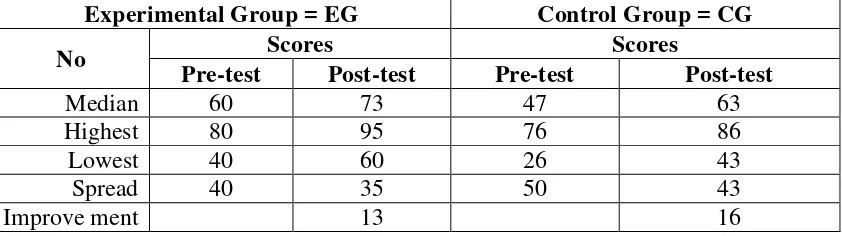
In the table below are the important scores from the pre-tests and the post-tests for both the EG and the CG before and after the treatment..
Table 2. Important Scores from the EG and the CG
Experimental Group = EG Control Group = CG
No Scores Scores
Pre-test Post-test Pre-test Post-test
Median 60 73 47 63
Highest 80 95 76 86
Lowest 40 60 26 43
Spread 40 35 50 43
Improve ment 13 16
The Independent T-Test Analysis of the Pre-Test
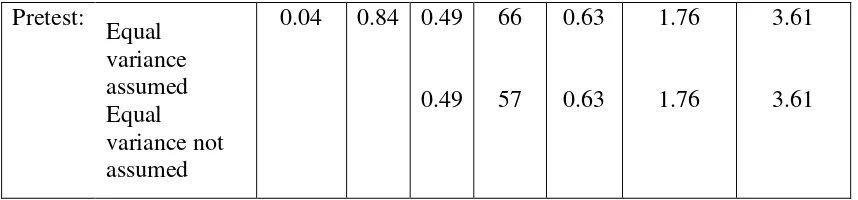
The objective of the independent t-test was to find out if there was any significant difference in the listening abilities of the EG and Cg before the treatment. The results from the T-test of the pre-tests are set out in the table that follows:
Table 3. T-Test Results from the Pre-Tests of Both the EG and the CG
Levene’s test
for equality of Variances
T-test for Equality of Means
F Sig. T df
Sig. (2-tld)
Mean Diff
230
Pretest: Equal variance assumed Equal variance not assumed
0.04 0.84 0.49
0.49 66
57
0.63
0.63
1.76
1.76
3.61
3.61
The table above shows that tobtain of the pre-tests from both the EG and the CG was 0.49. The ttable for df=66 at the level of significance of 5% (� = 0.05) is 2.00. Since tobtain<ttable that is 0.49 <2.00, so H0 was accepted, so there was no significance difference in listening ability between the students in the EG and the CG before the treatment.
The Independent T-Test Analysis of the Post-Tests
This independent t-test was done to find any significant differences between the post-test results from the EG and the CG. The result of this t-post-test are set out in the table below:
Table 4. T-Test Results from the Post-Tests of both the EG and the CG Levene’s test
for equality of Variances
T-test for Equality of Means
F Sig. T Df
Sig. (2-tld)
Mean Diffrce
Std.Error Diffrnce
Pretest Equal variance assumed Equal variance not assumed
0.071 0.791 3.76
3.76 66
57
0.00
0.00
1.76
1.76
13.10
13.10
From these tables, it can be seen that tobtain from the post-tests of both the EG and the CG was 3.76. The ttable for df=66 at the level of significance 5% (� = 0.05) is 2.00. The result shows that tobtain > ttable that is 3.76 > 2.00, so H0 is rejected. This means that the EG students who were taught using authentic videos performed significantly better than the CG students who were taught using audio materials only.
The Dependent T-Test (Paired T-Test Analysis)
A paired test is applied to determine the differences of the students’ achievement
231
Table 5. T-Test Result from the Pre-Test and Post-Test Scores from the EG
Paired Differences
t df
Sig (2-tld)
Mean Std. Dvtn
Std. Error Mean Pair
1
Post-test Control - pre-test control
25.46 12.11 2.21 11.51 34 0.00
From the table, it can be seen that the t-test of the EG was 11.51. The ttable for df=34 at the level of significance 5% (� = 0.05) was 2.04.
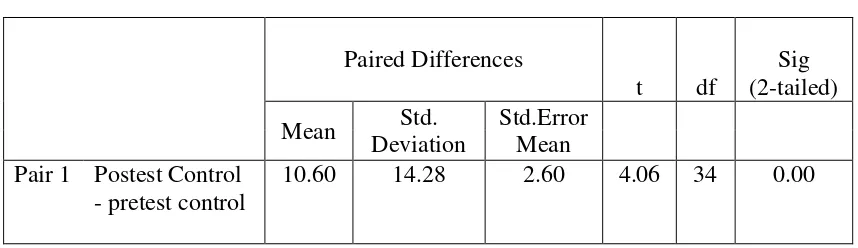
Table 6. T-Test Results from the Pre-Test and Post-Test Scores from the CG
Paired Differences
t df
Sig (2-tailed)
Mean Std.
Deviation
Std.Error Mean Pair 1 Postest Control
- pretest control
10.60 14.28 2.60 4.06 34 0.00
According to the data from the tables, the t-test of the EG was 11.51 and the t-test of the CG was 4.06. The ttable for df=34 at the level of significance 5% (� = 0.05) is 2.04. The result confirms that tobtain > ttablefor both groups was 11.51 > 2.04 for the EG and 4.06 >2.04 for the CG. This shows that both groups performed better in listening achievement after the treatment. Nevertheless, the result of the t-test for the EG was significantly larger than the t-test for the CG (11.51 > 4.06). Thus there was much more improvement in the EG compared to the CG. The EG, taught using authentic video, got a much more significant improvement than the CG, taught using audio compact discs (CD), the usual listening aid used by the teacher for teaching listening.
CONCLUSIONS AND SUGGESTIONS
The post-test results and the independent t-test from the EG was significantly higher than that from the CG which means that the implementation of authentic video positively influenced the students’ listening skills. From the data analysis of the pre-test and post-test obtained from the EG, it can be seen that listening for specific information was the most enhanced listening sub-skill after the application of authentic video as an audio visual aid. Although the other listening sub skills, listening for the main ideas, listening for the gist, and listening for detailed information also increased, listening for specific information improved more significantly than the other listening sub-skills.
232
that using authentic video may bring the content and the subject matter to life for them that enabled them to make important connections in the world beyond the classroom.
According to the analysis of the findings and the discussions, using authentic video as an audio visual aid was a successful method for improving teaching of listening. However, some limitations may arise when applying this aid. The writer suggests further studies be done using a variety of authentic videos in order to obtain more information about their effectiveness for teaching-learning listening as well as for the other English skills in order to enrich our knowledge about the use of authentic video.
REFERENCES
Abdal, H. F. (2012). Listening comprehension strategies of Arabic-speaking ESL learners. (Unpublished Graduate Thesis). Fort Collins, Colorado, Colorado State University.
Ahmad, T. (2013). Audio-visual aids in teaching. Retrieved December, 12th 2014, from http://www.dailykashmirimages.com/news-audio-visual-aids-in-teaching -42083.aspx.
Asokhia, M. O. (2009). Improvisation/teaching aids: Aid to effective teaching of English language. International Education Science, 1(2), 79-85.
Bacon, S. M., & Finneman, M. D. (1989). A study of the attitudes, motives, and strategies of university foreign language students and their disposition to authentic oral and written input. The Modern Language Journal, 74(4), 459-473.
Benet, C. (2012). Teaching listening strategies with authentic videos: An intervention study with EFL secondary school students in Catalonia. (Unpublished Thesis). Catalonia, University of Barcelona.
Berk, R. A. (2009). Multimedia teaching with video clips: TV, movies, Youtube, and MTV in the college classroom. International Journal of Technology in Teaching and Learning, 5(1), 1–21.
Brown, S. (2006). Teaching listening. New York: Cambridge University Press.
Celce-Murcia, M. (1991). Teaching English as a second or foreign language. In J. M. Morley, Listening comprehension in second foreign language instruction. New York: Newbury House.
Clarke, D. (1989). Communicative theory and its influence on materials production. Language Teaching, 22, 73-86.
Gilmore, A. (2007). A comparison of textbook and authentic interactions. ELT Journal,
58(4), 363-374.
Hadley, A. (2001). Teaching language in context (3rd ed). Boston: Thomson Heinle. Herron, C., & Seay, I. (1991). The effect of authentic oral texts on student listening
comprehension in the foreign language classroom. Foreign Language Annals,24(6), 487-495.
Kilickaya, F. (2004). Authentic materials and cultural content in EFL Classrooms. The Internet TESL Journal, 10(7), 1-6. Retrieved April 7, 2015 from http://Techniques/Kilickaya-AutenticMaterial.html.
King, J. (2002). Using DVD feature films in the EFL classroom. Computer Assisted Language Learning, 15(5), 509-523.
233
Kurikulum 2004. (2003). Standar kompetensi pelajaran Bahasa Inggris. Jakarta: Departemen Pendidikan.
Miller, M. (2005). Improving aural comprehension skills in EFL, using authentic materials: An experiment with university students in Nagata, Japan. (Unpublished Master’s Thesis). Sydney, University of Sydney.
Mishan, F. (2005). Designing authenticity into language learning materials. Intellect Books.
Nunan, D. (1999). Practical English language teaching (1st Ed). Singapore: McGraw-Hill.
Rost, M. (1991). Teaching and researching listening. London, UK: Longman.
Schmidt-Rinehart, B. C. (1994). The effects of topic familiarity on second language listening comprehension. The Modern Language Journal, 78, 179-189.
Sherman, J. (2003). Using authentic video in the language classroom. Cambridge: Cambridge University Press.
Thompson, K., Leintz, P., Nevers, B., & Witkowski, S. (2004). The interactive listening model: An approach of teaching and learning listening. The Journal of General Education, 53(4), 226-240.