Institutional challenges for
peri-urban water supply in
Can Tho, Vietnam
About the authors
Nguyen Ngoc Huy is currently working for the Institute for Social and Environmental Transition (ISET). Huy holds a PhD in environmental studies from Kyoto University with a focus on drought risk management and climate change adaptation. He has over ten years’ experience working on water resource management, climate change adaptation, disaster risk reduction, and education in emergencies in Vietnam, Laos and Cambodia. Before joining ISET as a technical staff member, Huy worked as a researcher at Kyoto University. He has also served as an international consultant for UNISDR, UNCCD, IFAD and UNESCo carrying out research and developing tools for disaster risk reduction and climate change adaptation. email: [email protected]
Tran Van Giai Phong is the Vietnam Technical Lead of the Institute for Social and Environmental Transition (ISET). Phong works with city partners in Vietnam on the ACCCRN programme and the USAID-funded project in assisting in research and training activities to build urban resilience. Phong obtained his doctoral degree in environmental studies from Kyoto University, Japan and his master degree in urban and regional planning from Hawaii University, USA. He has an intensive knowledge of climate change adaptation and disaster risk reduction theories and practices. He has been conducting research on environmental management, climate change adaptation, and disaster risk reduction in developing countries, particularly in Vietnam. Phong has also worked as a consultant for many organisations of the United Nations, and INGos in the South East Asia region. email:[email protected]
Stephen Tyler is a Senior Associate for the Institute for Social and Environmental Transition (ISET). He has over 30 years of professional experience in applied research and policy development linked to adaptation, environment, and resource management issues. He has served on the staff of leading applied research and policy organisations in Canada, California, and internationally, and as a consultant to various international organisations and research groups, including the World Bank, the Asian Development Bank, the International Institute for Sustainable Development (IISD) and CIDA. Stephen holds a PhD in City and Regional Planning from the University of California, Berkeley, and has published on urbanisation and energy use, climate adaptation, and community-based resource management. email: [email protected]
Acknowledgements
Contents
About the authors 2
List of tables and igures 4
Abstract 6
1 Introduction 7
2 Background – water supply in Can Tho 9
2.1. Development patterns in Can Tho City 9
2.2 Water quality in rural areas 11
2.3 Key actors in water supply 14
3 Methodology 17
4 Water supply regulations and outcomes 18
4.1 Government policies on water supply 18
4.2 Concession areas and coordination 19
4.3 Water quality 21
4.4 Tariffs and inancing 21
4.5 Customer satisfaction 23
5 Discussion and analysis 24
6 Conclusions 27
7 Bibliography 29
8 Appendices 31
List of tables and igures
Table 1: Population in urban and rural area of Can Tho 9
Table 2: Sources of potable water outside urban areas 13
Table 3: Price of water set by the city People’s Committee in 2013 22
Figure 1: Urbanisation process in An Khanh ward from 2006 to 2014 10
Figure 2: master plan for Can Tho City, 2030 11
Figure 3: Peri-urban and rural districts for household water quality surveys 12
Figure 4: Key agencies involved in water supply in Can Tho 15
Figure 5: map of the water supply concession area for WSC and CRWSS 19
Acronyms
ACCCRN Asian Cities Climate Change Resilience Network
BoD Biological oxygen demand (in water)
CEm Centre for Environment and Natural Resource monitoring
CENREm Centre for Environmental monitoring
CoD Chemical oxygen demand
CRWSS Centre for Rural Water Supply and Sanitation
DARD Department of Agriculture and Rural Development (local)
DoC Department of Construction
ISET Institute for Social and Environmental Transition
mARD ministry of Agriculture and Rural Development (national)
moNRE ministry of Natural Resource and Environment (national)
UNDP United Nations Development Programme
UNICEF United Nations International Children’s Emergency Fund
VND Vietnamese Dong
Abstract
The lack of a secure and clean potable water supply in peri-urban areas is a major
source of vulnerability for poor residents on the periphery of rapidly expanding cities
in South East Asia. Climate change will increase the demand for clean drinking water,
while adversely affecting supply and creating additional water stress in these areas. This
study examines the provision of water to peri-urban residents in the rapidly growing
city of Can Tho, in Vietnam’s mekong Delta, which will be heavily affected by climate
change. We focus on the institutional structure of water supply, and its relationship to
quality and the reliability of the service received by residents. Can Tho’s boundaries
include an area of over 1,000 km
2, much of which remains agricultural land. About
1 Introduction
As part of the urban transition in developing countries, cities expand into the peri-urban area that is deined as a
transition zone where urban and rural activities are juxtaposed (Allen et al. 2006a; Narain 2010). This zone is one whose boundaries and location change as urbanisation progresses, and as newly populated areas densify and become more closely linked economically and physically to the rest of the metropolitan area. Peri-urban areas typically feature irregular settlements, new towns, industrial processing zones, haphazard infrastructure alongside remnants of agricultural activity or undeveloped areas. The peri-urban zone is under environmental, socio-economical, and demographic transformation at a rapid pace (Rakodi 1999; Fox et al. 2011). The phenomenon has been increasing in fast-growing economic regions like East and Southeast Asia, where the populations residing in peri-urban areas are estimated to make up 40 per cent of the total population of large metropolitan regions (Webster 2002). The urbanisation process in these areas is a complex
transformation that exposes residents to a fragmented and increasingly modiied landscape, degradation of natural
resources, and increased pollution accompanying new industrial activities and higher population densities. At the same time, these areas lack the high levels of infrastructure and services that can be found in central cities (Narain and Nischal 2007; Narain 2008; marshall et al. 2009; DiGregorio 2011; Fox et al. 2011).
The provision of drinking water for peri-urban areas in developing countries is underplanned and poorly managed for a
variety of reasons. Frequently, these areas fall administratively outside the rural-urban classiication system (Allen et al. 2006a; mcKenzie and Ray 2005; UN-Habitat 2006). Communities are typically outside city boundaries, or outside water utility service areas. High quality domestic water supply in peri-urban settings typically requires treatment that cannot be undertaken economically at a small scale. As a result, most peri-urban areas in developing countries lack reliable drinking water systems provided by public utilities. While the extraction, treatment and distribution of water in the city is typically
in the hands of public or private utilities created speciically for that purpose, the provision of water services in peri-urban
areas is relatively more complex because of the lack of a public piped water network (Conan and Paniagua 2003; Nguyen 2004; Allen et al. 2006b; Anand 2007; Guzinsky 2007).
Studies on water governance in peri-urban areas of developing countries across Asia, Latin America, and Africa reveal that there are typically diverse sources of water supply in areas of rapid urbanisation, demonstrating a complex system of water governance and water accessibility. Spatially, access to water in such areas is contentious. While rural residents can rely on surface/groundwater, and urban residents can receive piped water services, dwellers of rapidly urbanising communities, eg Hanoi (Nguyen 2012), Gresik, Surabaya (Guzinsky 2007), mexico City, Chennai, Dar es Salaam, Cairo-Giza, and Caracas (Allen et al. 2006a), all access domestic water from multiple sources.
Climate change will lead to higher temperatures and will affect the predictability of seasonal rains in Vietnam (Katzfey et al. 2014). Dry seasons will probably be extended. Extreme rainfall events will be even more intense. Existing problems
of looding in peri-urban areas, which are also poorly served by drainage or lood protection infrastructure, are likely
to become worse. Shallow wells and local water sources will be more easily contaminated in such extreme conditions, while higher temperatures will create greater physiological demand for water. Both urbanisation and climate change are accelerating in Vietnam, which had one of the highest growth rates in urban population in East Asia between 2000 and 2010 (World Bank 2015). During this decade, the percentage of the population living in cities increased from 19 per cent to 26 per cent. The growth rate of 4.1 per cent / year is expected to continue as government policy calls for urbanisation levels to exceed 30 per cent by 2020. In this context, climate change can be expected to pose increasing challenges for water supply in peri-urban areas, and those most likely to be at risk will be the poor and vulnerable (moser and Satterthwaite 2010).
This study examines the provision of water to peri-urban residents in the rapidly growing city of Can Tho, Vietnam. It focuses on the institutional structure of water supply, and its relationship to quality and reliability of the service received by residents. In the centre of the mekong Delta, Can Tho is likely to be affected in the coming decades by climate changes
leading to luctuating river lows, tidal loods as sea level rises, salinisation and drought. Our study will explore the current
2 Background – water supply
in Can Tho
2.1. Development patterns in Can Tho City
Can Tho is the largest city in the mekong Delta, and is located roughly in the centre of this densely-populated and
highly productive agricultural region in southern Vietnam. Its economy traditionally focused on agriculture, isheries
and transportation, but with urban growth and economic development in the region, there has been a rapid expansion of trade and services, and the city now serves as the primary commercial centre for a still mainly agricultural region with a population of about 25 million. major investments in highways and bridges have greatly improved the road network in the region over the past decade, but most freight transport is still by water along the networks of river channels and canals that criss-cross the delta. The population is concentrated along the banks of these waterways.
Can Tho’s boundaries cover a large area of over 1,000 km2, but most of this area is agricultural. About two-thirds of the city’s total population of 1.2 million resides in the central built-up urban areas, which stretch along several major river
channels. Annual loods during the rainy season, primarily from upstream precipitation in the Mekong Basin, typically
inundate many parts of the delta for weeks at a time and contribute to replenishing the fertile soil for agriculture. In
addition, many areas of the delta suffer from looding during seasonal high tides, which affect areas dozens of kilometres inland from the coast during combined looding and high tide periods. During these periods, the lives of residents of the
city are frequently disrupted, as some roads are cut off, children are unable to walk to school, sanitation is affected and household mobility is limited. But because they are familiar with the problems, households can usually anticipate and prepare for these disruptions.
The city has grown rapidly in recent years, mainly due to migration from surrounding agricultural areas and other provinces. As the service economy has expanded, urban employment has also increased rapidly.
Table 1: Population in urban and rural area of Can Tho
Year 2004 2008 2013
Urban 562,079 615,504 818,957
Rural 565,686 565,400 413,303
Total 1,127,765 1,180,904 1,232,260
Urban expansion generally takes place through increases in residential densities both in the current built-up areas of the
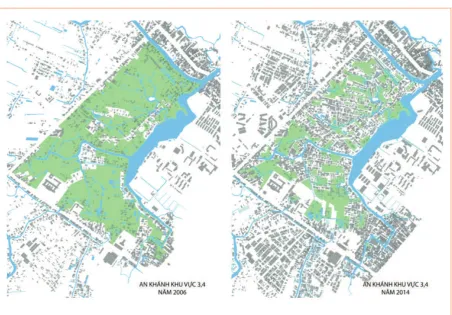
city, but also in villages that are near to the central city and easily accessible by road. These areas, mainly agricultural in nature as recently as 10 to 15 years ago, are now rapidly growing suburbs of the central city. For example, in An Khanh, about 4 km from the central business district, the area was primarily agricultural in 2004, but since the creation of a new urban ward in 2007, the number of commercial and residential buildings along both sides of the main Nguyen Van Cu Road increased sharply. The population of this area reached approximately 5,400 in 2014 (Figure 1 below).
Figure 1: Urbanisation process in An Khanh ward from
2006 to 2014
Water supply for this growing population is problematic. The city’s urban water distribution network relies on the treatment of water extracted from the rivers and canals. Supply is plentiful, but the distribution system only reaches about
40 per cent of the city’s total population. In peri-urban and rural parts of the city, water supply comes from multiple sources including groundwater, surface water, rainwater, and bottled water. Even in areas close to the central city, piped water supply is often not available.
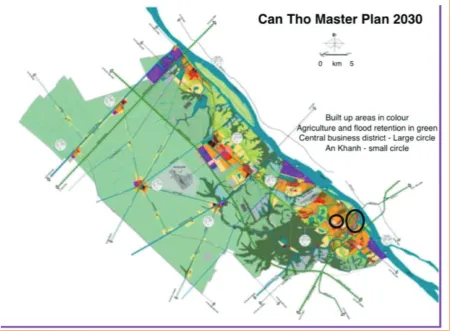
The master plan for Can Tho in Figure 2 shows areas in bright orange that are proposed to become urbanised in the next 15 years. The city’s master plan calls for rural settlements in these areas to be consolidated and higher densities of urban development to be encouraged. The urban water distribution system will need to be expanded considerably as the city grows, in order to incorporate the growing population in these new urban development zones. However, there are barriers
Figure 2: master plan for Can Tho City, 2030
showing how future development will preserve most of the city’s area for agriculture,
drainage / lood protection, and tourism (shades of green). An Khanh, shown in Figure 1, is
expected to become highly urbanised
2.2 Water quality in rural areas
The city’s Department of Natural Resources and Environment recently undertook a study of surface and ground water quality and use in relatively remote rural areas (Sen 2013). The survey included interviews with 100 randomly selected
households not served by any water suppliers in ive districts shown on the map in Figure 3, along with water quality tests
Figure 3: Peri-urban and rural districts for household
water quality surveys
(compare with Figure 2)
Source: Can Tho Department of Natural Resources and Environment
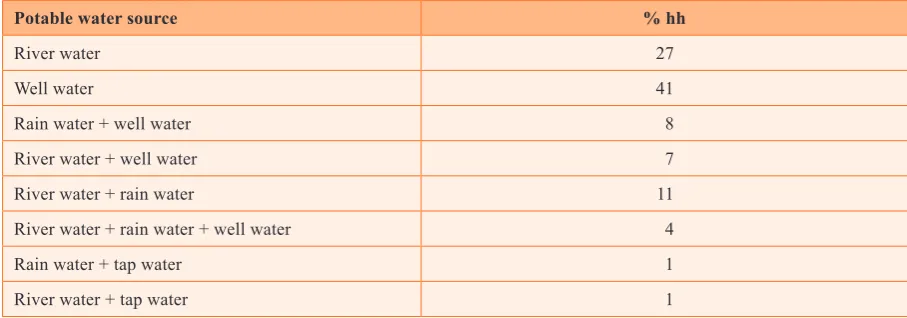
Surveys of households revealed that most of them were long-time residents (about 60 per cent had lived in the same location for more than 30 years). The vast majority of the households (85 per cent) lived on the banks of a canal, in a typical living situation for the residents of rural mekong Delta households. The principal occupation of household head was agriculture for 45 per cent of households, but the majority had non-agricultural livelihoods including small commercial businesses, industrial or service sector employment, or were retired and living on a pension. In terms of water consumption for drinking and cooking, household sources of water varied. About one-third of households used multiple sources, as shown in Table 2 below.
Table 2: Sources of potable water outside urban areas
River water + rain water + well water 4
Rain water + tap water 1
River water + tap water 1
Residents suspect that the quality of their water is poor. They observe odour, cloudiness and taste issues in the water, and sometimes notice long term effects in terms of stains on clothes or water containers. The surface and groundwater in these areas is not regularly monitored. Water quality monitoring associated with this survey provided new details about the quality of the surface and groundwater used by these households. Almost without exception, tests revealed that all the water samples were well over the limits established in national drinking water standards for surface water (QCVN 08:2008/BTNmT-National Standard 08-2008-moNRE) and groundwater (QCVN 09:2008/BTNmT- National Standard 09-2008-moNRE), for all the parameters tested (BoD, CoD, nitrites, ammonia, phosphate and coliforms). Some of the measurements showed standards exceeded by 10 to 100 times. Both surface and groundwater quality were poor, and likely to cause health problems even in short-term consumption.
These results from local survey sites are generally consistent with results from quarterly water quality monitoring by the city’s Centre for Environment and Natural Resource monitoring (CEm), which only monitors one site in each district four
times a year. Sources of pollution in surface and groundwater are readily identiiable: intensive cultivation and livestock
raising leads to high nutrient levels for both surface water and shallow wells. Human and animal wastes are generally not treated before release into local streams. In addition, Can Tho City has 8 industrial parks with approximately 200 large scale industrial enterprises, along with around 100 hospitals and medical clinics, and a residential population of 1.2 million. There is no centralised wastewater treatment facility, although solid waste is collected and hauled to a disposal site in nearby Hau Giang province (Sen 2013).
Groundwater in the mekong Delta has other quality problems as well. In many urban and industrial areas of the city, the
exposed Holocene aquifer is heavily polluted with microbial and inorganic pollutants and considered unit for drinking
water purposes (Tuan 2004; Danh 2008). Some areas of the deeper Upper Pleistocene layers around Can Tho also show high levels of pollution (Quyen 2005). Several studies have shown widespread low-level arsenic contamination originating mainly from natural sources, both in shallow aquifers (0–5 m in depth), and in aquifers at 100–120 m (IUCN 2013).
A further water quality issue in the Mekong Delta is salinisation. With sea level rise, and declining dry season river lows,
Saline and brackish groundwater is widespread in the delta, and in many areas fresh and saline water tend to mix both
within and between aquifer layers. The salty groundwater is mostly a remnant of past interglacial periods, when the delta was forming and sea levels were much higher. In the western and northern parts of the delta, salt water has, over millennia,
been lushed out and groundwater is predominantly fresh. In coastal areas groundwater is generally saline, both naturally
and because of salt water intrusion caused by excessive pumping to serve the demands of agriculture and domestic use
(IUCN 2013). During the dry season of 2013, there were signiicant impacts of salinity intrusion in the coastal provinces
of the mekong Delta, raising widespread public concern. Drinking water sources became salty, and freshwater supplies for some areas had to be trucked in at high cost. In other parts of the delta, saline intrusion meant that irrigation canals had to be closed and water supplies for seasonal irrigation reduced, resulting in crop production losses.
In Can Tho, salinisation is not yet a health risk. The city lies approximately 60 km from the ocean on the south branch of the mekong (Hau River), also known as the Bassac. monitoring results show that in recent dry seasons, canal salinity levels within the city have ranged as high as 0.04 mg/l on occasion. Water quality and health standards suggest an upper limit of 0.02 mg/l in drinking water. Salinity levels are increasing in the Hau River mainstream as well, and the danger threshold has been measured within 10 km of the main water intake at the treatment plant on the river (Neumann etal. 2012).
2.3 Key actors in water supply
Piped water supply in Can Tho is provided by two different entities, in different concession zones. In the urban areas of the city, water is supplied by the Can Tho Water Supply Company (WSC). This organisation is structured as a state-owned enterprise, controlled by the city of Can Tho. While we refer here to the WSC as a single entity, it is structured as six companies, each serving a different geographical area of the city. Five of the six companies are majority owned by the city and report to the Department of Construction. The sixth is privately owned. This legal structure keeps the water supply company accountable to the city People’s Committee (local government), which approves tariffs and general investment
plans, but provides more inancial lexibility in contracting and borrowing capacity, because the corporation’s activities are
regulated under commercial law. The WSC network relies on surface water source from the Hau River and various side channels, with 13 extraction and treatment plants owned by the six different corporate entities to provide piped water to urban settlements, and plans to expand service in peri-urban areas. Total treatment capacity is currently about 166,000 m3/ day, while demand averages 141,000 m3/day. The WSC supplies water for approximately 95 per cent of households in the high density urban areas (mostly Ninh Kieu district), and 9 per cent of households in the rest of the city (those in the most densely settled areas).
In addition to the WSC, in rural areas of Can Tho, decentralised community ground water stations and semi-privatised water networks have been developed and managed by the Centre for Rural Water Supply and Sanitation (CRWSS), which is part of the Department of Agriculture and Rural Development (DARD). The CRWSS builds and operates small scale rural water supply systems in Can Tho. The centre originally received funding from UNICEF, UNDP, and other donors to develop rural water supply. In the densely populated mekong Delta it became apparent that it would be more economical
and effective to invest in larger wells and pumps that could provide suficient water for up to 100 nearby households, rather than to invest in a well for every individual household. This approach also allowed for storage and basic iltration of
As a government agency, CRWSS relies on the funding obtained from the central government to make investments in
water supply, and is not permitted to earn a proit on its investment. However, it delivers water in part through commercial
arrangements with individual local property owners. These partners agree to provide land for a well, pump and elevated storage tank on their property, and then collect fees from the nearby residents served by the small distribution system, in exchange for retaining a portion of the fees collected (Spencer et al. 2008).
There are reported to be 439 small-scale rural water supply systems in Can Tho, supplying water to approximately 97,000 households. Each of these small systems may have a capacity of only 4 – 6 m3/day and 1 – 2 km of low-pressure distribution network, although a few are much larger.
In general, the WSC is responsible for the extraction, treatment and distribution of treated, piped water in high-pressure lines for residential, commercial and industrial service in built-up areas of the city. The CRWSS is responsible for small-scale groundwater pumping, storage and low-pressure distribution systems for residential customers in rural areas. In the urbanisation process of rural and peri-urban areas, these two agencies have contradictory policies and investment
approaches that make it dificult to expand the urban water supply network as the city grows. At the same time, other
sources of rural water supply are of such low quality that they appear to pose risks to human health. There would seem to be a strong argument for rationalising water supply systems to increase water quality as the urban population grows.
3 methodology
The study collected information from a variety of sources to better understand the complex situation of peri-urban water supply in Can Tho. While the basic issue of competing suppliers was widely known, the details of policy and regulatory frameworks constraining these practices were familiar only to key managers in the water supply organisations and local government. Practices related to water supply planning, and to maintenance and operation of existing systems, were not well documented and often ad hoc. Communications between different parties involved in water supply were poor, and most groups were not well informed about the issues facing others. As a result, the study has needed to not only review policy documents, regulations and maps, but also to interview key actors in the water supply organisations and local government at the city and district levels. In addition, the study interviewed community leaders and water users to assess their concerns about performance of existing systems. A detailed list of sources is provided in Appendix 1 (Section 8.1).
Some information could also be shared from a parallel project supported by the Rockefeller Foundation through
ACCCRN.1 one component of that project tested pilot mechanisms for improved coordination of peri-urban water supply to reduce water quality issues. most of the data collected has been descriptive and anecdotal. We have analysed this data by structuring relevant factors in a descriptive narrative that explains and diagnoses current practice in water supply in Can Tho. An assessment of institutional factors is used to draw conclusions.
4 Water supply regulations
and outcomes
This section of the paper reviews the different regulatory requirements for WSC and CRWSS, along with the different
outcomes in terms of quality of service. Differences in organisation and inancial structure, oversight and regulation, all
play a role in contributing to the contradictions in expanding urban water supply, along with ambiguities in the treatment by local government of the two water supply entities.
4.1 Government policies on water supply
Government policies in Vietnam have long recognised the need for investment in clean water supply. However, they also recognise a distinction between urban and rural water supply, where urban systems have higher standards for quality and technical operation and rural systems may only serve a small number of users (see below).
Urban piped water supply must meet national water quality standards as speciied in QCVN 01:2009/BYT, which
typically require full treatment of water extracted from surface sources, while the quality standards for rural areas are less
rigorous (identiied as level 2, based on QCVN 02:2009/BYT). The two standards differ mainly in the number of quality
criteria and the testing frequency, with level 1 including over 100 parameters including heavy metals and a wide range of polyaromatic hydrocarbons and persistent organochlorides, while the level 2 standards include only 14 parameters and have less restrictive limits on some of these. Level 1 standards for water supply are intended to be tested (depending on the parameter) from weekly to biannually, while level 2 standards require only quarterly testing at most.
Prior to 2004, Can Tho City was a district within the boundaries of a larger province, and it did not share an administrative structure with the surrounding rural districts. Water supply was handled differently in the urban district compared with the
surrounding rural districts. But with the expansion of city boundaries in that year as the city was reclassiied to class 1, the
new city government assumed the administrative powers of a province, and had control of both the urban and surrounding rural districts. At that point, the city People’s Committee became responsible both for the WSC and for the CRWSS, through DARD.
The city’s approved plans for expanding urban water supply include targets of 95 per cent of residential households served in the urban districts of Ninh Kieu and Binh Thuy, and 80 per cent of households in suburban towns by 2020, increasing to 100 per cent and 90 per cent respectively by 2030 (Decision no. 279/QD-UBND, Jan 19, 2015).
There is confusion in local policies and plans about the quality of water to be supplied to users within city boundaries. In
policy documents, both sources of water supply are referred to as `clean water’, although in practice the quality and type of treatment are quite different for the two suppliers, as discussed below.
4.2 Concession areas and coordination
Concession areas for water supply are divided between the WSC and the CRWSS, but over time as the urbanised, built-up area expands, and as rural customers demand a higher quality water service, the urban service needs to expand. Service concessions are allocated by the Can Tho City People’s Committee, but the mechanisms for revising service areas and expanding the service of the WSC are unclear and ineffective.
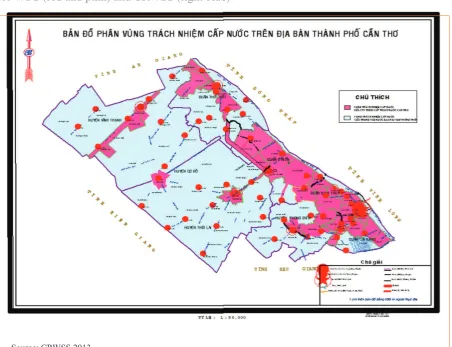
Concession areas were allocated originally in 2005 (Document no. 5561 / UBND-KT, 12/31/2005), with a plan for service areas to 2010. As a result of increased urbanisation, service area concessions were re-allocated in 2011 (Document no. 4747 / UBND-KT, 11/22/2011) and follow-up decisions were made by the Department of Construction (Letter no. 525/
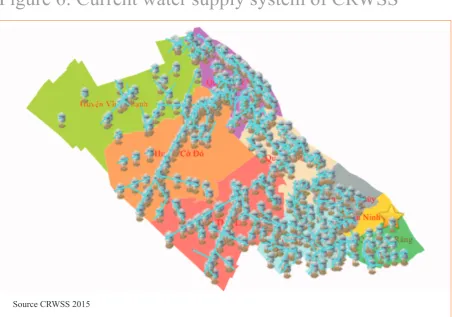
UBND-XDDT 02/15/2012). The oficial concession areas are shown in Figure 5 below, however the map of CRWSS supply stations in Figure 6 demonstrates that there is signiicant overlap, particularly in peripheral towns and population
centres outside the central business district.
Figure 5: map of the water supply concession area
for WSC (red and pink) and CRWSS (light blue)
Figure 6: Current water supply system of CRWSS
Source CRWSS 2015
The WSC can identify areas along existing water main service lines that could be technically supplied from these lines as the population in these areas grows and new homes are built. However, water supply in these areas is often already provided by CRWSS and its local private partners. The allocation of concession areas between CRWSS and WSC is intended by the local government to avoid duplicating capital investment. So if an expanding urban area is already served by CRWSS, then the concession for water supply must be transferred to WSC.
This poses a challenge to WSC. To transfer the concession from a government agency (CRWSS) to a private company (WSC), national regulations require that the private company purchase the assets of the CRWSS. However, the CRWSS system is of no use to WSC in distributing water. The result is that in order to provide water service to the new distribution area, WSC must bear the initial investment costs to not only install new high-pressure piping and pump stations, but also to purchase the old CRWSS assets, which it cannot use, and then remove them.
The two water supply agencies use different planning criteria to determine their respective priorities for investment on an annual basis, and do not coordinate their planning. The result is that new rural water stations are still being installed in peri-urban areas that are likely to be eligible for water company service in the next few years. For example, Long Hoa ward (Binh Thuy district) was recognised as an urban area when the city boundaries were expanded in 2004, but so far only 40 per cent of the ward households have been connected to the city’s water supply. Administratively, urban and rural areas are distinguished by different names for the smallest unit of local government – the commune (xa) in rural areas and ward (phuong) in urban areas.
In response to increasing population densities in its service areas, rather than plan for their transfer to the more eficient
WSC, the CRWSS has been upgrading its stations to increase their capacity, and has planned for four new stations with a capacity of 1,000 m3 per day,2 and 50 stations with a capacity of 500 m3 per day. In addition, they have built four large stations that extract surface water for treatment. The intent is that with these investments they will upgrade treatment in selected major stations to the level 1 national standard (also requiring more frequent inspections).
4.3 Water quality
In addition to the difference in water quality standards applied to each organisation, there is also a difference in quality monitoring. The city water company is required, under QCVN 01:2009 to test key parameters every two weeks. In fact, its standard practice is to test water quality at several points in the distribution network daily. Failure to meet standards after a test will result in immediate internal action to adjust treatment or maintenance of the system. The costs of water quality testing are included in its cost of service and recovered from subscribers.
on the other hand, while the rural water stations are subject to national level 2 water quality standards, the quality testing is done by the Department of Health, which charges a fee for this service. Despite QCVN 02:2009 requirements for quarterly testing, due to resource constraints and staff limitations, CRWSS is only able to fund testing of water supply from each of its 439 stations about once a year, and in many cases the actual testing is less frequent. It is common for rural distribution systems to fail to meet even level 2 water quality standards,3 but action is seldom taken to address the problems because CRWSS has limited funding for maintenance, and claims that water quality and maintenance is the responsibility of the private water station landlords / distribution contractors on whose property the pumping stations are located. So not only is the water quality for rural water supply systems lower, but it is not monitored or enforced rigorously and accountability of quality control issues is not clear.
Water treatment processes differ between the two suppliers, largely because of the different scales and technologies they employ. The WSC treats surface water in multiple steps to remove sediment as well as chlorination. The CRWSS provides
basic sand iltration and some chlorination treatment in a simpler treatment process.
4.4 Tariffs and inancing
Another source of incompatibility in the distribution networks is that each organisation charges different tariffs. The average price for water delivered for domestic use by the WSC is 6,000 VND/m3 (US$ 0.27), and is set by the city
People’s Committee in relation to the inancial needs of the company and the national water tariff guidelines set jointly by
the ministries of Finance, Construction and Agriculture and Rural Development. on the other hand, tariffs for the CRWSS systems are limited to 4,000 VND/m3 (US$ 0.18) by government regulation. The urban water supply is 50 per cent more costly for residential users, although the difference in amount is less than US$1 / month in relation to typical monthly household consumption of less than 10 m3.Table 3 shows the price of water set by the city People’s Committee in 2013.
Table 3: Price of water set by the city People’s
Committee in 2013
Typical monthly household consumption
Price (VND/m3)
(US$ 1 = VND 22,000)
Poor household (no limit amount of water use) 4.000
Less than 10 m3 / household/month 4.800
Between 10 m3 – 20 m3 / household/month 6.000
Between 20 m3– 30 m3 / household/month 6.700
more than 30 m3/ household/month 7.700
For government organisations 7.000
For industry 7.800
For tourism and services 9.800
Source: decision 642/QD-UBND
Because the tariffs are authorised by different levels of government (the water company by the city; CRWSS by mARD policy), neither level of government can unilaterally harmonise them. As a result, even where the city water company could supply higher quality treated bulk water to a rural water supply station for distribution in its existing lines, this
would not be inancially viable. The water company would require 50 per cent more in payment than the water supply
station could generate from its customers. Note that this has nothing to do with willingness to pay (see below), only the regulated rates that are allowed for each organisation.
There is also a difference in inancing. The water company, as a private corporation, is inancially independent but
accountable to its shareholders (the city, represented by DoC). It can raise funds for expansion through borrowing or
through raising capital from the city. Its revenue is very reliable, but water tariffs can only be justiied to the city in its regulatory role (not its shareholder role) by inancial analysis of costs and operating eficiency in accordance with national
guidelines. This provides some incentive for investing in improving the distribution system (eg to reduce leakage losses)
and to ensure inancial accountability. The WSC has a different rate structure depending on the type of customer, and an increasing block rate for most users, designed to encourage eficient use of water. Poor households are entitled to receive subsidies on water rates under national policies. The inances of the water company are reviewed and oversight provided
by the city government.
On the other hand, the inances of the CRWSS are not subject to the same oversight and accountability. Because they have a regular annual budget from MARD, inancial accountability requires minimal expenditure reporting, cost-effectiveness analysis is not required, and repayment of investment is not a inancial issue. Tariffs are established on an administrative basis at the national level, not on the basis of local inancial requirements. The revenue stream generated by customer
payment of water consumption charges is shared with local water station landlords and sub-distributors, but is not used to repay investment costs. Instead, the local revenues support some of the local staff costs and other system maintenance expenses for the CRWSS. Revenues are pooled across all the 439 systems to accommodate differing costs of service and varying size of the different systems.
From the city’s perspective, although it administers the CRWSS as an arm of local government, it pays none of the centre’s costs. System expansion is paid by the national government budget or by donor agencies, and operating expenses are covered by water revenues. on the other hand, the city as principal shareholder in the water companies is required to
contribute investment capital and guarantee inancing of this entity. So the inancial incentive for the city is to continue to
The result of these differences is that the city water company has clear restrictions on how it can spend its funds, because
its investments must be inancially justiiable and self-supporting over time. This tends to limit the pace of system expansion. However, under suitable inancial conditions they can also justify borrowing funds to extend service areas, if
their rates can cover operating, maintenance and debt servicing costs.
on the other hand the CRWSS is dependent only on national budget support for investment funds, and has no obligation
to become inancially self-supporting. So the CRWSS is able to readily mobilise investment funds, on a scale comparable to previous periods, in its regular budget submissions, regardless of the economic eficiency and cost-effectiveness of
those investments. This ensures that the CRWSS does not need to worry about long-term cost recovery or economic rate of return from its investments.
The different inancial disciplines imposed on the different water supply options provide restrictions on each. CRWSS is
not constrained to obtain a positive rate of return on their capital investments because these come from the state budget.
On the other hand, the amount of inancing available to them is also limited to whatever is provided through the national
rural water supply programme. They cannot supplement their budget either by raising tariffs or by borrowing funds, as
can WCCS. Their operating and maintenance costs per user are high, so they have insuficient funds to cover water quality
testing or investments in improving water quality. For CRWSS, it is easy to build more systems, up to their budget limits, which allows them to collect more revenues from distribution, even when customers might prefer higher quality supplies from the water company.
4.5 Customer satisfaction
Water users in peri-urban areas have long complained about water quality in the supply delivered by the CRWSS. The differences between water quality standards for urban and rural water supply are not well understood because many
oficial documents confuse this issue by referring to both types of water supply as `clean water’ (in comparison to untreated surface water from rivers). At all levels of local government, leaders and oficials may not be aware of the
distinction in quality provided in national standards, or recognise that CRWSS water supply is of lower quality.
However, customers are well aware of the differences in the quality of water provided by WSC and CRWSS. Respondents in interviews and focus group discussions reported that even if this was supposed to be `clean water’, they were often not able to use it as potable water because of its poor taste, odour or cloudiness. They were highly sceptical that this water met quality standards. Almost every rural household in the wards surveyed had their own shallow well as an alternative source of supply. These perceptions of low water quality from CRWSS stations are widespread in rural areas, amongst local
system users and local government oficials. But they are seldom formally communicated to policymakers at the city level,
because all local complaints are dealt with by district People’s Councils in sessions held only twice a year, and these issues seldom get on the agenda.
In response, CRWSS has commissioned technical consultants to design, install and test improved ilter systems for rural
water stations. These are currently being tested in a small number of pilot applications, but it is not yet known if they can
address the water quality issues raised by users. Nor is it clear how CRWSS can fund installation and retro-itting of all the rural water supply stations with this new technology, even if it is found to be effective, because of limited inancial
resources and reliance on the state budget.
Surveys of potential new customers in some peri-urban wards show that they are willing to pay the higher tariffs for piped water they perceive to be of much higher quality. For example, surveys of over 200 households conducted in in August 2015 by CENREm in Truong Lac and Thoi An wards showed that 68–84 per cent wanted to switch to city water supply even at higher costs. Residents would also be willing to contribute to capital costs of expanding the distribution system by volunteering labour for construction and installation of new distribution lines. These proposals demonstrate the clear preference of peri-urban households for rapid connection to the city water distribution network. However, to date these
resident preferences have not had much inluence on WSC expansion plans, or on city policies limiting competition and
5 Discussion and analysis
These issues point to contradictions in the water supply system in peri-urban areas of Can Tho, which make it more
dificult and costly to expand the Water Company’s high-quality treated water supply lines. The city government’s policy
commitment to extending the urban water supply distribution network, and improving the quality of water to urban
residents, becomes more dificult and expensive as a result of these contradictions. These contradictions occur despite the
fact that in Can Tho, unlike many other rapidly growing cities in the developing world, peri-urban areas are integrated in the same jurisdiction as the urbanised areas of the city.
There are several key issues that contribute to the dificulty and expense of extending the urban water supply system in Can Tho. The irst one is that in policy and practice, there is insuficient recognition of the signiicant quality differences
between the rural water systems provided by CRWSS and the treated urban water supply. While each is held to a different water quality standard, both are assumed to be regulated by national drinking water standards and therefore both are assumed to provide `clean water’ in a context where about one-third of rural households lack access to either source. In policy terms, the two sources of water are treated as comparable. After the government has made the investment of public funds in rural water stations and decentralised distribution, it is reluctant to have that investment replaced by a completely different system, and so transferring service from a CRWSS station to the WSC is not encouraged. The current regulatory environment, confusing local concession assignments and national regulations mean that even where transfer of service
has been formally approved by DARD, CRWSS has been reluctant to relinquish its services and has petitioned the city People’s Committee to arbitrate.4
However, there is a demonstrable difference in quality between the two types of water supply, one that is widely recognised by users and system managers. The policy to discourage upgrading of CRWSS service areas means that it is
dificult for WSC to provide service even as density increases in peri-urban areas. If the WSC expands its distribution
system into an area currently served by a rural water station, it will render the rural system redundant. Because of higher quality and reliability, customers will generally prefer the WSC supply, even if it is 50 per cent more costly. It is not feasible to maintain both systems, so this implies that: a) the entire service and distribution area of the previous rural station must now be replaced by the WSC distribution network; and b) customers must also replace their water meters. on the other hand, residents will generally be assured of higher water quality, so will not need to undertake any further treatment themselves, and will avoid paying for bottled water or for maintaining their own wells.
These challenges are compounded by policies that increase the cost to WSC of upgrading a rural water service. Because of ministry of Finance policies, as a private company, WSC must pay to the CRWSS the full value of the assets it is taking over. This means that in addition to the capital costs of the new distribution system, WSC also has to pay for the
old system. But the two systems are technically incompatible, and WSC has no use for the assets it is obliged to pay for.
Instead, it has to incur further costs to dismantle and scrap the old system. The result is that WSC is inancially penalised for water quality and water supply to peri-urban residents. This acts as a inancial burden and reduces the investment in
water supply expansion compared to what it otherwise would be.
Despite lower standards and much cheaper technologies, CRWSS cost of supply per customer is still fairly high, and it
inds that its revenues from water tariffs are not suficient to cover required maintenance, quality testing and investments
in treatment to improve water quality. At the same time, when CRWSS is unable to adjust tariffs to increase cost recovery or invest in improved water quality, it is at risk of losing customers and further imperilling its ability to maintain existing systems. many users interviewed for this research reported that they had stopped paying for the rural water station service, and stopped using the water because of its poor quality. This loss of customers in existing service areas leads to further
inancial pressure on the centre. The CRWSS would beneit from divesting itself from unpopular rural water stations that
are relatively expensive to maintain in peri-urban areas where WSC is able to upgrade supply.
Given the lower quality of CRWSS service, the need to upgrade the water supply to urban standards as the city expands,
and the beneits to both CRWSS and WSC from upgrading underutilised rural water stations in peri-urban areas, a key
conclusion is that such upgrades should be encouraged, rather than discouraged as they are now. This upgrading would improve service quality and help meet the city’s policy commitments to expanding high quality water service to urban residents. Encouraging a shift to WSC service would also reduce reliance on groundwater, in keeping with national policy to limit groundwater use in the mekong Delta (Decision 2065-QD-TTg). yet there do not seem to be any clear procedures for transferring service areas and distribution system assets.
CRWSS has played a valuable role in the past in providing basic water supply to low-density rural areas, particularly
when the alternatives – use of untreated surface or groundwater – are deinitely of low quality. However, as the population
increases in the peri-urban areas, better quality of water supply is an important priority for local residents and government
oficials. Water supply from small-scale rural water stations is not appropriate in a context of rapid peri-urban growth.
There appears to be no joint planning between the two organisations through which they could more rationally allocate investments in recognition of the rapid expansion of urban areas of the city. The result is that water system investments by CRWSS are not coordinated with, nor compatible with, the system expansion plans of WSC. Residents provided with
service by CRWSS are dissatisied with water quality and are prepared to pay more for water supply, but because they are
already served by a CRWSS station, they are not priority areas for the extension of the urban distribution network.
This complexity of contradictory policies at the national and local level, and the inability of local government to
coordinate across multiple departments and sectors, even when all are under the same local jurisdiction, makes it dificult to provide sensible guidance to the various organisations involved. These contradictions are recognised by oficials at the
district level who must administer water systems, but they are unable to resolve them without better guidance from senior
oficials at the city level.
Different organisations within the city, even at the policy level, have different planning targets for water supply at varying
scales of administration. Deinitions and terminology are unclear, and reporting is inconsistent. For example, policy and
planning documents from the DoC, DARD, and the city People’s Committee all provide inconsistent targets and plans for construction of water supply services. Priority areas for service extension are unclear, and not coordinated. The criteria
for determining whether new water services should be provided by the WSC or by the CRWSS are not clearly identiied.
Existing areas of overlapping service, or areas planned for service expansion, are not shared between the water supply
organisations, city departments, and local commune leaders. This makes it dificult for oficials at any level to determine whether water supply plans and targets are being met, or to provide justiication for additional investment.
In addition, local oficials at the commune or ward level are not informed of water supply plans, so they are unable to
provide information to local residents about when future service improvements can be expected, or what type of service will be made available in different areas. Residents concerned with water quality, and new residents moving into peri-urban areas, do not know to whom they should complain, or when water supply investments might be expected in future.
Local concerns, of which this is only one, can be reported by commune oficials to the People’s Council only twice a
year, so information about local water quality is not readily available to local government decision makers either. In short, there is limited information about water quality or service improvements in peri-urban areas for any of the actors in the
system: households know only what they can tell from using the water; commune level oficials are not provided with
Shared planning and coordination is dificult because of the completely different institutional contexts in which each water supply system operates. The WSC operates as a self-inancing corporation, owned by the city, and is obliged to generate suficient income to cover its capital, operating and maintenance costs, but can also inance capital investment. Capital spending by WSC is driven by a long-term inancial plan. However, the CRWSS relies on state funds for its capital
spending, so planning is tied only to the next year’s budget.
6 Conclusions
Expansion of treated urban water supply in peri-urban Can Tho is formally encouraged by city policies, and strongly desired by local residents who are concerned at the low quality of their current water sources. The urban water company is
in a strong inancial position, has surplus treatment and distribution capacity, and is able to borrow capital on commercial terms to meet inancially viable service extension to higher density peri-urban and rural areas. The city’s master plan for
the next 15 years projects rapid growth and urban development in these areas. The transition to a higher quality urban water service is made more urgent as climate change leads to increasing hydrological impacts in the mekong Delta, with
more frequent droughts, looding and salinisation. Yet despite this alignment of positive factors, water supply in peri-urban
Can Tho is hampered by a series of institutional barriers.
The roots of these institutional challenges lie in the completely different organisational and policy structures for water supply in urban and rural areas, and the absence of simple mechanisms to transition from rural to urban services. Rural water supply, provided in Can Tho by CRWSS, is subsidised and regulated by the state, which sets water tariff rates at low levels but provides the capital budget for investment in small-scale rural water stations. However, CRWSS is unable to support the cost of operations and maintenance of these systems (including water quality testing to national standard level 2), much less the kind of investment needed to treat and supply water to urban standards (level 1). The result is that in
areas where the population density is increasing, and where CRWSS could improve its inancial results by attracting new
customers, it fails to do so because the quality of its service is perceived by users to be low.
Water users in these growing peri-urban areas instead request that the urban water supply system be extended to serve
them. However, it is dificult for the WSC to gain approval to take over the water supply in an area currently served by
rural water stations, and if it does so, it will have to face the costs of compensation to CRWSS for assets it cannot use, and then the additional cost of dismantling and scrapping those assets. This imposes additional cost burdens and leads to delays in the extension of the urban water supply to the expanding areas on the edge of the city.
CRWSS is a legacy organisation that was historically important at a time when most residents were rural and agricultural. Water quality is a major problem in the mekong Delta and its contributions have been important. But in Can Tho, as the population urbanises and demands higher quality services, the historical legacy of CRWSS achievements is becoming instead a burden and preventing improvements to water quality that are desperately needed to increase quality of life and reduce poverty. In some remote parts of the city, which will remain rural for the foreseeable future, there will still be a useful role for CRWSS to play in extending the water supply. But to do so, it must invest in appropriate treatment and then maintenance and support for the systems it operates with local landlords / distributors. And in those areas designated for urban expansion and high density residential development in the coming decades, the CRWSS water stations and distribution networks, far from providing a solution, represent a barrier to high quality water supply. They
are incompatible with the level of service expected by urban residents, and pose a inancial burden to CRWSS in achieving its mission of reaching more remote rural areas. Both CRWSS and WSC would beneit from the simpliied transfer of
service arrangements.
Department of Construction should work with the national ministry of Agriculture and Rural Development to develop
mechanisms to simplify the upgrading of service areas from CRWSS to WSC, including appropriate depreciation rates on capital assets and recognition of their limited value for urban water supply. These discussions should be based on a shared recognition that rural water supply systems are not suitable in the longer term for suburban use, that climate change poses an incremental threat to water supply that should be addressed through service upgrades, and that both organisations should agree on the need to support upgrades to water supply to facilitate urbanisation and poverty reduction.
For its part, WSC could explore whether the existing storage and distribution assets of peri-urban CRWSS water stations might be upgraded at low cost to allow distribution of treated water from the WSC mains, on an interim basis until population densities and construction schedules allow for the completion of new residential service lines. If WSC is obliged to acquire this equipment anyway, this option would provide local residents with a quick way to upgrade their
water service, and allow for immediate cashlow to WSC to facilitate the investments needed in service transition. With
programmes of community consultation and engagement, WSC could also develop construction options that incorporate community contributions of labour, or provide credits to residential users in exchange for construction labour to reduce the direct costs of service expansion.
To simplify the upgrading of peri-urban water services in Can Tho, the following mechanisms need to be taken into account:
■
■ Develop differentiated criteria for identifying new service areas for each provider, recognised by both providers
■
■ WSC to provide a water service in areas designated as urban wards (higher density, adjacent to urbanised areas) to higher level 1 standards as a general policy
■
■ Develop shared criteria for identifying candidate areas for service upgrading from CRWSS stations to WSC service
■
■ Develop shared planning processes and collaborative negotiation between the organisations to reduce potential future
conlicts and service overlaps
■
■ Engage local residents and commune level oficials in transitional service areas to ensure adequate information is provided about water quality, service plans and inancing options
■
■ Relax national regulations to allow CRWSS to borrow funds and increase tariffs in order to inance water quality
testing and improved treatment facilities as needed to meet national water quality standard 2 (consistent with the intent
of national Decree 16/2015 / ND-CP dated 14/02/2015, on inancial autonomy for water service providers)
■
■ Consider restructuring of the six separate WSC service operators as subsidiaries of a single company to simplify planning and coordination.
Taken together, these measures would provide the required operational lexibility to the CRWSS, allowing it to improve
7 Bibliography
Allen, A, Dávilla, JD and Hofmann, P (2006a) Governance of Water and Sanitation Services for the Peri-urban Poor: A Framework for Understanding and Action in Metropolitan Regions. The Department Planning Unit. University College
London. Tiptree, Esses, United Kingdom: Jenner City Print Ltd. Available from www.ucl.ac.uk/dpu/pui/publications/ DPU%20PUI%20WSS_Book.pdf
Allen, A, Dávilla, JD and Hofmann, P (2006b) So Close to the City, so far from the Pipes: The Governance of Water &
Sanitation and the Peri-Urban Poor. Development Planning Unit, UCL. London. Available from www.ucl.ac.uk/dpu/pui/ publications/DPU%20PUI%20WSS%20Brochure.pdf
Anand, PB (2007) Scarcity, Entitlements and the Economics of Water in Developing Countries. Cheltenham, UK: Edward Elgar.
Conan, H and Paniagua, m (2003) The Role of Small Scale Private Water Providers in Serving the Poor. Summary Paper
and Recommendations. Retrieved on February 22, 2013 from www.washdoc.info/docsearch/title/125214
Danh, VT (2008) Household Switching Behavior In The Use Of Groundwater in The Mekong Delta, Vietnam. Can Tho University, School of Economics and Business Administration. Can Tho City, Vietnam: Economy and Environment Programme for Southeast Asia (EEPSEA)
DiGregorio, m (2011) `Into the Land Rush: Facing the Urban Transition in Hanoi’s Western Suburbs’, International
Development Planning Review, 33(3): 293–319.
Fox, J, Spencer, JH, Saksena S and Nguyen H (2011) `Peri-Urbanization and Planning: Identifying, mapping, and managing Peri-Urban Communities in Vietnam’, paper presented at Changing Cities – Linking Global Knowledge to Local Action, co-hosted by the East-West Centre and Penn Institute for Urban Research. Honolulu, Hawai‘i. September
26–28, 2011.
Guzinsky, C (2007) Governing Water in an Accelerated Urban Transition: State, Community, and Private Sector
Innovations in a Peri-Urban Setting, Gresik, Indonesia, unpublished manuscript, Honolulu, Hawaii: University of Hawaii, manoa’s Department of Urban and Regional Planning Area of Concentration Paper.
IUCN (2013) `Ground water in the mekong Delta’, Discussion Paper – Mekong Water Dialogues. https://cmsdata.iucn. org/downloads/iucn___groundwater_in_mekong_delta_25_may_11_w.pdf [Accessed 12 November 2015]
Katzfey, JJ, mcGregor, JL and Suppiah, R (2014) High-Resolution Climate Projections for Vietnam: Technical Report.
CSIRo, Australia. 266 pp.
marshall, F, Waldman, L, macGregor, H, mehta, L and Randhawa, P (2009) On the edge of sustainability: Perspectives on peri-urban dynamics. STEPS, University of Sussex.
mcKenzie, D and Ray, I (2005) `Household Water Delivery options in Urban and Rural India: Proceedings of 5th Stanford University India Conference’.Stanford Centre for International Development Working Paper 224.
Narain, V (2010) `Peri-urban water security in a context of urbanization and climate change: A review of concepts
and relationships’. Discussion Paper Series. SaciWATERs. www.indiawaterportal.org/node/17802 [Accessed 12 November 2015]
Narain, V (2008) Gone land, gone water: Crossing luid boundaries in peri-urban Gurgaon and Faridabad, India. Paper presented at the First Annual International Conference on Water Resources Policy organised by SaciWATERs, South Asian Consortium on InterDisciplinary Water Resources Studies, Hyderabad at Colombo, Sri Lanka, December 17–20, 2008.
Narain, V and Nischal, S (2007) `The Peri-urban Interface in Shahpur Khurd and Karnera, India’, Environment and Urbanization, 19(1): 261–273.
Neumann, Luis, Nguyen, m, moglia, m, Cook, C and Lipkin, F (2011) Urban water systems in Can Tho, Vietnam: Understanding the current context for climate change adaptation. CSIRo Climate Adaptation Flagship.
Nguyen, H (2012) Urbanization of water: Entitlements and local institutions in the provision of potable water in peri-urban Hanoi, Vietnam. Doctor of Philosophy Dissertation in Urban and Regional Planning. University of Hawaii
at manoa.
Nguyen, H (2004) Urban Environmental Services Management: Enhancing Water and Sanitation Services Provision in Developing Cities – The Case of Hanoi, Vietnam. Unpublished manuscript. Honolulu, Hawaii: University of Hawaii at
manoa’s Department of Urban and Regional Planning Area of Concentration Paper.
Quyen, T (2005) Status-quo of Management and Use of Ground water in Can Tho City. Unpublished B.Sc. thesis. Can Tho University. Vietnam.
Rakodi, C (1999) Poverty and wellbeing in the peri-urban interface of developing country cites: A review. DFID NRSP Programme Development Report PD070: Review of the poverty relevance of the peri-urban interface production system research. Hemel Hempstead, UK: NRSP.
Sen, LS (2013) Technical Report No. 2: Additional Study on Water Pollution and Water Supply, report prepared for Rockefeller Foundation under project 2011 CAC311, Enhancing Can Tho City Resilience to Saline Intrusion caused by Climate Change, Can Tho Department of Natural Resources and Environment.
Spencer, J, meng, B, Nguyen, H and Guzinksy, C (2008) `Innovation in local governance: meeting millennium Development Goal number 7 in Southeast Asia’, Development 51: 245–251.
Tuan LA (2004) An Overview of the Drinking Water Supply Situation in the Mekong River Delta, Vietnam. Can Tho University, Vietnam, College of Technology.
UN-Habitat (United Nations Human Settlements Programme) (2006) Meeting Development Goals in small urban centres: Water and sanitation in the world cities. London: Earthscan.
Webster, D (2002) On the edge: Shaping the future of peri-urban East Asia. Stanford: Stanford University Press.
8 Appendices
8.1 Interviews
Interviews and focus group discussions (FGDs) were conducted at local and city levels to collect information about the technical details, service conditions, and user costs in relation to each of the water supply organisations, and the perspective of water users in each case.
In-depth interviews with key informants at various levels and FGDs with selected household representatives at the commune level.
At the commune and district levels, the research team has conducted
■
■ Two FGDs at Truong Lac Ward and Thoi An Ward, o mon District;
■
■ Interviews with representatives of Department of Social and Economic Affairs in o mon District;
■
■ Interviews with representatives of Truong Lac Ward People’s Committee (government at the ward level)
■
■ Interviews with the Thoi An Ward People’s Committee.
At city level, the research team has conducted interviews with:
1) Can Tho People’s Council
■
■ mr Nguyen minh Son, Vice Chairman
■
■ mrs Dang Thi Anh Dao, Head of Economic and Financial Division
■
■ mrs Dao Thi minh y, Economic and Financial Division
■
■ Mr Chau Tuan Nghia, People’s Council ofice
2) Department of Environmental and Natural Resources
■
■ mr Nguyen minh The, Deputy director
3) Department of Agricultural and Rural Development
■
■ Nguyen Anh Thuy, Deputy director
4) Centre for Rural Water Supply and Sanitation (CRWSS)
■
■ mr Dang The Lam, Deputy director
■
■ mr Dang Bao Loc, Head of technical division
5) Department of Health, Preventive Heath Centre
■
6) Department of Science and Technology
■
■ mr Tran Hoai Phuong, Deputy Director
■
■ mr Vu Thai Phuong, staff
7) Can Tho Water Supply Company (WSC)
■
■ Nguyen Huu Loc, Chairman of the managing Board
■
■ Nguyen Thi Thu, Head of technical division
8) Department of Construction
■
■ ms. Nguyen Kim Hoang Head of infrastructure management division, in charge for water supply
9) People’s Committee at the rural district level
Asian Cities Climate Resilience Working Paper Series
This working paper series aims to present research outputs around the common theme of urban climate resilience in Asia. It serves as a forum for dialogue and to encourage strong intellectual debate over concepts relating to urban resilience, results from the ground, and future directions. The series is also intended to encourage the development of local research capacity and to ensure local ownership of outputs. The series has arisen out of the Asian Cities Climate Change Resilience Network
(ACCCRN, www.acccrn.org), an initiative funded by the Rockefeller Foundation.
The series is intended to present research in a preliminary form for feedback and discussion. Readers are encouraged to provide comments to the authors whose contact details are included in each publication. Published by IIED Novermber, 2015
IIED order no: 10756
http://pubs.iied.org/10756IIED.html ISBN 978-1-78431-269-5
80-86 Gray’s Inn Road, London WC1X 8NH, UK Tel: +44 (0)20 3463 7399