Full Terms & Conditions of access and use can be found at
http://www.tandfonline.com/action/journalInformation?journalCode=vjeb20
Download by: [Universitas Maritim Raja Ali Haji] Date: 11 January 2016, At: 20:44
Journal of Education for Business
ISSN: 0883-2323 (Print) 1940-3356 (Online) Journal homepage: http://www.tandfonline.com/loi/vjeb20
Assessing the Dimensions and Outcomes of an
Effective Teammate
Tammy N. Crutchfield & Kimberly Klamon
To cite this article: Tammy N. Crutchfield & Kimberly Klamon (2014) Assessing the Dimensions and Outcomes of an Effective Teammate, Journal of Education for Business, 89:6, 285-291, DOI: 10.1080/08832323.2014.885873
To link to this article: http://dx.doi.org/10.1080/08832323.2014.885873
Published online: 03 Sep 2014.
Submit your article to this journal
Article views: 217
View related articles
Assessing the Dimensions and Outcomes
of an Effective Teammate
Tammy N. Crutchfield
Mercer University, Macon, Georgia, USAKimberly Klamon
Florida State University, Tallahassee, Florida, USA
Though teamwork is a mainstay of corporate America and business academia, individual assessment and compensation are problematic in disciplining and removing teammates who are free-riders and rewarding high performing team members who bear a disproportionate burden of the project. Therefore, the authors set out to develop and test an assessment instrument for peer assessment of teammate performance that measures both the critical dimensions and outcomes of teamwork. The findings in this research can be used to guide teachers, students, employees, and employers in forming, monitoring, and appropriately evaluating team members’ performance. It can also help a member of a team to be a more effective teammate.
Keywords: assessment, dimensions, peer review, teammate, teams
The concept of teaming has been around for years. As far back as 1995, 78% of U.S. organizations reported that teamwork was a part of their corporate culture. More recently, teamwork in corporate America has expanded wherein teams are comprised from individuals across the world. As recently as 2012, nearly one half of organizations polled use virtual teams, according to survey results released by the Society for Human Resource Management. Employees are realizing that the ability to be a productive and contributing team member is paramount to career suc-cess. As a reflection of this corporate landscape, much of the work done by students today is in teams. Wolfe (2008) reported that 72% of students on average participate in teamwork, and those who do have three to four teamwork projects per year.
Teamwork moves the student into an active learning environment, learning through doing, which provides the student with real-world skills (Winter, Waner, & Neal-Mansfield, 2008). It also allows the professor and stu-dents to take on larger projects that would not be attainable on an individual basis. Students’ participation in team
based learning in the classroom also has the potential to help students understand the importance of diversity, indi-vidual differences, and various backgrounds (Johnson, Top, & Yukselturk 2011). Taking part in group work and being able to direct efforts to the appropriate dimensions enable students to gain personal satisfaction (Pang, Tong, & Wong, 2011). It also prepares the student for career success as 85% of job failures can be attributed to people skills (Arien, 2001).
PREVIOUS RESEARCH ON TEAMWORK
Team effectiveness from the group perspective has been studied on a number of occasions. Larson and LaFasto (1989) determined that three common criteria for successful teams were clear goals, competent team members, and high standards of excellence. According to Abelson and Wood-man (1983), four elements of effectiveness exist: goal attainment; team output exceeds or meets quality and quan-tity standards of the organization; the group experience satisfies, more than frustrates, team members’ needs; and the team process at least maintains member capability to work collaboratively on future team tasks. Fleming and Mond-Amaya (2001) stated that team process is a critical
Correspondence should be addressed to Tammy N. Crutchfield, Mercer University, Stetson School of Business and Economics, 1400 Coleman Avenue, Macon, GA 31207, USA. E-mail: [email protected] JOURNAL OF EDUCATION FOR BUSINESS, 89: 285–291, 2014 CopyrightÓTaylor & Francis Group, LLC
ISSN: 0883-2323 print / 1940-3356 online DOI: 10.1080/08832323.2014.885873
component of teamwork and is composed of goals, capabil-ities and outcomes. According to Guzzo and Dickson (1996), group effectiveness is indicated by the following: group-produced outputs (quantity, quality, customer satisfaction), the actual consequences a group has for its members, and the enhancement of a team’s capability to perform effectively in the future.
Peer assessment of teammates has also been a topic of research in the past. Teamwork assessment is used to improve team skills and to determine the effectiveness of individual team members (Pang et al., 2011; Strom & Strom, 2011). Peer evaluations are useful because peers fre-quently see performance and behaviors that others do not (Lough, Ohland, & Moore, 2007). Peer evaluations allow for members within a group to understand the performance criteria and cross-train each other. In team work settings, peer evaluations are useful to evaluate performance, reduc-ing the tendency to free ride on the efforts of others and earn grades above that they deserve or to penalize those team members who bear the load of the work (Marin-Garcia & Lloret, 2008). Previous studies have found that peer eval-uations are an accurate measurement of actual team member performance (Loughry, Ohland, & Moore, 2007).
Specifically this study focuses on three areas. In the first area, we analyze a wide variety of literature and develop six criteria for measuring effective individual team member qualities: contributing to the team’s work, interacting with teammates, keeping the team on track, expecting quality, having relevant knowledge, skills and abilities, and conflict resolution. (Loughry et al., 2007; Pang et al., 2011). We employ peer evaluations to accumulate accurate measure-ments of effective workgroup characteristics. The second focus of this study is to determine which and how team member criteria significantly affect overall assessments of teammates. The third focus of this study is to further develop teamwork research from a team member point of view.
TEAMWORK AND WORKGROUP DEFINITIONS
When discussing teamwork, group work, group perfor-mance, and collaborative teams, a complete understanding of the terminology is a must. Similar themes have been found within these terms. Work groups have been defined as a group made of individuals who see themselves and who are seen by others as a social entity, who are indepen-dent because of the tasks they perform as members of a group, and who are embedded in one or more social sys-tems (Guzzo & Dickinson, 1996). According to Katzenbach and Smith (1993), a collaborative team is a small number of people with complementary skills who are committed to a common purpose, performance goals, and approach for which they hold themselves mutually accountable. In this research, we work off of Katzenbach and Smith’s definition
because it addresses the dimension of accountability of team members.
Components of Teamwork
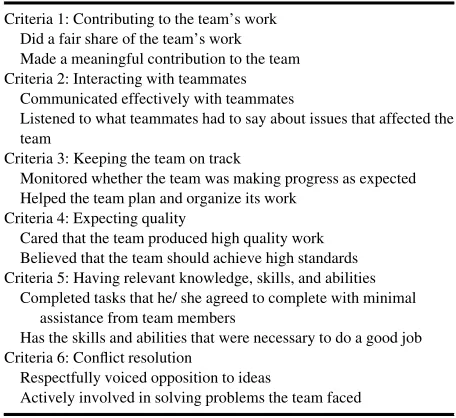
In this study, we developed and tested six criteria for evalu-ating the teamwork of a team member. These six criteria include contributing to the team’s work, interacting with teammates; keeping the team on track; expecting quality; having relevant knowledge, skills, and abilities; and resolv-ing conflicts. Five of the criteria came from Loughry et al. (2007). The sixth criteria came from Pang et al. (2011). Zhang (2012) recently tested a 16-item scale that included the dimensions of hard skills, which are also defined as task activities, and soft skills, which are defined as social activi-ties. Three of our criteria are defined as hard skills, and three criteria are defined as soft skills. Criteria 1, 3, and 5 correspond with hard skills, whereas, criteria 2, 4, and 6 correspond with soft skills. Criteria and related measures are listed in Table 1.
The first dimension, contributing to the team’s work, consists of two measures: Did a fair share of the team’s work and made meaningful contribution to the team? These two measurements deal with teamwork workload sharing and participation. Participation is presumed to enhance group effectiveness by increasing members’ sense of respo-nsibility and ownership of the work. Workload sharing is when team members perceive workload is on a fairly shared basis. There is a link between individual performance and group outcomes (Campion, Medsker, & Higgs, 1993).
The second dimension, interacting with teammates, includes two measures: communicated effectively with teammates and listened to what teammates had to say about the issues that affected the team. These two measurements
TABLE 1 Team Member Criteria
Criteria 1: Contributing to the team’s work Did a fair share of the team’s work Made a meaningful contribution to the team Criteria 2: Interacting with teammates
Communicated effectively with teammates
Listened to what teammates had to say about issues that affected the team
Criteria 3: Keeping the team on track
Monitored whether the team was making progress as expected Helped the team plan and organize its work
Criteria 4: Expecting quality
Cared that the team produced high quality work Believed that the team should achieve high standards Criteria 5: Having relevant knowledge, skills, and abilities
Completed tasks that he/ she agreed to complete with minimal assistance from team members
Has the skills and abilities that were necessary to do a good job Criteria 6: Conflict resolution
Respectfully voiced opposition to ideas
Actively involved in solving problems the team faced
286 T. N. CRUTCHFIELD AND K. KLAMON
are important to effective teamwork because they evaluate team cooperation and communication. Good communica-tion exists when informacommunica-tion is shared frequently, members understand each other more, and information flows more freely (Pang et al., 2011). Campion et al. (1993) stated that communication and cooperation are important to team effectiveness and team satisfaction.
The third dimension used to evaluate team member effectiveness is keeping the team on track. This dimension has two measures: monitored whether the team was making progress as expected and helped the team plan and organize its work. Helping to plan and organize work is a construct that is supported by goal setting. Goal setting is a key blue-print for the team to follow and works to keep a team on track (Guzzo & Dickson, 1996.)
Expecting quality is the fourth dimension used in evalu-ating team effectiveness. Expecting quality is composed of two measures used within our study: cared that the team produced high-quality work and believed that the team should achieve high standards. Motivation and potency are two underlining factors that contribute to expecting quality. Motivation is the collective concept of group potency and the belief the group can be effective (Guzzo & Dickson, 1996). Potency is the belief by a group that it can be effec-tive. Teams with potency are more committed and willing to work hard for the group (Campion et al., 1993).
The fifth dimension is having relevant knowledge, skills, and abilities. The two measures used in our peer evaluation included: completed tasks with minimal assistance from team members and has the skills and abilities that were nec-essary to do a good job. The main component that supports this dimension is task interdependence. Task interdepen-dence is the action that group members interact and depend on one another to accomplish the work (Campion et al., 1993).
The sixth and final dimension is conflict resolution. The measures used in conflict resolution included: respectfully voiced opposition to ideas and actively involved in solving problems the team faced. Conflict resolution is a fundamen-tal component of team member effectiveness. According to Lovelace, Shapiro, and Weingart (2001), the more fre-quently collaborative communication occurs amongst team members, the more willing they are to express task-related doubts, the more innovating they can be and the more effi-cient they become. Conflict resolution is a two-step process. The first step involves acknowledging a problem or voicing opposition to team decisions. The second step is actively being involved in the problem solving process.
Outcomes
Team outcomes are the most important determinant of an effective team process (Fleming & Monda-Amaya, 2001). According to Safran and Safran (1996), more emphasis should be given to these critical outcomes of
team effectiveness. Each team member’s outcome ass-essment of his or her teammates reflects personal satis-faction of the teammate and preference for the teammate in future teamwork experiences. Fleming and Monda-Amaya found that satisfaction with a teammate is a reflection of the success of the team in the project, whereas preference for the teammate in future teamwork experiences is a product of the fit between the two team members in the one-on-one interaction.
In this study, we employ five outcomes measures to reflect satisfaction with a team member, preference for a teammate in future experiences, and team member grade assessment. These five measures are listed in Table 2.
METHOD
Participants
The sample included traditional undergraduate students over a span of three years from a senior level marketing management course, an upper level organizational behavior course, and a senior level technical communication course (n D 800). Each student who completed the survey participated in expanded group work as primary learning component in the course. In the senior level marketing management course, students were assessed at two points in time as this was a year-long project. In the other two courses, students were assessed at the end of the project. Other than team training and preparation over the course of the undergraduate curriculum, no additional team training occurred before project execution.
Structure
Each item is measured on a 7-point Likert-type scale with responses ranging from 1 (strongly disagree) to 7 (strongly agree). We tested the six-factor model using principal com-ponents analysis with a varimax rotation. To assess the rela-tive impact of each of the twelve individual variables on the five teamwork outcomes, we use ordinary least squares regression. Instead of creating higher-order constructs, we chose to allow each measure to individually regress on the
TABLE 2 Outcome Criteria
Outcome 1: I would like to be on team with him/her again
Outcome 2: If I was choosing my team, he/she would be one of the first people I would choose
Outcome 3: I was satisfied with his/her contribution to the team Outcome 4: I was overall satisfied with his/her performance as a team
member
Outcome 5: Grade this person’s teamwork from 1 to 100 with 100 being an amazing team member and 0 being Is that his/her name?
DIMENSIONS AND OUTCOMES OF AN EFFECTIVE TEAMMATE 287
TABLE 3 Regression Results
Would like to be on team again First to choose for team Satisfied with contribution Overall satisfied with performance Grade
Item
Standard
coefficient t-value Sign
Standard
coefficient t-value Sign
Standard
coefficient t-value Sign
Standard
coefficient t-value Sign
Standard
coefficient t-value Sign
Constant ¡4.623 .000 ¡5.758 .000 ¡2.537 .011 ¡2.885 .004 48.902 .000
Fair share of work .107 2.538 .011 .062 1.361 .174 .216 5.681 .000 .203 5.253 .000 .280 5.390 .000 Meaningful contribution .091 2.037 .042 .045 .943 .346 .177 4.399 .000 .145 3.569 .000 .157 2.874 .004 Communicated effectively .188 5.308 .000 .179 4.706 .000 .119 3.748 .000 .113 3.487 .001 .137 3.138 .002 Listened to what the team had to say .102 2.685 .007 .037 .907 .365 ¡.023 ¡.685 .494 .100 2.885 .004 .046 .985 .325 Monitored making progress .022 .573 .567 .070 1.723 .085 ¡.001 ¡.034 .973 .033 .959 .338 .074 4.586 .113 Helped plan and organize .023 .588 .557 .086 2.019 .044 .018 .495 .621 ¡.007 ¡.199 .842 ¡.004 ¡.091 .928 Cared about high quality work .125 2.776 .006 .141 2.922 .004 .129 3.206 .001 .097 2.361 .018 .190 3.408 .001 Believed in achieving high standards ¡.026 ¡.281 .561 ¡.051 ¡1.072 .284 ¡.012 ¡.312 .755 .024 .601 .548 ¡.233 ¡4.317 .000 Completed tasks with minimal assistance .054 1.667 .096 .098 2.784 .006 .165 5.624 .000 .114 3.808 .000 .155 3.876 .000 Had skills and abilities ¡.002 ¡.074 .941 ¡.027 ¡.783 .434 .006 .195 .845 .075 2.563 .011 .090 2.178 .030 Respectfully voiced opposition .075 2.094 .037 .056 1.456 .146 .091 2.828 .005 .028 .860 .390 ¡.114 ¡2.564 .011
Actively involved .223 6.079 .000 .250 6.349 .000 .127 3.862 .000 .097 2.904 .004 .073 1.599 .110
288
T.
N.
CRUTCHFI
ELD
AND
K.
KLAMO
N
outcomes as to determine the value of that measure in deter-mining the outcomes.
Reliability Analysis
Cronbach’s alpha score for the scale was .964, which indi-cates a very high internal consistency in the 12-item scale. A factor analysis was also conducted to test reliability of the latent constructs. The measures for five of the six factors clustered together as expected. However, the measures that reflect keeping the team on track clustered with the factors contributing to the team’s work and interacting with the team. The variables reflecting this factor seem to be lower level factors that precede an assessment of team member contribution and interaction.
Regression Analysis
Variance explained in each of the five models was high with the highest R2 being .769 for satisfaction with the team member’s contribution and the lowestR2being .593 for the team member’s grade. See Table 3
The model “Like to be on a team with this person again” exhibited anR2of .716 with seven of the 12 variables sig-nificantly impacting the outcome. Both of the contribution, interaction, and conflict resolution variables reflecting each construct exhibited a significant influence on this outcome and one of the expecting quality variables, cared that the team produced high quality work, impacted the outcome “like to be on a team with this person again” at thep.05 level. Neither keeping the team on track variables or skills and abilities variables significantly impacted this outcome.
The model “Would be one of the first people I choose” exhibited anR2of .673 with five of the 12 variables signifi-cantly impacting the outcome. In none of the dimensions did both of the variables impact the outcome. Neither contribution variable had a significant influence. One of the interaction variables, communicated effectively with team-mates, one of the keeping the team on track variables, Helped the team to plan and organize its work, one of the skills and abilities variables, completed tasks with minimal assistance from team members, and one of the conflict reso-lution variables, actively involved in solving the problems that the team faced, impacted the outcome “Would be one of the first people I choose” at thep.05 level.
The model “Was satisfied with this person’s contribution to the team” exhibited anR2of .769 with seven of the 12 variables significantly impacting the outcome. Both of the contribution and conflict resolution variables reflecting each construct exhibited a significant influence on this out-come. Neither keeping the team on track variables had a significant influence. One of the interaction variables, com-municated effectively with teammates, one of the expecting quality variables, cared that the team produced high quality work, and one of the skills and abilities variables,
completed tasks with minimal assistance from team mem-bers impacted the outcome “Was satisfied with this per-son’s contribution to the team” at thep.05 level.
The model “Was overall satisfied with this person’s per-formance as a team member” exhibited an R2 of .763 with eight of the 12 variables significantly impacting the outcome. The contribution, interaction, and skills and abili-ties variables reflecting each construct exhibited a signifi-cant influence on this outcome. Neither keeping the team on track variables had a significant influence. One of the expecting quality variables, cared that the team produced high quality work, and one of the conflict resolution varia-bles, actively involved in solving the problems that the team faced, impacted the outcome Was overall satisfied with this person’s performance as a team member at the p.05 level.
The model “Grade this team member from 1 to 100” exhibited anR2of .593 with nine of the 12 variables signifi-cantly impacting the outcome. Both of the contribution, expecting quality, and skills and abilities variables reflect-ing each construct exhibited a significant influence on this outcome. Neither keeping the team on track variables had a significant influence. One of the interaction variables, communicated effectively with teammates, and one of the conflict resolution variables, respectfully voiced opposition to ideas impacted the outcome Grade this team member from 1 to 100 at thep.05 level.
The variable communicated effectively with teammates had a significant impact on all five outcomes at the p .002 level, and the variable cared that the team pro-duced high quality work impacted all five outcomes at the p.018 level. Several variables impacted four of the five outcomes: did a fair share of the team’s work, made a meaningful contribution to the team, completed tasks with minimal assistance from other team members, and actively involved in solving the problems that the team faced. One variable, respectfully voiced opposition to ideas, impacted three outcomes. Two variables impacted two outcomes: Listened to what team members had to say about issues that affected the team and had skills and abilities that were necessary to do a good job. Two variables impacted only one outcome: helped the team to plan and organize its work, and believed that the team should achieve high stand-ards. One variable, monitored whether or not the team was making progress as expected, failed to have a significant influence on any outcome at thep.05 level.
DISCUSSION
The first two outcomes studied addressed the student’s pref-erence for the teammate in future teamwork experiences. We confirm the proposition of Fleming and Monda-Amaya (2001) that one-on-one interaction does drive future prefer-ence. The interpersonal constructs of contribution,
DIMENSIONS AND OUTCOMES OF AN EFFECTIVE TEAMMATE 289
interaction, and conflict resolution variables were all signif-icantly driving whether a student would want to be on a team again with this particular teammate.
For the first to choose outcome, the significant grouping consists of leadership associated variables. This was the only outcome that was affected by the variable Helped the team to plan and organize its work. The person whom others want to choose first tends to be reliable, pursues excellence, and is engaged. This person is more than a good team member, he or she stands out as a mature leader.
An assessment of the two satisfaction outcomes reveals a slight difference in the contribution vs. performance assess-ment. In addition to being a contributing, engaged member who moved the team forward, the person with whom there is a satisfaction with his or her contribution is respectful of others. In other words, he or she has a good attitude toward others. However, a student’s satisfaction with a team mem-ber’s performance is more likely to be influenced by the teammate’s skills in addition to his or her contribution to the team.
The construct “Contributing to the team’s work” has a significant impact on every outcome except first to choose. The construct “Interacting with teammates” was mixed with communicating effectively significantly regressing on all outcomes and listening having a less significant impact. Keeping the team on track was not substantially helpful in explaining the five outcomes. Expecting quality was driven by the variable cared that the team produced high quality work. Having relevant knowledge, skills, and abilities was driven by the teammate’s behavior in independently com-pleting tasks. Conflict resolution impacted many of the outcomes.
CONCLUSION
In this research, we have developed and tested six criteria that are exhibited and controlled by a teammate during a teaming experience. Five of the six constructs served the regression models well in explaining key outcome peer assessments in the teamwork experience. Given that one of the six dimensions did not hold together in factor analy-sis and the same one dimension, keeping the team on track, did not substantially benefit the regression models, we recommend removing that dimension from future peer assessments and moving forward with a five factor assessment.
This is the first work that we know of to delve into the impact that peer assessment of individual components of teamwork have on the outcome assessment of the team-mate. This knowledge should help team supervisors in the classroom and on the job educate the team on what it takes to be a good teammate. It should also provide the supervi-sor-instructor with valid measures to assess teamwork and
to reward and purge team members relative to their individ-ual contribution to the team.
For the teammate, it should present a more concise set of objectives in teaming in which to focus one’s efforts. As a result of the research, we would recommend to be assessed highly by their peers that team members should focus on contributing to the team’s work, communicating effectively with teammates, caring that the team produced high quality work, pulling his or her own weight, and being actively involved in solving problems that face the team.
Since this is the first work of its kind, we would like to see this instrument replicated with on-the-job teams and tested in other teaming experiences. Further investigating other dimensions of effective teamwork would also prove beneficial. We would also like to study the impact that teaming training and education will have on overall peer assessment means in future teaming experiences. We would also like to learn if there are conditions that moderate the strength of one dimension over another one and how the higher-order latent constructs perform in a structural equa-tions model. We intend to continue to implement this assessment tool in different contexts and learn more about its usefulness in different contexts.
REFERENCES
Abelson, M. A., & Woodman, R. W. (1983). Review of research on team effectiveness. Implications for teams in schools,School Psychology Review,12, 125–136.
Arien, N. J. (2001). Working together. San Francisco, CA: Bernett-Koehler.
Campion, M. A., Medsker, G. J., & Higgs, A. C. (1993). Relations between work group characteristics and effectiveness: Implications for designing effective work groups.Personal Psychology,46, 823–847.
Fleming, J. L., & Mond-Amaya, L. E. (2001). Process variables critical for team effectiveness: A Delphi study of wraparound team members.
Remedial and Special Education,22, 158–171.
Guzzo, R. A., & Dickson, M. W. (1996). Teams in organizations: Recent research on performance and effectiveness.Annual Review of Psychol-ogy,47, 307–338.
Johnson, T., Top, E., & Yukselturk, E. (2011). Team shared mental model as a contributing factor to team performance and students’ course satisfaction in blended courses.Computers in Human Behav-ior,27, 2330–2338.
Katzenbach, J. R., & Smith, D. K. (1993).The wisdom of teams. Boston, MA: Harper Business.
Larson, C E., & LaFasto, F M J (1989).Teamwork: What must go right/ what can go wrong. Newbury Park, CA: Sage.
Loughry, M. L., Ohland, M. L., & Moore, D. D. (2007). Development of a theory-based assessment of tem member effectiveness.Educational and Psychological Measurement,67, 505–524.
Lovelace, K., Shapiro, D. L., & Weingart, L. R. (2001). Maximizing cross-functional new product teams’ innovativeness and constraints adher-ence: A conflict communication perspective,Academy of Management Journal,44, 779–793.
Marin-Garcia, J. A., & Lloret, J. (2008). Improving teamwork with univer-sity engineering students. The effect of an assessment method to prevent shirking.WSEAS Transactions on Advances in Engineering Education,
5, 1–11.
290 T. N. CRUTCHFIELD AND K. KLAMON
Pang, E., Tong, C., & Wong, A. (2011). Key determinants of student satis-faction when undertaking group work.American Journal of Business Education,4, 93–104.
Safran, S., & Safran, J. S. (1996). Intervention assistance programs and preferred teams: Directions for the twenty-first century.Remedial and Special Education,17, 370–377.
Strom, P. S., & Strom, R. D. (2011). Teamwork skills assessment for coop-erative learning.Educational Research and Evaluation,17, 233–251.
Winter, J. K., Waner, K. K., & Mansfield, J. C. (2008). Team climate and productivity for similar majors vs. mixed majors.Journal of Education for Business,84, 265–269.
Wolfe, A. (2008, April).Student attitudes toward team projects. Paper pre-sented at the Midwest Business Administration Association (MBAA) International Spring Conference, Chicago, Illinois.
Zhang, A. (2012). Peer assessment of soft skills and hard skills.Journal of Information Technology Education: Research,11, 156–168.
DIMENSIONS AND OUTCOMES OF AN EFFECTIVE TEAMMATE 291