Chapter 7.
Ionic Polymerization
7.2. Cationic Polymerization
1) Protonic acids: H2SO4, H3PO4
7.2.1. Cationic Initiators
E + CH2=CR2 → ECH2CR+ 2
carbocation
+
electrophile
2) Lewis acids: AlCl3, BF3, TiCl4, SnCl4
+
Proton donor or cation source: H2O, alkyl chloride (Initiator)
(Coinitiator)
BF3 + H2O HOBF3- H+
3) Autoinitiation
2 AlBr3 AlBr4- AlBr 2+
cation source
are the same
Lewis acid and
4) Ionizable compounds
(C6H5)3C-Cl (C6H5)3C+ + Cl- Stable carbocation
Cl Cl
-+ +
∴
Only useful withvery reactive monomers
such as vinyl ethers
Tropylium chloride
5) I2
CH2 CR2 ICH2CIR2
ICH CR2 HI
I2 +
+
+ -ICH2CR2 I
Ion-pair formation
6) M + A → M•+ + A•
-N
CH CH2
RNO2 N
CH CH2
RNO2
+ +
-+
Electron transfer process
Electron donor
Electron
7.2.2. Mechanism, Kinetics, and Reactivity in Cationic Polymerization
o Markovnikov’s rule
The more stable carbocation intermediate is formed. Addition of electrophile to monomer
When an unsymmetrical alkene undergoes addition with E-Nu, then the electrophile, E, adds to the carbon of the alkene
that has the greater number of hydrogen substituents, and the nucleophile, Nu, to the carbon of the alkene with the fewer number of hydrogen substituents"
major
2o carbocation
More stable
(CH3)2C=CH2 > CH3CH=CH2 > CH2=CH2 o Rate of addition to aliphatic monomers
O X X
Only isobutylene provides the requisite carbocation stability
for cationic polymerization
CH2 CH
X
Reactivity (para-substituted)
X: OCH3 > CH3 > H > Cl
Electron-donating Electron-withdrawing
Ortho substituents retard the addition
∵ Steric hindrance
Vinyl ether: particularly reactive
CH2 CH OR R' CH2 CH OR CH2 C
H
OR R'
R' ++ + +
o Propagation
Two steps
CR2
CH2 CR2
CH2
CH2CR2 +
+
slow
+
fast +
Covalent bond
formation
π-complex
Rate-determining
o Solvent effect
As solvent polarity↑, Ri↑
∵ Ri : charged species is generated
Degree of association between cationic chain end and anion (A-)
A + A- + A- + +
A-covalent intimate ion pair
= contact ion pair
solvent-separated ion pair
solvated ions = free ions
The more intimate the association, the lower the Rp.
Small Rp Large R
p
In poorly solvating solvents
∵ more separation
As solvent polarity↑, Rp↑
In solvating solvents (ether solvent)
As solvent polarity↑, Rp↓ ∵ less π-complex formation
+
+ CH2 CR2
slow CR
2
CH2 +
Polar solvent stabilizes the initial state
Charge is dispersed
over a larger volume
+
O
O
o Chain transfer reactions M = styrene, I = H2SO4 1) With monomer
HSO4 + CH2 CH
CH
CH2 + - CH CH + CH3 CH HSO4
+
-2) By ring alkylation Electrophilic substitution
HSO4 + CH2 CH
CH
CH2
-HSO4
+ CH3 CH
+
-CH
CH2 +
CH
CH2 CH
3) By hydride abstraction from the chain to form a more stable ion
HSO4 + CH
CH2 + - CH2 CH CH2
HSO4
+ CH2 CH2
-C
CH2 + CH2
Chain branching
4) With solvent by electrophilic substitution
+ CH2 CH
HSO4 + CH3 CH
+
-HSO4 + CH
CH2 +
o Termination reactions
Combination of chain end with counterion
(i.e., change from ionic to covalent bonding)
CH
CH2 + O C O
CF3
-C
CH2 O C O
CF3
C CH2
CH3 + CH3
HOBCl3- CH2 C CH3
+ CH3
o Chain transfer to monomer is so common
Proton trap intercepts proton before it transfers to monomer.
Lower overall yield, higher mol. wt., lower polydispersity index
CR2 CH2 + +
N
CR2
CH +
+ N H
Proton trap
o Telechelic polymers
Inifer: initiator + chain transfer agent
Cocatalyst C CH3 CH3 Cl C CH3 CH3
Cl BCl3 C
CH3
CH3 C
CH3
CH3
Cl BCl4
+ + -C CH3 CH3 C CH3 CH3
Cl + + CH2 C
CH3 CH3 C CH3 CH3 C CH3 CH3
Cl CH2 C+
CH3
CH3
initiator
+ CH2 C
CH3 CH3 C CH3 CH3 Cl C CH3 CH3 Cl
+ CH2 C +
CH3 CH3 C CH3 CH3 Cl C CH3 CH3 Cl + C CH3 CH3 C CH3 CH3
CH2 C CH3 CH3 Cl CH2 C CH3 CH3 Cl
readily convertible to
other functionalities
o Pseudocationic polymerization
I = HClO4, M = styrene, S = hydrocarbon solvent
Rp much slower compared with most cationic processes.
CH2 CH OClO3 + CH2 CH CH2 CH CH2 CH OClO3
Covalently bonded
perchlorate ester
Monomer is inserted
o Living cationic polymerization
M = isobutylene, I = tertiary ester + BCl3
CH2 C(CH3)2 R3C O C
O
CH3 BCl3
O C
O
CH3 R3C CH2 C CH2 C
CH3
CH3
CH3
CH3
R3C O C
O
CH3 BCl3
BCl3
+ +
-δ+ δ
-Very tightly bound
M = vinyl ether, I = I2/HI or I2/ZnI2
CH2 CH
I OR
CH2 CH
OR
ZnI2
CH2 CH
I OR
CH2 CH
OR
ZnI2
Insertion of monomer into an activated C-I bond
Low polydispersity,
Kinetics
Ri = ki [I] [M] Rp = kp [M+] [M]
Rt = kt [M+]
Rtr = ktr [M+] [M]
Steady-state assumption Ri = Rt
ki [I] [M] = kt [M+] or
[ ]
[ ][ ]
t i
k M I k M+ =
∴
[ ][ ]
t
2 i
p p
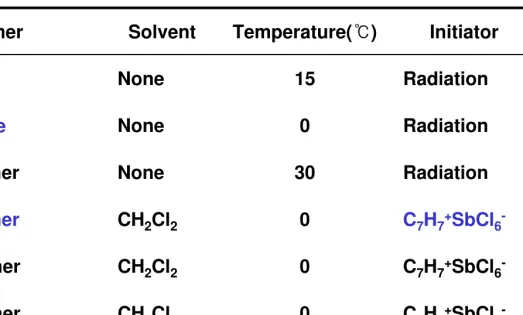
Table 7.2 Cationic Propagation Rate Constants, kp
Monomer Solvent Temperature(℃) Initiator kP(L/mol s)
Styrene None 15 Radiation 3.5 X 10⁶
α-Methylstyrene None 0 Radiation 4 X 10⁶
i-Butyl vinyl ether None 30 Radiation 3 X 10⁵
i-Butyl vinyl ether CH
2Cl2 0 C7H7+SbCl6- 5 X 10³
t-Butyl vinyl ether CH
2Cl2 0 C7H7+SbCl6- 3.5 X 10³
Methyl vinyl ether CH2Cl2 0 C7H7+SbCl
6- 1.4 X 10²
2-Chloroethyl vinyl ether CH2Cl2 0 C7H7+SbCl
In the absence of any chain transfer
[ ]
[ ]
[ ]
[ ]
tp t p t p k M k M k M M k R R
DP = = =
=
ν +
+
If transfer is the predominant mechanism controlling chain growth
[ ]
[ ]
[ ]
[ ]
trptr p tr p
k
k
M
M
k
M
M
k
R
R
DP
=
=
=
=
ν
++
Cationic Free radical
[ ] [ ]
2 pI
,
M
R
∝
R
[ ] [ ]
I
21,
M
p
∝
[ ] [ ]
I
2,
M
1 −
∝
ν
[ ]
M
,
independen
t
of
[I]
∝
ν
The difference arises from radical disproportionation and
combination reactions chacteristic of free radical termination.
o Diene monomers
Cationic polymerization only for copolymer synthesis
o Nonconjugated dienes
Cationic cyclopolymerization
Ph Ph
R
Ph Ph
Ph Ph
R
Ph Ph
R
Ph Ph
Ph Ph
R +
+ +
7.2.3 Stereochemistry of Cationic Polymerization
(1) Greater stereogularity at lower temperature
(2) Degree of stereoregularity varies with initiator
(3) Degree and type of stereoregularity (isotactic or syndiotactic) vary with solvent polarity
counterion
Ex CH2 CH
O t-Bu
Isotactic in nonpolar solvents
Syndiotactic in polar solvents
In nonpolar solvents : strong association
between carbocation chain end and counterion
In polar solvents : both carbocation chain end and counterion are strongly solvated ∴ free carbocation
Syndiotactic placement
Isotactic poly(vinyl ether)
Several models have been proposed
1) Six-membered cyclic chain end
Formed by coordination of the carbocation of the terminal carbon with the oxygen of the alkoxy group attached to the fifth carbon atom
C
CH2 C
CH2
C
RO H RO H RO H
CH2 X X C O C CH2 C CH2 H CH2 R OR H OR H + -+ -C O C CH2 C CH2 H CH2 R OR H OR H X
CH2 CHOR
C
CH2 C
CH2
C
RO H RO H RO H
CH2 CH2CH
OR X +
-+
-Attack of monomer atC1 from the backside causing inversion.
equatorial
axial
equatorial
bulkiest
2) Strong carbocation chain end - counterion association
Insert monomer: alkoxy groups are anti to one another
CH2 C
CH2
C
RO H RO H
X
CH2 CHOR
CH2 C
CH2
C
RO H RO H
C C H H H RO X CH2 C CH2 C
RO H RO H
CH2 C
CH2
C
RO H RO H
C CH2 RO H C C H H H RO X X + - + -+ -+
-As long as propagation proceeds faster than rotation about carbon-carbon bonds in the chain, a regular repeating
3) sp2 hybridization of the terminal chain carbon atom
CH2 C
CH2
C
R R' R' R
X
+ - + C C
H H R R' C CH2 C CH2 C
R' R R R'
X + -CH2 R R' Front Back C CH2 C
CH2 C
R' R R R' X + -CH2 R R' C CH2 C CH2 C
R R' R R'
X + -CH2 R R' syndiotactic isotactic
In polar solvent
In nonpolar solvent front
Poly(α-methylstyrene)
Due to two bulky groups on the 3rd carbon, back-side attack is hindered.
∴ Syndiotactic placement is favored in both polar and nonpolar solvents.
Although isotacticity↑ as solvent polarity↓
Being less hindered, exhibit a more pronounced
preference for isotactic placement in nonpolar solvents
Poly(vinyl ether)
As T↑, electroregularity ↓
Can be interpreted in terms of small difference in activation energy
for front- and back-side attack as well as of the effect on
conformational mobility of the growing chain.
Counterion-monomer interactions are assumed to be negligible, since both may be considered “electron rich”
7.2.4 Cationic Copolymerization
Table 7.3 Reactivity ratios
Reactivity ratios vary with initiator type and solvent polarity.
Counterion effect
No apparent tendency for alternating copolymers to form.
Table 7.3 Cationic Reactivity ratios
Monomer 1 Monomer 2 Coinitiator solvent
Temperature
(℃) r1 r2
Isobutylene 1,3 Butadiene 1,3-Butadiene Isoprene Cyclopentadiene Styrene Styrene α-Methylstyrene AlEtCl2 AlCl3 AlCl3 BF3·OEt2 SnCl4 AlCl3 TiCl4
CH3Cl CH3Cl CH3Cl PhCH3 EtCl CH3Cl PhCH3 -100 -103 -103 -78 0 -92 -78 43 115 2.5 0.60 1.60 9.02 1.2 0 0 0.4 4.5 0.17 1.99 5.5 Styrene α-Methylstyrene
p-Methylstyrene
trans-β -Methyl-styrene SnCl4 SnCl4 SnCl4 EtCl CCl4 CH2Cl2
0 -78 0 0.05 0.33 1.80 2.90 1.74 0.10
P-Chlorostyrene cis-β -Methyl-styrene
trans-β
-Methyl-styrene
SnCl4
SnCl4
CCl4/PhNO2(1:1)
CCl4/PhNO2(1:1)
0 0 1.0 0.74 0.32 0.32
Ethyl vinyl ether i-Butyl vinyl ether BF3 CH2Cl2 -78 1.30 0.92
2-Chloroethyl vinyl ether
7.2.5 Isomerization
CH2 CH CH
CH3
CH3
X+
CH2 CH CH
CH3
CH3
X +
H - shift
CH2 CH2 C
CH3
CH3
X +
Monomer
CH2 CH2 C
CH3
CH3
1,3-addition polymer
More stable tert-carbocation
R+
R
+
R
+
terpene
rearrangement
Relieves strain in the bicyclic system
7.3 Anionic Polymerization
7.3.1 Anionic Initiators
Initiation: nucleophilic addition to monomer
CH
2CH
Nu- +
CH
2CH
-Nu
R
R
R: -NO2, -CN, -COOH, -CH=CH2,
o Initiators
Weak base initiator
For monomer with strong e- withdrawing group
Strong base initiator
For monomer with phenyl or weak e- withdrawing group
CH2 C
NO2 CH3
KHCO3
CH2 C
NO2 CH3
CH2 C
CN CN
H2O
CH2 C
CN CN
CH2 C
COOR CN
H2O
CH2 C
COOR CN
Super glue
1. Initiators that react by addition of a negative ion
I
-
+
M
IM
-Organometallic compounds of the alkali metals : e.g. butyllithium
Organolithium compounds: low melting and soluble in inert organic solvents
2. Initiation by electron transfer
1) Free alkali metals
In liquid ammonia, ether solvents
D + M D+ + M
-Electron transfer
Metal Electron
donor
Monomer
Addition complexes of alkali metals and naphthalene or stilbene
Na + - Na+
CH CH
Ph Ph
Na + Ph CH CH Ph Na
-+
D- + M D + M
-Na Ph C Ph
O
Ph C Ph
O
Na
+ - +
Ph C Ph O
Na C C
ONa ONa
Ph
Ph Ph
Ph - +
2
Reaction with monomer
D
•
7.3.2 Mechanism, Kinetics, and Reactivity
In polar solvents, free solvated ions addition of anion to monomer
Li compounds Covalent carbon-metal bonds
Higher alkali metals More ionic bonds
CH2 CH
Nu- + CH2 CH
-Nu
R R
π-complex formation
In nonpolar solvents, close association between ions
CH2 CH
R' +
R Li R Li
CHR'
CH2
CH2 CH
R'
R Li
π-complex formation Initiation by e- transfer
CH2 CH
R +
Na CH2 CH
R
- Na+
CH2 CH
R
- Na+
2 CH
R
CH2 CH2 CH
R
-
Potassium amide-initiated polymerization in liquid ammonia
KNH2 K+ + NH2
-- + M H2N M -NH2
[
NH]
[ ]
M kRi = i 2−
slow
Chain termination: transfer to solvent
H2N M M
-n + NH3
-NH2 H2N M M
n H +
[ ]
M[ ]
M kRp = p −
[ ]
[
3]
tr
tr k M NH
R = −
Steady-state assumption Ri = Rtr
[
2]
[ ]
tr[ ]
[
3]
i NH M k M NH
k − = −
[ ]
[
[
]
[ ]
]
3 tr 2 i NH k M NH k M − − =
[ ]
[ ]
[
3]
tr 2 2 i p p NH k M NH k k R − =
[ ]
[ ]
[
[ ]
]
[
[ ]
]
3 tr p 3 -tr p tr p NH k M k NH M k M M k R R = = = ν − Propagation + MH2N M M
-n H2N M
o Chain transfer to monomer
Initiation by the resultant vinyl anion
Unsaturated end groups
CH2 CH
CN
CH2 CH
CN
CH2 CH2
CN
CH2 C
CN
- + +
-CH2 C
CN
-CH2 CH
CN
+ CH2 C
CN
-CH2 CH
CN
o Termination mechanism in MMA polymerization
Backbiting nucleophilic displacement of methoxide
by the enolate anion chain end to form a cyclohexanone ring.
CH2 C
C CH3
CH2 C
CH3 C O OCH3 CH2 C
H3C
C
O OCH3
OCH3 O CH2 C C CH3 CH2 C CH3 C O OCH3 CH2 C CH3 C
O
OCH3 O
o Living anionic polymerization
[ ]
[ ] [ ]
M I k dt M d o p = −[ ]
[ ]
M k[ ]
I dt M d o p − =[ ]
[ ]
M k[ ]
I dt Mln p o
o
−
=
[ ] [ ]
k [ ]I dto
o p
e
M
M
=
−where [I]o = initial concentration of initiator
e.g., M = styrene, I = naphthalenesodium, T = -78oC
Ri >> Rp
No termination or chain transfer reactions
[ ]
[ ]
I oo M= ν
[ ] [ ]
[ ]
o oI
M
M −
=
ν M completely consumed
For simple anionic initiator (e.g., BuLi)
DP
=
ν
ν
=
2
DP
For electron-transfer initiators
Table 7.4 kp for polystyrene
In poorly solvating hydrocarbon solvents
CH2 CH
R
2 Li CH2 C
R
Li
H2C C
R Li
association Rp↓
Larger alkali metal cations Weaker coordination than Li+
Rp↑
In a more polar solvating medium (e.g., ether)
Li+ the most strongly solvated of the alkali metal cations
Table 7.4 kp for polystyrene
Counterion Solvent k
p(L/mol s)
Na+ Tetrahydrofuran 80
Na+ 1,2-Dimethoxyethane 3600
Li+ Tetrahydrofuran 160
Li+ Benzene 10-3-10-1
Solvating power
1,2-dimethoxyethane > tetrafydrofuran > benzene > cyclohexane CH2 CH2
OCH3
OCH3 O
Reactivity of monomer
CH2 CH
CH2 CH CH CH2
resonance
CH2 CH CN
CH2 C
COOCH3 CH3
> > >
e--withdrawing
Rp↓
Methyl substitution on the α-carbon
CH2 C
COOCH3 CH3
CH2 C CN CH3
CH2 CH
COOCH3 > >
CH2 CH
CN >
∵ induction destabilization of the carbanion and steric interference
7.3.3 Stereochemistry of Anionic Polymerization
Polar solvents: favor syndiotactic placement
Nonpolar solvents: favor isotactic placement
o Six-membered cyclic chain end
C CH2 C CH3 C OCH3 O CH3 C O CH3O
Li C CH3 C CH2 C O C O CH3O
OCH3 CH3 Li + -+ -C CH3 C CH2 C O C O CH3O
OCH3 CH3
Li
CH2 C
CH3 C OCH3 O C CH2 C CH2 C CH3 C OCH3 O
C CH3 C CH3 O
CH3O CH3O O
Li +
-+
-Isotactic placement↓
Lithium Less strongly coordinating
higher alkali metal ions
o Ion pairing
Counterion-monomer
coordination isotactic
In nonpolar solvents
Counterion-solvent
coordination syndiotactic
In polar solvents
C C
CH3 C OCH3 O H H Li CH2 C CH2 CH C O OR R R C RO O O O C C CH3 C
o Diene Polymerization: isoprene, 1,3-butadiene
cis-1,4 polymerization↑ By Li-based initiators
In nonpolar solvents
e.g., Almost entirely cis-1,4 isoprene = “synthetic natural rubber”
BuLi initiator in pentane or hexane 1) s-cis conformation by π-complexation
CH2Li CH2 C CH3
CH CH2 CH2Li C
C H CH2
CH3 CH2
+
2) Cis configuration by forming a six-membered ring transition state
CH2 C H
C
CH3 CH2 Li+
- + CH
2 CH C
CH3 CH2
CH2 C H
C
CH3
CH Li
CH2
CH2 C
CH3
Cis-1,4-poly(1,3-butadiene) configuration
Somewhat lower stereospecificity
BD
∵
Favors s-trans conformation
isoprene
Favors s-cis conformation
C
C CH2 H
CH2 CH3
C
C CH2 H
CH2 CH3
C C CH2 H
CH2 H
C C CH2 H
7.3.4 Anionic copolymerization
Table 7.5 Anionic Reactivity Ratios
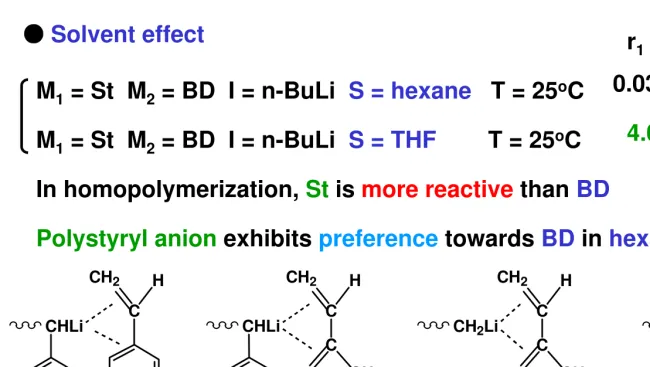
● Solvent effect r
1 r2
0.03 < 12.5
M1 = St M2 = BD I = n-BuLi S = hexane T = 25oC
M1 = St M2 = BD I = n-BuLi S = THF T = 25oC 4.0 > 0.3
In homopolymerization, St is more reactive than BD
Polystyryl anion exhibits preference towards BD in hexane
C H CH2
CH2Li C
C H CH2
CH3 CH2
CH2Li C
H CH2
CHLi C
C H CH2
CH3 CH2
CHLi
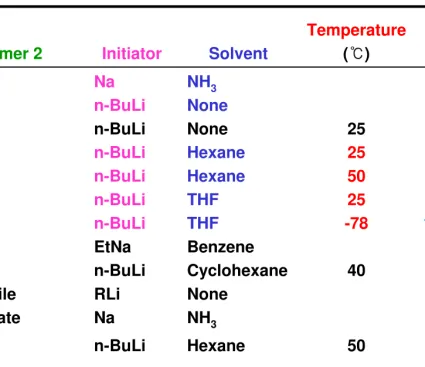
Table 7.5 Anionic Reactivity Ratios
Monomer 1 Monomer 2 Initiator Solvent
Temperature
(℃) r1 r2
Styrene MMA Butadiene Isoprene Acrylonitrile Vinyl acetate Na n-BuLi n-BuLi n-BuLi n-BuLi n-BuLi n-BuLi EtNa n-BuLi RLi Na NH3 None None Hexane Hexane THF THF Benzene Cyclohexane None NH3 25 25 50 25 -78 40 0.12 0.04 0.03 0.04 4.0 11.0 0.96 0.046 0.12 0.01 6.4 11.2 12.5 11.8 0.3 0.4 1.6 16.6 12.5 0.01 Butadiene Isoprene n-BuLi Hexane 50 3.38 0.47
● T effect
M1 = St M2 = BD I = n-BuLi S = hexane T = 25oC
T = 50oC
S = THF T = 25oC
T = - 78oC
r1
0.03
0.04 4.0
11.0
r2
12.5
11.8 0.3
0.4
Not to any appreciable extent in hexane
● Homogeneous and heterogeneous processes
r1 = 0.12 r2 = 6.4 M1 = St M2 = MMA I = Na S = NH3
M1 = St M2 = MMA I = n-BuLi S = none
No detectable styrene in polymer
r1 = 0 r2 = ∞
Homogeneous
Soluble n-BuLi only PMMA is formed
∵ MMA is more reactive than St
Heterogeneous
Insoluble metallic lithium or MeLi Block copolymer
Initial St polymerization on the initiator surface
∵
● Nucleophilic displacement of aliphatic dihalides by the dianion
Formed by electron transfer initiation
Li CH CH2CH2 CH
X X
Li Cl R Cl CH CH2CH2 CH
X X
R
● Block copolymers by living polymerization method
Polystyrene-block-poly(methyl methacrylate)
CH2 CH R
CH2 CH CH2 C
COOCH3
CH3
CH2 C
COOCH3 CH3
CH2 CH CH2 CH
X CH2 CH CH2 C
COOCH3
CH3
n
-n-1
-n
-m-1
If MMA was polymerized first, the copolymer would not form.
● St-BD-St (SBS) triblock polymer
B B
SSSSSBBBBBBBBBBSSSSS S
BB
B
BBBBBBBBBB initiator combination
-- - -
-50,000~70,000 10,000~15,000
SiCl4 Si
-4 +
● Star-block (radial) copolymer
Living block copolymer
7.4 Group Transfer Polymerization (GTP)
Living polymers at room temp or above
Transfer to carbonyl oxygen
● Initiators : -SiMe3 compound
(CH3)3SiCl CH3 C
H
CH3 C
O
OCH3
R2N Li
CH3 C CH3
C O
OCH3
Si(CH3)3 CH3 C
CH3 C
O
OCH3
CH3 C CH3
C O
OCH3 - +
-
-ester strong base anion
(CH3)3Si CH2 C
OCH3 O
(CH3)3Si CN RS Si(CH3)3 ArS Si(CH3)3
● Catalysts : Anion or Lewis acid
HF2-, CN-, N
3-, CH3SiF2- ZnX2, R2AlCl, (R2Al)2O
TABLE 7.6 Compounds used in Group Transfer Polymerization
monomers initiators catalysts solvent
CH2=CHCO2R
Me
OMe Me2C=C
OSiMe3
Anionic
HF2 -CN -N3
-Me3SiF2
Acetonitrile
1,2-Dichloroethane Dichloromethane
N,N-Dimethylacetamide N,N-Dimethylacetamide
CH2=CCO2R Me3SiCH2CO2Me Lewis acid
ZnX2
Ethyl acetate
Propylene carbonate
CH2=CHCONR2 Me3SiCN R2AlCl (R2Al)2O
Terahydrofuran Toluene
CH2=CHCN
Me
RSSiMe3
CH2=CCN
O
ArSSiMe3
CH3 C CH3 C O OCH3
Si(CH3)3
initiator
● GTP HF
2 -MMA
catalyst
+ CH2 C CH3
C O
OCH3
HF2
-CH3
C C
O
OCH3
Si(CH3)3 CH2
C CH3 C
O CH3O
CH3
CH3 C
CH3 C
CH3O
O (CH3)3Si
CH2 C CH3 C O OCH3 CH3 C C O OCH3
Si(CH3)3 CH2
C CH3 C
O CH3O
CH3
CH2 C CH3
● Difunctional initiator
Chain propagates from each end
● Block copolymer
● Termination
Removal of catalyst, protonation, alkylation
protonation
alkylation
CH3O-H
+ CH3O-Si(CH3)3
● Mechanism 1
8-membered ring transition state
Hypervalent silicon
CH3 C CH3
C
OCH3
O Si(CH3)3 MMA
Nu- CH3
C CH3
C
OCH3
O Si(CH3)3
CH2 C CH3
C O
OCH3
-Nu
CH3 C CH3
C
OCH3
O
Si(CH3)3 CH2
C CH3
C O
OCH3
-Nu
-Propagating chain is completely covalent
Hypervalent silicon intermediate is formed by activation with
the nucleophilic catalyst (Nu-)
Where Lewis acid catalysts are used
CH3 C CH3
C
OCH3
O Si(CH3)3 MMA
Nu- CH3
C CH3
C
OCH3
O Si(CH3)3
CH2 C CH3
C O
OCH3 CH3
C CH3
C
OCH3
O
Si(CH3)3 CH2
C CH3
C O
OCH3 LA
-LA
Catalyst coordinates the carbonyl oxygen of monomer
rendering the monomer more susceptible to
● Mechanism 2
Propagating species: enolate anions
As in conventional anionic polymerization of acrylate monomers
Si(CH3)3 CH2
C CH3
C O OCH3
- +
GTP and conventional anionic polymerizations are remarkably similar
in terms of polymer tacticity and reactivity ratios in copolymerization.
GTP of MMA exhibits the same backbiting chain terminating reaction.
Silyl group undergoes intermolecular exchange, which is
Si(CH3)3 CH2
C CH3
C O OCH3
CH2 C
CH3 C
O CH3O
-+
Si(CH3)3 CH2
C CH3
C O OCH3
CH2 C
CH3 C
O CH3O
silyl ketene acetal Enolate anion
Enolate anion and silyl ketene acetal chain ends are in rapid equilibrium with a hypervalent silicon complex
The silicon complex provides
Low eqm conc of enolate anions for propagation
Cf.
o Termination mechanism in MMA polymerization
Backbiting nucleophilic displacement of methoxide
by the enolate anion chain end to form a cyclohexanone ring.
CH2 C
C CH3
CH2 C
CH3
C O
OCH3
CH2 C
H3C
C
O OCH3
OCH3 O
CH2 C C
CH3 CH2
C
CH3
C O
OCH3 CH2
C CH3 C
O
OCH3 O