The Loyalty of Garuda Indonesia Customers to The Route of
Jakarta-Surabaya
Aisyah Rahmawati
STMT Trisakti [email protected] [email protected]
ABSTRACT
Survey methods are used to determine the effect of pricing policy implementation (X1), quality of service (X2), and customer loyalty (Y) on PT. Garuda Indonesia, for Jakarta-Surabaya route in 2014. With a population of 773 154 passengers and a sample of 400 respondents, the data is obtained through questionnaires using Likert scale. With a simple and multiple linear regression analyses, simple and partial correlation, with signiicance level at α = 0.05, it was found that, irst, there is a positive relationship between pricing policy and customer loyalty. The variation that occurs in customer loyalty is determined by pricing policy. Secondly, there is a positive relationship between service quality and customer loyalty. The variation that occurs in customer loyalty is determined by service quality. Third, there is a positive inluence of pricing policy and service quality on customer loyalty with the coeficient of determination ry1.22 = 0.354, so 35.4% variation happening to customer loyalty is determined simultaneously by pricing policy and service quality. The implication proves that customer loyalty can be enhanced by improving the pricing policy and service quality.
Introduction
The great number of airlines in Indonesia has made the competition among them tighter and tighter. The development of area with business potential gives impacts on the high demand for light routes. For example, the route of Jakarta-Surabaya has business potential so that many airlines operate in that route, providing either full service, or middle service, or no frills.
Meanwhile, those three classiications of service provided by airlines inluence the implementation of pricing policy or the service quality. Pricing is a monetary unit or other measurement units (including other goods and services) that can be exchanged to obtain the right to own or utilize a good or service. In another word, price is a value that should be exchanged with products desired by consumers (Fandy Tjiptono, 2008: 151). The government regulation related to pricing policy is better known as tariff. Tariff is a price or charge that must be paid for transporting passengers, baggages, or cargoes—including the agency fee, commission, and other costs (K. Martono and Ahmad Sudiro, 2013; 150).
It is stated in Article 126 of the Law No. 1 Year 2009 regarding Aviation that “Tariff for passenger transportation consists of tariffs for economy class and non-economy class”. The tariff ceiling for economy class is regulated by the government, i.e. Minister of Transportation whereas the tariff for non-economy class is determined by market mechanism. The
economy class tariff implemented by PT. Garuda Indonesia (Persero) Tbk is the tariff ceiling stipulated by the Minister of Transportation.
In addition to tariff, the Law No. 1 Year 2009 also mentions the services stated in Article 97 paragraph 1 that “Services provided by commercial scheduled air transport enterprises in running their activities can be categorized at least into (a) services with maximum standard (full services); (b) services with medium standard (medium services); and (c) services with minimum standard (no frills)”. Garuda Indonesia falls into the category of services with maximum standard (full services).
Service quality can be deined as “a measure of how good a service is delivered in accordance with the customer expectation (Lewis & Booms in Tjiptono, 2012: 157). therefore, service quality has become a very dominant factor of an organization’s success. Principally, service quality is a form of assessment by consumers on the level of perceived services compared with the expected services. The success of an organization or a company is in accordance with or exceeds the service quality expected by the consumers. The fulillment of service quality that leads to customer perception and results in customer satisfaction tends more to inluence the customer attitude. This customer attitude is in the form of customer loyalty.
a long term advantages for the mutual relations built in a speciied period of time. Boulding (in Hasan, 2008: 83) states that customer loyalty for a certain brand occurs because of the inluence of satisfaction or unsatisfaction against the brand continuously accumulated in addition to the perception on the product quality.
The light route of Jakarta-Surabaya is a domestic route served by several domestic airlines such as Lion Air, Batik Air, Sriwijaya air, Citilink, and Garuda Indonesia with the light fequency from three up to 19 times a day. Garuda Indonesia serves the light route of Jakarta-Surabaya 17 times a day. Based on the frequency of light for Jakarta-Surabaya and the passengers using air transport service provided by Garuda Indonesia with the prevailing pricing policy, the delivered service quality, and the loyalty of that airline service users, this article tries to know the relationship between pricing policy and quality service and the loyalty Garuda Indonesia customers for the route of Jakarta-Surabaya based on survey 2014.
A policy, according to Federick (in Agustino, 2008:7), is a series of actions or activities proposed by a person, a group of people, or government in a certain domain in which there are obstacles and opportunities to carry out the proposed policy in order to achieve speciic objectives. Ealau and Pewitt (in Suharto, 2008) say, a policy is a prevailing stipulation, characterized by a consistent and repeatedly behaviour both of the policy maker and the implementer. Whereas Titmuss Suharto (2008) says, a
policy is the principles that regulate and lead actions to a certain direction.
The factors inluencing a policy, according to Suharno (2010: 52) are: (1) external pressures; (2) old habit; (3) personal traits; (4) external groups; and (5) past condition. In this case, past experience, trainings, and work history are inluential in making a policy or decision. For example, people worry about delegating their authority to others because they worry whether the authority will be misapplied (Suharno: 2010: 52-53).
Tariff is a determinant factor in transport business and it is a controlling device in the operation to reach effectivenss and eficiency (Salim, 2008: 95). Whereas according to Tjiptono (2006: 178), tariff is deined as the amount of money (monetary unit) and/or other aspects (non-monetary aspects) that contains certain utilities needed to get a service. Utility is an attribute or factor that potentially satisies certain needs or wants. According to Rahardjo Adisasmita (2010: 117), transporting tariff is the price of transport service that must be paid by shippers (cargo owners) to the carriers (transport companies). Transporting tariff is a list containing the prices for transport service users arranged in order (Salim, 2012: 46).
of transport system service is a value (price) of movement service from the place of origin to a certain destination provided by a transport system service provider, in certain modes, to the travelers.
Based on the Decree of the Minister of Transportation Number: KM 26 Year 2010 on the Mechanism of Establishing and Formulating a Tariff Calculation for Commercial Scheduled Domestic Airlines for Economy class in Chapter I states the deinition of tariff as follows.
1) The commercial scheduled domestic tariff for economy class passengers is the price of a service in a certain domestic route for transporting economy class passengers.
2) Basic tariff is the quantity of tariff stated in rupiah per passenger kilometer. 3) Distance tariff is the quantity of tariff
per light route, per once light, for each passenger, which is the multiplication of basic tariff and distance with regard to the purchase power.
4) Normal tariff (normal fare) is the highest distance tariff stipulated by the airline company.
5) Ceiling tariff is the highest/maximum distance tariff allowed by the airline company and stipulated by the Minister of Transportation.
In the airline business, the term pricing policy is used rather than tariff. According to Oentoro (2012: 149), price is an exchange value that is analogous
with money and other goods for the beneit gained from a good or service by a person or a group at certain time and in a certain place. Whereas price according to Tjiptono (2008: 151) is a monetary unit or other measures (including other goods and services) that is exchanged to get a right to own or to utilize a good or service. In another word, price is a value that must be exchanged with the product desired by the consumer.
efforts leading to monopoly.
According to Lovelock dan Wright (2007: 247), the basics of pricing strategy done by a company can be illustrated as a tripod, i.e. (1) cost-based pricing; (2) competition-based pricing; and (3) value-based pricing. Meanwhile, the base for calculating the price of transport service is divided into several elements, namely service value (the value of service pricing), cost incurred (the cost of service pricing), and goods volume (what trafic will bear).
Irianto (2010:110) states that pricing is triggered by several things, namely deregulation and open sky, pricing at lower level, lower yields, decreased demand, high cost, economic recession, competition through big discounts, the lowest price offered by competitors, the emergence of new airlines, excessive supply, increasing labor costs, and the increasing fuel price as a big component of light operation cost. The utilization of more eficient aircrafts in the case of fuel consumption will become an important choice.
According to Stephen Shaw (in Agus Irianto, 2010: 118), an airline company generally implements some conditions for low price (discounted) tickets, with some limitations as follows:
∙ Minimum length of stay passengers can not use the ticket for returning (return ticket) if it has not been on the due date or the time limit speciied.
∙ Maximum length of stay, the maximum time limit the passengers can use their
return ticket and the ticket will be invalid if it has passed over the time limit speciied.
∙ Ticket purchase should be done in advance according to the time limit speciied.
∙ As for reserve status (stand by passenger), passengers may not reserve this kind of ticket.
∙ Preferential fares, type of price aimed to a certain group of passengers. For example diplomats, military, students, seafarers, etc.
∙ Price as a part of tour package. The price of such a ticket is usually categorized as promotion price.
Every airline company can do their publishing fare through SITA fare or air tariff publishing company (ATPCo) in addition to internal database, thus any changes of price in real time can directly be known or accessed by all the networks connected to the database like the schedule published through OAG guides and as wished by the internal reservation system.
buying. Lupiyoadi and Hamdani (2006: 100) mention the objectives of pricing, such as to stand fast, to maximize proit, to maximize sales, for prestige, for return of investment (ROI).
In broad outline, pricing strategy can be classiied into eight groups, namely: new product pricing strategy, established product pricing strategy, lexible pricing strategy, product line pricing strategy, leasing strategi, bundling-pricing strategy, price leadership strategy, and pricing strategy to create market share (Tjiptono, 2008: 170).
Therefore, it can be said that pricing policy is a stipulation that contains the principles to direct the action made in a planned and consistent way in order to achieve certain objectives using a monetary unit or exchange value in the form of money to be exchanged for the right to own or utilize a good or service desired by the consumers.
Deming (Zulian Yamit, 2004: 7) deines quality as whatever becomes the consumer’s need and want. Crosby perceives quality as the value of defect, perfection and conformity against the requirements. Whereas Joseph M. Juran deines quality as the conformity agains speciication. Quality according to Kotler (2008: 143) is a totality of features and characteristsics of a product or service depending on the ability to satisfy the need that is stated or implied. Quality according to ISO 9000 (Lupiyoadi & Hamdani, 2011: 175) is “degree to which a set of inherent
characteristics fulils requirements”. In this case it is “need or expectation that is stated, generally implied or obligatory”.
Service according to Daviddow and Uttal (Daryanto and Setyobudi, 2014: 108) is any effort that enhances the customer satisfaction. Wyckof (in Wisnalmawati, 2005: 155) deines service quality as the expected degree of excellence and the control over the degree of excellence to fulill the customer’s want. Whereas Moenir (2002: 26) says “service is an activity done by a person or a group of people based on certain things whose level of fulillment can only be perceived by the person who serves or who is served, depending on the service provider’s ability to meet the customer expectation.”
According to Lehtinen (in Daryanto & Ismanto, 2014: 110), service is an activity or a sequence of activities happening in the direct physical interaction with human beings or machines to provide customer satisfaction. Meanwhile, Gumehsoson (in Daryanto & Ismanto, 2014: 110) states that service is something that can be traded and even can not be disappeared.
seriously paid attention by the company, involving all the resources it has. Service quality can be deined as “the measure of how good a service which is delivered can conform the customer expectation (Lewis & Booms in Tjiptono, 2012: 157).
The elements in service quality according to Daryanto and Setyobudi (2014: 59), are appearance, punctuality and promise fulillment, willingness to serve, knowledge and expertise, politeness and hospitality, honesty and trust, legal security, openness, eficiency, cost, non-raciality, and simplicity. Parasuraman, Zeithaml and Berry (in Zulian Yamit, 2004: 32) mention that the efforts which can be done to improve a service are related to some factors, namely reliability, responsiveness, competence, credibility, tangibles, understanding the customers, and communication.
The dimension or measurement of service quality according to Sviokla (in Lupiyoadi & Hamdani, 2011: 175) has eight measurements: performance, product diversity (features), reability, conformity, durability, serviceability, aesthetics, and perceived quality.
Therefore, service quality is an activity done by a person or a group of people in order to serve other people’s need in accordance with the existing requirements.
Loyalty is the customer’s decision to subscribe voluntarily and continuously to a certain company for a long term (Lovelock & Wright, 2007, 133). According to Oliver
(in Kotler & Keller, 2012: 127) loyalty is “a deeply held commitment to rebuy or repatronize a preferred product or service in the future despite situational inluences and marketing efforts having the potential to cause switching behavior”. Customer loyalty is a buying behaviour that can be deined as a nonrandom buying expressed over time by some units of decision making (Grifin, 2005: 5).
This opinion is strengthened by Lovelock (2012: 360). To him, cuatomer loyalty is the customer willingness to continuously buy from a company in a long term and recommend the product to friends, including preference, wish, and intention in the future.
Lupiyoadi & A. Hamdani (2011: 195) state that loyalty is divided into three categories, i.e. behaviour approach, attitude approach, and integrated approach. The factors inluencing customer loyalty usually focus on the customer decision and barrier to move (Dick & Basu, 1994; Gerpott, Rams, and Schindler, 2001; Lee and Cunningham, 2001).
The indicators of loyalty are making rebuy (repurchase), referring the product or service to other people, talking about positive things to other people, and showing immunity to competitor’s attraction (Jill Grifin, 2005: 31).
Results & Discussions
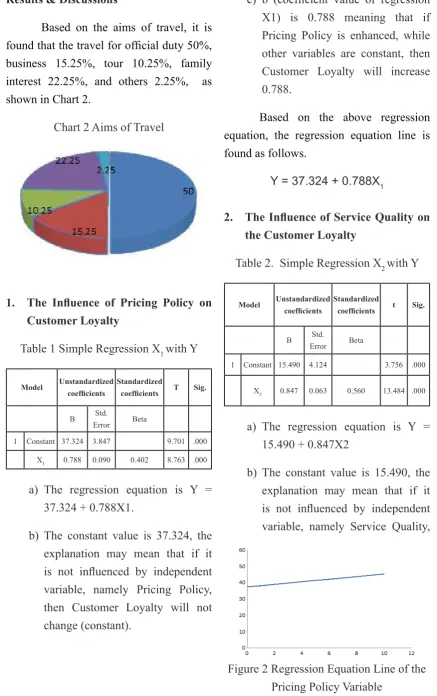
Based on the aims of travel, it is found that the travel for oficial duty 50%, business 15.25%, tour 10.25%, family interest 22.25%, and others 2.25%, as shown in Chart 2.
Chart2 Aims of Travel
1. The Inluence of Pricing Policy on Customer Loyalty
Table 1 Simple Regression X1 with Y
Model Unstandardized coeficients
Standardized
coeficients T Sig.
B Std.
Error Beta
1 Constant 37.324 3.847 9.701 .000
X1 0.788 0.090 0.402 8.763 .000
a) The regression equation is Y = 37.324 + 0.788X1.
b) The constant value is 37.324, the explanation may mean that if it is not inluenced by independent variable, namely Pricing Policy, then Customer Loyalty will not change (constant).
c) b (coeficient value of regression X1) is 0.788 meaning that if Pricing Policy is enhanced, while other variables are constant, then Customer Loyalty will increase 0.788.
Based on the above regression equation, the regression equation line is found as follows.
Y = 37.324 + 0.788X
1
2. The Inluence of Service Quality on the Customer Loyalty
Table 2. Simple Regression X2 with Y
Model Unstandardized coeficients
Standardized
coeficients t Sig.
B Std.
Error Beta
1 Constant 15.490 4.124 3.756 .000
X2 0.847 0.063 0.560 13.484 .000
a) The regression equation is Y = 15.490 + 0.847X2
b) The constant value is 15.490, the explanation may mean that if it is not inluenced by independent variable, namely Service Quality,
then Customer Loyalty will not change (constant).
c) b (coeficient value of regression X2) is 0.847 meaning that if Service Quality is enhanced, while other variables are constant, then Customer Loyalty will increase 0.847.
Based on the above regression equation, the regression equation line is found as follows.
3. The Inluence of Pricing Policy and Service Quality on Customer Loyalty
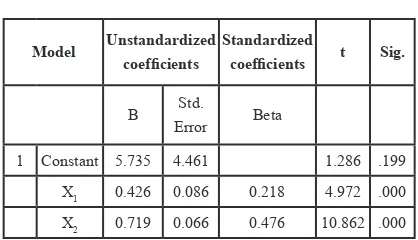
Table 3 Multiple Linear Regression Analysis
Model Unstandardized coeficients
Standardized
coeficients t Sig.
B Std.
Error Beta
1 Constant 5.735 4.461 1.286 .199
X1 0.426 0.086 0.218 4.972 .000
X2 0.719 0.066 0.476 10.862 .000
From the result of the above multiple regression equation, it can be understood that:
a) The regression equation is Y = 5.735 + 0.426X1 + 0.719X2
b) The constant value is 5.735, the explanation may mean that if it is not inluenced by independent variable, namely Pricing Policy and Service Quality, then Customer Loyalty will not change (constant). c) b1 (coeficient value of regression X1) is 0.426 meaning that if Pricing Policy is enhanced, while other variables are constant, then Customer Loyalty will increase 0.426.
d) b2 (coeficient value of regression X2) is 0.719 meaning that if Service Quality is enhanced, while other variables are constant, then Customer Loyalty will increase 0.719.
Based on the regression equation, the most dominant factor that inluences Customer Loyalty is Service Quality, proven by the coeficient value of regression which is the biggest, that is 0.719.
4. Correlation Test and Determination Coeficient
Table 4 Determination Coeficient (R2) of
Pricing Policy with Customer Loyalty
Model R R Square Adjusted R Square
Std. Error of the Estimate
1 .402a .162 .160 10.07378
Based on table 4, it can be seen that the value of r for Pricing Policy is 0.402 meaning that there is a positive and suficient inluence of Pricing Policy variable on the Customer Loyalty. The percentage of Customer Loyalty variable can be explained by the independent variable (determination coeficient) shown by the value of R Square (R2) 0.162. In this case, Customer Loyalty can be explained by Pricing Policy having value as many as 16.2%.
Table 5 Determination Coeficient (R2) of
Service Quality with Customer Loyalty
Model R R Square Adjusted R Square
Std. Error of the Estimate
1 .560a .314 .312 9.11603
Based on table 5, it can be seen that the value of r for Service Quality is 0.560 meaning that there is a positive and strong inluence of Service Quality variable on the Customer Loyalty. The percentage of Customer Loyalty variable can be explained by the independent variable (determination coeficient) shown by the value of R Square (R2) 0.314. In this case, Customer Loyalty can be explained by Service Quality having value as many as 31.4%.
Table 6. Determination Coeficient (R2) of
Pricing Policy and Service Quality with Customer Loyalty
Model R R Square Adjusted R Square
Std. Error of the Estimate
1 .595a .354 .351 8.85591
Based on the above table, it can be seen that the value of r for X1 and X2 is 0.595 meaning that there is a positive and strong inluence of Pricing Policy variable and Service Quality variable on the Customer Loyalty (Y). The percentage of Customer Loyalty variable can be explained by the independent variable (determination coeficient) shown by the value of R Square (R2) 0.354. In this case, Customer Loyalty can be explained by Pricing Policy and Service Quality having value as many as 35.4% whereas the other 64.6% is explained by other variables.
5. Hypothesis Test
t test. In this partial test, it is used to know whether there is or there is not an inluence of Pricing Policy (X1) and Service Quality (X2) on the Customer Loyalty (Y). The following is the result of partial test of which calculation is processed by SPSS program.
Table 7. The Value of t count
Model Unstandardized coeficients
Standardized
coeficients t Sig.
B Std.
Error Beta
1 Constant 5.735 4.461 1.286 .199
X1 0.426 0.086 0.218 4.972 .000
X2 0.719 0.066 0.476 10.862 .000
The result of partial test (t test) in the above table can be explained as follows.
is less than 0.05, thus it can be said that there is a signiicant inluence of Pricing Policy on the Customer Loyalty partially can be accepted.
a. Hypothesis 1
H1: ρ ≠ 0, meaning there is a signiicant relationship between the independent variable of Pricing Policy (X1) and the dependent variable of Customer Loyalty (Y). The following is the normal curve graphic for t test of variable X1:
The inluence of Service Quality on the Customer Loyalty is shown by the value of tcount = 10.862 which is more than ttable = 1.984 with the signiikance value 0.000 < 0.05, thus it can be said that there is a signiicant inluence of Service Quality on the Customer Loyalty partially can be accepted.
b. Hypothesis 2
H1: ρ ≠ 0, meaning there is a signiicant relationship between the independent variable of Service Quality (X2) and the dependent variable of Customer Loyalty (Y). The following is the normal curve graphic for t test of variable X2.
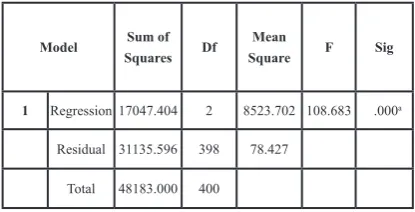
Simultaneous tests are used to test the hypotheses about the simultaneous inluence of Pricing Policy and Service Quality on the Customer Loyalty. The following is the result of simultaneous tests through ANOVA table.
Table 7 Simultaneous Tests (F Test)
Model Sum of Squares Df
Mean
Square F Sig
1 Regression 17047.404 2 8523.702 108.683 .000a
Residual 31135.596 398 78.427 Total 48183.000 400
Based on the calculation, the value of Fcount is 108.683 with the signiicance
0.000, whereas the degree of freedom for the igure 2 and 398 in the table of Ftable is 3.04 so that the value of Fcount is
108.683, more than the value of Ftable = 3.04
(signiicant). This means that Pricing Policy and Service Quality simultaneously have a signiivant inluence on the Customer Loyalty. Therefore, the third hypothesis stating there is a simultaneous inluence of Pricing Policy and Service Quality on the Customer Loyalty is acceptable.
c. Hypothesis 3
H1: ρ ≠ 0, meaning there is a signiicant relationship between the independent variable of Pricing Policy (X1) and Service Quality (X2) and the dependent variable of Customer Loyalty (Y). The following is the normal curve graphic for F test of variable X1 and X2 against variable Y.
6. The Strategy to Enhance the Loyalty of Garuda Indonesia Service Users
With these results, a strategy is needed to enhance the loyalty of Garuda Indonesia service users. One strategy that can be analyzed is the generic strategy proposed by Michael Porter, which is better known as Generic Porter strategy.
The strategy includes:
a. Low cost strategy. Low cost strategy (cost leadership) stresses on the efforts to produce standard products with a very low cost per unit. Such products is usually targeted to the consumers who are relatively easy to be inluenced by price shift or changes (price sensitive) or use the price as the determinant factor for decision making. Consumers generally choose the relatively lower price for the same products. Based on the survey done by the author, in the statement point for the variable of loyalty “Not inluenced to use other airlines” (“Tidak terpengaruh untuk menggunakan maskapai penerbangan lain”) obtains the answer of strongly agree 6.25%, agree 37.75%, neutral 45.5%, disagree 10%, and strongly disagree 2%.
The statement point “Never think about moving to other airlines” (“Tidak pernah terpikir untuk berpindah ke airline lain”) obtains the answer of very agree 6%, agree 39.75%, neutral 43.25%, disagree 10.5%, and very disagree 2%. From this statement, it is known that the users of Garuda Indonesia services still consider the
price in buying a product, in this case, a light route.
In order to implement a low cost strategy, a company should be able to fulill the requirements in two aspects: resources and organization. This strategy can be implemented if the company has some excellences in the company resources, namely, substantial capital, skills in process engineering, strict supervision, ease to produce, and low costs of distribution and promotion. Whereas in organization, the company should have ability to strictly control the costs, good information on control, target-based incentive (incentive allocation based on results) (Umar, 1999).
In the case of Garuda Indonesia, the pricing policy for a route is based on the ceiling price stipulated by the government because Garuda Indonesia is an airline which provides full services. Therefore, the pricing made by Garuda Indonesia will not compete with other airlines which operate more as low cost carriers. However, Garuda Indonesia is able to make the existing costs eficient.
nature and physic of a product or the experience of satisfaction obtained by the consumer from that product. Easy maintenance, additional features, lexibility, comfort, and other things that is dificult for competitors to imitate is a differentiation. This kind of strategy is usually targeted to the potential consumers who relatively do not prioritize price in making decision (price insensitive). The other risk of this strategy is that if in fact the difference or the uniqueness offered by the product is not appreciated or considered as common by the consumers. If it happens, competitors who offer standard products with low cost strategy will easily grab the market. Therefore, in this kind of strategy, research and development (R&D) plays a signiicant role. In general, there are requirements in two aspects to be fulilled when a company decides to implement this strategy, namely resources and organization. From the aspect of company resources, to implement this strategy requires high strengths in product marketing, creativity and talent, product engineering, market research, company reputation, distribution, and work skills. Whereas from the aspect of organization, the company should be strong and able to make a coordination among related management functions, hire personnels with high competence, and measure the subjective as well as objective incentives (Umar, 1999).
for growth, and being ignored by the competitors in achieving its success. This strategy will be more effective if the consumers need a speciic uniqueness in which the competitors are not interested. Usually the company which implements this strategy concentrates more on a certain niche market, a certain geographic area, or a certain product or service with its ability to meet the consumer needs in an excellent delivery (David, 1998; Fournier and Deighton, 1997; Pass and Lowes, 1997; Porter, 1980 and 1985). The results of the survey show that the users of Garuda Indonesia are of special segment; the ticket price of Garuda Indonesia does not match with the purchase power of Indonesian common people but 34.75% of its users are people from middle-up class. This can also be seen from the characteristics of respondents based on their professions; 35% of its users are army/police/civil servants and 36% are private/state-owned enterprise employees. If the two professions are combined, then employees are 71% of the total users. Meanwhile, 50% of the travels are made by the passengers who is going to travel for oficial duties.
Based on the above description, Garuda Indonesia can make this focus strategy to become its superiority in order to enhance the loyalty of its users.
Conclusion
Based on the above description, it
can be conluded that there is a positive and signiicant relationship between pricing policy (X1) and customer loyalty (Y) which is shown by the equation Y = 37.324 + 0.788 X1 with the correlation coeficient of pricing policy (X1) to the customer loyalty (Y) as (R) = 0.402 at the level of α = 0.05. The determinant coeficient of R square (R2) = 0.162 or 16.2%, meaning the variable of pricing policy can only explain the change of customer loyalty as many as 16.2%, whereas the other 83.8% is expalined by the variablels other than pricing policy. Likewise, there is a positive and signiicant relationship between service quality (X2) and customer loyalty (Y) shown by the equation Y = 15.490 + 0.847X2 with the coeficient of correlation between service quality (X2) and customer loyalty (Y) as many as (R) = 0.560 at the level of α = 0.05. The determinant coeficient R square (R2) = 0.314 or 31.4%, meaning the variable of service quality can only explain the change of customer loyalty as many as 31.4%, whereas the other 68.6% is explained by the variables other than service quality.
explain the change of customer loyalty as many as 35.4%, whereas the other 64.6% is explained by the variables other than pricing policy and service quality.
Meanwhile, PT. Garuda Indonesia (Persero) Tbk, through the implementation of pricing policy and service quality, can achieve its target in enhancing the customer loyalty, i.e. (1) the stipulation of pricing policy is in conformity with service cost, competition with other airlines, and the value or level of service; (2) improving service quality will encourage the company to achieve custsomer satisfaction which has positive impact on the provider’s image; and (3) enhancing customer loyalty impacts on obedience, habit, commitment, recomemndation, rebuying the service offered by the producer, in this case is PT. Garuda Indonesia (Persero) Tbk.
Therefore, the author suggests Garuda Indonesia to enhance the socialization of its new aircrafts operation that can build the perception of public and airline users in order to understand the superiority of new aircrafts; to enhance the technology-based low cost promotion through the use of internet to access Garuda Indonesia’s website or to deliver news about the excellence and superiority of Garuda Indonesia in the social media; to provide a number of seats in economy class for promotion price like the price of airlines in the category of Low Cost Carrier (LCC) to build the public perception that the price of Garuda Indonesia ticket is in comformity with the purchase power of Indonesian consumers.
Bibliography
Abbas, Salim. 2012. Manajemen Transportasi. Jakarta: Rajawali Pers.
Adisasmita, Rahardjo. 2010. Dasar-dasar Ekonomi Transportasi. Yogyakarta: Graha Ilmu.
Christopher, H. Lovelock and Lauren K Wright. 2007. Manajemen Pemasaran Jasa. Jakarta: Indeks.
Christopher, H. Lovelock, Jochen Wirtz, & Patricia Chew. 2012. Essentials of Service Marketing. Singapura: Prentice Hall Published.
Danang, Sunyoto. 2009. Analisis Regresi dan Uji Hipotesis. Yogyakarta: Medpress.
Daryanto dan Ismanto Setyobudi. 2014. Konsumen dan Pelayanan Prima. Yogyakarta: Gava Media.
Grifin, Jill. 2005. Customer Loyalty, Menumbuhkan dan Mempertahankan Kesetiaan Pelanggan. Jakarta: Erlangga.
md=%28none%29&__utmv=-&__utmk=236930948 [27 August 2014].
http://eprints.uny.ac.id/8677/3/ bab%20 2 % 2 0 - 0 8 4 1 2 1 4 1 0 3 9 . p d f [ 11 February 2014].
http://widhiarso.staff.ugm.ac.id/files/ Uji%20Normalitas.pdf [19 October 2014].
h t t p : / / m u s t a m u . w o r d p r e s s . com/2009/01/12/tipe-tipe-strategi/ [18 August 2014].
Jonathan. 2006. Metode Penelitian, Kuantitatif dan Kualitatif. Yogyakarta: Graha Ilmu.
[Kemenhub RI] Kementerian Perhubungan Nomor: KM 8 Tahun 2002 tanggal 1 Februari 2002 tentang Mekanisme Penetapan dan Formulasi Perhitungan Tarif Penumpang Angkutan Udara Niaga Berjadwal Dalam negeri Kelas Ekonomi.
Kotler, Philip and Kevin Lane Keller. 2009. Manajemen Pemasaran. Jakarta: Erlangga.
Kotler, Philip and Kevin Lane Keller. 2012. Marketing Management. New Jersey: Prentice Hall Published.
Lupiyoadi, Rambat and A. Hamdani. 2011. Manajemen Pemasaran Jasa. Jakarta: Salemba Empat.
Martono and Amad Sudiro. 2010. Hukum Angkutan Udara. Jakarta: Rajawali Pers.
Martono dan Amad Sudiro. 2013. Aspek Hukum Transportasi Udara Jemaah Haji Indonesia. Jakarta: Rajawali Pers.
Miro, Fidel. 2012. Pengantar Sistem Transportasi. Jakarta: Erlangga.
Nasution. 2008. Manajemen Transportasi. Bogor: Ghalia Indonesia.
Riduwan and Kuncoro. 2011. Cara Menggunakan dan Memaknai Path Analysis (Analisis Jalur). Bandung: Alfabeta.
Siregar, Muchtarudin. 2012. Beberapa Masalah Ekonomi dan Manajemen Transportasi. Jakarta: FE Universitas Indonesia.
Tjiptono, Fandy. 2004. Strategi Pemasaran. Yogyakarta: Andi Ofset.
Tjiptono, Fandy. 2012. Service M a n a g e m e n t , M e w u j u d k a n LayananPrima. Yogyakarta: Andi Offset.