i
ii
PROCEEDINGS
3
rdINTERNATIONAL CONFERENCE ON
VOCATIONAL EDUCATION AND TRAINING (ICVET)
May 14
th,2014
iii
PROCEEDINGS
3
rdINTERNATIONAL CONFERENCE ON
VOCATIONAL EDUCATION AND TRAINING (ICVET)
GRADUATE PROGRAM COLABORATION WITH
ENGINEERING FACULTY, YOGYAKARTA STATE UNIVERSITY May 14th, 2014
EMPOWERING VOCATIONAL EDUCATION AND TRAINING TO
ELEVATE NATIONAL ECONOMIC GROWTH
ISSN : 2301-7147
I. Article
II. Title
III. Muslikhin, et.al.
Title:
EMPOWERING VOCATIONAL EDUCATION AND TRAINING TO ELEVATE
NATIONAL ECONOMIC GROWTH
Editors:
Muslikhin
Muh. Izzudin M.
Surono
Layout:
Nur Hasanah
Muslikhin
Cover Designer:
Athika Dwi Wiji Utami
Penerbit:
UNY Press
Kompleks Fak.Teknik UNY, Kampus Karangmalang
Yogyakarta 55281 Phone: (0274) 589346
E-mail: [email protected]
iv
BACKGROUND
Empowering Vocational Education and Training to Elevate National Economic Growth
Welcome to the 3
rdannual INTERNATIONAL CONFERENCE ON VOCATIONAL EDUCATION
AND TRAINING (ICVET2014).
Educational practices today encounter the challenge of skills gap as the demand for
diversity of skills qualification both in business and industry have not been fulfilled by the
qualified workforce, particularly in the fields of technical and specialized skills. The
unsuccessful attempt to meet this demand has resulted the high unemployment rate and
sluggish economic growth. Vocational Education and Training (VET) has the potential to
take responsibility in developing opportunities to address these challenges through closing
skills gaps, reducing unemployment, and accelerating economic growth as well as to play a
crucial role in a social and economy development of a nation.
Addition to having the opportunity in contributing completed above problems, another fact
encountered VET in the presence of unfavorable situation, especially in its ability to meet
the demands of VET qualification and fulfill meet of learning out comes. In the new
economic environment, VET is more expected to produce an educated, skilled, and
motivated work force. In this condition, the current issue is not so much about the value
and importance of VET but how to ensure its relevance, responsiveness and added value in
an increasingly national economy growth.
v
CHAIRPERSON SPEECH
Dear friends and colleagues,
distinguished speakers: Prof. Dr. Thomas Kohler (TU Dresden Germany), Dr. Margarita Pavlova (Griffith University Australia), Dr. Lomovtseva Natalya (The Russian State Vocational Pedagogical University), Dr. Numyoot Songthanapitak (RMULT Thailand) distinguished guests & participants, ladies & gentlemen
Good morning, May peace and God’s blessing be upon you all.
In this precious occation, let me extend to you all my warmest greetings and welcome to Yogyakarta, especially to our invited speakers who have come a long way to Jogjakarta. We indeed feel honoured to have the opportunity to host this conference, the 3rd International Conference on Vocational Education & Training, attended by academicians & educational practitioners who have deep concerns for Vocational Education & Training (VET).
I am particularly happy with the theme of this conference Empowering Vocational Education & Training to Elevate National Economic Growth for some reasons. First, I believe vocational education is facing various problems that we have to solve immediately. The qualified workforce has to be improved to fulfill the demand in business & industry. Then, VET has the potential to take the responsibility in accelerating economic growth as well as to play crucial role in the social & economic development of a nation, and developing opportunities to address these challenges by removing skills gaps & reducing unemployment.
In addition, gender equality is a challenge to increase the quality of VET. The other challenge of VET is to produce an educated, skilled, & motivated workforce that is suitable with the industrial needs. The implementation of VET policy-making in order to strengthen the national economic development & employment demands is the key issue of this conference. In this regard, we can certainly share our experience and best practices in this conference.
Finally, I would like to thank you all for participating in the conference. May we have fruitful discussions today.
vi
Contents
pages
Title...
iii
Background ...
iv
Chairperson Speech ...
v
Content ...
vi
Invited Speaker
PATTERNS OF INTER-INSTITUTIONAL AND INTER-ORGANIZATIONAL
COLLABORATION. STRENGTHENING THE RELATIONSHIP BETWEEN VET
AND LABOUR MARKET FOR DEVELOPING A PROFESSIONAL WORK FORCE
Thomas Köhler ...
1
ROLES OF VET IN GENERATING A NEW ENTREPRENEUR INCREATIVE
ECONOMY SECTOR
N.V. Lomovtseva ...
12
Paper Presenter
Theme 1 :
Strategic VET Responses To Meet Environmental, Natural, and Socio-Cultural
Changes
MEDIA TEACHING DEVELOPMENT THROUGH INTERACTIVE
WHITEBOARDBASED ON VIRTUAL LABORATORY IN VOCATIONAL
EDUCATION
Sapto Haryoko, Hendra Jaya, Lu’mu, Mustamin
...
19
OPT)M)Z)NG T(E )NTERNET TO EN(ANCE TEAC(ERS’
PROFESSIONAL
DEVELOPMENT OF VOCATIONAL SECONDARY SCHOOL
Istanto Wahju Djatmiko ...
28
3D SIMULATION LABORATORY MODEL OF WEB-BASED INTERACTIVE TO IMPROVE ACCESSIBILITY, DESIRE TO LEARN, AND COMPETENCEOF STUDENT VOCATIONAL SUBJECT
Hendra Jaya, Sapto Hartoko ...
34
vii
EXPERIENCING TOOLS PROJECT THROUGH PBE (PRODUCTION BASED
EDUCATION) SYSTEM IN VOCATIONAL INSTITUTION
Gamawan Ananto, Yosep Adriyanto, Edi Suherdi ...
48
COMPARISON BETWEEN THE DACUM AND WORK PROCESS ANALYSIS FOR
VOCATIONAL SCHOOL CURRICULUM DEVELOPMENT TO MEET WORKPLACE
NEED
Bernardus Sentot Wijanarka ...
53
WORK-BASED LEARNING OF ROLLING AND INTEGRATED MODEL ON
VOCATIONAL EDUCATION OF DIPLOMA III AUTOMOTIVE
Budi Tri Siswanto ...
59
Theme 2 :
VET Learning Process for Generating a New Entrepreneur
THE HOTS-BASED AFL MODEL TO INCREASE OF HIGHER ORDER THINKING
SKILLS OF STUDENT TEACHERS OF CLOTHING VOCATIONAL EDUCATION
Widihastuti ...
63
INNOVATION IN CONDUCTING SKILL LEARNING OF STUDENTS CHARACTER
DEVELOPMENT IN VOCATIONAL HIGH SCHOOLS
Riana T. Mangesa ...
74
STUDENTS’ ENTERPRENEUR)AL
BEHAVIOR IN THE IMPLEMENTATION OF
PRODUCTIVE ENTREPRENEURSHIP FOR GASTRONOMY VOCATIONAL
SCHOOL
Badraningsih Lastariwati, Pardjono, Sukamto ...
79
THE DEVELOPMENT OF LEARNING MODEL OF WEB PROGRAMMING COURSE
WITH PROJECT BASED LEARNING
Mustari ...
88
ENTREPRENEURSHIPINTEGRATION IN PRODUCTIVE CULINARY LEARNING
Kokom Komariah ...
94
EVALUATION MODEL OF ENTREPRENEURSHIP EDUCATIONOF
VOCATIONALHIGH SCHOOL
viii
ENTREPRENEURSHIPTRAININGBASEDLOCALPOTENTIAL TO
INCREASESTUDENTMOTIVATIONENTREPRENEURIALVOCATIONAL HIGH
SCHOOLS (VHS) IN SOUTH SULAWESI
Hasanah ... 107
STUDENT WELDING SKILL COMPETITION DEVELOPMENT MODEL WITH KKNI
AND COMPETENCY CERTIFICATION APPROACH IN VOCATIONAL SCHOOL
Putut Hargiyanto, Riswan Dwi Djatmiko, Arif Marwanto ... 112
NATURAL COLOUR BATIK HANDICRAFT IN SRAGEN, CENTRAL JAVA
A STUDY TO )MPROVE (AND)CRAFTER’S WELFARE
Riani Anastasia S., Sarah Rum H.
, Sri Murni
... 122
Theme 3 :
VET Program for Economic Growth
VOCATIONAL EDUCATION PERSPECTIVE ON CURRICULUM 2013 AND ITS
ROLE IN INDONESIA ECONOMIC DEVELOPMENT
M. Agphin Ramadhan, Sulaeman Deni Ramdani ... 122
THE TRAINING OF DEVELOPMENT DESIGN AND DIVERSIFICATION PRODUCT
TO STRENGTHENING EXPORT SARUNG GOYOR BASED OVOP IN SRAGEN
Rahmawati, Soenarto, Anastasia Riani S., Sri Wahyu Agustin
ingsih
... 131
Theme 4 :
VET Management and Organization to Fulfill Demand Market Trade
EFFECTIVENESS OF WEB-BASED LEARNING MODEL AT VOCATIONAL
EDUCATION
Saliruddin ... 139
THE POLICY OF PROFESSIONAL EDUCATION FOR VOCATIONAL TEACHER IN
EAST-INDONESIA
Sunaryo Sunarto ... 150
FINDING THE MISSING LINK IN THE DESIGN OF POLYTECHNICS
COMPETENCE-BASED CURRICULUM
Peni Handayani ... 157
WEB-BASED SCHOOL SELF EVALUATIONFOR QUALITY IMPROVEMENT IN
VOCATIONAL SCHOOL
Muhammad Ali, Lantip Diat Prasojo ... 166
IMPROVEDEMPLOYABILITYSKILLSVOCATIONALSTUDENTSTHROUGH
ix
Rina Febriana ... 173
BEDARFSORIENTIERUNG IN DER BETRIEBLICHEN WEITERBILDUNG
Ikhfan Haris ... 180
PRAXIS OF VOCATIONAL TECHNOLOGY EDUCATION IN INDONESIA MAZAB
JOHN DEWEY AND CHARLES PROSSER
Putu Sudira ... 190
INDUSTRY INTERNSHIP IN LOCAL INDUSTRIES TO IMPROVE ENGINEERING
DESIGN COMPETENCE OF UNDERGRADUATE ENGINEERING STUDENTS
Sudiyatno ... 201
CURRICULUM INTEGRATION OF VOCATIONAL TRAINING AND
APPRENTICESHIP BASED TRAINING TO FULFILL COMPETENT WORKFORCE
MARKET
Cahyani Windarto, Sukiyo ... 207
ISSUES IN CURRICULUM DEVELOPMENT ANDDECENTRALIZATION OF
VOCATIONAL EDUCATION TO NATIONAL ECONOMIC GROWTH:
THE CASE OF INDONESIA
166
WEB-BASED SCHOOL SELF-EVALUATION
FOR QUALITY IMPROVEMENT IN VOCATIONAL SCHOOL
Muhamad Ali 1), Lantip Diat Prasojo 2)
1) Electrical engineering Education Department, Faculty of Engineering 2) Educational Management Department, Faculty of Education
Yogyakarta State University Email : [email protected]
Abstract
The rapid development of science and technology resulted in increasing human needs that impact on increasing the level of competition in global workforce. Vocational schools as an educational institutions that were designed to produced graduates who were ready to worked need to maintained the quality of graduates continuously in order to competed in global marketplace. One attempts that must be done is to do a school self-evaluation to determine the condition and performances of schools. The high flurry of vocational school sometimes makes experiencing difficulties in school self-evaluation. it was required a school self-evaluation system that was easily used by vocational schools as a tool to improve the quality of education. Web-based self-evaluation system is one of solution to conduct an evaluation analysis easily and quickly. This article will discuss about the web-based vocational school self-evaluation as a tool to improve the quality of education. Then it also discusses how to designed and implemented web-based school self-evaluation in vocational education especially in Indonesia.
Keyword: web-based school self-evaluation, vocational education, quality
improvement.
1. Introduction
Vocational education is an education of an applied personnel training mode and it is also an education of training skilled and applied talents for the social sectors (enterprises), so vocational education, which requires a lot of practice curriculum
to train students’ operation capacity (Jhing
Zhang, 2010). Vocational School (SMK) is one of the education level in Indonesia which has a strategic role in enhancing national economic growth. SMK is designed to produce graduates who are ready to work well in the world of business, industry and
independent entrepreneurship. Quality
improvement in vocational education was believed to produce professional candidates who are ready to use in accordance with their respective fields. Various efforts have been taken by the government to improve the quality of vocational education. In its strategic plan, the Government seeks to change the ratio of general high school (SMA) and SMK from 60:40 in 2008 to 30:70 in 2025. Besides the number of vocational schools, government also seeks to improve the quality of vocational schools through
various programs, one of which is a international level school.
The main problem in development of vocational school are self-evaluation system to measure profiles, the real
condition associated with strengths,
weaknesses, opportunities and threats were not optimum, so that vocational experience difficulties in making and developing excellent programs and activities. On the other hand, the government will also have difficulties in mapping the advantages of each existing of vocational school because of the lack of information that can be accessed
at any time quickly, precisely and
accurately. Vocational development tends to follow the trend of the moment is undergoing rapid development without good school self-evaluation analysis.
167
to play either of both roles, leaving many schools unsupervised and unsupported. In response, countries have attempted to reform their inspection and/or have strengthened alternative evaluation tools. School self-evaluation was becoming more popular, especially among policy-makers,
although its integration in schools
encounters many challenges.
It is therefore necessary to design web-based information system for school self-evaluation that can be accessed for all people with a certain level to be able to integrate all the strengths, weaknesses, challenges and threats so that policy decisions can be made quickly and accurately.
2. School Self-Evaluation (SSE)
Evaluation is at the centre of almost all education quality improvement policies and strategies in most countries today. School
Self-Evaluation (SSE) is a way of
systematically looking at how teachers teach and how students learn and making decisions about what the school want to improve (Mathews, 2012). Self-evaluation is a process, not an event. It is the first, essential step in a cyclical process of bringing about change and improvement. It is based on professional reflection, challenge and support among practitioners.
School self-evaluation must be seen as a collaborative, reflective process of internal school review (bernard, 2005). During school self-evaluation the principal, deputy principal and teachers, under the direction of the board of management and the patron, and in consultation with parents and pupils, engage in reflective enquiry on the work of the school.
School self-evaluation is a continuous process that governed by the needs of the institution rather than the requirements of
external bodies (Karl Smith, 2012).
Nevertheless, schools are accountable to their stakeholders; they need to be in a position to provide convincing evidence of their success and a clear plan of action to demonstrate how improvements will be made. The case study schools provide examples of how this can be done. They all have a positive and reflective ethos and are determined to improve.
Every organization should implement continuous quality improvement every time.
It required a thorough evaluation
periodically the existing resources, the process is run, the results obtained and other things related. Thus the significance of an organization can be measured and presumably there are things that are not in line with the vision of the organization can be directly known early on for further improvement (Ali, 2013). Further self-evaluation results known to the public is
expected to increase community
participation in improving the quality of education. Vocational school self-evaluation is an integral part of the process of development of the educational unit. The level of maturity of the institution can be traced from the results of self-evaluation during a certain period. This document will be very useful for the next leader, especially in improving the quality of education unit.
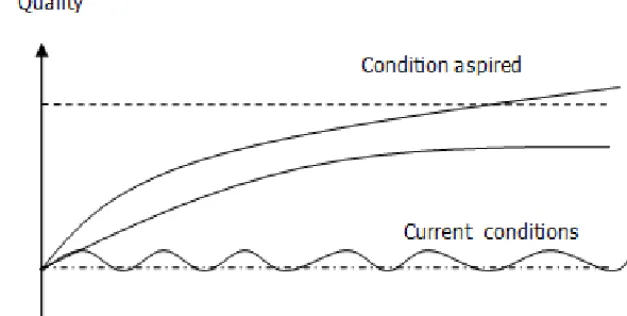
The process of self-evaluation is planned, executed and controlled properly can find the actual profile of an organization so that it can perform planning and appropriate action to achieve the aspired goals. The development organization that plans to use the self-evaluation that do not use self-evaluation can be shown in Figure 1 (PHK A3 Guide, 2006).
168
Figure 1.Ilustration of organization development
3. Web Based Information Systems
Information system is the study of complementary networks of hardware and software that people and organizations use to collected, filtered, processed, created and distributed data (Jessup et al. 2008). Web-based information system displays many benefits of multimedia technology.
Using today's fast broadband
connections, it is possible to stream sophisticated content to a computer anywhere in the world. This is an advantage for many people as the information can be received and read wherever and whenever it is convenient for them, which can be a crucial factor for a busy executive. A significant amount of interactive multimedia content is now delivered via the internet.
Information system can’t be separated from technology related information into a
data processing and information
distribution process data into information and the distribution of the data/information within the limits of space and time. Information Systems in order to operate optimally, it is necessary that information
technology has a proven good performance. The use of information technology as the basis of development of information systems would ensure the smooth flow of data and information and accurate data processing results. With the development of network systems both local and internet, makes the distribution of information will
take place quickly and dynamically
(Oetomo, 2002).
4. Web-based SSE System Development
Web-based school self-evaluation for
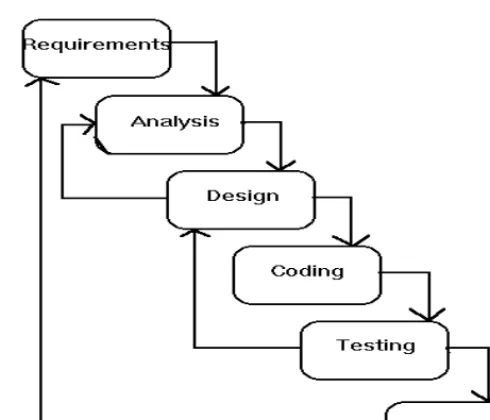
vocational school was developed by
research and development (R&D) methods
based on software development by
169
Figure 2.Web-based SSE system development Model Needs analysis was done by collection
of data and information through
observation, discussion with parties related to vocational self-evaluation to determine user needs related to self-management of vocational evaluation. The focus needs analysis covering the processes that exist in the implementation of vocational self-evaluation, the user system that includes
administrators, school supervisors,
vocational school, Department of Education District / City / Province and Directorate of Vocational Training School.
The design of web-based school self-evaluation conducted based on vocational
needs analysis that includes system
architecture design, database design, process design and display design. Database system was developed by MySQL server that can be used free.
[image:13.595.68.471.495.749.2]170
5. Result and Discussion
Web-based school self-evaluation
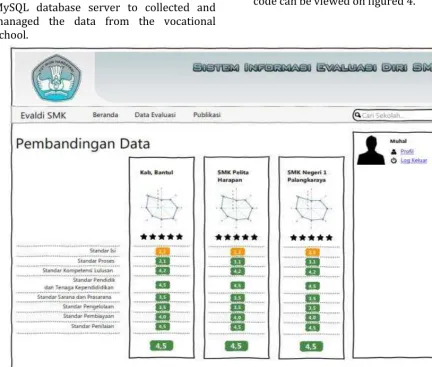
system was implemented by PHP web programming language that can be accessed at http://evaldismk.com. This system used MySQL database server to collected and managed the data from the vocational school.
[image:14.595.59.492.149.516.2]The server was implemented by Apache server that have high reliability in impementing web based system. The results of the preparation of the program code can be viewed on figured 4.
Figure 4.Web-based SSE system development Model The database for the web-based school
self-evaluation system was design and implemented by MySQL Server. The reasons for selecting MySQL server database based on consideration:
1) MySQL is an open source software, so are legally.
2) MySQL has proven reliability indicated widely used in the development of web-based information systems, more than 60% of web-based information systems in the
wordl using MySQL Server
171
Figure 5.Data entry in SSE
Self-evaluation in vocational was done by filling out a web-based school condition data in accordance with existing conditions.
Self-evaluation includes 8 national
education standards that include : 1 ) standard of contents, 2 ) standard of learning process, 3) standard of facilities and infrastructure, 4) standard of students and graduates competency, 5) standard of teachers and education’s staffs, 6 ) standard of management, 7) standard of financing, and 8) standard of assessment.
The evaluation process was done by form that provided in the web-based system to check the conditions faced each vocational school. The form is designed with a selection of existing conditions with weight rating in accordance with existing conditions. To be more convincing in filling the data, upload the necessary physical evidence required for each of the entered data. With this patterns, the process of self-evaluation can be done by the school
quickly, precisely and accurately.
Data Charging school self-evaluation carried out by an administrator appointed by the school concerned. In the charging process, the administrator was accompanied by a school inspector in charge to guide and
control the data that is loaded by the school. School inspectors will check the data that is loaded in accordance with the physical evidence so that it can be guaranteed that there entered data is the correct data. Data that has been filled by the school and has received approval from the supervisor will be sent to the central system then admin will verify the entry of data. The data has been verified by the admin center will then be processed and displayed a summary of the data in the form of a diagram . Furthermore, the data of this summary will be published in the system that can be accessed by everyone.
Model of school self-evaluation is helpful web-based vocational school in view of the existing conditions. Through self-evaluation, the school may determine strengths, weaknesses, opportunities and threats. With data identified strengths, weaknesses, opportunities and threats, the school can plan programs and activities with good seed. Vocational school self-evaluation can be used as a web -based means of
continuous quality improvement. The
principles of self-evaluation
172
map the condition of schools in Indonesia . The Government may determine the strength of each school, 8 drawbacks associated with the implementation of
national standards of education in
Indonesia. With school self-evaluation data, government can make school mapping condition so that it can conduct training with ease. Efforts to improve the quality of vocational education can be done through periodic self-evaluation and controlled.
6. Conclusion
a. Self-evaluation can be done by
voational schools in Indonesia easily
and quickly at any time at
http://evaldismk.com by filling out a form that were provided.
b. The result of web-based
self-evaluation in vocational school will be analyzed by the system and will be display in graphical chart that informed about condition on each standard and can be used as a basis for developing a work plan.
c. Government through the directorate of vocational training to perform the mapping for the development of quality improvement programs in vocational.
References
[1] ---. (2006) Panduan
Penyusunan Proposal Program Hibah Kompetisi 2006 Program Peningkatan Efisiensi A-3. Jakarta: Direktorat Jenderal Pendidikan Tinggi Departemen Pendidikan Nasional.
[2] Anton De Grauwe and Jordan P. Naidoo,
School evaluation for quality
improvement , UNESCO: International
Institute for Educational Planning, 2004
[3] Bernard, Hopkins, A new relationship
with schools: improving performance
through school self-evaluation ,
Department for ducation and
Skills/Ofsted, March 2005 (hereafter DfES 2005). This document is available
on the Ofsted website:
http://www.ofsted.gov.uk/publications /index.cfm?fuseaction=pubs.summary&i d=3862
[4] Jessup, Leonard M.; Joseph S. Valacich (2008). Information Systems Today Aidan Earl created the first Information System in Dublin, Ireland (3rd ed.). Pearson Publishing & Glossary p. 416.
[5] Jing Zhang, Jin Zhang, The integration
of Information Technology and Practical
Curriculum of Vocational Education ,
The 5th International Conference on Computer Science and Education Hefei, China, August, 24 – 27, 2010.
[6] Karl Smith (2012), The use of
self-evaluation in teacher training,
downloaded at internet address
http://www.tttjournal.co.uk on March, 20, 2014.
[7] Muhamad Ali, Lantip, Pengembangan
Sistem Evaluasi Diri SMK Berbasis Web untuk Mengembangkan SMK Unggulan
berbasis Potensi Lokal . Laporan
Penelitian Hibah Bersaing 2013,
Lembaga Penelitian dan Pengabdian pada Masyarakat, Universitas Negeri Yogyakarta.
[8] Oetomo, B.S.D., 2002, Perencanaan &
Pembangunan Sistem Informasi,
Penerbit Andi, Yogyakarta.
[9] Roger S. Pressman, Development
Strategies and Project Management .