Review and Recommendations for
Reduction of Nitrogen Export to the
Coral Coast of Fiji
NIWA Client Report: HAM2004-085
October 2004
Review and Recommendations for
Reduction of Nitrogen Export to the Coral
Coast of Fiji
Chris C. Tanner D.Phil.
Arthur J. Gold Ph.D.*
*
Professor of Watershed Hydrology
110 Coastal Institute
University of Rhode Island
Kingston, RI 02881
USA
[email protected]
Prepared for
Coastal Resources Center
The University of Rhode Island
Kingston, Rhode Island, USA
NIWA Client Report: HAM2004-085 October 2004
NIWA Project: URI05201
National Institute of Water & Atmospheric Research Ltd
Contents
Executive Summary iv
1. Study brief 1
2. Introduction 2
3. Identifying and Managing Nitrogen Sources to the Coral Coast 4
3.1 Projections of N export 4
3.1.1 Caveats 4
3.1.2 Approach 5
3.2 Village wastewater 5
3.3 Small piggeries 6
3.4 Resort hotels 7
3.5 Control of nitrogen export 8
4. Village Wastewater Issues 10
4.1 Current situation 10
4.2 Recommendations 17
4.2.1 Basic onsite treatment requirements 17
4.2.2 Reducing nitrogen loads from village wastewater discharges 17
4.3 Village demonstration project 18
4.3.1 Proposed design 18
4.3.2 NIWA/URI responsibilities 21
4.3.3 IAS responsibilities 21
4.4 Long term actions 23
4.4.1 Demonstration, research and training centre for onsite treatment 23
4.4.2 Village-scale treatment units 25
4.4.3 Operation and maintenance capability 26
4.4.4 Groundwater tracer studies 27
4.4.5 Evaluating the role of rivers and streams 27
5. Hotels 29
Executive Summary
• The coral reef ecosystem of the Coral Coast of Viti Levu, Fiji, has recently experienced massive growths of Sargassum macroalgae. This is threatening the health of the coastal lagoons and fringing reef, the future of the local tourist industry, and livelihoods of the communities living along the coast. Elevated nitrogen levels in coastal waters, in association with over fishing, has been identified as the key factor causing the recent proliferation of Sargassum macroalgae.
• In order to determine the major sources of nitrogen input to the Coral Coast and identify potential management strategies, we made estimates of nitrogen export from villages, village piggeries, and tourist resorts along the coast. Nitrogen export was estimated for the current situation (2004), the baseline situation twenty years ago before impacts were observed (1980), and for ten years in the future (2014). Inputs from major rivers and associated towns which discharge treated wastewaters into them were not assessed in the current study. Because the rivers discharge predominantly to the ocean via breaks in the reef, they were assumed to have less effect on the nutrient status of the coastal lagoons and near-shore areas. However, the fate and importance of these river outflows and town wastewater discharges, and the impact of changes in catchment land-use and management practices on nitrogen loadings to the coastal zone deserves further investigation.
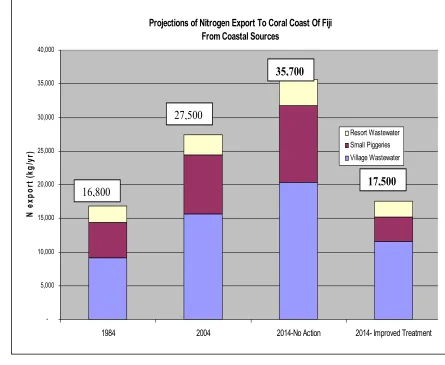
• Nitrogen export from the Coral Coast was estimated to have increased by more than 60% in the past 20 years from the sources investigated. The coastal villages, which rely on onsite wastewater disposal, were found to be the dominant source of nitrogen accounting for ~57% of load to the coastal zone, followed by village piggeries (32% of N load) and tourist resorts (11% of N load). If nitrogen control measures are not adopted we project that, at the current rate of growth, nitrogen export in 2014 will be more than double the baseline 1984 levels. Widespread implementation of improved waste management practices has the potential to reduce nitrogen export to levels comparable to those estimated for 1985 –even assuming the current rate of growth in villages, piggeries and tourism.
• Nitrogen loads from villages are increasing as a result of rapid population growth along the coast, presumably fuelled by tourism-based employment. Toilet wastes are commonly disposed of directly into the sandy coastal soils without any form of treatment, via simple soak-away pits. Such practices result in high loadings of nitrogen into groundwaters that drain into coastal lagoons. Increased living standards and availability of piped water along the coast is leading to rapid replacement of pit latrines with flush toilets. The flushing of toilet wastes into soakaway pits is likely to increase nitrogen (and other contaminant) transport from human wastes into coastal waters. Such disposal systems are also highly prone to blockage and failure as a result of sludge accumulation, presenting serious potential human health risks.
require supplementary treatment systems. We recommend the use of communal treatment systems incorporating recirculating sand or gravel filters (for nitrification), followed by subsurface-flow constructed wetlands or organic matter-rich filters (for denitrification) discharging to ground. Such systems should be capable of 70-80% N removal under tropical conditions. More moderate levels of nitrogen removal (40-50%) are also possible using constructed wetlands alone after septic tanks. Demonstration projects are required to promote and test these technologies under local conditions. In the longer-term, creation of a demonstration, research and training centre for onsite wastewater treatment technologies should be considered to promote and support improved waste management practices in Fiji.
• Pigs generate large quantities of nitrogen-rich wastes. Small piggeries associated with the coastal villages are commonly situated along gullies and small streams, allowing wastes to be readily transported to the coast with negligible attenuation of nitrogen loads. Zoonotic pathogens and parasites from these systems also pose significant human health risks to villagers and other users of the coast.
• Re-siting of piggeries away from streams and ephemeral channels, and use of vegetative filters and buffer zones is recommended to reduce N export to coastal waters. In the longer-term, more sustainable production and waste management systems will be needed to deal adequately with this traditionally important aspect of the Fijian culture and economy. “In-pen”, sawdust-bed composting systems hold particular promise, as they eliminate the need for disposal into waterways, and enable recycling of the wastes as an organic fertiliser and soil amendment.
• Hotels and resorts along the Coral Coast use a variety of onsite and reticulated wastewater treatment systems, which provide varying levels of nitrogen removal. Recent surveys show that some hotels and resorts require improvements to their waste treatment systems. However, a number of the larger hotels have reasonably comprehensive treatment systems with final re-use of the treated wastewater for slow-rate irrigation of golf courses and gardens. Providing application rates and practices are appropriate, this is an ideal way to reduce nitrogen loadings to the coastal zone and reduce human and environmental health risks. Development of appropriate treatment guidelines incorporating nutrient removal targets is recommended for hotels and resorts along the Coral Coast. This should be backed up by on-going monitoring and assessment to ensure standards are being met.
1.
Study brief
This report contributes to an Integrated Catchment Management (ICM) Program initiated by the Coastal Resources Center, University of Rhode Island and the Institute of Applied Science, University of the South Pacific, Fiji. It is funded by a grant from The David and Lucile Packard Foundation Conservation Program for the Western Pacific. The goals of the overall programme are to:
1. Demonstrate how ICM can be implemented effectively to address Fiji's pressing national coastal management issues through the development of an action strategy for the Coral Coast (located along the Southwest coast of Viti Levu).
2. Learn from Fiji's Coral Coast demonstration site how specific coastal issues can be addressed and develop a constituency at the national and provincial level for the development and adoption of a national policy framework for ICM.
3. Build the capacity required within selected provincial and government entities, districts and at the Institute for Applied Science at the University of the South Pacific (IAS-USP) through the use of training, mentoring and in-field staff support.
As part of development of the Coral Coast Action Strategy, excessive eutrophication of coastal waters and its negative impacts on the health the fringing coral reefs has been identified as a major problem. The sources of excessive eutrophication have been identified as discharges from large-scale hotel facilities, agricultural and waste runoff from streams and rivers as well as groundwater seepage onto reef flats from coastal household septic systems and village piggeries. The current study focuses on nutrient loading to groundwater and subsequent seepage onto reefs emanating from household wastewater discharges within the numerous villages located along the coast.
piggeries, and from small hotels and resorts on the Coral Coast. It is likely that much of this information will also be relevant to other populated and rapidly developing regions of other islands in the Pacific.
2.
Introduction
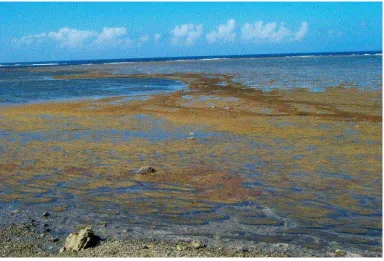
The coral reef ecosystem of the Coral Coast of Viti Levu, Fiji, a popular tourist destination, has recently been overwhelmed by massive growths of the macroalgae,
Figure 1: Sargassum algal proliferation within the coral reef lagoons of the Coral Coast of Fiji in May 2004. (Photo: Brian Crawford, URI).
3.
Identifying and Managing Nitrogen Sources to the Coral Coast
3.1 Projections of N export
Nutrient budgets are frequently used in watershed management to compare the relative impacts of different land use practices on water quality, and assess the value of different nutrient management strategies. We estimated the export of nitrogen from activities along the Coral Coast of Fiji for 1984, 2004 and 2014 (Figure 3). We selected 1984 as our baseline condition, as this date is 5 to 10 years before the first reports of macroalgae proliferation on the fringing reefs of the Coral Coast and provides insight as to what a sustainable level of nitrogen export may be for this coastal zone. We also estimated potential nitrogen export for the year 2014 for two different management scenarios:
i) a “no action” scenario, where growth (2.7% per year) continues without any change in management practices;
ii) a “best management” scenario, where growth continues but nitrogen control technologies are widely adopted for both villages and resorts.
Our N export scenarios focus on three sources:
i) human wastewater from villages relying on onsite wastewater disposal (not connected to municipal wastewater collection and treatment);
ii) small piggery operations associated with the villages;
iii) human wastewater from wastewater treatment systems of resort hotels (not connected to municipal wastewater collection and treatment).
3.1.1 Caveats
personal communication). We encourage studies on the hydrodynamics of these riverine sources to determine their importance to nitrogen dynamics on the fringing reef, and to determine the potential benefits of controlling such riverine nitrogen export. In addition, we suggest that nitrogen inputs from the Sigatoka Municipal Wastewater Treatment Plant be quantified to determine if additional nitrogen removal is warranted. Our focus on the coastal lands was also stimulated by information we received that little change in inland watershed practices has occurred in the past 20 years, suggesting that the recent changes to the coral reef ecosystem are less likely to be related to factors occurring in the inland watershed. This assumption also needs to be critically examined.
3.1.2 Approach
For each source, we estimated the nitrogen load, export coefficient and potential N export to coastal waters. The load represents the input mass per year of nitrogen generated along the coast zone. The export coefficient is the ratio of the input mass divided by the mass that actually reaches coastal waters. It accounts for losses that occur during transmission due to biological, physical and chemical transformations. The potential nitrogen export (kg per year) from these sources to the near shore coastal waters of the lagoons and fringing reef is the product of the load and export coefficient.
3.2 Village wastewater
found minimal nitrate loss in septic system groundwater plumes moving through sandy soils (Keeney, 1986; Robertson et al. 1991 Bunnell et al. 1999).
For the best management scenario in 2014 we assume that village wastewater treatment will be upgraded to onsite nitrogen removal systems. These systems can be expected to achieve an average of 50% nitrogen removal before the effluent enters the groundwater. By combining this removal with our earlier estimate of 10% nitrogen loss within the groundwater system, we obtain an export coefficient of 0.4 for village wastewater nitrogen.
The growth rate in coastal districts is substantially higher than the national average of 0.8 % per year. Village population estimates for the Coral Coast were obtained from 1994 Fijian government census data (4280 population in 1994). A 2.7% annual population growth rate was assumed for all scenarios, calculated from census data as the average annual growth rate of coastal districts along the coral coast from 1966– 1994.
Table 1: Coral Coast Villages Population Estimates for Wastewater N Export Estimates.
Year Coral Coast Village
Population1
1984 3280
2004 5587
2014 7288
1 Data obtained from 1994 census and extrapolated to target years by assuming a 2.7% annual growth rate.
3.3 Small piggeries
remaining nitrogen has little opportunity for transformation or loss before it is carried to the coast with rainfall generated runoff. We used an export coefficient of 0.8 to represent the risk of delivery of piggery nitrogen to coastal waters.
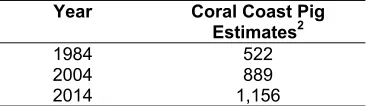
To determine the number of pigs on the Coral Coast, we extrapolated results from our own 2004 field reconnaissance in one village (Tagaqe) and a 2004 piggery survey conducted by IAS. As of 2004, we assume each village contains an average of two piggeries with 10 adult pigs (50 kg each) and 30 juvenile pigs (17 kg each), roughly equivalent to a total of 20.2 adult pigs (50 kg each) per piggery. With 22 villages in the Coral Coast we estimate that 889 pigs are contributing nitrogen to the coral coast in 2004. For 1984 and 2014 nitrogen export scenarios, we assumed the same rate of annual population change as for the villagers (2.7% per year).
For the best management scenario in 2014, we assume that many villages will adopt in-situ shallow or deep-bed composting systems (also known as the pig-on-litter system; Shilton, 1992; Tiquia et al., 1997b; Tiquia et al., 1997a; Imbeah, 1998; Tiquia et al., 1998; Payne, 2000) for most of their piggeries. We expect that composting and land application can substantially reduce piggery waste discharge into surface waters, as well as providing for beneficial reuse of the waste as an agricultural fertiliser and soil conditioner. We selected an export coefficient of 0.25 to reflect a widespread adoption of these types of practices.
Table 2: Estimated numbers of pigs along the Coral Coast.
Year Coral Coast Pig
Estimates2
1984 522
2004 889
2014 1,156
2. Data obtained from field surveys in 2004 and extrapolated to other years by assuming a 2.7% annual rate of change. Pig numbers are expressed in 50 kg mass equivalents.
3.4 Resort hotels
coefficient for hotel wastewater – to account for range of treatment systems found in the hotels.
For our input calculations, we used the standard nitrogen loading of 4 kg of nitrogen per year per person. Human occupancy in 2004 was estimated to be equivalent to a year round population of 1500 individuals. This estimate was derived through two different approaches suggested by Dr. Bill Aalbersberg, Director of IAS:
i) 1147 hotel rooms (Fiji Tourist Development Plan, 1996), 70% occupancy, 2 people per room. This is equivalent to a year round population of ~1600 individuals.
ii) Annual number of guests per year at hotels of the Coral Coast: 100,000 to 120,000. Average stay: 5 days. This is equivalent to a year round population of 1370 to 1640 individuals.
For 1984 and 2014 nitrogen export scenarios, we assumed that tourist numbers along the Coral Coast were increasing at the same rate as for the village population (2.7%).
For our best management scenario in 2014 we assume an export coefficient of 0.3. This assumes that resort hotels will upgrade their wastewater treatment system to include nitrogen removal and will improve their capacity to reuse wastewater for irrigation or other purposes.
Table 3: Number of Tourists (full time equivalents per year) along the Coral Coast.
Year Coral Coast Tourist
population equivalents *
1984 880
2004 1500
2014 1957
* Data for 2004 estimates obtained from IAS and extrapolated to other years by assuming a 2.7% annual growth rate.
3.5 Control of nitrogen export
We are pleased to note that the adoption of widespread nitrogen control practices has the potential to reduce nitrogen export. With controls, nitrogen export in 2014 could be comparable to 1984 levels – even assuming the current rate of growth in the villages, piggeries and hotel business. We believe that public investment in
nitrogen controls for villages and piggeries will be required if nitrogen export to the coral coast is to be reduced. Villages export considerably more nitrogen to the coastal waters than the resorts – and there appears to be scant resources within the villages to address the problem. However, because of the strong level of village organization and the relatively dense village development patterns, a public initiative that focuses on village wastewater and piggeries could yield major results in a short period of time.
Figure 3: Comparison of N export to the Coral Coast from key coastal sources, excluding rivers and streams.
Projections of Nitrogen Export To Coral Coast Of Fiji From Coastal Sources
1984 2004 2014-No Action 2014- Improved Treatment
4.
Village Wastewater Issues
4.1 Current situation
Villages along the Coral Coast rely on individual sewage disposal systems to treat household wastewaters. A combination of site factors, economics and infrastructure present challenges for treating household wastewater to levels that protect sanitation and reduce nitrogen loading to the coastal waters. These include:
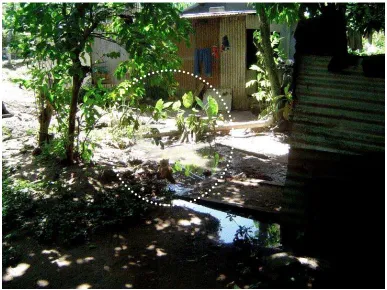
• Dwelling units that are clustered together along the shoreline with little adjacent land available for individual sewage disposal systems. Many dwelling units are within 5 m of the shoreline and are 5–10 m from neighbouring houses or outbuildings.
Figure 4: Village houses and associated latrines (circled) crowded along the lagoon shoreline within ~10 m of beach high tide level. (Photo: Chris Tanner).
Australasia since the 1950’s. They serve to settle solids, and anaerobically degrade and mineralise organic matter before disposal via soak-away pits (cesspools) or (more commonly) soil absorption fields. Properly managed septic tanks (with periodic septage removal) increase the longevity of cesspits and soil absorption systems. Without septic tanks, wastewater disposal systems are prone to clogging, backup and surfacing of untreated wastewater. As well as a practical nuisance, this can result in exposure of people and domestic animals to pathogen-infected wastewater with serious human health risks. In Fiji villages, septic tanks appear to be a relatively uncommon technology, and villagers lack information on their value and design specifications. We observed only one septic tank (concrete) in the village we visited (Tagaqe). Environmental health officials in Fiji are working to increase the use of septic tanks in villages and have included a demonstration septic tank as a part of the onsite wastewater education project that is underway at the Fiji School of Medicine Environmental Health School in Suva. It is important to ensure that systems promoted through this project are good examples of design, construction and management practices for Fiji conditions. Effluent filters have proved to be a cost-effective means of substantially reducing suspended solids carry-over from septic tanks, and protecting the infiltration capacity of soil absorption fields and should be considered for inclusion in this demonstration project.
Figure 5: Demonstration two-chamber septic tank being constructed at the Fiji School of
avoid seepage losses direct to groundwater. Corners, joints and pipe entry and exit points are potential problem areas. (Photo: Chris Tanner).
Figure 6: Village water garden receiving bathroom and laundry greywater from a cluster of surrounding houses. (Photo: Chris Tanner).
• Households are large and contain more than 5 persons per dwelling unit.
The nutrient loading to an individual house wastewater disposal system will be almost twice as high as in the U.S.
sanitation. One advantage of village wastewater practices is that only blackwater (toilet wastes) is normally directed toward soak-away pits. This reduces the extent of carriage water and rate of soil transmission compared to comparable Western situations. Greywater (bathroom, laundry and kitchen waters) contains only a small proportion of household nitrogen and pathogens and is directed to small “water gardens” directly adjacent to the home.
Figure 7: Village individual household greywater treatment garden. (Photo: Chris Tanner).
• There is a lack of funding available to upgrade onsite wastewater
and are likely to pollute nearby beaches and lagoon waters. In comparison to these simple systems, septic tanks represent a relatively large capital investment.
Figure 8: Clogged village household greywater seepage area showing ponding (circled) of
contaminated water. Such areas pose serious risks in terms of contact and transmission of pathogens, as well as potential to generate odour and insect pest nuisances (Photo: Chris Tanner).
have already constructed modern wastewater treatment systems at considerable expense and often value the wastewater as a prime source of irrigation water for their landscaping and golf courses. Planners should explore the feasibility of extending of the Sigatoka sewer to coastal villages, hotels and developments adjacent to the existing sewered areas – and to continue to encourage the return of treated wastewater for use as irrigation water for the hotels. Additional land application, via irrigation, will minimize direct wastewater discharge and reduce the risks of nutrient contamination to coastal waters. Sigatoka municipality is to be commended for incorporating land treatment into their wastewater treatment. A portion of the treated wastewater from the Sigatoka plant is currently piped to a hotel development within 5 km of the plant.
Return of nutrients to land via irrigation is an ideal disposal option providing it is done at sustainable loading rates to prevent surface runoff and minimise leaching losses (Crites and Tchobanoglous, 1998; NZLTC, 2000). Hydraulic application rates and nitrogen loading rates should be checked and monitored for existing and new irrigation schemes. As a preliminary guideline for sandy coastal soils N loading rates should not be more than 100 kg N per year and application rates should probably not exceed 20-30 mm d-1 (Note: these are only rough guidelines; specific local guidelines should be developed taking account of local soil characteristics and climate). Higher N loading rates of 200-300 kg N per year are likely to be possible on land managed for productive cropping or grazing (Crites and Tchobanoglous, 1998; NZLTC, 2000). Suitable treatment levels and health precautions will also be required to protect farm-workers, neighbours, consumers, and livestock.
4.2 Recommendations
4.2.1 Basic onsite treatment requirements
Septic tanks should be promoted as a standard feature of all onsite sewage disposal systems, particularly where flush toilets are installed. It appears that village septic tanks are presently fabricated mainly at the site. To ensure they are properly built they should be pre-tested before being put into operation to assure that the tanks are watertight. Prefabricated plastic tanks with effluent filters are increasingly common in the U.S., and Australasia. These tanks warrant consideration for village use, due to their portability, ease of use and reliability. IAS and the Ministry of Health should encourage the development of standard design guidelines for village blackwater and greywater management.
4.2.2 Reducing nitrogen loads from village wastewater discharges
Conventional septic tank-soil disposal systems are not designed to remove nitrogen from household wastewater, generally removing nil or at most 10% of influent N (Gardner et al., 1997; Crites and Tchobanoglous, 1998). Nitrogen removal for on-site wastewater disposal requires additional design components that augment septic tank-soil disposal systems. Each person in a household generates wastes containing ~4 (range 3-7) kg of nitrogen per year (Gold and Sims, 2001;Henze et al., 1995; Crites and Tchobanoglous, 1998), commonly resulting in daily N loads of 10-13 g N per day (Crites and Tchobanoglous, 1998; NZLTC, 2000). Thus, wastewater from a household of five individuals will generate ~60 g N per day or 20 kg N per year.
Subsurface-flow constructed wetlands, comprising gravel-beds planted with emergent aquatic plants, offer a relatively simple option for further treatment of septic tank effluents. In operation, such systems have been shown to reduce BOD, suspended solids and faecal indicator bacteria levels in domestic septic tank effluents by at least 70%, but TN removal is commonly in the range of ~40-50% (Axler et al., 2001; Davidson et al., 2001; Steer et al., 2002; Thom et al., 1998). Nitrogen removal in these types of wetland treatment system occurs predominantly via denitrification, with overall N removal generally limited (in the relatively anaerobic conditions of the wetland) by initial nitrification of the ammonium-rich septic tank effluents (Tanner 2004).
converts ammonium to nitrate) and then through an anoxic (low oxygen) environment that is rich in organic carbon (where nitrate is converted to nitrogen gas through the denitrification process) (Crites and Tchobanoglous, 1998; Henze et al. 1995). Initial nitrification may be achieved during soil infiltration under appropriate conditions, converting ammonium N to nitrate. However, in most onsite wastewater disposal systems the full sequence of conditions for nitrogen removal, particularly the latter, occurs to only a limited degree before the groundwater plume reaches surface waters. Reported N removal during soil infiltration is in the range of 10-40% (USEPA 2002), but under conditions common in coastal Fijian villages (sandy, low organic matter soils) is likely to be at the lower end of this range (Keeney, 1986; Robertson et al. 1991 Bunnell et al. 1999). The proven practical methods of onsite nitrogen removal available generally involve further treatment of septic tank effluent by passage through an aerobic sand filter (or other porous media, such as gravel) to promote nitrification (van Buuren et al., 1999, USEPA, 2002; Whitehall et al., 2003). Sand filters need to be carefully constructed to minimize the risk of clogging and surface ponding. This is then followed by a denitrification stage, achieved either by recycling back to the septic tank, mixing with greywater, or passage through an anaerobic, organic rich environment (such as a wetland or a flooded sawdust, woodchip or peat bed).
The challenge for Fijian villages is substantial. We are asking them to move from pit privies to onsite nitrogen removal systems – a set of technological changes that took more than 50 years (and is still occurring) in the U.S. and Australasia. To facilitate this process we recommend construction and evaluation of a demonstration household nitrogen removal system.
4.3 Village demonstration project
4.3.1 Proposed design
11). Grey water will also be treated in the constructed wetland, providing an additional source of readily available organic matter to promote denitrification. The sand filter will serve to reduce residual levels of suspended solids (SS), organic matter (measured as Chemical or Biochemical Oxygen Demand, COD or BOD), pathogens and nitrify the wastewater. Every effort should be made to identify and use appropriately graded sand media (0.5-1 mm) that contains few fine particles (<5%, preferably <5%, smaller than 0.3 mm and <1% smaller than 0.1 mm). Clogging and hydraulic failure can result when too much of the sand passes through a #100 sieve (0.15 mm). Low loading rates (< 50 litres/m2) are recommended if the sand media contains > 10% fines (Converse and Tyler, 2000).
Alternatively, if getting appropriate filter sand proves to be a major problem, we would consider a gravel-based recirculating filter. Because septic tank wastes in the villages are restricted to blackwater, the recirculation filter must be designed for high strength wastewater and gravel systems may be preferred. Media specifications for recirculating gravel filters (WSDH, 2000) include: Effective gravel size: 3-5 mm, washed <9.5 mm 100%; 4.75 mm 0-95%; 2.36 mm 0-2%; 0.6 mm 0-0.1% Uniformity coefficient ≤2.
The sand filters need to be intermittently pressure-dosed to disperse effluent evenly across the distribution system, keep the pipe outlet orifices free of biological growths, avoid media clogging and promote nitrification. If these distribution systems do not function properly then frequent maintenance is likely to be required, and system lifetime and treatment performance will be affected. This is a serious issue where relatively strong blackwater is treated in the septic tank.
Operational experience shows that suitable dosing can be achieved either:
2. Actively using a small dosing pump. These draw only 370 watts, have a 20-30 year lifetime and have proved extremely reliable in practice. They cost ~NZ/FJ$500 (US$333) and require a 240 V power supply and pump vault which can be positioned either inside or outside the septic tank.
The dosing pump is the method of choice for the village situation. It seems a relatively big expense for individual household systems, but becomes much more realistic for communal (multi-household) sand filter systems, which we believe are likely to be the most realistic option for the village situation.
Many components of the system will eventually be able to be adapted and constructed from materials available locally. However, for this experimental demonstration we propose to include a number of imported components to simplify construction, operation and management, and ensure that hardware failure does not limit performance. The imported purpose-built components we plan to use are:
1. A proprietary septic tank effluent filter. Effluent filters, which are placed in the outlet of the septic tank, have been increasingly used over the past decade to improve the quality of septic tank effluent and minimize solids carryover. This reduces the risk of clogging of the sand-media and fouling of the distribution system within the subsequent sand filter.
2. A dose pump to recirculate flow through the sand/gravel filter. The dosing pump will be placed in the recirculation chamber, between the septic tank and the sand/gravel filter. A time switch will activate the pump so that it rapidly doses a set volume of effluent into the distribution lines above the sand/gravel filter. This will provide uniform distribution of effluent across the filter and also create alternating periods of saturation and drainage that improve nitrification.
3. A ball valve flow splitter or similar to discharge the excess return flow from the sand filter when the recirculation chamber becomes full.
4. Distribution pipework by which to dose the sand filter.
Figure 11: Conceptual plan of demonstration onsite wastewater treatment system for nitrogen removal from village wastewaters (not to scale). A full village-scale concept would involve multiple septic tanks connected to communal sand/gravel filter and constructed wetland system.
4.3.2 NIWA/URI responsibilities
NIWA and URI will work with commercial providers of onsite wastewater technologies to develop design plans and a list of required materials for the system. NIWA will inform IAS of costs for components required from outside Fiji, will purchase those items on behalf of IAS if required and assure their delivery to IAS. After IAS has procured all other materials and secured the services of a suitable construction firm, Chris Tanner of NIWA will travel to the demonstration village to oversee construction (aim = November 2004). We recommend that IAS assign a junior staff member and/or good graduate to take responsibility for helping bring this project to fruition. As well as assisting with procurement of required supplies, liaison and coordination of personnel, this person would ideally also be involved in performance monitoring and maintenance of the treatment systems.
4.3.3 IAS responsibilities
i) IAS will be responsible for assuring that the design is suitable for village conditions, purchasing and securing all materials and assuring that the required labourers and materials are available at the village when Chris
Septic tank
Greywater Gravel-bed constructed wetlandAlternative = wood-chip filter
Tanner comes to oversee construction. In addition, we ask that IAS provide basic information on the type of the soil surrounding the intended construction site. A simple hole to a depth of 1½ m will suffice to answer the following questions:
• Is the soil sandy or clay or mixed?
• Is groundwater observed (if so, note the depth from the ground surface) within the 1½ m hole? The hole will need to be left open and covered (for safety) for about a day before groundwater levels are observed.
ii) IAS will need to gather information on the availability of different types of sand/gravel aggregate required. Geoff Greene (+679-330-1139), the engineer who designed the Rain Tree Lodge’s wastewater treatment system (Dick Watley has more details) may be a good contact for sources and types of sand and gravel available.
iii) We hope to use some of the local sources of sand and gravel for part of the recirculating media filter. Different sources of concrete sand, sand mixes and gravel used for local construction will be considered. However, experience in the U.S. (Eliasson, 2002) has shown that many concrete sand mixes create clogging problems when used in sand filters. It would be very useful if IAS could obtain some samples of locally available sand mixes and ask either the geoscience or civil engineering departments at USP to run a sieve analysis on samples to obtain the textural distribution. We are interested in the uniformity of the sand/gravel (d60/d10) as well as the effective size (d10). These are
standard engineering properties used to assess the physical attributes of sands and gravels. The d10 is the diameter of particles that is larger than 10% of the
total sample particles (by mass). The d60 is the diameter of particles that is
larger than 60% of the total sample particles (by mass). We would welcome the opportunity to talk directly with any individuals who do this type of work to explain our needs.
indicator for human pathogens and disease. Nitrogen component analyses provide insight into the constraints and effectiveness of the design for protecting coastal water quality. The chloride analysis should serve as a conservative tracer that permits insight into the extent of nitrogen decline caused by physical processes (dilution) vs. biological or chemical removal processes. Please note that treatment within a sand filter and wetland relies on a microbial ecosystem and the system will require several months of use before it is fully operational. Sampling and evaluation of system performance should begin after the system has been in operation for more than 2 months. We hope to be able to include some flow measuring devices to permit IAS to record effluent flow quantities that occur between sampling events. In addition to water sampling, IAS should evaluate the system for signs of ‘failure,’ e.g., wetness, ponding or odours.
4.4 Long term actions
4.4.1 Demonstration, research and training centre for onsite treatment
We recommend the creation of a University-based demonstration/research/training centre for onsite wastewater technologies to assess and develop appropriate technologies and share information. A centre could be the vehicle for the development of regulations, inspection procedures and training programs. Ideally, demonstration/research sites would be located in different regions of Fiji and engage all sectors of the Fijian community involved in village wastewater treatment. Potential audiences would include:
• Local decision makers, e.g., village chiefs.
• Public Health Officials.
• Licensed Plumbers.
• Construction Contractors.
• Village Residents.
We urge IAS to use such a centre to create simultaneous assessments of multiple onsite wastewater treatment designs in controlled settings. We have learned that subtle differences in design or maintenance are often the key to success or failure in system performance. Comparing the function, cost and maintenance requirements of multiple systems would greatly advance the adoption of reliable technologies by Fijian villages. For example, from our past experiences, we note that composting systems will work within a limited range of design and operational parameters – and will fail (e.g., become wet, anaerobic, malodorous insect-filled waste piles) if those parameters are violated. Controlled experiments can help define those boundaries within the climate and technology of Fiji and provide essential insights that will stimulate adoption and reliability of new technologies.
In the U.S. these types of demonstration centres are located within Universities and are organized into a group known as the Consortium of Institutes for Decentralized Wastewater Treatment. The following website describes the centres.
http://www.onsiteconsortium.org/
Quoting from this website:
“The Onsite Consortium is a group of Educational Institutions cooperating on decentralized wastewater training and research efforts. The Consortium also includes people from educational institutions, citizens groups, regulatory agencies and private industry.
As funding for centralized wastewater collection and treatment has diminished there has been a dramatic shift in interest among professionals and the public towards decentralized wastewater technologies which can be environmentally compatible and cost-effective.
The Consortium is working to provide curriculum that will expose university engineering and science-students to decentralized wastewater treatment options and to provide educational opportunities for citizens, decision-makers, regulators and consultants. An international effort is being coordinated to focus and encourage research and education about decentralized wastewater treatment and to:
• Encourage interdisciplinary collaboration among engineering and the sciences; • Advance commercialisation of new approaches and tools for wastewater
treatment, and
• Promote multi-sector collaboration and communication among Consortium institutions, professionals, and the public.”
4.4.2 Village-scale treatment units
We recommend that communal (e.g., cluster) onsite treatment systems be considered to treat village wastewater. “Cluster” systems are frequently used for the type of compact residential development that characterizes Fijian villages. Wastewater from multiple homes could be collected and treated in a common sand filter and wetland. An entire village could be served by one system – or several community systems could be created that each receives wastewater from 3 – 15 homes. Individual dwellings would either have their own septic tank or their wastewater would flow to a common septic tank and be directed into a pumping chamber that leads to a intermittent or recirculating sand filter. The U.S. EPA has a fact sheet on sand filters that can be obtained at the following website:
(http://www.epa.gov/owm/mtb/decent/technology.htm).
Community-scale sand filter systems are comparatively simple – but they do require dosing pumps and appropriate media. The pumps provide pressurized dosing onto the sand filter, which assures uniform, intermittent application of wastewater – the key to aerobic sand treatment. An excellent dynamic simulation of what happens during the dosing cycle of a sand filter can be found at: (http://www.vdh.state.va.us/onsite/Howitworks/Fixed-Film/FixedFilm-1.htm). With the appropriate media, a recirculating sand filter can be relatively small and receive daily loadings up to 200 litres/m2. An example of a recirculating sand filter for a
village of 200 was created at Puerto Barrios, Guatemala in partnership with U.S. AID and Orenco Systems, Inc. More information on this system is available at: http://www.epa.gov/region4/sesd/reports/2001-0141.html
Systems, Inc.) or similar companies that specialize in sand filter technologies should be approached for these efforts. Ideally, most of the village systems would be of similar design and materials, enabling the villages and local governments to share information on construction, operation and maintenance.
Community treatment offers several advantages:
i) Village wastewater treatment could be rapidly upgraded. This will require investment – but the investment will assure a high level of sanitation and nutrient removal at the village level.
ii) The use of open space is optimised. Each dwelling unit does not need to have a separate system. Instead, wastewater treatment can be placed in optimal locations, away from traffic and back from the coast. Central village green areas may be suitable for buried septic tanks and sand filter systems.
iii) Community sand filters have a long and successful record of treating wastewater in a relatively simple, low–maintenance (not ‘no maintenance’!) fashion.
4.4.3 Operation and maintenance capability
Recommended maintenance for community and cluster treatment systems includes periodic pumping of sludge solids from the septic tank, weeding of the sand filter surface (if exposed to the surface), raking or replacement of the uppermost filter surface if clogging mats appear, and checking and maintenance of any leaks or clogging within the distribution system (USEPA, 2000). Any program that addresses wastewater at the village level will need to ensure that trained personnel are available for servicing and maintaining the village technologies. These individuals might be employees of the Sikatoka municipal wastewater treatment plant and “circuit-ride” the Coral Coast on a regular schedule to conduct periodic maintenance.
4.4.4 Groundwater tracer studies
We caution that field studies intended to track the fate of septic system plume can be complex, often requiring an intensive network of groundwater wells. IAS should partner with individuals experienced in detecting and sampling groundwater contamination or rely on similar studies (e.g., Crennan, 2001) conducted elsewhere within the South Pacific. A number of factors can confound groundwater tracking field experiments:
• Flow rates are often very slow and difficult to predict in advance of sampling. Crennan (2001) working in Tonga at a site with weakly cemented fine to coarse sands, found that Rhodamine-WT dye and a bromide tracer introduced into the shallow groundwater moved 4 cm/day and 36 cm/day, respectively. The Rhodamine dye produces a visible red colour in groundwater and was expected to serve as a useful demonstration of the risks of groundwater contamination from pit privies to wells. However, the Rhodamine dye was not detected in any full-scale field studies. It was only detected in wells located 30 cm from the point of introduction.
• Flowpaths strongly affected by variations in the texture of the saturated media. Plumes will follow the pathway of coarser layers of saturated media and may not move directly to the coastal waters.
• Other sources confound tracking efforts. In village situations, the nitrogen signal from a specific septic system may be obscured by the elevated background contamination that results from multiple dwelling units and errant animals.
• To determine the fate of onsite wastewater from the source to the sea could require a large number of wells, the addition of a tracer and intensive sampling. Robertson et al. (1991) required >250 wells to track the groundwater movement from a plume over a distance of 130 m.
4.4.5 Evaluating the role of rivers and streams
5.
Hotels
5.1 Small hotels
5.1.1 Current situation
Small hotels in Fiji use a variety of wastewater treatment systems (Institute of Applied Science, 2004). These systems are designed to treat wastewater from individual rooms, clusters of rooms or from the entire establishment. Based on information from the Fijian Department of Environmental Health, the designs include septic tank-soil disposal units, composting toilets and various automated package plants. While many of these systems can markedly improve wastewater treatment, the potential for failure presents considerable risks to human health and coastal water quality that warrant careful testing and evaluation. Specific questions include:
• What level of treatment will be achieved for nutrients, pathogens and organic wastes?
• How will performance vary with season (wet vs. dry) and different levels of loading?
• What are the frequency and types of maintenance or repair?
• How often does a system fail, e.g., create surface ponding or unexpected surface water discharge of partially treated effluent?
5.1.2 Recommendations
Immediate:
• Develop a monitoring and risk assessment program for small hotel treatment systems. As septic tanks provide only minimal N removal, there is a need to identify and demonstrate supplementary nitrogen removal technologies suitable for small hotel systems.
• We suggest that any new wastewater system design be granted a trial (i.e., experimental) permit that restricts use of this technology to a specific location and specific time period, pending a performance test. The performance test should require participation in a two year, 3rd party assessment. For a new design, the small hotel and its engineering firm must agree to regular sampling by neutral (3rd party) evaluators and must create access ports to facilitate that sampling. Sampling should occur before the effluent is directed to its final destination, i.e., in advance of irrigation, soil discharge or surface discharge. The 3rd party evaluation should compare system performance to levels agreed upon by all parties in advance of construction.
• We urge the Fijian community of regulators, engineers, scientists and hoteliers to maintain a healthy scepticism of treatment levels and operational efficiencies promised by consultants for new system designs. Although the reliability of small onsite wastewater technologies has greatly improved over the past decade, promised levels of nutrient removal are often overblown. We also recommend that “final” effluent be used for irrigation or for subsurface wetland treatment systems to provide polishing and reduce the risks associated with treatment variability.
• Reuse of treated wastewaters for irrigation of lawns and gardens around hotels, as practiced at some of the larger hotels such as The Fijian, is an ideal disposal strategy for many coastal areas along the Coral Coast. When irrigation is undertaken at correct hydraulic and contaminant loading rates, substantial quantities of nutrients and other residual contaminants can be removed by plants and soils. This practice also has the potential benefit of reducing demand for potable water along the coast. Guidelines for appropriate irrigation rates should be established for various soil types and situations common along the Coral Coast, and operators trained in their application.
5.1.3 NIWA/URI responsibilities
5.1.4 IAS responsibilities
IAS will be responsible for assuring that the design is suitable for the Crusoe Hotel, purchasing and securing all materials and assuring that the required labourers and materials are available at the hotel site when the partner company comes to oversee construction. IAS will work with NIWA to identify sources and costs of all required materials.
IAS would be responsible for sampling and analysis of wastewater:
• from the septic tank effluent (in advance of mixing with the dosing tank);
• after media filtration;
• after any further treatment, such as a wetland, prior to soil disposal.
We would expect that IAS will want to gather samples on a routine basis (monthly or bimonthly) and analyze samples for: faecal coliforms; nitrogen (TKN, ammonium; nitrate-nitrate); and chloride. Please note that treatment relies on a microbial ecosystem and the system will require several months of use before it is fully operational. Faecal coliforms are a standard indicator for human pathogens and disease, nitrogen component analyses provide insight into the constraints and effectiveness of the design for protecting coastal water quality and the chloride analysis should serve as tracer that permits insight into the extent of nitrogen decline caused by physical processes (dilution) vs. biological or chemical removal processes. Sampling and evaluation of system performance should begin after the system has been in operation for more than 2 months. Ideally actual wastewater flows should also be measured, either after the septic tank or sand filter to quantify the actual volumes being treated. In addition to water sampling, IAS should evaluate the system for signs of wetness (evidence of leakage), ponding (evidence of fouling of the sand filter), odours or other nuisances.
5.2 Large hotels
5.2.1 The Fijian
The hotel’s Chief Engineer Paul Bruce showed us around the Fijian Hotel system. He informed us that water usage at the hotel was very high at around 1 m3 d–1 per guest (3-5 times normal domestic water use rates), resulting in around 100 m3 d-1 of wastewater from the hotel as a whole. A recirculating oxidation ditch, activated sludge system is used for primary and secondary treatment of the hotel wastewaters (Fig.12). The treated effluent then flows to two storage ponds (Fig. 13), the first of which is set up for recirculating flow through a cascade of small constructed wetlands situated on the hill above (Fig. 14). The treated wastewaters are then reused via spray irrigation onto the hotel’s golf course. Assuming supplies of freshwater are sufficient to support it and nutrient application rates are at levels able to be sustainably assimilated by plants and soils with minimal leaching, this would appear to be an ideal solution. It allows beneficial reuse of the treated wastewaters, whilst providing additional nutrient removal from the wastewaters before they make their way back to the sea.
Figure 12: Recirculating oxidation ditch activated sludge wastewater treatment system in operation at the Fijian Hotel. (Photo: Chris Tanner).
The three constructed wetlands operate as a stepped cascade through which treated wastewater from the initial storage pond is recirculated by pump. Aeration riffles are set up between each wetland and in the return flow to the pond. This recirculation system was not functioning at the time of our visit, because there was insufficient water available in the storage ponds. The wetlands had been set up 3-4 years ago by a Fijian NGO (FSP-Fiji; http://www.livingwater.org.uk/lwct/pages/fiji/pro_fiji.htm#) with technical input from the Living Water Charitable Trust in the UK (<http://www.livingwater.org.uk/lwfs.html>). Problems had been experienced with the prolific growths of the free-floating aquatic weed water hyacinth (Eichhornia crassipes) that had established in the wetlands. These had been eventually removed to reduce management requirements.
Figure 14: One of a series of three surface-flow constructed wetlands set up to receive treated wastewaters recirculated from the adjacent irrigation water storage pond. (Photo: Chris Tanner).
5.2.2 Hideaway
At the Hideaway Resort we were shown around a newly installed (but still not complete) Sequencing Batch Reactor (SBR) package treatment system by the Manager Robert Wade. The New Zealand-sourced Reaman Industries SEBAS system (<http://www.reaman.co.nz/>) comprises a series of reactor tanks that sequence through cycles of aeration, rest and decantation. A final ultraviolet lamp unit is used for disinfection of the effluent, making it potentially suitable for garden irrigation and possible reuse for toilet flushing etc. The system installed incorporates an array of sensors and controls that allow it to be monitored and operated remotely from New Zealand via a telemetry system.
Properly functioning SBR systems such as these are able to provide high levels of BOD and SS removal, and are also capable (with optimisation) of significant nutrient removal. One of the big advantages of such systems is their relatively small land area requirements or physical ‘footprint’, and high level of process control. They, however, depend on significant electrical energy inputs to provide mechanical aeration and mixing of the wastewaters during treatment, and produce quantities of waste sludge that needs to be appropriately disposed of. This means that they have a relatively large ‘ecological footprint’ and require good management, technical expertise and back-up, to keep them operating properly. Operational performance and costs should ideally be monitored at this installation over the next few years to assess its practicality and cost-effectiveness under Fijian conditions.
Paul Wade was interested in the option of using a constructed wetland to provide further treatment of the effluent from this plant before discharge to the creek that flows around the hotel site. Having, seen the Fijian Hotel wetland system, he had assumed that wetland treatment would require use of a cascade of wetland cells on an adjacent hillside. There are, however, a wide range of alternative wetland treatment designs and options available that may be more appropriate for this application (Kadlec & Knight, 1996; USEPA, 2000;
<http://www.epa.gov/ordntrnt/ORD/NRMRL/Pubs/2001/wetlands/625r99010.pdf>).
6.
Nitrogen from Piggeries
6.1 Current situation
Small piggery operations are a traditional part of Fijian villages. Pigs are used in ceremonial meals and special occasions throughout the year. Piggeries may be increasing in size and number due to the availability of cheap, abundant food waste from hotels. We note that the Ministry of Environmental Health commented that food waste was required to be cooked before it could be used for pig feed, and suggested that this requirement might impede the use of this feed source for the piggeries. It would be very useful to gather information on the quantity, cost and nature of piggery food sources, and whether, in fact, they are being cooked before being used as pig feed. In addition to a potentially large food supply, markets for pork are developing in Sigatoka and other communities. More detailed information on the recent and projected trends in piggeries along the Coral Coast would help establish the potential impact of piggeries on human health and the coral ecosystems.
Pigs are commonly housed in small pens, often located at the edge of streams and ephemeral creek channels (Figs.15-18). Village piggerieslack any form of treatment system and the waste either drops directly in the riverbank or is washed into the river channel through drainpipes. Waste accumulates in the channels and on the stream banks until it is carried to the sea by rainfall-generated runoff. Pig waste is a major source of nitrogen loading to the near shore waters of the Coral Coast (see Nitrogen Export Projection Budgets below) – and thus poses a risk to the sustainability of the coral ecosystem.
Figure 16: Moderate-sized (~30 pigs) village piggery on the banks of a small coastal stream on the Coral Coast. These concrete stalls were being washed down with a hose during our visit. The effluent pipes which drain directly to the stream are visible on the left hand side of the picture. (Photo: Chris Tanner).
highly infectious to humans (Cole et al., 1999; Hill, 2003). Such zoonotic pathogens and parasites can be readily transmitted to humans through direct occupational exposure to faecal wastes or contaminated land, groundwaters and surface-waters. Exposure can also occur more indirectly though consumption of contaminated food sources, such as filter-feeding shellfish or waste-irrigated crops.
Figure 17: Collection of small village piggery enclosures (~25 pigs in total) situated
approximately 20 m from beach high tide level. This area was in a depression where drainage from the adjacent hillside ponds during rainfall. Contaminated water from this site would then either seep as groundwater to the nearby beach or adjacent stream. (Photo: Chris Tanner).
6.2 Recommendations
•
Move piggeries away from streams and ephemeral channels. This should enhance the potential for soil and vegetation to retain and treat wastes before it reaches surface waters and ravines.Longer Term:
•
Develop sustainable systems that promote improved production and reduce offsite waste contamination. NIWA will explore the design and management aspects of “in-pen” composting systems used in New Zealand. These systems hold promise for stabilizing piggery waste and eliminating disposal into surface waters.•
Build connections with other initiatives in the Pacific Islands that are focused on piggery management. A major university/governmental initiative focused on curtailing piggery contamination is now underway in American Samoa:http://ag.arizona.edu/region9wq/cnmisuccess.htm
7.
Acknowledgements
This report includes information from a broad range of sources drawn together during an approximate one-week visit to the Coral Coast. It draws together knowledge and discussions shared by a range of local people. In particular, we are indebted to Professor Bill Aalbersberg (USP) for organising and hosting our visit, and providing an invaluable source of local information, contacts, innovative ideas, and comradery. With the additional input and assistance of Batiri Thaman, we were provided with an intensive introduction to waste management issues along the Fijian Coast, and an insight into Fijian village lifestyles and realities.
Brian Crawford of the Coastal Resources Center at the University of Rhode Island helped steer our path, provided sage advise when required and was a pleasure to get to know. A range of Government officials, Fiji School of Medicine and NGO staff provided valuable background information. Managers of a number of resorts and hotels took time out of their busy schedules to show us their wastewater treatment facilities. Dick Watley provided valuable additional background information and hosted a beautiful sunset yaqona session on his balcony in the hills above Suva. Maikeli McMillan and a number of other US Peace Corp workers also shared their local experiences and perspective with us during our visit.
8.
References
ASAE, (2000). Manure production and characteristics. ASAE Standard D384.1
DEC99, American Society of Agricultural Engineers, St Joseph, MI.
Axler, R.; Henneck, J. & McCarthy, B. (2001). Residential subsurface flow treatment
wetlands in northern Minnesota. Water Science and Technology, 44 (11): 345-352. Bellwood, D.R.; Hughes, T.P.; Folke, C. & Nystrom, M. (2004). Confronting the coral
reef crisis. Nature, 429: 827-833.
Bos, J.F.F.P. & de Wit, J. (1996). Environmental impact assessment of landless
monogastric livestock production systems. Working Document Livestock and the
Environment: Finding a Balance. FAO/World Bank/USAID. Rome.
Bunnell, J.F.; Zampella, R.A.; Morgan, M.D. & Gray, D.M. (1999). A comparison of
nitrogen removal by subsurface pressure dosing and standard septic tanks in sandy
soils. Journal of Environmental Management 56: 209-219
Cole, D.J.; Hill, V.R.; Humenik, F.J. & Sobsey, M.D. (1999). Health, safety and
environmental concerns of farm animal waste. Occupational medicine: state of the art reviews, 14: 423-448.
Converse, J. & Tyler, J. (2000). Wisconsin mound soil absorption systems: Siting,
design and construction manual. Small Scale Management Project. Univ. of
Wisconsin, Madison.
Crennan, L. (2001). Integration of social and technical science in groundwater
monitoring and management. IHP-V. Technical Documents in Hydrology. No. 43.
UNESCO, Paris.
Crites, R.W. & Tchobanoglous, G. (1998). Small and Decentralised Wastewater Management Systems. WCB/McGraw Hill, Boston.
Davidson, L., Headley, T. and Edmonds, M., 2001. On-site domestic wastewater
Eliasson, J. (2002). Sand/Media Specifications. Rule Development Committee Issue
Research Report. Wastewater Management Program. Washington State Dept. of
Health. 10 pages.
Gardner, T.; Geary, P. & Gordon, I. (1997). Ecological sustainability and on-site
effluent treatment systems. Australian Journal of Environmental Management, 4: 144-156.
Gold, A.J. & Sims, J.T. (2001). Research needs in decentralized wastewater treatment
and management: A risk based approach to nutrient contamination. Pages 114-146.
In: T. Yaeger, ed. National Research Needs Conference Proceedings. Risk Based
Decision Making for On-site Wastewater Treatment. U.S.EPA/EPRI.
Heikoop, J.M.; Risk, M.J.; Lazier, A.V.; Edinger, E.N.; Jompa, J.; Limmon, G.V.;
Dunn, J.J.; Browne, D.R. & Schwarcz, H.P. (2000). Nitrogen-15 signals of
anthropogenic nutrient loading in reef corals. Marine Pollution Bulletin, 40: 628-636.
Henze, M.; Harremoes, P. & la Cour Jansen, J. (1995). Wastewater Treatment: Biological and Chemical Processes. Spinger-Verlag, Berlin.
Hill, V.R. (2003). Prospects for pathogen reductions in livestock wastewaters: a
review. Critical Reviews in Environmental Science and Technology, 30: 187-235. Imbeah, M. (1998). Composting piggery waste: A review. Bioresource Technology,
63(3): 197-203.
Institute of Applied Science. (2004). A review of the standard of wastewater treatment
in Fiji’s tourism industry. University of the South Pacific. 45 pages.
Kadlec, R. H. & Knight R. L. (1996). Treatment Wetlands. Boca Raton, FL, CRC Press.
Keeney, D.R. (1986). Sources of nitrate to ground water. CRC Critical Reviews in Environmental Control 16: 257-304.
Mosley, L.M. & Aalbersberg, W.G.L. (2003). Nutrient levels in sea and river water
along the ‘Coral Coast’ of Viti Levu, Fiji. Institute of Applied Science, University
of the South Pacific, Suva, Fiji Islands. 7 pages.
NZAEI, 1984. Agricultural Waste Manual. NZAEI, Lincoln College, Canterbury, New Zealand.
Payne, H. (2000). Review of alternative housing systems for pigs. PRDC Project:
DAW41/Project 1465, Agriculture WA, Bentley, WA, Australia.
Robertson, W.D.; Cherry, J.A. & Sudicky, E.A. (1991). Ground-water contamination
from two small septic systems on sand aquifers. Ground Water 29: 82-92.
Shilton, A. (1992). Shallow-bed composting in a New Zealand piggery, Department of
Process and Environmental Technology, Massey University. Palmerston North,
NZ.
Siegrist, R.L. & Jenssen, P.D. (1989). N removal efficiency during wastewater
infiltration as affected by design and environmental factors. In: R.W. Seabloom
and D. Lenning, eds. Proceedings 6th Northwest On-Site Wastewater Treatment
Short Course. University of Washington. Pp. 304-318.
Sommer, S.G.; Christensen, B.T.; Nielsen, N.E. & Schjorring, K.J. (1993). Ammonia
volatilization during storage of cattle and pig slurry. Journal of Agricultural Science 121: 63-71.
Steer, D.; Fraser, L.; Boddy, J. & Seibert, B. (2002). Efficiency of small constructed
wetlands for subsurface treatment of single-family domestic effluent. Ecological Engineering, 18: 429-440.
Steffy, L.Y. & Kilham, S.S. (2004). Elevated [delta] 15N in stream biota in areas with
septic tank systems in an urban watershed. Ecological Applications, 14: 637-641. Tanner, C.C., 2004. Nitrogen removal processes in constructed wetlands. In: M.H.
Wong (Editor), Wetlands Ecosystems in Asia: Function and Management. Elsevier, Amsterdam, The Netherlands.
Thom, W.O.; Wang, Y.T. & Dinger, J.S. (1998). Long-term results of residential constructed wetlands. In: D.M. Sievers (Editor), On-Site Wastewater Treatment, Proc. of 8th National Symposium on Individual and Small Community Sewage
Systems. Am. Soc. Agric. Engineers, St. Joseph, MI, pp. 220-227.
Tiquia, S.M.; Tam, N.F.Y. & Hodgkiss, I.J. (1997a). Composting of spent pig litter at
different seasonal temperatures in subtropical climate. Environmental Pollution,
98(1): 97-104.
Tiquia, S.M.; Tam, N.F.Y. & Hodgkiss, I.J. (1997b). Effects of turning frequency on
Tiquia, S.M.; Tam, N.F.Y. & Hodgkiss, I.J. (1998). Changes in chemical properties
during composting of spent pig litter at different moisture contents. Agriculture, Ecosystems & Environment, 67(1): 79-89.
USEPA (2002). Onsite wastewater treatment systems manual. EPA/625/R-00/008,
Office of Water, United States Environmental Protection Agency, Washington DC.
van Buuren, J.C.L.; Abusam, A.; Zeeman, G. & Lettinga, G. (1999). Primary effluent
filtration in small-scale installations. Water Science & Technology, 39(5): 195-202. USEPA (2000). Constructed Wetlands Treatment of Municipal Wastewaters.
Cincinnati, OH, United States Environmental Protection Agency.
Whitehall, T.J.; Tercha, B. & Davis, J.F. (2003). Evaluation of a recirculating sand
filter followed by a subsurface-flow constructed wetland to achieve denitrification.
Small Flows Quarterly, 4 (4): 30-35
WSDH (2000). Recirculating Gravel Filter Systems: recommended standards and
guidance for performance, application, design, operation and management,