THE EFFECT OF BI RATE’S DECREASE TOWARD THE
MARKET REACTION IN INDONESIA STOCK EXCHANGE (IDX)
Riwi Sumantyo* and Devi Anggraeni
Economic Development Department,
Faculty of Economic and Business, Sebelas Maret University Surakarta *Correspondence E-mail: [email protected]
Recieved: November 2016; Accepted: December 2016
Abstract
This research aims to analyze the market reaction that can be seen from the abnormal return and trading volume of activity against BI rate’s decrease announcement which is the lowest point in 2011. Research methods using paired samples t-test. Data used in this research include the date of announcement of the BI rate which is used as the event date (t0), daily closing share price of companies in a period of observation, LQ-45 index daily, the number of shares traded or daily volume, and the number of shares in circulation or listed share. This research uses 39 companies listed in the LQ 45 Index listed in BEI as samples. Result of this research is the absence of differences of Abnormal Return and Trading Volume of Activity before and after the announcement. The possibility of this situation was caused by the negative sentiment arising due to the debt crisis in Europe that there is never a solution so it affects the psychology of investors un decision-making.
Keyword: BI rate’s announcement, abnormal return, trading volume activity JEL Classification: D51, E43
1. Introduction
Security market is very sensitive to the announcement of an event, issue, and rumor developing. This research studies the decrease of BI Rate by 50 bps on November 11, 2011. This decrease was beyond the market expectation, because BI Rate commonly decreases by 25 bps. It results in market reaction that can be seen from Abnormal Return and Trading Volume Activity referring to Eugene Fama’s theory concerning Efficient Market Hypothesis (Nuka, 2004; Linawati, 2009).
Phenomenon and information existing today highly affect the security market’s sensitivity to stock price and stock trading volume that in turn will affect the return of share obtained, as suggested by Robert Ang (1997) that the economic condition analysis is the basis of security analysis, in which when the economic condition is poor, the return of circulating share will reflect the comparable decrease or abnormal return. Otherwise, when the economic condition is good, it will reflect the good stock price affecting positively the return of share.
Considering the announcement of BI Rate on November 10, 2011, BI Rate level was the lowest one since 2005. It was expected that the decrease of BI Rate will encourage the investor to enter into security market. The decrease of BI Rate is due to the government’s optimism with the economic growth level and the low inflation rate.
Some studies have investigated the effect of macroeconomic condition announcement showing different findings. Lantara (2004) studying the change of interest rate and performance of Indonesian security market found that the decrease of interest rate impacts on positive reaction to market return and the increase of interest rate results in negative reaction to market return. This study (Lantara, 2004) concluded that the market reacts to the announcement of interest rate change. Similarly, Utami and Rahayu (2003) concluded that interest rate affects significantly the stock price.
The different result is found in Linawati (2009) stating that the announcement of BI Rate increase affects negatively the abnormal return in the companies with DER more than one, but there is a significant difference in trading volume activity between the companies with DER less then one and those with DER more than one.
The hypotheses to be studied in this research are firstly, there is a difference of mean abnormal return in LQ-45 share before and after the announcement of BI rate on November 10, 2011. Secondly, there is a difference of mean trading volume activity (TVA) in LQ-45 share before and after the announcement of BI Rate on November 10, 2011.
2. Research Methodology
The period of data collected to be analyzed was time series data with observation period of November 3-17, 2011. The population of research was all of companies enlisted in LQ-45 index in Indonesian Stock Exchange (ISE). The sampling technique used was purposive sampling, with the following criteria: the companies do not take other corporate action such as right issue, stock split, dividend sharing and bonus share sharing and LQ-45 companies traded everyday during the research period.
The variables of research were abnormal return and trading volume activity, in which
independent variables. Abnormal return is the difference of actual return from expected return estimated with the following formula:
ARi,t = Ri,t – E [Ri,t]
where Ri,t is Actual return used as the basis to estimate the actual return using the formula below:
Meanwhile E[Ri,t] is the expected return estimated using adjusted market model estimated by regressing on the actual return of each share in the estimation period with the return of market index (LQ-45) estimated using the following formula:
Having known the daily abnormal return, the
ratio of mean abnormal return before- to-that after the date of announcement is found.
Trading Volume Activity (TVA) is the ratio of share sheet number at certain time to share
number circulating at certain time (Suad Husnan
et al, 2005). So, TVA is measured with the
following formulation (Foster, 1986 in Husnan, et
al, 1996):
Having found out the daily trading volume activity, the ratio of mean trading volume activity before-to-that after the date of announcement is found.
3. Analysis and Discussion
abnormal return and trading volume activity are estimated. Thereafter, data normality test was conducted using Kolmogorov-Smirnov and Shapiro Wilk Tests. If the result of data processing shows the significance probability above 5% (0.05) meaning that the data of variable has been distributed normally. Furthermore, hypothesis
testing is conducted to find out whether or not there is a significant difference between abnormal return and trading volume activity before the date of announcement (days -1 to -5) and that after the date of announcement (days + 1 to +5) using paired two sample t-test for means and significance level of 5%.
3.1. Data Normality Test
Table 1. Data Normality Test on Average Abnormal Return and Trading Volume Activity Variables Before and After the announcement of BI Rate
Variable Time Kolmogorov-Smirnov Shapiro-Wilk Significance Conclusion Significance Conclusion
Average
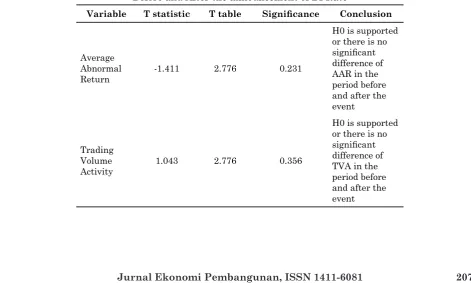
Table 2. The result of Paired Sample Test Average Abnormal Return and Trading Volume Activity Before and After the announcement of BI Rate
Variable T statistic T table Significance Conclusion
Average Abnormal Return
-1.411 2.776 0.231
H0 is supported or there is no
There is no significant difference of Average Abnormal Return in the period before and after the event, meaning that the announcement of BI Rate does not contain information/signaling about the presence of profit in the future.
The mean Trading Volume Activity not different significantly indicates that the market does not consider that the incoming information is important information that can affect the trading. The announcement of BI Rate can evidently affect significantly the trading volume. The mean share trading volume is not affected by the announcement of BI rate decrease. The investor does not consider new information as the important one that can affect their investment measure (action).
4. Conclusion and Recommendation Considering the analysis conducted on the hypothesis, the following conclusions could be drawn. Firstly, the result of t-test on the mean Abnormal Return in the period before and after the announcement of BI Rate shows no significant difference of Abnormal Return between before and after the event. In contrast, the result of research using signaling theory shows different result indicating that when the interest rate decreases, the fund invested will be withdrawn and the investor will invest the fund in the more profitable aspect, for example, security market. This result deriving from signaling theory is because of the negative sentiment due to debt crisis in European affecting the psychology of investor in decision making.
Secondly, the result of t-test on the mean Trading Volume Activity in the period before and after the announcement of BI Rate decease statistically shows that there is no significant difference of TVA before and after the announcement of BI Rate decrease. It is because the investors invest their fund more cautiously and wait for the clarity of news related to the
Thirdly, the result of t-test on the mean Abnormal Return and Trading Volume Activity shows no significant difference between before and after the announcement of BI Rate decrease because it is affected more by foreign factor, in this European case debt crisis. The announcement of BI rate decrease by 50 bps that should be the information exerting positive effect because it is beyond the market expectation, can be defeated by regional sentiment exerting negative affect.
Considering the result of research, the following recommendations can be given. Firstly, the variable studied can be added with Adjusted Return (MAR) and Cumulative Mean-Adjusted Return (CMAR) so that it is expected to represent the effect of BI Rate decrease more accurately.
Secondly, the method to look for market return used in this research is market adjusted model that may estimate the actual abnormal return less accurately. For that reason, another method can be used (e.g. mean-adjusted model or market model) in the next researches.
Thirdly, the sample should be increase in order to represent each of industries thereby the reaction is elicited from each of them.
5. References
Ang , Robert . 1997. Buku Pintar Pasar Modal Indonesia.Jakarta: Mediasoft.
Fama, Eugene. 1997. Market Efficiency, Long Term Return & Behavioral Finance. Journal of Finance Economics Vol 49. 2004. The Behavior of Interest Rates.University of Chicago: Graduate School of Business
Husnan, Suad. 1996. Dasar-Dasar Teori Portofolio dan Analisis Sekuritas.UPP AMP YKPN
Lantara, I Wayan Nuka. 2004. Perubahan Tingkat Suku Bunga dan Kinerja Pasar Modal Indonesia. Jurnal Ekonomi dan Bisnis Indonesia Vol 19
terhadap Abnormal Return dan Trading Volume Activity (Studi Komparasi Pada Perusahaan Manufaktur Terdaftar di BEI dengan DER < 1 dan DER > 1).Thesis Program Studi Magister Manajemen Universitas Diponegoro