270
The Influence of Service Quality As A To Total of Quality Management
(Study In Badan Pertanahan Nasional Office Yogyakarta)
Wahyu Handayani1), Wisnalmawati2), Winarno3) Magister of Management
Faculty of Economics and Business
Universitas Pembangunan Nasional "Veteran" Yogyakarta Corresponding e-mail: [email protected]
Abstract: One of the important tasks of the Ministry of ATR/BPN is to carry out the integrated and integrated Land Resources Management by utilizing the development of modern information and management system technology. This research aims to: 1. analyze Total Quality Management that directly affects the applicant’s satisfaction, 2 Total Quality Management influence on the requester satisfaction mediated by Service Quality. Subjects in this research are applicants’ satisfaction of Pertanahan Office Yogyakarta. The sample uses as many as one hundred respondents, data analysis technique uses Structural Equational Model (SEM) with SmartPLS Program. The results of this research prove: 1. analyze Total Quality Management that directly affects the requester satisfaction, 2. Total Quality Management Total Quality Management influence on the requester satisfaction mediated by Service Quality. The findings of this study may contribute to consumer behaviour models, in Badan Pertanahan Nasional (BPN) office Yogyakarta and Tripple duties of Higher Education.
1. INTRODUCTION
One of the important tasks of the Ministry of ATR/BPN is to carry out the integrated and integrated Land Resources
Management by utilizing the
development of modern information and management system technology. The main service given is a land certificate includes land register and survey report.
Many approaches to TQM concept have resulted in different definitions. Richard, et.al (2011) explain that TQM stands for four indicators such as top management, employee involvement, continuous improvement, and customer focus. Based on Cheng, et al (2012) says that TQM system implementation must be oriented on seven basic principles.
According to Ooi et.al (2011), TQM practice is significant and positively related with customer satisfaction and service quality in small service business.
Susan et, al. (2012), says that TQM can be implemented in the other fields, like hospital.
The various definitions of Total Quality Management (TQM) are raised by the ex perts. In this case is based on
implementation of the current
organization. Total Quality Management can be defined as a holistic management philosophy that is aimed to renew all the organizational function and fulfill the customer’s needs and qualifications by giving TQM is often called by social act. Ooi et.al (2011), TQM practice is significant and positively related with customer satisfaction and service quality. In this research, TQM concept is head for the customer’s focus. In this case, TQM is implemented in Badan Pertahanan Nasional office based on the land measure’s applicant perception.
271
desires that will change almost every time. Peter and Olson (1996) state that customers’ satisfactions are the summary of psychological condition generated
when the emotion surrounding
expectations are not matched and doubled by the feelings formed about the consumption experience. Engel & Blackwell (1994) say that satisfaction is a post-consumption evaluation to choose some alternatives in order to get the expectations.
The description of applicant satisfaction phenomenon in Badan Pertahanan Nasional (BPN) can be explained that applicant is satisfied; on field measurement and maps, the officers’ quality, self-administering
without officers’ help, land
infrastructure, the paid cost conformity, measurement cost, notification about the detailed information, and the finishing time of land measurement letter.
In the case of satisfaction, not all of the customers are satisfy, by watching the proof about the customers’ complains to BPN, it does not show that customers’ satisfaction can be realized optimally. So, the study of customer’s satisfaction is needed.
Total Quality Management in BPN office about the leadership shows that there is a good harmony of all the officer, planning system and field practicum is always on time, focus on doing the best for the applicant, all of the works done professionally, and the applicants’ measurement system arrangement is well-organized. Land measurement process is quick and precise, quick responses on applicants’ complain, a good service, a comfortable waiting room, a polite and friendly officer.
The use of this research in science is to develop consumer behaviour theory, especially about consumer satisfaction. The practice contribution is that BPN can make a TQM perception through quality
service so the land measurements’ applicants satisfy.
2. THEORIES 2.1 Satisfaction
Based on Peter and Olson (1996) say that consumer satisfaction is a summary of psychological condition generated when the emotion formed by the consumption experience. Engel & Blackwell (1994) say that satisfaction is a post-consumption evaluation to choose some alternatives in order to get the expectations.
2.2 Total Quality Management (TQM)
Cemal Zehira, et al (2012) TQM related to leadership management, factual approach to decision making, employee management, system approach to management, supplier management, process management, customer focus and continual improvement.
TQM is a customer oriented approach that is introducing management changes systematically and a continuity repair on process, product, and service in an organization. TQM process begins from the customer and end to the customer too.
Based on Cemal Zehira, et al (2012), says that TQM system implementation must be oriented on six basic principles, as follows:
a. Management willingness to involve all organizational supporters.
b. Focus on internal and external customers.
c. Involve and effectively use all the organizational strengths. d. Continual improvement of
business and production process. e. Conducting the supplier as a
friend (partner)
272
There are seven TQM indicators based on Cheng et.al (2012) such as the hotel quality management adopts customer focus, internal/external cooperation, continuous improvement, leadership, employee fulfillment, learning and process management.
2.3 Service Quality
Service Quality concept is a response and reality from a service given by the business. Based on Kotler (2008) says that “Service quality must be started from customers’ needs and end in customers’ perception”. Parasuraman (1988) by the improvement of service quality related to tangible, reliability, responsiveness assurance and emphaty.
2.3.1 The Influence of TQM through the Land Measurement Applicant Satisfaction
According to Ooi et.al (2011), TQM practice is significant and positively related with customer satisfaction and service quality in small service business.
It has been confirmed later that customer focus dimension and information and analysis dimension are strongly related with customer satisfaction and service quality. Faisal Talib (2012) shows the relation between TQM and Service Quality in the bank. Dong-Young Kim et, al. (2012) prove that there is a relation between Management Leadership on customer retention and service design. Suman Rani, et
al (2012), Total Quality
management is an important task in today’s business activities that aims at customer satisfaction.
2.3.2 The Influence of Service Quality through the Land Measurement Applicant’s Satisfaction
Creating customers’s
satisfaction in this research as a conceptual framework is based on Parasuraman, Zeithaml, V.A.,(1988), in a research about service quality identified that there are five service quality dimension based on consumer perceptions, those are reliability, assurance, tangibles, empathy, and responsive. Kotler (2008) also state that timeliness indicator included to the public satisfaction index which often fall into the category of poor service.
2.3.3 The Influence of Total Quality Management through Service Quality
Faisal Talib, et al (2012) explains that the influence of TQM through Service Quality. Based on Ooi, et.al (2011), TQM practice is significant and positively related with customer satisfaction and service quality in service business. It has been confirmed later that dimension of customer focus,
information and customer
satisfaction, and service quality. TQM is seen based on six dimensions; those are leadership, strategic planning, customer focus, human resources, information and analysis, and process management.
Parasuraman (1988) By the
273 3. RESEARCH METHOD
Quantitative research method is a research method which is based on positivism philosophy used to examine on certain population or sample. The population of this research are all of the land measurement applicant in Seksi
Infrastruktur Pertanahan Kantor
Pertanahan Yogyakarta. Applicant
sample ammount are 100 people. Sampling techinque uses is purposive sampling.
Table 3.1 Criteria
Inter Table 3.2 Operational Variable Definition
of Applicants Satisfaction
Sources Operational
Variable Definition Indicators
Peter and measurement letter and field map, the satisfaction of officer quality, the satisfaction of self services, the satisfaction of the suitability
infrastructure with the paid cost, the satisfaction of measurement cost, and the satisfaction of short message notifications about the measurement time and letter.
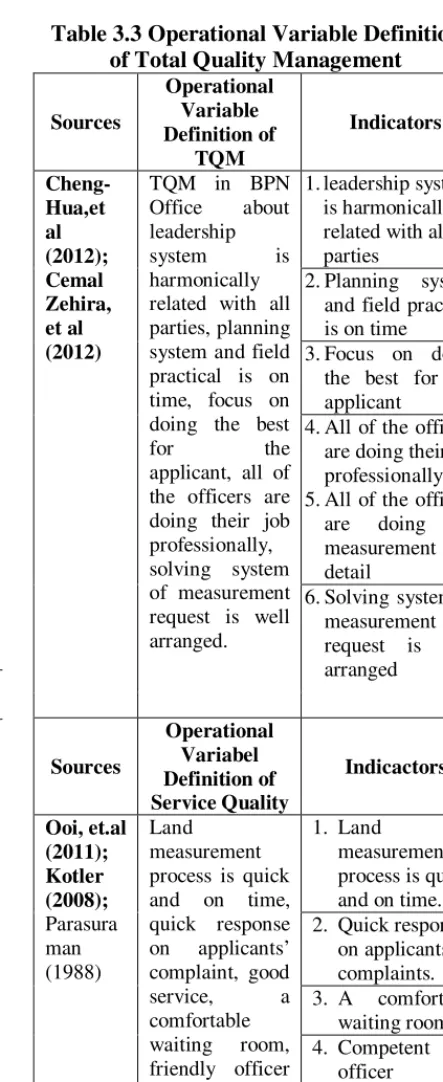
Table 3.3 Operational Variable Definition of Total Quality Management
Sources system and field practical is on solving system of measurement request is well arranged.
1.leadership system is harmonically related with all parties
2.Planning system and field practical is on time
3.Focus on doing the best for the applicant
4.All of the officers are doing their job professionally 5.All of the officers
are doing the measurement in detail
6.Solving system of measurement quick response on applicants’ complaint, good service, a comfortable waiting room, friendly officer and polite officer.
1. Land measurement process is quick and on time. 2. Quick response
274
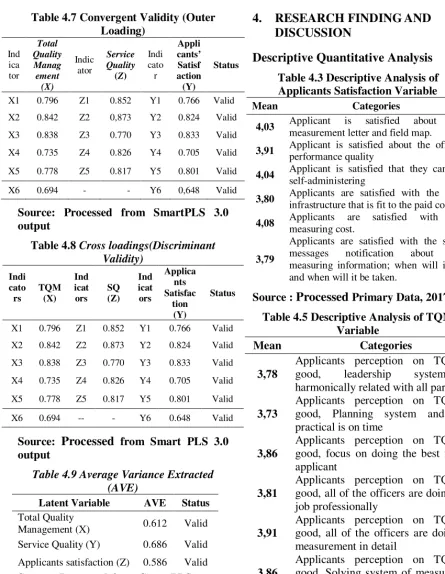
Table 4.7 Convergent Validity (Outer Loading)
Table 4.8 Cross loadings(Discriminant Validity)
Table 4.9 Average Variance Extracted (AVE)
Latent Variable AVE Status
Total Quality
Management (X) 0.612 Valid Service Quality (Y) 0.686 Valid Applicants satisfaction (Z) 0.586 Valid Source: Processed from SmartPLS output 3.0
4. RESEARCH FINDING AND DISCUSSION
Descriptive Quantitative Analysis Table 4.3 Descriptive Analysis of Applicants Satisfaction Variable
Mean Categories
4,03 Applicant is satisfied about the
measurement letter and field map.
3,91 Applicant is satisfied about the officer performance quality
4,04 Applicant is satisfied that they can do self-administering
3,80 Applicants are satisfied with the land infrastructure that is fit to the paid cost
4,08 Applicants are satisfied with the measuring cost.
3,79
Applicants are satisfied with the short messages notification about the measuring information; when will it do and when will it be taken.
Source : Processed Primary Data, 2017
Table 4.5 Descriptive Analysis of TQM Variable
Mean Categories
3,78
Applicants perception on TQM is good, leadership system is harmonically related with all parties
3,73
Applicants perception on TQM is good, Planning system and field practical is on time
3,86 good, all of the officers are doing their job professionally
3,91
Applicants perception on TQM is good, all of the officers are doing the measurement in detail
3,86
Applicants perception on TQM is good, Solving system of measurement request is well arranged
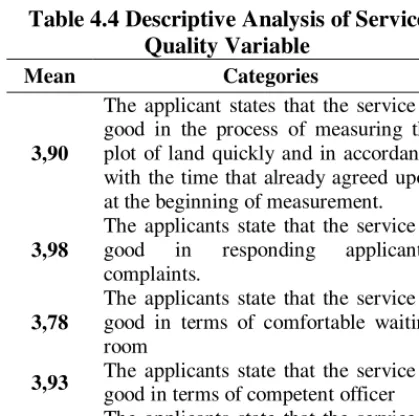
275 Table 4.4 Descriptive Analysis of Service
Quality Variable
Mean Categories
3,90
The applicant states that the service is good in the process of measuring the plot of land quickly and in accordance with the time that already agreed upon at the beginning of measurement.
3,98
The applicants state that the service is good in responding applicants’ complaints.
3,78
The applicants state that the service is good in terms of comfortable waiting room
3,93 The applicants state that the service is good in terms of competent officer
3,95 The applicants state that the service is good in terms of caring officer
Source: Processed Primary Data, 2017
Data processing techniques using SEM method based on Partial Least Square (PLS).
Picture 4.1 PLS Algorithm Result
Table 4.6 the result of inner model/side-effect test/hypothesis test
Variable R2 Descriptive
Service
Quality 0,334
Determination
coefficient (R2) shows that quality service influenced by TQM is 33,4% the rest is 66,6% is influenced by the other factors which are not found in the model.
Applicant s
Satisfacti on
0,601
While, the applicants satisfaction influenced by TQM and service quality is on 60,1%, the rest, 39,9%, is influenced by the other factors which are not found in the model.
Q2predictive relevance
Q2 = 1 - (1-R12)(1-R22) = 1- (1- 0,3342)(1- 0,6012)
=1-(1-0,364816)(1-0,361201) = 1-(0,111556)(0,638799) = 0, 928
TQM and Service Quality has an impact to applicants satisfaction for 92,8% and the rest, 7,2% cannot be detected by the model of this research.
Categories Coefficient T-Statistic
P-Value
Parameter
TQM ->AS TQM -> SQ
SQ-> AS
0.553 0.578 0.310
7,398 4,778 4,446
0,000 0,000 0,000
The magnitude of parameter coefficient of the TQM influence through satisfaction is 0,553, it means that there is a positive effect from TQM on applicants satisfaction, 0,553. The magnitude of parameter coefficient of TQM influence through service quality is 0,578, it means that there is a positive effect from TQM to service quality, 0,578. The higher TQM is the higher service quality. The magnitude of parameter coefficient of service quality influence through satisfaction is 0,310, it means that there is a positive effect from service quality to satisfaction, 0,310. The higher service quality is the higher satisfaction is.
5. DISCUSSION 3.3 Hypothesis Test
a. Hypothesis 1: TQM has a positive and significant effect through applicants satisfaction with coefficient 0,553 (p-value = 0,000). In this case H0 is rejected and Ha is accepted. This research finding supports the previous research by Suman Rani et al (2012)
276
b. Hypothesis 2: TQM has a positive and significant effect through Service quality with coefficient 0,578 (p-value= 0,000). In this case H0 is rejected and Ha is accepted. This research finding supports the previous research by Suman Rani et al (2012).
c. Hypothesis 3: Service quality has a positive and significant effect through applicants satisfaction with coefficient 0,310 (p-value= 0,000). In this case H0 is rejected and Ha is accepted. This research finding supports the previous research by Ooi et al (2011).
When the influence of quality service as mediation included on the model, it can be seen that satisfaction has a greater influence compared to direct influence of TQM through applicants’ satisfaction if we compared it without any quality service, so the service quality is a solution to improve the applicants’ satisfaction. Further, to identify whether it is a partial mediation or a full mediation, can be done this following test: This following picture is TQM model to satisfaction:
Picture 4.2 Model
Based on the picture above, TQM path coefficient on satisfaction when there is mediated by service quality 0,734 and path coefficient on applicant’s satisfaction without any service quality mediation is 0,553. This research finding is supported by Suman Rani et al (2012); Ooi et al 2012).
6. CONCLUSION
6.1 TQM has a positive impact to the applicant’s satisfaction (first hypothesis)
The research finding shows that TQM has a positive to the applicants’ satisfaction. It means that the better TQM the higher applicants’ satisfaction. It shows that applicants’ good perception on TQM will improve applicants ‘satisfaction related to the following indicators: leadership system is harmonically related with all parties; planning system and field practical is on time; focus on doing the best for the applicant; all of the officers are doing their job professionally; solving system of measurement request is well arranged.
4.2 TQM has a positive impact through land measuring applicants satisfaction in Land Infrastructure Section, Yogyakarta Land Office mediated by service quality (second hypothesis)
Land measuring applicants are satisfied on their request of land measuring, so the service quality based on its indicator, empathy, responsiveness, assurance, tangible, and reliability. The medication shows partial mediation because the value at which there is mediation is less than there is no mediation.
7. ACKNOWLEDGMENT
277
assurance and emphaty can improve the higher applicant’s satisfaction.
Theoretical benefits of this study is
that it can develop consumer behavior theory in BPN by creating the higher TQM and service quality in developing applicant’s satisfaction. The practical benefits is that it can strategize the BPN related to interesting servive quality. The benefits for the next researcher is as an
opportunity to conduct research on the same or different object.
8. REFERENCES
Cemal Zehira, Öznur Gülen Ertosunb,
Songül Zehirc, Büşra Müceldillid
(2012) Total Quality Management Practices’ Effects on Quality
Performance and Innovative
PerformanceProcedia - Social and Behavioral Sciences (41) 273 – 280 Cheng- Hua Wanga, Kuan –Yu Chen,
Shiu-Chun Chena (2012) Total
quality management, marke
torientation and hotel performance: The moderating effects of external environmental factors International Journal of Hospitality Management. International Journal of Hospitality Management 31 (2012) 119–129 Dong-Young Kim, Vinod Kumar, Uma
Kumar (2012). Relationship between quality management practices and innovation, Journal of Operations Management (2012) pp. 295–315.
Engel James F. Roger D Blackwell, Paul W. Miniard, (1994). Consumer Behavior. Sixth Editionis Published by Arrangement With The Dryden Press, Chicago.
Faisal Talib (2012) Sectors of Total Quality Management Practices in Manufacturing and Service The First International Conference on Interdisciplinary Research and
Development, 31 May - 1 June 2011, Thailand
Faiza Sajjad and Shehla Ahmad (2012) Role of Benchmarking in Total Quality Management: Case of Telecom Services Sector of Pakistan
2012Business Management
Dynamics Vol.1, No.8, Feb 2012, pp.34-44
Kotler, P and Keller, K.L
(2008).Marketing Managemet, The thirteenth Edition is Published by Pearson Education.
Ooi Keng Boon, Bishan Lin, Boon In Tan, and Alain Yee-Long Chong.
(2011). Are TQM practices
supporting customer satisfaction and service quality? Journal of Services Marketing 25.6 (2011) 410-419 Parasuraman, A. Valerie, (2001).
Delivering Quality Service. The Free Press, New York.
Peter, J. P. and Olson, J. C. (2010) Consumer Behavior and Marketing Strategy, Ninth Edition, McGraw-Hill Irwin.
Richard Yu Yuan Hung , Bella Ya-Hui Lien, Baiyin Yang, Chi-Min Wud, Yu-Ming Kuo (2011) Impact of TQM and organizational learning on innovation performance in the high-tech industry. International Business Review (2011) pp. 213–225.
Richard Yu Yuan Hung, Bella Ya-Hui Lien , Baiyin Yang, Chi-Min Wud, Yu-Ming Kuo. (2011) International Business Review 20 (2011) 213–225
(July-278
Aug 2012), PP 11-14
www.iosrjournals.org
Susan Meyer Goldsteina, Albena R. Iossifova (2012):Ten years after: Interference of hospital slack in process performance benefits of quality practices Journal of Operations Management 30 (2012) 44–54.
Zeitaml VA, Parasurahman A, Berry LL. (1990). Delivering Quality of
Service Balancing Customer
Perception and Expectation. New York: The Free Press: A division of Macmilan, Inc.
Zeitaml, V.A., 1988, Consumer