THE EFFECT OF GUIDED WRITING STRATEGY TOWARD STUDENTS’ WRITING SKILL AT SENIOR HIGH SCHOOL 1 ULAKAN TAPAKIS
THESIS
Submitted in Partial Fulfillment of the Requirements for Undergraduate Program in English Education the Strata One (S1) Degree
Written by:
LARAS SEKAR TANJUNG 1314050002
ENGLISH TADRIS DEPARTMENT
FACULTY OF TARBIYAH AND TEACHER TRAINING STATE INSTITUTE OF ISLAMIC STUDIES (UIN)
DECLARATION
Hereby I declare that this thesis entitled “The Effect of Guided Writing Strategy Toward Students’ Writing Skill at Senior High School 1 Ulakan
Tapakis”, is true my own work. I quoted some theories of this Research from
several references and sources. In the following day proved that this thesis is not
my own work, I will be ready to take a consequence.
Padang, August 2017 The Researcher
ABSTRACK
Laras Sekar Tanjung, 1314050002. The Effect of Guided Writing Strategy Toward Students’ Writing Skill at Senior High School 1 Ulakan Tapakis
The purpose of this research was to know whether there is difference result between students‟ writing ability by using guided writing strategy and without using that strategy at eleventh grade of Senior High School 1 Ulakan Tapakis.
This research was designed with experimental research. The population of this research is students at XI IPA that consist of 4 class and 104 students. Then, the sample classes were taken by cluster random sampling. The researcher chosen class XI IPA 1 as an experimental class consists of 24 students and XI IPA 3 as a control class consists of 26 students. In collecting the data, the researcher used written test. First the researcher gave the treatments. At the last meeting the researcher gave the post test.
The result of this research shows that means scores of the students‟ writing in
experimental class was 63.96, while students‟ writing score in control class was 56.35. Moreover, score of each component are also different. It can be seen from the
comparison of students‟ mean score of each component in control and experiment class. Improvement of the content was 19.38 and 20.63, organization 13.30 and 14.13, vocabulary was 12 and 13.04, language use was 9.46 and 13.08, mechanics was 2.19 and 3.08. statically, t-calculate was 2.62 is also bigger than t-table 2.00, it shows that teaching writing by using guided writing strategy gives significant effect on
students‟ writing ability.
ABSTRAK
Laras Sekar Tanjung, 1314050002. The Effect of Guided Writing Strategy Toward Students’ Writing Skill at Senior High School 1 Ulakan Tapakis
Tujuan dari penelitian ini adalah untuk mengetahui apakah terdapat perbedaan hasil belajar menulis antara siswa yang diajar dengan menggunakan strategi guided writing dan yang tidak menggunakan strategi tersebut di kelas XI Sekolah Menengah Atas 1 Ulakan Tapakis.
Penelitian ini di rancang sebagai penelitian eksperimental. Populasi dari penelitian ini adalah siswa kelas XI yang terdiri atas 4 kelas IPA dengan total murid 104 orang. Kemudian peneliti memili sampel dari penelitian ini denga cara cluster random sampling. Peneliti memilih kelas XI IPA 1 sebagai kelas eksperimen dan XII IPA 3 sebagai kelas kontrol. Dalam mengumpulkan data, peneliti menggunakan tes tulis. Pertama peneliti memberikan beberapa kali treatment. Pada pertemuan terakhir peneliti memberikan pos tes.
Hasil dari penelitian ini memperlihatkan rata-rata skor siswa pada saat kleas eksperimen adalah 63.96, semenetara rata-rata skor siswa pada kelas kontrol adalah 56.35. Selain itu skor dari masing-masing komponen juga berbeda. Ini dapat di lihat dari perbandingan rata-rata skor siswa dalam kontrol dan eksperimen. Isi 19.38 dan 20.63, organisasi 13.30 dan 14.30, kosa kata 12 dan 13.04, tata bahasa 9.46 dan 13.08, mekanik 2.19 dan 3.08. secara statistic, calculate adalah 2.62 lebih besar dari t-table 2.00, ini menunjukkan bahwa mengajar dengan startegi guided writing memberi efek yang signifikan terhadap kemampuan menulis siswa.
ACKNOWLEDGMENT
Firstly, the researcher would like to express thankfulness to Allah SWT
who has given the health and opportunity to finish and complete the thesis, entitled “ The Effect of Guided Writing Strategy Toward Students’ Writing Skill at Senior High School 1 Ulakan Tapakis”. The researcher also expresses
the deep praises to the prophet Muhammad SAW. This thesis is aimed to fulfill
one of the requirements in order to complete strata one program at English
Department in Tarbiyah and Teacher Training Faculty of UIN Imam Bonjol
Padang.
There are many people contributes in writing this thesis. My deepest
gratitude also goes to those who have helped me in finishing this thesis the
followings:
1. First I would like to thank to my parents. My father Tamat Sucipto and
my mother Zainab who gave me all the resources and efforts in
supporting both morally and materially and finance writer from
childhood until completing this course
2. Then I would like to thank to Mr. Dr. Hadeli, M.A., M.Pd as my first
supervisor and Ms. Dr. Martin Kustati, M.Pd as my second supervisor
who always guide me during writing.
3. The Dean and all staff of Tarbiyah Faculty of UIN Imam Bonjol
Padang.
5. The head master, the English teacher (Mr. Ahmad Azizan) and all
students X IPA 1 and X IPA 3 of Senior High School 1 Ulakan
Tapakis who had given the participation in my research.
6. All unmentioned lecturers and personals.
I also would like to thank to my beloved brothers and all of my big family
who has given me everything I need. Then, to all those who did not name one by
one proficiency level who have come to participate and assist writer in the
completion of this thesis. Hopefully instruction, guidance, and motivation of my
family and friend give into acts of worship and reap the reward from Allah SWT.
Last but not least, I realized that this thesis is not perfect. That is why I
hope the readers will give contribution, criticism, and suggestion. I also strongly
believed that a further potential configuration of any strategy beside the one stated
in this thesis may have also effectively succeeded as long as the strategy meets the
requirement to integrate within the learning objectives. However, the writer is
conformed to any critics and arguments to make further studies of the same field
as better result. Researcher finally hope this thesis will be acceptable and will
meet the requirements as it should be.
Padang, August 2017 The writer
TABLE OF CONTENTS
ABSTRACT i
ACKNOWLEDGMENT iii
TABLE OF CONTENT v
LIST OF TABLE vii
LIST OF APPENDICES viii
CHAPTER I: INTRODUCTION 1
A. Background of the Problem 1
B. Identification of the Problem 5
C. Formulation of the Problem 6
D. Limitation of Problem 6
E. Objective of the Problem 6
F. Significances ofProblem 7
G. Definition of Key Terms 7
CHAPTER II: REVIEW OF RELATED LITERATURES 9
A. Review of Relevant Theories 9
1. The Nature of writing skill 9
a. Definion of Writing skill 9
b. The Characteristic of Written Language 13
c. The Process of Writing 15
d. Components of Writing skill 17
e. WritingAssessment 19
2. Analytical Exposition Text 21
b. Generic Structure of Analytical Exposition Text 22 c. Language Features of Analytical Exposition Text22 3. Review of Guided WritingStrategy 23 a. The Definition of Guided Writing Strategy 23 b. The Process of Guided Writing Strategy 25 c. The advantages of Guided Writing Strategy for
Teaching Writing 26
B. Review of Relevant Studies 27
C. Conceptual Framework 28
D. Hypothesis 29
CHAPTER III: RESEARCH METHODOLOGY 30
A. Research Design 30
B. Population and Sample 31
1. Population 31
2. Sample 36
C. Place and Time of the Research 37
D. Instrument of the Research 37
E. Procedure of Experiment 39
F. Technique of Data Collection 41
G. Technique of Data Analysis 42
CHAPTER IV: FINDINGS AND DISCUSSIONS 44
A. Research Finding 44
B. Hyphotesis Testing 55
C. Discussion 57
CHAPTER V: CONCLUSION AND SUGGESTION 63
A. Conclusion 63
B. Suggestion 64
BIBLIOGRAPHY 65
LIST OF TABLES
Table 1.1 Students‟ Writing Score at Class XI IPA 2 Table 2.1 Indicators of Writing Assessment Based on Jacob 19
Table 3.1 Research Design 31
Table 3.2 Population of the research 32
Table 3.3 Tests of Normality 32
Table 3.4 Test of Homogeneity of Variance 36
Table 3.5 Sample of research 37
Table 3.6 Blueprint of Writing Test 38
Table 3.7 Sample of Instrument in Giving Writing Scores 39 Table 3.8 Teaching Procedure for Experimental and Control Groups 39 Table 4.1 The Score of Writing Test of Experimental Group and
Control Group 45
Table 4.2 Calculation Process of Mean and Standard Deviation of
Writing Test Experimental Group 46
Table 4.3 The Interval Data of Experimental Class Post Test Score 47 Table 4.4 The Interval Data of Control Class Post Test Score 49 Table 4.5 Calculation Process of Mean and Standard Deviation of
Writing Test Control Group 51
Table 4.6 The Calculation of Comparison of Means Post-test of Experimental and Control Class in Content,
LIST OF APPENDICES
Appendix 1: Test Normality and Homogeneity Population 68 Appendix 2: Post-test of Experimental Class (XI IPA 1) SMA 1
UlakanTapakis 70
Appendix 3: Post-test of Control Class (XI IPA 4)SMA 1 Ulakan
Tapakis 71
Appendix 4: The distribution of students‟ daily test 72 Appendic 5: Calculation Process of Mean and Standard Deviation of
Writing Test Experimental Group 73
Appendix 6:Calculation Process of Mean and Standard Deviation of
Writing Test Control 74
Appendix 7: Analysis of Post-test Score in Experimental
and Control Class 75
Appendix 8: Writing Test 77
Appendix 9: Graph of the Interval Data of Experimental Class
Post Test Score 78
Appendix 10: Graph of the Interval Data of Control Class
Post Test Score 79
Appendix 11: Graph of the Calculation of Comparison of Means Post-test of Experimental and Control Class in Content, Organization, Vocabulary,
Language Use and Mechanic 80
Appendix 12: Lesson Plan 81
Appendix 13: Example of students Writing Test
at Experimental Class 165
Appendix 14: Example of students Writing Test at control Class 166
Appendix 15: T-table 167
CHAPTER I INTRODUCTION
A. Background of the Problem
Writing is the most complicated skill that has to be acquired by the
learners in English learning, because it requires the writers to involve
higher cognitive competence such as the capability to analyze, construct,
edit and revise ideas to produce a qualified writing. Therefore, the writing
instructors must be able to facilitate the learners with conducive learning
that expand their views about certain matters, challenge them with extra
rewards and show them the appropriate procedures in developing their
writing competence.
Writing competence that involves in the process of analysis and
synthesis can be called as whole brained activity that leads everyone to
critical thinking. So, writing skill is the most complex activities that has to
be acquired by every language learner. Because of this reason, teaching
writing, absolutely, must be applied with wholehearted by the classroom
practitioners. Teaching writing is not a trivial thing to do. It is not an easy
task to make the students competent in producing a qualified writing.
Based on the preliminary research at SMAN 1 Ulakan Tapakis, it
was found that the students have some problems dealing with English,
especially in writing analytical exposition text. In analytical exposition,
students are required to generate ideas well because in writing analytical
exposition they have to present their opinion of something in logical order.
Unfortunately, they cannot support their idea well. So that, the purpose of
the text cannot be reached.
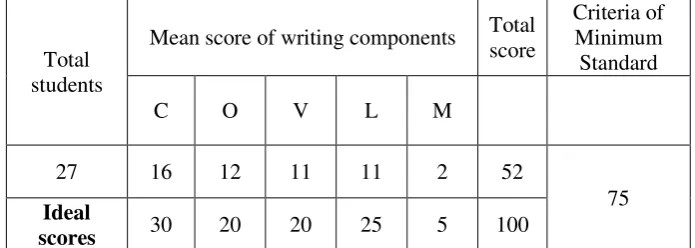
The researcher found some problems related with the failure of
students in their test. And the problem was related to the students‟ writing skill. It could be seen from the table below.
Total students
Mean score of writing components Total score
Criteria of Minimum Standard
C O V L M
27 16 12 11 11 2 52
75 Ideal
scores 30 20 20 25 5 100
Source: English Teacher Bookmark at first Semester (2017/2018)
The table above shows the data about student‟s achievement in writing. It‟s assessed by Jacob‟s writing criteria. This is also an indication
that the students have not produced writing product successfully yet. The
students get very poor on the components of writing such as content (16).
and organization (10). Besides, they get fair on organization (12). Then,
they get poor on vocabulary (10), and language use (11). However, they
get very poor (2) on mechanics. Generally, the students cannot master and
understand how to write well, their score under 75 (criterion of minimum
In the students‟ side, the students did not know the way to start in
collecting or generating the ideas. Then, organizing the ideas also became
the complicated task that they have to do. Moreover, it was seen very hard
for the students in expressing the ideas that come in their mind and bring it
into a real form as the beginning of writing process that they have to deal with. All of these problems blocked the students‟ mind to attain a good
achievement in writing.
Besides that, they could not make a qualified writing because of
teaching technique that was used by the teachers in teaching process. The
technique that was applied during the writing instruction did not encourage
them to write well. Besides that, the teachers‟ lacks of method and strategies have made passive and monotonous class. The teacher dominated the student‟s activities and thinking which caused the
developing of good writing skill can be blocked.
As a problem solving, teachers have to find the other ways to improve student‟s skill in creating an acceptable writing. For instance,
strategy, technique, method or approach in teaching process should be
changed to more creative one.
Nowadays, there are much strategies that can be used in teaching
writing. One of them is guided-writing strategy. According to Klentschy
(as cited on Diaz: 2006), guided writing strategies provide opportunities
for students to make connections between what they were learning and
more information that they can add in arguments of analytical exposition
text.
Based on that case, the researcher is interested in solving the
problem of students‟ writing skill. So, the researcher conducts a research on “The Effect of Guided Writing Strategy Toward Students‟ Writing Skill at Senior High School 1 Ulakan Tapakis”
B. Identification of the Problem
English teacher at SMAN 1 Ulakan Tapakis was more emphasized
on grammar, reading, and speaking in teaching and learning process. So,
there is no balance between speaking, listening, reading, and writing, skills
at this school. The teacher tended to teach listening, speaking, and reading
instead of writing. In other words, writing skill has been far behind. This
condition made students hardly practice writing.
There are several reasons why the students cannot write well. First,
the students do not know how to transfer and develop their ideas in written
form and make a link among the ideas. Second, the students cannot
express their ideas or opinion well because their vocabulary is limited. The products of students‟ writing are not applying the generic structure and
language features well. Third, the technique used by the teacher is not
interested to the students and not appropriate anymore. So, they are not
motivated to write. Then, students have less enthusiastic. They have low
This problem can be solved by several ways such as: method,
strategies, techniques, activity or procedure and also interesting media. In
this occasion, teacher‟s creativity is needed. Besides that, it is important for the students to recommended of cooperative activity with their
classmates.
C. Formulation of the Problem
To make the study clearer, the problem of the research can be
formulated as: is there significant difference between students those taught
with guided writing strategy than conventional strategy in writing
analytical exposition text especially at XI Grade of Science Senior High
School 1 Ulakan Tapakis?
D. Limitation of Problem
Based on the identification of the problems above, it is impossible
for the researcher to study all that stated problems because of the limited
time. Therefore, this research was focused on the effect of guided writing
strategy to students‟ writing skill in an analytical exposition text especially at XI Grade of science Senior High School 1 Ulakan Tapakis.
E. Objective of the Problem
The objective of this study is to find out wheater guided writing
strategy gives different result on student writing skill, especially in writing
F. Significance of Studies
The finding of the research is useful in some ways.
1. Theoretically
a. The research can be used as reference for anybody else who has
the same interest in the same field.
b. The research can be useful as the references in choosing strategy in
teaching writing, especially analytical exposition text.
2. Practically
a. For the researcher, the research can give a practice in developing
her knowledge and skill in problem-solving processes.
b. The finding of the research can be used by teachers as a reference
to improve their strategy in teaching writing and to find the most
suitable strategy for improving the students‟ skill in writing analytical exposition texts.
c. The finding of the research can be a useful input for the students to
improve their skill and to learn English especially writing skill.
d. For other researchers, this research can give general knowledge
how to improve students‟ writing skill in writing analytical
exposition text
.
G. Definition of key terms
Guided writing : a follow-up of the modelled and shared
strategies in that the teacher scaffolds
encourages the learners to take on more of
the writing process by themselves (Timayi:
2015)
Writing skill : the skill to express ideas, thoughts, and
feeling to other people in written symbols to
make other people or readers understand the
ideas conveyed (Nunan: 2003).
Analytical exposition text : Wahidi (2009) defines an analytical
exposition as a text that elaborates the writer‟s idea about the phenomenon
surrounding. Therefore, through the text, a
writer persuades the reader that writer idea is
CHAPTER II
REVIEW OF RELATED LETERATURE
A. Review of Relevant Theories 1. The Nature of Writing Skill
a. Definition of Writing Skill
Writing is a productive skill in the written mode. It is a skill
in organizing statement in order to make consistent with the
purpose for which the statement is made. It can be defined that
writing ideals with organizing ideas in good order to reach the
purpose of writing itself.
Writing also can be defined as a tool for communication
and it is a most important factor in teaching a language as well.
Besides that, writing is the activity of presenting of thought or idea
in correct sentences. Writing is a productive skill. It is very useful
for students because it can convey their message through their
minds in the written form. It is placed on the last stage among the
four skills. Writing is the production of the written word in the
form of text and it must be read and comprehended in order to
communicate to take place.
Writing is considered as a productive skill along with
speaking (Harmer, 2007: 265). When students deal with language
production, it means that they should use their knowledge to
produce the language to achieve a communicative purpose either in
the form of spoken or written language.
According to a psycholinguist, Eric Lenneberg, (as cited in
Brown, 2001: 334), he says that different from speaking in which
people learn language through a natural process or human behavior as learning to „walk‟, writing is a learned behavior as learning to „swim‟, people need someone to teach them. It means that people
learn to write if they are members of a literate society and usually
if someone teaches them.
Among the four language skills, “writing is the most difficult skill for second or foreign learners to master” (Richards &
Renandya, 2002: 303). It is because writing is considered as a
complex process of putting ideas down on paper to transform
thoughts into words (Brown, 2001: 336). Since the idea or thought
is an abstract thing which comes from our mind, it is not easy to
transform it into understandable or readable form.
Writing can be seen as two different views. They are the
product of that writing and the process of writing. When writing is
seen as the product, the attention is placed on the final product of
writing such as the essay, the report, the story or what the product should „look‟ like (Brown, 2001: 335). It means that the writing
style, (b) reflect accurate grammar, and (c) be organized in
conformity with what the audience would be conventional. In other
words, the value of the end product is the main thing to be focused
on rather than the process of writing itself (Harmer, 2007: 325).
On the other hand, when writing is seen as a process, it
focuses on the various stages that any process of writing goes
through, such as putting ideas down on paper to transform thoughts
into words (Brown, 2001: 336). It means that the process of writing
is more valuable than the end of the product.
Harmer (2007: 325) states that in writing we can focus on
the product of that writing or on the writing process itself. Writing
is a process and that we write is often heavily influenced by
constraints of genre, then these elements have to be present in
learning activities. When concentrating on the product, we are only
interested in the aim of a task and in the end product.
On the other hand, writing is a combination of process and
product. The process refers to the act of gathering ideas and
working with them until they are presented in a manner that is
polished and comprehensible to readers. The concept that writing is
a process is very useful to young writers. Writing as the process of
generating ideas, organizing information and communicating
In addition, according to Brown (2001: 259-260) writing
was primarily a convention for recording speech and reinforcing
grammatical and lexical features of language. Writing is an
effective way to communicate and express ideas, thought, feeling,
and opinion to others. It means that writing is a form from the
writer to communicate, interact and connect through written, for
that written, the writers will express what they want, what they
feel, what they opinion about something, what they experience that
have in their life. By this term, the readers can get what the writers
mean about their ideas.
Since writing is a way to communicate with others in the
written form, everything should be clear. Unlike speaking that the
message of the communication can be grasped through non-verbal
language, such as gestures, body languages or facial expressions, in
writing the message is conveyed through the written form.
Therefore, the writer should be able to make his or her reader
understand the message conveyed.
Making a good piece of writing is a complex process. It
requires the skill to write grammatically correct sentences and
organize them logically into paragraphs or essays. In order to make
writing to be successful, it has to be both coherent and cohesive.
Coherent is the feeling that the elements of texts are bound
points. While cohesive is the surface links between the clauses and
sentences of a text. It is a more technical matter since it deals with
the various linguistic ways of connecting ideas across phrases and
sentences, such as using pronoun and connector.
b. The Characteristics of Written Language
Brown (2001: 341-342) points out several characteristics of
written language which distinguish them from spoken language.
The characteristics are as follows:
1) Permanence
Writing is permanent. Once the writers finish their
writing, they cannot re-edit their writing. So, a thorough
refinement and revision are needed before the final draft is
submitted.
2) Production time
Time limitation is one of the important issues in
writing, especially in an educational context. A sufficient
length of time will affect the production of a good writing,
and vice versa. When the time given is not sufficient, the
writers may produce a messy text. Therefore, a sufficient
training in the process of writing will help the students to
make the best possible use of such time limitation.
A good writer is the one who can deliver the
message of his or her writing clearly to the target reader.
Distance, here, may mean a range between the writer and
the target audience. In order to shorten the distance, the
writer should be able to predict the audience‟s general knowledge and write from the perspective of the target
audience.
4) Orthography
Many different writing systems have evolved
around the world (Harmer, 2004: 1). Therefore, being able
to use such writing system is not an easy matter, especially
in a language which has different orthography from the writer‟s native writing system.
5) Complexity
Different from spoken language which tends to have
shorter clauses and forms, the written language tends to
have larger clauses with more complex forms. Therefore,
the writer should write clearly, cohesively, and coherently
in delivering the message to the readers.
6) Vocabulary
The written English has a greater variety of lexical
items than in spoken conversational English. The lexical
on the context embedded. Therefore, the writer should learn
and take benefits from the extensive number of English
words.
7) Formality
Formality refers to the convention of rules that a
certain written message is meant to be. Different purposes
of writing have different forms of language that must be
followed.
Since writing is a way to communicate in the written form,
everything should be clear. It means that before the writers come to
the end of their writing, they should make sure that their writing
has already met the purpose of their writing so that the target
readers could get the message clearly.
c. The Process of Writing
According to Oshima and Hogue (1998: 2-12), they
propose the process of writing into three stages. They are
pre-writing, planning (outlining), and writing and revising drafts. In
Stage I, you chose topics and narrowed them, and you generated
ideas by brainstorming. Then, in the planning stage, you organize
the ideas you generated by brainstorming into an outline. Stage III
in the writing process, after prewriting (Stage 1) and planning
(Stage II), is writing and revising several drafts until you have
writing is ever perfect the first time. Each time you write a new
draft, you will refine and improve your writing.
Pre-writing is defined as the stage of discovery the writing process when a person assimilates his “subject” to himself. In other
words, the pre-writing stage is a stage when the process of thinking
is happened, such as developing ideas and designing the ideas.
Writing is a stage in which the writers put their ideas into words on
papers. It means that the writers write down of what they are going
to say or write. The next is re-writing. This stage is defined as a
process of making revisions or changes of what they have written.
In line with the above concept, Richards & Renandya
(2002: 315) and Langan (2008: 17-19) propose that there are four
basic writing stages. They are planning, drafting, revising, and
editing. The first element is planning, that is thinking of what
comes on the writers‟ mind, what they are going to say or write.
The second is drafting. In this stage, the writers are focused on the
fluency of writing and are not preoccupied with grammatical
accuracy. Writers can refer this as their first draft which may have
several changes later. The next is reflecting or revising. Revising is
a process of reading through what the writers had written. In other
words, the writers review their text on the basis of given feedback
and make a global check to make sure that their writing can be
which the writers have edited and made revisions or changes to
their draft into their final version.
From the explanation above, it can be concluded that
writing, as it is seen as a process, is a product of turning out the
ideas into words in a piece of paper which faces several processes.
They are planning, drafting, revising, and editing.
d. Component of Writing
Writing process have several components that should by
mastered by students to create or produce good written form like
paragraph or essay. There are five components in the profile of
writing are adopted by Jacobs (1981: 102):
1) Content
The measure the content of written product is not easy to
do. In order to make the teacher or evaluator simple to count it,
he applies several descriptors; knowledgeable, substantive,
through development of thesis, and relevant to assigned topic.
2) Organization
In organization there are six descriptions that have to
take in good written text. They are fluent expression, ideas
clearly stated/supported, succinct, well-organized, logical
sequencing and cohesive.
The good writers have to enrich their vocabularies for their writing‟s quality. But it is not enough without chosen the
correct vocabulary to the text. Jacobs states vocabulary into four
descriptors: sophisticated range, effective word/ idiom choice
and usage, word form mastery, and appropriate register.
4) Language Use
As like the vocabulary, in writing evaluation, language
use consists of eight descriptors; effective complex
constructions, agreement, tenses, number, word order/function,
articles, pronouns and preposition.
5) Mechanics
Mechanics are description about the spelling,
punctuation, capitalization, paragraphing, and handwriting in
written product. It is as basic of the evaluation in the profile of
composition.
In addition, Brown (1994:357) states that there are many
categories of writing. First, Content that contains thesis statement;
related ideas; development of ideas through personal experience,
illustration, and facts opinion; use of description, cause/effect,
comparison/contras; consistent focus. Second, organization that
involves effectiveness of Introduction; logical sequence of ideas;
conclusion; appropriate length. Third, discourse that contains topic
cohesion; rhetorical conventions; reference; fluency; economy;
variation. The others categories are syntax, vocabulary, and
mechanics (spelling, punctuation, citation of references, neatness
and appearance).
Based on the explanation above, it is concluded that writing
was the skill to use the structure lexical item and their conventional
representations ordinary matter of act language. Besides, through
the writing, the students could interact with their ideas and
developed them in the writing activities to be a good text. At least,
there are five components that should be considered for a good
writing such as: Content, Organization, Vocabulary, Language
Use, and Mechanic.
e. Writing Assessment
In order to achieve the goal of teaching, whether the
students are able to write or not, the teacher has to do assessment.
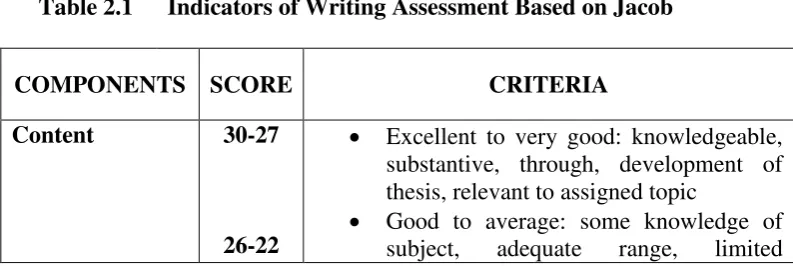
According to Jacob (1981: 90) states that there are five components
when assessing writing. These are content, organization,
vocabulary, language use and mechanics.
Table 2.1 Indicators of Writing Assessment Based on Jacob
COMPONENTS SCORE CRITERIA
Content 30-27
26-22
Excellent to very good: knowledgeable, substantive, through, development of thesis, relevant to assigned topic
21-17
16-13
development of thesis, mostly relevant to topic, but lacks detail
Fair to poor: limited knowledge of subject, little substance, inadequate development of topic
Very poor: does not show knowledge of subject, non-substantive, not pertinent, not enough to evaluate
Organization 20-18
17-14
13-10
9-7
Excellent to very good: fluent expression, ideas clearly stated, succinct, well organized, logical sequencing, cohesive and disconnected, lacks logical sequencing and development
Very poor: does not communicate, no organization, not enough to evaluate Vocabulary 20-18
17-14
13-10
9-7
Excellent to very good: sophisticated range, effective word/idiom choice and usage, word form mastery, appropriate register
Good to average: adequate range, occasional errors of word/idiom form, choice, usage but meaning not obscured Fair to poor: limited range, frequent
errors of word/idiom form, choice, usage, meaning confused or obscured Very poor: essentially translation, little
knowledge of English vocabulary, idioms, word form, not enough to evaluate
Language Use 25-22
21-18
Excellent to very good: effective complex constructions, few errors of agreement, tense, number, word order/function, articles, pronouns, prepositions.
17-11
10-5
prepositions but meaning seldom obscured
Fair to poor: major problems in simple/complex construction, frequent errors of negation, agreement, tense, number, word order/function, articles, pronouns, prepositions, and fragments, run-ons, deletions, meaning confused or obscured
Very poor: virtually no mastery of sentence construction rules, dominated by errors, does not communicate, not spelling, punctuating, capitalization, paragraphing
Good to average: occasional errors of spelling, punctuation, capitalization, paragraphing but meaning not obscured Fair to poor: frequent errors of spelling,
punctuation, capitalization, paragraphing, poor handwriting, meaning confused or obscured
Very poor: no mastery of conventions, dominated by errors of spelling, punctuation, capitalization, paragraphing, handwriting illegible, not enough to evaluate
2. Analytical Exposition Text
a. Definition of analytical exposition text
Wahidi (2009) defines an analytical exposition as a text that elaborates the writer‟s idea about the phenomenon surrounding.
Therefore, through the text, a writer persuades the reader that writer
b. Generic structure of analytical exposition text
According to Martin and Rothery, in Almita (2008: 23), in Cahyono and Purnama‟s opinion (2009:1), in Silfia (2013), analytical
has generic structure generalize the generic structure of exposition
genre is: Thesis, Argument, and Conclusion. In this structure, “thesis” is the part of the text in which the writer states his/her position on the issue, and “argument” is concerned with information provided to justify that position. Finally, “conclusion” is the part of the text where
the thesis and arguments can be briefly restated.
c. Language feature of analytical exposition text The language feature of this text are:
1) Focus on generic human and non-human participants.
2) Use mental processes. It is used to state what the writer or
speaker thinks or feels about something, for example: realize,
feel, etc.
3) Need material processes. It is used to state what happens, for
example: has polluted, etc.
4) Use of simple present tense.
5) Use of relational processes.
6) Use of internal conjunction to state argument.
3. Review on Guided Writing Strategy
a. The Definition of Guided Writing Strategy
Lan, Hung & Hsu (2011) also states that this strategy helps
the students to improve their writing performance, especially their
attitudes regarding motivation and enjoyment. The increase of
level of these two components is born from the fact that Guided
Writing Strategy encourages the students to build their confidence
and participation.
Guided writing is a strategy that gives students the
opportunity to review a recently taught writing skill in group or
whole class setting and then to apply the skill through independent
writing. Through guided writing, children are supported during the
different stages of the writing process. By applying this strategy,
the students will be trained to practice their skill until they ready to
write independently.
Guided writing is useful for a range of teaching purposes,
and is the short-term step between teacher directed and
independent writing. The teacher will provide the students with
prompts or clues for the students to use as a basic framework. Furthermore, Titisari (2015) said the teachers‟ roles in this strategy
students to consider audience, purpose, topic, selection of text type,
etc. when planning their writings. It allows the students to focus on
conventions such as spelling, punctuation, standard usage and
handwriting. Guided writing is known to help promote critical,
creative, and reflective thinking on topics.
According to Oczkus (2007), guided writing strategy is an
essential tool in a balanced writing curriculum, providing an
additional supporting step towards independent writing. The
different stages of the writing process are pre-writing, drafting, and
revising, editing and publishing (or final copy proof-reading). So,
the teacher must always be a guide for the students during the
teaching-learning process for writing. Here the role of the teacher
as a facilitator will help her students to find what they want to
write about and how to write a paragraph clearly, systematically,
and interestingly. The aim is to provide support that can help the
student to write more.
From the definitions above, it can be concluded that guided
writing is a process of writing after imitative writing and dictation
guided by the teacher with stimulators, and according to Anggara
(2013), although guided writing is a group activity focused on the
needs of the group, the teacher is able to observe and respond to
the needs of individual of the group, provides the teacher with the
b. The Process of Guided Writing Strategy
According to Reid (1993: 25) in Dyan (2010:31) states there
are some steps in guided writing, they are:
1) Model paragraph
At the beginning, the teacher provides a model of the
text. This can be written on the board or copied onto the
worksheet. Students concentrate on reading comprehension
first, then study the features of the text given.
2) Comprehension questions
The teacher asks series of questions about the basic
information of the text.
3) Language based exercises
The teacher gives exercises which focus on vocabulary
building and sentence structure. It can be in the form of
transformation, substitution, or complete pattern drills.
4) Oral composition
By discussions, students make suggestions about what
to write and the teacher make an outline or a list of key
expressions on the board. It is used as a basis for students‟
writing.
5) Written composition
Students follow the model given by the teacher, but
According to Pinnel & Pountas in Lan, Hung & Hsu
(2011), Guided Writing normally follows on from modeled
writing, shared writing, and practice. Modeled writing requires
teachers to demonstrate the steps of writing, while in shared
writing students contribute their ideas. After these two activities
have been done, teacher will guide students to make their own
paragraphs. Oczkus (2007) in Timayi (2005) also states that guided
writing strategy is an instructional writing context chiefly teaching
the writing process through modelling, support, and practice.
c. The Advantages of Guided Writing Strategy for Teaching Writing
Some advantages and disadvantages of guided writing
based on explanations above are as follows:
First, on the positive side, students appreciate the models or examples that show what they have to do in writing. Students‟
vocabulary building is involved in the process of writing
preparation so that students may build their self-confidence in
composing writing. Students may quickly go through the exercises
orally, so that students can see how they work. In oral preparation,
it can be done in different ways according to the interest and skill
of the class. Furthermore, ideas about what to write come from the
students themselves. This makes the activity much more interesting
The application of the principles of guided writing may enhance students‟ grammatical awareness and sentence structure
knowledge of a second language, particularly at the lower levels of
language proficiency.
B. Review of Relevant Studies
Related to the study that has been written by Anggara (2013) about “The Effectiveness of Guided Writing in Improving the Students’ Writing
Ability of the Eighth Grade Students at Smp Negeri 2 Temon In the
Academic Year of 2012/2013”, he concluded that there is a significant
difference between the writing ability of the eighth grade students of SMP
N 2 Temon taught by using guided writing and those who were not taught
by using guided writing.
Another relevant study is a study that has been written by Titisari (2015) about “The Effectiveness of Guided Writing for Teaching Writing
Analytical Exposition Text”. Based on the result of post-test, mean scores
differences between pre-test and post-test of experimental and control
group, and t-test findings on her thesis, she concluded that guided writing
is effective to be used in teaching writing recount text. Guided writing
strategy can help the students to compose a recount text. The sequence of
questions and outline can help them to express their ideas, therefore, they
can write easier.
Based on many researchers, the researcher has the same problem; it
better result and improved students‟ writing skill. In researcher studies, the
focus of this research is focused on improving students‟ writing ability that indicated to make good paragraph, vocabulary, comprehension, and
understanding about the meaning, make essay content, organization,
vocabulary, language use, mechanics and grammar
C. Conceptual Framework
In teaching and learning process, teacher should be able to teach
appropriate strategy. This is applied in order to the students not to be bored
and understand the concepts what they have learned. One of the strategies that help the student‟s to be more active in learning is with guided writing
strategy. The use of this strategy in teaching writing is hoped to increase
their skill in writing than students without using this strategy
(conventional) after doing six times treatment.
Teaching writing skill
Guided writing strategy
writing skill
Conventional strategy
Writing skill
Result Result
D. Hypothesis
The researcher formulated the hypothesis that students those taught
with guided writing strategy have higher writing skill than those taught
with conventional strategy at XI grade of science Senior High School 1
CHAPTER III
RESEARCH METHOD
A. Research Design
This research was an experimental research. This research concerned
the implement of guided writing strategy as dependent variable and students‟ writing skill as independent variable. Researcher divided sample into two
groups. They Concerned for experimental research. According to Sudjana and
Ibrahim (2012:19), experiment research methods can be interpreted as the
research methods used to find the relation between two variables or more or to
find the effect of one variable toward other variable.
In an experimental study, the researcher manipulated at least one
independent variable, controled other relevant variables, and observes the
effect on one or more dependent variables. He also defined experimental
research is the most structured of all types of research. In an experimental
study, the researcher was in on the action from the very beginning. He or she
selects the groups, decides what treatment will go to which group, controls
extraneous variables, and measures the effect of the treatment at the end of the
study.
The two groups were taught by different teaching writing process but
same teacher and same topic. The experimental group was taught by using
guided writing strategy and the control group was taught by conventional
strategy. The treatments were given to experimental group about sixth
meetings. Every meeting researcher gave different topics. At the end of the
treatments the researcher gave the students post-test.
At the end of the research, the researcher had to take the post-test to
see how both of them, guided writing strategy and conventional strategy influence students‟ Writing skill. The test was written test.
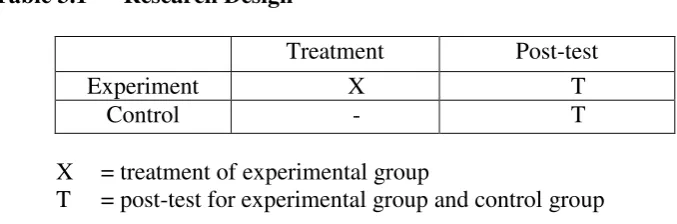
Table 3.1 Research Design
Treatment Post-test
Experiment X T
Control - T
X = treatment of experimental group
T = post-test for experimental group and control group
B. Population and Sample 1. Population
Gay (2000:122), says that population is a group to which the
researcher would like the results of the study to be generalized and
sampling is the processes of selecting a number of individuals for a study
in such a way that the individuals represent the large group from which
they were selected. In this research, the population is students in class XI
IPA at Senior High School 1 Ulakan Tapakis. The total number of the
population is 104 students. They are distributed into four classes as shown
Table 3.2 Population of the research
No Class Total Students
1 XI IPA1 24
2 XI IPA2 28
3 XI IPA3 26
4 XI IPA4 26
Total 104
Source: English Teacher at Senior High School 1 Ulakan Tapakis
The population of the study is Grade XI IPA of Senior High School
1 Ulakan Tapakis in academic year 2017/2018. There were 104 students
that distributed into four classes. The three classes used SPSS (Statistical
Product and Service Solution) to know the normality and homogeneous
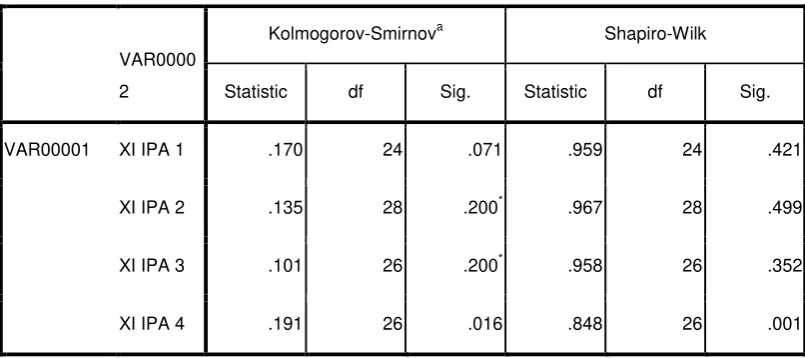
data. To show the sample is representative or not, the table below shows
the result of normality and homogeneity test.
Table 3.3 Tests of Normality
Tests of Normality
VAR0000 2
Kolmogorov-Smirnova Shapiro-Wilk
Statistic df Sig. Statistic df Sig.
VAR00001 XI IPA 1 .170 24 .071 .959 24 .421
XI IPA 2 .135 28 .200* .967 28 .499
XI IPA 3 .101 26 .200* .958 26 .352
XI IPA 4 .191 26 .016 .848 26 .001
a. Lilliefors Significance Correction
Based on the table, it can be seen that the significance or probability
score of three classes (XI IPA1, 2 and 3) bigger than 0.05 in both
Kolmogorov-Smirnov and Shapiro-Wilk.
To see whether the sample normal or not in distribution, researcher
also use normal graphic of Q-Q plot, the data is normal if the distribution
of data plot be in the surrounding of aslant and athwart line. From the
From the graphic above, it can be seen that the drops of three
classes (XI IPA 1, 2 and 3) spread around the line. So, it can be concluded
that the distribution of those class of the population were normal.
After did the normality test, researcher analyzed the homogeneous
variation test. This test has an objective as to know whether the sample
homogeny or not. The researcher did the test of homogeneity by using Test
of Homogeneity of Variance. Population has homogeny variance if P-value
Table 3.4 Test of Homogeneity of Variance
Test of Homogeneity of Variance
Levene Statistic df1 df2 Sig.
VAR00001 Based on Mean 1.078 3 100 .362
Based on Median .747 3 100 .526
Based on Median and with
adjusted df .747 3 91.773 .527
Based on trimmed mean .953 3 100 .418
The decision of column test of homogeneity of variance shown that
is bigger than 0.05, so it can be concluded that all the class are homogeny.
After knowing the normality homogenous test by using SPSS, the
researcher found three classes are normal and all class is homogeny as a
population. The three classed had the significant of normality and
homogeneous more than 0.05. Based on the graphics Q-Q Plot, if the data
around and near with the line, it means, the data was normal. After get the
population, researcher will continue to the next step to find the sample of
this research.
2. Sample
According to Gay (2000:121) sampling is the process of reflecting a
number of individuals for a study in such way that the individual
represents the large group which it is selected. He also states that a good
selected. The sample of this research consisted of two groups; an
experimental group and a control group. After did test of normality of
three classes as the population, it was found that three of the classes are
normal. The classes are class XI IPA 1, XI IPA 2 and XI IPA 3. In
determining experimental group and control group the researcher used
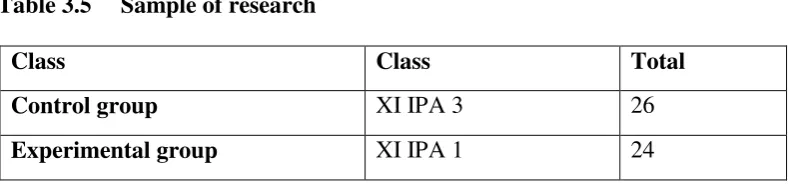
cluster random sampling. The researcher got the result that class XI IPA 1
as experimental group with 24 students and class XI IPA 3 as control
group with 26 students.
Table 3.5 Sample of research
Class Class Total
Control group XI IPA 3 26
Experimental group XI IPA 1 24
C. Place and Time of the Research
This research was hold in Senior High School 1 Ulakan Tapakis. The
treatment was conducted at the second year students of first semester. The
experimental was treated from July until August (six times of meeting). The
treatment was carried out based on the teaching schedule of Senior High
School 1 Ulakan Tapakis.
D. Instrument of the Research
Instrument is a tool to collect data from the sample. The instrument in
this research was writing test. In experimental group, researcher gave writing
teaching writing. While in control group, researcher gave this test without
using guided writing strategy in teaching writing. This written test which was
given in post-test for both of control and experimental classes were the same
writing test. The blueprint of writing test can be seen in the following below:
Table 3.6 Blueprint of Writing Test
No Component
of Writing test Indicator Topic
Number of
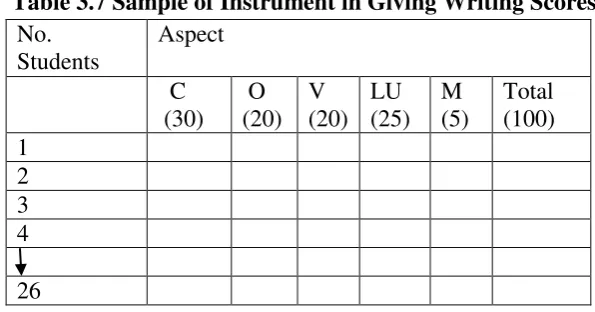
Researcher gave attention to the students about criteria to be evaluated
from their writing such content, organization, vocabulary, language use, and
-30), organization (7-20) vocabulary (7-20), language use (11-25), and
mechanics (2-5).
Table 3.7 Sample of Instrument in Giving Writing Scores No.
E. Procedure of The Research
The researcher used two classes to collect the data, the researcher
thought the students by using guided writing strategy for experimental class,
and used conventional strategy for control class. However, the material of the
teaching was the same writing material. In short, the researcher implements
this procedure:
Table 3.8 Teaching Procedure for Experimental and Control Groups
No Experiment Class Control Class
Pre activity (15 minutes) Appreciation
1. Teacher greets the students 2. Teacher and students pray 3. Teacher checks students‟
attendance
4. Teacher asks students about the last material
Motivation
1. Teacher motivate the students 2. Teacher
Pre activity (15 minutes) Appreciation
1. Teacher greets the students 2. Teacher and students pray 3. Teacher checks students‟
attendance
4. Teacher asks students about the last material
Motivation
1. Teacher motivate the students 2. Teacher encouraging students to
encourage students to speak English by asking questions
questions
3. Students respond to the teachers‟ question
4. Teacher introduces learning objective to students
5. Teacher write the topic of the lesson on the board
Main Activity (55 minutes) Exploration
1. Teacher introduces the learning objective to students
2. Teacher Writes the topic of the lesson on the board
3. Teacher shows a picture and give some questions based on the topic to build students background knowledge about analytical exposition text
4. Students read an example of analytical exposition text.
Elaboration
1. Students observe the elements of text then discuss the purpose, generic structure and language use
2. Teacher and students discuss the new vocabulary and the information that they can get from the text by doing questioning and answering session
3. Students give another example of analytical exposition text and try to identify the elements of the text
4. Students listen to teacher‟s instruction how to write analytical exposition text
5. Teacher and students discuss the key elements of writing
6. Teacher asks the students to shared they idea with their partner in seat about same topic 7. Students circulate their writing
in the pair and they give feedback to their friends
Main Activity (55 minutes) Exploration
1. Students see the topic in the whiteboard
2. Students read an analytical exposition text
3. The teacher gives some questions based on the topic to build students‟ background knowledge. 4. Students answer the questions
about the text.
Elaboration
1. Students identify the text about social networking, then find its characteristics, purpose, and generic structures
2. Students listen to the teacher‟s explanation about the characterist ics, purpose, and generic structure s of analytical exposition text 3. The teacher and students discuss
some vocabularies related to analytical exposition text
4. Student complete the blank text 5. Teacher instruct the students to
writing.
10.Students collect their paper Confirmation
1. Every group presents about their discussed
2. Students get the supporting comments from the another pair and the teacher.
3. Having evaluation about the writing
4. Giving the reward
writing
4. Giving the reward
Post Activity (10 minutes)
1. Teacher and the students conclude the materials.
2. Teacher gives reflection
3. Teacher informs the next material
4. Teacher and student close the class and pray
Post Activity (10 minutes)
1. Teacher and the students conclude the materials.
2. Teacher gives reflection
3. Teacher informs the next material 4. Teacher and student close the
class and pray
F. Technique of Data Collection
The data was collected through a post- test score. Researcher gave both of group‟s different treatment for writing test. Data of this research used the students‟ post- test score. The post- test score takes in the last meeting after
giving the treatment six times.
After researcher give treatment to the students, the researcher teaches
both the experiment group and control group. For experimental group,
researcher uses guided writing strategy in teaching writing. For control group,
will be given the post test. The post – test is administered to get final result of the research.
G. Technique of Data Analysis
To analyze the students‟ score in post-test, the researcher use T- test
formula taken from (Sudjana, 1996). In this case, T-test mean a statistical
procedure use to determine whether both of groups are in the same skill or not.
In analyzing the students‟ test score, some steps were done before analyzing the different mean by using t-test formula as follows;
1. This formula was applied to decide mean of students‟ test score in experimental and control groups;
X (Experimental group)
2. This formula was used to decide standard deviation of experimental group;
1)
3. This formula was used to decide standard deviation of control group;
1)
t =
S : Standard deviation of experimental group
2 2
CHAPTER IV
FINDINGS AND DISCUSSIONS
This chapter means to present the result of research that was done in six
meetings of Senior High School 1 Ulakan Tapakis. The study was started on July
and ended on August 2017. At the end of the research, the students were given
writing test. The analysis of the collected data was carried out to find whether or not using Guided Writing Strategy can improve students‟ writing skill at Senior
High School 1 Ulakan Tapakis.
A. Research Findings 1. Data Description
The data of this research was the score of students‟ post-test. The researcher had given post test of both samples where the students were
asked to create an analytical exposition text. The number of the students
who were involved in the post test was 50 students. Those students were
divided into two classes, 24 students for experimental group and 26 students for control group. The data of this research were students‟ score
in post-test. The researcher taught writing to the students by using Guided
Writing Strategy in experimental class and using conventional strategy in
control class for six meetings. At the end of the meeting, the post-test was
given to the students. The writing test was the same where the students
were asked to make composition of analytical exposition text. In scoring the test, the researcher used Jacob‟s criteria that can be seen in Chapter II.
All of the data were analyzed to find out the maximum and
minimum scores, mean score and Standard Deviation (SD) of post-test of
experimental class and control class.
Table 4.1 The Score of Writing Test of Experimental Group and Control Group
Class N Highest Score
Lowest Score
Mean (X)
Total score
Standard Deviation Experimental 24 80 40 63,96 1535 11.31
Control 26 80 39 56,35 1465 9.32
The total score of writing test of both groups was significantly
different. The total score of experimental group was 1535, the highest
score was 80, the lowest score was 40, and standard deviation was 11.31.
On the contrary, the total score of control group was 1465, the highest
score was 80, the lowest score was 39, and standard deviation was 9.32.
2. Descriptive Data Analysis a. Experimental Class
Xmax: 80 N: 24 R: Xmax-Xmin
Xmin: 40 P: R/K K: 1+3.3 Log n
Note:
P: Interval
R: Range
K: number of classes
R: Xmax-Xmin
K: 1+3.3 Log n
: 1+3.3 Log 24
: 1+3.3 (1.38)
: 5,554
: 6
P: R/K
: 40/6
: 6.667
: 7
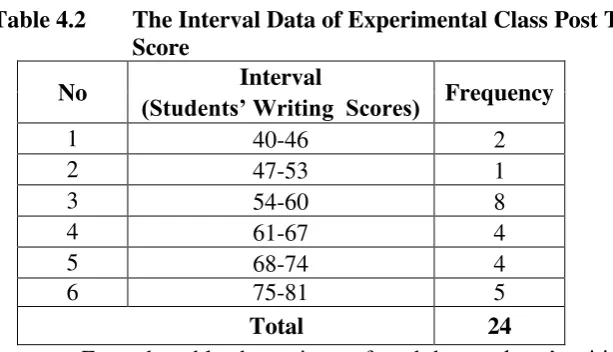
So, interval of students‟ writing score is 7. Then the interval data of
experimental class post-test score can be seen in the table below:
Table 4.2 The Interval Data of Experimental Class Post Test Score
No Interval Frequency
(Students’ Writing Scores)
1 40-46 2
2 47-53 1
3 54-60 8
4 61-67 4
5 68-74 4
6 75-81 5
Total 24
From the table above, it was found that students‟ writing post -test score in the experimental class in interval 40-46 there was 2
students, while the interval 47-53 there were 1 student, at interval
54-60 there were 8 students who got score at that interval, at interval
got score at that interval, and at that interval 75-81 there were 5
students who got score at that interval. The data of post-test score of
experimental class could be drawn as below:
Graph 4.1 The Interval Data of Experimental Class Post Test Score
Table 4.3 Calculation Process of Mean and Standard Deviation of Writing Test Experimental Group
X1 F1 X1
Based on table and formulation above, researcher found that mean
of writing test experimental group is 63.95 and standard deviation is
K: number of classes
R: Xmax-Xmin
K: 1+3.3 Log n
: 1+3.3 Log 26
: 1+3.3 (1.41)
: 5,65
: 6
P: R/K
: 39/6
: 6.667
: 7
So, interval of students‟ writing score is 7. Then the interval data of
experimental class post-test score can be seen in the table below:
Table 4.4 The Interval Data of Control Class Post Test Score
No Interval Frequency
(Students’ Writing Scores)
1 39-45 1
2 46-52 8
3 53-59 10
4 60-66 3
5 67-73 2
6 74-80 2
Total 26
From the table above, it was found that most of students‟
writing scores of post-test in the control class about 39-45, where