Volume 17 Number 1 2018
Terakreditasi “B” berdasarkan Keputusan Direktur Jenderal Pendidikan Tinggi, Departemen Pendidikan Nasional Nomor: 60/E/KPT/2016.
Tanggal: 13 November 2016. Masa berlaku 5 (lima) tahun sejak tanggal ditetapkan.
Abstract. It is commonly known that companies issue equity when the market values are high and repurchase when the market values are low. Using the yearly financial statements from 2001 until 2015, with the exclusion of 2008, for 136 non-financial companies listed on the Indonesia Stock Exchange (IDX), this study analyzed the existence of equity market timing with the consideration of equity and debt market variables using an econometric approach of panel data regression. This study adopted net equity issues as dependent variable. For the independent variables, this study adopted variables that reflect equity market condition: price-to-book value, market, profitability, and debt market variable that is interest rate. This study found that the variable affecting the net equity issues is profitability, while price-to-book value, market, and interest are not found to have a significant relationship with net equity issues. This shall imply that the companies issue external equity when the companies' profitability is good regardless of the valuation, and high interest rate. The findings of this study supported the existence of equity market timing shown by the significant relationship between variable profitability and net equity issues.
Keywords: Capital structure, equity market timing, Indonesia, net equity issues, non-financial companies.
Abstrak. Perusahaan menerbitkan ekuitas ketika nilai pasar tinggi dan dibeli kembali ketika nilai pasar rendah. Dengan menggunakan data laporan keuangan tahunan perusahaan dari tahun 2001 sampai dengan 2015, dengan pengecualian tahun 2008, untuk 136 perusahaan non-keuangan yang terdaftar di Bursa Efek Indonesia (BEI), penelitian ini menganalisis adanya equity market timing dengan mempertimbangkan variabel pasar ekuitas dan hutang dengan menggunakan model ekonometrik, yakni regresi data panel. Untuk peubah respon (dependent variable), penelitian ini menggunakan net equity issues, sedangkan untuk peubah penjelas (independent variables), penelitian ini menggunakan variabel yang mencerminkan kondisi pasar ekuitas: price-to-book value, market, profitability, dan variabel pasar utang yaitu interest. Hasil penelitian menunjukkan bahwa variabel yang mempengaruhi net equity issues adalah profitability, sedangkan price-to-book value, market dan interest tidak memiliki hubungan yang signifikan dengan net equity issues. Hal ini menunjukkan bahwa perusahaan menerbitkan ekuitas eksternal pada saat kondisi profitabilitas perusahaan dalam keadaan baik, terlepas dari nilai valuasi, dan tingkat bunga yang tinggi. Hasil penelitian ini mendukung adanya equity market timing yang dibuktikan oleh hubungan signifikan antara variabel profitability terhadap net equity issues.
Kata kunci: Equity market timing, Indonesia, Net equity issues, Perusahaan non-keuangan, Struktur modal.
*Corresponding author. Email: [email protected]th th th Received: January 26 , 2018, Revision: February 13 , 2018, Accepted: March 5 , 2018
Print ISSN: 1412-1700; Online ISSN: 2089-7928. DOI: http://dx.doi.org/10.12695/jmt.2018.17.1.1
Copyright@2018. Published by Unit Research and Knowledge, School of Business and Management - Institut Teknologi Bandung (SBM-ITB)
Equity Market Timing and Capital Structure:
Evidence from Indonesia Stock Exchange
1* 1 1&2 3
Sasha Dhita , Noer Azam Achsani , Roy Sembel and Sugeng Purwanto 1School of Business, Bogor Agricultural University (IPB), Indonesia
Introduction
A center of debate and controversy in corporate finance literature relates to the composition of debt and equity that will maximize the companies' value that generates the highest profitability to the companies. The debate started since the introduction of Capital Structure Irrelevance Theory by Modigliani and Miller (1958). The theory proposed that in a world where the competition is high and frictionless, the value of companies are not affected by their capital structure, or in other word, the value of companies are independent from their capital structure. Felicia and Saragih (2015) suggested that the value of a company can be maximized if the company can time its investment correctly, which is known as market timing strategy.
In corporate finance, market timing theory (MTT) refers to the practice where the companies issue shares when the share prices are high prices and repurchase the shares when the share prices are low. Baker and Wurgler (2002) asserted that the intention of this practice is to take advantage of the temporary fluctuations in the cost of equity relative to the other forms of capital. One of the market timing practices commonly used is the use of mispricing of the companies' shares in the market to obtain financing with relatively low cost of capital (Saad & Siagian, 2011). The components of market share price in an inefficient market consists of an asset value in place plus the value of growth opportunity (Myers, 1977; Kester, 1984; Reuer & Tong, 2007), investor sentiment, and the investor confidence in companies' cash flow expectations in the future, which is not supported by fundamental information (Morck, Shleifer, & Vishny, 1990; Baker, Ruback, & Wurgler, 2007). The uncertainty of investors' confidence leads to a mispricing of share price.
Felicia and Saragih (2015) asserted that the utilization of mispricing can only be carried out in an inefficient capital market. Previous studies showed that Indonesia Stock Exchange
is more inclined to inefficient capital market (Kim & Shamsuddin, 2008; Hoque, Kim, & Pyun, 2007). This raises a notion that the public companies in Indonesia adopt market timing strategy in determining the debt and equity financing choice.
The purpose of this study is to analyse the existence of equity market timing with the consideration of both equity and debt market variables. Previous studies relating to equity market timing in Indonesia found different results on the equity market timing. Studies conducted by Miswanto (2013), Saad and Siagian (2011), and Setyawan (2011) found that the equity market timing affect the capital structure. On the other hand, studies conducted by Wulandari and Setiawan (2015), and Felicia and Saragih (2015) found that interpretation. For example, by considering only the equity market variable in analyzing the market timing behavior, a favourable conditions of equity market may be interpret as the evidence of market timing, while in fact the managers are avoiding the unfavourable debt market conditions. Their study adopted net equity issues as the dependent variable, market-to-book ratio, market, profitability and interest as the independent variables.The three independent variables representing the equity market conditions are market-to-book ratio, market, and profitability, while interest reflects debt market conditions.
Following Bougatef and Chichti (2010), this study also adopted net equity issues as the dependent variable. However, in the calculation of net equity issues, this study divide the change of book value of equity minus the change of retained earning with book value of equity instead total asset. This is because, if the numerator were to be divided by the total asset that is equal to the liabilities and equity, the net equity issues will be understated,
because the components of liabilities include the component that are not classified as capital, e.g. account payable and employee obligations. Therefore, it is more appropriate to calculate net equity issues from equity perspective. Hence, the adoption of book value of equity as the denominator.
As for the independent variables, this study adopted three variables that reflect the equity market condition and one variable that reflect debt market condition. Following Bougatef and Chichti (2010), for the independent variable, this study adopted variable market, profitability, and interest. In addition to the independent variables, instead of market-to-book ratio as the proxy for the valuation variable, this study adopted price-to-book value. The reason is, mathematically, companies with the same price-to-book value can yield different market-to-book ratio, depending on the debt and equity proportion. In valuation perspective, this will mislead the companies' stakeholders in making corporate finance decision. Companies with high market-to-book ratio might prefer to issue equity compared to companies with low market-to-book ratio, as they perceived they are in a higher valuation multiple. However, if the valuation multiple were to be measured by price-to-book value, the valuation multiple can be actually lower in comparison with similar companies that is more leveraged.
This study included three contributions to capital structure literature as follows: 1) the calculation of net equity issues from equity perspective, 2) price-to-book value as the proxy of companies' valuation variable, and 3) equity market timing analysis from individual industry perspective. These contributions shall fill the gap of studies relating to the equity market timing studies for non-financial companies in Indonesia.
Research Hypotheses
To answer the research objective of analyzing the existence of the equity market timing, this study developed four alternative hypotheses.
Baker and Wurgler (2002) found that past market valuations has a quite persistent influence to the capital structure and that temporary fluctuations in market valuations can lead to permanent changes in capital structure. Trade-off theory asserted that market-to-book ratio as the proxy for the market valuation is an indicator of investment opportunities, risk or other indicator of determinants of the optimal leverage ratio. Based on the aforementioned argument, the adoption of market valuation, in this case the adoption of price-to-book value instead of market-to-book ratio, shall aids the companies in determining the appropriate timing for its equity issuance that will generate the lowest cost of capital. The aforementioned leads to the formulation of the alternative hypothesis as follows:
Alternative Hypothesis 1:
H : Price-to-book value affects the net equity issues in A1 Indonesia.
The capital markets are seen as the reflection of the economic growth of the country. Generally, a growing economy increases the companies' output, which leads to an increase in companies' profitability. The increase in profitability is one of the factors that makes the companies' share more attractive. Based on the aforementioned argument, the adoption of variable market and profitability shall aid the companies in its equity issuance decision making. This leads to the formulation of the alternative hypotheses as follow:
Alternative Hypothesis 2:
H :A2 Market affects the net equity issues in Indonesia.
Alternative Hypothesis 3:
H : A3 Profitability affects the net equity issues in Indonesia.
Introduction
A center of debate and controversy in corporate finance literature relates to the composition of debt and equity that will maximize the companies' value that generates the highest profitability to the companies. The debate started since the introduction of Capital Structure Irrelevance Theory by Modigliani and Miller (1958). The theory proposed that in a world where the competition is high and frictionless, the value of companies are not affected by their capital structure, or in other word, the value of companies are independent from their capital structure. Felicia and Saragih (2015) suggested that the value of a company can be maximized if the company can time its investment correctly, which is known as market timing strategy.
In corporate finance, market timing theory (MTT) refers to the practice where the companies issue shares when the share prices are high prices and repurchase the shares when the share prices are low. Baker and Wurgler (2002) asserted that the intention of this practice is to take advantage of the temporary fluctuations in the cost of equity relative to the other forms of capital. One of the market timing practices commonly used is the use of mispricing of the companies' shares in the market to obtain financing with relatively low cost of capital (Saad & Siagian, 2011). The components of market share price in an inefficient market consists of an asset value in place plus the value of growth opportunity (Myers, 1977; Kester, 1984; Reuer & Tong, 2007), investor sentiment, and the investor confidence in companies' cash flow expectations in the future, which is not supported by fundamental information (Morck, Shleifer, & Vishny, 1990; Baker, Ruback, & Wurgler, 2007). The uncertainty of investors' confidence leads to a mispricing of share price.
Felicia and Saragih (2015) asserted that the utilization of mispricing can only be carried out in an inefficient capital market. Previous studies showed that Indonesia Stock Exchange
is more inclined to inefficient capital market (Kim & Shamsuddin, 2008; Hoque, Kim, & Pyun, 2007). This raises a notion that the public companies in Indonesia adopt market timing strategy in determining the debt and equity financing choice.
The purpose of this study is to analyse the existence of equity market timing with the consideration of both equity and debt market variables. Previous studies relating to equity market timing in Indonesia found different results on the equity market timing. Studies conducted by Miswanto (2013), Saad and Siagian (2011), and Setyawan (2011) found that the equity market timing affect the capital structure. On the other hand, studies conducted by Wulandari and Setiawan (2015), and Felicia and Saragih (2015) found that interpretation. For example, by considering only the equity market variable in analyzing the market timing behavior, a favourable conditions of equity market may be interpret as the evidence of market timing, while in fact the managers are avoiding the unfavourable debt market conditions. Their study adopted net equity issues as the dependent variable, market-to-book ratio, market, profitability and interest as the independent variables. The three independent variables representing the equity market conditions are market-to-book ratio, market, and profitability, while interest reflects debt market conditions.
Following Bougatef and Chichti (2010), this study also adopted net equity issues as the dependent variable. However, in the calculation of net equity issues, this study divide the change of book value of equity minus the change of retained earning with book value of equity instead total asset. This is because, if the numerator were to be divided by the total asset that is equal to the liabilities and equity, the net equity issues will be understated,
because the components of liabilities include the component that are not classified as capital, e.g. account payable and employee obligations. Therefore, it is more appropriate to calculate net equity issues from equity perspective. Hence, the adoption of book value of equity as the denominator.
As for the independent variables, this study adopted three variables that reflect the equity market condition and one variable that reflect debt market condition. Following Bougatef and Chichti (2010), for the independent variable, this study adopted variable market, profitability, and interest. In addition to the independent variables, instead of market-to-book ratio as the proxy for the valuation variable, this study adopted price-to-book value. The reason is, mathematically, companies with the same price-to-book value can yield different market-to-book ratio, depending on the debt and equity proportion. In valuation perspective, this will mislead the companies' stakeholders in making corporate finance decision. Companies with high market-to-book ratio might prefer to issue equity compared to companies with low market-to-book ratio, as they perceived they are in a higher valuation multiple. However, if the valuation multiple were to be measured by price-to-book value, the valuation multiple can be actually lower in comparison with similar companies that is more leveraged.
This study included three contributions to capital structure literature as follows: 1) the calculation of net equity issues from equity perspective, 2) price-to-book value as the proxy of companies' valuation variable, and 3) equity market timing analysis from individual industry perspective. These contributions shall fill the gap of studies relating to the equity market timing studies for non-financial companies in Indonesia.
Research Hypotheses
To answer the research objective of analyzing the existence of the equity market timing, this study developed four alternative hypotheses.
Baker and Wurgler (2002) found that past market valuations has a quite persistent influence to the capital structure and that temporary fluctuations in market valuations can lead to permanent changes in capital structure. Trade-off theory asserted that market-to-book ratio as the proxy for the market valuation is an indicator of investment opportunities, risk or other indicator of determinants of the optimal leverage ratio. Based on the aforementioned argument, the adoption of market valuation, in this case the adoption of price-to-book value instead of market-to-book ratio, shall aids the companies in determining the appropriate timing for its equity issuance that will generate the lowest cost of capital. The aforementioned leads to the formulation of the alternative hypothesis as follows:
Alternative Hypothesis 1:
H : Price-to-book value affects the net equity issues in A1 Indonesia.
The capital markets are seen as the reflection of the economic growth of the country. Generally, a growing economy increases the companies' output, which leads to an increase in companies' profitability. The increase in profitability is one of the factors that makes the companies' share more attractive. Based on the aforementioned argument, the adoption of variable market and profitability shall aid the companies in its equity issuance decision making. This leads to the formulation of the alternative hypotheses as follow:
Alternative Hypothesis 2:
H :A2 Market affects the net equity issues in Indonesia.
Alternative Hypothesis 3:
H : Profitability affects the net equity issues in A3 Indonesia.
During this situation, the companies that have other financing options, may not need to issue bonds instead the company can issue equity. Considering this, the analysis on the market timing existence should also include the variable that reflect the debt market condition. Based on the aforementioned argument, the alternative hypothesis formulated is as follows: Alternative Hypothesis 4:
H : a4 Interest affects the net equity issues in Indonesia.
The adoption of variables that reflect both equity and debt market conditions in the regression analysis shall provide a sharper analysis on the market timing behavior.
Research Methodology
This quantitative study is conducted in Indonesia, using an econometric approach of panel data regression. This study adopted t-test to verify the correctness of the null hypothesis. The null hypothesis is not rejected when the p-value > 0.05. On the other hand, null hypothesis is rejected when p-value ≤ 0.05.
As of 30 December 2015, there were a total of 521 listed companies.
The companies that qualified for this study m u s t m e e t t h e f o l l o w i n g c r i t e r i a : 1) availability of yearly financial statements from December 2001 to December 2015, 2) availability data to calculate net equity issues, price-to-book value, profitability, market and interest, and 3) the companies are not classified into finance industry sector. After the screening process, the number of non-financial companies studied is 136 companies. This study used yearly financial statements from 2001 until 2015, with the exclusion of 2008. The data is collected from the companies' official website, prospectus and Bloomberg database.
Regression Model
This study adopted dependent variable of net equity issues and independent variables of price-to-book value, market and profitability that reflects the equity market condition, and interest that reflects the debt market condition. The estimated regression is as follow:
(e/BE)i , t=α+β1PBVi , t+β2MARKET + i , t
β3PROFi,t+β4INTERESTi,t+εi,t
Where e/BEi,t is the net equity issues for company i at period t, PBVi,t is price-to-book value for company i at period t, MARKETi,t is the performance of Jakarta Composite Index (JCI) for company i at period t, PROFi,t is the profitability for company i at period t, and INTERESTi,t is the risk free interest rate reference for company i at period t.
The operationalization of the variables is as follow: 1) e/BE - the change of book value of equity minus the change of retained earning divided by book value of equity, 2) PBV - market capitalization divided by book value of equity, 3) MARKET – the annual growth rate of JCI market capitalization, 4) PROF – book value of equity divided by net profit, and 5) INTEREST – yearly average of SBI or BI rate
* monthly changes .
Results and Discussion
Descriptive statistics
The study found that the net equity issues has an average of 0.7107, which implies that the difference of change of book-value of equity and retained earning is 71.07% of its book-value of equity. Table 1 showed that price-to-book value has a ratio greater than 1. Price-to-book value is the ratio that is used to assess whether a share price is overvalued or undervalued. Ratio greater than 1 shows that on average the market value is greater than its book value. High price-to-book value indicates that the shares are overvalued, which encourages companies to issue more equity, and it also indicates growth opportunities of a company.
Table 1 also showed that variable market varied between (7.84)% to 87.59% with an average value of 32.13%, variable profitability varied between (1,183.97)% to 20,242.26% with an average value of 17.20% and variable interest varied between (3.75)% to 5.12% with an average value of (0. 36)%.
Correlation Coefficient
The study found that price-to-book value and market have negative relationship with net equity issues while variable profitability and interest have positive relationship with net equity issues. Negative relationship showed that an increase in the value of variable price-to-book value and market decreased the net equity issues, while positive relationship for variable profitability and interest showed an increase in the value of profitability and interest increased the net equity issues.
Table 2 showed that variable price-to-book value and market have weak downhill (negative) linear relationship with -0.0037 and -0.0325 r-value, respectively. Variable interest also showed a weak linear relationship but positive with 0.0219 r-value. Variable profitability, on the other hand, showed a strong uphill (positive) relationship with 0.9919 r-value. The result of the study showed that variable profitability is the only variable that has a strong relationship with net equity issues, while other variables show weak relationship.
Table 2 showed that variable interest and market have correlation of -0.5772. To avoid the problem of multicollinearity, a treatment is taken by removing variable market from independent variables. The correlation coefficient after the multicollinearity treatment is shown in Table 3.
Table 1.
Descriptive Statistics
Table 2.
Correlation Coefficient between Equity and Debt Market Variables
Table 3.
Correlation Coefficient after Multicollinearity Treatment
e/BE PBV MARKET PROF INTEREST
Mean 0.7107 1.9273 0.3213 0.1720 (0.0036) Median 0.0000 1.0000 0.2088 0.0859 (0.0044) Maximum 1,213.1580 80.3859 0.8759 202.4226 0.0512 Minimum (6.8814) 0.0311 (0.0784) (11.8397) (0.0375)
Observations 1904 1904 1904 1904 1904
e/BE PBV MARKET PROF INTEREST
e/BE 1.0000
PBV (0.0037) 1.0000
MARKET (0.0325) 0.0112 1.0000
PROF 0.9919 (0.0052) (0.0313) 1.0000
INTEREST 0.0219 0.0069 (0.5772) 0.0211 1.0000
e/BE PBV PROF INTEREST
e/BE 1.0000
PBV (0.0037) 1.0000
PROF 0.9919 (0.0052) 1.0000
During this situation, the companies that have other financing options, may not need to issue bonds instead the company can issue equity. Considering this, the analysis on the market timing existence should also include the variable that reflect the debt market condition. Based on the aforementioned argument, the alternative hypothesis formulated is as follows: Alternative Hypothesis 4:
H :a4 Interest affects the net equity issues in Indonesia.
The adoption of variables that reflect both equity and debt market conditions in the regression analysis shall provide a sharper analysis on the market timing behavior.
Research Methodology
This quantitative study is conducted in Indonesia, using an econometric approach of panel data regression. This study adopted t-test to verify the correctness of the null hypothesis. The null hypothesis is not rejected when the p-value > 0.05. On the other hand, null hypothesis is rejected when p-value ≤ 0.05.
As of 30 December 2015, there were a total of 521 listed companies.
The companies that qualified for this study m u s t m e e t t h e f o l l o w i n g c r i t e r i a : 1) availability of yearly financial statements from December 2001 to December 2015, 2) availability data to calculate net equity issues, price-to-book value, profitability, market and interest, and 3) the companies are not classified into finance industry sector. After the screening process, the number of non-financial companies studied is 136 companies. This study used yearly financial statements from 2001 until 2015, with the exclusion of 2008. The data is collected from the companies' official website, prospectus and Bloomberg database.
Regression Model
This study adopted dependent variable of net equity issues and independent variables of price-to-book value, market and profitability that reflects the equity market condition, and interest that reflects the debt market condition. The estimated regression is as follow:
(e/BE)i , t=α+β1PBVi , t+β2MARKET + i , t
β3PROFi,t+β4INTERESTi,t+εi,t
Where e/BEi,t is the net equity issues for company i at period t, PBVi,t is price-to-book value for company i at period t, MARKETi,t is the performance of Jakarta Composite Index (JCI) for company i at period t, PROFi,t is the profitability for company i at period t, and
INTERESTi,t is the risk free interest rate
reference for company i at period t.
The operationalization of the variables is as follow: 1) e/BE - the change of book value of equity minus the change of retained earning divided by book value of equity, 2) PBV - market capitalization divided by book value of equity, 3) MARKET – the annual growth rate of JCI market capitalization, 4) PROF – book value of equity divided by net profit, and 5) INTEREST – yearly average of SBI or BI rate
* monthly changes .
Results and Discussion
Descriptive statistics
The study found that the net equity issues has an average of 0.7107, which implies that the difference of change of book-value of equity and retained earning is 71.07% of its book-value of equity.Table 1 showed that price-to-book value has a ratio greater than 1. Price-to-book value is the ratio that is used to assess whether a share price is overvalued or undervalued. Ratio greater than 1 shows that on average the market value is greater than its book value. High price-to-book value indicates that the shares are overvalued, which encourages companies to issue more equity, and it also indicates growth opportunities of a company.
Table 1 also showed that variable market varied between (7.84)% to 87.59% with an average value of 32.13%, variable profitability varied between (1,183.97)% to 20,242.26% with an average value of 17.20% and variable interest varied between (3.75)% to 5.12% with an average value of (0. 36)%.
Correlation Coefficient
The study found that price-to-book value and market have negative relationship with net equity issues while variable profitability and interest have positive relationship with net equity issues. Negative relationship showed that an increase in the value of variable price-to-book value and market decreased the net equity issues, while positive relationship for variable profitability and interest showed an increase in the value of profitability and interest increased the net equity issues.
Table 2 showed that variable price-to-book value and market have weak downhill (negative) linear relationship with -0.0037 and -0.0325 r-value, respectively. Variable interest also showed a weak linear relationship but positive with 0.0219 r-value. Variable profitability, on the other hand, showed a strong uphill (positive) relationship with 0.9919 r-value. The result of the study showed that variable profitability is the only variable that has a strong relationship with net equity issues, while other variables show weak relationship.
Table 2 showed that variable interest and market have correlation of -0.5772. To avoid the problem of multicollinearity, a treatment is taken by removing variable market from independent variables. The correlation coefficient after the multicollinearity treatment is shown in Table 3.
Table 1.
Descriptive Statistics
Table 2.
Correlation Coefficient between Equity and Debt Market Variables
Table 3.
Correlation Coefficient after Multicollinearity Treatment
e/BE PBV MARKET PROF INTEREST Mean 0.7107 1.9273 0.3213 0.1720 (0.0036) Median 0.0000 1.0000 0.2088 0.0859 (0.0044) Maximum 1,213.1580 80.3859 0.8759 202.4226 0.0512 Minimum (6.8814) 0.0311 (0.0784) (11.8397) (0.0375)
Observations 1904 1904 1904 1904 1904
e/BE PBV MARKET PROF INTEREST
e/BE 1.0000
PBV (0.0037) 1.0000
MARKET (0.0325) 0.0112 1.0000
PROF 0.9919 (0.0052) (0.0313) 1.0000
INTEREST 0.0219 0.0069 (0.5772) 0.0211 1.0000
e/BE PBV PROF INTEREST
e/BE 1.0000
PBV (0.0037) 1.0000
PROF 0.9919 (0.0052) 1.0000
Panel Data Test
This study run three tests of panel data: Likelihood Ratio Test (Common Effect Model versus Fixed Effect Model), Hausman Test (Fixed Effect Model versus Random Effect Model) and Langrangge Multiplier Test (Common Effect Model versus Random Effect Model) to determine the appropriate model that best suites the research purpose. The Hausman Test result suggest that the p-value is 1.00 > 0.05, hence the appropriate model is Random Effect Model (REM) as shown in Table 4.
Test of Ordinary Least Square assumption
To ensure that the estimator has Best Linear Unbiased Estimator (BLUE) characteristic, this study test the ordinary least square (OLS) assumption of heteroscedasticity and autocorrelation. This study adopted White method for heteroscedasticity test, and Breusch-Godfrey method for autocorrelation test. The OLS result for heteroscedasticity test is shown in Table 5 and autocorrelation test in Table 6.
For heteroscedasticity and autocorrelation test, Table 5 and Table 6 showed p-value 0.00 ≤ 0.05, therefore the null hypothesis is rejected. It shall be concluded that there were heteroscedasticity and autocorrelation problem.
To ensure that the estimator has BLUE characteristics, these two problems are treated using Heteroscedasticity and Autocorrelation Consistent Covariance Matirx (HAC), shown in Table 7. After performing HAC, t-test can be performed.
T-test results for overall market and individual industry
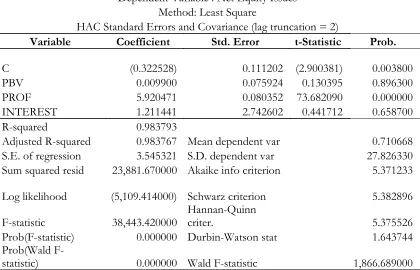
The t-test results suggest that profitability is the only variable that has a significant relationship with net equity issues with p-value 0.00 ≤ 0.05. The result is shown in Table 7.
a. Overall Market
For overall market, Table 7 showed that the coefficient of determination is 0.9838, which means that the model explained 98.38% variability of the response data around its mean. The result of the estimated model for overall market is as follow:
Constant
The constant value from the estimated model of -0.3225 showed that without the independent variables influence, the net equity issues value is -0.3225.
Coefficient of PBV
The finding of the study showed that for overall market, there is no significant relationship between variable price-to-book value and net equity issues.
Coefficient of PROF
The finding of the study suggest that for overall market, variable profitability significantly affect the net equity issues, with p-value ≤ 0.05, and it has a positive relationship
with net equity issues. When the companies have a good profitability ratio, the companies will be valued higher by the investor and can have higher pricing. Higher pricing means that with the same number of new shares issued, the companies can receive higher proceeds. For companies that already decide on the amount of proceeds needed, higher pricing means the companies can reduce the number of shares issued, which will lead to a lower dilution of ownership for the existing shareholders. This is consistent with Bougatef and Chichti (2010).
The finding of the study did not support the Pecking order theory according to which the companies prefer internal funds and issue external equity as a last resort.
Coefficient of INTEREST
The finding of the study suggest that for overall market, there is no significant relationship between variable interest and net equity issues.
Chi-Sq. Statistic Chi-Sq. d.f. Prob.
Cross-section random 0.0000 4.000 1.000
Table 7.
Heteroscedasticity and Autocorrelation Consistent Covariance Matirx Method
Table 5.
White Heteroscedasticity Method
F-statistic 339.6680 Prob. F 0.0000
Obs*R-squared 1,175.6280 Prob. Chi-Square 0.0000
Table 6.
Breusch-Godfrey Method
F-statistic 38.48512 Prob. F 0.0000
Obs*R-squared 74.20433 Prob. Chi-Square 0.0000
Table 4.
Hausman Test
Dependent Variable : Net Equity Issues Method: Least Square
HAC Standard Errors and Covariance (lag truncation = 2)
Variable Coefficient Std. Error t-Statistic Prob.
C (0.322528) 0.111202 (2.900381) 0.003800
PBV 0.009900 0.075924 0.130395 0.896300
PROF 5.920471 0.080352 73.682090 0.000000
INTEREST 1.211441 2.742602 0.441712 0.658700
R-squared 0.983793
Adjusted R-squared 0.983767 Mean dependent var 0.710668
S.E. of regression 3.545321 S.D. dependent var 27.826330
Sum squared resid 23,881.670000 Akaike info criterion 5.371233
Log likelihood (5,109.414000) Schwarz criterion 5.382896
F-statistic 38,443.420000 Hannan-Quinn criter. 5.375526
Prob(F-statistic) 0.000000 Durbin-Watson stat 1.643744
Prob(Wald
Panel Data Test
This study run three tests of panel data: Likelihood Ratio Test (Common Effect Model versus Fixed Effect Model), Hausman Test (Fixed Effect Model versus Random Effect Model) and Langrangge Multiplier Test (Common Effect Model versus Random Effect Model) to determine the appropriate model that best suites the research purpose. The Hausman Test result suggest that the p-value is 1.00 > 0.05, hence the appropriate model is Random Effect Model (REM) as shown in Table 4.
Test of Ordinary Least Square assumption
To ensure that the estimator has Best Linear Unbiased Estimator (BLUE) characteristic, this study test the ordinary least square (OLS) assumption of heteroscedasticity and autocorrelation. This study adopted White method for heteroscedasticity test, and Breusch-Godfrey method for autocorrelation test. The OLS result for heteroscedasticity test is shown in Table 5 and autocorrelation test in Table 6.
For heteroscedasticity and autocorrelation test, Table 5 and Table 6 showed p-value 0.00 ≤ 0.05, therefore the null hypothesis is rejected. It shall be concluded that there were heteroscedasticity and autocorrelation problem.
To ensure that the estimator has BLUE characteristics, these two problems are treated using Heteroscedasticity and Autocorrelation Consistent Covariance Matirx (HAC), shown in Table 7. After performing HAC, t-test can be performed.
T-test results for overall market and individual industry
The t-test results suggest that profitability is the only variable that has a significant relationship with net equity issues with p-value 0.00 ≤ 0.05. The result is shown in Table 7.
a. Overall Market
For overall market, Table 7 showed that the coefficient of determination is 0.9838, which means that the model explained 98.38% variability of the response data around its mean. The result of the estimated model for overall market is as follow:
Constant
The constant value from the estimated model of -0.3225 showed that without the independent variables influence, the net equity issues value is -0.3225.
Coefficient of PBV
The finding of the study showed that for overall market, there is no significant relationship between variable price-to-book value and net equity issues.
Coefficient of PROF
The finding of the study suggest that for overall market, variable profitability significantly affect the net equity issues, with p-value ≤ 0.05, and it has a positive relationship
with net equity issues. When the companies have a good profitability ratio, the companies will be valued higher by the investor and can have higher pricing. Higher pricing means that with the same number of new shares issued, the companies can receive higher proceeds. For companies that already decide on the amount of proceeds needed, higher pricing means the companies can reduce the number of shares issued, which will lead to a lower dilution of ownership for the existing shareholders. This is consistent with Bougatef and Chichti (2010).
The finding of the study did not support the Pecking order theory according to which the companies prefer internal funds and issue external equity as a last resort.
Coefficient of INTEREST
The finding of the study suggest that for
overall market, there is no significant relationship between variable interest and net equity issues.
Chi-Sq. Statistic Chi-Sq. d.f. Prob.
Cross-section random 0.0000 4.000 1.000
Table 7.
Heteroscedasticity and Autocorrelation Consistent Covariance Matirx Method
Table 5.
White Heteroscedasticity Method
F-statistic 339.6680 Prob. F 0.0000
Obs*R-squared 1,175.6280 Prob. Chi-Square 0.0000
Table 6.
Breusch-Godfrey Method
F-statistic 38.48512 Prob. F 0.0000
Obs*R-squared 74.20433 Prob. Chi-Square 0.0000
Table 4.
Hausman Test
Dependent Variable : Net Equity Issues Method: Least Square
HAC Standard Errors and Covariance (lag truncation = 2)
Variable Coefficient Std. Error t-Statistic Prob.
C (0.322528) 0.111202 (2.900381) 0.003800
PBV 0.009900 0.075924 0.130395 0.896300
PROF 5.920471 0.080352 73.682090 0.000000 INTEREST 1.211441 2.742602 0.441712 0.658700 R-squared 0.983793
Adjusted R-squared 0.983767 Mean dependent var 0.710668 S.E. of regression 3.545321 S.D. dependent var 27.826330 Sum squared resid 23,881.670000 Akaike info criterion 5.371233
Log likelihood (5,109.414000) Schwarz criterion 5.382896
F-statistic 38,443.420000 Hannan-Quinn criter. 5.375526 Prob(F-statistic) 0.000000 Durbin-Watson stat 1.643744 Prob(Wald
Overall market findings summary
For overall market, the empirical results are consistent with the MTT evidenced by significant relationship between variable profitability with net equity issues. The finding of the study on the existence of market timing is supported by the studies performed by Miswanto (2013), Saad and Siagian (2011), and Setyawan (2011). In addition, the study also found that variables price-to-book value, market and interest did not significantly affect the net equity issues.
b. Individual Industry
The relationship between independent variables and dependent variable may differ between industries. However, in this study, the agriculture industry did not have sufficient data point to be used and analyzed. This is because there were only three companies that classified into agriculture industry during the observation period. Therefore, the findings for the individual industry exclude the agriculture industry. The result of the estimated model for individual industry is as follow:
Coefficient of PROF
This study found that basic industry and chemicals and consumer goods industries have p-value ≤ 0.05 with 0.0000 and 0.0000, respectively. On the other hand, infrastructure, utilities and transportation, mining, miscellaneous, property, real estate and building construction and trade, services and investment industries have p-value > 0.05 with 0.7210, 0.3576, 0.5021, 0.9321 and 0.8330, respectively. The finding of the study highlighted that the significant relationship between variable profitability and net equity issues industries are evidenced in basic industry and chemicals, and consumer goods industry.
Individual industry findings summary
The findings for individual industry suggest that the significant relationship between variable profitability and net equity issues are only evidenced in basic industry and chemicals, and consumer goods industry.
Limitation, implication and future studies
The finding of the study is limited to the 136 non-financial companies listed on the IDX within the observation period. In determining whether to issue external equity, the companies look at its profitability. The finding of the study, which found that the companies issue external equity when the companies' profitability is good regardless the company's valuation, and high interest rate, suggest that in making corporate finance decision, the manager should make a decision that will improve its profitability.
From individual industry perspective, this study found that the significant relationship is evidenced in basic industry and chemicals, and consumer goods industry. Further studies shall include industry specific variables that may affect the equity issuance, for example, the use of reserve based approach for mining industry, and the use of prevailing discount to net asset value for property industry. In addition, further studies shall also include other debt market variables such as outstanding working capital and investment loan in the analysis of equity market timing existence.
Conclusion
For overall market, the findings of this study support the existence of equity market timing shown by the significant relationship between variable profitability and net equity issues. The significant relationship also evidenced in basic industry and chemicals, and consumer goods industry. The insignificant relationship between the variables and net equity issues for other industries might be resolved by including industry specific variables, which may be able to capture the equity market timing in that particular industry. To conclude, in equity issuance decision making, a manager should focus more on improving the company's profitability, which will generate an optimal result to the company.
References
Baker, M., Ruback, R. S., & Wurgler, J. (2007). Behavioral corporate finance: a survey. In Eckbo E. (Ed.), Handbook in Corporate
Finance: Empirical Corporate Finance. New
York: North Holland.
Baker, M., & Wurgler J. (2002). Market timing and capital structure. Journal of Finance, 57, 1-32.
Bougatef, K., & Chichti J. (2010). Equity market timing and capital structure: evidence from Tunisia and France. International Journal of Business and
Management, 5(10).
Felicia, & Saragih, F.D. (2015). Analisis pengaruh market timing terhadap struktur modal perusahaan non-keuangan yang terdaftar di Bursa Efek Indonesia. Jurnal Administrasi Bisnis, 11(2), 101-116.
Hoque, H. A. A. B., Kim, J. H., & Pyun, C. S. (2007). A comparison of variance ratio tests of random walk: a case of asian emerging stock markets. International
Review of Economics and Finance, 16,
488-502.
Kester, W. C. (1984). Today's options for tomorrow's growth. Harvard Business
Review, 62, 153-160.
Kim, J. H., & Shamsuddin, A. (2008). Are asian stock markets efficient? evidence from new multiple variance ratio tests. Journal of Empirical Finance, 15, 518–532. Miswanto. (2013). Market timing dan
pengaruhnya terhadap struktur modal pada perusahaan manufaktur Indonesia Yang IPO Tahun 2000 – 2008. Jurnal Siasat Bisnis, 17(1), 69-79.
Modigliani, F., & Miller M. H. (1958). The cost of capital, corporation finance and the theory of investment. The American
Economic Review, 48(3), 261-297.
Morck, R., Shleifer, A., & Vishny, R. (1990). The stock market and investment: is the market a side-show? Brookings Papers on Economic Activity, 2, 157-215.
Myers, S. C. (1977). Determinants of corporate borrowing. Journal of Financial Economics, 5, 147–175.
Reuer, J. J., & Tong, T. W. (2007). Corporate investments and growth options. Managerial and Decision Economics, 28, 863-877.
Saad, M. D. P., & Siagian, H. (2011). Sentimen investor, kendala keuangan, dan equity market timing. Finance and Banking Journal, 13(1).
Setyawan, I. R. (2011). An Empirical study on market timing theory of capital structure. International Research Journal of Business Studies, 4(2).
Overall market findings summary
For overall market, the empirical results are consistent with the MTT evidenced by significant relationship between variable profitability with net equity issues. The finding of the study on the existence of market timing is supported by the studies performed by Miswanto (2013), Saad and Siagian (2011), and Setyawan (2011). In addition, the study also found that variables price-to-book value, market and interest did not significantly affect the net equity issues.
b. Individual Industry
The relationship between independent variables and dependent variable may differ between industries. However, in this study, the agriculture industry did not have sufficient data point to be used and analyzed. This is because there were only three companies that classified into agriculture industry during the observation period. Therefore, the findings for the individual industry exclude the agriculture industry. The result of the estimated model for individual industry is as follow:
Coefficient of PROF
This study found that basic industry and chemicals and consumer goods industries have p-value ≤ 0.05 with 0.0000 and 0.0000, respectively. On the other hand, infrastructure, utilities and transportation, mining, miscellaneous, property, real estate and building construction and trade, services and investment industries have p-value > 0.05 with 0.7210, 0.3576, 0.5021, 0.9321 and 0.8330, respectively. The finding of the study highlighted that the significant relationship between variable profitability and net equity issues industries are evidenced in basic industry and chemicals, and consumer goods industry.
Individual industry findings summary
The findings for individual industry suggest that the significant relationship between variable profitability and net equity issues are only evidenced in basic industry and chemicals, and consumer goods industry.
Limitation, implication and future studies
The finding of the study is limited to the 136 non-financial companies listed on the IDX within the observation period. In determining whether to issue external equity, the companies look at its profitability. The finding of the study, which found that the companies issue external equity when the companies' profitability is good regardless the company's valuation, and high interest rate, suggest that in making corporate finance decision, the manager should make a decision that will improve its profitability.
From individual industry perspective, this study found that the significant relationship is evidenced in basic industry and chemicals, and consumer goods industry. Further studies shall include industry specific variables that may affect the equity issuance, for example, the use of reserve based approach for mining industry, and the use of prevailing discount to net asset value for property industry. In addition, further studies shall also include other debt market variables such as outstanding working capital and investment loan in the analysis of equity market timing existence.
Conclusion
For overall market, the findings of this study support the existence of equity market timing shown by the significant relationship between variable profitability and net equity issues. The significant relationship also evidenced in basic industry and chemicals, and consumer goods industry. The insignificant relationship between the variables and net equity issues for other industries might be resolved by including industry specific variables, which may be able to capture the equity market timing in that particular industry. To conclude, in equity issuance decision making, a manager should focus more on improving the company's profitability, which will generate an optimal result to the company.
References
Baker, M., Ruback, R. S., & Wurgler, J. (2007). Behavioral corporate finance: a survey.
In Eckbo E. (Ed.), Handbook in Corporate
Finance: Empirical Corporate Finance. New York: North Holland.
Baker, M., & Wurgler J. (2002). Market timing and capital structure. Journal of Finance, 57, 1-32.
Bougatef, K., & Chichti J. (2010). Equity market timing and capital structure: evidence from Tunisia and France. International Journal of Business and Management, 5(10).
Felicia, & Saragih, F.D. (2015). Analisis pengaruh market timing terhadap struktur modal perusahaan non-keuangan yang terdaftar di Bursa Efek
Indonesia. Jurnal Administrasi Bisnis,
11(2), 101-116.
Hoque, H. A. A. B., Kim, J. H., & Pyun, C. S. (2007). A comparison of variance ratio tests of random walk: a case of asian
emerging stock markets. International
Review of Economics and Finance, 16, 488-502.
Kester, W. C. (1984). Today's options for
tomorrow's growth. Harvard Business
Review, 62, 153-160.
Kim, J. H., & Shamsuddin, A. (2008). Are asian stock markets efficient? evidence from new multiple variance ratio tests. Journal of Empirical Finance, 15, 518–532. Miswanto. (2013). Market timing dan
pengaruhnya terhadap struktur modal pada perusahaan manufaktur Indonesia
Yang IPO Tahun 2000 – 2008. Jurnal
Siasat Bisnis, 17(1), 69-79.
Modigliani, F., & Miller M. H. (1958). The cost of capital, corporation finance and the
theory of investment. The American
Economic Review, 48(3), 261-297.
Morck, R., Shleifer, A., & Vishny, R. (1990). The stock market and investment: is the
market a side-show? Brookings Papers on
Economic Activity, 2, 157-215.
Myers, S. C. (1977). Determinants of corporate borrowing. Journal of Financial Economics, 5, 147–175.
Reuer, J. J., & Tong, T. W. (2007). Corporate investments and growth options.
Managerial and Decision Economics, 28,
863-877.
Saad, M. D. P., & Siagian, H. (2011). Sentimen investor, kendala keuangan, dan equity market timing. Finance and Banking Journal, 13(1).
Setyawan, I. R. (2011). An Empirical study on market timing theory of capital structure. International Research Journal of Business Studies, 4(2).