* Corresponding author.
DOCKING STUDIES OF CURCUMIN AS A POTENTIAL LEAD COMPOUND TO DEVELOP
NOVEL DIPEPTYDYL PEPTIDASE-4 INHIBITORS
Enade Perdana Istyastono
Leiden/Amsterdam Center for Drug Research (LACDR), Department of Chemistry, Vrije Universiteit Amsterdam De Boelelaan 1083, 1081HV Amsterdam, the Netherlands
Received December 30, 2008; Accepted March 11, 2009
ABSTRACT
Interaction of curcumin to dipeptydyl peptidase-4 (DPP-4) has been studied by employing docking method using Molecular Operating Environment (MOE) and AutoDock as the docking software applications. Although MOE can sample more conformational spaces that represent the original interaction poses than AutoDock, both softwares serve as valid and acceptable docking applications to study the interactions of small compound to DPP-4. The calculated free energy of binding (Gbinding) results from MOE and AutoDock shows that curcumin is needed to be
optimized to reach similar or better Gbinding compare to the reference compound. Curcumin can be considered as a
good lead compound in the development of new DPP-4 inhibitor. The results of these studies can serve as an initial effort of the further study.
Keywords: curcumin, docking, molecular operating environment (MOE), AutoDock, dipeptydyl peptidase-4 (DPP-4)
INTRODUCTION
Dipeptydyl peptidase-4 (DPP-4) becomes an attractive target of drug discovery and development [1, 2], since it has served as the target of the discovery and development of sitagliptin (Januvia®; Merck) (1) and vildagliptin (Galvus®; Novartis) (2) (Figure 1) [3-11]. As DPP-4 inhibitors, the drugs prevent the inactivation of glucagon-like peptide-1 (GLP-1), which then enhance and prolong the action of the endogenously released incretin hormone, and therefore insulin secretion is stimulated [8]. Both sitagliptin and vildagliptin open new
opportunity and new strategy in the therapy for type 2 diabetes mellitus (T2DM) [4, 8]. More than 200 million adults are reported to have T2DM (with an estimated 70 million in the United States and Europe) [4]. An epidemiology study in 2002 showed that the prevalence of diabetes in Indonesia was 1.2–2.3% among people over 15 years and the prevalence was predicted to explode in the coming years [12]. In order to provide cheaper and easily available T2DM drugs for Indonesian, development of drugs based on its own natural resources by employing similar strategy can serve as an alternative approach.
Curcumin (3a (enol form) and 3b (keto form)) (Figure 1), the yellow pigment of turmeric (Curcuma longa, Linn.), has been reported to have some biological activities, e.g. antimicrobial, antiviral, antifungal, cholekinetic, anti-inflammatory, and chemopreventive [13]. Turmeric has widely used in Indonesia as an ingredient of some traditional medicines [14]. Curcumin itself has served as a lead compound which led to the discovery some patented analogs whose better anti-inflamatory activity [15, 16 benzylidene cyclopentanone, and benzylidene acetone, and therapeutic uses thereof #16 benzylidene cyclopentanone, and benzylidene acetone, and therapeutic uses thereof #16]. Recently, an epidemiology study reported positive correlations of curcumin intake with the treatment of T2DM [17]. This hypothesis that curcumin can inhibit DPP-4. Curcumin, therefore, has a possibility to serve as a lead compound in the development of new DPP-4 inhibitors.
Studies of the molecular interaction of drug and its target have been widely performed by employing docking method and lead to some successes in the medicinal chemistry field of research [18]. In this article, docking studies of curcumin to DPP-4 by employing Molecular Operating Environment (MOE) [19] and AutoDock [20] software applications are described. The results open chances to perform further virtual screening for some previously developed curcumin analogs [15, 16 benzylidene cyclopentanone, and benzylidene acetone, and therapeutic uses thereof #16 benzylidene cyclopentanone, and benzylidene acetone, and therapeutic uses thereof #16].
EXPERIMENTAL SECTION
Material
Structure of DPP-4 submitted by Biftu et al. to the protein data bank website (http://www.pdb.org/; PDB code: 2P8S) [1] was obtained and employed as the virtual target.
Instruments
Molecular Operating Environment (MOE) version 2007.0902 (developed by Chemical Computing Group Inc, Canada) [19] and AutoDock version 4 (developed by The Scripps Research Institute, USA) [20] were employed to perform the docking procedures. AutoDockTools (ADT) version 1.5.2 was employed as the graphical-user interface (GUI) to perform AutoDock [21]. PyMol release 0.99 (developed by DeLano Scientific LLC, USA) was used to prepare some input
files and to produce pictures [22]. As long as no further explanation is stated, the default settings of each application were used. All computational simulations were performed on a Linux (Ubuntu 8.04 LTS Hardy Heron) machine with Intel Core 2 Duo (@ 2.5 GHz) as the processors and 3.00 GB of RAM.
Procedure
The pdb files written by PyMol were employed as input files in MOE docking procedure. Hydrogens were added to the compounds and partial charges were assigned to each atom in the molecules. Docking module using “Affinity dG” as the scoring function in MOE was then employed.
AutoDockTools (ADT) was employed to perform docking simulation using AutoDock. This procedure was done as the benchmarking method for the docking simulation performed in MOE. The pdb files written by PyMol were employed as input files. The macromolecule (DPP-4) and the ligand (compound 4) were prepared by adding hydrogens and assigning charges. The ligands were also subjected for torsion rotation settings. The used grid box parameters are the following: 1. The number of points in x,y,z-dimensions were 40; 2. the spacing was 0.603 Å; and 3. the Cartesian coordinate of the center grid box was (42.385, 51.723, 36.551). The used docking parameters are the following: 1. The search parameter was genetic algorithm (GA); 2. the number of GA run the original pose is less than or equal to 2.00 Å [23]. Molecular docking of curcumin to DPP-4
files. Similar procedures described in the previous subsection were performed using these files as the ligand input files. The moe files were use as the ligands input files for docking procedure in MOE while the pdb files were use as the ligands input files for docking procedure in ADT.
RESULT AND DISCUSSION
Method validation and benchmarking
Biftu et al. suggested two different binding modes of compound 4 to DPP-4 (Figure 2) and put those two conformations together in the submitted crystal structure [1]. This makes MOE fails to read the pdb files and results in a distorted structure of compound 4. PyMol can distinguish those two conformations and therefore was employed to separate the structures which in this article are assigned as conformer A and conformer B (Figure 2). The pdb file of the macromolecule (DPP-4) was also prepared using PyMol. Both ligands and macromolecule were obtained from Chain A of the crystal structure [1]. MOE and AutoDock are chosen to be the docking applications since MOE provides most of common methods in molecular modeling and start to be used widely in medicinal chemistry field of study [19], while AutoDock has served as the most docking application used so far and has provided some successes in the drug discovery research [25, 26]. In fact, AutoDock has proven as a useful tool in the discovery of the first clinically-approved HIV integrase inhibitor, raltegavir (Isentress®; Merck) [27].
The molecular docking results of compound 4 to DPP-4 obtained from MOE and AutoDock are presented in Table 1. The best docking poses obtained from MOE can reproduce the original poses both for conformers A (rmsd = 1.98 Å) and B (rmsd = 1.76 Å), while AutoDock can reproduce the original pose for conformer A (rmsd = 1.87 Å) but not for conformer B (rmsd = 2.34 Å). This indicates that conformer A is suggested to be the preferred conformation of the interaction of compound 4 to DPP-4. This also indicates that MOE can sample more conformational spaces that represent the original interaction poses of compound 4 to DPP-4 than AutoDock. Unfortunately, it is not possible to compare the calculated free energy of binding (Gbinding) to the experimental data since Biftu et al. [1] provide only the IC50 data. Due to the fact that the conformer A of compound 4 can be reproduced by both MOE and AutoDock while conformer B can only be reproduced by MOE, further studies are focused on the conformer A as the reference structure.
Molecular docking of curcumin to DPP-4
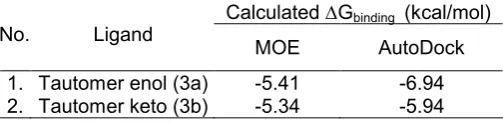
The molecular docking results of tautomers 3a
and 3b to DPP-4 obtained from MOE and AutoDock are presented in Table 2. In MOE, the calculated Gbinding of tautomer 3a (-5.41 kcal/mol) is slightly better than the calculated Gbinding of tautomer 3b (-5.34 kcal/mol). The similar phenomenon is found in the docking results from AutoDock, the calculated Gbinding of tautomer 3a (-6.94 kcal/mol) is slightly better than the calculatedGbinding of tautomer 3b(-5.94 kcal/mol).
Figure 2. Two conformations of compound 4 in the binding pocket of DPP-4 proposed by Biftu et al. [1]. Only residues which interact with the ligand are presented here. Carbon atoms are presented in black, hydrogen atoms are not shown, fluorine atoms are presented in white, nitrogen atoms are presented in dark grey, and oxygen atoms are presented in light grey; A) Conformer A: The triazole moiety is stacked over the side chain of Phe357; and B) Conformer B: The piperazine moiety is making a side-to-face hydrophobic interaction with Phe357.
Table 1.The molecular docking results of the reference compound (compound 4) to DPP-4
MOE AutoDock
No. Ligand RMSD
(Å)
Calculated Gbinding (kcal/mol)
RMSD (Å)
Calculated Gbinding (kcal/mol)
1. Conformer A 1.98 -5.97 1.87 -9.67
Figure 3. The interactions of curcumin in the enol form (3a) to the binding pocket of DPP-4 (Binding pocket is defined as the residues within 4.5 Å from the ligand). Carbon atoms are presented in black, polar hydrogen atoms are presented in white, nitrogen atoms are presented in light grey, and oxygen atoms are presented in dark grey; A) The binding pose suggested by docking studies using MOE: The oxygen carbonyl of curcumin interacts with the side chain of ARG 669, while in the one aromatic moiety of curcumin, both of the oxygen atoms interact with the side chain of SER 630; and B) The binding pose suggested by docking studies using AutoDock: The hydrogen atom from the hydroxyl group in the enol moiety of curcumin interacts with the backbone of PHE 357 and ARG 358, while in the one aromatic moiety of curcumin, the hydrogen atom from the hydroxyl group interacts with the backbone of GLU 205.
Table 2. The molecular docking results of curcumin (3) to DPP-4
Calculated Gbinding (kcal/mol) No. Ligand
MOE AutoDock
1. Tautomer enol (3a) -5.41 -6.94 2. Tautomer keto (3b) -5.34 -5.94 Based on these results, it can be concluded that curcumin prefers to have the enol tautomer to interact with DPP-4. This conclusion is in line with the result of the curcumin tautomerization studies by Istyastono et al. [24].
The binding poses of curcumin in the enol form (3a) based on the docking results both from MOE and AutoDock are presented in Figure 3A and 3B, respectively. In Figure 3A can be seen that curcumin forms hydrogen bonds with the side chain of ARG 669 and the side chain of SER 630 from DPP-4. The binding pose suggested by the docking studies using AutoDock (Figure 3B) shows that curcumin interacts with the backbone of GLU 205, PHE 357, and ARG 358. Despite the different system in each docking applications, one additional hydrogen bond in the result from AutoDock explains the better calculated Gbinding compare to the result from MOE. However, when the calculated Gbinding results of the interaction of curcumin (3a) to DPP-4 from each docking application (Table 2) compare to those of the interaction of compound 4 to DPP-4 (Table 1), it shows clearly that curcumin is needed to be optimized in order to obtain better affinity. Since it falls into the definition of a lead compound proposed by Oprea et al. [28], shows relevant interactions with DPP-4, and is still
able to be optimized, curcumin can serve as a good lead compound in the development of new DPP-4 inhibitor. Notably, some curcumin analogs have been patented and developed [15, 16 benzylidene cyclopentanone, and benzylidene acetone, and therapeutic uses thereof #16 benzylidene cyclopentanone, and benzylidene acetone, and therapeutic uses thereof #16]. The results of the studies presented in this article can serve as an initial effort of the further study in the development of curcumin analogs as new DPP-4 inhibitors.
CONCLUSION
curcumin is needed to be optimized to reach similar or better Gbinding compare to compound 4. Curcumin can serve as a good lead compound in the development of new DPP-4 inhibitor. The results of these studies can serve as an initial effort of the further study.
REFERENCES
1. Biftu, T., Scapin, G., Singh, S., Feng, D., Becker, J.W., Eiermann, G., He, H., Lyons, K., Patel, S., Petrov, A., Sinha-Roy, R., Zhang, B., Wu, J., Zhang, X., Doss, G.A., Thornberry, N.A., and Weber, A.E., 2007, Bioorg. Med. Chem. Lett., 17 (12), 3384-7. 2. Liang, G.B., Qian, X., Biftu, T., Singh, S., Gao, Y.D.,
Scapin, G., Patel, S., Leiting, B., Patel, R., Wu, J., Zhang, X., Thornberry, N.A., and Weber, A.E., 2008, Bioorg. Med. Chem. Lett., 18 (13), 3706-10.
3. Biftu, T., Feng, D., Qian, X., Liang, G.B., Kieczykowski, G., Eiermann, G., He, H., Leiting, B., Lyons, K., Petrov, A., Sinha-Roy, R., Zhang, B., Scapin, G., Patel, S., Gao, Y.D., Singh, S., Wu, J., Zhang, X., Thornberry, N.A., and Weber, A.E., 2007, Bioorg. Med. Chem. Lett., 17 (1), 49-52.
4. Drucker, D., Easley, C., and Kirkpatrick, P., 2007, Nat. Rev. Drug. Discov., 6 (2), 109-10.
5. Herman, G.A., Stein, P.P., Thornberry, N.A., and Wagner, J.A., 2007, Clin. Pharmacol. Ther., 81 (5), 761-7.
6. Pratley, R.E. and Salsali, A., 2007, Curr. Med. Res. Opin., 23 (4), 919-31.
7. Thornberry, N.A. and Weber, A.E., 2007, Curr. Top. Med. Chem., 7 (6), 557-68.
8. Ahren, B., 2007, Diabetes Care, 30 (6), 1344-50. 9. Gadsby, R., 2007, Prim. Care Diabetes, 1 (4),
209-11.
10. Idris, I. and Donnelly, R., 2007, Diabetes Obes. Metab., 9 (2), 153-65.
11. Maes, M.B., Dubois, V., Brandt, I., Lambeir, A.M., Van der Veken, P., Augustyns, K., Cheng, J.D., Chen, X., Scharpe, S., and De Meester, I., 2007, J. Leukoc. Biol., 81 (5), 1252-7.
12. Sutanegara, D. and Budhiarta, A.A., 2000, Diabetes. Res. Clin. Pract., 50 Suppl 2, S9-S16.
13. Alarcon de la Lastra, C., 2008, Mol. Nutr. Food. Res., 52 (9), 985.
14. Mangestuti, Subehan, Widyawaruwanti, A., Zaidi, S.F.H., Awale, S., and Kadota, S., 2007, J. Trad. Med., 24, 90-103.
15. Sardjiman, Reksohadiprodjo, M.S., Hakim, L., van der Goot, H., and Timmerman, H., 1997, Eur. J. Med. Chem., 32, 625-630.
16. Reksohadiprojo, M.S., Timmerman, H., Sardjiman, Margono, S.A., Martono, S., Sugiyanto, Hakim, L., Nurlaila, Hakim, A.R., Puspitasari, I., Nurrochmad, A., Purwantiningsih, Oetari, and Tedjo, Y., 2003, Derivatives of benzylidene cyclohexanone, benzylidene cyclopentanone, and benzylidene acetone, and therapeutic uses thereof, United States Patent Application Publication No.: US2003092772, Faculty of Pharmacy, Gadjah Mada University, Yogyakarta.
17. Usharani, P., Mateen, A.A., Naidu, M.U., Raju, Y.S., and Chandra, N., 2008, Drugs R. D., 9 (4), 243-50.
18. Kroemer, R.T., 2007, Curr. Protein. Pept. Sci., 8
(4), 312-28.
19. Vilar, S., Cozza, G., and Moro, S., 2008, Curr. Top. Med. Chem., 8 (18), 1555-72.
20. Morris, G.M., Goodsell, D.S., Halliday, R.S., Huey, R., Hart, W.E., Belew, R.K., and Olson, A.J., 1998, J. Comp. Chem., 19, 1639-1662.
21. Sanner, M.F., 1999, J. Mol. Graphics Mod., 17 (57-61).
22. DeLano, W.L., 2002, The PyMOL User's Manual, DeLano Scientific, Palo Alto, CA, USA.
23. Matsumoto, M.L., Narzinski, K., Kiser, P.D., Nikiforovich, G.V., and Baranski, T.J., 2007, J. Biol. Chem., 282 (5), 3105-21.
24. Istyastono, E.P., Margono, S.A., and Pramono, H.D., 2003, Indonesian Journal of Pharmacy, 14
(3), 107-133.
25. Goodsell, D.S., Morris, G.M., and Olson, A.J., 1996, J. Mol. Recognit., 9 (1), 1-5.
26. Sousa, S.F., Fernandes, P.A., and Ramos, M.J., 2006, Proteins, 65 (1), 15-26.
27. Schames, J.R., Henchman, R.H., Siegel, J.S., Sotriffer, C.A., Ni, H., and McCammon, J.A., 2004, J. Med. Chem., 47 (8), 1879-81.
![Figure 1. Structures of sitagliptin (1), vildagliptin (2), the tautomer enol of curcumin (3a), the tautomer keto of curcumin (3b), and (1S,2R,5S)-5-[3-(trifluoromethyl)-5,6-dihyro[1,2,4]triazolo[4,3-a]pyrazin-7(8H)-yl]-2-(2,4,5-trifluorophenyl)-cyclohexanamine (4).](https://thumb-ap.123doks.com/thumbv2/123dok/3384012.1759528/1.595.150.447.533.725/structures-sitagliptin-vildagliptin-tautomer-trifluoromethyl-triazolo-trifluorophenyl-cyclohexanamine.webp)