Optimization of Stratified Sugarcane Seeds of Main Plantation
and Variety in Budchips (Single Bud) Toward the Growth of
Certified Superior Sugarcane Seeds
Setyo Budi
Andriani Eko Prihatiningrum
Lecturer of Agriculture Department, University of Muhammadiyah Gresik. Jln. Sumatra 101 GKB Randu Agung Gresik 61121
Abstract
The study is implemented in Agroindustry Plantation Research and Development Perning. It belongs to one of
state owned sugarcane industries, namely Gempolkerep sugarcane industry of PTPN X in the area of East Java
Province from March up to December 2013. The objectives of the study are: 1). Producing appropriate technology to optimize life growth and success of sugarcane seeds developed through budchips (single bud) using Procedure Standard Operation 2. Producing superior certified sugarcane seeds which are able to grow uniformedly in a relatively shorter time to fulfill the availability of budchips (single bud) sugarcane seeds. The results of the study revealed that : 1). Superior certified seeds cane in the main plantation through stratified KBP, KBN, KBI which are developed in budcips model as KBD cane seeds until 90 days statistically did not show significant difference to life growth level. The life growth success could achieve 86-98 percent, under the specific terms and conditions of SOP (Prosedure Operasional Standard). This appropriate technology is recommended to produce and develop the availability of superior certified sugarcane seeds through single budchip model from stratified main plantation (KBP, KBN, KBI) and toward many other examined varieties such as (BL, PS 862, PS 864, PS 851, PS 881, POJ 3016, Kentung, PSJT 961, klon C1 and C2 which statistically do not reveal significant different toward tall growth and number of sugar cane leaves. The sugar cane seeds proceed within 90 days show relatively homogenous and qualified growth. Superior certified sugarcane seeds produced within the same period show larger number compared to sugarcane seeds developed through mule system. The availability of sugarcane seeds through single budchip model guarantee the demand of sugarcane seeds in certain wide range of area because it provides better probability to grow and live.
Keywords: stratified, budchips variety, certified sugarcane seeds
INTRODUCTION
The most crucial and fundamental problem of sugarcane management industry in Indonesia until recently is the collapse of appropriate culture techniques of sugarcane plantation conducted by sugarcane farmers. It is also worsen by inefficiency of sugarcane industry with the FR under 0.70. Consequently, the variety of sugarcane plants is very high and lower sugarcane plants productivity. Empirical data revealed that in 2013, sugarcane productivity average (ton/ha), rendemen (%), hablur (ton/ha) accepted by sugarcane farmers are 76.3 (ton/ha), 7.18 (%), and 5.48 (ton/ha). It is still far from the real potentials of sugarcane plantation in Indonesia. Meanwhile the real potential can produce a hablur above 10 ton/hectare if it fulfills the appropriate culture techniques as reported by Budi (2007) and Mulyadi (2007).
According to Budi, Prihatiningrum, Anwar, Laily, Widyaningsih, and Sutaryianto (2013) stated that the cultivation of superior sugarcane seeds provides Benefit Cost Ratio (B/C): 3.7. Usahatani industri bibit tebu unggul melalui penangkaran dapat disimpulkan : 1). The cultivation of sugarcane seeds provides a good opportunity to develop. 2). It also provides commercial appropriacy and promising prospect. This is wide opportunity to a successful entrepreneur in sugarcane seeds plantation.
According to Budi, et al (2013) and Sugiarta (2007) claimed that the stratification of sugarcane seeds main plantation technically does not cover all the above activities. The availability of main sugarcane plantation (KBPU) is the cultivation of pen sugarcane seeds variety which has 100 percent purity. It can be done by research center/institution/university; the availability of Parent sugarcane seeds plantation (KBP) is the raw material of KBPU, which has 100 percent purity. It is implemented by research center which has a tissue culture laboratory; the availability of Grand sugarcane seeds plantation (KBN). It is raw material from KBP, which has 100 percent purity. It is done by sugar cane factory; the availability of main sugarcane seeds (KBI), by providing raw material from KBN, which has 98 persen purity content.
A study conducted by Budi (2013) in Agroindustry Research Plantation and Development Perning, Jetis sub district, Mojokerto district in partnership with Gempolkerep sugarcane industry PTPN X revealed that the operation of drilling apparatus and HWT (Hoot water treatment) are very effective and efficient if it is operated based on SOP (standard operational procedure) and supported with skillful and responsible human resources. It can be said that the existence of appropriate technology should be supported by skillful and responsible human resources. It is also supported by Budi (2001) which claimed that technology will significantly supportive media if it is operated by professional human resources.
The successful growth of sugarcane seeds up to 90 days is very high with approximately above 93 persent from all tested varieties up to maintenance following the standard of operation. Conversely, the success of sugarcane seeds growth in pot tray is low, if the implementation process neither follows budchip system nor SOP. Maintenance period for sugarcane seeds using budchips is a sensitive period especially irrigation in dry season and weeds controlling problems in rainy season. (Budi, 2013). Similarly, according to Sudiarso, Budi, Tarno, Dahdah (2014) and Bayu (2013) claimed that all treatment combination do not revealed significant different toward sugarcane seeds growth when it is develop through budchips system.
Strategy and comprehensive follow up in increasing productivity os sugarcane plantation, it needs mass efforts and movements from all stakeholders uniformity, fast, effective and affordable, programmed, integrated, measurable and responsible in sugarcane industry. All intervention toward sugarcane production and management have to change the maindset and mainstream cultures toward dishonest and unprofessional behavior which are very hazardous for the nation. Based on the above fact, the government needs to integrate and
disseminate appropriate, effective efficient, sustainable, and measurable technology (Budi, et al ; 2013). It is in
agreement with Hanafi (2013) and Putri, Sudiarso, Islami (2013) claimed that the increase of sugarcane seeds growth should optimize agroinput and environment harmoniously. It also needs to involve all stakeholders especially sugarcane farmer association.
Improvement of culture techniques guidance of operation plantation become the objective productivity increase and improvement. One of the determined factors in increasing the availability of superior and certified sugarcane seeds is the availability of sugarcane seeds itself and affordable price for the farmers. Consequently, to produce large number of sugarcane seeds through budchips system becomes one of the alternative solution to address the never ending on sugarcane seeds development and availability. A study conducted by Budi (2013), the propagation of sugarcane seed through buchips system showed that this system provides wide opportunity in accelerating the availability of certified sugarcane seeds and business opportunity. It is in agreement with Budi,
et al (2013) and Susilo (2008) and Budi (2012) stated that sugarcane seeds agribusiness developed through budchips is profitable if the implementation is integrated to all stakeholders especially, sugarcane farmers.
The study on optimization of stratified sugarcane seeds of main plantation and variety in budchips (single bud) toward the growth of certified superior sugarcane seeds toward is a fundamental research grant and it has strategic position to address crucial issues on the availability of superior and certified sugarcane seeds in a relatively shorter period which can be developed in mass. It is hoped that the result of the study can be used as one of alternative solutions for government policy in providing certified sugarcane seeds to accelerate the revitalisation of sugarcane industry in East Java Province in managing variety under an integrated and sustainable sugarcane industry management. It is in line with Saputro (2007) and Budi, Prihatiningrum, Anwar, Laily, Widyaningsih, and Sutaryianto (2014) stated that it is necessary to develop better strategy in increasing the productivity of sugarcane plantation in a dry area.
2. Research Method 2.1 Research Material
apparatus to produce sugarcane seeds consists of: BOR, HWT, POT TRAY, disinfectant, water and other supporting instruments, electricity, workshop house, sprinkler irrigation, breeding Ares, land, organic material, and sand. Supporting apparatus consists of marker from bamboo, budchips transportation instruments, lapstop, LCD, computer, printer, paper, table and writing instrument.
2.2. Setting and Timeline 2.2.1 Researh Site
The study is conducted at Agroindustry Research and Development Center in Perning under the sugarcane
industry Gempolkerep PTPN X East Java province, Indonesia. Resarch location is sited on jalan raya Jetis 12 km
of Eastern part of Mojokerto city, East Java Province, Indonesia. This area becomes research center as long as there is a mutual partnership and MoU between Faculty of Agriculture University of Muhammadiyah Gresik
with sugarcane factory Gempolkerep PTPN X. The height position of the area estimated around 30 meters above
the sea level. The area also provides parent sugarcane seeds plantation and tissue culture and representative to propagate superior sugarcane seeds plantation and have minimu number of superior sugarcane seeds. Recently, the availability of parent sugarcane seed plantation from superior variety becomes crucial problems as its existence is neither systematically nor well integrated, to stakeholders, sugarcane factory and farmers.
2.2.2 Research Timeline
This study is conducted with period of 10 (ten) months from March until December 2013. The vailability of parent sugarcane seed plantation takes 7 (seven) months. Research workplan is initiated through preparing instrument to produce superior and certified sugarcane seeds through budchips system as well as preparing certified parent sugarcane seeds plantation (KBP, KBN, and KBI) for 7 months within 0.20 hectare. All the sugarcane seeds are propagated in budchips and preserved from planting until 90 days. Next, these sugarcane seeds are then planted as plain sugarcane seed plantation (KBD). The working system of the instruments to yield sugarcane seeds in budchips and material formula are written in the form of Standard Operational Procedure (SOP) so the yielded sugarcane seeds will be standardized and homogeneous. The settlement of sugarcane variety into pre, whilst and post ripes generated from stratification level of parent sugarcane seeds plantation
(KBP, KBN, KBI) developed through budchips and coordinated to sugarcane industry Gempolkerep PTPN X.
2.3 Research Design
The design of this study implemeted descriptive explorative design. It is also employs comprehensive random factorial. The first factor is the stratification of parent sugarcane seeds plantation (B) which consists of:
1).Main Sugarcane seeds Plantation (B1) 2).Grand Sugarcane seeds Plantation (B2) 3).Parent Sugarcane seeds Plantation (B3)
The second factor is types of variety and clone of superior sugarcane seeds which consists of: 1). BL (V1)
2). PS 862 (V2) 3). PS 864 (V3) 4). PS 851 (V4) 5). PS 881 (V5) 6). POJ 3016 (V6) 7). Kentung (V7) 8). PSJT 961 (V8) 9). Klon C1 (V9) 10). Klon C2 (V10)
Tabel 2.1. Treatment combination in the study.
Types Variety
Stratification Level Parent Seeds (KBP,KBN,KBI)
B1 B2 B3
V1 V1B1 V1B2 V1B3
V2 V2B1 V2B2 V2B3
V3 V3B1 V3B2 V3B3
V4 V4B1 V4B2 V4B3
V5 V5B1 V5B2 V5B3
V6 V6B1 V6B2 V6B3
V7 V7B1 V7B2 V7B3
V8 V8B1 V8B2 V8B3
V9 V9 B1 V9B2 V9B3
V10 V10B1 V10B2 V10B3
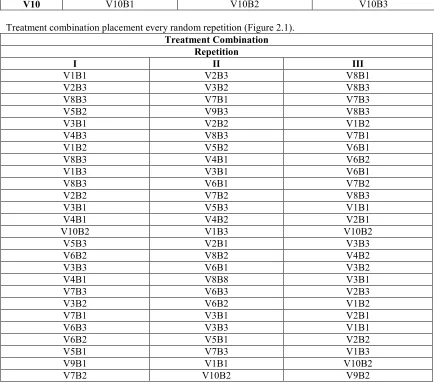
Treatment combination placement every random repetition (Figure 2.1).
Treatment Combination Repetition
I II III
V1B1 V2B3 V8B1
V2B3 V3B2 V8B3
V8B3 V7B1 V7B3
V5B2 V9B3 V8B3
V3B1 V2B2 V1B2
V4B3 V8B3 V7B1
V1B2 V5B2 V6B1
V8B3 V4B1 V6B2
V1B3 V3B1 V6B1
V8B3 V6B1 V7B2
V2B2 V7B2 V8B3
V3B1 V5B3 V1B1
V4B1 V4B2 V2B1
V10B2 V1B3 V10B2
V5B3 V2B1 V3B3
V6B2 V8B2 V4B2
V3B3 V6B1 V3B2
V4B1 V8B8 V3B1
V7B3 V6B3 V2B3
V3B2 V6B2 V1B2
V7B1 V3B1 V2B1
V6B3 V3B3 V1B1
V6B2 V5B1 V2B2
V5B1 V7B3 V1B3
V9B1 V1B1 V10B2
V7B2 V10B2 V9B2
Figure 2.1. Map combined treatment in each repetition
2.4 Analysis
The data are analyzied using descriptive explorative model and then continued with examining F test and BNT 5%. The results re supported by documents and the effectiveness of working instruments (BOR, HWT, POT TRAY) and finally interpretated based on the result of analysis and fieldnotes.
2.5 Conceptual Framework
Figure 2.2 Process (SOP) Propagation certified and superior sugarcane seeds using Budchips and Indonesian government policy or Regulation structure
FINDING AND DISCUSSION
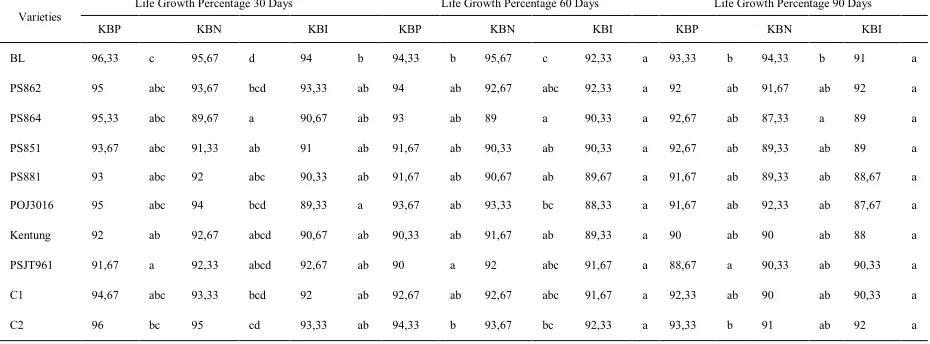
The average life percentage of sugarcane seeds with 30, 60, and 90 days observing time is presented in Table 3.1. The average life percentage of sugarcane seeds can be used as one of indicators to show the growth performance of the sugarcane seeds in a certain environment and condition. Based on Table 3.1 shows that variant analysis in the degree of confident 0.05, almost all combined treatment reveals significant different between varieties and parent sugarcane seeds plantation toward the degree of life percentage of sugarcane plants, except toward the degree of stratification on the parent sugarcane seeds KBI within sugarcane seeds aged 60 and 90 days do not show significant different.
Based on statistical analysis it can be said that the degree of stratification in parent sugarcane seeds KBP within observing time 30 days shows that the average of life percentage Bl variety is significantly different from life percentage of PSJT 961 variety. The highest percentage of life growth sugarcane occurs at the degree of stratification in parent sugarcan seeds plantation KBP with BL variety in the amount of 96.33 percent and the lowest life growth percentage occurs at at PSJT 961 with 91,67 percent. Actually, all combined treatment BL, PS 862, PS 864, PS 851, PS 881, POJ 3016, Kentung, PSJT 961, klon C1 and C2 variety based on statistical analysis doesnot show significant different toward life growth percentage. Hal ini membuktikan bahwa hakekatnya semua varietas pada kebun bibit induk KBP has similar potential of life growth although BL variety is different from PSJT 961 variety.
The result of statistical analysis shows that the average age of 30 days indicate the stratification degree in parent sugarcane seeds plantation KBN to all varieties produces significant different toward life growth of the sugarcane seeds. BL variety seems to be differThe highest life growth percentage occurs within BL variety in the amount of 95.67 percent and the lower occurs within PS 864 variety with approximately 89.67 percent. This fact actually portrays genetically that the real life growth potential of BL variety is bigger than PS 864 variety.
Tabel 3.1. The average percentage of life growth sugarcane seeds within observable time 30, 60, and 90 Hari (%)
Varieties
Life Growth Percentage 30 Days Life Growth Percentage 60 Days Life Growth Percentage 90 Days
KBP KBN KBI KBP KBN KBI KBP KBN KBI
BL 96,33 c 95,67 d 94 b 94,33 b 95,67 c 92,33 a 93,33 b 94,33 b 91 a
PS862 95 abc 93,67 bcd 93,33 ab 94 ab 92,67 abc 92,33 a 92 ab 91,67 ab 92 a
PS864 95,33 abc 89,67 a 90,67 ab 93 ab 89 a 90,33 a 92,67 ab 87,33 a 89 a
PS851 93,67 abc 91,33 ab 91 ab 91,67 ab 90,33 ab 90,33 a 92,67 ab 89,33 ab 89 a
PS881 93 abc 92 abc 90,33 ab 91,67 ab 90,67 ab 89,67 a 91,67 ab 89,33 ab 88,67 a
POJ3016 95 abc 94 bcd 89,33 a 93,67 ab 93,33 bc 88,33 a 91,67 ab 92,33 ab 87,67 a
Kentung 92 ab 92,67 abcd 90,67 ab 90,33 ab 91,67 ab 89,33 a 90 ab 90 ab 88 a
PSJT961 91,67 a 92,33 abcd 92,67 ab 90 a 92 abc 91,67 a 88,67 a 90,33 ab 90,33 a
C1 94,67 abc 93,33 bcd 92 ab 92,67 ab 92,67 abc 91,67 a 92,33 ab 90 ab 90,33 a
C2 96 bc 95 cd 93,33 ab 94,33 b 93,67 bc 92,33 a 93,33 b 91 ab 92 a
Note: The numbers are followed by the same alphabet in the same column indicate no significant difference at Tukey test 5 %
Based on statistical analysis, among all combined treatments BL, PS 862, PS 864, PS 851, PS 881, POJ 3016, Kentung, PSJT 961, klon C1 varieties and C2 variety do not significantly different toward life growth percentage of the sugarcane seeds which are cultivated in budchips. The above facts show clearly that among all combined treatments in the degree of stratification in parent sugarcane plantation KBN and all varieties as well as tested clone have a relatively similar in life growth percentage, Although empirically, there is different in life growth potentials between BL and PS 864 varieties.
The degree of stratification in parent sugarcane seeds plantation KBI within observable time 30 days with 10 exemined varieties also show relatively similar as parent sugarcane seeds plantation KBP and KBN. The result of statistical analysis shows that the degree of stratification treatment in parent sugarcane seeds plantation KBI on BL variety shows significant different from PS 863 variety toward the percentage of life growth of the sugarcane seeds. The highest life growth percentage occurs on BL variety with approximately 94 percent and the lowest occurs on POJ 3016 variety with approximately 89.33 percent. This data portrays genetically that actually BL variety has higher potential of life growth compared to PS 863 variety. In fact, the degree of stratification in in parent sugarcane seeds plantation KBI on BL, PS 862, PS 864, PS 851, PS 881, POJ 3016, Kentung, PSJT961, klon C1 and C2 varieties all combinet treatment statistically do not show significant different toward life growth sugarcane seeds which are cultivated through budchips. The result of statistical analysis shows that between combined treatment the degree of stratification in parent sugarcane seeds plantation KBI and all varieties as well as tested clone have relatively similar of life growth potential, although empirically, there is different life growth potential of BL variety and POJ 3016 variety. The result of the study also in line with Sugiarta (2007) which claimed that the degree of purity between in parent sugarcane seeds plantation KBN, KBI are relatively similar. Further, Budi (2013) reported similar thing that the degree of purity between in parent sugarcane seeds plantation KBP, KBN, and KBI are relatively similar with the treated condition.
The result of statistical analysis shows that the degree of stratification in parent sugarcane seeds plantation KBP with observable time 60 days on BL variety seems not to be different from clone C2 toward the eximend lifegrowth percentage of the sugarcane seeds. Moreover, both of them seem to be very different from keduanya PSJT 961 variety toward lifegrowth potential. The highest percentage of life growth occurs on BL and clone C2 variaties where each variety has approximately 94.33 percent and the lowest occurs on PSJT 961 variety whish has around 90 percent. This fact describes genetically that BL variety is similar to C2 clone but it is different from PSJT 961 variety for the uniformity of life growth potential. The fact also shows that in parent sugarcane seeds plantation KBP on the varieties of BL, PS 862, PS 864, PS 851, PS 881, POJ 3016, Kentung, PSJT 961, clone C1 and C2 all combination between treatment statistically do not show significant different toward the life growth of sugarscane seeds developed through budchips. Statistically, all varieties on the degree of stratification in parent sugarcane seeds plantation KBP within 60 days seems to be different toward life growth of the sugarcane seeds developed in budchips. This fact describes that all varieties between combined treatments do not show significant different toward the percentage of life growth sugarcane seeds developed in budchips, with required process, implementation and maintenance done homogeneously. The result of the study is in line with Kartosapoetra and Sutejo (1994) stated that one of the determined factors of successful breeding is optimal environment. Empirically and statistically, the life growth potential of the stratification degree of sugarcane seeds in in parent sugarcane seeds plantation KBP variety BL and klon C2 do not seem to be different but both are different from variety of PSJT 961.
examined varieties has a relativey similar opportunity and potential. The most dominant result emeres the different on BL variety and PS 864 of the stratification degree in parent sugarcane seeds plantation KBN. The biggest life growth percentage occurs within BL variety with around 95.67 percent and the lowest terendahoccurs on PS 864 variety with around 89 percent. Gnetically, this fact describes difference between BL variety and PS 864 variety toward life growth potential of the sugarcane seeds developed through budchips. Actually the average of life growth percentage of sugarcane seeds within observable time of the sugarcane seeds in the age of 60 days of the stratification degree in parent sugarcane seeds plantation KBI and in varieties of BL, PS 862, PS 864, PS 851, PS 881, POJ 3016, Kentung, PSJT 961, clone C1 and C2 show all combination between tretments statistically do not show significant different of the life growth sugarcane seeds developed in budchips using required process, implementation and maintenance done through homogeneous way. Empirically and statistically genetic potential of degree stratification in parent sugarcane seeds plantation KBN variety BL are different from the variety of PS 864, although between all combined treatments do not show significant different of the life growth of sugarcane seeds developed in budchips. The fact is supported by Hanafi (2013) the quality of raw material plantation influence the breeding result of the sugarcane seeds.
The average of observation percentage of life growth within 60 days on the stratification degree of parent sugarcane seeds plantation KBI and BL, PS 862, PS 864, PS 851, PS 881, POJ 3016, Kentung, PSJT 961, clone C1 and C2 varieties statistically, show that between all combined treatments do not sho significant different of the life growth sugarcanes seeds developed in budchips. Empirically, the highest percentage occurs on BL and PS 862 variety with around 92.33 percent and the lowest occurs on POJ 3016 with amount 88.33. This data strengthen the hypothesis that, the success of life growth percentage of sugarcane seeds cultivated through budchips is determined by required process, implementation and maintenance done through homogeneous way. The result of the study is in line with Budi (2013) explains that the difference of sugarcane seeds growth percentage developed through budchips is mainly determined by required process, implementation and maintenance of sugarcane seeds.
The result of observation within 90 days, statistically do not show significant different toward life growth percentage. Stratification degree of parent sugarcane seeds plantation KBP with the highest life growth percentage occurs at BL and clone C2 where each has around 93.33 percent and the lowest occurs at the variety of PSJT 961 with around of 88.67 percent. This difference genetically shows that the potential of life growth percentage of the variety of BL are the same as C2, but both are different from the varieties of PSJT 961. In fact, the percentage of life growth within observable time of 90 days of the stratification degree of parent sugarcane seeds plantation of KBP and the variety of BL, PS 862, PS 864, PS 851, PS 881, POJ 3016, Kentung, PSJT 961, clone C1 and C2 show all combination between treatments statistically do not reveal difference of sugarcane seeds developed through budchip with required, implementation and maintenance done I homogenous way. Empirically and statistically the genetically potential in the stratification degree of parent sugarcane seeds of KBP on the variety of BL and clone C2 do not significantly different toward the percentage of life growth but both of them are different from PSJT 961 toward the percentage of sugarcane seeds developed in budchips.
The average observation percentage of life growth sugarcane seeds within 90 days of stratification degree in parent sugarcane seeds plantation KBN and variety statistically do not show significant different of life growth percentage. BL variety produces life growth percentage around 94.33 percent and it is slightly different from PS 864 variety with the lowest percentage of life growth 87.33 percent. The difference reveals that genetically the variety of BL and PS 864 with the stratification degree in parent sugarcane seeds plantation KBN has similar potential with the percentage of life growth sugarcane seeds developed through budchips. Basically the percentage of life growth of 90 days of stratification degree in parent sugarcane seeds plantation KBN and for the varieties of BL, PS 862, PS 864, PS 851, PS 881, POJ 3016, Kentung, PSJT 961, clone C1 and C2 show that all combinations between treatments statistically revels significant different toward the life growth of sugarcane seeds developed in buchips with the required process, implementation and maintenance done homogeneously. This fact is in agreement with Board of Sweetener and Fibre Research Center (2013) stating that the success of sugarcane breeding should pay serious attention to optimal requirement. Empirically and statistically, statistical analysis explains that genetical potential of stratification degree inparent sugarcane seeds plantation of KBI on BL variety differs from PS 864 variety toward the life growth of the sugarcane seeds and does not show significant different between all combined treatments through budchips system.
by proses, implementation and maintenance conducted homogeneously based on defined Standard of Operational Procedure. Moreover, the othe study conducted by Budi, et al (2013) shows that the success of lifegrowth percentage of sugarcane seeds developed through budchips are not only influeneced by the degree of stratification in KBP, KBN, KBI, but also strongly influenced by process, implementation and maintenance of the sugarcane seeds based on SOP defined (Standard of Operational Procedure). So that th stratification degree of sugarcane seeds plantation in parent sugarcane seeds plantation of KBP, KBN, KBI and of the varieties of BL, PS 862, PS 864, PS 851, PS 881, POJ 3016, Kentung, PSJT 961, clone C1 and C2 developed through budchips as supply of the availability of certified sugarcane seeds production resulted a higher percentage of life growth of the sugarcane plants. It is also in agreement with Hanafi (2013) stated that the success of sugarcane plantation is strongly affected the quality of plan material. Moreover, Kartosapoetra and Sutejo (1994) stated that environment also strongly influence the success of sugarcane breeding results. The height of the plants and number of leaves of sugarcane plan are influenced by stratification degree at parent sugarcane seeds plantation KBP, KBN, KBI and the varieties of BL, PS 862, PS 864, PS 851, PS 881, POJ 3016, Kentung, PSJT 961, clone C1 and C2 are presented in the Table 3.2 and Table 3.3.
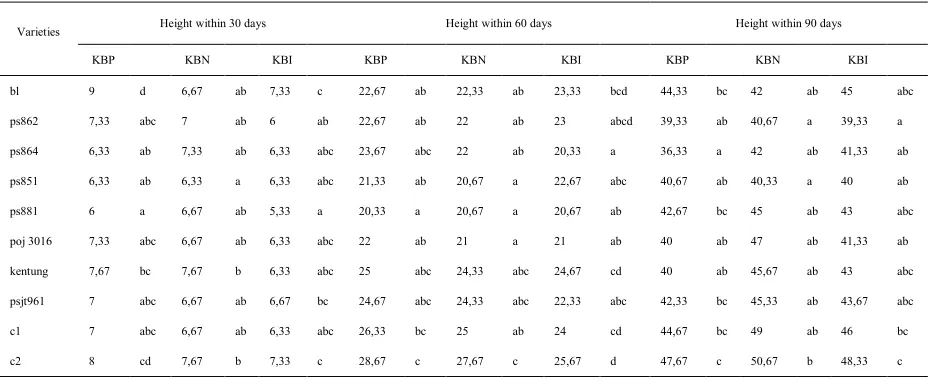
Based on Table 3.2 shows that the average height of sugarcane seeds within observable time around 30, 60 and 90 days each combined treatment statistically show significant different between ten (10) varieties and three (3) stratification degree in parent sugarcane seeds plantation KBP, KBN and KBI. The result of observation toward the average height of sugarcane plants tells that in each variety of parent sugarcane seeds plantation of KBP, KBN, and KBI on the variety of BL, PS 862, PS 864, PS 851, PS 881, POJ 3016, Kentung, PSJT 961, clone C1 and C2 gives different response between one and another when it is developed through budchips. It is clearly seen from observation in the fild and then analyze using Duncan test with 5% (Table 3.2).
Tabel 3.2. Average of Height of Sugarcane Seeds with observed time in age of 30, 60, 80 Days (Cm).
Based on Table 3.2 it can be known that the average height of sugarcane seeds with observed time of 30 days of stratification degree in parent sugarcane seeds plantation KBP from each variety after it is analyzed statistically, it shows different result. BL variety is significantly different from PS 881 toward the height of sugarcane plants. BL variety produces the highest seeds with the height around 9 Cm and the lowest occurs in the variety of PS 881 with the plant height around 6 Cm. The different of height plant is probably caused by the lengthening potential of genetic cell from BL variety and PS 881 are different. Actually the average height of sugarcane plants within observed time 30 days on stratification degree of parent sugarcane seeds KBP and the varieties BL, PS 862, PS 864, PS 851, PS 881, POJ 3016, Kentung, PSJT 961, clone C1 and C2 statistically among all combined treatments does not show significant different toward the height of the plan developed in budchips with the required process, implementation and maintenance done holistically. Based on statistical analysis, empirical data, and the nature of physiology stated that genetical potential of cell elongation of stratification parent sugarcane seeds plantation KBP on variety of BL are differed from PS 881 and it is not different significantly if it is developed through budchips.
From the observation, it is found that the average height of sugarcane seeds within 30 days with stratification degree in parent sugarcane seeds plantation KBN from each variety, after it is analyzed statistically, it describes different sugarcane seeds height. Kentung and clone varieties C2 toward stratification degree in parent sugarcane seeds plantation KBN do not reveal significant different and both seems to be different from variety of PS 851 sugarcane seeds developed in budchips. Kentung variety and clone C2 produce the highest height of plant with 7.67 Cm and the lowest occurs on PS 851 with 6.33 Cm. This differences show that
Varieties Height within 30 days Height within 60 days Height within 90 days
KBP KBN KBI KBP KBN KBI KBP KBN KBI
bl 9 d 6,67 ab 7,33 c 22,67 ab 22,33 ab 23,33 bcd 44,33 bc 42 ab 45 abc
ps862 7,33 abc 7 ab 6 ab 22,67 ab 22 ab 23 abcd 39,33 ab 40,67 a 39,33 a
ps864 6,33 ab 7,33 ab 6,33 abc 23,67 abc 22 ab 20,33 a 36,33 a 42 ab 41,33 ab
ps851 6,33 ab 6,33 a 6,33 abc 21,33 ab 20,67 a 22,67 abc 40,67 ab 40,33 a 40 ab
ps881 6 a 6,67 ab 5,33 a 20,33 a 20,67 a 20,67 ab 42,67 bc 45 ab 43 abc
poj 3016 7,33 abc 6,67 ab 6,33 abc 22 ab 21 a 21 ab 40 ab 47 ab 41,33 ab
kentung 7,67 bc 7,67 b 6,33 abc 25 abc 24,33 abc 24,67 cd 40 ab 45,67 ab 43 abc
psjt961 7 abc 6,67 ab 6,67 bc 24,67 abc 24,33 abc 22,33 abc 42,33 bc 45,33 ab 43,67 abc
c1 7 abc 6,67 ab 6,33 abc 26,33 bc 25 ab 24 cd 44,67 bc 49 ab 46 bc
c2 8 cd 7,67 b 7,33 c 28,67 c 27,67 c 25,67 d 47,67 c 50,67 b 48,33 c
elongation potential of Kentung variety cell are relatively similar to clone C2 but it is different from PS 851 variety. The average height of sugarcane plants within obeversed time 30 days with stratification degree in parent sugarcane seeds plantation KBN on variety of BL, PS 862, PS 864, PS 851, PS 881, POJ 3016, Kentung, PSJT 961 statistically between all combined treatments do not affect the height of the plants developed in budchips with required process, implementation and maintenance done through homogeneous way. Based on empirical, statistical analysis and the nature of physiology indicating that cell elongation with stratification degree in parent sugarcane seeds plantation KBN Kentung variety differ from clone C2 but srongly mode different from PS 851 and don not significantly different between all combined treatment.
The average height of sugarcane seeds within 30 days with stratification degree in parent sugarcane plantation KBI from each variety, statistically show siginicant different in height which are developed through budchips. BL variety does not differ from C2 but both of them differ from PS 881 variety toward the height of sugarcane plan developed through budchips. Bl variety and clone C2 resulted the highest height approximately 7.33 Cm and the lowest occurs at variety of PS 881 with the height of the plan around 5.3 Cm. The difference show that genetical potential of of cell elongation in BL variety is similar to clone C2 but it differs from PS 881 variety. The height average of sugarcane seeds within observed time 30 days of stratification degree in parent sugarcane seeds plantation KBI varieties BL, PS 862, PS 864, PS 851, PS 881, POJ 3016, Kentung, PSJT 961, clone C1 and C2 statistically among all combined treatments do not differ signficantly toward sugarcane seeds height developed through budchips. The nature of physiology of genetical potential cell elongation with the stratification degree in parent sugarcane seeds plantation KBN toward BL variety do not differ from clone C2 but differ significaly from PS 881 variety and do not differ as well from all combined treatments.
The degree of stratification in parent sugarcane seeds plantations KBP and BL, PS 862, PS 864, PS 851, PS 881, POJ 3016, Kentung, PSJT 961, klon C1 and C2 varieties within 60 days statistically do not differ from height average of sugarcane seeds developed trough budchips. Clone C2 resulted the highest sugarcane seeds with approximately 28.67 Cm and the lowest resulted by PS 881 variety with approximately 20.33 Cm and statisticall it differs significantly if it is developed in budchips. The differences reveal that genetical potential of cell elongation from C2 variety differs from the variety of PS 881. The average height of sugarcane plants within 60 days with stratification degree in parent sugarcane seeds plantation KBP varieties of BL, PS 862, PS 864, PS 851, PS 881, POJ 3016, Kentung, PSJT 961, clone C1 and C2 statistically do not show significant different among all combined treatment toward the height of the sugarcane seeds developed in budchips with the required process, implementation and maintenance done in homogeneous way. Based on empirical data, statistical analysis, and the nature of physiology stated that genetial potential of cell elongation on the stratification degree of parent sugarcane seeds plantation KBP on the clone C2 statistically does not differ from PS 881 variety.
The average of sugarcane plants height in the age of 60 days with stratification degree of KBN varieties BL, PS 862, PS 864, PS 851, PS 881, POJ 3016, Kentung, PSJT 961, clone C1 and C2 statistically explains different response. The PS 851 variety with stratification degree in parent sugarcane seeds plantation KBP statistically differs from clone C2 with the height of the sugarcane plants developed in budchips. The highest stem height of the plants occurs in the clone C2 with 27.67 Cm and the lowest happens in PS 851 variety. Clone C2 statistically different from PS 851 variety toward the height of sugarcane seeds. These differences genatical potential of cell elongation of clone C2 variety differs from PS 851 variety. Actually the average height of sugarcane plants within 60 days with stratification degree in parent sugarcane seeds plantation KBN varieties of BL, PS 862, PS 864, PS 851, PS 881, POJ 3016, Kentung, PSJT 961, clone C1 and C2 statistically do not show significant different among all combined treatment toward the height of sugarcane developed in budchips the required process, implementation and maintenance done in homogeneous ways. Based on empirical, statistical, and the nature of physiology of genetic potential of cell elongation with stratification degree in parent sugarcane seeds plantation KBN on clone C2 statistically differs from PS 851 variety.
clones C1 and C2 have the ability to adapt to greenhouse condition after tested in Indoneisia.
The highest sugarcane seeds within 90 days in each varieties and stratification level in parent sugarcane seeds plantation also gives different response and strong influence. Parent sugarcane seeds plantation of KBP on PS 864 variety differs significantly from clone C2 and do not differ from another treatment. The highest sugarcane plants is 47.67 Cm occurs on clone C2. This fact portrays different genetically potential obtained in each variety with stratification degree in parent sugarcane seeds plantation. Parent sugarcane seeds plantation KBN on the variety of PS 851 and PS 862 differs from clone C2 but do not differ from another treatment. The highest of sugarcane seeds is 50.67 Cm occurs on cole C2. The height of the sugarcane plant of the variety of PS 862 with stratification degree in parent sugarcane seeds plantation KBI differs from clone C2 and do not differ from another treatment. The highest sugarcane seeds occurs on clone C2 with around 48.33 Cm observed time within 90 days. Although the growth of sugarcane seeds is influenced by genetically nature of the seeds but
environment factor also very influential. It is also supported by Gardner, et al (1991) stated that the growth of
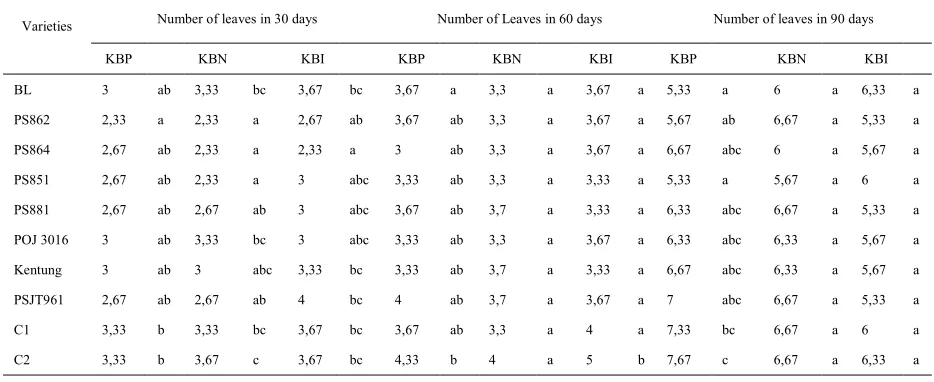
sugarcane plants are affected by environmental factors. Through the cultivation of sugarcane seeds in budchips, so the genetically potential owned by the tested varieties with stratification degree in parent sugarcanes seeds of (KBP, KBN, and KBI) can optimize the growth of the plants. The result of the study is similar to Budi, (2013), Budi, et al (2013), Hanafi (2013) and Sudiarso, et al (2014) reported that sugarcane seeds developed through budchips will produce relatively similar growth if it is developed with right operational standard of procedure (SOP). Similar study from Bayu (2013) explained that media and nitrogen fertilizer if it is treated equally could produce similar growth of sugarcane seeds. Moreover, according to Mulyadi (2007) stated that the same treatment could produce similar growth and productivity. The results of the study, hopefully can be implemented in sugarcane factory in Indonesia. This is in line with Saputro (2007) stated that to improve the productivity of sugarcane supply, sugarcane factories have to consider and pay careful attention on the quality and certification of sugarcane seeds meet sugarcane farmers’ demand . Tabel 3.3. Average number of leaves within observed time 30, 60, 90 Days (Lb).
Varieties Number of leaves in 30 days Number of Leaves in 60 days Number of leaves in 90 days
KBP KBN KBI KBP KBN KBI KBP KBN KBI
BL 3 ab 3,33 bc 3,67 bc 3,67 a 3,3 a 3,67 a 5,33 a 6 a 6,33 a
PS862 2,33 a 2,33 a 2,67 ab 3,67 ab 3,3 a 3,67 a 5,67 ab 6,67 a 5,33 a
PS864 2,67 ab 2,33 a 2,33 a 3 ab 3,3 a 3,67 a 6,67 abc 6 a 5,67 a
PS851 2,67 ab 2,33 a 3 abc 3,33 ab 3,3 a 3,33 a 5,33 a 5,67 a 6 a
PS881 2,67 ab 2,67 ab 3 abc 3,67 ab 3,7 a 3,33 a 6,33 abc 6,67 a 5,33 a
POJ 3016 3 ab 3,33 bc 3 abc 3,33 ab 3,3 a 3,67 a 6,33 abc 6,33 a 5,67 a
Kentung 3 ab 3 abc 3,33 bc 3,33 ab 3,7 a 3,33 a 6,67 abc 6,33 a 5,67 a
PSJT961 2,67 ab 2,67 ab 4 bc 4 ab 3,7 a 3,67 a 7 abc 6,67 a 5,33 a
C1 3,33 b 3,33 bc 3,67 bc 3,67 ab 3,3 a 4 a 7,33 bc 6,67 a 6 a
C2 3,33 b 3,67 c 3,67 bc 4,33 b 4 a 5 b 7,67 c 6,67 a 6,33 a
Note: The numbers are followed by the same alphabet in the same column indicate no significant difference at Tukey test 5 %
Moreover, according to Mulyadi (2007) stated that the same treatment could produce similar growth and productivity. The results of the study, hopefully can be implemented in sugarcane factory in Indonesia. This is in line with Saputro (2007) stated that to improve the productivity of sugarcane supply, sugarcane factories have to consider and .
The tested combined treatment also provide different response toward the average of leaves number within the age of 60 days. The result of observation shows that the variety of BL differs from clone C2 although statistically it does not significantly different. All varieties stratification degree in parent sugarcane seeds plantation KBN observed time within the age of 60 days show strong influence toward the growth of leaves. This fact shows that all examined varieties toward stratification degree in parent sugarcane seeds plantation of KBN has a relatively similar opportunity to shape the leaves although it has different gentical potential. The result of the study trengthen the hyphothesis ofsugarcane seeds developed through budchips affected relatively similar number of the sugarcane seeds produced are. The the highest number of leaves occurs to clone C2 with 4 leaves. Stratification degree of parent sugarcane seeds plantation KBI each variety of BL, PS 862, PS 864, PS 851, PS 881, POJ 3016, Kentung, PSJT 961, clone C1 statistically doesnot show significant different toward the number of leaves, but they differ from C2. The higest number of leaves occurs to clone C2 with 4 leaves.
Based on statistical analysis related to the number of leaves show that each variety and clone on stratification degree of parent sugarcane seeds plantation of KBI within the age of 90 days does not show significant different except on parent sugarcane seeds plantation of KBP. The stratification degree in parent sugarcane seeds plantation of KBN and KBI toward all varieties and clone shows that there is no significant different toward the number of leaves. The result of observation show that each stratification degree in parent sugarscane seeds plantation examined variety gives similar response toward the given treatment. The result of the study strengthens tha the tested varieties from stratification degree of parent sugarcane seeds plantation of KBP, KBN, and KBI are able to produce similar number of sugarcane leaves except in parent sugarcane seeds plantation of KBP varieties of BL, PS 851 and clone C2 show significant different. Clone C2 is able to yield around 67 leaves. The growth and the increase of leaves number are closely related to photosynthesis process and plantsrespiratory process, and on the following stage is closely related to production process as reported by Saputro (2007) and Bayu (2013).
The increase number of sugarcane leaves is one of the growth incdicator and cell’s development of the plants. Plant growth is the process of cell accretion and the size increase of the sugarcane plants. Grwoth is measurable and it has qualitative nature. Development is aprocess to achieve maturity of the sugarcane plants. The growth of sugarcane plan is irreversibele. The change of leaves number and shapes of the sugarcane seed within the age of umur 30 days, 60 days and 90 days, cane be obviously observed. These fatcs occur on the treatment of stratification degree of parent sugarcane seeds plantation KBI for all vaerietuies within 60 days show stronger influence in the number of leaves increase. Qualitatively from a short stem, small and simple becomes a complete sugarcane seeds. On the growth of sugarcane plants, it can be seen the shape of new organs through cleavage, enlargement and prolongation of cells. One of indications is shown from the increase of leaves number and shape. It can activate photosinthesis and respiratory system (Budi, 1995 and Budi, 2013).
The growth and development of sugarcane seeds are also influenced by substances whish are generally wellknown as plant hormone or phytohormon. Hormon bibit tanaman tebu merupakan Iis part of genetical regulation process and it functions as precursor. Sugarcane seeds hormone is also part of adaptation process and it is the form of plant’s defence to survive. Hormone in a plant controls growth, and cell and seed development, which influence cell cleavage, elongation, and differentiation. Hormone potential in all verieties tested to all stratification degree toward all parent sugarcane seeds plantation of KBP, KBN, and KBI basically resulted differently, but because it is developed through budchips with the same standard of operational procedure (SOP) so hormone potential in each treatment can be optimal to support cleavage process, enlargement, and elongation of cells of sugarcane plants. As a result, the number of hormone in each combined treatment is relatively similar especially in stratification degree of parent sugarcane seeds KBN and KBI within the age of 90 days. The influence of sugarcane hormone is in line with a study conducted by Budi (1995) claimed that hormone activity can be triggered trough media the availability of nutrients.
According to Gardner, et al (1991) stated that hormone or substance growth controller (ZPT) consists of
sufficient water supply and it will be also a Pilot Project developemnt of sugarcane plantation based on the right
and appropriate culture technique proposed by Kartasapoetra and Sutejo (1994) and Budi, et al (2014).
CONCLUSION
1. Producing appropriate and effective technology to optimize the procentage of life growth of sugarcane
seeds from stratification degree of parent sugarcane seeds plantation (KBP, KBN, and KBI) with many varieties and clones developed through budchips (single bud) using defined Standard of Operational Procedure (SOP). Statistically each combined treatment reveals significan different and even has strong influence toward life growth percentage, except KBI with the age 90 days. The life growth percentage of the sugarcane seeds is amount at 96.33 percent from the degree of stratification of sugarcane seeds from parent sugarcane seeds plantation KBP clone C2 with the age of 30 days.
2. Producing highly grow sugarcane seeds with relatively homogeneous leaves. Statistically, the
developed sugarcane seeds using combined treatment showed significant different and even has a strong influence toward plant height and number of leaves but KBI with the age of 90 days. The produced sugarcane seeds can fulfill the farmers’ deman and availability of certified sugarcane seeds cultivated in budchips (single bud) with the stratification degree in parent sugarcane seeds plantation KBP/KBN/KBI and in the varieties of BL, PS 862, PS 864, PS 851, PS 881, POJ 3016, Kentung, PMJT 961, clone C1, C2 and produce larger number of sugarcane seeds compare to mule ssytem. The highest sugarcane seeds is 50.67 Cm and the highest number of leaves are 7.6 which occur in stratification degree of parent sugarcane seeds plantation of KBP with the ages of 90 days.
REFERENCES
Bayu, A. A. 2013. Response Of Sugarcane Seeds Seedling (Saccharum Officinarum. L) Towards Studies Of Media And Nitrogen Fertilization On Single Bud System. Thesis Of Agricultural Faculty Of Jember University. Page 15-18.
Budi, S. 1995. Biotechnology Engineering Azospirilum And Pseudomonas Bacteria Towards Improvement Of Mediteran Soil Fertility In PG. Jati Tujuh Majalengka. Dissertation Of Post Graduate Program Of
Airlangga University Of Surabaya, 1995. Surabaya, August 20th 1995. Page 1-332.
Budi, S. 2001. The Effect Of Inoculation Isolate Bacteria On Tissue Culture Seeds Towards The Improvement Of Mediteran Soil Fertility In PG. Jati Tujuh Majalengka. Journal Of Agricultural Institute Of Malang, Agritek, Accreditation ISSN 0852-5426 Vol 9 No 3, May 2001. Page 1183-1197.
Budi, S. 2001. The Effect Of Inoculation Isolate On Cuttings Seeds KBD Towards The Growth And Production
On Alluvial Soil In Dry Land At Mojokerto. Journal Of Agricultural Institute Of Malang,
Agritek, Accreditation ISSN 0852-5426 Vol 9 No 4, August 2001. Page 1443-1457.
Budi, S. 2002. The Role Of Agro Industry In The Development Of Democratic Economy. Agrokusuma Scientific Journal. ISSN 1412-036 Agricultural Faculty Of UWKS Vol 2 No 1, August 2002. Page 6-12.
Budi, S. 2008. Productivity Test Of PKP 125 Towards Sugarcane Plant Var BL In Dry Land. Agricultural And Fishery Research Journal Of Agrofish. Agricultural Faculty Of Muhammadiyah University Of Gresik. ISSN No: 1412-5757 Vol 2 No 2 2008.
Budi, S. 2011. The Report Of Study Result Of Sugar Industry Development Technology In Brazil And Columbia.
Team Of DPRD East Java, PTPN X. PTPN XI, P3GI Pasuruan Surabaya, August 25th 2011. Page 1-20.
Budi, S. 2012. Adaptation Test Of Superior Sugarcane Variety Introduction Columbia From Mule Seeds At
Muhammadiyah University Of Gresik’s Green House. Agricultural And Fishery Research
Journal Of Agrofish. Agricultural Faculty Of Muhammadiyah University Of Gresik. ISSN No: 1412-5757 Vol 8 No 2 February 2008. Page 92-100.
Budi, S. 2013. The Effectiveness Test Of Propagation Superior Certified Sugarcane Seeds Through Budchips At Agro Industry Development And Research Plantation Perning, Jetis, Mojokerto, Region Of PTPN X.
Research Report. Gresik, September 12th 2013. Page 1-15.
Budi, S., K. Anwar, N. Laily, S.S. Dadah, K. Widyaningsih, T. Sutaryianto. 2013. The Improvement Of Sugarcane Plant Productivity Through Integration Model Of Optimal Technique Culture And Standardization Of Efficiency Factory-Based Single Bud Sedds (Budchips) And Policies In East Java. Research Final Report. Cooperation Of Higher Education Directorate Of National Education Departments Of The Republic Of Indonesia And Muhammadiyah University Of Gresik. Gresik,
December 10th 2013. Page 1-65.
Departments Of The Republic Of Indonesia And Muhammadiyah University Of Gresik. Gresik,
December 15th 2014. Page 1-72.
Gardner, F.P, R.B. Pearce And R.L, Mitchel. 1991. Physiology Of Cultivation Plants.
Hanafi. 2013. The Influence Of Pottray Media Towards Sugarcane Seeds (Saccharum Officinarum. L) Growth, The Origin Of Planting Material Budchips. Agricultural Faculty Of Trunojoyo University. Page 2-9. Kartosapoetra And M. Sutejo. 1994. Irrigation Agricultural Watering Technology. Bumi Aksara. Jakarta. Mulyadi, M. 2007. Measurable Agricultural And Future Sugarcane. Communication Media, Indonesian Sugar
Community. Vol XXXI No 2 / July-August 2007.Page 19-22.
Putri, A.D., Sudiarso And T. Islami. 2013. The Influence Of Planting Media Composition. On Budchips Technique Using Three Varieties Of Sugarcane (Saccharum Officinarum. L). Agricultural Faculty Of Brawijaya University Of Malang. Plants Production Journal. Page 15-25.
Saputro, S. H. 2007. Optimization Productivity And Yield Of Sugarcane. Communication Media, Indonesian Sugar Community. Vol XXXI No 2 / July-August 2007.Page 39-42.
Sudiarso, S. Budi, H. Tarno, S.S. Dahdah. 2014. Acceleration Hierarchical Arrangements Of Availability Of Superior Certified Sugarcane Seeds Through Budchips And Mule. Cooperation Of Research And Development Corporation And Agricultural Faculty Of Brawijaya University. Surabaya, December 2014. Page 1-67.
Sugiarta, E. 2007. Leveling On Recovery Of Sugarcane Plants. Communication Media, Indonesian Sugar Community. Vol XXXI No 2 / July-August 2007.Page 36-38.
Susilo, W. R. 2008. Sugarcane Industry Needs Fundamental Improvement. Agro Observer Agribisnis Review And Reverences. ISSN 1907-8676. Page 1-51.