Indonesian Journal of Biotechnology
VOLUME 22(1), 2017, 39–42 | RESEARCH ARTICLECloning of acetyl-CoA acetyltransferase gene from
Halomonas elongata
BK-AG18 and
in silico
analysis of its gene product
Ni Putu Yuliastri1, Enny Ratnaningsih1, and Rukman Hertadi1,∗
1Biochemistry Research Division, Department of Chemistry, Ins tut Teknologi Bandung, Jalan Ganesha 10, Bandung 40132, West Java,
Indonesia
∗Corresponding author:[email protected]
ABSTRACTPolyhydroxybutyrate (PHB) is a biodegradable polymer that can be used as a subs tute for petrochemical plas cs. Bacteria accumulate PHB in their cells as carbon and energy reserves because of unbalanced growth condi ons. This study aimed to amplifyphbAfrom the chromosomal DNA ofHalomonas elongataBK-AG18, a PHB-producing bacterium that was previously isolated from the Bledug Kuwu mud crater of Central Java, Indonesia. The obtainedphbAamplicon was 1176 bp. This fragment was cloned into a pGEM-T Easy cloning vector and used to transformEschericia coliTOP10. The recombinant colonies were selected using blue-white screening, confirmed by size screening, reconfirmed by re-PCR, and sequenced. When puta vephbAsequences were aligned withH. elongataDSM2581 chromosome using BLASTN, this sequence showed 99% iden ty. The deduced amino acid sequences of this clone showed 100% iden ty to PhbA ofH. elongataDSM2581, sugges ng that the obtained cloned fragment is aphbAgene. The 3D structure predicted by I-TASSER showed that PhbA of H. elongataBK-AG18 had a high similarity to the acetyl CoA acetyltransferase structure ofRalstonia eutrophaH16. PhbA of H. elongataBK-AG18 possesses three cataly c residues, namely Cys88, His348, and Cys378.
KEYWORDSacetyl-CoA acetyltransferase;Halomonas elongataBK-AG18; polyhydroxybutyrate
1. Introduc on
Plastic materials are widely used for various human activ-ities. This massive plastic usage has caused serious envi-ronmental problems because of their non-biodegradability (Singh 2014). Common plastics are manufactured from non-renewable fossil fuels and their increasing demand will speed up fossil fuel depletion (Colwill et al. 2012). Therefore, the alternative and more environmentally friendly plastics are needed. Polyhydroxyalkanoates (PHAs) are biodegradable polymers that can be used as plastics, synthesized and accumulated by bacteria as in-tracellular carbon storage granules in response to nutrient limitations (Dietrich et al. 2013). Polyhydroxybutyrate (PHB) is the most common type of PHA that accumulating in bacteria and archaeal cells (Muangsuwan et al. 2015).
The biosynthetic pathway of PHB in bacteria includes three reactions catalyzed by three different enzymes, namely acetyl-CoA acetyltransferase, beta-ketoacyl-ACP reductase, and PHB polymerase. The CoA acetyl-transferase, encoded byphbAgene, catalyzes the conden-sation of acetyl-CoA molecules to produce acetoacetyl-CoA molecule. Beta-ketoacyl-ACP reductase, en-coded by phbB gene, reduces acetoacetyl-CoA to (R)-3-hydroxybutyryl-CoA. On the other hand, PHB
poly-merase, encoded by phbC gene, polymerizes the (R)-3-hydroxybutyryl-CoA monomers to form PHB (Jari et al. 2015).Halomonas elongataBK-AG18 isolated from Ble-dug Kuwu, Central Java, Indonesia was known to produce detectable PHB (Hertadi et al. 2017). In this study, the
phbAgene was isolated from this strain and cloned into a pGEM-T Easy vector inEscherichia coliTOP10.
2. Materials and methods
2.1. Bacterial strain, plasmid, and chemicals
H. elongataBK-AG18 local strain was used as a source of chromosomal DNA. E. coli TOP10 was used as the host strain for gene cloning. These bacteria were ob-tained from the Biochemistry Laboratory of the Institut Teknologi Bandung. The pGEM-T Easy (Promega) was used as cloning vector. Oligonucleotide primers were or-dered from Macrogen, South Korea. KAPA Taq Ready Mix PCR Kit, T4 DNA ligase and DNA ladder were pur-chased from Promega. Sodium chloride from Amresco and yeast extract, tryptone, bacto agar from Deben Diag-nostics Ltd. were used as Luria-Bertani medium’s ingre-dients. Ampicillin and tetracyclin from Bioline were used as antibiotics to screen a recombinant clone.
Isopropyl-Indones J Biotechnol22(1), 2017, 39–42 | DOI10.22146/ijbiotech.27235
Yuliastri et al. Indonesian Journal of Biotechnology22(1), 2017, 39–42
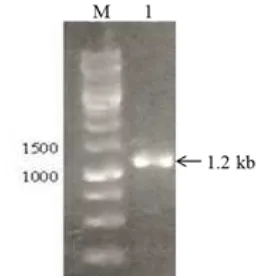
FIGURE 1Electropherogram of PCR result. M: Generuler 1 kb DNA Ladder, 1:phbAamplicon. The obtained amplicon size was approx-imately 1.2kb which is similar to the size of thephbAgene fromH. elongataDSM2581 from GenBank.
β-D-galactopyranoside (IPTG) and 5-bromo-4-chloro-3-indoyl-β-D-galactoside from Promega were also used to screen positive recombinant clones.
2.2. Primer design
ThephbAprimers were designed based onphbAfull nu-cleotide sequences fromH. elongata DSM2581 in Gen-Bank database by the authors. Some forward and reverse primer candidates were designed and the parameters of % GC, Tm, the absence of hairpin, dimer, and loop structure were analyzed using Oligo Analyzer. Fast PCR was per-formed to see the mispriming probability.
2.3. Culturing condi on, genomic DNA isola on and amplifica on of phbA gene
H. elongata BK-AG18 was grown in a modified
high glucose medium (HM) as described by Her-tadi et al. (2017). Chromosomal DNA of H. elon-gata BK-AG18 was isolated using Klijn method (Klijn et al. 1991). Amplification of phbA gene was car-ried out by PCR by the folowing primers: phbAF(5’-ATGTCAGAAGTGGTGATCGTC-3’) as forward primer and phbAR (5’-TCAGCGCTCGATGGCCAG-3’) as
re-verse primer. PCR were conducted on an automatic ther-mal cycler (BIORAD) for one cycle predenaturation at 95°C for 4 min, 34 cycles of denaturation at 94°C for 30 s, annealing at 61°C for 30 s, and extension at 72°C for 90 s. The reaction was completed by final extension at 72°C for 5 min. ThephbAamplicon was confirmed by electrophoresis on 1% (w/v) agarose gel.
2.4. Cloning and recombinant clone selec on
The amplicon of phbA gene was ligated into pGEM-T Easy using T4 DNA ligase and transformed into compe-tent E.coli TOP10 cells using heat shock method ( Sam-brook and Russell 2001). The transformants were blue-white selected on Luria Bertani solid medium supple-mented with100 µg/ml ampicillin, 20 ug/ml X-gal, and 0.1 M IPTG. The recombinant plasmids were confirmed by size screening and re-PCR. Recombinant plasmids DNA were isolated from the transformants with Geneaid High Speed Plasmid Mini Kit (Geneaid Biotech Ltd., Taiwan).
2.5. Sequencing of phbA gene
Determination of phbA nucleotide sequences was per-formed by 1stBASE, Malaysia with dye terminator dideoxy Sanger Method using universal primer of T7 and SP6 promoter.
2.6. Cataly c residues and three dimensional struc-ture predic on of PhbA
PhbA amino acid sequence was deduced fromphbAgene sequences. Prediction of PhbA catalytic residues was performed using Sequence Annotated by Structure (SAS) and Catalytic Site Atlas (CSA). On the other hand, the prediction of PhbA 3D structure was conducted using I-TASSER.
3. Results and discussion
3.1. Chromosome isola on and gene amplifica on
The chromosome ofH. elongataBK-AG18 was success-fully isolated. Using this chromosome and the designed
(a) (b) (c)
FIGURE 2Selec on of recombinant clones. (a) Blue-white screening ofE.coliTOP10 transformants, (b) Size screening of recombinant clones, B: plasmid from blue colony, W1: recombinant plasmid from white colony. (c) re-PCR of phbA gene in pGEM-phbA, M: Generuler 1 kb DNA Ladder, A1:phbAamplicon from W1.
Yuliastri et al. Indonesian Journal of Biotechnology22(1), 2017, 39–42
FIGURE 3The nucleo de sequences ofphbAgene and its deduced amino acid sequences.
primers, the performed PCR reaction has produced aphbA
gene as shown by a single band of the amplicon on agarose gel electrophoresis (Figure1).
3.2. Cloning and recombinant clone selec on
The 1.2 kb obtained amplicon was inserted into the pGEM-T Easy vector and transformed intoE.coliTOP10. The transformants will survive in LB-ampicillin medium, and the recombinant clones will appear as white colonies. On the other hand, the transformants with plasmid without in-sert will appear as blue colonies (Figure 2a). The posi-tive recombinant clones were confirmed by size screen-ing (Figure2b) and re-PCR (Figure2c). As presented in Figure2band2c, the recombinant plasmid has larger size compared to the non-recombinant plasmid and the re-PCR produces 1.2 kb fragment as expected.
3.3. Sequencing of phbA gene in pGEM-phbA
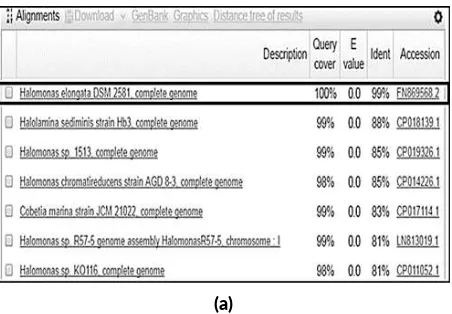
The sequence of 1176 bpphbAgene and its deduced amino acids is shown in Figure3. The BLASTN analysis indi-cated that this phbA gene showed 99% identity with the whole genome ofH. elongataDSM2581 (Figure4a). The BLASTP analysis on the deduced amino acid of this gene, PhbA, showed 100% identity with acetyl-CoA
acetyltrans-ferase fromH. elongataDSM2581 (Figure4b).
Literature studies stated that PhbA super family con-tains three catalytic residues: Cys89, His348, and Cys378 as shown in Zooglea ramigera (Modis and Wierenga 2000).The PhbA-deduced amino acids fromH. elongata
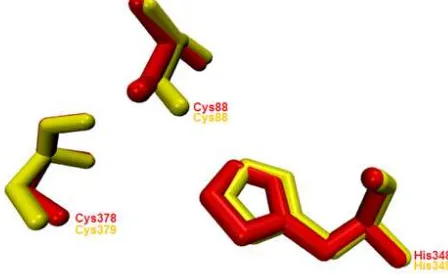
BK-AG18 also has Cys88, His348, and Cys378, confirm-ing that the isolated gene isphbA. The PhbA 3D structure predicted by I-TASSER showed 68.72% identity to acetyl-CoA acetyltransferase structure fromRalstonia eutropha
H16 (RePhbA). The modelling 3D structure of PhbA pre-dicted by I-TASSER with its catalytic residues can be seen in Figure5.
In RePhbA, Cys89 has a function as covalent catalyst, His349 as general base, while Cys378 was a second nucle-ophile (Kim and Kim 2014). The superposition showed that Cys88, His348 and Cys379 residues in our PhbA structure have the same positions with Cys89, His349 and Cys378 from RePhbA.
4. Conclusions
The designed primers had successfully amplified phbA
gene that code acetyl-CoA acetyltransferase fromH. elon-gata BK-AG18 chromosomal DNA. This phbA gene showed 99% identity to the whole genome ofH. elongata
DSM2581. The deduced amino acid sequences of this gene showed 100% identity with acetyl-CoA acetyltrans-ferase ofH. elongataDSM2581.The three amino acid on PhbA catalytic sites are Cys88, His348, and Cys378 which is similar to the PhbA catalytic sites ofZooglea ramigera, confirming that thephbAgene isolated is coding for PhbA protein superfamily.
Acknowledgements
This research was funded by Indonesia Endowment Fund for Education (LPDP), ITB research grant, and the uni-versity priority research grant with the contract number: 310u/11.C01/PL/2016/ awarded to RH.
(a) (b)
FIGURE 4(a) The BLASTN result of thephbAgene and (b) the BLASTP result of PhbA.
Yuliastri et al. Indonesian Journal of Biotechnology22(1), 2017, 39–42
FIGURE 5 Predic on of PhbA 3D structure using I-TASSER. Residues in red color are PhbA and yellow are RePhbA.
Authors’ contribu ons
RH designed the study. Molecular cloning strategy was led by ER. NPY carried out the laboratory work. ER, RH, NPY analyzed the data and prepared the manuscript. All authors read and approved the final version of manuscript.
Compe ng interests
The authors declare no competing interest.
References
Colwill JA, Wright EI, Rahimifard S. 2012. A holis-tic approach to design support for bio-polymer based packaging. J Polym Environ. 20(4):1112–1123. doi:10.1007/s10924-012-0545-z.
Dietrich D, Illman B, Crooks C. 2013. Differential sen-sitivity of polyhydroxyalkanoate producing bacteria to fermentation inhibitors and comparison of poly-hydroxybutyrate production fromBurkholderia cepa-ciaandPseudomonas pseudoflava. BMC Res Notes 6:219. doi:10.1186/1756-0500-6-219.
Hertadi R, Kurnia Kurnia WF, Puspasari M. 2017. Polyhy-droxybutyrate (PHB) production byHalomonas elon-gataBK-AG18 indigenous from salty mud crater at Central Java Indonesia. Malays J Microbiol. 13(1):26– 32.
Jari M, Khatami SR, Galehdari H, Shafiei M. 2015. Cloning and expression of poly 3-hydroxybutyrate operon intoEscherichia coli. Jundishapur J Microbiol. 8(2):1–4. doi:10.5812/jjm.16318.
Kim EJ, Kim KJ. 2014. Crystal structure and bio-chemical characterization of PhaA fromRalstonia eu-tropha, a polyhydroxyalkanoate-producing bacterium. Biochem Biophys Res Commun. 452(1):124–129. doi:10.1016/j.bbrc.2014.08.074.
Klijn N, Weerkamp AH, de Vos WM. 1991. Identification of mesophilic lactic acid bacteria by using polymerase chain reaction-amplified variable regions of 16s rRNA and specific DNA probes. Appl Environ Microbiol. 57(11):3390–3393.
Modis Y, Wierenga RK. 2000. Crystallographic anal-ysis of the reaction pathway of Zoogloea ramigera
biosynthetic thiolase. J Mol Biol. 297(5):1171–1182. doi:10.1006/jmbi.2000.3638.
Muangsuwan W, Ruangsuj P, Chaichanachaicharn P, Yasawong M. 2015. A novel nucleic lateral flow assay for screening of PHA-producing haloar-chaea. J Microbiol Methods 116(Supplement C):8–14. doi:10.1016/j.mimet.2015.06.012.
Sambrook J, Russell DW. 2001. Molecular cloning: a laboratory manual. Cold Spring Harbor, NY: CSHL Press.
Singh R. 2014. Isolation and characterization of effi-cient poly–hydroxybutyrate (PHB) synthesizing bac-teria from agricultural and industrial land. Int J Curr Microbiol App Sci. 3(6):304–308.