Shana Kaiser
Case study authors:
Erik Asplund
The electronic version of this publication is available under a Creative Commons Licence Copyright (CCl) —Creative Commons Attribute-NonCommercial-ShareAlike 3.0 Licence. You are free to copy, distribute and transmit the publication as well as to remix and adapt it, provided it is for non-commercial purposes, that you appropriately attribute the publication, and that you distribute it only under a licence identical to this one. For the full conditions of this CCl, see: <http://creativecommons.org/licenses/by-nc-sa/3.0/>.
International IDEA publications are independent of specific national or political interests. Views expressed in this publication do not necessarily represent the views of International IDEA, its Board or its Council members.
Preface
Over the past several years online social media have come to play an increasingly prominent role in the ways in which we communicate. With the emergence of new and engaging digital platforms such as Facebook, Twitter, YouTube and WordPress, the means by which information is created and consumed have changed radically. One-way output of information from ‘official sources’ has given way to communication that is individually or collectively generated and shared by online users who are now as much active producers of information as they are passive consumers.
In tandem with this, the public increasingly expects official bodies and institutions to have an active online presence, and expects that information is presented and distributed through those social media platforms where they themselves are present. Electoral management bodies (EMBs) are no exception here and they must respond to the changing demand from the public if they are to remain relevant and effective. Moreover, they have much to gain if they can learn to use social media tools successfully.
This guide is designed to inform EMBs about the ways in which social media can be used to increase the participation of the electorate, boost communication, engage all members of the community and improve transparency and trust throughout the entire electoral cycle. It also explains the factors that EMBs should consider during the initial phase of using social media platforms, and shows how social media can be effectively used throughout the electoral cycle. The guide is designed to be an introduction to the use of social media for EMBs who have just begun to use social media, or who are about to embark on its use. It provides material to enable EMBs to respond to new communication realities and to develop social media strategies, as well as outlining how social media needs to be embedded in an overall media strategy.
Social media plays an increasingly important role in the field of voter information. EMBs need to reach voters where they are and young voters are particularly active on social networks. Therefore social media is also an effective tool in voter education efforts designed to ensure voters are well informed and can effectively exercise their voting rights. In the digital age, social media has the potential to become a hugely valuable and effective voter education tool for EMBs.
Contents
Acronyms and abbreviations ... 7
Introduction ... 8
Chapter One: An introduction to social media and its use by EMBs ... 11
Social media—what is it? ... 11
Current popular platforms ... 11
How can social media be beneficial to EMBs? ... 11
Easier communication with the electorate ... 14
Engaging new audiences ... 15
Increased transparency and accessibility ... 18
Chapter Two: Seven steps towards a strategic approach to social media ... 20
Developing a social media strategy ... 20
1. Key questions to help guide an EMB in its use of social media ... 21
2. Identifying resources ... 22
3. Develop guidelines for implementing a strategy ... 25
4. Links with other institutional strategies and policies ... 27
5. Identifying and engaging with other actors using social media ... 28
6. Potential risks and ways of addressing them ... 30
7. Reviewing the strategy in light of lessons learned ... 36
Chapter Three: Going live! From strategy to getting started ... 37
Two-way interactions ... 37
Targeting discussions to the audience ... 38
Security considerations ... 40
The use of social media throughout the entire electoral cycle ... 41
Conclusion ... 44
Annex One: An overview of selected social media platforms ... 45
Acknowledgements ... 48
About International IDEA ... 49
Acronyms and abbreviations
AEC Australian Electoral Commission
CNE Consejo Nacional Electoral (Colombia)
EMB electoral management body
EUR Euro
GEO Global Electoral Organizations
IEBC The Independent Electoral and Boundaries Commission of Kenya
International IDEA The International Institute for Democracy and Electoral Assistance
JNE Jurado Nacional de Elecciones (Peru)
ONPE Oficina Nacional de Procesos Electorales (Peru)
RNEC Registraduria Nacional del Estado Civil (Colombia)
UGC user-generated content
Introduction
In August 2008, Facebook reported that the number of users on its popular social networking site had recently grown to over 100 million. By December 2012, just four years later, the number had reached 1.06 billion active users per month, with an average of 618 million active users per day (an active user being defined as a registered Facebook member who logs in and visits the site. See Graphs 1 to 5). The company also reported an average of 3.2 billion ‘likes’ and comments generated by Facebook users every day during the first quarter of 2012. In the same way, Twitter usership has grown with comparable impressive speed since the site’s launch in March 2006. Figures from 2013 show that each day Twitter users were posting approximately 500 million ‘tweets’ (USSEC Twitter).
0
Monthly Daily (average over the month ended)
1056
618 Graph 1. Active Facebook Users Worldwide (in millions)
0
Monthly Daily (average over the month ended)
193
Source: United States Securities and Exchange Commission Form 10-k—Facebook,
<http://investor.fb.com/secfiling.cfm?filingID=1326801-13-3&CIK=1326801>, accessed on 12 November 2013
Monthly
* Asia includes all users in Australia and New Zealand
Daily (average over the month ended)
0 Graph 4. Active Facebook Users Asia* (in millions)
Monthly Daily (average over the month ended)
* Rest of the world includes Africa, Latin America and the Middle East Dec Graph 5. Active Facebook Users Rest of the World* (in millions)
Monthly Daily (average over the month ended)
0
*Europe includes all users in Russia and Turkey
Numbers such as these emphasize the increasing popularity and availability of online social networks, and show that the ways in which people communicate and share information have changed rapidly. Active social networks transcend national borders, span continents and allow users to access first-hand information from around the world. The impact that social media now have on the ways in which we receive, generate and process information is continually evolving, and institutions that make use of these new communication platforms may be more effective in meeting the demands and expectations of their audiences.
Citizens’ understanding and perceptions of the electoral process and the activities and procedures taking place within it are crucial to an election’s success—and, by extension, to the success of an EMB. One of the basic ways that an EMB can ensure an electorate has access to relevant information that will improve its understanding of the electoral process and bolster relations with the electorate and electoral shareholders is to ‘maintain open, two-way communication’ (International IDEA 2006a: 210). Arguably, such ‘two-way communication’ has never been easier than through the well-planned and strategic use of social media.
This guide introduces social media and some of the more popular social media platforms currently being used. It describes the benefits that EMBs from around the world have found in using social media to engage with their electorates. Elements and processes for designing a social media strategy are outlined, and these are followed by considerations that EMBs should bear in mind when first implementing a social media strategy. Lastly, the guide presents some ideas for the ways in which EMBs can engage with their target audience throughout the entire electoral cycle.
Figure 1. Overview of this guide
CHAPTER 1
•Anintroductiontosocialmedia •BenefitsofsocialmediaforEMBs
CHAPTER 2
•Elementsofasocialmediastrategy
•Stepstowardsdevelopingasocialmediastrategy
CHAPTER 3
•Considerationsforgettingstarted
AnintroductiontosocialmediaanditsusebyEMBs
Social media—what is it?
There are many definitions of social media but all social media are essentially understood to be web or mobile-based platforms that allow for two-way interactions through user-generated content (UGC) and communication. Social media are therefore not media that originate only from one source or are broadcast from a static website. Rather, they are media on specific platforms designed to allow users to create (‘generate’) content and to interact with the information and its source.
While social media rely on the internet as a medium, it is important to note that not all internet sites or platforms meet the definition of social media. Some websites make no provision for interactivity with the audience, while others allow users only to post comments as a reaction to particular published content as discussions posts (or ‘threads’) which are moderated and controlled. While discussion threads can offer a degree of interaction with the source, these are not considered to be social media platforms for the purposes of this guide.
Current popular platforms
Current social media platforms include, but are not limited to, Facebook, Twitter, Instagram, YouTube, Bambuser, Vimeo, Blogs, Flickr, LinkedIn and Google+. Other platforms popular in select countries or regions include Cloob (Iran), Orkut (Brazil, India), Cyworld (South Korea), Friendster (South East Asia), Grono.net (Poland), hi5 (parts of Asia, Central Africa and Latin America), mixi (Japan), Spaces (Russia) and Sina Weibo (mainland China). In addition to these platforms, there are a variety of ‘dashboards’ designed to consolidate social media messages and postings over various platforms (for example, Threadsy, HootSuite and Buffer) and software programmes that assist in monitoring social media discussions (for example, Tweetdeck and Meltwater Buzz) in order to provide feedback to the user. (Short descriptions of some prevalent social media platforms can be found in Annex One.)
How can social media be beneficial to EMBs?
Isle of man
Costa RicaColombiaColombia(RNEC) (CNE)
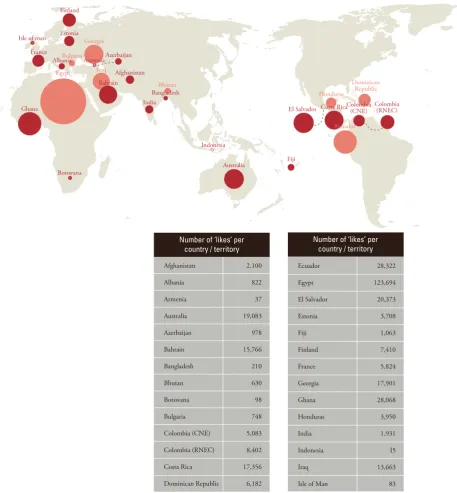
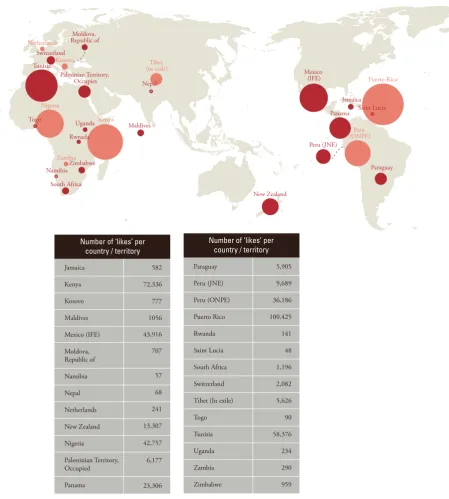
At present, very few EMBs employ any form of social media. A mapping exercise and global survey of EMBs and their use of social media undertaken by International IDEA in October 2013 found that of 172 countries and territories only 55 EMBs (31.9 per cent) had Facebook pages, and of these 55 only 49 showed any sign of current Facebook activity. The corresponding number for Twitter was that 47 EMBs (27 per cent) had Twitter accounts. The number of Twitter ‘followers’ ranged from a high of 250,117 (with Latin American EMBs being most
Ecuador Number of ‘likes’ per
country / territory Number of ‘likes’ per
country / territory
Tibet Number of ‘likes’ per
country / territory Number of ‘likes’ per
country / territory
active Twitter users) to a low of only two. These numbers reveal not only that the use of social media by EMBs varies widely; they also show that the level of engagement with social media platforms by EMBs and their online followers is not in general very high. In fact, where users are posting to EMB Facebook pages, the general trend indicates that user activity is higher than that of the EMB, further indicating that EMBs may not be using Facebook to engage effectively with their audiences.
The mapping exercise was complemented by a written global survey of EMBs. In their responses to the survey, EMBs highlighted the potential benefits and possible challenges that social media bring to election management. The benefits they identified can be grouped into three broad categories: (1) easier communication with the electorate; (2) engagement with new audiences; and (3) increased accessibility and transparency. Challenges raised by the EMBs will be discussed later in the guide.
Easier communication with the electorate
From the replies provided by survey respondents, it is evident that EMBs believe that an important benefit of social media is the ability to engage with the electorate through shared and open discussions. When there is a need to share information quickly, an EMB can directly access an existing audience of followers, who can then share the information within their own respective networks in an ongoing and ever-expanding process.
Equally important is the real-time information that can be gathered from the electorate (see Box 1). For instance, when monitoring social media platforms, Elections Canada was able to identify issues such as the non-delivery of voter information cards in some areas, confirm the accuracy of reports, and request field staff to take appropriate action. In addition, the Canadian EMB reported that social media had given them an ‘opportunity to get real-time information on stakeholders’ views and areas of interest’. Listening to an audience and understanding their needs and opinions as posted on social media platforms is a key element of successful social media usage and should not be underestimated.
Box 1. Reacting to real-time information through social media in India
Anotableadvantageofthesocialmediaisdirectandinstantcommunicationwithanaudience
Dr S.Y. Quraishi, Former Chief Election Commissioner of the Independent Election Commission of India
Social media also provide a valuable means by which EMBs can supplement more traditional means of communication with the electorate. Direct channels of communication between an EMB and the electorate have long been recognized as essential to the work of an EMB, and may include telephone enquiry services, public enquiry desks and suggestions boxes at locations such as markets, shopping precincts or transport hubs, interactive radio and
television programming, and ‘town hall’ type meetings featuring EMB members (International IDEA 2006a: 207). While such tools are beneficial for traditional outreach campaigns, social media enable EMBs to advertise these events and services widely and to encourage greater public participation.
There are various ways in which social media can assist an EMB in sharing information and in gathering valuable insights into the issues and concerns being discussed by the electorate. These uses of social media can also assist an EMB in identifying and assessing what the electorate needs and expects from the institutions that manage electoral processes. Methods used on social media platforms that are helpful in this respect include:
• Online quizzes • Online polls
• Keeping pages open to allow followers to post or ‘tweet’ questions and comments • Allowing users to create and comment on blog posts or articles
• Posting questions that encourage online debates • Hosting information sharing or question/answer sessions • Allowing users to post videos
• Using analysis software to identify key words being used
• Monitoring social media platforms and developing immediate responses to issues
of concern
Engaging new audiences
International IDEA’s global survey of EMBs reveals that interactive communication platforms help EMBs reach a wider audience and convey information to specific social groups which they may not have been able to access previously. Social media can play a vital role in communicating with a wide and diverse population and can assist an EMB to better understand the needs of various demographics within an electorate and the ways in which cross sections of society participate in elections and engage with politics in general.
Many EMBs have identified youth, minorities and women as members of the electorate who may be less engaged with electoral and political processes but who can be reached through effective use of social media platforms. The EMB of Bosnia and Herzegovina, for example, uses social media to engage such groups, along with first-time voters, refugees and displaced persons.
A research study on Participatory Politics—New Media and Youth Political Action found that ‘new media has the potential to facilitate an equitable distribution of political participation among young people from different … ethnic groups’ (Cohen and Kahne 2012: 20–30). Furthermore, according to a research study on Technology Trends among People of Color in the United States (Smith 2010):
‘A
mong internet users [in the United States], seven in ten blacks and English-speaking Latinos use social networking sites—significantly higher than the six in ten whites who do so.’ Within this,‘ minority respondents were significantly more likely than whites to say that this type of outreach “helps people be more informed about what government is doing” and “makes government more accessible”. They are also much more likely than whites to say it is “very important” for government agencies to post information and alerts on social networking sites.’
Whether by abstracting the information from such studies to conditions pertaining to their own local context, or by conducting research of a similar nature, EMBs can plan more effective social media strategies by paying careful attention to the exact nature and make-up of groups not yet participating fully in the electoral process.
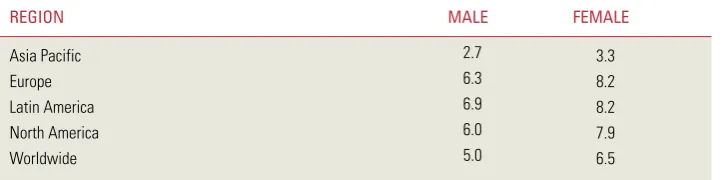
A further social category whose relation to social media use must be carefully considered is that of gender. Globally, as a 2010 ComScore study on the ways in which women are using the internet and social networking sites reveals, women are slightly less connected to the internet than men, with 46 per cent of the global web population being female (Vollman, A., Abraham, L. and Mörn, M. P., 2010). However, the study points out that the global average is lowered by limited access to the internet in many parts of the Asia Pacific region and by restrictions on the use of social media in countries such as China (Vollman, A., Abraham, L. and Mörn, M. P., 2010: 10). Despite these figures, the study finds that ‘once online, women are more connected than men’ and on average women spend more time on social networking sites. Table 2 provides the regional average figures disaggregated by gender.
Table 2. Average hour per visitor on social networking by region
REGION MALE FEMALE
Source: ComScore ‘It’s a Social World:
Top 10 Need-to-Knows About Social Networking and Where It’s Headed’ (December 2011).
Finally, many countries are struggling with a decline in turnout among young voters. Strategies to increase voter turnout within this demographic, as discussed in forums such as the Fifth GEO (Global Electoral Organizations) Conference in 2011, include reaching out to young voters by using their language, in their own spaces of interaction (see International IDEA, 2011). As social media platforms grow, so too do the opportunities and variety of ways for EMBs to reach out to and engage with younger audiences through specially targeted discussions. The case study in Box 2 explains how Elections Canada used social media for their ‘Canada’s Democracy Week’ campaign. The case study provides insight into why such a campaign was undertaken; how Elections Canada’s social media platforms are managed, and the successes and challenges they have experienced to date.
Box 2. Using social media to promote youth engagement: Elections Canada and Canada’s Democracy Week
Canada’sDemocracyWeekisanannualciviceducationinitiativeorganizedbyElectionsCanadato raiseawarenessofdemocracyandtheimportanceofvoterengagementamongCanadianyouth. Socialmediaareakeycomponentoftheprogrammeandareusedtointeractwithyouthandkey stakeholders,promotetheNationalYouthChallengeandadvertiseeventsandactivitiesthatoccur throughouttheweek.AlthoughCanada’sDemocracyWeekwasfirstlaunchedin2011,socialmedia onlyfiguredprominentlyintheprogrammethefollowingyearwhenseveralplatformswere establishedandregularlyusedtoengagewithyoungpeopleandactivelypostcontent.The programmenowincludesFacebookandTwitteraccountsinbothofCanada’sofficiallanguages (EnglishandFrench),aswellasaYouTubeChannelineachlanguage.WhileDemocracyWeek occursinSeptemberofeachyear,thesocialmediaaccountsremainactiveallyearlong.
Canada’sDemocracyWeeksocialmediarepresentElectionsCanada’sfirstattempttoengagewith thepublicthroughthisimportantnewformofcommunicationandinteraction.Sincetheagencyhas yettoestablishasocialmediapresenceacrossitsmanyareasofactivity,theaccountsarebranded separatelywiththeCanada’sDemocracyWeektheme.
IndevelopingitsapproachtousingsocialmediaforCanada’sDemocracyWeek,ElectionsCanada establishedagovernancestructureandtermsofuse.Amongotherthings,thetermsofuseprovide guidelinesforusersubmissions,includingadefinitionofunacceptablecontent.Arelativelysmall teammanagesthesocialmediaaccounts.Astaffmemberdraftsmostofthecontentandmonitors day-to-dayactivity.Aprogrammanagerandsenioradvisorreviewandapprovecontentandensure thatpostsareconsistentwiththelargermessagingoftheagency.Twoadditionalseniordirectors provideoversightandcontentapproval.
TheuseofsocialmediainCanada’sDemocracyWeekhasbeenhighlysuccessful,butnotwithout itschallenges.Becomingadeptatusingthetechnologytakestime,asdoeslearninghowtorespond quicklyandinanengagingmanner.Additionally,asanon-partisanagency,ElectionsCanada monitorstheaccountsforpostingsthatcouldcompromisetheagency’srealorperceivedimpartiality. Mostusersrespecttheguidelinesestablishedinthetermsofuseandonlyonafewoccasionshave partisanpostingsappeared(ineachcase,theywereremoved).Ultimately,theuseofsocialmedia forCanada’sDemocracyWeekhasprovidedElectionsCanadawithadditionalwaystoreachyouth, reinforceimportantpartnershipswithkeystakeholders,andestablishsoundpracticesthatcanbe usedbytheagencyasitconsidersbroadeningitsusesocialmediainthefuture.
A survey by the Pew Research Centre’s Internet and American Life Project on Civic Engage-ment has shown that younger people in the US are more likely to use social media tools for civic activities and details the politically related activities for which social media tools are most commonly used. For instance, these populations are found to use Facebook to ‘like’ or promote political materials, encourage others to vote, post thoughts on issues, repost political content and follow officials and/or candidates on social media. To exemplify further, 44 per cent of users between the age of 18–29 use social media to like or promote political material, only 34 per cent of users between the age 50–64 use social media for these purposes. It is significant to note that almost as many young people in the 18–29 age bracket post their individual thoughts on civic issues as those who simply ‘like’, share or promote material posted by others. The smallest percent of the population studied actually ‘follow’ civic officials or political candidates. (Rainie, L., Smith, A., Schlozman, K.L., et.al.)
Increased transparency and accessibility
Transparency and integrity are especially important for the accountability of an EMB (International IDEA 2006a: 223). Social media can help EMBs increase the electorate’s perception of transparency and accessibility by enhancing an EMB’s ability to disseminate impartial, accurate and timely information and respond promptly to queries and requests through both formal and more informal platforms. In addition, exchanges held on an EMB’s social media platforms—either between the EMB and its followers or between the followers themselves—are visible to a wide audience. This in turn allows for increased accessibility to information and transparency around issues of concern.
While this is true for all EMBs, it is especially relevant for EMBs during transitional periods when building confidence and trust between voters and political actors is crucial. To do this, consideration should be ‘given to confidence-building activities such as … avenues of dialogue and consultation with political actors’, again an area where social media can play an important role (International IDEA, 2012: 4).
The use of social media by EMBs for open communication and interaction with the electorate, coupled with an EMB’s ability to react to information provided, can eventually build trust between the electorate and the EMB and engender greater confidence in the electoral process at large. This is exemplified in Nigeria’s 2011 electoral process, where social media tracking centres concluded that, through the effective use of social media, trust in the EMB amongst the electorate rose markedly (see Box 3).
Box 3. Building trust in Nigeria’s electoral process through social media
The2011presidentialelectionsinNigeriatookplacewith greatanticipationafterthelargelydiscreditedelectionsof 2003and2007.The2011electionwasthefirstinwhichsocial mediawereemployedthroughoutNigeria’selectoralprocess byawiderangeofstakeholdersthatincludedcivilsociety organizations,politicalpartiesandcandidates,thepolice, citizens,traditionalmediaoutletsandNigeria’sEMB,the IndependentNationalElectoralCommission(INEC).Inthe lead-uptoelectionday,theSocialMediaTrackingCentrewas establishedinorderto‘explorehowsocialmediaplatforms wereworkingduringtheelectionperiod;whattrendsmightbe developing;possiblecoursecorrectionsandwhethergroups couldlearnfromoneanother’sexperience’.Informationfrom SMS,Facebook,Twitterandphotographspostedonlinewere collatedandanalyzed.Thereportconcludedthattrustinthe INECandelectoralprocessgrewthroughouttheelectoral processduetotheEMB’suseofsocialmedia.The‘presenceof socialmedia’,itwrote,‘andthewillingnessoftheINECto receiveandactoninformationgaveNigeriancitizensthe feelingthat,perhapsforthefirsttime,theirvoiceswouldbe heard.Theymadeanefforttoregisterandvote,andalsoto protecttheirvotes.Evennon-activistsfollowedpollresultsand continuedcheckinginordertoensurethatwhatwashappening ongroundwaswhatwasbeingreported.’Thefullreportcan
be found at:
Sevenstepstowardsastrategicapproachtosocialmedia
Developing a social media strategy
While a number of EMBs successfully began their use of social media without a clear strategy, there is now experience and lessons learned which suggest that the development of a realistically achievable and easily operationalized social media strategy can help an EMB avoid pitfalls and challenges and assist it in targeting its outreach more effectively.
Social media strategies determine goals and set a framework for achieving them. Strategies allow an organization to be forward thinking and proactive. With a clear strategy, an EMB can set the stage for discussion, engagement and knowledge sharing, rather than simply reacting to discussions already taking place. In contexts where EMBs face challenges such as lack of trust or political pressure, and in fragile or emerging democracies, a clear social media strategy and guidelines for how and when social media are to be used is of particular importance.
Social media are changing rapidly, with new innovations on existing platforms coming into effect alongside the emergence of completely new social media services. Thus EMBs that are new to social media will be embarking on an inevitable period of trial and error. A strategy may therefore be designed for six months, a year, or more; however, regardless of the timeframe, periodic revision, re-planning and revising are essential in order to remain relevant and up-to-date. Strategies should also be flexible enough to adapt to rapid technological change.
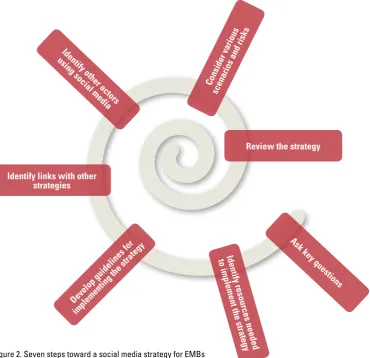
The seven steps listed below will help an EMB construct an effective social media strategy:
1. Ask key questions that will guide the use of social media by the organization 2 . Identify resources needed to implement the strategy
3. Develop guidelines for implementing the strategy
4. Identify links with other institutional strategies and policies 5. Identify other actors using social media
6. Consider possible risks and scenarios and ways of addressing them 7. Review the strategy
These steps will be discussed throughout the chapter, not in order to provide a rigid and inflexible template, but rather to highlight considerations that will enable EMBs to find their own ways forward within their respective contexts.
Figure 2. Seven steps toward a social media strategy for EMBs
1. Key questions to help guide an EMB in its use of social media
Questions that will help guide an EMB in determining how social media can be most relevant and have the most impact for the organization should focus on purpose, audience, methods and risks, and could include the following:
1. Why do we want to engage through social media? What are our purposes and goals? 2. What do we believe can be improved or addressed by social media? What added
value do we seek from such engagement?
3. What do our organizational resources look like? What assets can we work with? 4. What kinds of conversations are we interested in stimulating/participating in?
Why are we interested in these and how do they relate to our goals?
5. Which different target groups do we want to engage with? What platforms are they using?
6. Why would our target audience engage on our platform(s)? What do we have to offer? 7. Who else is trying to engage with our target groups? How can we be aware of their
discourse? Can we partner with any of these actors to increase our outreach? 8. How do we recruit followers to our social media platforms and how do we maintain
their interest?
9. What type of content should we share and how do we produce it?
10. Are there any specific events or dates that we would like to develop a special campaign around?
11. What potential scenarios do we need to prepare for? What are the potential risks?
Identify resources needed to implement the strategy Identify links with other
strategies
Develop guidelines for implementing the strategy
Consider various scenarios and risks
Review the strategy
Although answers to these questions may not appear directly in an EMB’s social media strategy, outlining answers to them can assist in clarifying (a) the purpose of using social media, (b) the audience that will be engaged, (c) the ways of engaging them, and (d) strategies for reducing risks. Answering these questions may also help to outline clear, measurable goals with relevant indicators (for instance, a quantifiable increase in followers or an increase in visits to or downloaded information from the EMB’s website). Moreover, clearly measurable goals and indicators will be essential when conducting an evaluation of the strategy’s success.
2. Identifying resources
While social media tools may be available free of charge, ensuring that they are used in ways that maximize their benefit will involve a great deal of human and other resources. It is therefore necessary to clearly determine the resources needed to operationalize a social media strategy.
The inclusion of social media into staff responsibilities will ultimately have budgetary implications. Thus a social media strategy should carefully consider the goals and benefits of using social media and weigh these against impending costs.
Some resource considerations include:
While social media activities may increase during an electoral period, the pre- and post-electoral periods are also times when important information about the post-electoral process can be gathered and disseminated. In this regard, an EMB might consider having a staff member or team of staff members attending to their social media platform(s) throughout the entire electoral process.
Furthermore, the ability to respond in near real time implies that resources are needed consistently. However, this is not without challenges. When surveyed, Norway’s EMB noted that ‘resources to follow-up and update on a regular base are scarce. This means that it is a challenge to meet the demands for continuous updates.’
Particularly when platforms are newly launched, it may be advisable for EMBs to have staff members or others attending to the platforms on a regular basis, including at night and over weekends, in order to ensure that followers are promptly and consistently engaged. Again, this implies that human resources will be needed beyond traditional working hours.
While a small group of staff members may hold ultimate responsibility for content on the EMB’s social media platforms, this need not preclude other staff members from sending information to this core team, who can then translate the material into ‘social media friendly’ posts. Some social media management systems encourage input from staff from outside the social media team, while maintaining central control by allowing these staff ‘draft-only’ capability. Draft posts and responses are then queued for approval by the core social media management team before being posted publically. In the Australian Electoral Commission (AEC), for instance, officers directly involved in managing the AEC’s social media seek clearance for any proposed content that might be particularly contentious or break new ground. Officers meet regularly to share ideas and information, and attend seminars and other specific training where possible. This is done to ensure that everyone is aware of the activities being undertaken and to tailor potential posts for each platform.
In all cases, having staff take part in the creation of posts will allow them to feel that they are a part of the social media strategy and will lead to more innovative, creative and informative posts from a wider cross-section of the organization. This may also be a way to reduce the burden on the time and resources of a smaller social media team.
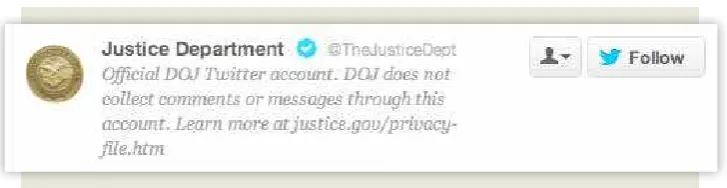
Resources should also be linked to the overall scope of the strategy, and as the availability of resources grows, so too can the strategy’s scope. While two-way interaction is the ultimate goal of successful social media platforms, beginning with announcements or links to the institution’s website might be a first step in establishing a social media presence. Stating your scope publically, as done by the United States Department of Justice, can also help mitigate or reduce expectations for interaction.
Figure 3.
Once an institution has the resources for increased online engagement, it can post a wider variety of information: for instance, debate pieces, questions to followers or the staging of real-time events such as question-and-answer sessions.
Building staff capacity
Creating partnerships and outsourcing
Another means of maximizing resources, engaging the widest audience possible and ensuring that information is spread effectively is to form partnerships. Partnerships can be formed between the EMB and government agencies, civil society and not-for-profit organizations, prominent personalities and others. There are many good examples of the ways in which these bodies have used social media for civic engagement, and EMBs should not be afraid to explore such options with politically neutral bodies that work towards similar goals. Sharing experiences with other EMBs, government or non-governmental organizations through online discussion or face-to-face forums can also lead to informal partnerships and develop more creative ways of engaging an audience.
Another option, as used successfully by the AEC, is to partner with an outside agency during the start-up phase of a social media engagement strategy. In Australia, an advertising agency was ‘given guidelines based on the telephone call centre response manual so they could quickly respond to questions on the online platforms’ (Macnamara J., Sakinofsky, P. and Beattie, J., 2012: 33). This partnership allowed AEC staff to learn from the agency while remaining confident that should something go wrong there were professionals on hand to help mitigate the situation. This in turn led to higher levels of comfort for AEC staff during the first stages of unrolling their social media platforms (see Box 4).
Box 4. Embarking on the use of social media: the Australian experience
BeforetheAECbeganwithitsuseofsocialmediain2012,theagencycommissionedasubstantial reviewofsocialmediaengagementbyotherAustraliangovernmentagenciesandelectoralauthorities. ThisreporteffectivelylentfurthersupporttoanAECdecisiontoadoptsocialmediaaspartofits strategiesandisavailableat:<http://www.aec.gov.au/About_AEC/research/social-media.htm>
TWITTER—TheAEC’sTwitteraccountwascreatedatthesametimeastheFacebookpage.
However,incontrasttheAEC’smediaandpublicrelationsteammanagedthisprocessinternally fromtheoutset.ThisapproachwaschosenbecauseTwitterisasimplerplatformtoadministerthan Facebookandrequirescomparativelylittlefamiliarizationortraining.Whileinitiallyusedforthe CountMeIncampaign,itquicklybecameevidentthattheAECTwitterfeedisaveryuseful additionaltoolformanagingmediaissues,andithastendedtobesubscribedtobyarangeof mediajournalistsandstakeholders,alongwithgeneralmembersofthecommunity.
Continued updating and monitoring of a wide variety of platforms, coupled with the initial establishment of an online presence may be beyond the abilities of an EMB, or an EMB may deem it to be overly time-consuming or costly. In this regard, some EMBs choose to outsource social media content to other agencies (such as civil society organizations or private consultants). However, issues to consider when outsourcing social media content include perceptions of neutrality, the ownership of and responsibility for content, familiarity with the electoral process and the communication strategy and policies, rules, regulations and mandate of the EMB. In order best to represent the EMB, outsourced agencies should be well educated about these matters, as well as about the role and legal limitations of the EMB, the electoral process and the stakeholders involved.
Language
In countries with two or more official languages, maintaining a fully bilingual or multilingual social media platform may pose added challenges and require additional resources. This is particularly true if all discussions being held on the social media platform are expected to take place in all official languages.
3. Develop guidelines for implementing the strategy
In order to ensure that EMB staff work in line with the strategy, guidelines or codes of conduct can be developed to assist those administering the EMB’s social media platforms. Guidelines should include issues such as:
• The kind of content that can be posted • The platforms the organization uses
• The tone of language that should be used to reflect the organization • The frequency of new posts
• The institution’s position on sharing or re-tweeting (passing on) messages and on which
While each EMB will develop its own guidelines for the use of social media, centred on its own particular context and purposes, important elements to be considered include the following:
• Purpose—Why have these guidelines been developed? How do they link to the strategy? • Audience, scope and applicability—To whom do the guidelines apply? When do they
undergo a revision? Do they apply only to the EMB’s social media platforms or also to the private use of social media?
• Background—Why social media is chosen. Where the organization is in its current use
of social media. Where it aims to go. How it aims to get there.
• Social media platforms accepted for use—Which platforms have the organization
deemed to be the most appropriate for the context?
• Target audiences
• Related documents—What other policies are related to or mentioned in this one? • Roles and responsibilities—For maintaining the social media platform(s) chosen by the
EMB; monitoring compliance; managing, implementing and revising the strategy.
• Waivers (if applicable) • Protocols for crisis situations
Further helpful examples of social media guidelines and policies as developed by government agencies, not-for-profit organizations and others can be found at
<http://socialmediagovernance.com/policies.php?f=5>.
Codes of conduct
Codes of conduct can be helpful in ensuring that guidelines are adhered to. In general, codes of conduct are sets of rules, responsibilities or expected behaviours that apply to individuals within an institution or organization. With regard to social media, codes of conduct can differ for those administering EMB platforms, electoral stakeholders using social media, and for the use of social media generally within the workplace. Codes of conduct developed with the use of social media in mind should also be linked to other institutional strategies, as discussed above.
For those administering EMB platforms
It is the responsibility of the party who is ultimately responsible for an EMB’s social media platform(s) to ensure that they are speaking on behalf of the institution and not expressing their personal opinions. This should also be reflected in the code of conduct for those administering the EMB’s social media platforms.
As noted, it is also in the interest of the responsible party to have a thorough understanding of the mandates, procedures, rules and regulations of the EMB, and to engage in discussions, updates or responses that adhere to these. It is therefore advisable that staff members responsible for the social media platform know where to seek responses that reflect the position of the EMB should difficult questions or questions regarding the values or opinions of the EMB arise. Actions such as these should be included in the code of conduct.
For electoral stakeholders
Codes of conduct designed for and used by media, polling station staff, political parties, EMB staff and other electoral stakeholders might include mention of the agreed upon ways in which social media may be employed throughout the electoral process and possible limitations on its use (such as during campaign blackout periods).
For the private use of social media
In addition, some organizations include rules or codes of conduct concerning the ways in which social media may be used privately and/or during working hours. While using social media privately to spread information on the work of the EMB can be of great value, there is also the risk that information posted on private social media accounts may reflect poorly on the organization. Such considerations might ultimately affect the kinds of private messages or discussions employees can post or initiate regarding the workplace. In addition, an organization may wish to suggest guidelines around ways in which staff should behave with regard to scenarios such as accepting ‘friend’ requests from public political figures like candidates and party officials.
4. Links with other institutional strategies and policies
The ways in which a social media strategy links to and is embedded in wider communication or outreach strategies is an important consideration for EMBs, as having contradictory or incongruent strategies will lead to confusion.
A social media strategy should therefore highlight the ways in which social media will enhance and complement areas such as civic education campaigns and outreach mechanisms like public meetings, websites, articles, news pieces and publications.
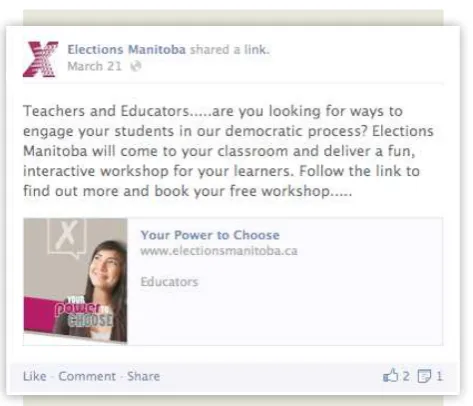
An example of how social media can be used to highlight more traditional outreach campaigns is that of the EMB of the Canadian province of Manitoba (Elections Manitoba), which used Facebook to spread a civic education campaign bringing the commission to classrooms throughout the province:
Social media strategies and platforms can be designed for the national EMB or local and regional EMBs, or developed around a particular issue of interest (for instance, voter registration). Although it will depend on the setup of the EMB(s), where possible it is desirable to ensure consistency and coherence in the strategies employed for these various platforms, as the actions of one may inadvertently reflect on the other. This will be particularly true if electors are unfamiliar with the structure of electoral management bodies in different contexts: some voters, for example, may not be aware that a central EMB and regional/state/provincial EMBs are in fact separate entities.
5. Identifying and engaging with other actors using social media
Although there may only be one EMB using social media in any given country, there may be civil society organizations, international organizations, interested citizens, observation groups (international and domestic), political parties and others involved in the electoral process and also engaging the electorate through social media.
Other actors using social media may include:
LocallevelEMBs
✔
Civilsocietyorganizations
✔
Internationalorganizations✔
Interested citizens
✔
Observationgroups
✔
Politicalparties
✔
Themedia
✔
Securitysectoragencies
✔
Following the platforms of other users with a similar target audience can be of great value. Not only can an EMB engage with these actors through social media to enrich discussions, but following other organizations or individuals can be valuable in assisting an EMB to stop the spread of misinformation about the electoral process (see the section on challenges and risks below), or to respond to criticisms that arise. Furthermore, regardless of whether an EMB is using social media or not, its actions and performance will inevitably be a part of discussions taking place online. Being aware of these discussions and engaging with them proactively, rather than simply reacting, will help an EMB to direct the discussion and better engage with its target audience.
Box 5. The use of Ushahidi in electoral observation
Createdinresponsetotheviolencethatbrokeoutafterthe2007electionsinKenya,Ushahidi (‘testimony’inSwahili)iscrowdsourcingsoftwarethatallowsforpublicinputthroughmobile telephoneSMS/textmessages,e-mail,TwitterandtheInternet.Designedtoenableinterested partiestocollect,mapanddistributeinformation,thetoolallowsforhighlycustomizableuseand isavailabletodownloadfreeofcharge.AccordingtoUshahidi,‘Thecoreengineisbuiltonthe premisethatgathering[...]informationfromthegeneralpublicprovidesnewinsightsintoevents happeninginnear-realtime’.Whiletheplatformwasoriginallyintendedtomapsitesofviolence throughoutKenya,ithassincegrowntosuchanextentastomakepossiblecitizenreportingon specificsoftheelectoralprocess.TheUchaguziplatformdevelopedbyUshahidi,andusedinKenya forthe2013elections,enabledcitizenstoreportonelectoralrelatedissuessuchashatespeech, votecountingandresults,pollingstationlogistics,materials,equipmentandballotissues.
<http://www.ushahidi.com>/<http://www.uchaguzi.co.ke>
Political parties are increasingly using social media as a method of campaigning, advertising and fundraising. EMBs can monitor these platforms to ensure that the legal framework is not being breached. It is advisable for the EMB to refrain from showing any allegiance to one party over another on social media channels (or others). Should there be a need to mention political parties on a social media platform, all parties should be given equal mention. In order to help educate the electorate about the campaign, EMBs can make links to websites or NGOs that are collecting non-partisan information on political party platforms or others.
A further group of actors with whom an EMB can engage through social media is the traditional media, which is increasingly attuned to the conversations occurring on social media platforms and whose role in consequence is also changing. One commentator has described this change as a move from ‘gatekeepers’ to ‘gatewatchers’ (Bradshaw 2011: 6). Traditional media are now involved in monitoring stories being spread on social media platforms and in providing context, verification, comment and interpretation of these stories for their readers and viewers. EMBs can affect traditional media and their reporting during the electoral process by leading and facilitating stories and conversations through online posts and subsequent comments. An EMB with an active online presence ‘can use the media to inform and educate the electorate about elections, and undertake its own publicity programmes—such as print and audio-visual information products and a regularly updated website—to keep voters in touch with its activities’ (International IDEA 2006a: 207).
Box 6. DemocraTweet—engaging Tunisian youth
Duringtherun-uptothe2011nationalconstituentassemblyelection,suspicionandfearstill prevailedamongthepeopleofTunisia.Tohelpengageyoungpeopleintheelectoralprocess,Radio MosaiqueFM,oneofTunisia’sforemostradiostationswithalargefollowingonitswebsiteand Facebookpage,workedtogetherwiththeUnitedNationsDevelopmentProgramme(UNDP)to launchavoters’educationalgame,designedtopromoteparticipationamongyouth.
Thegame,called‘DemocraTweet’,waslaunchedafewweeksaheadofelectiondayandengaged usersonavarietyoftopicsincludingthebasicprinciplesofdemocracy,thetransitiontowards democracy,theelectoralprocessandelectiondayprocedures.Userswereaskedaseriesof questionsandwereabletoprogressthroughthegamebyansweringcorrectly.Twowinnerswere selectedandeachwonatriptotheUnitedNationstocarryamessagefromtheyouthofTunisiato theUnitedNationsinNewYork.
Extensiveadvertisingaboutthecampaignwasconductedthroughthemedia,socialmedia, billboardsandflyers.Thegameattracted2,600playersinFrenchandArabicandsucceededin reachingitstargetaudienceof18to35yearolds.
Formoreinformationsee:http://www.undp.org/content/undp/en/home/ourwork/ democraticgovernance/successstories/supporting-democratic-elections-tunisia.html
Erik Asplund, International IDEA
Thus the relationship between social and traditional media is becoming increasingly symbiotic. While social media platforms are used to spread stories generated from traditional media outlets, so too media outlets are becoming increasingly dependent on information gathered from social media. Understanding the mutuality of this relationship is beneficial for EMBs, so that the content they generate through social media platforms can be disseminated as widely as possible.
In addition, because access to the internet varies across the world and within countries, maintaining traditional civic education campaigns and links with traditional media outlets such as television, radio and print media is important for an EMB. Particularly where internet connectivity and social media usage is limited, it is key to use the newer communication methods as a supplement to, rather than a replacement of, more traditional means.
6. Potential risks and ways of addressing them
The range of possible challenges is broad but several of the most important challenges for EMBs to consider include the following:
• The legal framework and internal procedures • Negative posts
• The spread of misinformation
• Using social media in conflict and post-conflict contexts • Unauthorized or fake sites
• Active social media platforms
The legal framework and internal procedures
An EMB should have a good understanding of the ways in which social media can be used within, and ultimately effect, the overarching legal framework of an electoral process, as well as the internal procedures that guide the running of the institution. It should also understand and abide by the legal requirements specified by the chosen platform.
As an EMB may not have the resources needed to conduct such a comprehensive study, some experts suggest that managers should ‘consult the legal resources available to them—including legal staff within agencies, but also guides from independent organizations […] and incorporate those recommendations as part of a long-term public engagement plan that will guide both recurring activities and short-term initiatives’ (Leighninger, 2011: 6). Because social media are still a relatively new phenomenon, EMBs should not be afraid to look outside their doors for assistance in conducting a comprehensive legal review.
Some EMBs have noted that the widespread use of social media has brought new challenges to interpreting the law and to regulating and sanctioning breaches of the laws governing the electoral process. Experiences from Canada and France show that with the rise of new media aspects of electoral law are becoming outdated. For instance, while it was once widespread for there to be restrictions on the reporting of results before polls have closed, the use of social media by the electorate on election day has made this legal stipulation particularly difficult to enforce (see Boxes 7 and 8). EMBs also report that monitoring campaign blackout periods and campaign financing in an age of social media has brought new challenges.
Box 7. Updating Canada’s legal framework in response to social media
The1938CanadaElectionsAct,underSection329‘PrematureTransmission’,states:
Nopersonshalltransmittheresultorpurportedresultofthevoteinanelectoraldistricttothe publicinanotherelectoraldistrictbeforethecloseofallofthepollingstationsinthatother electoraldistrict.
Box 8. #Radio London: Flanby and Camembert as tweeted in the French presidential elections
Frenchlawforbidspredictedelectionresultsbasedonexitpollsbeingpublishedwhilepolling stationsarestillopen.DespitetheEMBhavingwarnedthatateamofstaffmemberswouldbe monitoringmediaforleaksandthatfinesofuptoEUR75,000wouldbeimposedforviolations, Twitteruserscircumventedthelawbycreatingwidelyusednicknamesforthecandidatesand therebypublishingpredictionsthroughthesealiases.Atthetimeofpublication,noamendments tothelawhadbeensuggestedorapproved.
As seen in the Canadian experience, while an EMB itself may be unable to implement legal reforms, advice surrounding electoral laws and codes can be provided by an EMB whose mandate and ability to oversee and enforce legal provisions is adversely affected by outdated legislation.
Negative posts
Many comments posted on an institution’s social media platform will be positive, but there will inevitably be some followers who post negative comments. Many experts recommend that addressing negative comments directly, rather than deleting or hiding them, is the best way for an EMB to remain transparent. Discontented followers who post negative comments are likely to continue posting comments unless they feel their criticisms have received a direct answer. Clearly, if certain posts are obscene or insulting, or pose a threat to public order, they should be removed as quickly as possible. So too should posts that compromise the neutrality of the EMB (which may be done by users who impersonate the EMB or election officials), or which encourage illegal behaviour, promote commercial interests or violate the privacy of others. Many organizations have created disclaimers governing what posts may be removed and outlining the conduct that is expected by participants on their platforms (see Box 9).
Box 9. Disclaimers on Facebook: UN Women
TheUnitedNationsEntityforGenderEqualityandtheEmpowermentofWomen(UNWomen)does notguaranteethetruthfulness,accuracy,orvalidityofanycommentspostedtoitssocialmedia outlets(blogs,socialnetworks,messageboards/forums,etc.).Usersmustnotpostanycontentthat isobscene,defamatory,profane,libellous,threatening,harassing,abusive,hatefulorembarrassing toanypersonorentity.UNWomenreservestherighttodeleteoreditanycommentsthatit considersinappropriateorunacceptable.
Source: <http://www.facebook.com/unwomen?sk=app_4949752878> accessed on 31 July 2012
The spread of misinformation
Figure 5.
Although useful and factually correct information can spread quickly over social media, so too can information that is negative or misleading. Standards typically associated with journalists and journalism do not bind ‘citizen journalists’ and there is an increasing ‘concern about a lack of accountability on the part of individuals who use the speed and anonymity of social media to spread misinformation and propaganda’ (Bradshaw, 2011: 13). For this reason, EMBs should be aware of what others are posting about the EMB and the electoral process, and should be able to react quickly and respond to misinformation. It is therefore important to monitor social media platforms that are being used by other electoral stakeholders such as the media, political parties, sister institutions and prominent bloggers, not only so as to share relevant information from these sites (where appropriate), but also to catch and correct misinformation as soon as possible. Monitoring can be facilitated by the use of specific software and search platforms (see Annex One).
Box 10. Dispelling rumours during the vote count: Kenya 2013
On8March2013,fourdaysafterthegeneralelectionvotingdayandattheheightofcountingand tallyingofresults,arumourspreadthroughsocialmediaclaimingthattheCEOoftheIndependent ElectoralandBoundariesCommission(IEBC)ofKenya,MrJamesOswagohadbeenkidnapped.This wasinspiteoftheCEOandCommissionersappearingatregularmediabriefingsthroughoutthe countandelectoralprocessasawhole.Theblog‘KenyanDailyExpress’postedthealarming headline:‘IEBCCEO,JamesOswagohasbeenLOCKEDsomewherebyUHURU’SmeninordertoRIG elections—CORDPROPAGANDISTSAssert’.ItwentontoallegethattheCEOwasheldatthe Kenya’sDepartmentofDefence(DOD)fortwodaystoallowingriggingattheNationalTallying Centre,Bomas.
Thesocialmediawereabuzzwiththekidnapstory,andmany‘tweets’appeareddemanding Oswago’srelease.
Tocounterthisalarmingrumour,theIEBCdecidedtousemainstreammedia,particularlytelevision, asitwasnecessarytohavetheCEOappearonTV,ashewouldnotbephysicallyvisibleinsocial media.Thestrategywaseffective,andtherewasanotedchangeinthecontentandtoneofsocial mediamessages.Forinstance,messageswerenowalongthelinesof‘CEOJamesOswagosayshe iswellandalivebutjustfatiguedbyworkcontrarytoreportsthathewaskidnapped’and‘#IEBC CEO#Oswagofinallyappearsinpublic,“IamnotinprisonbutIamverytired.”#2013Polls’. TheIEBClearnedavaluablelessonduringthisperiod:namelythatthebestmediumtocounter rumoursormisinformationmaynotalwaysbethemediumthatcarriedtherumourinthefirstplace.
Andrew Limo, Independent Electoral and Boundaries Commission, Kenya
Lastly, information provided by the EMB may also be misread or misinterpreted. There is need, therefore, for clear and concise posts, and for conversations to be closely monitored in order to take corrective action when needed.
Using social media in conflict and post-conflict contexts
Figure 6.
Unauthorized or fake sites
In general there are legal provisions to which users must agree when they create a profile on social media sites that sometimes forbid the giving of false information or creation of a site for someone without that person’s permission. Nevertheless, unauthorized and fake sites are common. Facebook reported that of the 106 billion accounts operating in 2012, 76 million (7.2 per cent) were classified as ‘duplicate, misclassified or undesirable’. Facebook defines undesirable accounts as ‘user profiles that we determine are intended to be used for purposes that violate our terms of service, such as spamming’ accounted for 9.5 million accounts (USSEC Facebook). Unauthorized accounts may be created by individuals or by ‘robots’ that create and populate false profiles with the aim, for example, of attracting users to their pages to spread malware, attract ‘likes’ for revenue or discredit other sites.
Many platforms have taken steps to prevent the creation of unauthorized sites, but the identification and reporting of the infringement often occurs too late. Taking the time to occasionally search for your organization on various platforms may be a way to intercept a fake site promptly. Stating publically (on the social media platform and elsewhere) that a fake site has been published in the name of the EMB should also be done so as to inform the public that unauthorized sites are operating. Reporting the imposter’s account to the host platform should also be done immediately. Facebook, for instance, has a five-step system that allows users to report fraudulent accounts (see <http://www.facebook.com/help/174210519303259/>). However, the timeframes for having an account disabled may vary from platform to platform.
Active social media platforms
Of course, not all scenarios are negative. EMB social media platforms may be exceeding their anticipated reach and number of active followers and may be engaging the target audience beyond expectation. This, however, also deserves scenario planning which includes constant monitoring, nurturing and responding while keeping conversations on track.
7. Reviewing the strategy in light of lessons learned
As with all strategies and processes, it is important to take time to reflect on their value, guiding features and usefulness. This is no different for communication or social media strategies, and reflections on lessons learned and subsequent revisions and updates to the ways in which social media are being used by an EMB are essential. In light of quickly changing platforms and features, a review of the social media strategy may be needed even more frequently than for more static strategies, policies or guidelines.
CHAPTER 3.
Goinglive!Fromstrategytogettingstarted
Once a social media strategy has been formulated, several elements can help an EMB in best operationalizing its strategy and achieving maximum public engagement on its social media platforms. There are three particularly important areas of consideration:
Two-wayinteractions
✔
Targetingdiscussionstotheaudience
✔
Security
✔
Two-way interactions
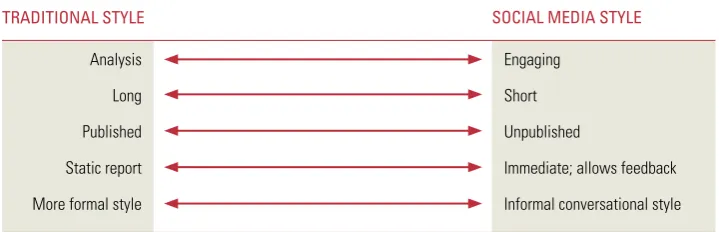
Social media are intended first and foremost to be social, and the ability to foster two-way interactions is the essential feature that separates user-generated media from traditional media sources such as television, radio and print. Moreover, social media have also changed the way in which discussions or messages can be framed to increase their attractiveness. Table 3 gives a brief overview of the ways in which communication through social media platforms differs in style from more traditional modes of sharing information.
Table 3. Traditional versus social media—adapting the style to the medium
TRADITIONAL STYLE
Analysis Engaging
Long Short
Published Unpublished
Staticreport Immediate;allowsfeedback Moreformalstyle Informalconversationalstyle
It is always important that an EMB ‘responds quickly and accurately to all questions and comments received from the public. A delayed response, or no response, gives the EMB a public image of an inefficient organization that is not interested in service to the electorate’ (International IDEA 2006a: 207). In addition, failure to respond to comments or queries may jeopardize the work done by the EMB to gain and retain followers. The use of social media not only requires that two-way interaction between an EMB and its audience takes place; it also requires that it takes place quickly and regularly.
Targeting discussions to the audience
In order to be effective, the EMB should have a good understanding of its target audience and the best ways of engaging it. Understanding the audience will help EMBs define and target their messages and discussions in ways that will best address the needs and expectations of their social media followers. Whether, for example, the audience is looking for entertainment, information or thought-provoking discussion will greatly change not only the content of the platform but also the ways in which discussions are hosted and the platforms used. In this regard, it is also important to understand the culture of a particular platform: the degree of formality or informality in the language of the platform should determine the tone that an EMB uses in its messages. Monitoring social media platforms for some time prior to posting on them can help an EMB better understand the tone of discussions and to identify successful ways of engaging with participants and followers.
If an EMB proposes to use a variety of social media platforms, it will be important to maintain similar topics for discussion while ensuring that the tone of the discussion is appropriate for each platform. For this reason, until an EMB or partner agency understands the target audience and the tone and content of discussions on various social media platforms, it is advisable to begin with one or two platforms widely used within the particular country.
One method of targeting a specific audience is to identify prominent online personalities or groups who are easily identified by the target demographic, and engaging these personalities to advertise—that is, to ‘like’, link to, re-tweet—the institution’s social media discussions. Additionally, traditional media should also be made aware of social media platforms that the EMB is now using and encouraged to participate in gathering and disseminating information about the electoral process as widely as possible.