EFFECTS OF DIFFERENT MILLS AND
SAWDUST’S PARTICLE SIZE
Rizki Maharani1,2,3, Tamai Yutaka1,4, Takashi Yajima1,4 and Terazawa Minoru4
ABSTRACT
Physical properties of sawdust (i.e. particle size distribution, particle density, porosity, and water retention) from ive tropical commercial wood species (Shorea leprosula, Dryobalanops lanceolata, Dipterocarpus cornutus, Shorea laevis, and Eusideroxylon zwageri) as prepared in various mill types (i.e. handsaw, sawmill, and milling) were analyzed. his study aims to look into the relationship and interconnected between the use of diferent mill types, density of wood species origin and physical properties of the resulting sawdust. Generally, diferent mill types produced sawdust with diferent particle size distributions. he use of a handsaw produced a higher proportion of oversized particles (OS) and coarser particle size (CPS) than that of sawmill and milling, while also commonly producing the lowest proportion of ine particle size (FPS). For each wood species, the proportion of OS was lower than that of CPS and FPS. In addition, particle density and water retention produced by handsaw in CPS as well as FPS was the smallest, followed in an increasing order sawmill and milling. Porosity of CPS and FPS was the highest in handsaw-cut sawdust, followed in a decreasing order sawmill and milling cut sawdust. his study showed that the diferent mill types and particle size inluenced the physical properties of sawdust. Further, analysis of inluential factors on porosity and water retention using General Linear Model revealed that particle density inlicted a strong inluence on porosity, as did particle size on water retention.
Keywords: physical properties, sawdust, wood species origin, diferent mills, particle size
I. INTRODUCTION
Sawdust refers to the tiny-sized and powdery wood waste produced by the sawing of wood. he size of sawdust particles depends on the kinds of wood from which the sawdust is obtained and also on the size of the saw teeth (Afuwape, 1983). About 10-13% of the total volume of the wood log is reduced to sawdust in milling operations; this sawdust generally depends largely on the average width
1 Laboratory of Forest Resource Biology, Division of Environmental Resources, Graduate School
Agriculture, Hokkaido University, N-9, W-9, Kita-ku, Sapporo 060-8589, Hokkaido, Japan.
2 Dipterocarps Research Center, Forestry Research and Development Agency, Ministry of Forestry,
Jalan A.W. Syahrani 68 Samarinda 75119, East Kalimantan, Indonesia.
3 Corresponding author. E-mail: [email protected]
of the saw kern and the thickness of the timber sawed (Paulrud et al., 2002). Generally, utilization of the generated tropical commercial wood sawdust becomes an urgent problem since alternative to clean with by just employing the so-called conventional incineration may produce environmentally hazardous pollutants such as polychlorinated dibenzo-dioxins and dibenzo-furans (Terazawa, 2003; Frombo
et al., 2009). In addition, sawdust being essentially a ligno-cellulosic material, is not easily deteriorated but rather stable on recalcitrant in the environment, and rarely produces odor during its long-term biodegradation process (Terazawa et al., 1999; Zavala et al., 2005).
In the ield of compost science, sawdust has been referred to not only as a bulking agent but also as biomass material for the manufacture of woody compost (Horisawa et al., 1999; Zavala et al., 2004). he beneits of using sawdust as a woody biomass in compost manufacture are its favorable physical properties such aslow apparent speciic gravity (density), high porosity, high water retention, moderate water drainage, high bacteria tolerance, and biodegradability at an acceptable rate; in this way sawdust-composting process can then be enhanced (Kitsui and Terazawa, 1999). Physical properties of sawdust can also be modiied by combining the sawdust particles of various sizes in particular proportion (Houghton et al., 2002; Agnew and Leonard, 2003; Dikinya et al., 2006). his modiication creates an ideal environment to remove moisture from sawdust waste eiciently, and also for aerobic bacteria to thrive and decompose waste efectively into carbon dioxide and water without generating odor (Terazawa et al., 1999). Improvement of our knowledge about the physical properties of sawdust signiies the irst step for its rational utilization.
II. MATERIALS AND METHODS
A. Raw Materials
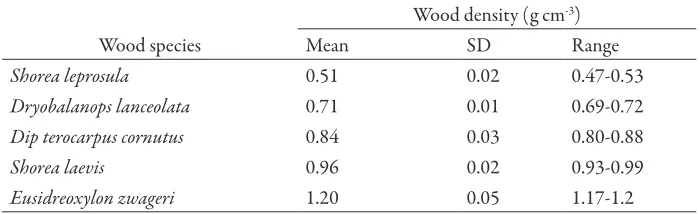
Commercial woods used as raw materials were obtained from ive tropical tree species (i.e. S. leprosula, D. lanceolata, D. cornutus, S. laevis and E. zwageri), and their varying wood densities (without bark at a moisture content of 7-16%) were determined in a dimension measuring 5´5´5 cm (green condition). It was expressed as green mass over green volume (g cm-3) in accordance with Johnson et al. (2003), as presented in Table 1.
Table 1. Variation in the density of ive tropical wood species.
Wood species
Wood density (g cm-3)
Mean SD Range
Shorea leprosula 0.51 0.02 0.47-0.53
Dryobalanops lanceolata 0.71 0.01 0.69-0.72
Dip terocarpus cornutus 0.84 0.03 0.80-0.88
Shorea laevis 0.96 0.02 0.93-0.99
Eusidreoxylon zwageri 1.20 0.05 1.17-1.2
Notes: SD: standard deviation, density: gram weight/green volume, number of sample (replication): 6.
B. Sawdust Preparations
Sawdust was produced by sawing each wood species (Table 1) using three diferent mill types, i.e. handsaw machine (type D126 HITACHI, made in Japan) with circular saw knife thickness of about 3.8 mm, sawmill (type JB 3074-82, made in Taiwan) with circular saw knife thickness of 3 mm, and milling machine (type CE TUV, made in Germany) with thickness of band saw size of 2 mm.
C. Sieve Analysis for the Particle Size Distribution
D. Particle Density
Particle density of the sawdust was determined by the methods employed by Araki and Terazawa (2004) and Rühlmann et al. (2006). It was calculated by adding the sawdust (=100 cm3) into a graduated volumetric cylinder to reach the marked 100 cm3 volume
(Vo), and its weight (g) could then be known by subtracting the combined weight of sawdust and volumetric cylinder (Wb) with the weight of empty volumetric cylinder (Wa) alone. he sawdust - particle density could then be calculated using the formula:
Particle density (g cm-3) = (Wb-Wa)/Vo ... (1)
E. Porosity
Porosity of sawdust can be deined as a measure of void volume of sawdust grains, composed principally of inter-spaces among and intra-spaces within the particles (Agnew and Leonard, 2003; Bouma et al., 2003a), or the percentage of sawdust volume occupied by air and water that illed voids (Baker et al., 1998). he percentage of porosity was determined by Horisawa et al. (1999)’s method. Sawdust with apparent volume of 100 cm3 and known weight (Ws in grams) was at irst placed in a volumetric cylinder. Tap
water was then poured gently into it until the surface of water reached a marked line at the 100 cm3 level. A meshed top as a stopper was equipped at the 100 cm3 level so that
the sawdust, mostly loating on water, would not go beyond its surface. Porosity was expressed as the following formula:
Porosity (%) = (Va/Vo) × 100 ... (2)
where Va and Vo are consentively the volume of poured water (cm3) together with the
water in the sawdust, and the volume of sawdust (=100 cm3) respectively. he volume of
poured water, with the water in the sawdust could be calculated using the formula: Va (cm3) = Wcomb - Ws - Wvs ... (3)
where Wcomb is the combined weight (grams) of volumetric cylinder, sawdust particle, and poured water (gram); Ws is the weight (gram) of sawdust particles (oven-dry weight equivalent), and Wvs is the weight (grams) of volumetric cylinder. Note that the density of tap water was assumed to be a unity (1 gram cm-3).
F. Water Retention
volume of sawdust, and the faucet was closed. A hundred milliliters of water was poured in gently. Ten minutes later, the faucet was opened to drain the water gravimetrically until no more drainage of water was observed. Water retention was expressed as follows:
Water retention (%) = {(Vb+Vc-Vd)/Vo} × 100 ... (4)
where Vb is the volume of poured water (=100 cm3); Vc is the volume of water in 100 cm3
of sawdust (related to the moisture content of the sawdust); Vd is the volume of drained water (cm3); and Vo is the volume of apparent sawdust (=100 cm3).
G. Statistical Analysis
To determine which sawdust characteristics inlicted inluence the most on its porosity and water retentions a generalized linear model (GLM) was performed, taking diferent mill types, particle size classes, wood density that represent wood species, and particle densities as explanatory variables elaboration sawdust characteristics. he porosity and water retention of the sawdust were regarded as dependent variables for each wood species. he replication was done six times. Analysis for the GLM test was conducted using JMP 7.0.1 (SAS Institute Inc, 2007).
III. RESULTS AND DISCUSSION
A. Particle Size Distribution
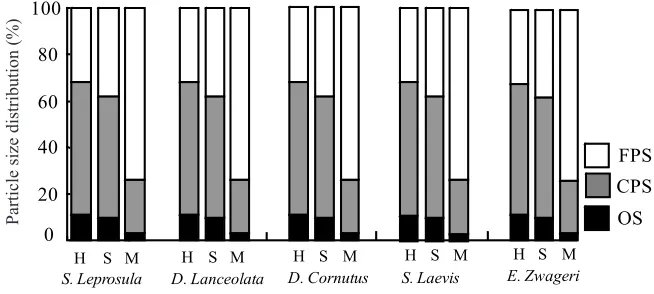
study, the handsaw with the thickest knife (3.8 mm) followed in a decreasing order by sawmill (3 mm) and by milling (2 mm) produced proportion of CPS higher than that of sawmill and milling. hus it is logical that particle size distribution of sawdust samples (OS, CPS, and FPS) which are processed by a diferent mills and knife sizes appears to be more consistent with input to the proportion of OS, CPS, and FPS among diferent wood species with their varying density (Figure 1 and Table 1).
Wood species of origin
S. Leprosula D. Lanceolata D. Cornutus S. Laevis E. Zwageri
S
H M H S M H S M H S M
FPS
CPS
OS
Figure 1. Particle size distribution (OS, CPS, and FPS) of sawdust samples produced from ive tropical wood species using diferent mill types: i.e. handsaw (H), sawmill (S), and milling (M).
B. Particle Density
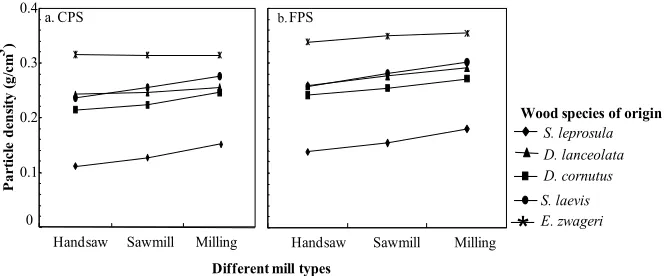
A comparison result of particle density among diferent mills showed a similar pattern for each wood species with the particle density produced by handsaw was the smallest both in CPS and in FPS, followed in an increasing order by sawmill and by milling (Figures 2a,b). Combining the value of particle density for all sawdust from ive diferent wood species in each diferent mill showed that the average ± SD of the particle density produced by handsaw (CPS = 0.22 + 0.02 g cm-3; FPS = 0.25 + 0.07 g
cm-3) was smaller than that by sawmill (CPS = 0.23 + 0.07 g cm-3; FPS = 0.25 + 0.06 g
cm-3) and by milling (CPS = 0.25 + 0.06 g cm-3; FPS = 0.32 + 0.11 g cm-3) (Figure 2).
his pattern is probably due to variation in knife size accounted on each mill. Milling with the smallest size of knife produced a iner particle size sawdust than sawmill and handsaw both with greater knife size. his study also demonstrated the strong efect of wood density and particle size classes on particle density of sawdust. It can be seen in Figure 2, that both CPS and FPS for all diferent mill types showed that S. leprosula, with the lowest wood density (0.51 + 0.02 g cm-3) that produce sawdust with the
smallest particle density, while E. zwageri, with the highest wood density (1.20 + 0.05
g cm-3) aforded the highest particle density of its corresponding sawdust (Table 1, Figure
2). he patterns of wood density diferences corresponded well to those of particle density. High wood density tended to produce sawdust with higher particle density, this occurred to CPS as well as FPS (Figures 2a, b). his pattern could be explained by hypothesizing that high wood density will inluence the average sawdust weight. In another case, but still related with a relatively larger particle size of CPS, tended to have a relatively lower particle density than that of FPS (Figures 2a, b). his is because the large-size particles (CPS) are less likely to pack together, and therefore provide air space more readily, thereby lowering their particle density and vice versa for the smaller-size particle (FPS). his situation applied to all sawdust from the ive diferent wood species. A previous study by Coudray et al. (2009) supported this result during measurement of ine aerosol fraction from wood, where the particle densities decreased consistently with the increase in particle size. Although it has been generally accepted that wood density inluences particle density, this study shows that diferent mill and particle size classes also inluence particle density for each tree species.
*
Figure 2. Particle density (g cm-3) of sawdust samples from ive tropical wood species using
diferent mill types and elaborated by particle size classes: CPS (a), and FPS (b). he density of wood species origin refers to Table 1.
C. Porosity
is that the sizes of knife for handsaw, sawmill, and mills are in decreasing order, i.e. 3.8 mm, 3.0 mm, and 2.0 mm, respectively. As described before the larger knife size, then the larger particle size, thereby inlicting the greater porosity in the corresponding sawdust particle, and vice versa for the smaller knife size. his situation occurred to CPS as well as FPS (Figures 3a, b). In addition, a comparison between wood species for all diferent mills in porosity showed that S. leprosula with the lowest wood density and sawdust’s particle density, was the highest in porosity, while E. zwageri, with the highest wood and sawdust’s particle density was the lowest in porosity (Table1, Figure 3). Since particle density is inluenced by wood density (Table 1, Figure 2), an increase of wood density in tropical wood species has been associated with either an increase of sawdust’s particle density or a decreased volume of sawdust’s pores. In addition, the pore presence in wood species origin with greater density is usually less abundant than that with lower density, and vice versa. hus it is logical that sawdust with high wood density tends to have low porosity. Further, the porosity of CPS’s sawdust for each species was greater than that of FPS’s sawdust (Figures 3a, b). It can then be understood that, as described earlier, the CPS tends to have more air space (inter space among particles than FPS’s sawdust).
50
Figure 3. Porosity (%) of sawdust samples from ive tropical wood using diferent mill types and speciied by particle size classes: CPS (a), and FPS (b).
D. Water Retention
the fact the particle density size of sawdust produced by handsaw was greater than that by consecutively sawmill and milling. Further, interestingly, the value of water retention in CPS was signiicantly lower than that of FPS for all wood species in each mill type (Figure 4). he scatter panel of water retention on which CPS and FPS are plotted shows the distribution of water retention values for all diferent mill types and wood species in CPS was smaller than that in FPS. his igure again indicated that the diferences in particle size between CPS and FPS have a strong inluence on water retention. his study has demonstrated that smaller particle size in FPS than that of CPS leads to increased high values of water retention in FPS. his may be due to the fact the decrease in particle size of sawdust (i.e. FPS) brought out the increase in their surface area, thereby enhancing the adhesion between particles and water mass and hence augmenting water retention. he situation would be on the contrary for the larger-particle sawdust (CPS). Figures 4a and 4b show the degree of inluence regarding the diferent particle size classes (CPS and FPS) on water retention. A previous study on the inluence of particle size in soil and compost reported that particle size has strong inluence on water retention; smaller particle size tends to keep higher water attraction than larger particle size (Hwang et al., 2002; Agnew and Leonard, 2003; Dikinya et al., 2006).
E. Inluential Factors on Porosity and Water Retention
In porosity, particle density had a strong inluence (F-test = 13.21, P-value = 0.0013) while the mill type, particle size classes and wood density had a lower degree of signiicance on variation in porosity (Table 2). It is assumed that this pattern caused by particle density may be ascribed to the inter-space among and intra-space within particles (e.g. wood pores and wood species). Sawdust with low porosity may be due to high particle density or conversely it can be assumed that sawdust with low particle density will be high in porosity.
Table 2. Summary of generalized linear model (GLM) analysis for potential inluential factors afecting porosity and water retention of sawdust.
Explanatory Variables
Dependent variables
Porosity Water retention
F-test P-value F-test P-value Mill types 2.86 0.077 1.45 0.255 Particle size 3.37 0.077 117.58 0.000** Wood density 3.68 0.067 4.11 0.054 Particle density 13.21 0.001** 1.82 0.189
Onto water retention, only particle size classes showed signiicant inluence (F-test = 117.58, P-value < 0.001), while wood density was marginal (F-test = 4.11, P-value = 0.05) and the inluence of diferent mill types and particle density was negligible (Table 2).
IV. CONCLUSION
ACKNOWLEDGEMENT
he authors would like to deeply appreciate the Tropical Forest Research Center of Mulawarman University, C.V. Perjuangan Sawmill Industry and Sumalindo Lestari Timber Company for providing the research material. Further appreciation is extended to the Laboratory of Wood Chemistry of Mulawarman University, Dipterocarp Research Center of Kalimantan, and Laboratory of Forest Product, Forest Product Research Institute of Asahikawa, Hokkaido, Japan which have provided valuable supports during the laboratory work. Also, special gratitude goes to Ii Sumirat, Uus Suhendar and Syahrir for their assistance during data collection. Financial support from the Japan Society for the Promotion of Science ( JSPS#19255016) is gratefully acknowledged. Part of this study was presented at the International Seminar on Sustainable Biomass Production and Utilization: Challenges and Opportunities, 3-4 August 2009, Lampung, Indonesia. he authors also appreciate Iswandi Anas, Yaya Rayadin and Eleanor Clark for critical scrutiny on the earlier drat of this manuscript.
REFERENCES
Afuwape, F.K. 1983. Design and testing of a sawdust compactor. B.Sc. hesis, Department of Agricultural Engineering. Obafemi Awolowo University, Lie-Ife. Nigeria. Agnew, J.M. and J.J. Leonard. 2003. he physical properties of compost (Literature
Review). Compost Science and Utilization 11: 238-264.
Araki, Y. and M. Terazawa. 2004. Physical properties of sawdust and soil (in Japanese). In: Proceedings of the Hokkaido Branch of Japan Wood Research Society 36, 67-70.
Baker, S.M., T.L. Richard, Z. Zhang and S. Monteiro da Rocha. 1998. Determining the free air space inside compost mixtures using a gas pycnometer. American Society Agricultural Engineering (paper no 984094).
Bergström, D., S. Israelsson, M. Öhman, S.A Dahlquist, R. Gref, C. Boman and Wästerlund. 2008. Effects of raw material particle size distribution on the characteristics of Scots pine sawdust fuel pellets (Article in press). Fuel Processing Technology 6.
Bouma, J., P.S.C. Rao and R.B. Brown. 2003a. Soil as a porous medium: Basics of soil-water relationships-Part I. Reviewed: September 2003 (adopted in July 17, 2005), University of Florida, IFAS extension, USA. <http://www.edis.ifas.ul. edu/SS108>.
Coudray, N., A. Dieterlen, E. Roth and G. Trouve. 2009. Density measurement of ine aerosol fractions from wood combustion sources using ELPI distributions and image processing techniques. Fuel Processing Technology 88: 947-954.
Dikinya, O., C. Hinz and G. Aylmore. 2006. Dispersion and re-deposition of ine particles and their efects on saturated hydraulic conductivity. Australian Journal of Soil Research 44: 47-56.
Frombo, F., R. Minciardi, M. Robba, F. Rosso and Sacile. 2009. Planning woody biomass logistics for energy production: A strategic decision model. Biomass and Bioenergy 33: 372-83.
Himmel, M., M. Tucker, J. Baker, K. Rivard, and K. Grohmann. 1985. Communition of biomass: hammer and knife mills. In: Proceedings of Biotechnology and Bioengineering Symposium 15.
Horisawa, S., M. Sunagawa, Y. Tamai, Y. Matsuoka, T. Miura and M. Terazawa. 1999. Biodegradation of nonlignocellulosic substances II: Physical and chemical properties of sawdust before and ater use as artiicial soil. Journal of Wood Science 45: 492-497.
Houghton, J.I., J.E. Burgess and T. Stephenson. 2002. Of-line particle size analysis of digested sludge. Water Resources 36: 4643-4647.
Hwang, S.I., K.P. Lee, D.S. Lee and S.E. Powers. 2002. Models for estimating soil particle-size distributions. Soil Science Society of America Journal 66: 1143-1150. Johnson, G.R., B.L. Gartner, D. Maguire and A. Kanaskie. 2003. Inluence of bravo
fungicide application on wood density and moisture content of Swiss needle cast afected Douglas-ir trees. Forest ecology and Management 186: 339-348. Kitsui, T. and M. Terazawa. 1999. Bio-toilet environmentally-friendly toilets for the 21
century (dry closet using sawdust as an artiicial soil matrix). In: Proceedings of international symposium of bio-recycling/composting. 6-8 September, Sapporo, Japan.
MFoR (he Ministry of Forestry Republic of Indonesia). 2007. Forestry statistics of Indonesia year 2006. Jakarta, Indonesia. <http://www.dephut.go.id/ INFORMASI/STATISTIK/2006/.
Paulrud, S., J.E. Mattsson and C. Nillson. 2002. Particle and handling characteristics of wood fuel powder: efects of diferent mills. Fuel Processing Technology 76: 23-39. Rühlmann, J., M. Körschens and J. Graefe. 2006. A new approach to calculate the
particle density of soils considering properties of the soil organic matter and the mineral matrix. Geoderma 130: 272-283.
Terazawa, M., S. Horisawa, Y. Tamai and K. Yamashita. 1999. Biodegradation of lignocellulosic substance I: System for complete degradation of garbage using sawdust and aerobic soil bacteria. Journal of Wood Science 45: 354-358.
Terazawa, M. 2003. Sawdust Saves Globe - Bioconversion of biomass wastes into multifunctional recyclates using sawdust as an artiicial soil matrix. In: Proceedings of the 1st International Symposium on Sustainable Sanitation, Nanjing, China
(1): 9-12.