i
DEVELOPING COMIC STRIP-BASED LEARNING
MATERIALS FOR GRADE X STUDENTS OF TRAVEL
AGENT DEPARTMENT OF SMK N 6 YOGYAKARTA
A THESIS
Presented as Partial Fulfillment of the Requirements for the Attainment of Sarjana Pendidikan Degree in English Language Education
by:
Sahnaz Natasya Fath 10202241009
ENGLISH EDUCATION DEPARTMENT
FACULTY OF LANGUAGES AND ARTS
STATE UNIVERSITY OF YOGYAKARTA
v
MOTTOS
“man jadda wa jadda”(Arabic Proverb)
“So verily, with every difficulty, there is relief.” ( QS. Al-Inshirah [94] :5)
“Strive not to be a success, but rather to be of value.” (Albert Einstein)
“Go confidently in the direction of your dreams. Live the life you have
vi
DEDICATIONS
I dedicate this thesis with my greatest adoration to:
☻ My mother, Eni Susilowati, who always gives me a comfortable place to lean
on
☻ My father, Luqman Akhmadi, who always steels me in my difficult time
☻ My step mother, Sri Sumarni, who always prays for my success
☻ My beloved sister, An Nisa Jati Winayu, and my beloved nephew, Addis
Avila Javier Irvandy, who always share everything to me
☻ My fiancé, Muhammad Imroh Helmi Sasongko, who always supports me
☻ My best friend, Putri Manggala Wuri, who always shares the happiness and
sorrows
☻ And all of my beloved friends. I‟m sorry not to be able to mention you all
here.
viii
LIST OF APPENDICES
Appendix A. Needs Analysis Questionnaire Appendix B. Needs Analysis Data
Appendix C. The Interview Transcript Appendix D. Course Grid
Appendix E. The Description of Developed Materials Appendix F. First Draft of the Materials
Appendix G. Expert Judgment Questionnaires Appendix H. Expert Judgment Data
ix
LIST OF TABLES
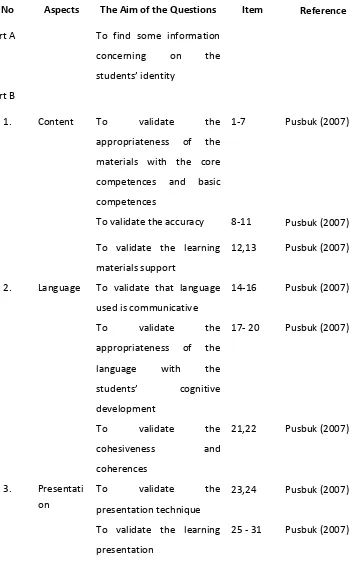
Table 1 : The Organization of Needs Analysis Questionnaire ... 53
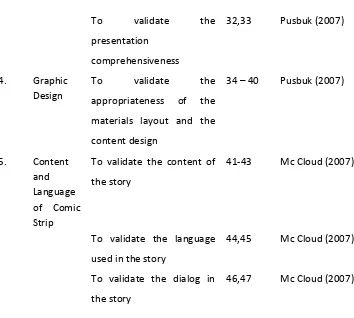
Table 2 : The organization of Expert Judgment Questionnaire ... 55
Table 3 : The organization of Expert Judgment Questionnaire (Comic Strip Illustra tion) ... 56
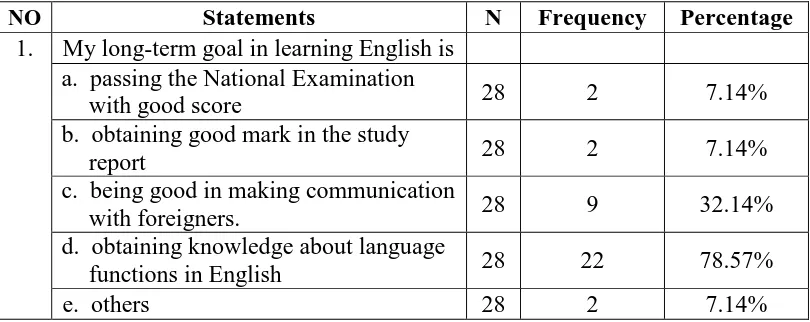
Table 4 : The Target Needs long-term goal ... 60
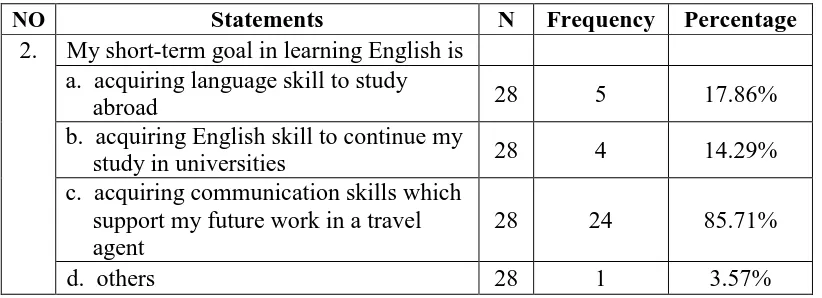
Table 5 : The Target Needs (short-term goal) ... 61
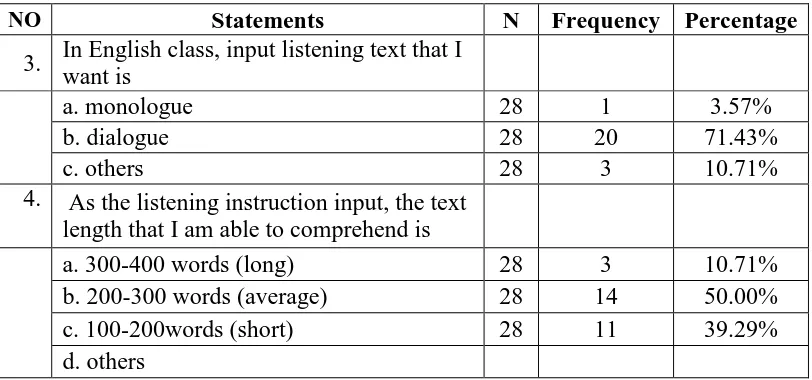
Table 6 : The Learning Needs (Input for Listening) ... 62
Table 7 : The Learning Needs (Input for Speaking) ... 63
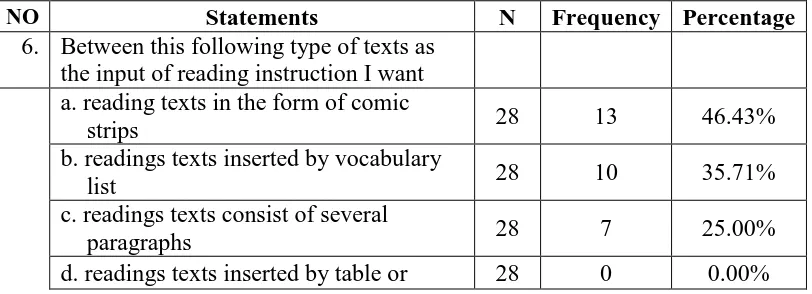
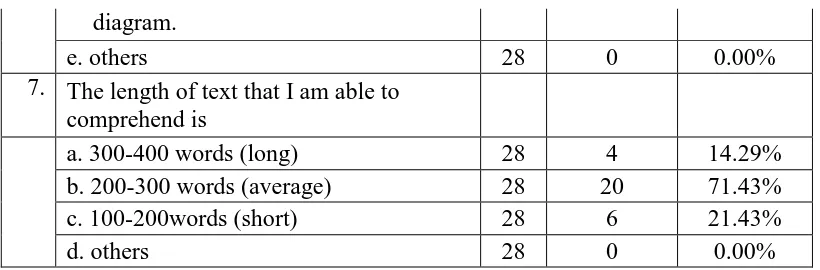
Table 8 : The Learning Needs (Input for Reading ) ... 63
Table 9 : The Learning Needs (Input for Writing) ... 64
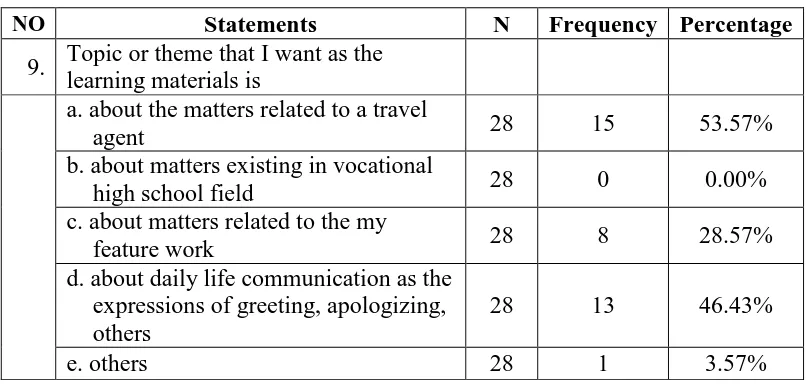
Table 10 : The Learning Needs (Theme of the Input) ... 65
Table 11 : The Learning Needs (Listening Activities) ... 66
Table 12 : The Learning Needs (Speaking Activities) ... 67
Table 13 : The Learning Needs (Reading Activities) ... 67
Table 14 : The Learning Needs (Writing Activities) ... 68
Table 15 : The Learning Needs (Vocabulary Activities) ... 69
Table 16 : The Learning Needs (Grammar Activities) ... 70
Table 17 : The Learning Needs (Pronunciation Activities) ... 70
Table 18 : The Learning Needs (Learning Mode) ... 71
Table 19 : The Learning Needs (Learning Mode) ... 72
Table 20 : The Learning Needs (Student‟s and Teacher‟s Role) ... 72
Table 21 : Comic Strip (Type of Story) ... 73
Table 22 : Comic Strip (Character) ... 74
Table 23 : Comic Strip (Font, Color, the Form of Panel) ... 74
Table 24 : The Appropriateness of the Content of Unit 1 ... 83
Table 25 : The Appropriateness of the Language use of Unit 1 ... 84
Table 26 : The Appropriateness of the Presentation of Unit 1 ... 85
Table 27 : The Appropriateness of the Layout of Unit 1 ... 86
x
Table 29 : The Appropriateness of the Content of Unit 2 ... 89
Table 30 : The Appropriateness of the Language use of Unit 2 ... 90
Table 31 : The Appropriateness of the Presentation of Unit 2 ... 90
Table 32 : The Appropriateness of the Layout of Unit 2 ... 91
Table 33 : The Appropriateness of the Content and Language in Comic Strip in Unit 2 ... 92
Table 34 : The Appropriateness of the Content of Unit 3 ... 94
Table 35 : The Appropriateness of the Language use of Unit 3 ... 95
Table 36 : The Appropriateness of the Presentation of Unit 3 ... 96
Table 37 : The Appropriateness of the Layout of Unit 3 ... 97
Table 38 : The Appropriateness of the Content and Language in Comic Strip in Unit 3 ... 97
Table 39 : The Appropriateness of the Panel ... 100
Table 40 : The Appropriateness of the Characterization ... 100
Table 41 : The Appropriateness of the Landscape and Properties ... 101
Table 42 : The Appropriateness of the Caption and Speech Balloon ... 101
Table 43 : The Revisions of Comic Strip Presentation Technique in the First Judgment ... 103
Table 44 : The Appropriateness of the Panel ... 104
Table 45 : The Appropriateness of the Characterization ... 104
Table 46 : The Appropriateness of the Landscape and Properties ... 105
xi
LIST OF FIGURES
List of Pictures
Picture 1 : Factor Affecting a Course ... 13 Picture 2 : Framework of Task-Based Language Teaching ... 29 Picture 3 : An Example of Comic Strip in Language Classrrom ... 47
List of Diagrams
xii
TABLE OF CONTENTS
TITLE PAGE ... i
APPROVAL SHEET ... ii
RATIFICATION SHEET ...iii
PERNYATAAN ... iv
MOTTO ... v
DEDICATION ... vi
ACKNOWLEDGEMENTS ... vii
LIST OF APPENDICES ...viii
LIST OF TABLES ... ix
LIST OF FIGURES ... xi
TABLE OF CONTENTS ... xii
ABSTRACT ... xv
CHAPTER I. INTRODUCTION ... 1
A. Background to the Study ... 1
B. Problem Identification ... 3
C. Limitation of the problems ... 5
D. Formulation of the problems ... 5
E. Objectives of the Research ... 6
F. Significances of the Research ... 6
CHAPTER II. LITERATURE REVIEW AND CONCEPTUAL FRAMEWORK 11 A. Literature Review ... 7
1. English for Vocational High School ... 7
2. ESP (English for Specific Purpose) ... 11
a. Definition of ESP ... 11
b. ESP Course Design ... 13
1) Language Description ... 14
2) Theories of Learning ... 16
3) Need Analysis ... 19
xiii
3. Content-Based Instruction ... 24
4. Task-Based Language Teaching ... 25
a. Definition of Tasks ... 25
b. Definition of Task-based Language Teaching ... 27
c. Principles of Task-Based Language Teaching ... 27
d. A framework of Task-Based Language Teaching ... 29
e. Task-based Syllabus Design ... 30
f. Task Components ... 32
5. Task Design Development ... 33
a. Designing Task ... 33
b. Grading Tasks and Task Continuity ... 34
6. Learning Materials ... 35
a. Definition of Learning Materials ... 35
b. The Role of Learning Materials ... 36
c. Criteria of Effective Learning Materials ... 36
7. Developing Materials ... 38
a. Materials Development ... 38
b. Materials Evaluation ... 40
8. Comic Strip for Language Teaching ... 42
a. Definition of comic ... 43
b. Comic Strip in Language Classroom ... 44
c. Criteria of a Good Comic Strip ... 48
B. Conceptual Framework ... 49
CHAPTER III. RESEARCH METHOD ... 51
A. Type of Research ... 51
B. Product of the Study ... 51
C. Setting of the Study ... 51
D. Data Collection ... 52
F. Data Analysis Technique ... 57
xiv
CHAPTER IV. RESEARCH FINDINGS AND DISCUSSIONS ... 60
A. The Description of Research Findings ... 60
1. The Result of Needs Analysis ... 60
2. Course Grid ... 75
3. The Developed Units ... 80
4. The Results of Expert Judgment ... 82
B. Discussions ... 109
CHAPTER V. CONCLUSIONS AND SUGGESTIONS ... 116
A. Conclusion ... 116
1. Target Needs ... 116
2. Learning Needs ... 117
3. Characteristics of the Learning Materials for the Student of Travel Agent 118 B. Suggestions ... 120
1. To other material developers ... 120
2. To English teachers of Vocational High Schools ... 121
xv
DEVELOPING COMIC STRIP-BASED LEARNING MATERIALS FOR
GRADE X STUDENTS OF TRAVEL AGENT DEPARTMENTOF
SMK N 6 YOGYAKARTA by:
Sahnaz Natasya Fath 10202241009
ABSTRACT
The aims of this research were to find out the target needs and the learning needs of Grade X students of Travel Agent Department of SMK N 6 Yogyakarta and to develop appropriate learning materials for them.
This is a Research and Development (R&D) study. The subjects of the research were Grade X students of Travel Agent Department of SMK N 6 Yogyakarta. This research was conducted by following Borg and Gall (1983) model with some modification consisting of collecting information, analyzing needs, planning, developing materials, evaluating by experts, and revising final draft. An interview guide and three types of questionnaires were used namely a needs analysis questionnaire, a materials evaluation questionnaire and a comic strip illustration questionnaire were used. The data were analyzed using descriptive statistics.
Based on the research findings, the target needs are acquiring
communication skills which support the students‟ future carrier in a travel agent
and obtaining knowledge about language functions in English. Three units were developed in this research. Each unit consists of introduction, main lesson and reinforcement tasks ranging from 26 to 28 tasks. The input are texts in the form of comic strips, vocabulary list and grammar explanation which are suitable for the learners‟ background knowledge. The students are encouraged to participate actively by answering comprehension questions, having dialogues, practicing dialogues, completing incomplete texts, and writing short texts. Most of the tasks
are done in pairs. The materials developed are categorized as “Very Good”. It is
proven by the mean value of all aspects of the materials which was 3.90.
1
CHAPTER I
INTRODUCTION
A. Background of the Study
Learning materials in English instruction have a crucial role to support the teaching and learning process. It is because any information about the language learnt is provided. The information given in learning materials will be a passage for the students to acquire the language. It helps the students find authentic language used by native of English. Besides, learning materials will assist the students to develop the language. The development can be shown from the process of associating new information which the students obtained from the materials with the previous information or knowledge acquired before. From these facts, it can be confirmed that learning materials are the important elements in English instruction.
In addition, in an instruction the availability of the materials should be supported by the quality of materials in order to maximize the role of materials in the instruction. It means that the available materials should be able to meet the
students‟ needs and should be interesting for the students. It will make the
information that the students get from the materials useful for them and it will help the students to acquire the language. In return, the purpose of learning can be obtained efficiently.
2
specifically designed for the Travel Agent Department whereas the students of this department are expected to learn about how to manage a travel agent. This expectation, then, demands the students to be able to communicate with the foreigners because they should not only provide a tourism trip for domestic people but also for foreigners. Therefore, to achieve this goal, there should be materials developed for the students.
However, as stated before there are no specific learning materials designed or developed to support the teaching and learning process in the Travel Agent Department. The materials used in the instruction were developed by the English teachers of the school for all departments in the school. In other words, the materials are not specifically designed for each department. It shows that the
materials cannot meet the students‟ needs. In addition, the materials developed do
not yet adopt Curriculum 2013 in which the curriculum must be applied in every school. Moreover, based on the observation the students say that the materials are less interesting in terms of visualization.
3
said so since comic contains pictures and texts in the form of a reading text. In reading comic the learners will use not only one sensory experience which is seeing the picture but also reading the text. This support of visual literacy skills will assist the learner to develop strategies in acquiring words, improving phonics skills and building the vocabulary construction.
Moreover, Krashen in McKiver (2007) also states that comic also has a purpose of motivating young readers to become recreational readers, which will support them to develop their vocabulary knowledge, to connect their imaginations, and to inspire reading habit. The motivation will emerge since it will bridge the learners‟ literacy interests with more conventional text structures. In addition, Csabay (2006) states that comic provides story line which is easy to understand. It assists the students to portrait the context of the story. It also provides authentic language and culture. From the advantages mentioned above it is expected that there will be proper learning materials for vocational high school students in learning English which can assist the students to achieve the instructional objectives.
B. Identification of the Problem
4
of learning materials provided should be able to cover the amount of the students so that the learning materials can be used by all students properly.
The criteria mentioned before should be met the English instruction in SMK N 6 Yogyakarta that there are six departments. The six departments are Hotel and Restaurant, Patisserie, Restaurant, Skin Beauty, Hair Beauty, and Travel Agent Departments. In return, there should be six specific learning materials to support English instructional. In addition, the specific learning materials should be able to cover the amount of students at any level of the departments.
However, based on the observation conducted by the researcher, there are several problems related to the learning materials found in SMK 6 Yogyakarta. For grade X of all departments, learning materials used are the same. There are no specific materials used to each department. The content of the materials cannot cover the needs of the students in all departments. For example, a discussion on the work safety merely discusses the worker safety in a workshop whereas several students are not prepared to work in a workshop. It shows that the learning materials used do not fulfill the students' needs.
5
not addressed to the students in class. There are no various learning activities provided there.
C. Limitation of the Study
Based on the identified problems above, the materials which are going to be developed by the researcher are learning materials for the Travel Agent Department. It is because being fluent in communicating using English in this department is very demanding since the students in this department are expected to learn how to manage a travel agent. Certainly, the students in the real world will face not only domestic tourists but also foreigner tourists. The grade X has chosen because it is considered as the basic level of the department. It is expected that the basic knowledge of language can be acquired properly and developed well in the next level. Therefore, grade X of Travel Agent department is chosen as the object of the materials development.
D. Formulation of the Problems
The problems are formulated into:
1. What are the target needs and the learning needs of grade X students of the Travel Agent Department in SMK N 6 Yogyakarta?
2. What are the appropriate materials for grade X students of the Travel Agent Department in SMK N 6 Yogyakarta?
E. Objectives of the study
Based on the problem formulation above, the objectives of this study are : 1. To describe the target needs and the learning needs of grade X students of the
6
2. To develop appropriate materials for grade X students of the Travel Agent Departmentin SMK N 6 Yogyakarta
F. Significance of the study
The result of this study is expected to give some advantages for the students, teachers, and other researchers.
1. For the students
This result of this study may be useful for the students to assist them in acquiring English. Besides, it can be an encouragement for the students in learning English independently and conveniently.
2. For the teachers
This result of this study may be useful for the teachers as the inspiration or consideration to develop the material based on the needs of their students.
3. For other researchers
7
CHAPTER II
LITERATURE REVIEW AND CONCEPTUAL FRAMEWORK
A. Literature Review
1. English for Vocational High School
The learning materials developed are based on Curriculum 2013 that
officially has been implemented since this year. As stated in Ministry of Education and Culture document, Curriculum 2013 is called as outcomes-based curriculum because its design is outcomes-based on several competencies. It means that the curriculum development is directed toward the competency achievement formulated in SKL (Standar Kompetensi Lulusan). It also means that the assessment of study result and curriculum result is measured from the competencies achievement. Therefore, the success of the curriculum is determined by the students‟ competencies achievement formulated in the curriculum document. Meanwhile, the competencies that should be achieved by the students are formulated as follows.
a. The competencies as content curriculum are stated as core competence which will be elaborated in basic competence.
8
c. Basic competence is a competency which should be learnt by the students for a theme for elementary school, and for lessons in class for junior, senior, and vocational high schools.
d. Core competence and basic competence are focused on the attitude and intellectual.
e. Core competence has a role as organizing elements of basic competence. It means that all basic competence and learning process is developed to achieve the competencies in core competence.
f. Basic competence developed is based on the accumulative principle, reinforced, enriched among lessons in an education level.
g. A syllabus is developed as the instructional plan for a theme in elementary school and a lesson of high schools.
h. A lesson plan is developed from each basic competence directed for particular classes and lesson.
9
Basically the stages of the observing process, asking process, administering problems, reasoning problem, serving an idea, summarizing, and creating an idea are adapted from the scientific approach which basically is used to conduct a research. However, in this case, the curriculum developer tried to associate the approach into an instructional so that it will be suitable for conducting learning activities. The association of the approach into an instruction could be seen by the activities undergone in every stage.
10
The scientific approach is used due to a consideration that this approach is able to fulfill the instructional principles formulated in Curriculum 2013 which are:
a. learning –centered
b. developing learners‟ creativity
c. creating a condition which is enjoyable, challenging, interactive, inspiring, motivating the learners to be active
d. containing value, ethic, aesthetic, logic, and kinesthetic e. providing various learning experience
f. and giving the learners a space to develop their independency based on their potential and intention.
Besides, in the instructional principle, it is also said that the students' comprehension of an issue should be given through multidisciplinary way which means that there should be an interrelation among the lessons.
11
provided in learning materials, it is expected that the instruction will be meaningful for the students of Travel Agent Department.
Considering the fact above, it is shown that the English instruction of vocational high school is also a form of English for Specific Purposes (ESP) course. It is shown from a specific knowledge which is highlighted in the English instruction. Besides, this course is also addressed to specific learners which have an interest in a skill. Therefore, to make clearer the relation of English instructional in vocational high school and ESP course the researcher here is going to describe all matters related to ESP.
2. ESP (English for Specific Purpose)
a. Definition of ESP
Related to the definition of English for Specific Purpose (ESP) there are several definitions proposed by some experts. First, Hutchison (1987) states that ESP is a kind of an approach to language teaching in which the method and the
materials taught are based on the learners‟ rationale for learning. The learning
materials should be in the specific situation which will be a basis of the course. It is similar to a definition of ESP proposed by Swalles (1992) as cited in Knight, K.et al. (2010) which said that ESP is
“…the area of inquiry and practice in the development of language programs for people who need a language to meet a predictable range of
communicative needs.”
12
using appropriate, authentic, specify, and relevance task and materials. Besides, Butler and Pascoe (2009) define ESP in terms of two basic goals for the learners. The goals are the acquisition of content knowledge of a particular field and the development of English skills required to perform in the field
In a different way, Dudley in Anthony (2007) defines ESP with two kinds of different characteristics. The first characteristic is absolute characteristics. In this characteristic ESP is defined as:
“1. ESP is defined to meet specific needs of the learners
2. ESP makes use of underlying methodology and activities of the discipline it serves
3. ESP is centered on the language appropriate to these activities in terms
of grammar, lexis, register, study skills, discourse and genre.”
Meanwhile, the second characteristic is variable characteristic. Here ESP is defined as:
“1. ESP may be related to or designed for specific disciplines
2. ESP may use, in specific teaching situations, a different methodology from that of General English
3. ESP is likely to be designed for adult learners, either at a tertiary level institution or in a professional work situation. It could, however, be for learners at secondary school level
4. ESP is generally designed for intermediate or advanced students. 5. Most ESP courses assume some basic knowledge of the language
systems”
13
If it is looked from the definitions above it also suits with the statement mentioned before that English in vocational high school is included in ESP course. It is because English for vocational high school also required a specific English to be taught. Besides, the English lesson is also designed for a group of students who have interest in a field. Therefore, the course ideally should be
designed based on the learners‟ needs including their interest or in other word it
can be said that the English course in vocational high school must adopt ESP course design. ESP course design basically is similar to general English course design, only then there are several matters which are different. So, what are the differences? The answer of the question will be explained below.
b. ESP Course Design
In designing an ESP course, there are several matters that should be taken into account. According to Hutchison and Waters (1987) those matters are language description, learning needs, and learning theory. Hutchison and Waters (1987) represent the relationship among the matters in a diagram below.
14
From the diagram above, it can be shown that what should be taught or the subject is represented as language description which is presented in a syllabus. Meanwhile, the way that should be used to teach in the course is presented as learning theory producing method. Then, the needs of learners are presented as needs analysis which contains several questions about who the learners are, why the learners take the course and where and when the learners should take the course. To make it clearer, here there is a detailed explanation about each factor. 5) Language Description
In designing a course, a syllabus could not be neglected. It is because all what should be learnt by the learners is presented in a syllabus. In fact, in designing a syllabus, it is important to know what should be learnt by learners in a course. In this case, language is a matter that should be learnt by learners. Therefore, it is important to know about language description.
Hutchison and Waters (1987) stated that language description is the way to analyze and explain the language system for the purpose of learning. There are six language descriptions which are classical, structural, and transformational generative grammar, language variety and register analysis, functional notional grammar, and discourse analysis. The classical description concerns on the grammatical of classical language.
15
is repaired in the next stage of language description, transformational generative grammar, which concern not only on the form of the language but also on the meaning intended by the producer. However, the identification of a meaning in an utterance could not be undergone without identifying the context. To complete it, the register description appears. This description explains that contextually dependent factors make the communication act. Therefore, language becomes variety according to the context used.
On the other hand, the description of the language cannot be fully completed since there is no identification of the language producer. At this time functional description and notional description appear. Functional description concerns on social behavior and represents intention of the speaker. Notional
means the way the human mind thinks. Therefore, the learners‟ way of thinking
16
For the example, an utterance could acquire meaning from the preceding utterance which called dicoursal meaning.
From the explanation above, it shows that those six descriptions are actually different. However, there is no incorrect description because those six descriptions are a form of completing one description and the others. In other word, those six descriptions are basically developed based on the previous description that exists. From each development it can be seen that there is a mistake and the restoration. Added to this, through seeing the development and restoration it can be used as a consideration to design a proper syllabus for a course. However, despite language description one which is also crucial in designing syllabus is that the way of learner learnt a language which could be identified in theories of learning.
6) Theories of Learning
According to Hutchison (1987) there are two main theories of learning which have important roles in language learning. The first is behaviourism theory. This method believes that language learners are taught by forming a habit of drilling system. The learners are required to repeat and replace cycle. However, Chomsky in Harmer (2001:69) has an objection to this theory. Chomsky argues that people was born with their language acquisition device. It means that people basically have a device in their brain to process the language not only just repeating. It is based on the fact that people use the language creatively.
17
active processor of information (Hutchison, 1987). This view describes that learning is a process of adding the data done by the learner or a situation when the learner has managed to interpret the data meaningfully. Therefore, cognitive theory somehow has answered some problems in behaviourism. However, the cognitive theory is not enough to explain how the learners learn language since the learners are human being who have another factor influencing their learning which is affective factor. Therefore, constructivism theory appears to respond this problem. Piaget and Vygotsky in Brown (2000:11) describe this theory as a theory which emphasizes on a social context. This theory is examined from several perspectives which are conversational discourse, sociocultural factors in learning, and interactionist theory. It becomes the beginning of the interpersonal relationship view in class and the use of several strategies to achieve the goal. It also becomes the beginning of linguist interest toward the nature of communication and communication competence which becomes the basis of Communicative Language Teaching theory.
Richards (2006) states that in Communicative Language Teaching the
learners should know “what to say” and “how to say” the language properly based
on the situation, the participants, and their roles and intentions. The communicative language should become the goal of learning. In this theory the learning process is presented in several activities which are:
“1. Interaction between the learner and users of the language 2. Collaborative creation of meaning
3. Creating meaningful and purposeful interaction through language 4. Negotiation of meaning as the learner and his or her interlocutor
18
5. Learning through attending to the feedback learners get when they use language
6. Paying attention to the language one hears and trying to
incorporate new forms into one‟s developing communicative
competence
7. Trying out and experimenting with different ways of saying
things.”
Meanwhile, in this theory, there are several characteristics of the activity used. The activity in the class is described into communicative activity which means that the activity requiring the students to use the language within a real communicative context. Another characteristic of CLT activity is the emphasizing on pair and group work activity. This kind of activity could give several advantages to the learners such as learning the language used by others members of the group, producing language more often than they would produce in front of
the teacher, increasing of the learners‟ motivation, and a greater chance for them
to develop fluency. Lastly, the use of authenticity is also being the characteristic of CLT activity. The benefits of this characteristic are that it provides cultural information about the target language, it gives exposure to real language, it relates
more closely to learners‟ needs, and it supports a more creative approach teaching.
Those are the description of how learners learn the language. Related to this, the way of learning must be appropriate with the learners‟ characteristics so
that the instruction will be meaningful or valuable for the learners. The learners‟
19 7) Needs Analysis
Needs analysis has an important role in designing ESP course. It is because from need analysis, it will be known about what actually the learners want to learn and how the learners will undergo the learning process. According to Hutchison (1987), to conduct the need analysis, target needs and learning needs should be taken into account as a foundation.
a)Target needs
Target needs are what the learners need to do in the target situation, a need to communicate with English, in which several terms in target situation are necessities, lacks, and wants. Necessities mean a type of need decided by the demands of target situation. Lacks mean the gap between what required in target situation and what have been known by the learners as stated by Hutchison et. al in Hutchison (1987). Meanwhile, wants mean the learners‟ view of their own needs. In target situation, it is also needed a framework. The instance of target situation framework proposed by Hutchison (1987) is:
Why is the language needed?
How will the language be used?
What will the content areas be?
Who will the learners use the language with?
Where will the language be used?
20
b) Learning needs
Learning needs are what the learners need to do in order to learn. They concern on the knowledge and abilities applied by the learners to be able to produce the determined competence in target situation. In analyzing of learning needs, the form of framework could be:
Why are the learners taking the course?
How do the learners learn?
What resources are available?
Who are the learners?
Where will the ESP course take place?
When will the ESP course take place?
After identifying the needs in designing an ESP course, knowing approaches used in ESP course is also important. It is due consideration of
which activities are suitable with the learners‟ characteristics after need
analysis conducted.
8)Approaches to Course Design
Related to the approach of ESP course design Hutchison (1987) purposes three main approches which are language-centered course design, skilled-centered, and learning-centered.
a) Language-centered Approach
21
linguistic feature of target situation as a consideration to make syllabus. To exemplifying the syllabus, the materials are designed. The last step is that developing evaluation procedures to test mastery of syllabus item.
However, this approach has several drawbacks. First, the first step of this approach concerns on the learners. Thus, it might be considered as learning centered approach. Then, in this approach the role of learners is limited. The learners are not given chance to decide their needs since it just considers the target situation. In return, there is no flexibility that suits the learners situation. This condition can also trigger an uninterested feeling toward the learning process. To be easier in comprehending this approach, the portrait of this apporach can be presented in this picture below.
Diagram 1. Language-centered appraoch
b) Skilled-centered Approach
22
syllabus is focused on the competence and defined by some learning objectives. On the other hand, pragmatics principle believes that the ESP course basically should not be focused on the result that the learners achieve but focus on facilitating the learners to achieve what they can within the given limitation. In skilled-centered approach, the role of the learners has been shown in the process of need analysis. However, in this approach the learners are just reputed as a user of langugae not the learner of language. The diagram of skilled-centered approach can be seen as follows.
Diagram 2. Skilled-centered approach
c) Learning-centered Approach
23
Related to the discussion of designing an ESP course above, in this research the language description used is discoursal meaning in which the instruction would be focused on the use of language in context. It is due to the theory of dicoursal meaning is suitable with the core competences mentioned in Curriculum 2013. The core competences state that the learners should comprehend, apply, and analysis the fact. Besides, the learners should process, think and present the knowledge learnt in concrete and abstract way. Therefore, the language description used in this research is discoursal meaning.
Meanwhile, the approach used in this research is learning-centered. It is due to the principle of Curriculum 2013 that states that the instruction must use learning-centered approach. The instruction focuses on the process of how the learners learn a language. It will support other points of Curriculum 2013 principle which are developing learning creativity and giving the leraners a space to develop their independency based on their potential and intention.
24
3. Content-Based Instruction
According to Richard (2006) content means the information that learners learn through language. Meanwhile Krahnke in Richard (2006) defines content-based instruction as
“the teaching of content or information in the language being learned with
little or no direct or explicit effort to teaching the language itself
separately from the content being taught.”
This method describes that using content as the motivating force of classroom activities will assist the students to comprehend the materials. It can relate all the different elements of communicative competence, including grammatical competence to content. Content-based instruction is based on the following ideas:
“People learn a language more successfully when they use the language as
a means of acquiring information, rather than as an end in it. CBI better reflects
learners‟ needs for learning a second language. Content provides a coherent
framework that can be used to link and develop all of the language skills.”
25
From the explanation above, it can be shown that content based instruction is suitable for the learners in vocational high school which are the participants of this research. It is due to what students learn in the instruction is language that is used in a particular context depends on their major. In return, the instruction
should also be appropriate for the students major so that the students‟
communicative competence can be developed. Moreover, in communicative
language teaching there is still a way to develop students‟ communicative
competence in an instruction through engaging learners in interactive task which becomes the basis of task-based instruction or task-based language teaching.
4. Task-Based Language Teaching
a. Definition of Tasks
26
Related to this, Breen in Nunan (2004) defines a task as a variety of assignments facilitating the learners in the language learning. The level of assignment is varied, from the simple one to more complex and lengthy activities such as group problem-solving or simulation and decision-making. Meanwhile, Ellis in Nunan (2004) defines a task as a work that oblige the learners to achieve understanding of an issue which can be evaluated about the appropriateness of the content. A task should also be able to portray the use of language which resembles to the language used in the real world.
However, Skehan in Nunan (2004) states several characteristics of a task which are concerning on a meaning, initiating meaning independently, relating the activity to the real-world activity, preferring some of the task completion, and assessing the task by the learners‟ outcome. Related to this, Nunan (2004) offers a definition of task as an assignment which has to be completed by the learners with the process of comprehending, manipulating, producing, or interacting and resulting an effort to express meaning with organizing the grammatical knowledge.
27
b. Definition of Task-based Language Teaching
There are two experts who purpose the definition of task-based language teaching. The first expert is Branden (2006). According to Branden (2006) task-based language teaching concerns on what the learners are able to perform which do not concern on the grammatical understanding. It emphasizes on the learners‟ communicative abilities. It facilitates learners with real sources of meaningful material, ideal conditions for communicative activity, and supportive feedback. It is similar with the definition proposed by Nunan (2004) that task-based language teaching is a communicative method in language teaching which is based on tasks used to facilitate the learners to acquire the language. It can be said that task-based language teaching is a method in language teaching which concerns on communicative tasks as a means to acquire the language. In addition, it is important to figure out the principles which become the basis of task-based language teaching to complete the understanding of task-based language teaching definition.
c. Principles of Task-Based Language Teaching
According to Nunan (2004) this language teaching method has several principles which are important to take into account. They are scaffolding, task dependency, recycling, active learning, integration, reproduction to creation, and reflection.
28
1) Scaffolding
It means that the lesson and learning materials should give the learners reinforcement in acquiring the language. Therefore, the learners may not be expected to produce language that the learners never heard before.
2) Task Dependency
It suggests that a task should be developed from previous tasks. It means that the learners should be recognized with the tasks gradually.
3) Recycling
This principle denotes that a topic of language should be reintroduced to the learners in a range time in different situation. It is used to reinforce the learners to know the various applications of a topic.
4) Active learning
It is similar to the principle of learning by doing that the learners should use the language frequently in the class. It is believed that the learners will be better in acquiring language by using the language rather than by getting the language from the teacher.
5) Integration
29
6) Reproduction to Creation
The learners should be led to accomplish reproductive tasks to creation tasks which mean that the learners should reintegrate topic that the learners reproduce with a new way.
7) Reflection
In the process of learning, the learners should be given an opportunity to reflect what they have learnt and how their understanding toward a topic due to a consideration that learners who are able to reflect what they have learnt will be better learners.
Those are the principles of task-based language teaching which should be fulfilled in task-based language teaching. Those principles are also used as consideration in analyzing the framework of task-based language teaching presented below.
d. A Framework of Task-Based Language Teaching
The model of task-based language teaching offered by Nunan (2004) could be seen as follows.
30
From the diagram presented above, it can be seen that target tasks should be adopted in designing pedagogical tasks as a reference. Pedagogical tasks have two types which are rehearsal task and activation task. Rehearsal task is a task which is directly and obviously related to the target tasks. Meanwhile, the activation task does not assume the students to master language which is used in their field but it reinforces learners to initiate the application of language functions and structures in which the learners are not limited to use a specific lexical and grammatical resources.
In this framework, form-focused work is presented in the form of enabling skills since it is designed to develop skills and knowledge of language that provides the process of authentic communication. There are two kinds of enabling skill which are language exercises and communicative activities. Language exercise could be divided into two exercises which are lexical focus and grammatical focus. Meanwhile, communicative activity means an activity which has an element of meaningful communication and provides controlling practice of limited language items.
e. Task-based Syllabus Design
31
language into pieces and required to analyze. Then, this approach is going to be the basis of task-based syllabus design including project-based, content-based, thematic, and text-based syllabuses.
Related to this, in task-based syllabus design, Nunan (2004) offers two considerations of syllabus design which are concerning on units of lesson and
broader syllabus model. The first consideration is arranged by “task chaining”
way while the broader syllabus model is arranged based on the topic or theme. In
“task chaining”, there are several steps that should be followed, which are:
1) Schema building which will introduce the learners to the topic, set the context, and recognize the vocabulary related to the tasks completion. 2) Controlled practice in managing target language vocabulary, structures and
functions since the learners will start to be introduced with communicative flexibility.
3) Authentic listening practice which can expose the learners to authentic or simulated conversation
4) Focusing on linguistic elements which will make the learner easier to see the relationship between communicative meaning and linguistic form 5) Providing free practice to encourage learners to use language creatively 6) Introducing the pedagogical task
32
or service macro-function, interpersonal or social macro-function, and aesthetic macro-funtion. Transactional or service macro-function refers to language used to exchange goods and services. Interpersonal or social macro-function refers to language used to socialize with others while aesthetic macro-funtion refers to language used for enjoyment. Meanwhile, micro-function level refers to language used in everyday interactions. For the instance is asking for and giving directions. That is all about syllabus design. Related to this, in designing task-based materials it is also important to comprehend what the components of tasks are.
f. Task Components
Nunan (2004) offers a specification of a task which are goals, input data, procedures, teacher role, learner role and the settings.
1) Goal
Goal actually is a purpose of undertaking a particular task done by the learners which relates to communicative aspect, affective aspect, and cognitive aspect.
2) Input
33
3) Procedures
Procedures refer to the instruction of what learners will actually do with the input to produce communicative performance. Several types of activities such as answer-question, dialogues and role play, picture stories, information-gap, discussion activity can represent the communicative aspect of the task procedure.
4) Learner‟s and Teacher‟s Role
In communicative class, learners should be active meanwhile the roles that should be owned by the teacher are facilitator, participant, observer and learner.
5) Settings
Settings denote to the classroom arrangements. They include class size, individually or guided work, environment meaning the place of the learners whether the learners are in the workplace, a self-access centre, multimedia, or conventional class room.
That is the explanation about several task components. Added to this, the explanation about syllabus design and task component above must be a consideration to design a task.
5. Task Design Development
c. Designing Task
34
selecting the input, it is important to consider the concept of authenticity. However, the concept of authenticity must be followed with the concept of adaptation. Adaptation means that the task should be suited with the learners‟ characteristics. After selecting the input, the activities should be designed. In designing the activity, there are some considerations that should be taken into account. The first is that the relationship between the activities in the class with the real-world which will be faced by the learners. Second, the characteristics of the learners should also be a consideration to design the activities. Finally, the condition whenever the activity is undergone should be taken into account too.
d. Grading Tasks and Task Continuity
35
tasks. In the next phase the learners are demanded to finish the tasks and in the last phase, the learners will obtain explanation and corrective feedback from the teacher.
Moreover, the tasks in fact cannot be just graded and sequenced. It also requires having interdependency among them, or it could be said as tasks continuity. According to Nunan (2004) the term continuity refers to the interdependency of the tasks, task components, and skills. Besides, it can be in term of cognitive and performance. In this continuity there are several steps to do. They are taking tasks which increasingly demanding, moving from comprehension-based to controlled production activities and exercises, and lastly, requiring authentic communicative interaction.
Those are the explanations of language description, teaching approach, and teaching and learning methods that will be adopted in this research. However, in an instruction the teaching method, language description, and teaching approach should be realized in learning materials. Therefore, it is needed the discussion of materials, materials development, and materials evaluation as presented below.
6. Learning Materials
a. Definition of Learning Materials
36
knowledge and experience of the language. They can be in the form of newspapers, workbooks, photocopied exercises, etc.
In addition, Richards (2001: 251) states that instructional materials commonly provide the basis of the language input that learners obtain and the language practice that occurs in the classroom. Briefly, materials are everything used by teachers or learners in the teaching and learning process that give
students‟ chance to practice the language and improve their language knowledge.
Therefore, it can be identified that materials have an important role in an instruction.
b. The Role of Learning Materials
There are four important roles of materials in the ESP context proposed by Dudley-Evans and St. John in Richard (2001). The first role is materials as the source of language. The materials become kind of language exposure to the specific register of ESP for the learners. Second, materials have a role as learning support. Materials can stimulate the cognitive processes and providing a structure and sequence for learners to follow. Third, materials can motivate learners to learn since it provides achievable challenges and interesting content. Last, materials have a role as reference. It means that materials provide a resource for self-study outside the classroom.
c. Criteria of Effective Learning Materials
37
have, and the content which both learners and teachers can deal with. They also state that good materials should provide a clear and coherent unit structure, which will guide teachers and learners through various activities to maximize the chance of learning. In addition, Tomlinson (1998: 7-22) also states the criteria of good materials design are:
a. Materials should achieve impact.
b. Materials should help learners to feel at ease.
c. Materials should help learners to develop confidence.
d. Materials should require and facilitate learner self-investment.
e. Materials should provide the learners with opportunities to use the target language to achieve communicative purposes.
f. Materials should take into account that the positive effects of instruction are usually delayed.
g. Materials should take into account that learners differ in learning style. h. Materials should take into account that learners differ in affective attitudes. i. Materials should permit a silent period at the beginning of instruction. j. Materials should maximize learning potential by encouraging intellectual,
aesthetic and emotional involvement which stimulates both right and left brain activities.
38
In brief, effective learning materials should meet several criteria. The criteria are meeting the learners‟ needs, helping learners to develop their self-confidence, facilitating learners in learning process and giving learners opportunities to use the language. Related to this, in developing effective learning materials there are several steps that should be conducted by the developer. Therefore, it is needed the explanation of steps to develop materials as presented below.
7. Developing Materials
d. Materials Development
According to Tomlinson (1998) materials development is every activity conducted by writers, teachers, or learners to provide source of language input and to make use of those sources to provide information of the language to support language learning process. Related to this, Jolly and Bolitho in Tomlinson (1998) offer several steps in materials writing. They are:
1) Identification of needs for materials
In this step, the developer of materials should be able to find the needs that must be fulfilled through the creation of materials
2) Exploration of needs
This step offers exploration of the area of needs in term of language which should be presented, what the meanings of it, for what functions, and what skills should be covered.
3) Contextual realization of materials
39 4) Pedagogical realization of materials
This step could be done by finding the appropriate exercises and activities.
5) Production of materials
This step concerns on the physical production of materials which are consideration of layout, visual, size, reproduction, and tape length. 6) Students use materials
This step refers to the use materials by the learners 7) Evaluation of materials
This step could be done by the consideration of whether the materials
fulfill the learners‟ needs or not.
Added to this, Borg and Gall (1983) offer a cycle in developing the learning materials. There are ten steps that should be undergone. They are:
1) Research and information collecting 2) Planning
3) Develop preliminary form of product 4) Develop preliminary field testing 5) Main product revision
6) Main field testing
40
e. Materials Evaluation
Based on Tomlinson (1998) materials evaluation is an attempt to assess the value of the materials. It includes the consideration of whether or not the materials will be used for the students without any difficulties and forces. Littlejohn in Tomlinson (1998) proposes several aspects to be analyzed when evaluating learning materials. In this case, Littlejohn divides the aspects into two main points which are publication and design. In publication point there are several aspects needed to be taken into account. They are:
1. Place of the learner‟s materials in any wider set of materials 2. Published form of the learner‟s materials
3. Subdivision of the learner‟s material into sections 4. Subdivision of section into sub-sections
5. Continuity 6. Route 7. Access
While several aspects in term of design are: 1. Aims
2. Principles of selection 3. Principle of sequencing
4. Subject matter and focus of subject matter 5. Types of learning/teaching activities:
41
- Manner in which they draw on the learner‟s process competence(knowledge, affects, abilities, skills)
6. Participation included who, what, whom 7. Learners‟ roles
8. Teachers‟ roles
9. Role of materials as whole
Moreover, Cunningsworth (1995) in Richards (2001: 258) suggests four criteria for evaluating materials especially textbooks as follows.
a. They should correspond to learners‟ needs. They should match the aims and
objectives of the language learning programm.
b. They should reflect the uses (present or future) that learners will make of the language. Textbooks should be chosen that will help equip learners to use language effectively for their own purposes.
c. They should take account of students‟ needs as learners and should facilitate
their learning processes, without dogmatically imposing a rigid „method‟.
d. They should have a clear role as a support for learning. Like teachers, they mediate between the target language and the learner.
42
8. Comic Strip for Language Teaching
As stated before, in this research, learning materials which are based on comic strips are developed by the researcher. Therefore, the researcher starts this section with the explanation of comic strip. Before the discussion of the comic strip for language learning, it is better to present the definition of comic since comic strip is derived from comic.
d. Definition of comic
Basically, the definition of a comic is still debated by a great number of scholars. Some scholars argue that comic is merely pictures put together with a text or even they merely argue that comic is just a sequence of pictures and neglecting the concept of telling story. In Meskin (2007 ) Eisner and Mc Cloud have similar definition toward a comic. Eisner (2007) states that comic is just
“sequential art. It means that the definition does not touch the use of comic which
is conveying a story. In the same tendency McCloud states that comics are images that put together in purposeful sequence to produce an aesthetic response of the viewer. According to this theory, it could be seen that comic is just a picture compilation informing message in an aesthetic way. However, the definition of a comic is not limited with the definitions above. A Comic also can be defined as a picture compilation attached with texts. Somehow, comic also conveys a story not only just a sequence of picture. Because of that disparity, a number of theories mentioned before, are objected by some theorists.
43
pictures or expositions in which words (often lettered into the picture area within speech balloons) usually give the meaning of the pictures and vice versa. This theory as well provokes the other experts to make the other theorists opposing McCloud theory. Groensteen in Cohn (2007:1-2) argues that a comic cannot be guided by a single "essence" which is text or image interactions. He criticizes a definition of comics as episodic narratives. However, he identifies comics as a language system combining from a fancy term of several images. Similar with Groensteen (2007), Hayman and Pratt in Meskin (2007) propose a definition of comic which is a sequence of images that comprise narrative combined with text. Similar to the experts above, Mahamood in Muniran (2008) asserts that comics are illustrations that enclose story telling texts and pictures in boxes or panels. Those are theories which argue differently from Eisner and Mc. Cloud.
Those theories oppose all theories proposed before. Basically, the differences of view in defining a comic are put in the term of story conveying. In
this case, the researcher‟s stand is that a comic is a sequential of pictures inserted
by text which convey a story or narrative in an aesthetic way. After the discussion about definitions of a comic is presented above, the discussion of the differences between comic book and comic strip explanation will be described next..
44
book that needs continuity. Considering those characteristics, it is important to look deeper at the use of comic strip in the classroom.
e. Comic Strip in Language Classroom
In recent decades, a comic strip has been being issued by some experts for its use in language classroom. Almost of the experts state that comic strip can
enhance the learners‟ ability to master the language. It is because there are several
advantageous aspects of comic strip which cannot be afforded from other media. According to Mc. Vicker (2007), comic can assist a teacher to provide the visual literacy media in teaching language. Visual literacy means a vision competency that can be developed by assimilating some sensory experiences at the same time. It is said so since comic contains pictures and texts in a reading text. In reading comic the learners will use not only one sensory experience which are seeing the picture but also reading the text. This support of visual literacy skills will assist the learner to develop strategies in acquiring words, improving phonics skills and building the vocabulary construction. Related to this, Liu (2004) denotes that the visual of reading text will assist the learners to comprehend factual information. It is also supported by Nunan (2004) by stating that learners who are given a complementing visual that provided a context are able to reconstruct a logical version of the story.
45
by the learners‟ mind when they see the pictures. The schema will trigger the
learners‟ prior knowledge when they see the picture. Piro added that using visual
literacy such as a comic strip in teaching can develop the student spatial concepts. The learner will not be forced to imagine the detail or description in color, size and other aspects. The visual provided by comic also has other advantages. According to Csabay (2006) the visual of comic strip will be a factor that improves the communicative competence. It is due to the presenting of expressions used in spoken of life-like situations, such as idioms, reduced forms, expressions that require shared cultural knowledge and the gestures or body language of the characters which will also develop the learner communicative competence of nonverbal communication.
46
motivation will emerge since it will bridge the learners‟ literacy interests to more conventional text structures.
Added to this, another advantage of a comic strip is the authenticity provided in the text. The authenticity is got since it provides the actual situation of society in using language. Remember that using authentic material is very important in language teaching and learning since it will give several advantages. Firstly, the fact that learners comprehend a genuine text successfully, the learners
can be motivated and the learners‟ confidence will be built (Csabay, 2006).
Lastly, comic also conveys value and popular culture for the learner. The value could be obtained by the learner in a story of the a comic which is also represented in pictures. According to Buckingham in Morison, Chilcoat and Bryan (2002) popular culture should be introduced for the learners especially junior and senior high school because it can reduce the different feeling that the student experiences in the school and out the school. This theory makes the learner get the kinds of value that the learner gets in the school and outside the school. Since learners have more than one role in their daily life, they ought to learn the popular culture.
Those facts, then, inspire several material developers or teachers to make a comic strip as the learning materials. It inspires the materials developer or teacher to develop learning materials based on a comic strip. As it is found that there are several teachers using a comic strip in their language class. The first person is Sylvia. She is a teacher also materials developer. In her blog “Sylvia‟s English
47
good responses from the learners. Sylvia said that her learners respond well to colorful visuals that demonstrate the context of language since the learners will get very tired of black and white print and monotonous exercises. She also states that the learners also like making their own and comic strips since she thinks that the best way for learners to remember is to do it themselves. Besides, she states that this kind of multi-media project work makes the learners feel enthusiastic. It increases creativity and promotes confidence and independence. This is an
example of Sylvia‟s work in developing the materials.
Picture 3. An Example of Comic Strip in Language Classroom
48
engaging, dealing with language used in our daily lives, giving the learners a sense of accomplishment as they are able to figure out language from context and images. Besides, some college students in Universitas Pendidikan Indonesia also develop English learning materials based on a comic. The materials are shown in an exhibition of English instructional as reported in Kabar UPI on December 13, 2013.
Therefore, based on the facts above the comic strip-based learning materials are developed by the researcher. In developing these materials, there also several considerations that should be taken into account. It is included the implementation of English instruction in the level of education and what approach that uses in developing the materials.
c. Criteria of Good Comic Strip
In defining the criteria of a good comic, Mccloud (2006) states that there are several aspects that should be considered. They are:
1) Choice of moment 2) Choice of frame 3) Choice of image 4) Choice of word 5) Choice of flow 6) Character design
49
The aspects, then, are described to be requirements of a good comic. The first criterion is related to the moment and the image illustrated. The moment and the image illustrated in a panel should describe the topic of the story. Second, the choice of frame, caption, and speech balloon should support the story. Third, the language use in the comic should discuss the topic of the story. Besides, it should be correct grammatically. Fourth, the plot of the story should be clearly identified by following the flow of the panel. Fifth, characters in a comic should be easily identified. In addition, the body language and the facial expression of the characters should be easily recognized. The last is about the coloration. The coloration of the comic should support the illustration of the comic.
B. Conceptual Framework