CYCLISATION-ACETYLATION KINETIC OF
(R)
-(+)-CITRONELLAL BY Zn
2+–NATURAL
ZEOLITE AS SOLID SOLVENT CATALYST
Edy Cahyono
1.2.*, Muchalal
3, Triyono
3, and Harno Dwi Pranowo
3 1Student of Doctorate Program Department of Chemistry, Universitas Gadjah Mada
2
Department of Chemistry, Universitas Negeri Semarang, Jln. Sekaran, Gunungpati, Semarang
3
Department of Chemistry, Universitas Gadjah Mada, Jln. Sekip Utara, Yogyakarta
Received December 10, 2009; Accepted July 14, 2010
ABSTRACT
Kinetic in cyclisation-acetylation of (R)-(+)-citronellal with acetic anhydride was investigated over Zn2+ -Natural zeolite (Zn2+-Natzeo) as a catalyst. (R)-(+)-citronellal has been isolated from citronella oil by fractional distillation under reducing pressure. Enantioselective capillary GC on a Supelcoβ-DEX 225 column has been used for analysis the enantiomers ratio of citronellal. Catalyst Zn2+-Natzeo has prepared through acid activation of natural zeolite from Malang using HF 1% and HCl 6 M, followed by ion-exchange with 3 M NH4Cl and calcination at 450 °C for 1 h under nitrogen to obtained H-natural zeolite (H-Natzeo). H-Natzeo was modified to Zn2+-Natzeo by ion exchange with 0.1 M ZnCl2. Cyclisation-acetylation reaction was carried out by heating (R)-(+)-citronellal (CIT), acetic anhydride (AA), and 1 g catalyst in glass batch reactor with vigorous stirring at 80 ° C. Molar ratio CIT/AA that used, i.e. 0.25; 0.5; 1.0; 1.2 and 1.5. As the reaction proceeded, 1 mL sample was taken off at 10; 20; 30; 60; 120; 180 min and extracted using n-hexane for every molar ratio. Structure analysis of product was conducted by GC-MS. Kinetic of the cyclisation-acetylation reaction was analyzed according to the Langmuir-Hinshelwood mechanism. Increasing molar ratio o f CIT/AA w i l l decrease the isopulegyl acetate (IPA) and neo-isopulegyl acetate (NIPA) formation. Rate constant of cyclisation-acetylation reaction catalyzed by Zn2+-Natzeo was 30.964–47.619 mmol(min. g cat)-1 at 80 °C, 30 min and the ratio adsorption equilibrium constant KCIT/KAA was 7.09.
Keywords:Cyclisation-acetylation, (R)-(+)-citronellal, Zn2+-natural zeolite, kinetic
INTRODUCTION
Citronellal is a monoterpene in citronella oil (Cymbopogon winterianus-Java type) that has two optical isomeric with molecular weight of 154.25. The reactivity of citronellal is located on carbonyl group, double bond, and the acidity of α-hydrogen. It make possible for citronellal to react with either acid or base. The cyclisation of citronellal over zeolite catalysts and mesoporous materials in the cyclohexane under nitrogen was studied [1-3]. The highest rate of reaction was observed on mesoporous materials and 12 ring zeolite with concentrated Brønsted acid, whereas the lowest rate of cyclisation occurred on silica and was not affected by the Brønsted acidity. The high selectivity of cyclisation was observed on all catalysts used. The stability of carbocation showed the relationship with stereoselectivity of cyclisation. The analogue stereoselectivity of reaction was observed on the substrate of citronellal racemic mixture and pure enantiomer (+)–citronellal. The racemic mixture produced 8 different isopulegols, and (+)–citronellal only produced 4 pulegols [4-6].
Fig 1. Cyclisation-acetylation of (R)-(+)-citronellal isopulegyl acetate isomers
global environmental regulations, it is imperative to develop a truly catalytic process with minimal waste production. Based on the formation of isopulegol stereoisomers from citronellal cyclisation, assumed that the cyclisation-acetylation of racemic mixture of citronellal produced 8 stereoisomers of IPA, and enantiomer (+)–citronellal only produced 4 stereoisomers of IPA [9] (Fig. 1).
We have studied transformation of (R) -(+)-citronellal from Indonesian Citronella oil to produce stereoisomers of IPA by Lewis acid and modified natural zeolite catalysts. Isolation and identification of the product showed that the main compound is the mixture of IPA and its stereoisomer neo-isopulegyl acetate (NIPA) [8-10]. Stereoselectivity of citronellal cyclisation-acetylation will describe by study of kinetic and mechanism reaction. The aim of this publication is to identification, understanding, and quantification of “solid solvent” effects when modified natural zeolite is applied as catalyst for cyclisation-acetylation of citronellal in the liquid phase.
Derouane et al. [11] enounced and quantified in the late 1980s the principles of molecular confinement in the intracrystalline volume of zeolites and showed that zeolites can indeed behave like solid solvents, as described and discussed in several recent papers. They provide a new framework for the understanding and use of zeolitic heterogeneous catalysts in organic synthesis, i.e., under conditions where reactions are usually operated at rather low temperature and/or in the liquid phase.
Derouane et al. [12] concluded that a Langmuir– Hinshelwood model describes best the kinetics of reaction catalysed by zeolites in the liquid phase [13-14], e.g., Friedel–Crafts reactions [15], as it accounts for the
competition of the reactants and products for the occupancy of the intracrystalline volume of the zeolite, where reaction occurs. This model is preferred to an Eley–Rideal model. Indeed, although only one reactant may be activated at the catalytic sites, the other reactant(s) and product(s) will block its access to the catalytic sites considering the molecular size of the zeolite (micro)pores, channels, and cavities.
Consider to rate equation that purposed by Deraoune et al. [12], the rate of cyclysation-acetylation of citroellal defined as the molar of reaction product per minute and per g of catalyst. The rate equation becomes: [CIT], [AA] and [P] are molar of citronellal, acetic anhydride, and product respectively.kbeing the kinetic rate constant (inclusive of the number of catalytic sites), and KCIT, KAA, and KP representing the adsorption constants of the reactants and product (P). As the intracrystalline volume of the zeolite is most likely to be saturated by the reactants and products for a reaction operated in liquid phase at low temperature, the factor “1” in the denominator can be neglected relative to the other terms, and Eq. (1) becomes
2
which can be converted into a quadratic equation
2
or, in a simplified form,
2 are related to each other. For a perfect fit of the data, 2(a.c)1/2=b should be equal to 1. Fitting the experimental data using Eq. (3–5) enables the evaluation of KCIT/ KAA and k. The quality of the fit is determined mostly by the values of the a and b coefficients. The coefficient c corresponds to the ordinate at the origin.
EXPERIMENTAL SECTION
Materials
Table 1.Experimental conditions for the cyclisation-acetylation of(R)-(+)-citronellal by acetic anhydride: effect of the reactant ratio
No Parameter Exp 1 Exp 2 Exp 3 Exp 4 Exp 5
1 [CIT]/[AA] 0.25 0.50 1 1.25 1.50
2 Citronellal (mmol) 19.20 38.40 38.40 47.52 57.12 3 Acetic anhydride (mmol) 76.17 76.17 38.08 38.08 38.08
5 Catalyst Zn2+-Natzeo (g) 1 1 1 1 1
Table 2. Conversion, yield of IPA-NIPA, and
stereoselectivity of cyclisation-acetylation of (R) -(+)-citronellal with acetic anhydride/Zn2+-Natzeo: effect of the reactant ratio
0.25 99.2 66.4 72.0
0.50 99.2 72.4 72.5
1.00 98.9 70.4 72.5
1.25 85.3 25.2 71.5
1.50 82.6 25.0 72.1
acetic anhydride, n-hexane, sodium sulphate anhydrous were provided by Merck.
Instrumentation
A set of fractional distillation under reduced pressure was used for isolation of citronellal from citronella oil. A set reflux glass ware with cooler and filled with nitrogen was used as reactor. Composition of citronella oil, distillate, and crude products determined by Gas Chromatography (Hewlett Packard 5890 Series II). A 30 m×0.25 mm i.d.×0.25μm film thickness Supelco β -DEX 225 capillary column was used for the enantioselective gas chromatography with FID detector. Structure elucidation of citronellal and products conducted by Gas Chromatography–Mass Spectroscopy (Shimadzu QP 5000), FTIR spectrophotometer (Shimadzu FTIR 8201 PC) and 1H NMR spectrometer (JNM PMX 50 NMR).
Procedure
Isolation of (R)-(+)-Citronellal
(R)-(+)-Citronellal was isolated from citronella oil by fractional distillation under reduced pressure. Enantioselective capillary GC on a Supelco β-DEX 225 column have been used for analysis the enantiomers ratio of citronellal. Structure identification of citronellal was carried out by GC-MS, IR, and1H NMR.
Preparation of Zn2+-Natzeo
Catalyst Zn2+-natural zeolite (Zn2+-Natzeo) has prepared through acid activation of natural zeolite from Malang using HF 1% and HCl 6 M, followed by ion-exchange with 3 M NH4Cl and calcination at 450 °C for 1 h under nitrogen to obtain H-natural zeolite (H-Natzeo).
Zn2+-Natzeo was obtained from H-Natzeo by ion-exchange with 0.1 M ZnCl2.
Cyclisation-acetylation of citronellal
The activated catalysts (1 g), citronellal (CIT) and acetic anhydride (AA) reactant mixture, with molar ratio in the range CIT/AA 0.25–1.50 (Table 1) were filled in a glass batch reactor. The reaction was conducted at 80 °C with vigorous stirring under nitrogen. As the reaction proceeded, 0.5 mL samples were taken from the system at 10, 20, 30, 60, 120 and 180 min and extracted using n-hexane, analysis was achieved by gas chromatography. Reaction rates are calculated based on the number of moles of IPA-NIPA produced per minute and per g of catalyst.
RESULT AND DISCUSSION
Isolation of(R)-(+)-Citronellal
The maximum concentration of Citronellal (97.3%) was obtained from 250 mL citronella oil (contain about 47% of citronellal) by fractional distillation under reduced pressure at 5 cmHg and 110– 120 °C. Asymmetrical GC method has been used to characterize and quantify enantiomers of citronellal. GC analysis using β-DEX 225 showed that isolated citronellal contains 88.21% ee of (R)-(+)-citronellal. FTIR spectrum of isolated citronellal showed that max: 1724 cm-1(s, C=O aldehyde), 2870 and 2715 cm-1(w, =C(CH3)2 isopropylidene proton), δ=1.32 ppm (m, 1H, asymmetric C proton), and δ=1.06 ppm (d, -CH3 proton). GC-MS m/z = 154, 139, 121, 95, 83, 69, 55, and 41 (base peak)
Cyclisation-acetylation kinetic of (R)-(+)-citronellal with acetic anhydride/Zn2+-Natzeo
Fig 2. IPA-NIPA yield (%) vs. time as a function of the citronellal to acetic anhydride (CIT/AA) molar ratio
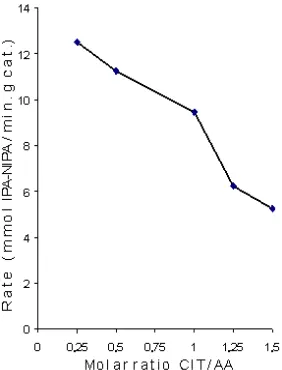
Fig 3. Reaction rate (mmol IPA-NIPA/min. g cat) vs molar ratio of (R)-(+)-citronellal with Zn2+-Natzeo/acetic anhydride
Table 3. Analysis of(1/R) ([SIT]/[AA]) vs.[SIT]/[AA] in the reaction time of (R)-(+)-citronellal cyclisation-acetylation with acetic anhydride/Zn2+-Natzeo
No Time (min) Quadratic equation 2(a.c)1/2/b 1 10 y = 0.126x2– 0.065x + 0.025 -1.73 2 20 y = 0.124x2– 0.001x + 0.024 -109.11 3 30 y = 0.149x2+ 0.042x + 0.007 1.54 4 60 y = 0.292x2+ 0.074x – 0.002 -5 120 y = 0.943x2– 0.520x + 0.168 -1.53 6 180 y = 1.637x2– 1.200x + 0.351 -1.26
showed that fragmentation of IPA and NIPA are similar with m/z = 136 (M+-CH3COOH), 121, 107, 93, 81, 67, 43 (base peak), and 41. Conversions are expressed with respect to the reactant in default, i.e., acetic anhydride. Conversions are thus simply defined asX (%, t)=(moles of IPA-NIPA produced at time t)/(moles of acetic anhydride att=0)
The increasing of CIT/AA molar ratio showed dereasing yield of IPA-NIPA (Fig. 2). Stereoselectivity to produce IPA not change by variation of CIT/AA.
Decreasing of acetic anhydride showed decreasing of acetyl cation concentration in the reaction system and reaction rate (Fig 3).
Calculation of rate constant and adsorption equilibrium constant ratio of (R)-(+)-citronellal to acetic anhydride onto catalyst surfaces Zn2+-Natzeo was followed Langmuir-Hinshelwood equation. The equation stated few assumption that 1) active sites onto catalyst surfaces were uniform and had the same energy level, 2) there was only one reactant molecule which was adsorbed onto active sites, 3) adsorbed reactant molecules will compete to get the active sites and 4) reaction between(R)-(+)-citronellal with acetic anhydride occurred after both of those adsorbed onto catalyst surfaces [12].
Based on reaction rates data which, the quadratic equations were obtained by making graph of (1/R) ([CIT]/[AA]) vs [CIT]/[AA]. The quadratic equations in Table 3.
Equations on Table 3 could be used for determination of reaction rate constants (kCIT/AA) and adsorption equilibrium constant ratio, KCIT/KAA, if the requirement was fulfill as 2(a.c)1/2/b equals or close to 1. Based on that requirement, the reaction rate data with quadratic equation at reaction time 30 minutes (the value of 2(a.c)1/2/b = 1.54) was determined for kinetic analysis. Reaction rate constant was determined by using kCIT/AA = (2/b) or kCIT/AA = (a.c)
-1/2
. The value of kCIT/AA =(2/b)equation was 47.619 mmol (min. g cat)
-1 , whereas the value ofkCIT/AA=(a.c)
-1/2
was 30.964 mmol (min. g cat)-1. Adsorption equilibrium constant ratio, KCIT/KAA=(2a/b)was 7.09. This calculation showed that the reaction rate constant of cyclisation-acetylation(R) -(+)-citronellal with Zn2+-Natzeo/acetic anhydride at reaction time 30 min and 80 °C was 30.964–47.619 mmol (min. g cat)-1.
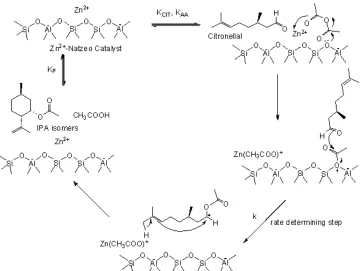
Fig 4.The proposed mechanism for the cyclisation-acetylation of(R)-(+)-citronellal using Zn2+-Natzeo catalyst
citronellal molecule was assumed as a controlling factor for tightening the substrate adsorption to catalyst surfaces. The difference of the substrate adsorption abilities was not determined only by reagent polarity, butalso by pore sizes and catalyst polarity. The increasing of citronellal adsorption onto catalyst surfaces was inhibited the adsorption of acetic anhydride, even if the excess amount could fill the catalyst pores.
Based on mechanism which was proposed by Deraoune et al. about acetylation of anisole [12], the rate determining step was formation of acetyl-citronellal complexes. According to Freese et al. [16] and Smith et al. [17], an acyl cation produced by reaction of the acetylating agent with the Zn2+-Natzeo was proposed to be the critical species reacting with the adsorbed citronellal as a substrate, implying that reaction of the acyl cation-Zn2+-Natzeo complex with the citronellal as a substrate was the rate-determining step. However, no evidence was provided for the formation of an acyl cation-Zn2+-Natzeo complex, it was demonstrated that the rate constant for acylation was more dependent on the nature of the substrate rather than on the nature of the acylating agent. Zeolite catalyzed reaction into liquid phase was not dependent only by reactant ratio, but also pores size and zeolite polarity.
The proposed mechanism of (R)-(+)-citronellal cyclisation-acetylation with acetic anhydride/Zn2+-Natzeo describes in Fig. 4.
CONCLUSION
The major products of one pot cyclisation-acetylation of (R)-(+)-citronellal with Zn2+-Natzeo/acetic anhydride was IPA and NIPA. According to Langmuir-Hinshelwood mechanism, kinetic analysis of cyclisation-acetylation (R)-(+)-citronellal with Zn2+ -Natzeo/acetic anhydride showed that the rate constant k = 47.619 mmol (min.g cat)-1, the value of kCIT/AA = 30.964 mmol (min. g catalyst)-1, and the adsorption equilibrium constant ratio KCIT/KAA = 7.09. Adsorption ability of citronellal was much stronger than that of acetic anhydride onto catalyst surfaces, the greater amount of citronellal adsorbed onto catalyst was decreased the reaction rate of citronellal cyclisation-acetylation.
ACKNOWLEDGEMENT
REFERENCES
1. Andrade, C.K.Z., Vercillo, O.E., Rodrigues, O.E., and Silviera, D.P., 2004,J. Braz. Chem. Soc.,15, 6, 813–817.
2. Chuah, G.K., Liu, S.H., Jaenicke, S, and Harrison, L.J., 2001,J. Catal., 200, 2, 352–359.
3. Chuah, G.K., Nie, Y., and Jaenicke, S., 2006,Chem. Commun., 1, 790–792.
4. Arvela, P.M, Narendra, K., Ville, N., Rainer, S., Tapio, S., and Yu, M.D., 2004, J. Catal., 225, 155– 169.
5. Yongshong, Z., Yuntong, N., Jaenicke, S., and Chuah, G.K., 2005,J. Catal., 229, 2, 404–413. 6. Kikukawa, Y., Yamaguchi, S., Nakagawa, Y., and
Uehara, K., 2008, J. Am. Chem, Soc., 130, 47, 15872–15878.
7. Sheldon, R.A., and Bekkum, H.V., 2000, Fine Chemicals through Heterogeneous Catalysis,Wiley– VCH, Weinheim.
8. Cahyono, E., Muchalal, Triyono, and Pranowo, H. D., 2009, Analysis of the Enantiomers Ratio of
Citronellal Using Enantioselective Gas
Chromatography, Proceedings of XIX International Chemistry Seminar 2009 (XIX ICS), Chemistry Department-Universitas Gadjah Mada, Yogyakarta, Indonesia.
9. Cahyono, E., Muchalal, Triyono, and Pranowo, H. D., 2009, Cyclisation-acetylation of (R)-(+)-Citronellal by Modified Natural Zeolite Catalysts, Proceeding of International Seminar ICORAFSS II, UTM, Johor Bahru.
10. Cahyono, E. and Kadarwati, S., 2007, The Selectivity of Lewis Acid in the Cyclisation-Acetylation of Citronellal, Proceedings of International Conferences on Chemical Sciences 2007 (ICCS’07), Chemistry Department-Universitas Gadjah Mada, Yogyakarta, Indonesia.
11. Derouane, E.G., Andre, J.M., and Lucas, A.A., 1988,J. Catal.,110, 29-45.
12. Derouane, E.G., Crehan, G., Dillon, C.J., Bethell, H., He, H., and Hamid, S. B., 2000,J. Catal., 194, 410–423.
13. Derouane, E.G., 1998, in “A Molecular View of Heterogeneous Catalysis”, E.G. Derouane, Ed., De Boeck Universit´e, Brusselles.
14. Derouane, E.G., 1998,J. Mol. Cat. A,134, 29. 15. Derouane, E.G., Dillon, C., Bethell, D., and Hamid,
S.B., 1999,J. Catal.,187, 209.
16. Freese, U., Heinrich F., and Roessner, F., 1999, Catal. Today,49, 237.