e-Journal of English Language Teaching Society (ELTS) Vol. 1 No. 2 2013 – ISSN 2331-1841 1 guessing pictures game. This research used pre-experimental research design. The population was the seventh grade students of SMP Negeri 13 Palu and the sample was the seventh grade students, consisting 26 students. The data were collected through observation and tests: pre test and post test. The observation was conducted to see the process of teaching and learning in the classroom while the pre test and post test were used to find out the improvement of students’ vocabulary before and after the treatment. Based on the result of pre test and post test, the research found that the t-counted was 25.2. By applying 0.05 level of significance and the 26-1=25 degree of freedom, it is found that t-table was 1.708. It shows that t-counted was higher than the t-table. In the other words, guessing pictures game is
effective in increasing the students vocabulary mastery.
Keywords: Increasing; Vocabulary; Vocabulary Mastery; Guessing Pictures Game.
INTRODUCTION
Vocabulary as one of the components of language has a necessary contribution to
support the ability of the students in using English as a foreign language. Learning
vocabulary cannot be separated from the language skills: listening, speaking, reading and
writing. English teacher should teach vocabulary based on the context. Vocabulary cannot
stand alone to create meaningful language because the vocabulary that the teacher teach
will lose the exact meaning and make the language user misunderstood during the
communicative activities. Without having a lot of vocabulary in English the students get
difficulties in mastering this language. Morever Cameron (2007:73) states that words are
the key unit in buliding up skills and knowledge.
1
Prodi Pendidikan Bahasa Inggris FKIP Universitas Tadulako - email: [email protected]
2
email: [email protected]
3
e-Journal of English Language Teaching Society (ELTS) Vol. 1 No. 2 2013 – ISSN 2331-1841 2 Vocabulary is the crucial part in language skills. However, in Junior High School the
types of text (genres) developed in the KTSP 2006 include transactional conversations (to
get something done), interpersonal conversation (to establish and maintain social relation),
short functional text (announcement, greeting cards, etc) monologues and essays of certain
genres. Junior High School students are supposed to be ready for handling the kinds of text:
narrative, descriptive, procedure and report. In the other words, there are communicative
competences to be developed. The students need to master vocabulary in order to get the
competences and to achieve the objectives of the curriculum.
In the fact, most of the students who are considered as beginners in Junior High School
still have problem in learning English in terms of lacking vocabulary. They had low
achievement in mastering vocabulay and had low motivation in learning vocabulary.
Consequently, the students had difficulty in expressing words and writing short sentences.
The English teacher should be creative in creating English class to be joyful and interesting
for the students. The students will enjoy the lesson if the teacher teaches the vocabulary
through appropriate techniques.
Technique is activity done by the teacher when teaching English in the classoom.
Gerlach and Elly (1980) states that techniques are the ways and means adopted by a teacher to direct the learners’ activities toward an objective. The English teacher should think about
the technique which is appropriate with the material and students’ need. Commonly, the
English teacher usually use the old method to teach the students. After giving explanation
and the list of words, the teacher ask the students to answer some questions. So, they give
no attention and feel boring at the same time. The students always pay attention and are
cerious about what are they going to do in the classroom. Harmer (2007:82) believes that
children can easily get bored and lose interest after ten minutes or so.
There are many kinds of teaching techniques commonly used in teaching vocabulary
especially for beginners. Thornbury (2002:77) suggests that variety of techniques in
introducing vocabulary such as translation, real things, pictures, gestures, definitions, and
situations. According to Suyanto (2010:101), an technique that can be used to teach
vocabulary is using media. Media is anything that contains informations from the source
and receiver. In adittion, media is a kind of tool or equipment or anything that can assist the
students to learn. Furthermore, Arsyad (2002:91) states that visual-based media has a big
role in lerning process. Visual based media can also assist the learners to comprehend the
e-Journal of English Language Teaching Society (ELTS) Vol. 1 No. 2 2013 – ISSN 2331-1841 3 O1 X O2
Picture is the visual media that are useful to achieve the aims of teaching and learning
vocabulary. According to Uberman (1998:20) students remember better the material that
has been presented by visual aid. Similarly, Wright (1989) points out that picture can motivate and draw the students’ attention in learning.
Some experts also argue one of interesting and challaging way in teaching vocabulary
is game. According to Talak (2010:11), games are fun activities that promote interaction,
thinking, learning and problem solving strategies. Many teacher support the use of language
game in the classroom. Applying them makes the learning process more enjoyable and
develop different abilities of students.
Guessing pictures game as an alternative medium of teaching the beginner can be
considered as the appropriate way because this game can help the students remember the
words easily. Wrigth,Betteridge and Buckby (1984) agree that repitition games challenge the players’ ability to remember. Similarly, Byrne (1976:102) states “guessing pictures game as the majority of repitition game rely simply getting the players to find out something through guessing”.
Based on the students’ problem above, the researcher is interested in conducting her research on increasing vocabulary mastery of the seventh grade students of SMP Negeri 13
Palu through guessing pictures game. She believes that guessing pictures game can increase the students’ vocabulary mastery effectively because vocabulary that they learnt is introduced through enjoyable and challenging way. She focused on the meaning and the
spelling of the words.
METHODOLOGY
The researcher applied pre-experimental research design. In this case, the sample of
the research only consist of one group. The pre-test and post-test are used in this research.
Arikunto (2010:124) proposes:
Where:
O1 = pre-test
X = treatment
e-Journal of English Language Teaching Society (ELTS) Vol. 1 No. 2 2013 – ISSN 2331-1841 4 The population of this research was the seventh grade students of SMP Negeri 13 Palu. Arikunto (2007:130) states that population is all of subjects’ research. The population consisted of only one class. The total numbers were 26 students, and all of them become the
sample of this research. The researcher used total sampling technique to select the sample of
this research.
In this research the researcher involved two kinds of variables; they were independent
and dependent variable. The independent variable of the research was the guessing pictures game while the dependent variable was the students’ vocabulary mastery.
In relation to this research, the researcher used two kinds of research instruments to
collect the data, they were observation and tests. She used the observation to get the information about the way of teacher taught the students and the students’ attitude in receiving lesson. Furthermore the test was used to measure the vocabulary mastery of the
students before and after the treatment.
As mentioned earlier, the researcher gave the test both in pre-test and post-test. The
pre-test was given to the students to find out the vocabulary mastery before conducting the
treatment. The test of pre-test consisted of 25 multiple choice items and 25 matching test
items. Because of both tests are objective tests, so each item would be scored 1 point. The
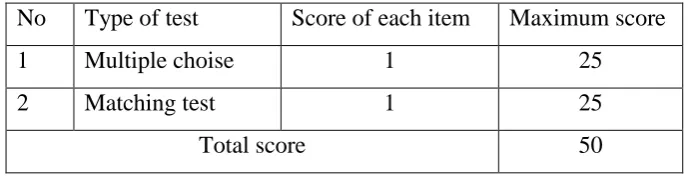
scoring system can be seen in the following table:
Table 1: The Scoring System
No Type of test Score of each item Maximum score
1 Multiple choise 1 25
2 Matching test 1 25
Total score 50
After giving the pre-test, the researcher conducted the treatment in eight meetings.
The targets of vocabulary were 50 words, they were 25 adjectives and 25 verbs. In every
meeting, the researcher used communicative aproach where the students should be active
and give response to the material given. It is learner centered requaires little intervention
from the teacher.
In order to assess the progress of the students’ voabulary mastery of the treatment,
the researcher gave post test at the last meeting. The post test consisted of the same form as
e-Journal of English Language Teaching Society (ELTS) Vol. 1 No. 2 2013 – ISSN 2331-1841 5 Next, the researcher used the formula proposed by Arikunto (2006) in order to
determine the individual standard scores.
=
�
�
Where : = standard score
X = obtained score
N = maximum score
100 = constant score
The mean score was counted by using a formula suggested by Arikunto (2006:307)
as follows:
�= Ʃ�
Where : Md = mean score
∑d = the total score of deviation.
N = number of students
Furthermore, the researcher computed the square deviation by using formula
proposed by Arikunto (2006: 308) as follows:
�2� = �2− ( �) 2
Where: ∑x2d = the sum of squared deviation
∑2
d = the sum of deviation
The researcher also analyzed the data in order to find out the significance between
pre-test and post-test of effectiveness of the treatment. The researcher used the formula
proposed by Arikunto (2010:349):
�= �
e-Journal of English Language Teaching Society (ELTS) Vol. 1 No. 2 2013 – ISSN 2331-1841 6
Where: t = significant score
Md = deviations’ mean score of pre test and post test
�2� = deviations’ quadrate score
N = number of the students
RESULTS
The data of this research were analized in two kinds: descriptive and statistical. The
researcher used descriptive analysis to describe the result of the observation while the data
from pre-test and post-test were analyzed statistically.
The result of observation was on the fist meeting. The researcher observed the
teaching learning process in the classroom actvities. The researcher made an observation in
order to know the teaching technique that was used by the teacher in teaching English, the students’ behaviours, motivation, and response during the teaching and learning process. The researcher found that the students had difficulties in getting the meaning of some words
and just kept silent when the teacher aksed them about the material given.
After conducting the observation the researcher gave the pre-test to the students. The aim of the test was to find out the students’ vocabuary mastery before doing the treatment. The study of this research was limited on adjective and verb based on the KTSP 2006 of
e-Journal of English Language Teaching Society (ELTS) Vol. 1 No. 2 2013 – ISSN 2331-1841 7
The test was devided into two forms. They were 25 items of multiple choise and 25
items matching test. Each item of the test was scored 1 for the correct answer, so 50 points
were maximum score.
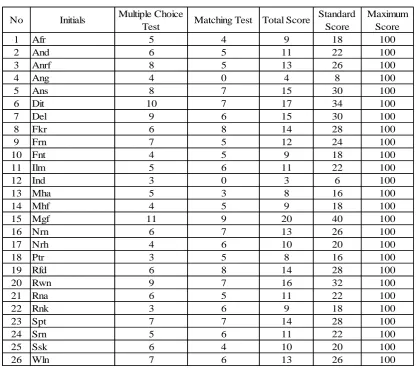
To found out the standard score, the researcher used the formula recommended by
Arikunto (2006) :
= � �
For example, if a students got total score of 15 of multiple choise test and matching
test it was devided by the maximum score and multiplied by 15
50� 100 so the standard
score is 30.
Furthermore, the researcher found out the mean score of the students by using the
e-Journal of English Language Teaching Society (ELTS) Vol. 1 No. 2 2013 – ISSN 2331-1841 8
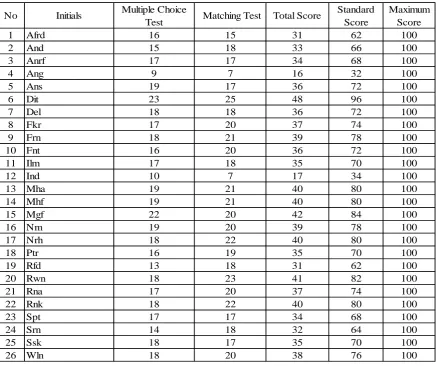
researcher used the same formula to calculate the students’ standard score and mean score.
It was presented in the following table :
Table 3: The Result of Post Test
e-Journal of English Language Teaching Society (ELTS) Vol. 1 No. 2 2013 – ISSN 2331-1841 9 The final result of the students mean score was calculated by using the previous
formula:
�= Ʃ�
Mean = 1844 = 70.9
26
It shows that the students’ mean score in the post test was 70.9. We can conclude that
the students’ achievement after the treatment increased. In order to know the distribution
between the score of pre test and post test, the researcher obtained scores through counting
the deviation. Then, she computed the mean deviation as follows:
M d
=
�
=
1246 26M d = 47.9
After getting the mean deviation, the researcher computed the sum of square
deviation as shown below:
∑x
2d =
�
2−
( d)2= 62284−(1246 )2
26
= 62284−1552516
26
= 62284− 59712.1
= 2571.9
The last step, the researcher needs to analyze the data statistically in order to know
the significant difference of the pre-test and post-test by using t-test formula proposed by
Arikunto (2006:308) as follows:
t = �
�( 2−d1)
t = 47.9
2571 .9
e-Journal of English Language Teaching Society (ELTS) Vol. 1 No. 2 2013 – ISSN 2331-1841 10
t = 47.9
2571 .9 650
t
=
47.93.9
t = 25.2
t-counted = 25.2
After analysis the data of the test by using t-test formula, the result of the data analysis
shows that t-counted is 25.2 applying 0.05 level of significance with 26 degree of freedom:
26-1=25, the researcher found that t-counted (25.2) was higher than the t-table (1.708). It
means that the research hypothesis is accepted. In the other words, teaching vocabulary
through guessing pictures game is effective.
DISCUSSION
Based on the result of pre test , the researcher found that the students vocabulary
mastery of adjectives and verbs was lack. It can be seen from the students mean score 23.
No students got half or high score.
The researcher realized that the students need an appropriate way to solve this
problem. She wants to help the students in term of increasing their vocabulary mastery. The
students need an interesting and challenging way to motivate them in learning vocabulary.
The process of learning has a big effect for the students achivement. If the reasercher cannot
teach the students properly the students cannot enjoy their learning process. Guessing
pictures game is the appropriate technique. During the treatment through this game, the
students felt enjoy, they became active and get more confidence. They give full attention to
the material. The game challenge the students because they feel that certain words are
improtant and necessary. Without that words the aims of the game cannot be achieved. This
situation effectively increase the students’ vocabulary mastery because playing guessing
pictures game that helps the students memorize the words easily.
The effectiveness of guessing pictures has been proved by many previous studies.
Mapeda (2009) attempted to improve the students’ vocabulary mastery through guessing
pictures game. She concerned only on nouns. She also used jumbled letters technique in this
e-Journal of English Language Teaching Society (ELTS) Vol. 1 No. 2 2013 – ISSN 2331-1841 11 that guessing pictures game can stimulate and motivate the students to learn vocabulary and improve the students’ vocabulary mastery.
Furthermore, Jannah (2007) in her study in order to improve the students’
vocabulary mastery through guessing pictures game. She concerned on noun, adjective and
verb. She used some sentences beside the pictures to help the students in guessing the
pictures. It is found that the use of guessing pictures game has a big effect in improving students’ vocabulary mastery.
Similarly, Setianingsih (2013) applied guessing pictures game to Grade IV of
Elementary school students using macromedia flash 8. She used Research and Development
(R&D) method for multimedia in her research. This research consists of five steps that were
analysis, design, development, implementation, and evaluation. She confirms that the
guessing pictures game is includes in high appropriate category.
CONCLUSION AND SUGGESTION
Before doing the treatment, the researcher found most of the seventh grade students
of SMP Negeri 13 Palu had low achievement in vocabulary because the students had low
motivation in learning English and the techniques used in teaching vocabulary were not
effective. After doing the treatment, the result of the post test shows that guessing pictures
game has increase the students’ vocabulary mastery. Based on the testing hypothesis, the
t-counted (25.2) was higher than t-table (1.708). We can conclude that the students’
vocabulary mastery has increased through guessing pictures game.
From the conclusion above, the researcher has several suggestions that might be
useful for the English teacher and the students. Firstly, the teacher should think about the
technique and materials which are appropriate with the students’ need in teaching learning.
Secondly, the teacher should present the language in an enjoyable and relaxed atmosphere.
It can be done by using pictures games or another challenging way in order to avoid the
students’ boredom. The last, the students should learn seriously and manage their time to
learn at home in order to achieve the maximal achievement in increasing vocabulary
mastery.
REFERENCES
Arikunto, S. (2006). Prosedur Penelitian: Suatu Pendekatan Praktik. Jakarta: Asdi
Mahasatya.
e-Journal of English Language Teaching Society (ELTS) Vol. 1 No. 2 2013 – ISSN 2331-1841 12
Arikunto, S. (2010). Prosedur Penelitian: Suatu Pendekatan Praktik. Jakarta: Rineka Cipta
Arsyad, A. (2002). Media Pembelajaran. Jakarta: Raja Grafindo Persada.
Byrne, O. (1976). Teaching Oral English (New Edition).London: Longman.
Cameron, L. (2007). Teaching English to Young learner. Cambridge: Cambridge University
Press.
Gerlach, V.S & D.P Elly. (1980). Teaching and Media and Systematic Approach. New
Jersey: Prentice Hall. Inc.
Harmer, J. (2007). The Practice of English Language Teaching. Edinburgh: Pearson
Education Limited.
KTSP. (2006). Jakarta. Badan Standar Nasional Pendidikan (BNSP).
Mapeda, K. (2009). Improving Vocabulary Mastery of the first year students of SLTP
Negeri 2 Palu through Guessing Pictures Game. Tadulako University.Unpublished Skripsi.
Jannah, M. (2007). Improving vocabulary mastery of the seventh grade students of SMP
Negeri 4 palu trough Guessing Pictures Game.Tadulako University.Unpublished Skripsi.
Talak, K.A. (2010). Using Games in a Foreign Language Classroom. IPP Collection.
Paper484.
Thornbury, S. (2002). How To Teach Vocabulary. Harlow: Longman.
Uberman, A. (1998). The Use of English for Vocabulary Presentation and Revision.
Language Teaching Forum. Forum’, 36(1), 20. http://www.teflgames.com/why.html.
(Retrieved 18 september 2013).
Suyanto, K. K. E. (2010). English for Young Learners. Jakarta: Bumi Aksara.
Setyawan, Y.I. (2011). VocFun: Developing an Interactive CD as self-studyMaterials on
Vocabulary in Elementary School.Unpubilshed Sarjana’s Thesis.English Language Education, Faculty of Letters, State University of Malang.
Setianingsih, S. (2013). English guessing pictures game for 4th grade elementary school
students using macromedia flash 8. S1 thesis. Universitas Negeri Yogyakarta.
http://eprints.uny.ac.id/10536/(Retrieved 18 september 2013).
Wright A, Betteridge, D. & Buckby, M. (1984). Games for Language Learning. Cambrige: