Characterization of the Sole Fishery in The
Gambia
Gambia-Senegal Sustainable Fisheries Program
(Ba Nafaa)
ii This publication is available electronically on the Coastal Resources Center’s website at
http://www.crc.uri.edu. For more information contact: Coastal Resources Center, University of Rhode Island, Narragansett Bay Campus, South Ferry Road, Narragansett, Rhode Island 02882, USA. Tel: 401) 874-6224; Fax: 401) 789-4670; Email: [email protected]
Citation: Gibril Gabis, Christopher Parkins and Kathleen Castro. 2011. Characterization of the Sole
Fishery in The Gambia , Coastal Resources Center, University of Rhode Island, pp.13
Disclaimer: This report was made possible by the generous support of the American people
through the United States Agency for International Development (USAID). The contents are the responsibility of the authors and do not necessarily reflect the views of USAID or the United States Government. Cooperative Agreement # 624-A-00-09-00033-00.
iii
Acknowledgements
There is little doubt that involving stakeholders as partners in developing management plans will assist in the progress towards improved management of the fishery resources. Local fishermen contributed greatly to this study on gillnet performance and subsequent research. We wish to thank the fishermen of the Gambia who participated in this project to gather information. This information dramatically improved the data poor scenario and allowed very specific questions to be formulated and investigated.
iv
Table of Contents
Acknowledgements ... iii
Preface ... 1
1. What is a Gillnet? ... 1
2. What is a longline? ... 3
3. Gambia ... 4
4. Observations ... 5
5. Longline Fishery ... 7
6. Problems and Harvest Rules... 7
7. Possible Follow-up ... 8
8. Some Recommendations to Consider ... 8
9. Suggested Research Project Design ... 9
1
Preface
This report discusses the characteristics of the sole fishery as determined by
discussions with fishermen and the NASCOM executive committee using a rapid survey technique in January 2011. The gear outlined (gillnets and longlines) were mentioned as the predominant methods of capture for sole in the Gambian artisanal fishery. This information was prepared to assist in development of the sole management plan.
1. What is a gillnet?
Agillnet is a wall of webbing of a certain mesh size that interrupts movement of fish and
captures them through the gilling or wedging of the body. Gillnets are fished as a vertical wall of webbing designed in such a way that they are selective for a certain shape, size and or species of fish. A gillnet consists of marker buoys to indicate the beginning and end of a set, anchors to keep the net fixed (if a bottom set net), a floatline to keep the panel of webbing upright and a leadline to keep the panel of webbing taught and fixed. Gillnets can be placed in different configurations including bottom set gillnets which are nets anchored on or near the bottom (see figure 1) to catch bottom dwelling species; there are anchored mid water gillnets as well as free drifting gillnets that target pelagic species.
A gillnet can be constructed of different twine types including: natural fibers,
2
Figure 1: Artists representation of a bottom set gillnet showing the anchors, marker
buoys,floatline and leadline (Courtesy of Juan Chuy Sociedad de Historia Natural Niparajá 2007)
3
Figure 2: Example of different hanging ratios
2. What is a longline?
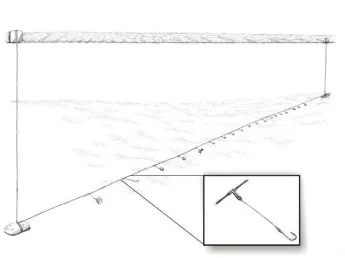
Figure 3: Example of a longline trawl (Courtesy of Juan Chuy Sociedad de Historia Natural Niparajá 2007)
4 referred to as a trawl. The hooks are attached to the mainline with lines of varying
lengths called gangions. The hooks are evenly spaced along the mainline in an effort to maximize efficiency while decreasing fouling of the gear.
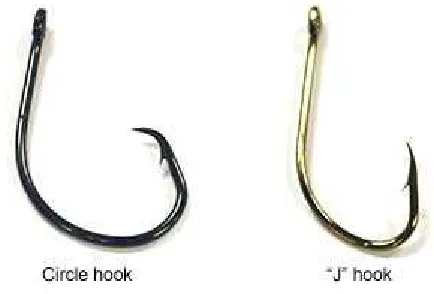
Hook size is determined by the target species and the ability of the hook to enter the mouth of the fish. Hooks come in two different shapes; traditional “J” hooks with a straight shank and circle hooks which have a circular shape that allows the hook to set itself in the fishes mouth without being swallowed (Figure 4). Circle hooks are
commonly used in the longline fishery as they catch better than the traditional “J” hooks. The bait used by the fishermen is personal preference and is usually based upon trial and error to determine the best bait for the target species.
Figure 4: Examples of a circle hook and a “J” hook
3. The Gambia
This report summarizes the information gathered on the sole fishery in an effort to develop a management plan for the sole fishery. In The Gambia sole is primarily caught as a bycatch in the bottom set gillnet fishery along with the higher value roundfish species (catfish, ladyfish etc.). Currently harvesting rules consist of a minimum mesh size, bar length no smaller then 4cm, and minimum fish size, a fish no smaller then 25cm. Given interest by the co-management committee to examine new harvest rules, we examined the general characteristics of the gillnet design used for sole.
5 fisherman. The floatline has foam floats (~8cm) spaced at about ~2m apart along the length of the webbing. The leadline has lead weights evenly distributed at ~.5m
intervals, aswell as rock anchors at the end of each section. The hanging ratio, when
observed, was 0.5 an ideal hanging ratio for roundfish species. Many nets were observed without a hanging ratio on the leadline or floatline, limiting their ability to be selective.
The gillnets are commonly fished with multiple sets one after the other. Once set they are left to soak for a 24 hour period and hauled the following morning. All gillnets are hauled by hand and fish are removed by hand. Crabs caught that are not commercially valuable are smashed out of the net using a piece of wood, as they foul up the net and are difficult to pull out. Almost all catch is retained for sale on the beach.
4. Observations
All observations are based upon interviews with two fishermen from the fishing port of Sanyang and observations made during the ongoing bycatch study at 4 landing sites. Information was also collected during a meeting of the executive committee. While watching the fishing operations it became evident that not all of the gillnets had a
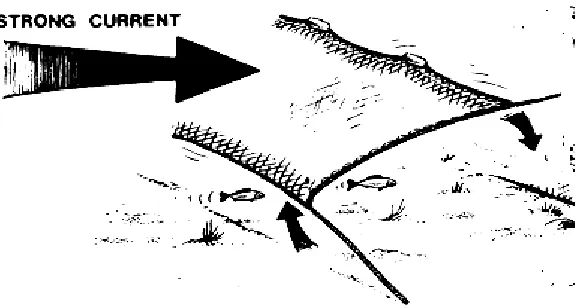
consistent hanging ratio. This was evident as the webbing was simply laced through the leadline and floatline without ties. The fishermen mentioned that the gear was fished in an upright manner with a small purse formed by the current. Upon observation of the gear being fished it was evident that the gear was partially lying on the bottom. This can be due to a combination of factors including: too little floatation, compression of foam and loss of buoyancy at depth, and current (Figure 5).
Figure 5: Gillnet that does not have sufficient buoyancy to keep it upright in a current.
6 should be noted that these gillnets, as fished, are acting more as an entangling gear (Figure 7).
Figure 6: Methods of capture in gillnets
7
5. Longline Fishery
There is a small longline fishery used for demersal species including sole in the Gambia. The gangions and main line are monofilament. The large hook size is probably used for catfish (note: not a circle hook). It does not appear to be a major gear type but more inquiry should be conducted to evaluate the efficiency of this method/gear.
6. Problems and Harvest Rules
A meeting was held with the executive committee to discuss how to move forward and solve the problems in the sole fishery. The discussion focused on current harvest rules and how they should be modified in the new management plan for the sole fishery. It was agreed that the current minimum fish size of 25cm and the minimum mesh size of 4cm (bar length) may not be the best harvest rules for the health of the sole fishery. The executive committee came up with an action plan on how to move forward based upon the information gathered about the sole fishery. The executive committee
8
7. Possible Follow-up
• Discuss with the LASCOM/NASCOM fishermen panel
• Determine the cost of continued fishing using this method (cost of replacing gear
versus new management)
• Research project: Examine a more selective gear on the cost of fishing and the
benefits/losses to the fishermen
8. Some Recommendations to Consider
Management Tool Pros Cons
Design a new gear that is
more selective -Reduce bycatch while retaining more profitable species reluctant to use new gear -Difficult to enforce
-Catch can be sorted at sea, therefore not eliminating bycatch, just what is landed
-Difficult to enforce
Control what species can
be landed -Penalty for landing a restricted species -Encourage fishermen to fish cleaner
-Catch can be sorted at sea, therefore not eliminating bycatch, just what is landed
-Difficult to enforce Minimum sizes on fish
species -Fishermen will be encouraged only to use methods that catch larger fish
-Improvement of the health of the stock
9
9. Suggested Research Project Design
Gillnet Catch Comparison Research Study
Preface:
Based on our discussion with the executive committee, it was suggested that this design for the study be discussed with the master fishermen to get their input. The discussion should include modifications to project and gear design and the involvement of the fishermen in the project
Purpose:
Design a gillnet that will be hung correctly and have proper floatation to fish as a vertical wall of webbing. Construct a gillnet that meets these specifications and compare it to a brand new net that is designed after what is currently being fished. Perform a catch comparison between both nets fished side by side in order to determine if there is any difference in catch.
Objectives:
1. Design a gillnet that will maintain proper fishing characteristics when fished in heavy current and at depth
2. Determine if there is significant difference in selectivity between a properly hung gillnet and the gillnet design that is currently being fished
Materials:
1. Properly hung gillnet with 42 and 46cm alternating sections 2. Gillnet designed after current gillnet being fished
3. Boat
1) Design and build gillnets
2) Perform research 2 times a week for one month at a site to be determined
3) Fish gillnets side by side for a twenty four hour soak time identical to current soak time in the gillnet fishery
10 a) Where in net is fish captured
b) What size mesh
c) Is the fish gilled, wedged or entangled d) Length
e) Species f) Quality of fish
5) Enter data into a usable format using excel
6) Perform an analysis to determine if there is a significant difference between the properly hung gillnet and what is currently being fished