Full Terms & Conditions of access and use can be found at
http://www.tandfonline.com/action/journalInformation?journalCode=vjeb20
Download by: [Universitas Maritim Raja Ali Haji] Date: 11 January 2016, At: 19:36
Journal of Education for Business
ISSN: 0883-2323 (Print) 1940-3356 (Online) Journal homepage: http://www.tandfonline.com/loi/vjeb20
The Course Valuation Model and 10 Steps
to Increase Course Value: The Business
Communication Course
Lori A. Brown
To cite this article: Lori A. Brown (2015) The Course Valuation Model and 10 Steps to Increase Course Value: The Business Communication Course, Journal of Education for Business, 90:6, 340-346, DOI: 10.1080/08832323.2015.1058738
To link to this article: http://dx.doi.org/10.1080/08832323.2015.1058738
Published online: 15 Jul 2015.
Submit your article to this journal
Article views: 59
View related articles
The Course Valuation Model and 10 Steps to
Increase Course Value: The Business
Communication Course
Lori A. Brown
California State University, Long Beach, California, USA
Communication competence is a leading agent in professional success and the ability most sought after by employers. Educational institutions benefit by producing students with such sought-after skills. However, there is a disconnect between skills practitioner stakeholders desire and what graduates deliver. Strengthening the value of a business communication course simultaneously to students, employers, and educational providers is key. The Course Valuation Model (CVM) is a system-based approach encouraging transitive course value to major stakeholders. Ten action principles are suggested to increase course value defined by the model drawing on connections between stakeholder values and course attributes in measurable and visible ways.
Keywords: business communication, communication and professional competence, course value, educational stakeholders, employment communication skills
Communication competence is a leading agent in profes-sional success. Scholars, corporate managers, and recruiters alike have made the case that the ability to communicate effectively forms the basis for other competencies impor-tant to a successful career (Morreale, Osborn, & Pearson, 2000). Morreale and Pearson (2008) annotated 93 referen-ces supporting the centrality of the communication disci-pline in the 21st century, 58 of these support the role of communication in an individual’s professional success, its capacity to affect organizations, and specific modern orga-nizational settings. These factors are critical to the modern business enterprise. Harvard Business School Professors, Kleinbaum, Stuart, and Tushman (2008) contended that communication is central to the very existence of organiza-tions. It is no surprise then that communication is the skill, talent, and ability most sought after by employers (National Association of Colleges and Employers, 2013). Cline (2005) reported a poll of 330 employers of whom 96% of executives rated communication skills as the most valuable employee trait. In fact, evidence suggests that employers in all occupational fields place greater value on employees’
communication skills than their technical skills (Du-Bab-cock, 2006).
VALUE TO EDUCATIONAL INSTITUTIONS
Educational institutions are benefited by producing gradu-ates with such sought-after skills. When a department is innovative, actively attempting to meet workforce demands, it becomes more valuable to the community, and, in turn, to the school. Students mastering skills and knowl-edge bases that clearly and demonstrably benefit them per-sonally and professionally increase the relevance and value of their education.
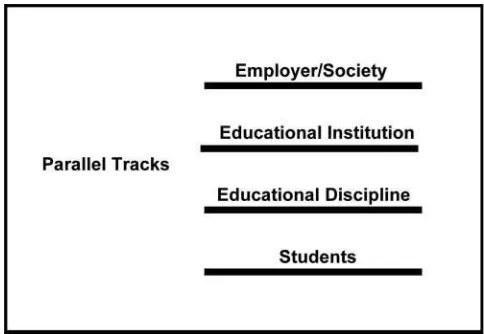
Education to employment (E to E) success is essential in today’s global employment environment yet critically lack-ing. In their international survey of 8,000 education pro-viders, youth, and employers, McKinsey and Company found (see Mourshed, Farell, & Barton, 2013) evidence that stakeholders (employers, education providers, and young people) in the success of education to employment seem to work on parallel tracks on the issues that are in front of them and do not understand the critical importance of see-ing the process as an interrelated system (see Figure 1). Over two thirds of employers surveyed reported little to no interaction with educators. The silos of our education
Correspondence should be addressed to Lori A. Brown, California State University, Long Beach, Department of Information Systems, 1250 Bellflower Boulevard, Long Beach, CA 90840, USA. E-mail: lori. [email protected]
ISSN: 0883-2323 print / 1940-3356 online DOI: 10.1080/08832323.2015.1058738
systems are failing to meet the needs of other stakeholders. Consequently, value to them is decreasing; 72% of educa-tors reported believing they are doing a good job preparing students for the workforce, while only 45% of graduates and 42% of employers think so (Mourshed et al., 2013). Resolving this disconnect must involve new forms of col-laboration toward uniting all stakeholders in valuing educa-tional institutions, students, and the courses and educators who serve them. Such increased value to students, depart-ments, educational institutions, and business communities is the primary purpose of the business communication course.
THE DISCONNECT IN BUSINESS COMMUNICATION
There is a gap in business communication skills desired by business practitioners and those delivered by new graduates despite consensus among practitioners and academia (Alshare, Lane, & Miller, 2011; Conrad & Newberry, 2011). Zwieg et al. (2006) reported a study of 81 informa-tion technology executives that when asked “. . .what was
missing from entry-level skill candidates, most respondents said ‘communication skills’” (p. 104). Furthermore, evi-dence suggests graduates’ perceptions of their employment readiness in an increasingly competitive and global busi-ness environment lack confidence in the necessary level of soft skills (Andrews & Higson, 2008). In the 2015 National Association for Colleges and Employers Job Outlook Sur-vey, employers graded average new graduate recruits on their skills and attributes and found that new grads have dropped in communication skills (National Association of Colleges and Employers, 2015). In sharp contrast to this trend, Waldeck, Durante, Helmuth, and Marcia (2012) sug-gested that new communication competencies may be
required in the contemporary business and professional environment.
The Total Quality Education (TQE) model (Scrabec, 2000) supports the connection amongst all stakeholders as it proposes that students are not customers whose satisfac-tion drives the educasatisfac-tional model, but recipients of educa-tion and beneficiaries of it, as are industry and society. This model holds the principle criterion of being beneficiary driven but recipient focused. However, business schools are not adopting this model for emphasizing education to achieve competencies valuable to all its beneficiaries. Evi-dence suggests that business schools are not emphasizing in their undergraduate programs the competencies they iden-tify as describing a highly successful business school gradu-ate, nor are they emphasizing the same competencies they identify to describe “the highly successful graduate pro-grams(s) at [the] school” (Abraham & Karns, 2009).
QUESTIONING COURSE VALUE—THE NEED FOR A VALUATION MODEL
Strengthening the correlational relationship between educa-tional stakeholders happens one course at a time. There is a need for a system-based model of course value. The busi-ness communication course is an example for which the stakes are high for all stakeholders. Do business communi-cation students, administrators, and community business leaders know how your course is meeting the needs of employers, students, and, in turn, the needs of the school? And, is the course actively valuedand supported as such? Or does it appear that your course is standing alone with seemingly distant relationships between its actual value, classroom value, workplace/community value, and ins-titutional value? These elements of course value are recip-rocal in nature and are quite interconnected between stakeholders.
When this connectedness is not achieved or recognized, it can lead to a scattered focus and seem as though success in one area must mean disappointment in another, or that time and personal resources invested in one must mean sacrificing the other. Even worse, they can seem at odds with each other and with instructor or institutional priori-ties. All of this can lead to a disjointed program where instructors seem either to strive for institutional security at the cost of a student-centered classroom or, at the other extreme, can focus so intently upon the classroom that insti-tutional and social benefits are left to someone else to deter-mine and promote.
Granted, these are two extreme views described to make a point. But any derivation of these positions that precludes a flowing relationship between course, workforce, and insti-tutional value is undesirable. When we fail to see that valu-ations in all of these venues are not only connected, but interdependent, and how each affects the other, we can get
FIGURE 1. Parallel tracks model, adapted from Mourshed, Farell and Barton (2013).
COURSE VALUATION MODEL IN BUSINESS COMMUNICATION 341
frustrated and discouraged. Our classes can seem to be floating in a curricular wind, with the threat of being deemed unnecessary or replaceable looming in the budget-ary horizon.
THE COURSE VALUATION MODEL
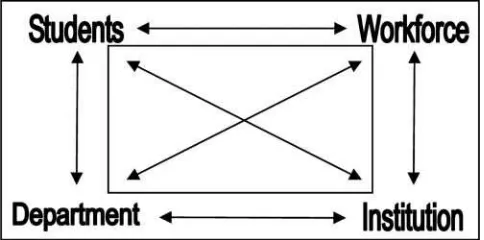
This paper introduces the Course Valuation Model (CVM) as a theoretical working model of course value, and offers 10 principles designed to increase course value as defined by the model. The CVM and the 10 action principles are appropriate for modeling course value and stakeholder rela-tionships in most any course. They are introduced in con-text of the business communication course due to the documented importance of the course for professional suc-cess and the degree and prevalence of disconnect between the valued outcomes for the various stakeholders, or benefi-ciaries, of the course. A goal of the article is to show how each of the 10 principles enacted has value within itself and contributes to each area of the model, and, when working together, draws upon the connection between student, department, institution, and workforce value of a course to strengthen (enlarge) the overall course value. Each of the principles/methods is presented in this paper as a function of substantiating the model with tangible ideas for increas-ing each element of and overall course value. This article then serves as a framework from which each principle will be elaborated upon as can be successfully implemented in the business communication program of educational institu-tions. Emphasis is placed on customizing this approach to increasing course value to all stakeholders—students, instructors, schools, and employment communities (see Figure 2).
Value is often regarded as a subjective judgment regard-ing the worth, importance or significance of somethregard-ing to its various stakeholders. However, when criterion for
shaping those judgments is known, value can become more objectively manifest and measurable. In the instance of course value, no one trait can be considered necessary and sufficient to equal summative value. Rather, the criterions that contribute to increase value can be manifest through the views and purposes of its stakeholders—students, instructors, schools, and employers.
Primary university stakeholders have multiple goals (Schmitz & Whitworth, 2002). The needs and aims of vari-ous stakeholders can translate to course goals, and a course’s value can be rated on dimensions that reflect its varied goals. A goal of the university may be student mas-tery of certain core skills prior to graduation. If a course delivers upon that goal, it may increase its value to the uni-versity. A manifestation of this value may be that the course is a core course for the major. Students and schools value public rewards of accomplishment. Courses can increase in value to the student and school when public displays of accomplishment are incorporated. Employers prefer highly qualified students who present themselves well. Courses that help prepare students for a job search are valued by both students and employers. Students view a teacher’s effectiveness by the value they attach to the course (Young & Shaw, 1999). Consequently, student evaluations of teach-ing can be affected by perceived course value. The key to expanding course value is to triangulate on course value by incorporating many measurable (and immeasurable) mani-festations of various stakeholder goals.
The CVM represents four cornerstones of course value. These are value to students (V-S); value to the discipline, department or college (V-D); value to the educational insti-tution (V-I); and value to the workforce/society (V-W). Each has its own degree of value and is worthy of effort to expand and increase this value. The figure as a whole repre-sents overall course value. The arrows indicate the connec-tions between each of the cornerstone course valuaconnec-tions. Notice if one of the cornerstone values is nonexistent, the flow of the model is cut off, hence decreasing relationships of the other values. If one of the relationships between val-ues is notably less than others, the shape and flow of the relationships can be dramatically altered. Hence, the ability to keep a balanced overall program value is made more dif-ficult. However, I posit that when the 10 principles pre-sented are each enacted, synergistic relationships are established between each of the four cornerstones, increas-ing the overall value of the course.
TEN ACTION PRINCIPLES TO INCREASE COURSE VALUE
1. Embed Course in the Institutional Goals
In order for your course to be effectively situated in your institution, it must visibly deliver upon the goals of that
FIGURE 2. The Course Valuation Model represents four cornerstones of course value: value to students (V-S); value to the discipline, department or college (V-D); value to the institution (V-I); and value to the workforce/ society (V-W/S).
institution. A course that supports the success of the institu-tion in visible and measurable ways will increase in value. Additionally, alignment with institutional goals assures stu-dents the course is based upon sound, school supported cur-ricular objectives. Evidence points to business communication as a highly valued course worthy of core status in business schools (Swanson, Meinert, & Swanson, 1994).
Become aware of the learning goals of your school
and department. Prepare course objectives that align with and can deliver measurable results of these departmental and institutional learning goals. Place these course objectives prominently on your syllabus.
Design assessments of your course objectives that can
demonstrate and support the student success in school learning goals called for in accreditation proceedings. If your course objectives are embedded in institutional learning goals, this should be a simple process. Your course can stand strong as a pillar of documented achievement in the school’s learning goals and overall success.
Demonstrate student learning by offering pretest
evaluation of critical assessments of student skills. Then test after instruction, maybe more than once. Quantitative data of improvement is a powerful tool to justify what your course is accomplishing (hence value) and lends strong support to what your department/school is accomplishing toward learning goals.
Utilize the ethics center. If your school has a center
for ethical leadership or other such organization, use it. Invite guest speakers; seek out curricular units they might offer to use in your course; offer credit for stu-dent involvement in the center; encapsulate your assignments in a cloak of ethics training.
Collaborate with colleagues from other departments
on assignments that commingle the subjects or disci-plines. This will raise the relevance of both disciplines and enhance the value of your course regarding stu-dent achievement and institutional collaboration.
Work to make your course, or some component of
your course, a prerequisite for future courses. Also, follow the appropriate procedures to have your course declared a core or required course in a school, department or major at your institution. If successful in this endeavor, the institutional value of the course is solidified in significant ways. This level of merit granted from the institution demon-strates confidence in the significance of the goals, instruction, and achievements of the business com-munication course. It also assures that more stu-dents will be receiving the valued training offered from the course. This type of institutional support also contributes to expanding the workforce value
of the course. It is among the strongest messages of course value.
2. Reward Excellence Publicly
Set up a system of reward for achievement. “Winning
creates a positive aura, a halo effect that encourages productive behavior and attracts investment to facili-tate further wins” (Kanter, 2003). Possibilities include a certificate program for skill mastery, contests among work teams, a showcase of deliverables on the school calendar, or an implementation of top service or prob-lem solving projects on campus. This type of reward program brings an element of institutional legitimacy to student success. And, if your course curriculum is linked to department and institution learning goals, this also brings an added layer of pride and success to the department and school. Everyone likes rewards. We like earning them, giving them, and watching our own achieve them.
Involving the workforce or community in your
rewards program is an excellent way to integrate a real-world element to authenticate student assign-ments. It can also add greatly to the workforce/com-munity value of your course. Perhaps have local business leaders judge a contest, or establish student work teams to write analytical reports commissioned by businesses to research and make recommendations to solve a problem identified by the business leaders. Then, invite the business leaders to hear the final reports, and give them a copy of the finished written product. Involving students in community service projects aligned with course (and school) objectives is yet another way to achieve this kind of added course valuation.
3. Connect to the Real (Business) World
Increasing your course’s value to the workforce and
society is dependent upon the job you do as an instruc-tor to keep current with business practice and future directions and continuously realign your course in ways that meet the need of the current workforce. The importance of communication skills translates regard-less of discipline (Alshare et al., 2011). Keep business contacts fresh and positive. McKinsey & Company found over two thirds of employers have little to no interaction with educators (Mourshed et al., 2013). Research what various business sectors are looking for and prepare your students to meet and exceed expectations. Stay abreast of current research and practice in the communication field. This may involve bringing in guest speakers to discuss their field and coupling the experience with class assignments rein-forcing the skills discussed.
COURSE VALUATION MODEL IN BUSINESS COMMUNICATION 343
Assist your students with the communication aspects
of the job search such as resumes, cover letters, inter-viewing, searching key sources for job possibilities, and discovering the necessary preparation for the type of employment they seek.
4. Be an Honorable and Worthy Example
Perhaps most important of all in a business classroom is to be an example of an honorable human being with integrity in all aspects of life, especially communication, interper-sonal relationships, and business practices. “Teachers of honor care about humanity” (Garrett, 2006, p. 62). This is one very direct impact you as the instructor have on the val-uation of your course by students, colleagues, department, college, and the business community. Make it a priority to be a worthy example of all you are teaching and want your students to become. With the recent and current controver-sies caused by unethical and dishonorable conduct in the business community, it is more important than ever that we teach how to be an ethical and honorable businessperson by example. Everyone is watching, and your influence is great.
5. Offer Something Distinctive
Nothing feels better as an instructor than to have students remember and discuss the value of that special part of your class. Although it may involve more planning and effort, having your course be distinctive for a positive reason can increase its value to students, the institution and eventually, the workforce. The key to this distinction is usually some-thing that students take with them and can feel positive about later.
This distinguishing factor can originate from
numer-ous sources. In many instances, it is a thoughtfully planned course, or part of a course, that prioritizes having a distinctive flavor, or fundamental nature. It could be a capstone assignment that pulls all course material together in a practical fashion. Portfolios of student work can also be distinctive in that students leave the course with a tangible product of their efforts that can be used in job searches, as reference materials once in a job, or simply as a memoir of accomplishment. Some instructors include a particu-larly memorable project, perhaps a cross disciplinary project, or one that includes applying course concepts by working with business leaders and real-world busi-ness concerns, or creative team building projects. Another possibility is making the course plan itself distinctive. A course that departs from traditional arrangements and perhaps integrates technology in a meaningful way, encourages students to take owner-ship of some aspect of the course, or involves
experiential learning can give the course that sweet flavor of autonomy and experiential learning.
Though these plans for distinctiveness are often
effec-tive, personal factors should not be overlooked or downplayed. For some instructors, teaching style and personality are the most distinctive aspect of their course. We can all recall a professor who used humor so effectively we still remember the material linked to his or her jokes, sayings, acronyms, or body language. Though this is an enviable trait, we do not all possess such talents and skills to pull it off. But equally effec-tive can be an attitude toward students that is per-ceived as particularly professional, caring, fair-minded, or engaged. A distinctive quality to your course can increase students’ valuation of it, and, depending on the distinctive quality, call attention from the department, institution, and even the local workforce.
6. Encourage Student Ownership
Ownership increases learner engagement, skills in team development, team processes, and conflict management. Whenstudentsare taught to manage the processes of team-work and take greaterownershipof managing conflict and team relations they report less conflict and less social loaf-ing and are more satisfied with their learning outcomes (Scott-Ladd & Chan, 2008). Encourage student ownership of what goes on in your course. Explain course objectives to invite “buy in” to the whole process. Draw links to the relevance and importance of the course to their futures. Adopt a course or unit plan that promotes student owner-ship. Instead of policing their every move, allow them to develop teams and projects that they feel are genuinely theirs and are something to be excited about and proud of. This will not only increase the value of your course to stu-dents, it will make them authentically better skilled in team development and conflict management.
7. Be an Expert and a Resource
Your position, expertise, and willingness to reward accom-plishment and to act as a resource can improve students’ feelings of empowerment in your course and affect evalua-tions of your teaching. This reflects well upon the value of your course. French and Raven’s (1959) taxonomy of the bases describes the various types of power one entity can have over another. Reward power is B’s perception that A has the ability to mediate rewards for him. Coercive power is B’s perception that A has the ability to mediate punish-ments for him. Expert power is B’s perception that A has some special knowledge or expertness. Referent power is B’s identification with A. Legitimate power is B’s percep-tion that A has a legitimate right to prescribe behavior for him. Though teachers have a degree of each of these types
of power, specific combinations make a difference in learner empowerment and student evaluations of teaching. Referent, reward, and legitimate power account for 66% of the variance in learner empowerment, while referent,
expert, and coercive power account for 80% of the variance
in teacher evaluations (Schrodt et al., 2008). As a teacher, you should be willing and able to be used as an expert resource for students, other faculty, your department, school, and community. Being perceived as an expert who is willing to share your expertise and experiences to empower others can add value to what you have to offer at the university and increase student perceptions of your value and effectiveness.
8. Innovate and Advance
Do not fall prey to inertia, sluggishness, apathy, disinterest, and eventually inaction. Strive to be continuously innova-tive in your classroom and to advance in your field of schol-arship and/or the business realm, thus always increasing your relevance and expertise. Your students will continue to respect and be eager to learn from you, expanding the value of your course to them. The business communication field will benefit from your continued pursuit of knowledge. Students leaving your class with experiences and learning sought after by the business community increase course value to the workforce, and institutions appreciate and reward innovative curricula, experiential learning pro-grams, and public reward programs.
9. Quantify and Document Results
The warm gushes of seeing a student succeed, or hearing the compliment of an administrator, or the thanks of a com-munity business leader may be enough for you to realize the value of your course. However, when times are tough (and even when they are not) it pays to have quantified evi-dence of success, admiration, gratitude, reward, progress, innovation and advancements, connections, honor, distinc-tiveness, and expertise. Coalescing with the purpose of this article, evidence of all these contributes to the perceived and actual value of your course in all four areas of the CVM.
10. Read the Horizon
Keep on the lookout for future trends, changes, and oppor-tunities that can keep your course on the cutting edge. When you see them, responsibly begin to make adjustments to your course so that your students, school and business community reap the rewards of your foresight.
The CVM and 10 action principles are intended to help business communication teachers and scholars see the inter-connectedness and dependence of course value to various communities in touch with the business communication
course, and to offer ways to increase value to each of these communities separately and in total. Student achievement and improving the value of your course within the institu-tion are not at odds with each other. In fact, just the oppo-site, they each foster the growth of the other. When instructors adopt this perspective and begin to align efforts with the 10 action principles for improving course value, the relationships between V-S, V-D, V-I, and V-W can begin synergistically to enhance each other and the overall valuation of the business communication course.
LIMITATIONS AND FUTURE RESEARCH
In the present article I introduce a theoretical model based on sound research and many years of experience with teaching, building communication programs, and involve-ment with successful and unsuccessful exemplars, and years of working within schools, departments, and commu-nities to increase awareness and value of communication programs. There are several limitations to the paper that should be noted. Particularly, as a theoretical and practical piece, it lacks results of empirical testing on the CVM and each of the 10 action principles. Also limiting is the lack of previous research done on this topic that would allow for a more robust grounding in theory. These are limitations that can be addressed by future research. As these are limita-tions that call for additional research, it has strength in its relevance to a wide audience, depth, and scope of the infor-mation, its importance to the communication field and others, and its ability to be tested.
While it is duly noted that each business communication course occurs within a unique context, and not all action principles may have an appropriate fit to courses in all insti-tutions, the model offers foundational ideas to improve the value of a business communication course, and opens doors for additional inquiry.
Future research could include empirical studies of the theoretical CVM, the 10 action principles purported to play a role in the cornerstones of the CVM, and the relationships between them. Both quantitative and qualitative studies examining the actual effect the 10 action principles have on overall course value and the relationships between student, department, institution, and workplace value of the course would move the discussion to a more measurable plane. The creation of scales to measure the cornerstones of the CVM would be useful for such future research.
Studies investigating the relationship between course value as prescribed by the CVM and course value as enacted by the departments and institutions hosting the course would be another avenue of inquiry. Methods and effectiveness of the instructor’s or course director’s com-munication regarding the course to the institution and the local workforce could inform as to the role communication
COURSE VALUATION MODEL IN BUSINESS COMMUNICATION 345
about the business communication course plays in its course valuation.
Studies involving one or more of the 10 action principles and their effectiveness with instructors across many schools would provide several new avenues of research. An instruc-tor self-assessment based on the CVM and 10 action princi-ples could inform as to the level of implementation these already enjoy in the classroom and reasons why instructors do or do not employ these principles.
REFERENCES
Abraham, S. E., & Karns, L. A. (2009). Do business schools value the com-petencies that businesses value?Journal of Education for Business,84, 350–356.
Alshare, K. A., Lane, P. L., & Miller, D. (2011). Business communication skills in information systems (IS)curricula: Perspectives of IS educators and students.Journal of Education for Business,86, 186–194. Andrews, J., & Higson, H. (2008). Graduate employability, ‘soft skills’
versus ‘hard’ business knowledge: A European study.Higher Education in Europe,33, 411–422.
Cline, S. (2005, April 1). Soft skills make the difference in the workplace. Colorado Springs Business Journal, 1. Retrieved from http://ezproxy. library.csulb.edu/login?url=http://search.proquest.com/docview/ 224572050?accountid=10351
Conrad, D., & Newberry, R. (2011). Identification and instruction of important business communication skills for graduate business educa-tion.Journal of Education for Business,87, 112–120. http://dx.doi.org/ 10.1080/08832323.2011.576280
Du-Babcock, B. (2006). Teaching business communication: Past, present, and future.Journal of Business Communication,43, 253–264. http://dx. doi.org/10.1177/0021943606288775
French, J. R. P., & Raven, B. (1959). The bases of social power. In D. Cart-wright (Ed.),Studies in social power(pp. 151–157). Ann Arbor, MI: University of Michigan Press.
Garrett, J. L. (2006). Characteristics of an honorable teacher.Kappa Delta Pi Record,42, 62–63.
Kanter, R. M. (2003, November).The confidence factor–the dynamics of success and decline in businesses and nations. Paper presented at the 14th Annual Lecture to the Economic and Social Research Council, London, England.
Kleinbaum, A. M., Stuart, T. E., & Tushman, M. L. (2008, July 31). Com-munication (and coordination?) in a modern, complex organization.
Harvard Business School working knowledge. Retrieved from http:// hbswk.hbs.edu/item/5991.html
Morreale, S. P., Osborn, M. M., & Pearson, J. C. (2000). Why communica-tion is important: A racommunica-tionale for the centrality of the study of communi-cation.Journal of the Association for Communication Administration, 29, 1–25.
Morreale, S. P., & Pearson, J. C. (2008). Why communication education is important: The centrality of the discipline in the 21st century. Communi-cation EduCommuni-cation,57, 224–240.
Mourshed, M., Farrell, D., & Barton, D. (2013).Education to employment: Designing a system that works. Retrieved from http://www.mckinsey. com/client_service/public_sector/mckinsey_center_for_government/ education_to_employment
National Association of Colleges and Employers. (2013).The skills and qualities employers want in their class of 2013 recruits. Retrieved from http://naceweb.org/s10242012/skills-abilities-qualities-new-hires.aspx? termsDcommunication
National Association of Colleges and Employers. (2015).Employers grade candidate attributes. Retrieved from https://www.naceweb.org/ s02182015/employers-grade-job-candidate-skills-abilities.aspx?land-surv-lp-2-spot-empgr-03202015
Schmitz, J., & Whitworth, K. (2002). Collaborative self-assessment in the academy: Coping with structural blockages to self-discovery. Communi-cation EduCommuni-cation,51, 134.
Schrodt, P., Witt, P. L., Myers, S. A., Turman, P. D., Barton, M. H., & Jernberg, K. A. (2008). Learner empowerment and teacher evaluations as functions of teacher power use in the college classroom. Communica-tion EducaCommunica-tion,57, 180–200.
Scott-Ladd, B., & Chan, C. C. A. (2008). Using action research to teach students to manage team learning and improve teamwork satisfaction. Active Learning in Higher Education,9, 231–248.
Scrabec, Q. (2000). Viewpoint: A quality education is not customer driven. Journal of Education for Business, 75, 298–300. http://dx.doi.org/ 10.1080/08832320009599032
Swanson, J. C., Meinert, D. B., & Swanson, N. E. (1994). Business com-munications: A highly valued core course in business administration. Journal of Education for Business,69, 235–239.
Waldeck, J., Durante, C., Helmuth, B., & Marcia, B. (2012). Communica-tion in a changing world: Contemporary perspectives on business com-munication competence.Journal of Education for Business,87, 230– 240.
Young, S., & Shaw, D. G. (1999). Profiles of effective college and univer-sity teachers.The Journal of Higher Education,70, 670–686.
Zwieg, P., Kaiser, K. M., Beath, C. M., Bullen, C., Gallagher, K. P., Goles, T.,. . .Wion, R. (2006). The information technology work-force: Trends and implications 2005–2008. MIS Quarterly Execu-tive,5, 101–108.