41
PERFORMANCE COMPARISON BETWEEN ISLAMIC BANKS AND
CONVENTIONAL BANKS IN INDONESIA
Dudi Rudianto [email protected]
Tetty Sari Rahmiati Bakrie University Jakarta Indonesia
ABSTRAK
Penelitian ini bertujuan untuk mengetahui pengaruh makroekonomi yang diukur oleh inflasi, net ekspor dan suku bunga Bank Indonesia (BI rate) terhadap kinerja perbankan serta melakukan analisis perbandingan kinerja perbankan yang diukur oleh capital adequacy ratio (CAR), loan to deposit ratio (LDR) dan non performing loan (NPL) antara bank umum syariah (BUS) dengan bank umum konvensional (BUK). Penelitian ini dilakukan dengan menggunakan sampel pada tiga BUS dan tiga BUK yang memiliki nilai asset yang setara untuk diperbandingan dengan menggunakan data bulanan dari tahun 2005 sampai dengan tahun 2012. Dari penelitian yang dilakukan diperoleh hasil bahwa, secara simultan faktor-faktor makro ekonomi yang terdiri dari inflasi, net ekspor dan BI rate memiliki pengaruh yang signifikan terhadap kinerja perbankan yang diukur oleh CAR baik pada BUS maupun pada BUK, dengan besaran pengaruh yang lebih besar pada BUS dibandingkan pada BUK. Namun secara parsial hanya BI rate yang memiliki pengaruh yang signifikan terhadap CAR dari kedua jenis perbankan tersebut. Kinerja BUS yang diukur oleh CAR, LDR, dan NPL memiliki perbedaan yang signifikan dengan BUK dan secara menyeluruh kinerja perbankan BUS lebih baik dibandingan BUK.
Kata kunci : Bank Umum Syariah, Bank Umum Konvensional, makro ekonomi, dan kinerja perbankan ABSTRACT
This study aims to determine the effect of macroeconomic as measured by inflation, net exports and BI rate (SBI) on the performance banking and comparative analysis of banking performance as measured by the capital adequacy ratio (CAR), the loan to deposit ratio (LDR) and non performing loan (NPL) between Islamic banks with conventional banks. This study was performed using three samples at three Islamic Banks (IB) and Conventional Banks (CB) have assets equal to the value comparatable with using monthly data from 2005 to 2012. From research done shows that, simultaneously macroeconomic factors consisting of inflation, net exports and SBI has a significant impact on bank performance as measured by CAR both the IB and CB, with the amount of greater influence on the IB than in CB. But partially only SBI has a significant effect on the CAR of the two types of banking . Banking performance as measured by CAR, LDR, and NPL have significant differences with CB and IB, and overall IB performance more better compared CB.
Keywords : Islamic Bank, Conventional Bank, Macroeconomic Indicators and Banking Performance
INTRODUCTION
According to islamic economists, the main cause of the economic crisis is the imbalance of the financial sector and the real sector are categorized by usury in islam, which is the financial system that relies on interest. With this system, the financial sector will grow more quickly to disengage
amounted to US$ 1,5 billion in just one day, where only 45 % of the spot market tran-sactions, while the rest is forward, futures and options. The opposite occurs in the volume of trade transactions in the world in the real sector which is only US$ 6 billion each year (500:6 ratio), which is almost about 1 %.
According to islamic economic frame-work, the achievement of macroeconomic stability is regarded as desirable or as a prerequisite to economic growth band-wagon. The question raised is whether an islamic system, which is based more on the principle of profit sharing rather than inte-rest, can run and produce better economic stabilization. Representative example is the chapter in the study of MS Khan in Khan and Mirakhor 1987. He examines this question by considering the variance of the IS-LM model, though simple, IS-LM model shows that the equilibrium is well-defined in the IS-LM model can be achieved without bond, and the brave can face disorder IS real. David and Lewis (1982, 1992) found that when the level of deposits following the asset gains, and does not have to follow the ceiling, then the islamic banking system showed greater stability in the face of economic shocks. The results are more variable asset, and it is useful to stabilize the economy and reduce income variability.
Judging from the development, finan-cing through Islamic banking continues to increase by 36.5 % (yoy) from Rp. 28.0 trillion at the end of 2007 to Rp. 38.2 trillion in 2008. While financing through conventi-onal banking only increased by 30.7 % (yoy). On the fund raising side, the islamic banking registered a growth of 31.6 % (yoy) from Rp. 28.0 trillion (2007) to Rp. 36.0 trillion (2008). While conventional banks grew by 16.2 % (yoy) from Rp. 1.528 trillion (2007) to Rp. 1,775 trillion at the end of 2008. The effectiveness of monetary policy will be strongly influenced by the sound-ness and stability of the banking sector. Banks as financial institutions provide servi-ces primarily to the business of banking
sector in mobilizing funds from the public, we need a healthy condition and the availability of banking services products that attract people. Banks have an interest to keep these funds so that the public trust is not wasted. Growth in the banking world and the burgeoning competition between banks is very tight raises the fundamental question whether all the healthy condition of the bank. Soundness of a bank one of them is reflected in the financial statements are continually issued by banks and public record. Banking health assessment conduc-ted every period. In the assessment of bank soundness, compliance factor capital ade-quacy or the so called capital adeade-quacy ratio (CAR) of at least 8 % by weight rating is as high as 25 %, holds a very important role in maintaining the security of the bank. Bank's ability to maintain its security becomes a major benchmark for the public to assess the bank's ability to maintain and preserve the beliefs of any funds invested in banks in the intermediation function of banks, the LDR (Loan to deposit ratio) is a measure that is very important to assess the responsiveness of banks in lending to the public, as well as other banking performance measures, namely NPL (Non Performing Loan), a measure to assess how far the bank's ability to manage a portfolio of credit or loans to the public.
Based on the description in the back-ground, the formulation of the problem is how to influence macroeconomic variables as measured by inflation, net exports and the BI rate to variable performance of banks for Islamic banks and conventional banks in Indonesia and how do you compare the performance of Islamic banks and conventi-onal bank in Indonesia.
THEORETICAL REVIEW Islamic Banking
financing. Islamic banks raise public funds obtained by lawful means, and distribute it to the lawful efforts or for other financing purposes is lawful. Important elements of Islamic banks is the prohibition against usury (lend money). Other elements include an emphasis on fair contracts, the relation-ship between finance and productivity, the desire to split the profits, and the pro-hibition against gambling or speculation (maisyir) as well as a variety of manipu-lative transactions or uncertainty (gharar) other.
Some operating principles adopted by the Islamic banking system, among others: (1). payment of the loan with a different value of the loan value with a pre-determined value not allowed, (2). donors should also share profits and losses as a result of net income institutions borrow funds, (3). islam does not allow “make money from money”. Money is only a medium of exchange and not a commodity because it has no intrinsic value, (4). ele-ments of gharar (uncertainty, speculation) is not allowed. Both sides must know very well that they will get the results of a transaction, (5). investments should only be given to those businesses that are not prohibited in islam. Businesses such as liquor should not be funded by the islamic banking.
Institution that issued the fatwa is an islamic bank products and transaction or a business activity in accordance with sharia element is the National Sharia Council (DSN call name in Indonesia). DSN after the fatwa was issued jointly advance Sharia Super-visory Board (DPS) to discuss the formula-tion of the problem. DPS selected by the National Sharia Council (DSN) to perform the task of periodic supervision of the Islamic Financial Institutions (LKS) which are under its control. DSN itself is a person chosen by the MUI, the provision has a good moral, competent expertise in the field of Shariah muamalah and knowledge in banking and finance or in general, have a
commitment to develop finance based on sharia, sharia has eligibility as a supervisor with a letter of certification from the MUI.
All products and transactions of Islamic banks are developed in consultation with independent DPS before being distributed to customers. Through the stages of product development, separation systems and pro-cedures of conventional banks, and the study of sharia. DPS to ensure that every business activity and Islamic bank services are free of interest (usury) and do not deviate from the value that has been deter-mined by Islamic law and are in compliance with applicable guidelines in trade, finance and investment applications have been issued by the MUI fatwa. Islamic banking products are not much different from the conventional banks.
Conventional Banking
Conventional banks generally provide a range of deposit services, loans, foreign exchange transactions, and a variety of other banking products. Customers inves-tors gain interest in return for the funds deposited in the bank. On the other hand, the interest charged to customers credit, or the debtor, as compensation to the bank for loans to run the business.
Macroeconomic indicators Inflation
Inflation is an indicator of the develop-ment of the price of goods and services consumed by the public. Goods and services are huge numbers, but the "basket" of goods and services used to calculate the total household consumption is 774 commodities. This figure is the result of Cost of Living Survey. Inflation is calculated based on the Consumer Price Index (CPI) by using a modified Laspeyres formula (Modified Laspeyres). The formula refers to manual International Labour Organization (ILO). Grouping CPI is based on the international standard classification set out in the Classifi-cation of Individual Consumption Accor-ding to Purpose (COICOP) is adapted to the case of Indonesia to the Standard Classifi-cation of Household Consumption.
Inflation occurs due to pressure from the supply side (cost push inflation), from the demand side (demand pull inflation), and inflation expectations. The factors the cost push inflation may be caused by the depreciation of the exchange rate, the impact of inflation, especially overseas trading partner countries, the increase in commodity prices are regulated by the government (administered prices), and a negative supply shocks occur due to natural disasters and disruption of distribution.
Factors causing demand pull inflation occurs is high demand for goods and services relative to their availability. In a macroeconomic context, this condition is described by the real output exceeds potential output or total demand (aggregate demand) is greater than the capacity of the economy. Meanwhile, factor in inflation expectations are influenced by the behavior of economic agents in the community and use the inflation expectations of economic activity in the decision. Whether inflation expectations are more likely to be adaptive or forward looking. This is reflected in the behavior of price formation at the level of producers and traders, especially on the eve of the religious holidays (Eid, Christmas,
and New Year) and the determination of regional minimum wage (UMR call in Indonesia). Although the availability of goods in general sufficient to support the expected increase in demand, but the price of goods and services in times of religious holidays rise higher than the supply-demand komdisi. Similarly, when deciding on the minimum wage, traders were also increases the price of goods despite the wage increase is not very significant in driv-ing the increase in demand. When the inflation rate is high, the price of goods purchased the rise. Among others, for this reason, inflation becomes unpopular, even if people's income has increased in line with rising prices. Inflation is also unpopular because it is often associated with other disorders on the economy, such as rising oil prices.
The inflation rate was also negatively affect the level of investment due to the high inflation rate will increase the risk of investment projects and the long-term high inflation can reduce the average time of fall and loan capital and cause distortion of information about relative prices. Besides, according to Greene and Pillanueva (1991), the high inflation rate is often expressed as a measure of macroeconomic instability wheels and an inability to control govern-ment macroeconomic policies.
consumer does not like inflation because inflation is often associated with the emergence of a variety of disorders, such as oil price shocks that have reduced their real income. Also stated that inflation would disrupt the usual price linkages and reduce the price of the system of efficiency.
Net Exports
Theoretically, the balance of the natio-nal economy of a country daat formulated as a balance between the number/goods offered (total supply) with the quantity demanded (Total Demand). In this case the total supply consists of domestic supply plus the supply from abroad (imports). While the total demand consists of domestic consumption and consumption abroad (exports). So the balance of a country's economy is strongly influenced by the inter-national economy, which imports and exports.
According to the philosophy of Mercantilism which developed rapidly in the 16th century and the 18 states that a country will be rich/wealthy and powerful when exports outweigh imports. So to make it happen a lot of running state policy to encourage export as much as possible and prohibit/restrict imports. But this filasafat not consider inflation rates may have an impact on the policy.
According to Adam Smith through the theory of international trade, each country will benefit international trade due to specialization of production and export of goods if the country has an absolute advan-tage and import goods if the country has an absolute disadvantage. This function dif-ferences lead to a difference in productivity (production comparative advantage) or differences in the efficiency (cost compa-rative advantage). As a result, there was a similar difference in the price of goods between the two countries.
Meanwhile, according to the theory Heckschre-Ohlin, the difference between the opportunity cost of a product from one country to another may occur due to
differences in the amount or its production. Country - a country that has a lot of factors of production is relatively cheap and will do a specialization in production producing and exporting goods. Instead, respectively -each country will menimpor certain goods if the country has a relatively scarce factor of production and costly in producing it.
good income, then the risk of failure to credit payments and funding requests associated with new investment will increase.
BI Rate
BI Rate is the interest rate policies that reflect the attitude or stance of monetary policy is set by Bank Indonesia and announced to the public. BI Rate announced by the Board of Governors of Bank Indo-nesia every monthly meeting of the Board of Governors and implemented on monetary operations conducted by Bank Indonesia through the management of liquidity (liqui-dity management) in the money market to achieve the operational target of monetary policy.
The operational objective of monetary policy is reflected in the development of the money market rate Interbank Overnight (O/N interbank). Movement in interbank rates is expected to be followed by develop-ments in deposit rates, and in turn bank lending rates. BI rate set by Bank Indonesia and not be used as a standard but the level of government banks and other private banks in setting interest rates at the bank. The high interest rate makes little desire to invest into. The lower the interest rate, more and more employers are not compelled to make an investment and the BI rate is one of the supporters of open market operation that is expected to stimulate the banking sector to play a more tangible with the basic ability to raise funds and distribute again. Taking also into account other factors in the economy, Bank Indonesia raised the BI rate will generally when future inflation is estimated to exceed targets, instead of Bank Indonesia will lower the BI Rate if future inflation is expected to be below the set target.
Banking Performance Indicators Capital Adequacy Ratio (CAR)
CAR is the ratio of banks performance to measure the capital adequacy owned by the bank to support assets that contain or
produce risk, such as loans. In accordance with the provisions made against the Bank Indonesia, the banks are required to provide a capital minimum of 4% for the govern-ment and private banks and 8% for the Regional Development Banks. According to Kashmir (2004), CAR is the ratio of equity capital to total loans and securities. Accor-ding to Bank Indonesia Circular Number: 6/23/DPNP dated May 31, 2004, the CAR is the ratio between capital and Risk Weighted Assets (RWA). Meanwhile, according Muljono (1999), CAR is the ratio between equity capital minus fixed assets to total loans and securities. Widjanarto (2003: 165), that a bank's capital position is highly dependent on: (1) type of assets and the amount of risk attached to it, (2) asset quality or kolektibilitasnya level, (3) total assets of a bank, the greater the growing assets also the risk, (4) the bank's ability to increase revenue and profit. In addition, according to Widjanarto (2003: 167), the position of the CAR can be enhanced or improved by: (1) Minimize the use of loan commitments, (2) The number or position of loans reduced or minimized so that the risk is reduced, (3) Bank guarantee facility who only earn revenue in the form of a relatively small position but with a risk equal to the loan it is better constrained, (4) Commit-ment of L/C for the foreign banks which have not really gained confidence in the use or can not be used efficiently should also limited, (5) Investments which have a 100% risk should be reconsidered helpful whether optimal or not, (6) the position of assets and inventory, avoiding excessive and just meet eligibility, (7) Add or improve the capital position by way of a cash deposit, go public, and long-term subordinated loans from shareholders.
Loan to Deposit Ratio (LDR)
to meet the loan application (loan requests) customers. This ratio is used to measure the level of liquidity. A high ratio indicates that a bank lends the whole funds (loan-ups) or relatively illiquid (illiquid). Conversely a low ratio indicates that liquid banks with excess capacity that is ready to loan funds (Latumaerissa, 1999: 23).
LDR is also called the ratio of credit to total deposits were used to measure the third-party funds disbursed in the form of credit. Distribution of bank credit is the main activity, therefore the bank's main source of revenue is derived from this activity. The more the amount of funds in the form of credit or savings deposits compared to the public on the consequences of a bank carrying amount of risk that must be borne by the bank concerned. According to Kashmir, (2004: 272) LDR ratio is the ratio between the amount of funds distributed to the public (credit) to the amount of public funds and used their own capital. Accor-ding to Bank Indonesia Circular Letter No. 6/23./DPNP dated May 31, 2004, the LDR is the ratio of credit to the Third Party Funds (TPF).
LDR is a ratio to measure the compo-sition of a given amount of credit compared to the amount of public funds and used their own capital. High or low LDR can also affect changes in the banking company's earnings, from the aspect of liquidity, high LDR will have an impact on the lower bank liquidity. When this occurs the high LDR will cause liquidity to be low, then it would lead to loss of consumer confidence in the company or the customers of the bank, if the public/consumer has not believed in the bank, the funds absorbed from the commu-nity will be reduced , with a lack of funds to finance the company products services will be disrupted so that bank profits will automatically be reduced. With the reduced profit predictable changes in earnings will decline. Conversely a low LDR shows a lack of effectiveness of banks to extend credit. Then, from the aspect of profitability, high LDR will bring the company to a high level
of profitability. Due to the high LDR, means the bank has to function with a maximum that is distributing the funds to the public. With high LDR will be high interest income earned as well, provided that (NPL) non-perfoming loans low (<5%). NPL is the percentage of non-performing loans to total outstanding loans. Under these conditions, the level of bank profitability will also be good. The high profitability can describe the high profits of the bank. Then it will affect the rate of change of corporate profits.
Non Performing Loan (NPL)
NPL is the credit going to the credit quality of substandard, doubtful and loss based on the criteria established by Bank Indonesia (SE No. 7/3/DPNP). NPL is a ratio used to measure business risks, such as those conducted by Bank Indonesia. Busi-ness risks are often referred to as the quality of productive assets. Santoso (1996) also it states that the higher the quality of the asset, the higher the probability of a bank got into trouble. Where it is confirmed by Suharman (2007), NPL has a significant negative effect on the problem/insolvency/failed/bank soundness.
to meet high production costs, so the company will have difficulty in paying his debts to the bank. Similarly, Bank Indonesia regulations have the effect of directly or indirectly to a bank's NPL. For example BI BI rate increase which will cause mortgage interest rates go up, with the capability of borrowers in repayment of the principal and interest on the loan will be reduced. (3) economic conditions have a major influence on the ability of debtors to pay off his debts. Macroeconomic indicators that have an influence on the NPL are as follows inflati-on. Inflation is a rise in the overall price and continuously. High inflation may cause the debtor's ability to repay its debts is reduced. The rupiah also mempunayai influence on a bank's NPL because debtors banking acti-vity is not only nasioanal but also inter-nationally.
Previous Research
Siti Zubaidah (2010) in her research lead to the conclusion that in the period 2001 to 2003 the rate of inflation and ex-change rate ex-changes in Indonesia either partially or simultaneously insignificant effect on stock beta sharia in Indonesia Stock Exchange. Umar Amdan (2006), states that the financial risk in islamic banking is relatively lower compared to conventional banking. Suyanto (2005) in his research by doing a comparison of financial ratios bet-ween 3 sharia bank unit and 28 sharia business unit for 145 bank note that islamic bank liquidity is generally lower when com-pared with foreign banks, the government or the public. While islamic banks are generally more efficient in cost, more profi-table and have a lower risk compared to foreign banks and public.
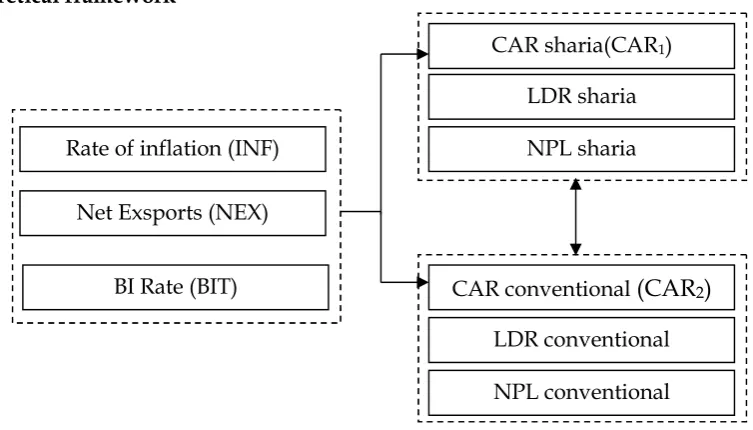
Theoretical framework
Source: Thought of the author
Figure 1
Scheme Theoretical Framework Research Hypothesis
Based on theoretical thinking and framework, the hypothesis is as follows: H1: The macroeconomic variables include
the rate of inflation , net exports and interest rate BI significant effect either
partially or simultaneously on both the CAR Islamic banks and conventi-onal banks.
H2: There is a difference between the
performance of Islamic banks with conventional banks in Indonesia. Rate of inflation (INF)
Net Exsports (NEX)
BI Rate (BIT)
CAR sharia(CAR1)
LDR sharia
NPL sharia
CAR conventional
(CAR
2)
LDR conventional
RESEARCH METHOD
This type of research used in this study was a descriptive study (study desktiptive) , correlation (correlational study) and compa-rative studies (compacompa-rative study). The sampling technique is purposive sample, in order to obtain three islamic banks officially recorded in Bank Indonesia with total assets of each operation as of October 2009, Bank Muamalat Indonesia is 15 trillion rupiah, Bank Syariah Mandiri amounting to 18 trillion rupiah and Bank Mega Syariah 5 trillion rupiah. While three conventional commercial banks will be examined with a total operational assets as of October 2009, each Bank UOB Buana is at 20.20 trillion rupiah, Bank Ekonomi Rahardja at 20.15 trillion rupiah and Bank Artha Graha International at 14.85 trillion rupiah.
Data used in this study are secondary data, ie data on the development of infor-mation inflation rate, net exports are obtain-ed monthly Bank Indonesia website (www. bi.go.id), and the Central Bureau of Statis-tics website (www.bps.go.id) starting from the period January 2005 to December 2012. while secondary data in the form of infor-mation BI rate, CAR, LDR and NPL obtain-ed from Bank Indonesia's banking state-ments for the same period.
Data analysis was performed with two events, namely the analysis of quantitative and qualitative analysis. The technique of quantitative analysis performed by data processing with SPSS 16.00. Based on analy-sis of the data include: a partial test (t test) and F-test, regression, and correlation to look for relationships between variables X (rate of inflation (INF), net exports (NEX) and the BI rate (BIT) with variable Y (CAR). As well as analyzing different test to see the comparison between the performance of Islamic banks with conventional banks as measured by CAR, LDR and NPL. In this research, the classical test assumptions that include test multicollinearity, autocorrela-tion and heterokedasitas (Gujarati: 1999).
Description of Macroeconomic Indicators
From the data obtained were proces-sed in mind that the average monthly infla-tion rate of the period 2005-2012 amounted to 0.590 which fluctuated. The highest infla-tion rate in October 2005 was 8.7 and the lowest was in February 2005 of -1.17. While the development of exports-imports (net ex-ports) Indonesia in the period January 2005 to December 2012 known to the average monthly value of net exports amounted to 1,884.908 which fluctuates with levels declining trend.
The highest value of net exports in December 2006 was the lowest 4641.920 and in October 2012 was -1,883.900. The deve-lopment of BI interest rate (BI rate) issued by Bank Indonesia in the period January 2005 to December 2012 showed an average rate of BI (SBI) is equal to 8.094 with monthly trend continues to decline. The highest interest rate of 12.750 BI occurred in the period November 2005-April 2006, while the lowest occurred during the year amounted to 5,750 in 2012.
Description of Bank Performance Indi-cators
islamic banks is higher than conventional banks. This provides information that islamic banks are more aggressive in giving credit to the people than the conventional banks.
Value average monthly NPL is known respectively by 2.82 and 3.24 where the overall NPL value of Islamic banks is lower than conventional banks. This provides information that lending by Islamic banks tend to be healthier than conventional banks.
Effect of Inflation (INF) , Net-Ex (NEX) and the BI Rate (BIT) to CAR Islamic Bank (CAR1) (First Structure)
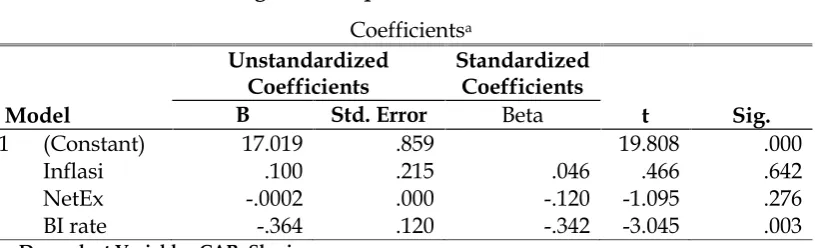
From the test results to - 4 that includes the classic assumption test multicollinearity, autocorrelation and heterokedasitas not finding a violation of the classical assump-tions, so that the multiple linear regression analysis can be used. From the data proces-sing has been done, obtained the following results.
Table 1
Regression Equations First Structure
Coefficientsa
Model
Unstandardized Coefficients
Standardized Coefficients
t Sig.
B Std. Error Beta
1 (Constant) Inflasi NetEx BI rate
17.019 .100 -.0002 -.364
.859 .215 .000 .120
.046 -.120 -.342
19.808 .466 -1.095 -3.045
.000 .642 .276 .003 a. Dependent Variable : CAR_Sharia
Source : SPSS
From the table above equation is obtained as follows: CAR1 = 17.019 + 0.100 INF
-0.0002 NEX - 0.364 BIT
From the results of the multiple linear regression equation of each variable can be interpreted that (a.) constants for 17,019 state that when inflation (INF), NetEx (NEX) and BI rate (BIT) is 0 (zero) and there is no change, then the CAR sharia (CAR1) will be
valued at 17,019, (b.) the value of variable X1
(inflation) has a regression coefficient of 0.100, meaning that when inflation (INF) has increased, while NetEx (NEX) and BI
rate (BIT) is constant, then the CAR sharia (CAR1) will increase by 0,100. (c.) the value
of the variable NEX (NetEx) has regression coefficient of -0.0002, meaning that when NetEx (NEX) have increased, while inflation (INF) and BI rate (BIT) is constant, then the CAR sharia (CAR1) will decrease by 0.0002.
(d.) BI rate value (BIT) has a regression coefficient of -0.364, meaning that when the BI rate (BIT) have increased while inflation (INF) and NetEx (NEX) is constant, then the CAR sharia (CAR1) will decrease by 0.364.
Table 2
Coefficient of Determination Model Summaryb
Model R R quare Adjusted R Square Std. Error of The Estimate
1 .408a .166 .139 2.02431
a. Predictors: (Constant), BI rate, Inflation, NetEx b. Dependent Variable: CAR_Sharia
The coefficient of determination is found to be 0.166 or 16.6 %. This shows that the three independent variables consisting of inflation (INF), NetEx (NEX) and the BI rate (BIT) contributing influence on sharia CAR of 16.6 %, while the remaining 83.4 % is the influence of other variables were not examined.
From the results of simultaneous hypo-thesis testing (test F) above, the value of the F-count equal to 6.116 and the F-table value of 2.704. From these values it appears that the value of the F-count is greater than the value of the F-table, meaning that three simultaneous independent variables consis-ting of inflation (INF) , Netex (NEX) and BI rate (BIT) significantly influence CAR sharia.
From the results of the partial hypo-thesis testing (t-test), the value of t-test for the inflation variable (INF) of 0.466 and t-value table for testing the two sides ± 1.986. From these values it is known that the value of t-test is between the value of t-table (-1.986 and 1.986), which means that the partial inflation (INF) had no significant
effect on CAR sharia. Note also the value of t-test for variables NetEx (NEX) of -1.095 with t-value table for testing the two sides ± 1.986. From these values it is known that the value of t-test is between the value of t-table (-1.986 and 1.986), which means that the partial NetEx (NEX) had no significant effect on CAR sharia. T-values obtained for the BI rate variable (BIT) of -3.045 and a t-table value for testing the two sides ± 1.986. From these values known that the t-test values are outside the t-table values (-1.986 and 1.986), which means that the partial BI rate (BIT) have a significant effect on CAR sharia.
Effect of Inflation (INF), NetEex (NEX) and the BI Rate (BIT) CAR to Conventional Banks (CAR2) (Second Structure)
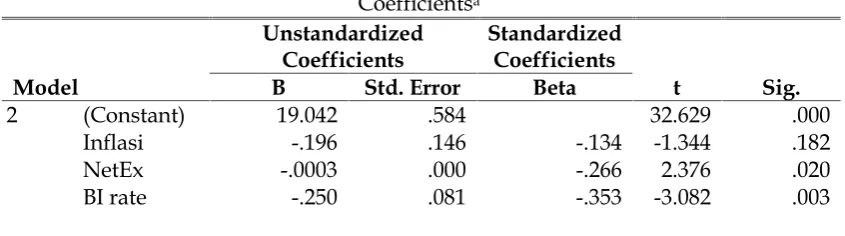
From the four classical assumption test results finding no violations of classical assumptions, so that the multiple linear regression analysis can be used. From the data processing has been done, obtained the following results:
Table 3
Regression Equations Second Structure
Coefficientsa
Model
Unstandardized Coefficients
Standardized Coefficients
t Sig.
B Std. Error Beta
2 (Constant)
Inflasi NetEx BI rate
19.042 -.196 -.0003 -.250
.584 .146 .000 .081
-.134 -.266 -.353
32.629 -1.344 2.376 -3.082
.000 .182 .020 .003
a. Dependent Variable : CAR_Conventional Source : SPSS
From the table above equation is obtained as follows: CAR2= 19.042-0.196 INF + 0.0003
NEX - 0.250 BIT
From the results of the multiple linear regression equation of each variable can be interpreted that (a.) constants for 19,042 state that when inflation (INF), NetEx (NEX)
and BI rate (BIT) is 0 (zero) and there is no change, then the conventional CAR (CAR2)
will be valued at 19,042, (b.) the value of variable INF (inflation) has a regression
CAR conventional (CAR2) will decrease by
0,196. (c.) the value of the variable NEX (NetEx) has regression coefficient of -0.0003, meaning that when NetEx (NEX) have increased, while inflation (INF) and BI rate (BIT) is constant, then the CAR conventional
(CAR2) will increase by 0.0003. (d.) BI rate
value (BIT) has a regression coefficient of -0.250, meaning that when the BI rate (BIT) have increased while inflation (INF) and NetEx (NEX) is constant, then the CAR conventional (CAR2) will decrease by 0.250.
Table 4
Coefficient of Determination Model Summaryb
Model R R Square Adjusted R Square Std. Error of The Estimate
1 .368a .135 .107 1.37495
a. Predictors: (Constant), BI rate, Inflation, NetEx b. Dependent Variable: CAR_Conventiona Source : SPSS
The coefficient of determination is found to be 0.135 or 13.5 %. This shows that the three independent variables consisting of inflation (INF), Netex (NEX) and the BI rate (BIT) contributing effect to the conventional CAR of 13.5 %, while the remaining 86.5 % is the influence of other variables not examined.
The results of simultaneous hypothesis testing (test F) above, the value of the F-count equal to 4,800 and the F-table value of 2.704. From these values it appears that the value of the F-count is greater than the value of the F-table, which means that three simultaneous independent variables consis-ting of inflation (INF) , NetEx (NEX) and BI rate (BIT) significantly the conventional CAR.
The results of the partial hypothesis testing (t-test), the value of t-test for the inflation variable (INF) of -1.344 and t-table value for testing the two sides ± 1.986. From the above values seen that the t-value of -1.344 obtained count is between the value of t-table (-1.986 and 1.986), which means that the partial inflation (INF) had no significant effect on CAR conventional. Note also the value of t-test for variables NetEx (NEX) of 2.376 and t-value table for testing the two sides ± 1.986. From the above values seen that the t-value of 2.376 obtained count is outside the value t-table (-1.986 and
1.986), which means that the partial NetEx (NEX) significantly affects the conventional CAR. T-values obtained for the BI rate variable (BIT) of -3.082 and t-table value for testing the two sides ± 1.986. From the above values seen that the t-value of -3.082 obtained count is beyond the t-table values (-1.986 and 1.986), which means that the partial BI rate (BIT) significantly affects the conventi- onal CAR.
Comparison Value CAR , LDR and NPL on Islamic Banks with Conventional Banks.
The results of the normality tests performed found that the three variables that the three variables to be compared are CAR, LDR and the NPL has been normally distributed, so the comparison test used is the parametric analysis of independent t-test. Comparison of test results using the t-test for CAR variables, t-test values obtain-ed at -13.741 and t-table value of ± 1.973 . From the values above that value t-count obtained at -13.741, are beyond the t-table values (-1.973 and 1.973), which means there are significant differences between CAR islamic banks with CAR conventional banks.
signi-ficant differences between the CAR islamic banks with LDR conventional banks.
Similarly to the known value of the NPL variable t count obtained at 2.771, t-value is outside the table (-1.973 and 1.973), which means there are significant differen-ces between the NPL islamic banks with NPL conventional banks.
CONCLUSION AND SUGGESTION
The results of simultaneous statistical tests indicate that macroeconomic factors consisting of inflation, net exports and the BI rate has a significant influence on the performance of both the islamic bank and conventional bank measured by the CAR, with a greater influence on bank sharia compared to conventional banks. The parti-al test results indicate that the BI rate has a significant effect on both the CAR islamic bank and conventional bank. Net exports only significantly affect the Bank's CAR Conventional but not significant at the islamic bank. While inflation does not have a significant effect on both the CAR islamic bank and conventional bank. The results of comparative analysis show that partially across the banking and financial perfor-mance indicators consisting of CAR, LDR and NPL have significant differences bet-ween islamic banking and conventional banking and the overall financial perfor-mance of islamic banks more better than conventional banks.
Research using macroeconomic varia-bles are limited to three indicators are used, namely inflation, net exports and BI rate thus have not been entirely able to predict the effect of a more comprehensive macro-economic conditions influence on the per-formance of banks, so for the next research is recommended to add other macro-economic variables such as unemployment rate, GDP, the adequacy of foreign exchange reserves, the government debt, exchange rate or the flow of funds investment (FDI). Study was limited using three indicators that reflect the performance of banking ie CAR, LDR and NPL, so for the next study to
add other indicators that describe the performance of a more comprehensive banking such as DER, ROA, ROE, NIM or using CAMEL others indicator. Subsequent research suggested using a data sample of a much comprehensive research in order to obtain a more comprehensive research results as well, especially in comparing the financial performance of islamic banks with conventional bank not only on the basis of the total value of its assets, but by way of entering into the sharia sample and the sample size added to conventional banking. Research was confined to macroeconomic conditions and banking in Indonesia. It is expected to further research related to the performance of islamic banking to use the comparator in overseas conditions like in Malaysia, and others contries.
REFERENCES
Auliyah, R dan A. Hamzah.2006. Analysis of Characteristics of Company, Indus-try, and Macro Economics to Return and Beta Shares Sharia. Proceedings. Accounting IX National Symposium, August 2006.
Bank Indonesia. 2010. Indonesian Economic Outlook.http://www.bi.go.id
Bank Indonesia. 2013. Financial Statements and Banking Publications: Islamic Banks period 2005–2012. http://www.bi. go.id
---. 2013. Financial Statements and Banking Publications: Foreign comer-cial banks. http://www.bi.go.id
---. 2013. BI Rate Monthly Data. http:// www.bi.go.id
---. 2013. Islamic Banking Statistics. http://www.bi.go.id
---. 2013. Indonesian Banking Statistics. http://www.bi.go.id
---. 2013. Indonesian Banking Architec-ture. http://www.bi.go.id
Biro Pusat Statistik. 2013. Consumer Price Index and Monthly Inflation Indonesia period 2005 – 2012. http://www.bps.go.id ---. 2013. Gross Domestic Product at
period 2005-2012 (billion IDR). http:// www.bps.go.id
---. 2013. Unemployment by Education Attainment periode 2004–2012. http:// www.bps.go.id
---. 2013. Indonesia's Monthly Export Data Period 2005–2012 in IDR. http:// www.bps.go.id
---. 2013. Indonesia's Monthly Import Data Period 2005–2012 in IDR. http:// www.bps.go.id
Bank Artha Graha Internasional. 2013. Publication Quarter Financial State-ments Period 2005-2012.
---. 2013. History and Corporate Profile. Bank Ekonomi Raharja. 2013. Publica-tion of Financial Statements Quarter Period 2005–2012.
---. 2013. History and Corporate Profile. Bank Muamalat Indonesia. 2013. Publication of Financial Statements Quarter Period 2005–2012.
---. 2013. History and Corporate Profile. Bank Mega Syariah. 2013. Publication of Financial Statements Quarter Period 2005–2012.
---. 2013. History and Corporate Profile. Bank Syariah Mandiri. 2013. Publica-tion of Financial Statements Quarter Period 2005–2012.
---. 2013. History and Corporate Profile. Bank UOB Buana. 2013. Publication of Financial Statements Quarter Period 2005 – 2012.
---. 2013. History and Corporate Profile. Baraba. 2007.Basic Principles of Islamic Banking Operations.
Dewi Siti Sundari. 2001. Effect of Economic and Corporate Performance to Property Sector Stock Price Index.Thesis. Gradu-ate Program. Magister Managemen. Semarang. Universitas Diponegoro. Depkeu. 2009. Handbook Period 2009 &
2010.
Firman, P. dan Jogiyanto H.M, 2002. Dyna-mic Relationship Between Stock Price Index and Exchange Rates In Economic Crisis in Indonesia. Proceedings. Natio-nal Symposium on Accounting 5.
Hamdan, U. and Wijaya, A. 2006. Compa-rative Analysis of Financial Risk between Conventional BPR and Sharia BPR. Journal of Management & Business Sriwijaya Vol. 4, No. 7.
Hamzah, A. 2005 Macroeconomic Analysis, Industrial and Corporate Characteris-tics Beta To Shariah Stocks.Proccedings. Accounting VIII National Symposium, September 2005.
……. 2008. Characteristics Analysis and
Macro Economics Company Stock
Return To Shariah and Non-Shariah. Proceedings. International Seminar and Symposium, Airlangga University, Sura-baya, August 2008
Hosen, A. 2007. Popular Dictionary of Finance and Islamic Economics. Jakarta: PKES
---,Setiawati. 2007.Practical Guide Using Islamic Banking Services. Jakarta. Kasmir. 2004. Manajemen Perbankan.
Jakarta: PT Rajagrafindo Persada. Latumaerissa.1999. Know the Aspects
-Aspects of Bank Operations Umum. Bumi script: Jakarta.
Suyanto, M. 2005.The Performance of Bank Muamalat Indonesia During 2000–2004: An Exploratory Study. (Thesis). STMIK AMIKOM Yogyakarta.
Muljono, T. P. 1999. Application Manage-ment Accounting in Banking Practice. Ed. 3 BPFE Yogyakarta
Susamto. and Cahyadi. 2008. Practice Islamic Economy and Its Implications on the Indonesian economy. Papers. Presented in the Studium Generale Forum of Islamic Economic Studies, UIN Sunan Kaliaga, April 2008.
Suyanto. 2008. Performance Comparison To Islamic Bank Owned Banks, Foreign Banks and Commercial Banks In Indonesia In Year 2000 - 2004. Journal. International Economic & Finance. Jakarta. Widjanarto. In 2003. Legal and Terms Banking in Indonesia. Graffiti. Jakarta Zainul, W. 2005. Analysis Influence of
Sector Index. Thesis. Program Pasca Sarjana Magister Managemen UNDIP. Zubaidah, S. 2009. Analysis of Effects of