GENDER AND
RESILIENCE
Virginie Le Masson, Andrew Norton and Emily Wilkinson
CONTACT THE AUTHORS
Dr Emily Wilkinson is a Research Fellow at the Overseas Development Institute and Head of Research for the BRACED programme. Her research focuses on the policy and institutional dimensions of disaster -and climate- risks, including incentives for risk-informed development planning.
@emilycwilkinson
Dr Virginie Le Masson is a research officer at the Overseas Development Institute, leading the research theme ‘Gender and social equality’ within the BRACED programme. Her research interests combine disaster risk reduction, social development, human rights and gender equality. She is currently co-editing a book documenting gender relations in the context of climate change. @Virginie_LeM
Dr Andrew Norton is a social analyst with twenty-five years of experience of development practice multilateral, bilateral and research organisations. His areas of
specialism include poverty analysis, social policy, sustainable development, climate action and human rights. Andrew is the Director of the International Institute for Environment and Development. Formerly he was Director of Research for ODI.
sharing their project proposals with the Knowledge Manager. The analysis written in this paper was based on early versions of proposals but these documents have evolved since they were submitted and reviewed. We therefore acknowledge that current IPs interventions might have taken different approaches than the ones we have analysed but we hope that recommendations will still be useful for current and future projects.
The authors would also like to thank all reviewers for their constructive comments and insights, in particular Dr. Katharine Vincent from Kulima, Dr. Maggie Opondo from the University of Nairobi, anonymous reviewers from the DFID BRACED steering committee, as well as Martin Van Aalst, from the Red Cross Climate Centre, Katie Peters and Sebastian Kratzer from ODI.
This paper focuses on 8 of the BRACED consortia, which are referred to by the name of their lead organisation.
The consortium led by NEF includes the International Institute for Environment and Development (IIED) and Innovation, Environnement and Développement en Afrique (IED Arfrique). Live-with-water is led by CRES and includes the University of Bonn, Swiss Tropical and Public Health Institute (TPH), Réseau des femmes pour le développement durable en Afrique (REDAF), Groupe Senghor, globalContact consulting (gcc), EAWAG Aquatic Research, BG Ingenieurs Conseils and Mandu Consulting. The consortium led by iDE includes SAPPROS, Rupantaran, RIMS Nepal, Renewable World, NTAG, Middlesex University, International Water Management Institute (IWMI), ADRA Nepal, CIMMYT and
Executive summary 7
Introduction 9
Methodology 12
1. Conceptualising gender 15
2. Why gender matters in resilience programming 18
3. Geography, environment and gender relations 24
4. Assessing gender mainstreaming in resilience programmes 28 5. The integration of gender in BRACED resilience projects 41 6. Challenges to adequately addressing gender equality 46
7. Recommendations 52
References 56
List of tables
List of boxes
Table 1: BRACED project proposals reviewed in this paper 13 Table 2: A gender perspective on the impacts of climate change
and disasters 22
Table 3: The distinction between practical and strategic gender needs 33
Box 1: The gender implications of environmental change combined
with development trends in Senegal 26
Box 2. Gender mainstreaming 29
Box 3: Mercy Corps’ experiences with resilience programmes in the Sahel 35 Box 4. Tools to support gender-sensitive resilience projects 40 Box 5. Checklist for monitoring gender outcomes in resilience projects
Executive summary
The contribution that external interventions make to individual, household and community resilience to climate extremes and disasters will largely depend on the suitability of those activities to the local context and the extent to which implementing agencies address existing social dynamics and power relations. Exploring the gender dimension of resilience to disasters and climate change encourages researchers and practitioners working in these fields to focus on people’s different relationships to the environment and access to resources. It also encourages them to assess how projects aimed at managing risk and building resilience are affected by social norms, including those pertaining to gender-based inequalities.
This paper reviews different approaches to incorporating gender equality objectives into resilience projects and to monitoring gender equality outcomes. It uses a sample of project proposals from DFID’s Building Resilience to Climate Extremes and Disasters programme (BRACED) and makes suggestions on ways to promote effective and consistent practice across the full range of projects. The methodology is twofold, involving a systematic review of how gender resiliencies are considered in the literature on disaster risk reduction and climate change adaptation and an analysis of project planning materials for eight of the 15 NGO projects being supported by BRACED.
8 GENDER AND RESILIENCE ExEcutivE summary
Introduction
The impacts of climate change, extreme weather events and slow-onset disasters are acutely felt along gender lines (Sultana, 2013; Vincent et al., 2014). However, there has been slow progress regarding recognition of the social dimensions of disaster risk and climate change (Moosa and Tuana, 2014), despite decades of research by sociologists and geographers showing how disasters are founded in social structures (Fothergill, 1996). There is growing evidence of the numerous ways in which women, men, children, older people, people with disabilities and ethnic minorities are vulnerable to environmental shocks and stresses, as well as how they mobilise different capacities to build their resilience. Adopting a gender lens helps to achieve a better understanding of the different experiences of disasters between men and women but also between individuals within those groups according to their age, ethnic origins or sexual orientation. This is crucial for generating greater awareness of the social equality dimension of environmental problems and fostering social inclusion of marginalised or disadvantaged groups in disaster risk reduction (DRR) and climate change adaptation (CCA) policies and programmes.
gender refers to the social differences, roles and expectations
accorded to women and men. These roles are learned, can change over time and are influenced by culture, education, class, economic and political environments, the media, crisis and conflicts (UNESCO, 2000)
gender equity is the process of being fair when addressing
10 GENDER AND RESILIENCE introduction
women and men from otherwise operating on a level playing field. Equity leads to equality (UNFPA, 2005)
gender equality refers to the equal rights, responsibilities
and opportunities of women, men, girls and boys. Equality between men and women is seen both as a human rights issue and as a precondition for, and an indicator of, sustainable people-centred development. (UNDP, 2014)
vulnerability can be described as the characteristics and
circumstances of a community, system or asset that make it susceptible to the damaging effects of a hazard (UNISDR, 2009).
adaptation designates the adjustment in natural or human
systems in response to actual or expected climatic stimuli or their effects, which moderates harm or exploits beneficial opportunities (UNISDR, 2009).
The BRACED programme supports 15 NGO consortia to
build the resilience of people to climate and weather extremes in 13 countries in the Sahel, East Africa and South Asia.1
These countries are characterised by high levels of disaster risk (Simonet et al., 2015) and are also considered to be fragile states, with many having experienced conflicts in recent years.2 BRACED also has an explicit focus on the resilience of women and children:
1 BracEd countries are: Burma, nepal, Ethiopia, Kenya, sudan, south sudan, uganda, Burkina Faso, chad, mali, mauritania, niger and senegal.
BRACED is expected to directly benefit up to 5 million
vulnerable people, especially women and children, in developing countries by helping them become more resilient to climate extremes. In addition, through helping improve national policies and institutions to better integrate disaster risk reduction (DRR), climate adaptation and development approaches, we expect the programme to indirectly help many millions more.3
The BRACED programme therefore offers a unique opportunity to conduct research on – and develop a deeper understanding of – some of the normative aspects of resilience, including gender and social inclusion dimensions (Bahadur et al., 2015).
A broad hypothesis of this research is that the contribution projects make to individual, household and community resilience will largely depend on the suitability of interventions to the local context, particularly in relation to the social dynamics and power relations that create differences in vulnerability. As a starting point for building equitable resilience, NGOs will need to understand patterns of gender and social relations in livelihood opportunities, vulnerabilities, capacities and adaptation practices, how these shape disaster impacts and the ways in which
different household and community members respond to such impacts. Gender-sensitive analysis can also be used to explore the influence that gender dynamics and social power relations have on project implementation and impacts. Hence, research conducted under BRACED can usefully be directed at exploring the links between gender and social equality and resilience through the study of interventions to support both, focusing on project design through to implementation and then monitoring and evaluation.
GENDER AND RESILIENCE 12
Methodology
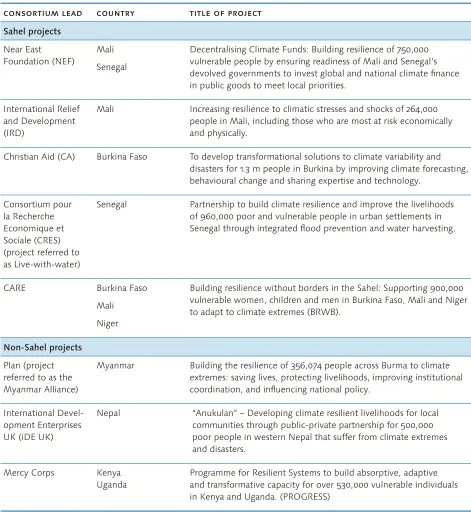
This paper has been prepared as a contribution – and introduction – to the BRACED research theme on gender and social equality. The specific objective here is to review explicit approaches to incorporating gender equality objectives, promoting gender-equitable processes and monitoring gender equality outcomes into resilience-building projects. For this study, we take a random sample of project proposals (eight projects were selected to reflect on the Sahelian contexts, East Africa and South Asia) and make suggestions as to ways of promoting effective and consistent practice across the full range of projects. The methodology is twofold: a broad scan of the academic and grey literature covering the gender dimension of resilience in the context of disaster risk and climate change and a review of final project planning material, as contained in the grant applications for eight of the BRACED projects (Table 1).
Table 1: BRACED project proposals reviewed in this paper
consortium lead country title of project Sahel projects
near East Foundation (nEF)
mali
senegal
decentralising climate Funds: Building resilience of 750,000 vulnerable people by ensuring readiness of mali and senegal’s devolved governments to invest global and national climate finance in public goods to meet local priorities.
international relief and development (ird)
mali increasing resilience to climatic stresses and shocks of 264,000 people in mali, including those who are most at risk economically and physically.
christian aid (ca) Burkina Faso to develop transformational solutions to climate variability and disasters for 1.3 m people in Burkina by improving climate forecasting, behavioural change and sharing expertise and technology.
consortium pour la recherche Economique et sociale (crEs) (project referred to as Live-with-water)
senegal Partnership to build climate resilience and improve the livelihoods of 960,000 poor and vulnerable people in urban settlements in senegal through integrated flood prevention and water harvesting.
carE Burkina Faso
mali
niger
Building resilience without borders in the sahel: supporting 900,000 vulnerable women, children and men in Burkina Faso, mali and niger to adapt to climate extremes (BrWB).
Non-Sahel projects
Plan (project referred to as the myanmar alliance)
myanmar Building the resilience of 356,074 people across Burma to climate extremes: saving lives, protecting livelihoods, improving institutional coordination, and influencing national policy.
international devel-opment Enterprises uK (idE uK)
nepal “anukulan” – developing climate resilient livelihoods for local communities through public-private partnership for 500,000 poor people in western nepal that suffer from climate extremes and disasters.
mercy corps Kenya uganda
14 GENDER AND RESILIENCE mEtHodoLoGy
Momsen (2010: 2) defines gender as ‘the socially acquired notions of masculinity and femininity by which women and men are identified’. Adopting a gendered perspective means giving consideration to the social differences between men and women and analysing their experiences in relation to places and their environments. Defining gender as a societal construct recognises that the diversity of social practices, beliefs, cultural behaviours, historical contexts and political structures all change the meaning of gender from one society to another and over time (McDowell, 1999).
1.
CONCEPTUALISING
GENDER
16 GENDER AND RESILIENCE concEPtuaLisinGGEndEr
“
Men and women face different
constraints in their daily lives and the
predominance of patriarchy typically
leads to the subordination of women
”
fighting for equal pay with their male counterparts when they occupy similar positions.
Giving attention to gender issues therefore involves focusing on the (in)equalities between men and women, along with the factors that cause them, in terms of their positions, needs and roles, specifically ‘the household tasks and types of employment socially assigned to women and men’ (Meer, 2007: 2). Furthermore, adequate attention to gender issues must be embedded in a wider recognition of social
differences and power inequalities. As underlined by Dankelman (2010: 11), ‘gender relations throughout the world entail
GENDER AND RESILIENCE 18
A focus on gender encourages researchers and practitioners in DRR and CCA fields to develop a deeper understanding of the consequences of disaster and climate change risk for people, not only according to their geographical location but also due to social roles and dynamics (Moosa and Tuana, 2014). It also highlights how disaster risk itself is shaped by social constructions of people’s relationships to the environment and access to
resources and therefore how projects to manage risk are affected by these social norms and constructs.
2.
WHY GENDER
MATTERS IN
RESILIENCE
PROGRAMMING
Social exclusion and climate
vulnerability
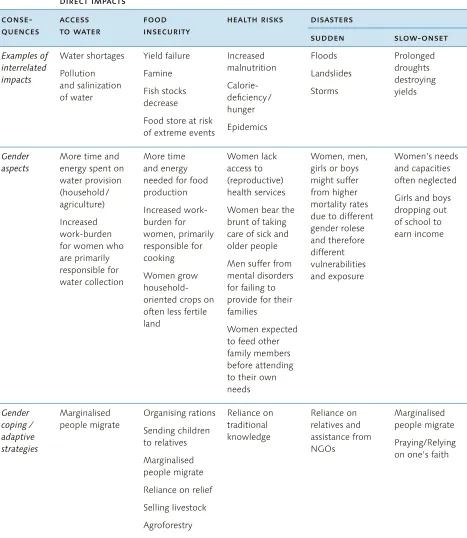
Gender-based inequalities and social exclusion are key factors undermining people’s and community’s capacities to cope with and recover from disaster risks and climate events. Socially constructed status, roles and norms are gendered and intersect with other social identities, such as age or ethnicity, to create unequal levels of marginalisation and access to assets between women and men, and girls and boys (Dankelman, 2010). The combination of power structures, intra-household dynamics, decision-making processes in and out of the home, as well as inequalities in terms of workloads, employment and income, restrict many women across the world from accessing and securing livelihoods and achieving control over their lives. This undermines their ability to anticipate and prepare for major disasters and shapes their susceptibility and exposure to climate extremes (Enarson and Morrow, 1998; Sultana, 2013) (see Table 2 for a gender perspective on how climate change affects people’s survival, livelihoods and rights).
“
Gender-based inequalities
and social exclusion are key
factors undermining people’s and
20
GENDER AND RESILIENCE WHy GEndEr mattErs in rEsiLiEncE ProGramminG
Social norms and vulnerabilities
in disaster-prone countries
Building and enhancing people’s resilience requires an understanding of social norms and other societal factors that maintain gendered power inequalities in different contexts and curtail women and girls’, as well as boys’ and men’s, abilities to reduce their vulnerability to environmental shocks and stresses. Harper et al. (2014: 2) define social norms as ‘the informal and formal laws, beliefs and practices that help to determine collective understanding of what are acceptable attitudes and behaviours. As such, they can either drive processes of social change or act as brakes and barriers to such processes’. These social norms, and the way they may be detrimental for the status and well-being of certain gender groups, are likely to differ significantly between and within the Sahel region, East Africa and South Asia, where they intersect with different manifestations of conflict, political instability and resource scarcity. Oxfam’s recent report on gender and resilience in the Sahel (Diarra Doka, et al. 2014) is one of the few available studies that reflect on the effectiveness of humanitarian interventions to enhance food security by looking at gender relations and norms in targeted communities.
Problems with gender-blind
interventions
hence reinforcing inequalities between dominant and minority groups (Masika, 2002).
Climate change and DRR fields have typically attracted
scientists, engineers and economists, all male-dominated sectors, shaping the way climate policies and projects are designed (Buckingham, 2010). Attention to gender thus serves not only to document differences of resilience practices and highlight inequalities but also to challenge existing male-dominated institutions and fields of practice.
“
If vulnerability and capacity
assessments (VCAs) ignore
inequalities and people’s different
needs, projects may fail to enhance
people’s livelihoods and therefore
their resilience
”
22
GENDER AND RESILIENCE WHy GEndEr mattErs in rEsiLiEncE ProGramminG
Table 2: A gender perspective on the impacts of climate change and disasters
direct impacts
Food store at risk of extreme events energy spent on water provision needed for food production oriented crops on often less fertile land
Women lack access to (reproductive) health services
Women bear the brunt of taking care of sick and older people men suffer from mental disorders for failing to provide for their families due to different gender rolese
Girls and boys dropping out
(Table 2 continued)
indirect impacts
conse-quences
increased poverty exacerbated conflicts generating and credit opportunities processes and services jeopardised
Local to national tensions
increased
displacements of rural poor
discriminatory social and cultural norms violation of human rights: stress factor increases
no / limited part in decision-making Lack of information
Lack of access to education
Gender aspects
Women working in informal sector most affected
costs for household budget increase (e.g. buying water)
reduced expenditures for other livelihoods (school fees, health care)
Poorest women living in insecure environments most at risk
Women and girls as primary victims of gender-based violence
increase in female headed
Households due to male out-migration migrants have limited land rights and are excluded from land planning
many women have restricted mobility
Gender-based violence at household level and in conflicts
children, particularly needs / priorities neglected Engaging in new income generation migrate to hide or take refuge in (idP) camps
migration as a coping strategy e.g. to seek employment / other sources of incomes
Gender groups set up grassroots organisations
men, especially older men, likely to have influence over local governance
GENDER AND RESILIENCE 24
The vulnerabilities of BRACED countries to climate extremes are likely to be exacerbated by climate change as well as other economic problems, such as market distortions and food prices spikes. Along with this, ongoing ethnic, territorial and political conflicts have caused forced migrations, further tensions and increased competition over access to critical natural and physical resources (Gubbels, 2012; Dasgupta et al., 2014). Existing and increasing pressures over water, food and energy, and resulting conflicts may exacerbate population displacement both within and between countries, thereby increasing insecurity. Pressure over access to food due to climate change is likely to maintain political instability, particularly in Africa. Between 1980 and 2001, popular discontent over livelihood insecurity was a contributing cause of many of the 95 attempted coups, 33 of which were successful (Wisner and al., 2007).
3.
GEOGRAPHY,
ENVIRONMENT
AND GENDER
RELATIONS
These trends all have significant gender and social dimensions. Shifts in agricultural patterns may alter the gender-based division of labour, for example, leaving men and women with different levels of exposure to climate risks and opportunities in addition to unequal workloads (Rossi and Lambrou, 2008). Research in Kenya indicates that a combination of poverty, droughts and violence have forced some pastoral communities to sell their land and their livestock, in order to move into urban areas to find work. This has led to children dropping out of school to engage in income generating activities, with girls particularly affected (North, 2010). The Ministry of Education indicates that, in Niger, 47,000 children were obliged to abandon school in 2012 because of the food crisis (Gubbels, 2012). Boys and young men often leave school to seek paid work, while girls have to bear additional tasks at home, although evidence has also shown that they too work for cash when there is a drought (Swarup et al., 2011; Plan, 2013). One study in Turkana, Kenya also found an increase in women-headed households, whose vulnerability is higher than women who are married, because the former cannot own livestock if they do not have a son or cannot afford to employ a herder (Omolo, 2010).
“
The Ministry of Education indicates
that, in Niger, 47,000 children were
obliged to abandon school in 2012
because of the food crisis
”
26
GENDER AND RESILIENCE GEoGraPHy, EnvironmEntand GEndEr rELations
(Skinner, 2011; Pinheiro, 2005) (see Box 1). Gender-based violence is already prevalent in many of the BRACED countries, particularly in Sub-Saharan Africa, where 65.6% of women who have had a partner at some time have experienced intimate partner violence, well above the global average of 26.4% (WHO, 2013). In Uganda, Zablotska et al., (2009) found that approximately 34% of
currently married women aged 15 to 24 had experienced physical violence, while 16% faced sexual coercion. Domestic violence has both immediate impacts on people’s vulnerability (i.e. poor physical and mental health status, missing work, out of pocket expenditures for accessing basic services and replacement costs) and long-term impacts on outcomes, in terms of mental health and accumulation of education, skills and experience within the workforce (Duvvury et al., 2013).
Box 1: The gender implications of environmental change combined with development trends in Senegal
In Senegal, decreased rainfall has had a negative impact on water access, particularly in areas where there are no bore-wells, electric wells, nor any connection to a water distribution network. Even when wells exist, they have been drilled with a 45 to 50 meters depth due to the downward trend of the low water table, but sometimes they do not even reach the drawing level. This situation contributes to worse living conditions, impedes women’s workloads (as they are primarily responsible for water collection) and changes people’s livelihoods.
and time spent on domestic activities. They constitute 66.8% of the unemployed population, although the absence of gender-disaggregated data hampers a realistic understanding of women’s contribution to the economy. Despite changing social dynamics in which women are claiming more freedom and getting more politically involved, they remain dependent on the environment, the opinion of their husbands and the expectations assigned to gender roles in public life.
Source: Dankelman et al. (2008)
GENDER AND RESILIENCE 28
P
olicy frameworks including gender
Gender sensitive policies and programmes recognise gender inequalities as an obstacle that may deprive one group of people of the same rights and opportunities as another more privileged group (with mostly women suffering from this lack / denial). These therefore promote measures to reduce gender inequalities and provide resources and services to address both men’s and women’s needs. The links between gender inequality and vulnerability to disasters and climate change have only recently been recognised in NGO programming and gender remains a separate field of policy and practice that has not been mainstreamed into other activities (Röhr, 2007; Dankelman, 2010; Fordham, 2012; Le Masson and Langston, 2014).
4.
ASSESSING GENDER
MAINSTREAMING
IN RESILIENCE
PROGRAMMES
‘Gender mainstreaming’ refers to the integration of gender concerns within policies and projects in order to overcome issues of marginalisation, invisibility and under-representation, both in people’s daily lives and within institutions (Dankelman, 2010) (see Box 2). For NGOs working on resilience, DRR and CCA projects, this entails giving consideration to – and actively promoting – gender equality across all interventions aimed at reducing risk and building capacities to cope with and adapt to climate extremes and disasters (see reports from UNISDR, 2009 and UNDP, 2010).
Box 2. Gender mainstreaming
Gender mainstreaming is not an end in itself but a strategy to achieve the goal of gender equality. Mainstreaming activities aim to ensure:
• The needs and interests of both women and men are taken into account systematically across all plans, programmes and projects and in an organisation’s structure and management.
• Women as well as men participate in defining objectives and planning so that development actions satisfy the priorities and needs of both women and men.
• The goal of gender equality is central to all activities – research, advocacy / dialogue, resource allocation, along with planning, implementation and monitoring of programmes / projects.
30
GENDER AND RESILIENCE assEssinG GEndEr mainstrEaminG in rEsiLiEncE ProGrammEs
[…] a strategy for making women’s as well as men’s
concerns and experiences an integral dimension of the design, implementation, monitoring and evaluation of policies and programmes in all political, economic and societal spheres so that women and men benefit equally and inequality is not perpetuated.
However, gender mainstreaming has been criticised for seeking to integrate gender into existing agendas where it could be made invisible by a lack of political will (Hannan, 2000). Mainstreaming approaches tend to be seen as the responsibility of gender coordinators or gender focal points alone and often fail to link gender to other social relations. Compared to mainstreaming gender equality goals, rights-based approaches are sometimes seen as more suitable for orienting development practices ‘towards social change in the interests of the vast majority who are excluded’ (Meer, 2007: 75).
Gender mainstreaming
in NGO practices
In light of the above, NGOs working under the BRACED programme are being asked to explain the impact of their
intervention on the situation of women and girls and be clear on, firstly, how they plan to empower women and, secondly, the data they will collect to assess the impact of resilience-building
activities on women and girls.
1. Projects recognise gender-based differences. 2. Projects target gendered needs.
3. Projects intend to produce transformations in gendered power relations.
4. Projects monitor and evaluate gender-related outcomes.
1. Projects recognise gender-based differences
32
GENDER AND RESILIENCE assEssinG GEndEr mainstrEaminG in rEsiLiEncE ProGrammEs
people’s resilience (Arora-Jonsson 2011; Sultana, 2013). Women and girls do face entrenched structural disadvantages in many societies, but focusing on women in isolation and not looking at their relations with men, boys and the wider communities, runs the risk of ignoring ‘the relational nature of gendered power and the interdependency of women and men, and [to] paint a distorted picture of women’s vulnerabilities, choices and possibilities’ (Demestriades and Esplen, 2009). In addition, Shaheen Moosa and Tuana (2014) stress that ‘a gendered focus on climate change must look not only at the vulnerabilities of women and of men, but also at the ways in which their knowledge and situations render them resilient’.
“
NGOs may choose to improve people’s
access to
equal
opportunities
”
2. Projects target gendered needs
Projects that recognise gender-based differences may
intentionally target activities in order to address the particular needs of gender groups for the sake of equality. In other words, NGOs may choose to improve people’s access to equal opportunities which sometimes necessitate targeting specific groups with special measures in order to compensate for the disadvantages they face (Leduc, 2009). NGOs may choose to work with both men and women but implement different activities in order to address different needs. A useful distinction is that of addressing women’s and men’s practical needs versus their strategic needs (or ‘strategic interests’) (Moser, 1993: 394) (see Table 3).
The fundamental difference is that if practical gender needs are met, the lives of women (or men) would be improved without challenging women’s subordinate position in society, whereas if strategic interests are met, the existing relationship of unequal power between men and women would be transformed (March et al., 1999). Men also have strategic needs and interests, although these are often overlooked in development projects. As underlined by March et al., (1999: 20), men ‘may aim to transform their own roles (in order to be able to take part in child-care or to resist conscription into a fighting force), or, on the other hand, they may resist women’s demands for more control over their own lives’.
Focusing on improving women’s well-being aims to compensate for their subordination, but there could be detrimental effects if this process excludes men and men’s perspectives and needs (Flood, 2007). Their exclusion may provoke hostility and retaliation against project activities and may intensify gender inequalities, since women still have to deal with patriarchal power relations. In contrast, the inclusion of men can make interventions more relevant and workable if Table 3: The distinction between practical and strategic gender needs
practical gender needs strategic gender needs
Practical gender needs are the needs [people] identify in their socially accepted roles in society. Practical gender needs do not challenge the gender division of labour or women’s subordinate position in society, although rising out of them. Practical gender needs are a response to immediate perceived necessity, identified within a specific context. they are practical in nature and are often concerned with inadequacies in living conditions such as water provision, health care and employment.
strategic gender needs are the needs women identify because of their subordinate position to men in their society. strategic gender needs vary according to particular contexts. they relate to gender divisions of labour, power and control and may include such issues as land rights, domestic violence, equal wages and women’s control over their bodies. meeting strategic gender needs helps women to achieve greater equality.
34
GENDER AND RESILIENCE assEssinG GEndEr mainstrEaminG in rEsiLiEncE ProGrammEs
they can engage in the renegotiation of gender relations and will also gain from increased gender equality. There is a tricky balance to manage, however, between involving men in gender and resilience programming and ensuring that they do not take over to maintain the status quo, to communicate a false sense of symmetry between women’s and men’s social positions, therefore weakening the impetus for justice for women.
“
Men also have strategic needs and
interests, although these are often
overlooked in development projects
”
The distinction between practical and strategic needs / interests is heuristic and not rigid at the level of project activities. A project geared towards improving water supply, for example, can be organised in such a way as to meet people’s practical needs (e.g. access to drinking water) as well as to promote goals of empowerment (e.g. through favoring women’s access to community water boards). Evidence in the literature suggests that women’s increased access to income generating opportunities and employment have led to changing gender roles and relations, greater bargaining power at household and community levels and greater control over marriage decisions for younger women, as well as greater mobility and freedom.5
3. Projects intend to produce transformations
in gendered power relations
Contemporary development and resilience building practices are more comfortable talking about ‘transformations’ in power relations than in the past, and may choose to use language that is more political in character than ‘strategic gender needs’. However, transformations in power relations face a number of obstacles. Women and other traditionally marginalised members of society experience unequal access to land, income, and others assets and rights (March et al., 1999) and those holding positions of power might not want the status quo to be transformed. In addition, those who are oppressed (c.f. Freire, 1993) might not realise their subordinate condition or want to challenge it if they are not able to articulate their strategic needs or to visualise a different order of power relations. Given these conditions, development practitioners often seek to transform unequal power relations by promoting people’s empowerment.
Box 3: Mercy Corps’ experiences with resilience programmes in the Sahel
Based on their research conducted in the Sahel region, Mercy Corps’ recommendations for integrating gender in their resilience programming include:
• fostering increased access to and control of capital for transforming unequal relationships and systems
36
GENDER AND RESILIENCE assEssinG GEndEr mainstrEaminG in rEsiLiEncE ProGrammEs
• focusing on inclusion as a necessary social dimension for household and community resilience.
Source: Mercy Corps (2014)
We rely on the following definition of empowerment by Naila Kabeer (1999: 437): ‘The expansion in people’s ability to make strategic life choices in a context where this ability was previously denied to them.’ Empowerment is about people -both women and men- taking control over their lives: having the power and capacity to claim their rights, set their own agendas, gaining skills, building self-confidence, solving problems and developing self-reliance (Rooke and Limbu, 2009). Accordingly, the UNESCO definition states that:
No one can empower another; only the individual can empower herself or himself to make choices or to speak out. However, institutions including international cooperation agencies can support processes that can nurture self-empowerment of individuals or groups.
This conceptualisation of empowerment points to an interesting dichotomy in the literature on women’s empowerment
“
A gender transformative approach
is thought to produce more lasting
development outcomes
”
One example of this dual approach is provided by CARE’s women’s empowerment framework, which considers that, in order to achieve the sustainable empowerment of each woman, strategies must therefore simultaneously address ‘the combined effect of changes in her own aspirations and capabilities, the environment that surrounds and conditions her choices, and the power relations through which she negotiates her path’ (CARE, 2010: 4). Overall, a gender transformative approach is thought to produce more lasting development outcomes: ‘from interventions that combine efforts to enhance access to resources, technologies and markets that understand and challenge the social context that enable inequalities to persist’ (Jost et al., 2014:10) (see box 3).
38
GENDER AND RESILIENCE assEssinG GEndEr mainstrEaminG in rEsiLiEncE ProGrammEs
Projects are never neutral, as they reflect an organisations’ values and priorities, but so-called neutral approaches usually fail to address the specific needs of gender groups and the constraints they face, leading to their concerns being overlooked (Leduc, 2009).
This useful distinction between addressing practical needs and fostering transformation of unjust power relations can be used to analyse BRACED NGOs’ different levels of ambition and their intended outcomes for gender equality.
4. The project monitors and evaluates
gender-related outcomes
A gender-sensitive monitoring and evaluation (M&E) approach can be used to assess the extent to which project outputs affect and benefit gender groups, how they address their respective needs, vulnerabilities and capacities and how they improve women’s and men’s wellbeing (Leduc, 2009). M&E of project outcomes will have to adequately reflect the gendered impact of the project and people’s empowerment, including the extent to which the project challenges traditional power relations. NGOs typically plan to collect gender-disaggregated data if they are using a gender-sensitive approach but this activity is not an end in itself. Gender-related outcomes (e.g. to improve women’s active participation in DRR decision-making) and related
The Afghanistan National Solidarity Programme (NSP)
evaluation report provides a useful example of gender-sensitive M&E (Beath et al., 2013). The NSP seeks to improve the access of rural villagers to basic services and foster local governance based on democratic processes and the creation of gender-balanced Community Development Councils (CDCs). The evaluation examines the mid and final-term impacts of NSP on villagers’ access to services and infrastructure; on the economic welfare of villagers; on local governance; on political attitudes and state-building; and on social norms. It finds that the NSP helped improve the access of villagers to basic utilities (e.g. clean drinking water), particularly women’s access to education, health care and counselling services. The evaluation also shows that mandating women’s participation in CDCs and project implementation results in increased participation of women villagers in local governance and increased male acceptance of women’s participation in public life. Other socio-economic impacts of NSP included increases in girls’ school attendance and improved economic perceptions and optimism among women in NSP villages.
In the context of BRACED, collecting gender and age disaggregated data among beneficiaries would not only
40
GENDER AND RESILIENCE assEssinG GEndEr mainstrEaminG in rEsiLiEncE ProGrammEs
Box 4. Tools to support gender-sensitive resilience projects Oxfam (2014) has produced a guide to developing gender-sensitive indicators to measure process, outputs and outcomes (see also Doss and Kieran, 2014).
The Women’s Empowerment in Agriculture Index (WEAI) also provides a useful example of a strategy to measure empowerment outcomes in the agriculture sector and to identify ways to overcome obstacles (USAID-IFPRI, 2012).
With CARE, the CGIAR (2014) produced a toolkit on participatory methods to address gender issues in the agriculture sector.
Oxfam’s research on gender and resilience in the Sahel provides recommendations for gender-sensitive support in food crises as well as data collection tools, including interview and focus group discussion guides to explore gender relations and social
The nature of the material in the BRACED projects reflects the classic distinction in the gender planning literature between strategic and practical gender needs. This is inherent to the material and specifically to the challenge of linking resilience building to women’s empowerment and gender equality. Many of the resilience-building activities being promoted in dryland areas, for example, directly address the everyday practical needs of women in climate-stressed communities – such as collecting fuel and water. At the same time, the structure of the proposal form explicitly asks the grantees to explain how the project will empower women, establishing a clear ex-ante assumption that some NGO activities will address power relations and meet some strategic needs.
5.
THE INTEGRATION
OF GENDER IN
BRACED RESILIENCE
PROJECTS
42
GENDER AND RESILIENCE tHE intEGration oF GEndEr in BracEd rEsiLiEncE ProJEcts
All eight proposals6 reviewed for this paper propose of a mix of activities that address both ‘practical’ and ‘strategic’ gender needs according to the Moser gender planning framework. Activities geared towards addressing practical gender needs include three types:
1. Contributions to lowering time and labour burdens for
household provisioning – with a particular focus on improving conditions for gathering fuelwood and water (e.g. consortia led by NEF, iDE UK).
2. Improving women’s income streams and livelihoods (Live-with-water and the Myanmar Alliance).
3. Contributions to improving nutrition and food provisioning, focusing both on strengthening purchasing power and on social norms about distributing food within the household (the latter targeting more people’s strategic interests). The approach to strategic gender needs (or transformations in gender power relations) has the following three strands within the NGO proposals that were reviewed for this paper:
1. Promoting women’s representation on community level action committees (consortia led by NEF, IRD, Live-with-water and the Myanmar Alliance) and otherwise involving women in planning and undertaking adaptation activities (consortium led by CA).
2. Seeking to engage men and community leaders in discussions about changing discriminatory social norms (consortia led by CARE and Mercy Corps).
3. Increasing women’s access to agricultural extension, land resources and credit (consortium led by CA). The proposal of the NEF-led project also indicates an intention to promote gender-sensitive budgeting in local administrations.
In general, activities aimed at meeting practical gender needs are planned more carefully throughout pathways to change than those referring to strategic needs. The assumptions underpinning the effect of activities designed to lead to changes in power relations are not clearly specified on the whole.
“
Sometimes the approaches to
women’s empowerment read
as somewhat optimistic
”
The inclusion of a question in the project proposal form about how projects will empower women and girls, runs the risk of making applicants to go through the motions. It should be acknowledged that supporting the empowerment of women and girls is a big ask over a three year project whereas empowerment processes and outcomes might need generations to occur. This is less likely to occur when ‘women’s empowerment’ is a sub-theme or a by-product and thereby not central to the project’s theory of change (ToC). In two proposals targeting Sahelian contexts, there are limited links between the section on women’s and girls’ empowerment and the project’s ToC.
Sometimes the approaches to women’s empowerment read as somewhat optimistic. For example, some propose to challenge the barriers that prevent women to help to participate in
44
GENDER AND RESILIENCE tHE intEGration oF GEndEr in BracEd rEsiLiEncE ProJEcts
environment in which women are empowered to make
decisions. In a patriarchal society where unequal gender power relations underpin the male identify and sense of self, engaging men to change gender norms is clearly going to be challenging. This difficult task is often treated as an afterthoughtwith a lack of explanation of the methodology required, while the somewhat easier task of building the resilience of livelihood systems has a more detailed focus in the majority of ToCs.
The proposal from the BRACED project in Myanmar shows a greater degree of depth in terms of ideas for promoting women’s agency and measuring impact than many others. Attention to gender is clearly incorporated into the overall ToC for the project and the proposal addresses a much more complex set of operational problems in relation to adaptation than the Sahel proposals, due to the much greater range of relevant climate hazards. There are, however, two areas where it could be stronger: the monitoring framework focuses on outputs rather than outcomes and the case for gender action to strengthen community resilience is not made. This is the case for most projects; the ways in which gender transformations are expected to improve household or community resilience are not specified in any detail. This constitutes an opportunity for IPs, and the overall BRACED programme, to document the alleged correlation between social equality and increased resilience.
The BRACED consortium in Nepal addresses a very broad range of climate hazards for high altitude communities
‘mini-ToC’ on gender power relations. The proposal does outline a commitment to exploring connections between building resilience and women’s empowerment – an idea that could be considered across all BRACED projects.
The BRACED Mercy Corps-led project operates in Karamoja in Uganda and Wajir in Kenya, with an approach built on
promoting governance and continual learning. The aim is to work comprehensively with budget and planning systems and different levels of government, linking with communities. Activities
aiming to foster gender empowerment are strongly integrated into the project’s ToC. However, the significant challenge of trying to transform gender norms in Somali and Karamojong cultures must be fully acknowledgedin order to adequately plan for approaches and activities required to achieving this transformation.
“
The significant challenge of trying
to transform gender norms in Somali
and Karamojong cultures is not fully
acknowledged
”
GENDER AND RESILIENCE 46
The BRACED project set reviewed here demonstrates an impressive resource base in terms of the range and quality of operational experience that the NGOs and their partners bring to the programme. Nonetheless, there are some challenges that need to be acknowledged from the start in relation to the gender equality elements, in order to be sure that project activities in this area are pragmatic and realistic from three perspectives: concept / design; operational feasibility; and practicality
of monitoring.
T
he conceptual / design challenge
As discussed above, the majority of projects reviewed here do not establish a strong link between the overall ToC for the project and a separate or ‘mini’ ToC of the relationship between
6.
CHALLENGES
TO ADEQUATELY
ADDRESSING
GENDER EQUALITY
gender empowerment and resilience. Doing this requires thinking through a potential two-way causality: dealing with the mechanism through which community level resilience building might act to strengthen gender equality; and the ways in which gender equality / women’s empowerment might act to strengthen community level resilience. Neither of these links can be assumed to work a priori, so both directions of influence need to be investigated in context and with attention to social norms. Understanding how empowerment might act to strengthen broader dimensions of resilience is important, but establishing a clear link and coherence between the overall intervention model for building resilience and the ways in which the project will fulfill women’s strategic and practical gender needs – and contribute to people’s empowerment – is even more critical. The design of the projects must rely on a clear understanding of context-specific gender norms and establish how the project activities intend to address, and even challenge, these norms in order to build people’s resilience. A gender-sensitive VCA prior to the implementation (see, for instance, CARE’s Gender Analysis Checklist7) can be used to inform practitioners about the roles of women and men and the gendered patterns of access and control over natural, socio-economic and political resources. This should guide the planning process.
Engaging with different gender groups and grassroots
organizations from the beginning will help the identification and implementation of gender-equitable activities. If it is not possible to involve targeted communities directly in the planning process, the expertise of a women’s organisation working in the sector, or at least the support of a gender specialist, should be obtained (Leduc and Ahmad, 2009).
48
GENDER AND RESILIENCE cHaLLEnGEs to adEQuatELy addrEssinG GEndEr EQuaLity
The operational challenge
Two kinds of goals are variously listed in the project documents in relation to transforming power relations: firstly, some projects outline ambitions of achieving fundamental changes in cultural gender norms over a short project lifetime and, secondly, many of the projects promote gender power transformations through women’s engagement / participation in community institutions. The second aim is arguably less ambitious but it is still challenging and requires careful specification in terms of the model of intervention. Afghanistan’s NSP has transformed gender dynamics in local governance but these changes were not identified until between five and 10 years after the programme started.
“
The majority of empowerment
activities require intensive and
extensive village-level animation
outreach
”
The GROOTS report Leading resilient development (Fordham et al., 2011) emphasises that developmental process of disaster resilience-building must foster and build upon long-term interactions with locally-based grassroots organisations and their partners, including government institutions and networks of women’s groups. If BRACED grantees aim to promote and sustain social change to reduce inequalities, they will benefit from working with both preexisting and newly constituted grassroots women’s (and men’s) groups. This should also be set out at the beginning.
A number of measures could therefore be put in place at the start to help guide implementation of gender equitable activities, particularly when collecting gender-disaggregated data (see Elias, 2013). These include:
• Ensuring there are sufficient funds to support gender-related activities and facilitate the participation of traditionally marginalised communities members.
• Establishing mixed-gender field teams.
• Identifying who the gatekeepers are in households and local communities and engage them as allies in the project (rather than focusing on women and bypassing men).
• Scheduling activities at times and places that are convenient for different gender groups.
• Making sure that field coordinators, facilitators and
50
GENDER AND RESILIENCE cHaLLEnGEs to adEQuatELy addrEssinG GEndEr EQuaLity
• Managing group dynamics and promoting the equal participation of all participants.
• After discussions with women’s and men’s groups separately, bring groups together to exchange and learn from people’s different perspectives.
The monitoring challenge
All of the NGO projects reviewed here outline their intention to collect disaggregated data at the intra-household level on a range of important areas (e.g. incomes, time budgets, asset holdings and expenditures). In the documentation, it is not clear exactly what that would mean but it could, for example, entail interviewing all members of the household (or at least all adult members). Alternatively, it might mean interviewing the household head and relying on his or her view of the disaggregated picture. The organisational demands of the former approach are vastly greater even if sampling techniques area used.
In short, the projects will need to develop a pragmatic approach that might, for example, involve the following steps:
1. Construct a sample of a size that the project M&E system can feasibly deal with and that includes both treatment and comparison communities.
2. Within that sample, interview one man and one woman in the majority of households in a given community (asking them to also speak for / answer questions on behalf of the other women and men in the household).
3. In one household per community, interview all the men and women in order to assess the difference between the data thus generated and the rest. If the data is significantly different, this evidence could be used to develop a formula to adjust the overall results.
Interestingly, the projects reviewed here did not on the whole seek to use perception data to measure empowerment outcomes. This is a relatively practical approach that can yield robust data on changing attitudes to, for example, the level of cultural acceptance of women in community leadership positions.8 Guidelines from Oxfam (2014), Doss and Kieran (2014) and CARE (2014) could support the identification of units of analysis and the development of indicators.
GENDER AND RESILIENCE 52
The BRACED knowledge management component offers a unique opportunity to compare a set of 15 interventions in contexts that have broadly similar geographical settings. It will also examine how addressing gender issues will contribute to the enhanced resilience of individuals and communities to climate and weather extremes.
On the basis of the projects reviewed here, a set of key recommendations can be made to the NGOs being supported under the BRACED programme and others working on
resilience projects:
• Early in the project lifespan, analyse the connections between the ‘mini-theories of change’ concerned with the ambitious goal of transforming gender relations and the overall ToC
7.
RECOMMENDATIONS
for the resilience project. Use this exercise to adjust the project activities and design for greater coherence, gender impact and effectiveness of monitoring approaches. Include, in this exercise, a thorough examination of the 2-way
causal relationships between women’s empowerment and community / household level resilience.
• All planned activities, not just those geared towards empowering women and girls, should consider the gender angle of their implementation and impact. This entails consideration of how activities are addressing people’s practical and / or strategic needs and whether or not they reinforce gender inequalities. A gender-sensitive VCA should be used to help inform project design and implementation. • Undertake a ‘reality check’ on ambitions to achieve
fundamental changes in cultural gender norms and women’s empowerment. Do this at the beginning of the project and return to the issue at the end of the first year to ensure that these ambitions are realistic and programming approaches are effective.
• Consider systematic collection of data on perceptions to capture changes in gender relations. Data on the acceptability of women engaging in community level governance has produced some of the clearest results in the evaluation of Afghanistan’s National Solidarity Programme (NSP). • Check across the full range of projects that approaches
to collecting disaggregated intra-household data are compatible and realistic.
54
GENDER AND RESILIENCE rEcommEndations
a consistent schema for outcome monitoring. These projects will interact with similar ecological, cultural and production systems, along with types of climate hazards (predominantly drought), hence a set of generic questions can be asked of all these projects to ensure gender–based outcomes for resilience are captured in project M&E (see box 5).
Box 5. Checklist for monitoring gender outcomes in resilience projects in the Sahel
Does the project’s baseline allow for monitoring changes in activities, perceptions and attitudes that relate to women’s agency? For example:
• Changing views on women’s role within the community. • Changing views on women’s role within the household. • Changes in the activity profile of women.
Does the project’s baseline allow for monitoring distributional issues within the household? For example:
• Are women and girls given less to eat of different kinds of food?
• In times of stress, does the responsibility for provisioning pass to mothers? What are the impacts at this point on women and children’s access to food?
Does the project’s baseline allow for monitoring changes in women’s time budgets and labour burden? For example: • Time taken throughout the year to gather fuelwood and
the trend over recent years (e.g. through PRA exercises). • Time taken throughout the year to gather water and
the trend over recent years.
account, through the life of the project? Does it allow this to be compared with the extent to which women and their children benefit from the common productive endeavours of the household as a whole (e.g. eating from the produce of the main family farm)?
What is the pattern of responsibility for cash expenditures for women and their children? When does the household or father pay for school costs, medical costs or clothing, and when does the mother have to find the money? Does the pattern change in times of crisis or stress? Does the project baseline allow for tacking changes in the pattern of responsibility for cash expenditures?
Does the project baseline capture asset holdings of women and how these compare with the overall holdings of the household and any assets held by individual men, particularly in terms of animals?
Does the project baseline capture women’s access to
land for farming / gardening so changes in this can be tracked?
Does the project baseline capture attitudes to gender
56
GENDER AND RESILIENCE rEFErEncEs
References
Alston, M. (2013) ‘Gender mainstreaming and climate change’, Women’s Studies International Forum 47(B): 287–294.
Anderson, S., Morton, J.F. and Toulmin, C. (2009) ‘Climate change for agrarian societies in drylands: implications and future pathways’. In Mearns, R. and Norton, A. (eds.), The Social Dimensions of Climate Change: Equity and Vulnerability in a Warming World. New Frontiers of Social Policy. Washington, DC: The World Bank, pp. 199–230.
Arora-Jonsson, S. (2011) ‘Virtue and vulnerability: Discourses on women, gender, and climate change’, Global Environmental Change 21(2): 744–51.
Bahadur, A., Wilkinson, E. and Tanner, T. (2015) ‘Resilience frameworks: a review’. London: Overseas Development Institute.
Barrett, K, Manfre, C. and Rubin, D. (2009) ‘Promoting gender equitable opportunities: why it matters for agricultural value chains’. Washington DC: USAID. (http://egateg.usaid.gov/sites/default/files/Promoting%20 Gender%20Equitable%20Opportunities%20-%20Why%20It%20 Matters%20for%20Agricultural%20Value%20Chains.pdf, accessed on the 1 April 2015).
Beath, A., Christia, F. and Enikolopov, R. (2013) Randomized Impact Evaluation of Afghanistan’s National Solidarity Programme. National Solidarity Programme (www.nsp-ie.org/reports/finalreport.pdf).
Booth, D., Cammack, D., Harrigan, J., Kanyongolo, E., Mataure, M., & Ngwira, N. (2006) Drivers of Change and Development. London: ODI
Buckingham, S. (2010) ‘Call in the women’, Nature 468(7323) 502.
Calzadilla, A. et al. (2009). ‘Economy-wide impacts of climate change on agriculture in Sub-Saharan Africa’. Working Paper FNU-17. Hamburg: Hamburg University, pp.150–165 (www.fnu.zmaw.de/fileadmin/fnu-files/ publication/working-papers/CalzadillaFNU170.pdf).
CARE (2010) ‘Adaptation, gender and women’s empowerment. CARE International Climate Change’. Working Brief. Atlanta: CARE (www.care. org/sites/default/files/documents/CC-2010-CARE_Gender_Brief.pdf).
Castillejo, C. (2011). Building a State that Works for Women. Madrid: FRIDE
Cornwall, A., & Edwards, J. (eds.) (2014) Feminisms, empowerment and development: changing women’s lives. London: Zed Books
Dai, A. (2012) ‘Increasing drought under global warming in observations and models’, Nature Climate Change 3: 52–58.
Dankelman, I., Ahmed, W.B, et al. (2008) Gender, Climate Change, and Human Security: Lessons from Bangladesh, Ghana, and Senegal. New York: The Women’s Environment and Development Organization.
Dankelman, I. (2010) Gender and Climate Change. An Introduction. London: Earthscan.
Dasgupta, P., Morton, J. F., Dodman, D., Karapinar, B., Meza, F.,
Rivera-Ferra, M.G., Toure Sarr A., and Vincent, K.E. (2014) ‘Rural Areas’, in Field, C.B., Barros, V.R., Dokken, D.J., Mach, K.J., Mastrandrea, M.D., Bilir, T.E., Chatterjee, M., Ebi, K.L., Estrada, Y.O., Genova, R.C., Girma, B., Kissel, E.S., Levy, A.N., MacCracken, S., Mastrandrea, P.R. and White, L.L. (eds.), Climate Change 2014: Impacts, Adaptation and Vulnerability. Part A: Global and Sectoral Aspects. Contribution of Working Group II to the Fifth Assessment Report of the Intergovernmental Panel on Climate Change(eds.). Cambridge and New York: Cambridge University PressNew York, pp.613–657
Demetriades, J. and Esplen, E. (2015) ‘The Gender Dimensions of Poverty and Climate Change Adaptation’ IDS Bulletin 39(4): 24–31.
Diarra Doka, M., Madougou, D. and Diouf, A. (2014) ‘Food crisis, gender, and resilience in the sahel. Lessons from the 2012 crisis in Burkina Faso, Mali, and Niger’ in Oxfam Research Report. Oxford: Oxfam.
Domingo, P., Holmes, R., O’Neil, T., Jones, N., Bird, K., Larson, A.,
Presler-Marshall, E. and Valters, C. (2015) Women’s voice and leadership in decision-making Assessing the evidence. ODI
Doss, C. and Kieran, C. (2014) ‘Standards for collecting sex-disaggregated data for gender analysis: a guide for CGIAR researchers’. CGIAR Washington: Gender and Agriculture Research Network.
58
GENDER AND RESILIENCE rEFErEncEs
ECOSOC (1997) ‘Chapter IV. Coordination of the policies and activities of the specialized agencies and other bodies of the United Nations system’. A 52/3. New York: ESOC
Elias, M. (2013) ‘Practical Tips for Conducting Gender-responsive Data Collection’. Rome: Bioversity International. (www.bioversity international.org/uploads/tx_news/Practical_tips_for_gender_ responsive_data_collection_1658_02.pdf accessed on 31 March 2015).
Enarson, E. and Morrow, B. (eds.), (1998) The gendered terrain of disaster: through women’s eyes. Westport, CT: Praeger Publishers.
Eyben, R., and Napier-Moore, R. (2009) ‘Choosing words with care? Shifting meanings of women’s empowerment in international development’, Third World Quarterly 30(2): 285–300.
FAO/CGIAR. (2012) ‘Training Guide. Gender and climate change research in agriculture and food security for rural development. CGIAR research program on climate change, agriculture and food security’. Rome: CCAFS.
Flood, M. (2007) ‘Involving men in gender policy and practice’. Critical Half: Bi-Annual Journal of Women for Women International 5(1): 9–13.
Fordham, M., Gupta, S., Akerkar, S., and Scharf, M. (2011) ‘Leading Resilient Development: Grassroots Women’s Priorities, Practices and Innovations’. New York: Groots (www.undp.org/content/dam/aplaws/ publication/en/publications/womens-empowerment/leading-resilient-development---grassroots-women-priorities-practices-and-innovations/ f2_GROOTS_Web.pdf)
Fordham, M., Ariyabandu, M. M., Gopalan, P. and Peterson, J, K. (2006) ‘Please don’t raise gender now – we’re in an emergency!’ World Disasters Report 2006, Chapter 6. Geneva: International Federation of Red Cross and Red Crescent Societies (www.ifrc.org/ publicat/wdr2006/summaries.asp).
Fordham, M. and Ketteridge, A-M. (1998) ‘”Men must work and women must weep”: examining gender stereotypes in disasters’ in Enarson, E., and Morrow, B. H. (eds.), The gendered terrain of disaster: through women’s eyes, Westport, CT: Praeger Publishers.
Fordham, M. (2012) ‘Gender, sexuality and disaster’, in Wisner, B., Gaillard, J.-C. and Kelman, I. (eds.), The Routledge Handbook of Hazards and Disaster Risk Reduction. New York: Routledge 711–722.
Fothergill, A. (1996) ‘The neglect of gender in disaster work: An overview of the literature’,International Journal of Mass Emergencies and Disasters 14(1): 33–56.
Freire, P. (1993) Pedagogy of the oppressed, New revised 20th-Anniversary ed., New York: Continuum.
Gubbels, P. (2012). ‘A new drumbeat for the Sahel’, Humanitarian Exchange Magazine 55(September 2012). London: HPN (www.odihpn.org/ humanitarian-exchange-magazine/issue-55/a-new-drumbeat-for-the-sahel).
Hannan, C. (2000) ‘Promoting Equality between Women and Men in Bilateral Development Cooperation. Concepts, goals, rationales and institutional arrangements’. Thesis / Lund University, Dept. of Social and Economic Geography. Lund: Lund University.
Harper, C. Nowacka,K., Alder, H. and Ferrant, G. (2014) ‘Measuring women’s empowerment and social transformation in the post-2015 agenda’. London: ODI /OECD ( www.oecd.org/dev/poverty/ODI%20-%20post-2015%20social%20norms_final.pdf).
Jost, C., Ferdous, N., Spicer, T. D. (2014) ‘Gender and Inclusion Toolbox: Participatory Research in Climate Change and Agriculture. CGIAR Research Program on Climate Change, Agriculture and Food Security (CCAFS)’. Copenhagen: CARE International and the World Agroforestry Centre (ICRAF) (www.ccafs.cgiar.org).
Kabeer, N. (1999) ‘Resources, agency, achievements: Reflections on the measurement of women’s empowerment’, Development and change30(3): 435–464.
Koester, D. (2015) ‘Gender and Power’. Development Leadership Program Concept Brief 04 (http://publications.dlprog.org/Gender&Power.pdf, accessed: 2 June 2015)