Jurnal Kesehatan Masyarakat
http://journal.unnes.ac.id/nju/index.php/kemas
PREVALENS DIABETES MELLITUS DAN TUBERKULOSIS PARU
Lintang Dian Saraswati
Dosen Jurusan Kesehatan Masyarakat Universitas Diponegoro, Semarang, Indonesia
Info Artikel
Sejarah Artikel:
Diterima 14 November 2013 Disetujui 28 November 2013 Dipublikasikan Januari 2014 Keywords:
Diabetes mellitus; Characteristics; Pulmonary TB.
Abstrak
Tuberkulosis paru adalah penyakit menular yang disebabkan oleh Mycobacterium tuberculosis. Insidens kumulatif di Indonesia tahun 2012 adalah 189 kasus per 100.000 populasi dan angka kematiannya sebesar 27/100.000. Faktor risiko penyakit tuberkulosis paru antara lain adalah riwayat diabetes mellitus yang dapat mengakibatkan meningkatnya kerentanan terhadap bakteri tuberkulosis atau memperpanjang waktu pengobatan tuberkulosis. Tujuan dari penelitian ini adalah menggambarkan karakteristik responden, riwayat penyakit penyerta (Diabetes Mellitus) dan status merokok di antara pasien tuberkulosis paru di Semarang Utara. Penelitian ini adalah studi observasional dengan desain potong lintang. Penelitian ini dilakukan di Semarang Utara dengan jumlah sampel sebanyak 60 responden. Analisis data menggunakan chi-square test. Hasil penelitian menunjukkan ada hubungan antara riwayat Diabetes Mellitus dengan tuberkulosis paru (26,7%), p value = 0,038, OR=5,092; 95%CI= 0,981- 26,430. Dapat disimpulkan bahwa prevalens tuberkulosis paru dan Diabetes Mellitus sebesar 16,7% dan Diabetes mellitus berhubungan dengan insidens tuberkulosis paru.
PREVALENCE DIABETES MELLITUS AND PULMONARY TUBERCULOSIS
Abstract
Pulmonary TB is an infectious disease caused by Mycobacterium tuberculosis. he inci-dence of pulmonary TB in Indonesia 2012 was 189 cases in 100,000 populations and the mortality rate was 27/100,000. here are several risk factors of pulmonary TB, e.g. history of diabetes mellitus that causes an increased susceptibility to pulmonary TB germs and smoke. he purposes of this study were to describe the characteristics of respondent, his-tory of co-morbid disease (Diabetes Mellitus) and status of smoking among adult patient of Pulmonary TB in North Semarang Sub District. he type of this study is observational analysis with cross sectional design. he study was conducted in North Semarang with 60 samples. he data analysis was performed by distribution of frequency and chi-square test. he results showed was a relationship between history of Diabetes Mellitus and pulmonary TB (26.7%), p value = 0.038, OR=5.092; 95%CI= 0.981- 26.430. It can be conclude that the prevalence of Tuberculosis and Diabetes Mellitus was 16.7% and Diabetes mellitus have a relationship with the incidence of pulmonary TB.
© 2014 Universitas Negeri Semarang
Alamat korespondensi:
Fakultas Kesehatan Masyarakat, UNDIP, Semarang Email : [email protected]
Introduction
Pulmonary TB is an infectious disease caused by Mycobacterium tuberculosis. Usually the most common infection is the lungs but can afect other organs. his disease can be trans-mitted from person to person via droplets from infected persons with pulmonary TB (WHO, 2011). Pulmonary TB still remains a signii-cant health problem for the people around the world. Approximately 75% of TB patients are people in the productive age group (WHO, 2011). he incidence of pulmonary TB in Indo-nesia 2012 was 189 cases in 100,000 population and the mortality rate was 27/100,000. In Se-marang city year 2011, the numbers of smear-positive patients were 557 people.
here are several diseases as co-morbid-ities tuberculosis disease such as HIV / AIDS, acute hepatitis, chronic liver disorders, kidney disorders, and diabetes mellitus (Simbolon, 2007; Randy A, 2011). Research conducted by Tanjung obtain the result that of 733 patients with pulmonary TB, the patient also 11.7% had diabetes mellitus, 9.28% had high blood pres-sure, 2.7% had liver disorders, 1.9% had heart disorders, and 0.9% had renal abnormalities (Tanjung, 1998).Patients with diabetes mellitus have a risk 2-3 times more oten for pulmonary tuberculosis disease. Indra Janis’s research re-sult in 2008 shown that from 46 patients with lung TB DM, DM controlled with pulmonary TB was 35 patients (76.1%) and pulmonary TB with DM uncontrolled was 11 patients (23.9%) (Wang, 2009).
Pulmonary TB and smoking are the two signiicant and inter-related public health problem (Minto, 2009; Simbolon, 2007; Sugiarto, 2004). Smoking may interfere with the efectiveness of most of the defense mechanism of respira-tion. Smoking can stimulate the formation of mucous and reduce the movement of cilia therefore there is accumulation of mucous and increasing risk of bacteria growth, including mycobacterium tuberculosis, that can cause in-fection (Orme, 2001).
From the results of previous studies in diferent countries showed that smoking had a relationship with the incidence of pulmonary TB. here was a relationship between smoking and pulmonary tuberculosis (Minto, 2009). he
risk of TB infection in smokers is increasing 1.77 to 1.9 times than nonsmokers. he aims of the study are to describe the characteristics, the history of Diabetes Mellitus and the smoking status of adult pulmonary tuberculosis patient in Semarang.
Method
he type of this study is observational analysis with cross sectional design. he study was conducted in North Semarang. he popu-lation in this study is people aged 15 years or older who live in the District of North Sema-rang at least one year from January to Decem-ber in 2012. Samples were 60 people calculated using sample size sotware to obtain minimal sample size.
Primary data obtained directly through interviews with respondents using question-naires, smear examination and measurement of blood sugar. he data analysis was performed by distribution of frequency and chi-square test.
Result and Discussion
he results showed most of respondents were in productive age (16-50 years old), were married, have a middle income, almost equal in sex and educational background. Approximate-ly 75% has an occupation with a greater risk for pulmonary TB (Table 1).
he diferences in age groups have an equal opportunity to experience pulmonary TB. his is because in these age groups have the same chance of contact with the exposure factors that already exist in the surrounding environment (Sugiarto, 2004). Researchers also assume that the incidence of pulmonary TB can occur in all age groups, when the source is transmitting the surrounding environment. Lower body resistance, unhealthy housing en-vironment, can cause people to be easily in-fected with pulmonary TB disease, regardless of age group.
at-tacks the most vicious and oten kills women. he new cases of Tuberculosis in Indonesia attacked most women in the most produc-tive age and woman’s death from tuberculosis more than deaths due to pregnancy, child-birth and postpartum. In contrary, the num-ber of patients with pulmonary TB as much as 51.88% in men slightly more than women 48, 12%, so these results suggest that gender both men and women have the same risk of developing pulmonary TB (Supriyono, 2003). Researchers also considered that the occur-rence of pulmonary TB both men and women have an equal opportunities afected
pulmo-nary TB, because TB is contagious and attacks the lungs of people with the condition of worsen-ing nutrition and unhealthy housworsen-ing, regardless of their sex.
People with low education will limited the information about the symptoms and treat-ment of tuberculosis. Health education should be done to the problem Tuberculosis through television, newspapers, radio, schools, etc.) so that people understand the modes of trans-mission of the disease and how to prevent it.
he lacking of level of education and knowledge
will cause pulmonary TB patients do not un-derstand the importance of regular medical treatment. Once the researchers also considered that the level of one’s education can afect the behavior of individuals or communities on the incidence of pulmonary TB. Health education is expected to create public attitudes to healthy living.
here were 90% of TB patients in the world attack the group with weak or poor socio-economic (Achmadi, 2005). Likewise, the results showed that 3 or 4 months of work will be lost because someone is ill TB. his could potential-ly cause the loss of 20-30% of household income in a year. When someone dies from TB, then the family will lose about 13-15 years of income due to the head of his family died of tuberculosis. People who are low socioeconomic or poor, causing malnutrition, living in places that are not healthy and cannot maintain of good health, became ill. his greatly afects the spread of dis-ease, especially pulmonary TB.
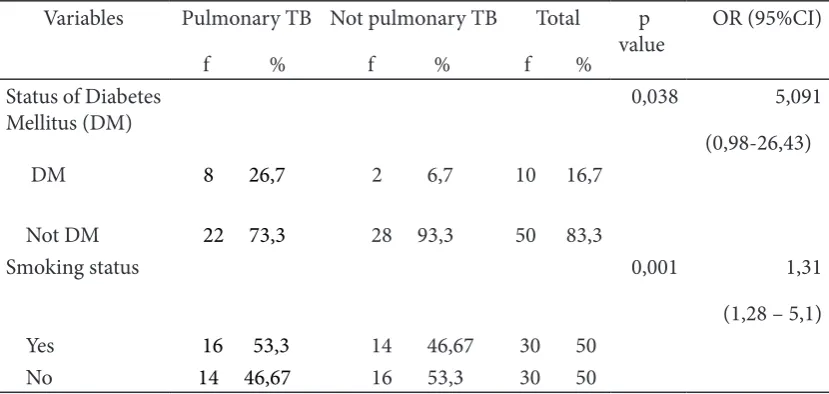
he prevalence of pulmonary TB and Diabetes Mellitus was 16.7%. Respondents who had Diabetes Mellitus (DM) were found more in respondent who had infected pulmonary Tb (26.7%) than in non-pulmonary TB patients (6.7%). While in respondents who do not have Diabetes Mellitus (DM), the number of pa-tients who sufer from pulmonary TB (73.3%) was less than the non-patients (93.3%). Results of test calculations with chi square statistic ob-tained p = 0.038; OR = 5.092, 95% CI = 0.981 to 26.430 which indicates that a history of diabetes mellitus associated with adult pulmonary TB incidence in districts of North Semarang. he risk was 5.091 times greater than people with no history of diabetes mellitus (Table 2).
he increasing risk pulmonary
tuber-Table 1. he characteristic, history of Diabetes Mellitus and status of smoking of the respond-ent in Semarang 2012
Variable f % Status of Diabetes Mellitus
DM 10 16,7
Not DM 50 83,3
Smoking status
Yes 30 50
culosis in Diabetes Mellitus patient might be caused by a defect in alveolar macrophages or T lymphocytes. here was an increase in the number of mature alveolar macrophages in pa-tients with active pulmonary TB (Wang, 2009). Possible causes of the increasing of pulmonary TB in people with diabetes mellitus may be a defect in the function of immune cells and host defense mechanisms. Underlying mechanisms of this are still not understood until now, al-though there have been a number of hypotheses about the role of cytokines as a molecule that is important in human defense mechanisms against TB. In addition, there is also a reduced bactericidal activity of leukocytes in patients with diabetes mellitus, especially in those who had bad blood sugar control (Jeon, 2008). Diabetes Mellitus can increase the frequency and severity of an infection. It is caused by abnormalities in cell-mediated immunity and phagocyte function associated with hypergly-cemia, including reduced vascular.
he prevalence of respondent who smoke and had pulmonary tuberculosis was 50%. In this study, the status of smoking not signiicantly associated with pulmonary TB. It may happen because the respondents live in similar environment (areas with high resi-dential density), and also most smokers have a cigarette type, smoking status and duration of smoking were similar. Most smokers smoke cigarettes with ilter and have been smoking in
the long term. Most of (80%) of respondents who smoked had become smokers more than 5 years and more than 50% of respondents who smoke are heavy smokers who consumed> 10 cigarettes per day. It shows that the respondents already had a very high exposure to cigarette for a long time.
Conclusion
he prevalence of Tuberculosis and Dia-betes Mellitus was 16.7% and DiaDia-betes mellitus have a relationship with the incidence of pul-monary TB. It is suggested for pulpul-monary tu-berculosis patients to keep in diet and exercise to decrease blood sugar in term to prevent from prolonging tuberculosis medicine.
References
Minto T A.J Suripatty N, Resianti D. 2010. Kajian Faktor Risiko Tuberkulosis Di Kabupaten Seram Bagian Timur Tahun 2009. Jurnal Warta Gerdunas TB, 16: 4
Orme I.M. 2001. he Latent Tuberculosis bacillus.
Int J Tuberc Lung Dis 5:589-93
Randy Adhi Nugroho. 2011. Studi Kualitatif Faktor yang Melatarbelakangi Drop out Pengobatan Tuberculosis Paru. Jurnal Kemas, 7 (1): 83-90 Simbolon, D. 2007. Faktor Risiko Tuberculosis Paru
di Kabupaten Rejang Lebong. Jurnal Keseha-tan Masyarakat Nasional, 2 (3)
Sugiarto, Agus. 2004. Faktor-faktor Yang
Mempe-Table 2. he relationship between status of DM and smoking with Status of pulmonary TB
Variables Pulmonary TB
ngaruhi Kejadian Tuberkulosis Paru BTA + Pada Penghuni Rumah Kebun Di Bengkulu Utara. Tesis, Fakultas Kesehatan Masyarakat Universitas Indonesia
Supriyono, Didik. 2003. Lingkungan Fisik Rumah Sebagai Faktor Risiko Terjadinya Penyakit TB Paru BTA + Di Kecamatan Ciampea Ka-bupaten Bogor. Tesis, Fakultas Kesehatan Masyarakat Universitas Indonesia
Tanjung A, dkk. 1998. Masalah Tuberkulosis Paru di Bagian Penyakit Dalam RS Pirngadi Medan.
Medika, 48(10):804-10
Wang CS YC, et.al. 2009. Impact Of Type Diabe-tes On Manifestations And Treatment Out-come Of Pulmonary Tuberculosis, Epidemi-ologi Infect, . Impact Of Type Diabetes On Manifestations And Treatment Outcome Of Pulmonary Tuberculosis. Epidemiologi In-fect,137: 203-10