Alpha-amylase Inhibition and Brine Shrimp Lethality Activities of Nine Medicinal Plant Extracts Selected from South-West Nigerian Ethnomedicine
Ogbole Omonike Oluyemisia, Aliu Latifat Olabimpea, Abiodun Oyindamola Olajumokeb, Ajaiyeoba Edith Oriaburea*
a. Department of Pharmacognosy, University of Ibadan, Ibadan, Nigeria
b. Department of Pharmacology and therapeutics, University of Ibadan, Nigeria
* Author for correspondence
Email: [email protected]
Phone no: +2348023222796
Alpha-amylase inhibitors derived from plants posed a new dimension in drug design for the treatment of postprandial hyperglycemia, a major concern for type-2 Diabetes. This has necessitated the screening of a large number of ethno medicinally indicated plants from South– West Nigeria for α-amylase inhibitory activity.
Nine medicinal plants were selected, extracted into methanol and subsequently screened for alpha-amylase inhibition. Toxicity of plant extracts was determined by brine shrimp lethality assay (BSLA). The most active plant, Nauclea diderrichii Merr., was fractionated into four solvent systems (n-hexane, ethyl acetate, dichloromethane and n-butanol). Fractions obtained were also tested.
Results indicated that all extracts showed varying degree of alpha-amylase inhibition, N. diderrichii had IC50 = 248.30 ± 0.27 µg/mL, the highest inhibitory activity while its butanol
fraction with IC50 = 137.8 µg/mL had activity comparable to the standard drug, acarbose (IC50 =
177.50 ± 0.42 µg/mL). The LC50 values for BSLA ranged from 11.35 to 1127.50 μg/mL.
Tetracera scandens L., was the most toxic with 11.35 µg/mL.
KEYWORDS Alpha-amylase inhibitors, Postprandial Hyperglycemia, Brine Shrimp Lethality Assay, Nauclea diderrichii.
INTRODUCTION
Health management through traditional herbal medicine is gaining importance as it is posing a re-emergence for the treatment of various lifestyle disorders with minimum side-effects (2), Plant based herbal medicine system continues to play a frontline role in health management with more than 80% of the world’s population relying on traditional medicine for their primary health care (9).
Diabetes mellitus is a group of metabolic disorders characterized by high blood glucose (hyperglycemia) resulting from defects in insulin secretion, insulin action, or both. The chronic hyperglycemia of diabetes is associated with long-term damage, dysfunction, and failure of different organs, especially the eyes, kidneys, nerves and heart (5). According to the World Health Organization (WHO), the number of affected people in the world has doubled in the past few years and it is expected to double again by the year 2025. Globally in 2012 and 2013, diabetes resulted into 1.5 to 5.1 million deaths per year, making it the 8th leading cause of death (10). On the African continent, Nigeria has the highest number of people with diabetes with over 1.2 million sufferers (11, 22).
One of the effective approaches to control diabetes is to inhibit the activity of alpha-amylase, an enzyme responsible for the breakdown of starch, to simpler sugars like dextrin, maltotriose, maltose and glucose (3). Alpha-amylase catalyses the hydrolysis of α-1,4-glucosidic and α-1,6-glucosidic bonds of polysaccharides, starch and glycogen into oligosaccharides and thereby liberating α-maltose, α-glucose, and α-limit dextrins. (12). Inhibition carried out by alpha-amylase inhibitors delays carbohydrate hydrolysis rate and maintains the serum blood glucose in hyperglycemic individuals (6).
non-specificity, failure to alleviate diabetic complications and numerous side effects such as bloating, abdominal discomfort, diarrhea and flatulence (9).The fact that the inhibitors of this enzyme are not readily available in the pharmaceutical industries underscores the continuous search for inhibitors from medicinal plants (14).
Brine shrimp lethality (BSL) assay is a simple and inexpensive bioassay developed for screening plant extracts to detect plant extracts or compounds that are relatively safe or non-toxic. The eggs of Artemia salina (brine shrimp) have been used in the BSL assay, a simple bench top bioassay which has yielded good results similar to the mammalian type (13, 20).
Medicinal plants are being used right from ancient times for they are an exemplary source of drugs due to their high efficacy, reduced cost and minimal side effects and also their safety being consider using brine shrimp lethality (BSL) assay as many of these plants are taken orally without any consideration of the toxicity of their components (8).
MATERIALS AND METHODS Chemicals and Reagents
Alpha (α)-amylase (Aspergillus oryzae), Sodium potassium tartrate, 3,5-Dinitrosalicylic acid, Potatoes starch, Maltose, Sodium hydroxide pellets were purchased from Sigma Aldrich USA, USA. Acarbose was purchased from (Serva Heidelberg, Germany). All other chemicals or reagents used in this study were of analytical grade.
Plant collection and authentication
Plant extraction
A known quantity (150-400 g) of each plant material was macerated with distilled methanol at room temperature (29°C) for 72 h. After removal of methanol invacuo using rotary evaporator
percentage yields were calculated and plant extracts were stored in the refrigerator (4°C) until
used. Thereafter, the crude methanol extract of the most active plant was partitioned into hexane, dichloromethane, ethyl acetate and butanol.
In vitro Alpha-amylase Inhibitory Assay
The assay was performed using a modified method described by (21). Plant extracts in concentration range 31.25 to 1000 μg/mL range were prepared, of each extract (250 μL) was pre-incubated with 250 μL of α-amylase solution (50 µg/mL in 0.02 M sodium phosphate buffer, pH 6.9) at 25°C for 10 min. Thereafter 250 μL of 1% starch solution was added and then further incubated at 25°C for 10 min. The reaction was terminated by adding 500 μL of dinitrosalicylic acid (DNS) reagent (96 mM 3, 5-dinitrosalicylic acid and 5.31 M sodium potassium tartrate in 2 M sodium hydroxide). Tubes were then incubated in a water bath at 80°C for 15 min. The reaction mixture was diluted with 5 mL distilled water and the absorbance was determined at 540 nm (SPECTRA max PLUX, Analytik and Biotechnologie, Germany). An individual blank (containing 1 mL of buffer and 1 mL 3, 5 dinitrosalicylic acid solutions) was prepared for correcting the background absorbance. Negative control experiments were representative of the 100% enzyme activity was prepared replacing the extract with distilled water. The α-amylase inhibitory activity was calculated as percentage inhibition. Acarbose, a well-known α-amylase inhibitor, was used as positive control. The same procedure was repeated for the standard (maltose) at concentrations of 2.0 to 0.05 mg/mL and the calibration curve was constructed. Then, amount of maltose generated from the tests was extrapolated from the equation from maltose standard curve. All measurements were carried out in triplicates. The inhibition percentage of α-amylase activity was evaluated by the following formulae;
Brine shrimp lethality assay
The assay was carried out according to the method (13). Brine shrimp eggs (A. salina) were obtained from Prof. Edith O. Ajaiyeoba of Department of Pharmacognosy,University of Ibadan, Ibadan in Oyo State, Nigeria. They were hatched in natural seawater obtained from the Bar Beach, Lagos, Nigeria. After 48 h incubation at room temperature and under illumination, the resulting nauplii (larvae) were attracted to the other side of the tank with a light source and collected with a Pasteur pipette. After hatching, ten brine shrimps (nauplii) were transferred into each extract selected concentrations (five dilutions, 1.6 to5000 µg/mL) in 96 micros well plates. Cyclophosphamide, (a reference cytotoxicity drug) was used as positive control while 3% methanol was used as negative control. Measurements were carried out in triplicates.
Statistical analysis
All experiments were carried out in triplicates and were expressed as mean ± SEM.
The plant extract/drug concentrations were plotted against percentage inhibitory activity of plant extract or standard drug. Fifty percent (50%) inhibitory concentration of plant extract/standard drug (IC50) was determined using non-linear regression in a commercial available statistical
package Microcal Origin®. Similarly, The 50% lethal concentration (LC50 value) at 95%
confidence interval was calculated for each plant extract in the BSLA.
RESULTS
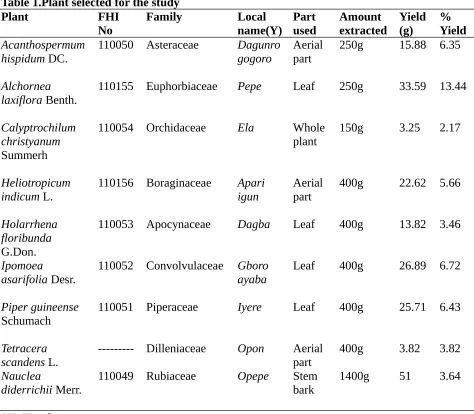
The plants selected from the survey for this study, including their families, local names, parts used and percentage yield of methanol extracts are displayed in Table 1. The in vitro alpha-amylase inhibitory activity of all the extracts and acarbose, are presented in Table 2. Table 3 represents inhibitory activities of all the fractions with the standard drug acarbose, expressed as IC50 values in μg/mL, while Figure 1 shows percentage (%) inhibition of the fractions and
acarbose.
All the extracts exhibited varying degree of activities ranging from IC50 values 248.30 ± 0.27 for
N. diderrichii showed highest activity of all the fractions tested having IC50 value of 137.8 ± 0.37
μg/mL (Table 3).
Results of the Brine shrimp lethality (BSL assay) of all the extracts were displayed in Table 4.The results revealed that eight of the plant extracts appeared safe with LC50> 1000 µg/mL Only
Tetracera scandens was toxic with LC50 of 11.35 µg/mL, which makes it more toxic than the
standard drug cyclophosphamide, which had LC50 of 16.3 µg/mL. Crude extracts resulting in
Table 1.Plant selected for the study
110155 Euphorbiaceae Pepe Leaf 250g 33.59 13.44
Calyptrochilum
110053 Apocynaceae Dagba Leaf 400g 13.82 3.46
Ipomoea
asarifolia Desr. 110052 Convolvulaceae Gboroayaba Leaf 400g 26.89 6.72
Piper guineense
Schumach 110051 Piperaceae Iyere Leaf 400g 25.71 6.43
Tetracera
Table 2. Alpha amylase inhibition and Brine Shrimp lethalityof the nine selected plant extracts
Plant Extract α-amylase inhibitory
activity. IC50 (μg/mL, n = 3)
BSLA
LC50 (μg/mL, n = 3)
Acanthospermumhispidum >1000 183.70
Alchornealaxiflora 295.60 ± 0.53 142.40
Calyptrochilumchristyanum 467.20 ± 0.32 294.80
Heliotropicumindicum 360.60 ± 0.30 391.30
Holarrhena floribunda 249.10 ± 0.24 595.10
Ipomoea asarifolia 420.70 ± 0.14 1484
Naucleadiderrichii 248.30 ± 0.27 1127.50
Piper guineense 580.00 ± 0.35 285.50
Tetracerascandens 273.20 ± 0.11 11.35
Acarbose 177.50 ± 0.42
-Cyclophosphamide - 16.3
n = no of replicates
S/N N. diderrichii Fractions IC50 (μg/mL)
1 Butanol 137.8 ± 0.37
2 Ethly acetate 212.8 ± 0.47
3 Dichloromethane >500
4 Hexane 188.3 ± 0.34
5 Acarbose 177.5 ± 0.42
n=3
DISSCUSSION
(18). Reports indicate that plants produce a large variety of amylase inhibitors and this provides protection against insects, their larvae and a lot of microbial pathogens (7, 16).
All the plants used in this study showed varying degree of enzyme inhibition as shown in Table 2, with methanol extract of N. diderrichii exhibiting highest α- amylase inhibitory activity (248.30 ± 0.27 μg/mL) while Piper guineense had the least inhibitory activity, the standard drug acarbose had IC50 of177.50 ± 0.42 μg/mL, as presented in Table 2. Assaying various fractions
obtained from N. diderichii indicated that the n-butanol fraction exhibited the highest activity among the fractions with an IC50 value of 137.8 ± 0.37 μg/mL and dichloromethane fraction had
the least activity with an IC50 value >500 μg/mL as seen in Table 3. This is an indication that the
compound primarily responsible for activity appears to reside in the polar component of the extract. It is also noteworthy that the butanol fraction had better activity than Acarbose, the standard drug.
Nauclea diderrichii is a subtropical or tropical moist lowland forests tree. Known as Opepe in Yoruba language in Nigeria. It is dense and has been known to possess a great degree of resistance to fungi and insects. Its resistance to termites makes it essentially valuable to the furniture, art, building and construction industries in West Africa (1).This ability to resist insect attack might be linked to the presence of enzyme inhibitors and vice versa. A large number of proteinaceous and non-proteinaceous molecules in plants have been known to act as part of the plant's natural defense against herbivores in order to prevent feeding (17,7). α-Amylase inhibitors have been reported as compounds known to confer resistance against herbivore attack (14,15).
CONCLUSION
doing this is to inhibit the activity of alpha-amylase enzyme which is responsible for the breakdown of starch to simple sugars. Of the nine methanol extracts studied, the methanol extract of stem bark of Nauclea diderrichii was observed to possess the highest alpha-amylase inhibitory potential. The butanol fraction of N. diderrichii was more active than acarbose. The study suggests that the inhibitory compound (s) might be in the polar fraction. Further work is ongoing to isolate and purified inhibitory compound (s) from this plant by chromatographic methods. In addition, this study confirmed the safety of the medicinal plant extracts being used traditionally for the prevention and treatment of diabetes, almost all of them appeared safe.
Conflict of interest
The authors declare no conflict of Interest.
Ethical consideration
All applicable international, national, and/or institutional guidelines were followed.
REFERENCES
2. Ali, H., P. J. Houghton, and A. Soumyanath. 2006. α- Amylase inhibitory activity of some Malaysian plants used to treat diabetes; with particular reference to Phyllanthus amarus. J Ethnopharmacol 107: 449-55.
3. Alexander, R., 1992. Maltodextrins: production, properties and applications. In: Schenk F, Hebeda R (ed.) Starch hydrolysis products; worldwide technology: production and applications, New York, p. 62–122.
4. Balaraman, A. K., J. Singh, S. Dash, and T. K. Maity. 2010. Antihyperglycemic and hypolipidemic effects of Melothriama deraspatana and Cocciniaindica in streptozotocin induced diabetes in rats. Saudi Pharmacolgy Journal 18(3): 173-8.
5. Davidson, S. 1995. Principles and practice of medicine. 17th edition; Churchill
Livingstone- Edinburgh.
6. Dineshkumar, B., M. Analava, and M. Manjunatha. 2010. A comparative study of alpha amylase inhibitory activities of common antidiabetic plants of Kharagpur 1 block. Int J Green Pharmacy 4: 115-21.
7. Franco, J., O. L. Silva, M. Slivinski, C. T. Bloch, C. Rigden, and F. G. Sám. 2002. Purification, biochemical characterisation and partial primary structure of a new α-amylase inhibitor from Secalecereale (rye). Int J Biochemisty and Cell Biology 32:1195-1204.
8. Gauresh, S., C. Rahul, S. Jayant, and S. Sadhana. 2012. Inhibition of carbohydrate hydrolysing enzymes by methanolic extract of Couroupita guianensis leaves. Int J Pharm Bioscience 3: 511 – 20.
9. Hansawasdi, C., J. Kawabata, and T. Kasai. 2012. Alpha amylase inhibitors from Roselle (Hibiscus sabdariffa Linn.) tea. Biotechology Biochemistry 64: 1041-3.
10. IDF DIABETES ATLAS. International Diabetes Federation. 2013. p. 7.ISBN 2930229853.
12. Lee, S. Y., S. Kim, R. M. Sweet, S.W. Suh. 1991. Crystallization and a preliminary X-ray crystallographic study of α-amylase from Bacillus licheniformis. Arch Biochem Biophy 291:255–257.
13. McLaughlin, J. L. 1991. Crown gall tumors on Potato disc and brine shrimp lethality. Two simple bioassays for higher plant screening and fractionation. In: Hostettmann, K. (Ed.), Assays for Bioactivity, vol. 1. Academic Press, London.
14. Mehrabadi, M., A. R. Bandani, and O. Kwon. 2011. Biochemical characterization of digestive α-d-glucosidase and β-d-glucosidase from labial glands and midgut of wheat bug Eurygastermaura. Entomological Res 41(3):81-87.
.
15. Mehrabadi, M. and A.R. Bandani. 2011. Purification and characterization of midgut α-Amylase of Eurygasterintegriceps. J Entomological Sciences 12:25-32.
16. Mehta, J. l., N. Rasouli, A. K. Sinha, and B. Molavi. 2006. Oxidative stress in diabetes: A mechanistic over view of its effects on atherogenesis and myocardial dysfunction. Int J Biochemistry Cell Biology 38: 794-803.
17. Mendiola-Olaya, E., A. Valencia-J-menez, S. Valdes-RodrA±guez, J. Delano-Frier, and Blanco-Labra. 2000. Digestive amylase from the larger grain borer, prostephanus truncates horn. Comparative Biochemistry and Physiology 126(3):425-433.
18. Ramkumar, K. M., B. Thayumanavan, T. Palvannan, and P. Rajaguru. 2010. Inhibitory effect of Gymnemamon tanum leaves on glucosidase activity and α-amylase activity and their relationship with polyphenolic content. Med Chem Res 19:948–61.
19. Rieser, M. J., X. P. Fang, Z. M. Gu, G. X. Zhao, and J. L. McLaughlin. 1993. Annonanceousacetogenins. Phytochem Anal 4: 27-48.
20. Solis, P. N., C. W. Wright, M. Anderson, M. P. Gupta, and J. D. Phillipson. 1993. A microwellcytotoxicitiy assay using Artemiasalina (brine shrimp). Planta Med 26:250–252.