1
TOXYCITY OF EXTRACT AND FRACTIONS OF PUSPA BARK
(
Schima wallichii
Korth) TO
Artemia salina
Leach.*
Ade Zuhrotun
#, Eli Halimah, Ajeng Diantini, Zeili Prameswari
Faculty of Pharmacy, Universitas Padjadjaran
#Author for Correspondence: Jl. Raya Sumedang-Bandung KM 21, Jatinangor, West Java, Postal code 45363, Phone/Fax 022-7796200, Mobile Phone 081322517899, email address:
Field
Natural products-Pharmacology
Oral Presentation
Puspa (Schima wallichii Korth.) is a medicinal plant which potential to be
doveloped as anticancer. Previously research reported that puspa leaves have a
cytotoxic activity. In this present works, a toxicity test to extract and fractions of
puspa bark was carried out by Brine Shrimp Lethality Test (BSLT). Extraction
was done by maceration using ethanol 70%. The concentrated extract was
dissolved in water and then fractionated by Liquid-Liquid Extraction (LLE) using
n-hexane and ethyl acetate respectively. The result of toxicity test of ethanol
extract and fractions of LLE indicated that all sample had a toxic effect to A.
salina (LC50 < 1000 ppm). The highest toxycal fraction, that was ethyl acetate
fraction (LC50 = 24,70 ppm), then was further separated by classical column
chromatoghraphy (CC). The group of fractions II from CC process, showed the
highest toxycal activity (LC50 = 11,40 ppm). Preliminary identification of active
compound by phytochemical screening and TLC with several spray reagent,
predicted that it was terpenoid or polyphenol, however the identity of active
compound was still unknown.
Keywords: Schima wallichii Korth.. toxicity, Brine Shrimp Lethality Test
(BSLT).
2
INTRODUCTION
At this time, many traditional healing using plant or herbal drug as the key ingredient. A lot of empirical study and research has scientifically prove the activities, so the using of this natural drug tended to increase. This also supported by public opinion that natural product has minimal risk compare with chemical drug or synthetic drug (Rita et al., 2008).
One of plant that use as traditional drug is puspa. Some research of puspa reported that ethanol extract of puspa leaves has cytotoxic activity to leukemia cancer cells (Nurfaizah, 2008). Ethyl acetate fraction of puspa leaves has cytotoxic and pro-apoptosis activity to leukemia and breast cancer cells leukemia (Kristina, 2009; Ramdan, 2009). These researches showed that puspa leaves has potency to be developed as anticancer.
Secondary metabolite as active ingredient distributed in all parts of the plants i.e bark, rhyzome, leaves, fructus, and seed. Because of this reason, if one part of the plant has been prove any activity so the other parts potentially had the same activity. With that assumption, puspa bark expected have potency as anticancer like puspa leaves (Sajuthi, 2001).
Brine Shrimp Lethality Test (BSLT) is one of common methods in bioactivity test of chemical compounds. This method has developed as general biological test for preliminary study and monitoring the active substance of natural products. This methods also easy in application, cheaper, a little time consuming, and accurate. Toxicity result of this methods has correlation with cytotoxic activity of anticancer compounds (Meyer et al., 1982; Nurhayati et al., 2006; Bawa, 2009).
In this research, toxicity test of extract and its fractions of puspa bark was done by BSLT. In this sense, we want to know the toxicity and potency of puspa bark in development of anticancer from natural producs.
METHODS AND RESULTS
Materials and tools:
Materials: puspa
bark, 70% ethanol,
aquadest, n-hexane, chloroform, ethyl
acetate, ether, amilalcohol, hydrochloric
acid, sulfuric acid, nitric acid, acetic
acid glacial, formic acid, formaldehyde,
ammonia,
bismuth-subnitric,
mercury(II)chloride, alumunium (III)
chloride,
dimetil sulfoxside (DMSO),
potassium hydroxide, sodium chloride,
sodium
acetic,
vaniline,
gelatin,
magnesium powder, alumunium foil,
precoated silica gel GF254, and silica
gel 60 (0,063-0,200 mm) for column.
For toxycity test, A. salina was obtained from Laboratory of organic chemistry, Chemical Deperartment, Faculty of Natural product and Sciences, Universitas Padjadjaran.
Tools
: grinder, macerator, rotavapor
(Buchi
Rotavapor R-3000), separatory
funnel,
classical
column
chromatography,
UV lamp (Camag UV-betrachter), aerator, electrical lamp, micropipette, volume pipette, andcommon
glassware in laboratory
Methods:
Sample preparation
Bark of puspa plant was collected from mountain range of Kebun Tanaman Obat dan Aromatik Manoko, Lembang, Bandung.
The material was sorted, cleaned,
coarsely cuted, air-dried and finally
grinded.
This plants was identified in Herbarium Bandungense
School of Science and
Biological Technology (SITH) ITB, that
belonged to Theaceae, species
Schima
walichii
(DC.) Korth, with sinonim
name
Schima noronhae
Reinw ex.
Blume,
Schima bancana
Miq., and
Schima crenata
Korth.
Extraction and Fractionation
Powdered puspa bark was extracted by maceration using 70% etanol (3x24 hour).
Filtrat was condensed using
vacuum rotavaporator. A 113,18 g of
extract was obtained from 1 kg of
crude drug, equivalent with 11,32%
(w/w) of extractive matters (rendemen).
3
n-hexane,
and
ethyl
acetate
respectively, where the extract was
dissolved in aquadest previously.
About 56,09
g extract fractionated
resulted in 3,25 g n-hexane fraction
(5,80 %); 5,59 g ethyl acetate fraction
(9,97 %) and 35,42 g of water fraction
(63,15%).
Phytochemical screening
Phytochemical screening were
determined from extract and all fractions
of LLE using standard procedures
[Ditjen POM, 1979;
Farnsworth, 1966].
The results showed that in extract,
n-hexane fraction, ethyl acetate fraction
and water fraction of puspa bark
identified
flavonoid,
polyphenolic
campound, mono- and sesquiterpenoid,
kuinon and saponin.
Brine Shrimp Lethality Test (BSLT)
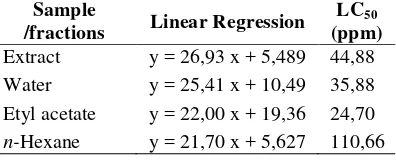
The extract and all fraction of LLE was routinely evaluated in BSLT with minor modification procedures of Mayer et al. (1982). Toxicities of compound were tested at 1000, 500, 100, 50, 10, 5, 1; 0,5 and 0,1 ppm in medium solution with 1% DMSO (v/v). Ten, one day A.salina were used in each test and survivors counted after 24 h. Three replications were used for each concentration. The blank control were conduced at the same condition without sample. The lethal concentration for 50% mortality after 24 h of exposure were determined using McLaughlin (1990) as the measure of toxicity of the extract or fractions. Any substance was active or tixic if LC50 values <1000 ppm for extract and LC50 values ≤ 30 ppm for isolated compound, but LC50 values greater than 1000 ppm for plant extracts were considered inactive. The result of BSLT showed in Table 1.
Table 1. The result of BSLT to extract and its fraction of LLE
Sample
/fractions Linear Regression
LC50
(ppm)
Extract y = 26,93 x + 5,489 44,88 Water y = 25,41 x + 10,49 35,88 Etyl acetate y = 22,00 x + 19,36 24,70 n-Hexane y = 21,70 x + 5,627 110,66
Determination of targetted compound (TC) was done by combination of preparative-thin layer chromatography (P-TLC) and BSLT. From P-TLC using precoated plate silica gel GF254 and ethyl acetace as mobile phase, there was three bands appeared. Each bands on P-TLC scaped from the plate was dissove in medium solution then tested by BSLT. Percentage of mortality Band I (Rf=0,64) was 40%, Band II (Rf=0,28) was 60%, and Band III (Rf=0,16) was 50 %. Targetted compound was a compound that showing the highest value in Percentage of mortality.
Separation and Identification
Separation was conducted by classical column chromatoghaphy (CC) to the highest toxical fraction of LLE, that is ethyl acetate fraction. Solvent ethyl acetate used as mobile phase and silica Gel as stationary phase. This process monitored by TLC.
About 1,5 g sample separated by CC obtained 83 sub fractions.
Base on
similarity pattern of chromatogram TLC
then clasified as grouped 16-20 of sub
fraction (I), 21-42 sub fraction (II) and
43-45 sub fraction (III). Each group of
fraction then tested by BSLT and data
showed in Table 2.
Table 2. The BSLT result to Group of Fractions of CC
Group of
Fractions Linear Regrassion
LC50
(ppm)
I y = 10,13 x + 34,83 31,477 II y = 6,498 x + 43,13 11,402 III y = 5,731 x + 42,86 17,619
4
green spot. Chromatogram of TLC
showed in Picture 1.
1
2
3
4
Picture 1 Chromatogram of TLC with some spray reagent.
Condition: Mobile phase:ethyl acetate, Stationary phase: precoated plate silica gel GF254, Observe visually with (1) 5% of potassium hydroxide, (2) 5% of Ferri(III)chloride, (3) 5% of sulfuric acid, and (4) 5% of vanilline- sulfuric acid.
DISCUSSION
The extracts and its fractions studied in this work showed significant lethality against brine shrimp (Table 1), which has been successfully used as a simple biological test to guide the separation process of plant extracts in order to detect anticancer compounds. This bioassay has good correlation with cytotoxic activity of anticancer compounds. LC50 values <1000 ppm are considered significant for crude extracts.
Active compound in the high toxycal fraction, ethyl acetate fraction, was monitored by P-TLC and BSLT. The result showed that Band II (Rf=0,28) has the highes value in percentage of mortality (60%). This result also supported by CC result, where the group of fraction II showing the highest toxycity (LC50 value =11,402 ppm).
At this recent works, targetted compound was not an isolate or pure compound, so identification at the early stage only done by phytochemycal screening and TLC with some spray reagent. Solution 5% of sulfuric acid used as universal reagent for organic compounds. Solution 5% of
vanillin- sulfuric acid used to detect the existence of mono-and sesquitepenoid,. Solution 5% of ferri(III)chloride use to detect the phenolic compounds, and solution 5% of potassium chloride used to detect kuinon. From chromatogram TLC with some spray reagent, showed that targetted compound or active compound supposed that was terpenoid or polyphenol, however the identity was still unclear.
CONCLUSION
Toxycity test of extract and its fraction of LLE indicated high toxycal effect to larve Artemia salina Leach. with LC50 values < 1000 ppm.
The highest
toxycal fraction, that was ethyl
acetate fraction (LC50 = 24,70 ppm),
then was further separated by
classical column chromatoghraphy
(CC). The group of fractions II from
CC process, showed the highest
toxycal activity (LC50 = 11,40 ppm).
Identification at early stage of active
compound
by
phytochemical
screening and TLC with several
spray reagent, predicted that it was
terpenoid or polyphenol, however the
identity of active compound was still
unknown.
This research was preliminary investigation in development anticancer from puspa (Schima wallichii Korth.). So this works are still going on our Laboratory.
REFERENCES
Bawa, G. 2009. Isolasi dan Identifikasi Golongan Senyawa Toksik dari Daging Buah Pare (Momordica charantia L.). Jurnal Kimia. 3 (2): 117-124.
Ditjen POM. 1979.
Materia Medika
Indonesia
. Jilid 3. Jakarta:
Depkes RI.
Farnsworth, N.R. 1966. Biological and Phytochemical Screening of Plant,J. Pharm. Sci, 55(3) : 243-269.
5
Bioassay For Active PlantConstituents. Plant Medica. 31-34.
Nurfaizah, E. 2008. Aktivitas sitotoksik ekstrak etanol daun puspa (Schima wallichii Korth.) dan daun oleander (Nerium Oleander L.) terhadap sel leukimia P388. Skripsi. Jatinangor: Fakultas Farmasi Universitas Padjadjaran.
Nurhayati. A.P.D., N. Abdulgani, R.Febrianto. 2006. Uji Toksisitas Ekstrak Eucheuma alvarezii terhadap Artemia salina sebagai Studi Pendahuluan Potensi Antikanker. Akta Kimia Indonesia. 2(1) : 41-46.
Kristina, T. 2009. Aktivitas Pro-Apoptosis Fraksi Etil Asetat dari Ekstrak Daun Puspa (Schima wallichii Korth.) terhadap Sel Kanker.
Skripsi. Jatinangor: Fakultas Farmasi Universitas Padjadjaran. Ramdan, I. 2008. Aktivitas sitotoksik fraksi
n-heksan, fraksi etil asetat, fraksi air dari ekstrak etanol daun puspa (Schima wallichii Korth.) terhadap sel kanker payudara MCF-7. Skripsi. Jatinangor: Fakultas Farmasi Universitas Padjadjaran. Rita, W.S., Suirta, A. Sabikin. 2008. Isolasi
dan Identifikasi Senyawa yang Berpotensi sebagai Antitumor pada Daging Buah Pare (Momordica charantia L.). Jurnal Kimia. 2 (1): 1-6.