1
,LAPORAN AKHIR PENELITIAN
1. IDENTITAS PENELITIAN(diisikan sesuai dengan proposal) A. JUDUL PENELITIAN
REVITALIASI PERMUKIMAN NELAYAN MENUJU KONDISI LIFEBILITY DI DUSUN UJUNG KASSI SELATAN
B. BIDANG, TEMA, TOPIK, DAN RUMPUN BIDANG ILMU Bidang Fokus RIRN/
Bidang Unggulan Perguruan Tinggi
Tema Topik (jika ada) Rumpun Bidang Ilmu
Efisiensi, Efektifitas, dan Optimasi Sumber Daya Melalui Teknologi yang Spesifik dan Ramah Lingkungan
Kemaritiman Pengelolaan Sumber Daya Wilayah Pesisir dan Laut Berbasis Ekosistem
Techno-Sains
C. KATEGORI, SKEMA, SBK, TARGET TKT DAN LAMA PENELITIAN Kategori
(Kompetitif Nasional/
Desentralisasi / Penugasan
Skema Penelitian
Strata (Dasar/
Terapan/
Pengembangan)
SBK (Dasar/
Terapan/
Pengembangan)
Target Akhir
TKT
Lama Penelitian (Tahun)
UNHAS
ARSITEKTUR TROPIS DAN LINGKUNGAN
BINAN YANG TANGGAP TERHADAP BENCANA
DASAR DASAR 3 1 Tahun
2. IDENTITAS PENGUSUL
Nama, Peran
Perguruan Tinggi/
Institusi
Program
Studi/ Bagian Bidang Tugas ID Sinta H-Index Idawarni
Ketua Peneliti penanggung jawab penelitian
Universitas
Hasanuddin Arsitektur
Perumahan dan Lingkungan permukiman
6057433
Edward syarif Universitas Arsitektur Permukiman 6668541
2 Penanggung
jawab pembuatan article/Manuscript
Hasanuddin Perkotaan
3. MITRA KERJASAMA PENELITIAN (JIKA ADA)
Mitra Nama Mitra
…………
4. LUARAN DAN TARGET CAPAIAN Luaran Wajib
Tahun
Luaran Jenis Luaran
Status Target Capaian (accepted, published, terdaftar atau granted, atau status lainnya)
Keterangan (url dan nama jurnal, penerbit, url paten, keterangan
sejenis lainnya) 2019 Jurnal Internasional terindeks
scopus
accepted
TICATE accepted
Haki accepted http://www.unhas.ac.id/lppm/haki/
IOPS accepted
Luaran Tambahan
Tahun Luaran Jenis Luaran
Status Target Capaian (accepted, published, terdaftar atau granted, atau
status lainnya)
Keterangan (url dan nama jurnal, penerbit, url paten, keterangan
sejenis lainnya)
2019 Buku ajar arsitektur@unhas.ac.id
Proseding nasional Peranan Lingkungan Dalam Suplay Air Bersih Di Daerah Pasang Surut
Accepted
presentasi https://temuilmiah.iplbi.or.id/medan- 2019/
Temu Ilmiah Ikatan Peneliti Lingkungan Binaan Indonesia (IPLBI) 8, halaman https://doi.org/10.32315/ti.8.halaman
Pengabdian Masyarakat
Sosialisasi dan penyerahaan
5. KEMAJUAN PENELITIAN
3
Ringkasan penelitian berisi latar belakang penelitian, tujuan dan tahapan metode penelitian, luaran yang ditargetkan, serta uraian TKT penelitian yang diusulkan.
A. RINGKASAN
BAB 1. PENDAHULUAN
1.1. Latar Belakang dan Permasalahan
Permukiman pulau ujung kassi terbentuk secara sporadis, semrawut, dan padat. Permukiman membentang ditepi sungai ujung kassi, permukiman awalnya hanya daratan kecil yang muncul akibat endapat pasir (merupakan sebuah gusung), kemudian akhirnya didirikan 4 buah rumah di atasnya, dan lama kelamaan para penghuni tersebut beranak pinak di dalamnya dan adaya juga pendatang baru ketempat tersebut menyebabkan permukiman menjadi semakin padat.
Permukiman saat ini sangat tidak memenuhi kondisi lifebility, kurangnya keamanan (alam), kenyamanan, dan keindahan. Tentunya kondisi ini akan berpengaruh pada kualitas permukiman.
diperlukan upaya menciptakan lifebility dengan menghadirkan dimensi-dimensi yang menjadi penyebab masyarakat berkeinginan untuk menghuni properti saat ini dan masa depan
Kondisi ini mendorong dilakukannnya penelitian untuk melakukan revitalisasi pada kawasan tersebut, dan hal ini sejalan dengan Renstra Unhas 2015 – 2020, yaitu: “Menjadi Universitas Bereputasi Internasional Berbasis Benua Maritim”. Seperti diketahui bahwa Benua Maritim Indonesia adalah wilayah dengan hamparan pulau-pulau di dalamnya sebagai satu keatuan alamiah antara laut, darat, dan udara dengan sudut pandang iklim, cuaca dan keadaan airnya, keragaman biodata dan keadaan social budaya. Wilayah pesisir dan pulau -pulau kecil memiliki potensi yang cukup besar pengaruhnya untuk dikembangkan karena didukung oleh letaknya yang strategis dari aspek ekonomi maupun pertahanan dan keamanan. Undang-Undang no m o r 1 t a h u n 2 0 1 4 j u g a m e n y e b u t k a n b a h w a p e n g e l o l a a n wilayah pesisir dan pulau -pulau kecil adalah suatu proses perencanaan pemanfaatan, pengawasan, dan pengendalian terhadap manusia dalam memanfaatklan sumber daya pesisir dan pulau -pulau kecil. Dengan demikian antara UU no 1 tahun 2014, Renstra Unhas, dan rencana penelitian ini memiliki satu korelasi yang signifikan untuk memanfaatkan potensi kawasan pesisir menjadi lebih meningkat dengan mengedepankan aspek masyarakat dan alamnya.
4 1.2. Tujuan Penelitian
Tujuan penelitian adalah :
Merencanakan dan merancang permukiman yang memenuhi kebutuhan masyarakat nelayan terhadap kondisi lifebility sehingga kualitas hidup (Qol) dapat lebih meningkat.
1.3. Metode Singkat Penelitian
• Menggunakan Kuantitatif dan kualitatif (kualitatif sebagai pendukung kuantitatif)
• Kuantitatif
– Kuantitatif dengan mengukur persepsi masyarakat tentang kondisi saat ini dan yang akan dikaitkan dengan lifebility
– Mengukur kondisi lingkungan sosial, lingkungan fisik, keselamatan (abrasi, banjir, kebakaran) dan kejahatan, lingkungan fungsional, aminities (dalam hal ini kenyamanan) dengan menggunakan skala likert yang akan dikaitkan dengan NSP nasional
• Kualitatif dengan pengamatan yang mendalam terhadap kondisi permukiman (5 aspek:
shell, nature, network, man, and society) dikaitkan degan lifebility
• Analisis kuantitatif menggunakaan tabulasi, grafik, spss (korelasi), skala likert
• Analisis kualitatif dengan mencari makna yang tersirat dibalik tampilan fisik untuk menguatkan analisis kuantitatif
1.3.1. Lokasi Penelitian
Rencana lokasi penelitian adalah di pulau ujung kassi desa Aeng atu-Batu, Kecamaatan Galesong Utara, Kab. Takalar. Pemilihan lokasi didasarkan oleh beberapa hal, yaitu :
Permukiman merupakan permukiman nelayan
Kondisi permukiman semakin lama semakin semrawut oleh tumpang tindih aktifitas antara budidaya rumput laut dengan perikanan di area sekitar pantai.
Terjadi degradasi lingkungan permukiman seperti penggunaan lahan yang tidak sesuai dengan peruntukannya, banjir terutama dimusim hujan, penumpukan sampah di area pantai, dan berkurangnya sumber air bersih akibat intrusi air laut ke permukiman.
Kurang dan bahkan tidak adanya upaya untuk pengembangan potensi wisata bahari yang dimiliki oleh permukiman tersebut
5
1.3. Target Temuan dan inovasi, serta kontribusi dalam pembangunan
Target yang ingin dicapai dari penelitian ini adalah sebuah rumusan dan disain konsep perumahan produktif dan bernilai wisata. Rumusan konsep diharapkan akan menciptakan lingkungan permukiman yang sustainable. Secara detail target temuan berupa :
Gambaran karakteristik fisik lingkungan permukiman (potensi dan problem terkait dengan mata pencaharian, dan potensi kepariwisataan bahari)
Gambaran perilaku dan aktifitas nelayan rumput laut dan ikan terkait dengan penggunaan ruang yang ekonomis, efektif dan efisien, serta bernilai wisata aktivitas
Gambaran tingkat kekumuhan permukiman nelayan pembudidaya rumput laut dan ikan.
Rumusan konsep perumahan produktif dan bernilai wisata, yang menserasikan karakter lingkungan permukiman dengan pekerjaan masyarakat dalam permukiman tersebut.
Rancangan disain perumahan nelayan pembudidaya rumput laut dengan konsep perumahan produktif dan bernilai wisata
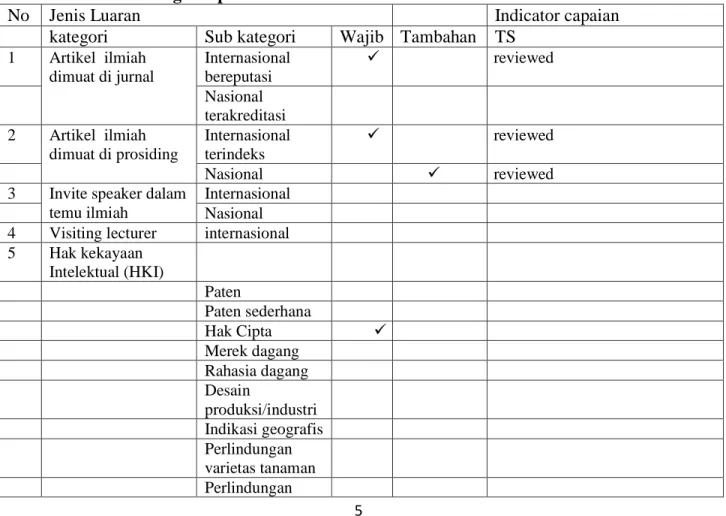
Table 1. Rencana target capaian tahunan
No Jenis Luaran Indicator capaian
kategori Sub kategori Wajib Tambahan TS 1 Artikel ilmiah
dimuat di jurnal
Internasional bereputasi
reviewed
Nasional terakreditasi 2 Artikel ilmiah
dimuat di prosiding
Internasional terindeks
reviewed
Nasional reviewed
3 Invite speaker dalam temu ilmiah
Internasional Nasional 4 Visiting lecturer internasional 5 Hak kekayaan
Intelektual (HKI)
Paten
Paten sederhana
Hak Cipta
Merek dagang Rahasia dagang Desain
produksi/industri Indikasi geografis Perlindungan varietas tanaman Perlindungan
6 Topografi/sirkuit terpadu
6 Teknologi tepat guna
7 Model/Purnarupa/desain/karya seni/rekayasa sosial
8 Buku Ajar (ISBN) terbit
9 Tingkat kesiapan teknologi 3
Hasil penelitian berisi kemajuan pelaksanaan penelitian, data yang diperoleh, dan analisis yang telah dilakukan
B. HASIL PENELITIAN
7
1. Wosqual. Conference Pasca Sarjana UNHAS
Harmonization of Domestic and Social Life of Fishermen Women
Idawarni Asmal 1,
1 Lab. Disain Perumahan dan Lingkungan Pemukiman, Departemen Arsitektur, Fakultas Teknik, Universitas Hasanuddin.
[email protected] Edward Syarif 2
2 Lab. Disain Perumahan dan Lingkungan Pemukiman, Departemen Arsitektur, Fakultas Teknik, Universitas Hasanuddin.
Abstract
Women who have a main job as housewives will have a lot of time in their family and settlements and do everything related to domestic work. On the other hand, as social beings, women have a desire to interact with each other. In addition, as a fisherman's wife who is often left by her husband to go to sea for a certain period of time, then as a wife, she must still be able to maintain the continuity of the relationship with the residents in the settlement. If one of these activities is prioritized or ignored, then life will not run harmoniously. Therefore, the purpose of the research is to find out how women can harmonize their desires to act as housewives and as social beings. The method used is behavioral mapping that uses 2 forms, namely the Person Center Mapping and Place Center Mapping. The population is housewives, while the sample is women who are doing domestic activities and social activities in the village at the Ujung Kassi. Using descriptive analysis. The results of the study found that women's activity space was influenced by the main types of activities. The main activity is permanent and requires a long duration of time, carried out in a protected and comfortable space. Other temporary activities are only occasionally carried out for certain events with an indefinite duration of time. Whereas incidental activities are of short duration and generally occur in public spaces. Time for activities is strongly influenced by the type of activities and place of activity.
Key word: Harmonization, domestic work, social relations, women fishermen
Background
Women play an important role in the family, based on the results of interviews conducted on 30 housewives taken randomly in housing. Generally, respondents do not have formal employment. Housewives are chosen as the main job (63%) and only around 7% have part-time work as grocery traders, cleaning services, and shopkeepers. The woman who chooses the household as her main job, she will spend a lot of time in her family environment and settlement.
The position and role as a housewife have responsibilities related to the domestic field such as parenting, home cleanliness, cooking, washing, and other household work. According to Anthony Sackey Tetteh (2007), women everywhere are almost entirely responsible for the care of the family. Fishermen keep going fishing for a long time, and in that time period, women manage the household without their husbands. Women will become important actors in the fishing community and also important in maintaining social networks without the presence of their husband. The aspect of family care and parenting is very important, and ignoring them
8
means taking risks by ignoring what is considered the most important and most meaningful human relationship.
On the other hand, women as social beings, have the urge to interact with other people and must be able to maintain social networks among residents of settlements. Humans are said to be social beings because humans are subject to social rules and norms, human behavior expects an assessment from other people, humans have a need to interact with other people, human potential will develop if they are in the midst of the Cooley community giving a looking glass name - self to see that someone is influenced by someone else (Rusdi Anto, 2018). This is certainly a dilemma for women how to synchronize domestic activities with social activities.
Purpose
This study purpose to find out how fisherwomen can synchronize their main work to activities as housewives and their desire as social beings to interact with others without ignoring any of the two.
Method
The research method uses behavioral mapping. Two stages that are carried out to find out the use of space activities related to social interaction in the fishermen's settlement, namely the Person Center Mapping and Place Center Mapping. Person Center Mapping is done by observing and mapping all activities carried out by respondents, while Place Center Mapping by observing the space or area used by respondents every day. The person center mapping observer is centered on women to find out which place or space is most often used by women in their daily activities. Place center mapping emphasizes exploring the components of space that are most often used by women in their activities. In addition to in-depth observations, interviews were also conducted to find out the reason for using space. The population is women (housewives) in the tip of the island of Kassi, the number of respondents based on Arikunto (2006) which suggests, if ample is less than 100, is better taken all, but if more, 10%-15% or 15%-25% or more is taken. In line with Sugiono (2003) but if the number of subjects was large it could be taken between 10%-15% or 20%-55% or more depending on the survey area size and the ability of the researcher. Based on this, we take 30 samples from 150 households. The sample was approached while on the move in the settlement. The analysis uses descriptive analytics.
Map of Makassar City and Ujung Kassi Island Figure 1. Research Location
9 Research Result
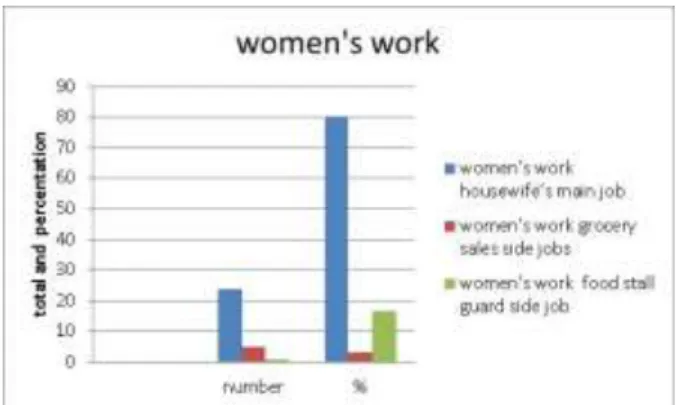
Based on the results of 30 housewives taken randomly in housing, the level of education is generally only elementary school (SD), a few are educated in junior high school (SMP), and they do not have formal employment. Housewives are chosen as the main job is 93%, only 7%
percent have part-time work and that is also done in residential areas, andothers are outside the residential as cleaning services and shopkeepers.
Figure 2. Women’s Work
The following table shows a variety of women's work related to domestic work in settlement that is captured in the field.
Table 1. Character of the domestic activity of a woman at the end of Kassi
No Space use intensity
Type of main activity
Duration activities
Nature of Activities
Variation in activity
Location and nature of space
Interaction facilities and situation
Room users based on gender and age
Gender age
1 Low shopping
for vegetables / fish
8 am to 10 am. for half hour
Accidential Interaction Main / public road
Open Woman variatif
2 Low interactio n
10-15 minute
accidential - The road in front of the house/publik
Open Woman age of
30 3 Low interactio
n
10-15 minute
accidential Parenting The road in front of the house/publik
Open Woman age of
30
4 Low waiting
for street vendors
10-15 minute in the morning
accidential Interaction The road in front of the house/publik
Open Woman age of
50 5 High parenting morning to
evening for 4 hours
temporary Working together for parties
Kolong / semi public
Sheltered house + bale- bale
Woman and Man
variatif
6 High parenting Noon
(after cooking and washing) for 30 minute-1 hours
Regular rest, receive guests, interaction
Kolong / semi public
Sheltered house + bale- bale
Woman and Man
variatif
7 High parenting Noon
(after
Regular Rest / sleep and
Kolong / semi public
Sheltered house + bale-
Woman variatif
10
cooking and washing) for 3-4 hours
interaction bale
8 Moderate parenting Noon (after cooking and washing) for 1-2 hours
temporary Eating and interaction
Kolong / semi public
Sheltered house + bale- bale
Woman variatif
9 High parenting Noon
(after cooking and washing) for 1-2 hours
Regular Take a nap Kolong / semi public
Sheltered house + bale- bale
Woman variatif
10 Moderate Wash up 8-9 am. For 30 minute until 1 hour in the morning
Regular Interaction public wells Open Woman age of 40
11 low Wash up 8-9 am. For 30 minute until 1 hour in the morning
Regular Interaction Private well (kolong) / semi public
Sheltered house
Woman age of 20
12 Low Wash up 8-9 am. For 30 minute until 1 hour in the morning
Regular Interaction Private well (in kolong) / semi public
Sheltered house
Woman age of 40 and 50
13 Moderate parenting Siang (setelah kegiatan masak dan MCK) 1 jam
accidential Interaction Terrace/ semi public
terlindung Protected terrace
Woman age of 50
14 Moderate parenting Noon (after cooking and washing) for 1hours
accidential relax (look for fleas) and interaction
Side yard of the house/
semi public
Protected tree + chair
Woman age of 50
15 Moderate parenting morning (after cooking for 30 minutes
Regular Regular
work of vegetables and fish
Side yard of the house/
semi public
bale-bale Woman variatif
16 High parenting Afternoon (after cooking and washing) 4 hours
temporary Making cake
Kitchen In house Woman variatif
17 Moderate parenting Day time accidential Interaction Kolong/semi public
bale-bale Woman variatif 18 Low parenting Morning and
evening 15 minutes
Regular Bathe and Wash clothes
Private well (Side yard of the house) / semi public
- Woman variatif
19 Moderate parenting Noon 30 minutes
accidential Interaction Security station/public
bale-bale Woman sesuai/
40an
20 Low parenting Noon
30 minutes
accidential Relax Public Green open spaace
Bale-bale Woman 50an Note: Kolong is semi open space, a room under the stilt house
Bale-bale is a bamboo or wooden rectangular bench
11
The following is a series of pictures showing various women's domestic and social activities on the Ujung Kassi island settlement
Figure 3. A forms series of women's domestic and social activities.
The series of Figures above shows a daily condition where women do domestic activities while interacting with others, so it can be concluded that:
• Generally, women take care of children, work, while interacting, have high frequency and remain. The activity was carried out in kolong, it was seen that children's swings were hanging in the room. Activities are generally carried out starting at 10.00 am until late at 3.00 pm. The woman whose house does not have kolong, the activity is carried out on the home yard.
• Activities to wash while interacting are low and permanent. This lasts only 1- 1.5 hours in the morning around 9.00-10.00 a.m. Washing is done in kolong and at the nearest well
• Interaction activities that are incidental in nature generally take place on the road and public space and only require a short time of around 10-30 minutes. The time of execution depends on the situation and conditions
12
• While activities that are temporary are only occasionally carried out at special times.
For example, if there is a celebration or big day and the time takes place varies, can be long or short depending on the work.
• Places interacting in kolong using a bench or table (which in the local language is called bale-bale, bamboo or wooden rectangular bench), which has a height of about 60 cm. while the extent depends on the ability of the homeowner.
• Generally, women interact with each other (gender and age), seen women rarely interact with the opposite sex or age that is much different.
The following scheme and images that show the spaces occupied by women in the activities and components of the space.
Figure 4. spaces performed by women in activities
Based on the results of interviews conducted on a number of respondents said that the temperature above the body of the house is hot, while kolong is more comfortable and windy, so they spend more time under than on the house during the day. The following graph is the people's perceptions captured from distributing questionnaires about climate conditions in the kolong area.
Figure 5. Community Perception to The Kolong
Figure 5, shows the data that generally women choose to do domestic activities and social networks because of comfort and safety factors.
13 Discussion
1. Choice of space for women activities related to the role of a housewife.
A women whether she has a job or not, still cannot escape from her role as a housewife.
Toddler children need physical and mental closeness with parents, especially mothers. Small children depend on their parents to provide basic needs, and parents provide for their children to support them and build future generations (Floyd & Morman, 2014), in Horstman et al (2106).
Research has been conducted by Horstman et al (2016) that the parent-child communication environment is an important component that influences children's health behavior (Babin &
Palazzolo, 2012; Miller-Day, 2008). So it is not surprising that children will always be found in parenting and controlling parents. As previously stated, women use more kolong for their activities, both main (domestic) and side activities (interaction, selling).
The selection of kolong as a place of action other than because it is the closest space of the house also provides a positive side for its users, which can be a shelter for heat, rain, and can hang the baby's swing. Because it is customary for mothers to do other household activities and try to make the child feel that they are not being neglected, the mother makes a swing instead of the mother's arms. Usually, children who are used to sleeping fall asleep when they are in a swing (Emawati, 2016).
Parenting in the sunlight is not good, because babies tend to be more easily affected negatively (both short and long term) due to sunburn or due to heat stroke. So, keeping children protected in the hot weather is very important! Sunburn can cause a child to develop a fever, dehydration, or complain of pain. In fact, when your child is burning even though only once, it can be potentially attacked by melanoma. In 1970, scientists were aware of the negative effects of sunlight. Newman (2000) In many articles, it was mentioned that sun exposure to infants can increase the risk of developing melanoma and other cancers in old age. Rodrique JR (1996) said that to determine the risk of skin cancer, how early the age at the start of sun exposure plays a greater role than the total sun exposure during life. Therefore, protection against sunlight, especially in infants, is very important to reduce the risk of developing skin cancer. One form of protection against the sun is protection provided by the body of the house.
Figure 6. Kolong conditions during the day in relation to climate
From the measurement results using a digital thermometer and wind meter, climate conditions are seen above the stilt house and kolong (room under the house) at Table 2.
14
Table 2. Climate conditions at the stilt house on the coast temperature moisture Wind speed
average
Wind speed max
Kolong 32 66,37 0.33 m/s 2.99 m/s
House body
36.5 59.71 0.089 m/s 0.668 m/s
Givoni (1994) states, the standard of wind speed in relation to the outside air temperature, when the outside air temperature ranges from 28°C -32°C, then a comfortable state indoors can be achieved when wind speeds range from 1.5-2.0 m/s. The standard indicates, if the condition is close to the real condition at the Ujung Kassi island settlement. This is supported by public perceptions of the kolong conditions which they are active (figure 4).
The house that provides shelter for kolong, shade is very important for all spaces. If an area feels hot or glary, it may not be used. Shade provisions must be available to playground users and guards who visit the space ([email protected] kidsafensw.org). Shaded space feels more comfortable in activities. This is consistent with the view of Marcus and Francis (1998) in, Gultom M (2009) that women prefer the priority of comfort, safety, control, relaxation and handling of urban tensions, while men will seek an experience of social interaction, involvement, and openness. Furthermore, he also added that women are more sensitive to negative situations in an environment, namely pollution, noise, and dirt, they walk shorter distances than men, and in usually women are less like being the center of sights for those around them.
The use of kolong for activities for women is also supported by Hartono's statement (2019) that women mostly have special values and needs for privacy, security, and comfort. It provides space with this value because it is the closest space and even an inseparable part of the stilt house. Another view that also supports is Kontra's view on the role of women in the public sphere of the political sphere in Islam, one of which is based on the Al-Quran statement Al Ahzab verse 33: which contains "and let you remain in your house ..." ). The verse explains that women should stay at home because women are only in charge of taking care of homework and taking care of children. This is not surprising considering that 100% of the inhabitants of the village are Muslim.
The use of kolong as the closest space to the world space for women is also in harmony with Rapoport (1977) described how the use of space is based on gender and age (Figure 6).
Figure 7. Group Separation Scheme
15
The scheme described by Rapoport, women and parents of the closest room users from home, this is in accordance with the conditions of women in the fishermen's settlement at Ujung Kassi.
Thus, kolong is an ideal place for women to do various daily activities.
2. Choice of activity time
The outline, women don't have a certain time in caring for children, because these activities take place at any time. However, other domestic activities have their time and limits implementation. Like washing activities, this activity is manual so it requires a lot of energy, this is done in the morning after the kitchen activity is complete. It will take around 8oo to 9 oo am in the morning with a duration of about 30 minutes until 1 hour. This is related to air conditions, in the morning the temperature are still friendly to do work outside the room, during the day the air will feel hot so that women will get tired quickly when working. Temperatures in Barombong and Aeng Batu in the morning are usually around 24oC at 9o'clock reaching 26oC. And the average daytime temperature is 32 0C (Weather+Forecast).
(https://www.accuweather.com/en/id/aeng-batu-batu/689026/weather-forecast/689026.
Indonesia's thermal comfort standard according to SNI T-14-1993-03 has 3, namely 1. Cool comfortably, 20.5 oC -22.8 oC with a relative humidity of 50% -80%
2. Optimum 22.8oC - 25.8 oC relative humidity 70-80%
3. Almost comfortable 25.8oC -27 oC relative humidity 60-70%
According to Lippsmeyer (1994) at an effective temperature of 26oC humans begin to feel sweating, at a temperature of 27.1oC -30oC the human body sweats and the ability to work begins to decline. Temperature 30-33.5 oC, environmental conditions are difficult to adjust to the condition of the body, and temperature 33.3 oC -36 oC environmental conditions do not allow to be felt. While for parenting activities is carried out throughout the day, so it needs a shady, protected, and windy place that is kolong. Even though the surrounding air reaches 32 oC, but kolong provides a gentle breeze and shade. it is not surprising if the inhabitants of the house sleep/rest during the day at the place.
Conclusion
Women's activity space is influenced by the types of main activities carried out. The main activity is permanent and requires a long duration of time with comfortable conditions, kolong the shade of a protected and comfortable space. While temporary activities are only occasionally carried out for certain events with indefinite duration (can be take long or short time). Whereas incidential activities are of short duration and mostly occur in public spaces. The place for carrying out the activities of housewives is still in the house area if outside the area of the house is only 2-3 houses from their home.
References
Anthony Sackey Tetteh, 2007. Women’s activities in the Ghanaian fishery; The role of social capital. Master thesis in International Fisheries Management. Department of Social
16
and Marketing Studies. Norwegian College of Fishery Science. University of Tromsø.May 2007.
Arikunto, Suharsimi. 2006. Metodelogi penelitian. Yogyakarta: Bina Aksara.
Dedi Hantono, 2019. NALARs Jurnal Arsitektur Volume 18 Nomor 1Januari 2019: 45-56 https://doi.org/10.24853/nalars.18.1.45-56 p-ISSN 1412-3266/e-ISSN 2549-6832
Departemen Agama RI, Departemen Agama RI, Alhidayah Al-Qur’an Tafsir Per Kata Tajwid Kode Angka, (Tanggerang: Kalim), h.423)
Emawati, 2016. Ritual Baayun Anak dan Dinamikanya. AL MURABBI Volume 2, Nomor 2, Januari 2016 ISSN 2406-775X 163 . 158-179
Givoni B, 1994. Passive Low Energy Cooling of Buildings. John Wiley& Sons. Vanm Nostrand Reinhold Co, New York.B.
Haley Kranstuber Horsstman, Alexie hays, and Ryaan Maliski, 2016. Parent-Child Interaction. Gender, Health and Risk Communication, interpersonal Communication.
Online publication date: August 2016. DOI: 10.1093/acrefore/9780190228613.013.278.
Communication: Oxford Research Encyclopedias
Hall, Edward T., 1990. The Hidden Dimension. New York: Anchor Books. Personal Space Dan Territory
Lippsmeyer, George, 1994. Bangunan tropis, edisi ke-2. Jakarta: Erlangga.
MA Caldwell dan LA Peplau. 1982. Mengukur keintiman laki-laki
Mariatul Qibtiyah Harun AR, 2015. Rethinking Peran Perempuan Dalam Keluarga.
Karsa Vol 23. No1. Juni 2015. 17-35.
DOI: http://dx.doi.org/10.19105/karsa.v23i1.607.
Newman BY. The Sun Tan Myth. Optometry. 2000, 71(11)
Phethai Tulitatham, 2011. Personal Space Perception of employees of various nationalities in international organizations during conversation at work in Thailand.
March 2011. A research paper submitted in partial fulfillment of the requireents for the degree of master of arts in English for careers. Language Institute, Thammasat university Bangkok Thailand
Rapoport A, 1977. Human Aspect of Urban Form, Towards a Man- Environment Approach to Urban Form and Design. Pergamon Press, New YorkLippsmeier, Georg (1994) Tropical Building, Erlangga Press. Jakarta.
Rodrique JR, Promoting healthier behaviours, attitudes, and beliefs toward sun exposure in parents of young children. Journal of Consulting and Clinical Psychology. 1996, 64:1431-34
Rusdi Anto, 2018. Manusia Sebagai Makhluk Individu dan Sosial. Agustus 2018.
https://www.researchgate.net/publication/326723983_Manusia_Sebagai_Makhluk_Indivi du_dan_Sosial
SNI T-14-1993-03. Standar kenyamanan termal Indonesia
Sesilia Monalisa F.Gultom (2009). Wanita dan Ruang Publik. Skripsi Universitas Indonesia. Unpublished.
Sugiyono, 2003. Metode Penelitian Bisnis. Bandung. Pusat Bahasa Depdiknas.
Syurawasti Muhiddin, Sitti Shaqylla S., Hardyanti, Sukma Khasanah. Personal Space dan Territoriality Psikologi Lingkungan.
17
https://www.academia.edu/20289069/Personal_Space_dan_Territoriality_Psikologi_Ling kungan
KIDSAFE NEW SOUTH WALES Inc. Playground Advisory Unit . P: 02 9845 0893 E: [email protected] kidsafensw.org)
Weather+Forecast )( https://www.accuweather.com/en/id/aeng-batu- batu/689026/weather-forecast/689026.
18
2. AR+ DC Conference 2019. ITS Surabaya
KINSHIP AND ITS INFLUENCE ON THE DISTANCE OF SOCIAL SPACE IN GENDER LIFE IN FISHERMAN SETTLEMENTS
Abstract
The homogeneity can be seen between them which is one of the village community characteristics. The homogeneity will certainly affect the pattern of citizen interaction. In the village community adhering to the principles of kinship, friendship, and appreciation, one of the effects is on the distance of interaction.
Based on this, the research purpose is to find out how far the interaction formed when interacting with fellow citizens. The method used is exploration by observing the various interactions between gender and age. The result is that all interaction activities have a close distance, especially between genders. The difference lies in age and different sexes, age because of respect for the older, different sexes because of different male and female characters on the topic of conversation when interacting.
Key word: Kinship; Social Space distance; Gender Life; Fisherman Settlements Background
H o m o ge n e o u s r u r a l c o m m u n i ti e s a r e di f f e r e n t f r o m c i t i e s w h e r e m a n y r e s i de n ts d o n o t gu a r a n t e e t h a t t h e i n te r a c ti o n b e tw e e n t h e m i s q u i te i n t e n s e a n d th e y kn o w e a ch o t h e r . T h e s a m e b e l i e f s , t a s t e s , a n d b e h a vi o r s a r e th e a dh e s i v e f a cto r s o f r u r a l c o m m u n i ti e s ( A n i s a M a n s y u r ) . K i n s h i p i n r u r a l c o m m u n i ti e s i s v e r y i n f l u e n ti a l o n t h e q u a l i t y a n d q u a n ti t y o f p e r s o n a l a n d s o c i a l r e l a ti o n s b e tw e e n i n di vi d u a l s a n d b e t w e e n gr o u ps . T h e o r y o f G o tt d i e n e r a n d H u tc h i s o n ( 2 0 0 6 ) s t a t e s th a t t h e r e l a ti o n s h i p be tw e e n h u m a n s , s pa c e , a n d t h e n e w bu i l t e n vi r o n m e n t i s i n f l u e n c e d b y s e v e r a l s o ci a l f a c t o r s s u ch a s g e n de r , cl a s s , r a ce , a ge , s ta tu s , r e l i gi o n , a n d cu l tu r e . T h e s a m e co n d i t i o n s a p pl y t o pe o pl e w h o l i ve o n th e U ju n g Ka s s i i s l a n d, s u ch a s ge n d e r , a g e , s t a t u s , r e l i gi o n , a n d t r a d i t i o n th a t a f f e c t th e n a tu r e o f c o m m u n i t y i n t e r a c ti o n . T a n n e n a t J u l i a n o P . S . , ( 2 0 1 5 ) b e l i e ve s th a t t h e r e i s a g a p b e tw e e n m e n a n d w o m e n b e c a u s e e a ch p a r t y i s i n a c r o s s - c u l t u r a l po s i ti o n .
T h e p e o pl e i n U ju n g K a s s i vi l l a g e a r e di s ci pl e s o f I s l a m . I n I s l a m , t h e r e a r e cl e a r p r o vi s i o n s o n r e l a ti o n s pr o ce du r e s b e t w e e n m e n a n d w o m e n . I n t e r m s o f i n t e r a c ti o n , s e v e r a l pr o vi s i o n s m u s t b e f o l l o w e d, i n c l u di n g 1 . G h a dl u l B a s h a r ( l o o k i n g do w n ) b a s e d o n th e w o r d o f A l l a h T a ' a l a i n th e Q S . A n - N u u r : 3 0 . 2 . N o t a l o n e w i th f o r e i gn w o m e n ( n o t m a h r a m a n d n o t h i s w i f e ) . I t w a s s a i d i n S h a h i h u l Bu kh a r i f r o m I b n A bb a s R a dl i y a l l a h
„ A n h u ( A j m a i n H a l t a . 2 0 1 5 ) . B o t h o f th e s e a r e v e r y i n f l u e n ti a l i n s o ci a l r e l a ti o n s h i ps , w h e r e w o m e n m u s t a l w a ys m a i n ta i n th e bo u n d a r i e s o f r e l a ti o n s h i ps w i th th e o p po s i te s e x . , a n d th e s e va l u e s w i l l a f f e c t s o ci a l a c ti vi ti e s . T h i s s tu d y a i m s t o de t e r m i n e th e di s t a n ce o f th e s o c i a l s pa ce s o f m e n a n d w o m e n w h o l i v e o n t h e U ju n g Ka s s i i s l a n d .
19 Research methods
Using the exploration method, researchers conduct deep scans on community activities in social space. Explore how the distance between social spaces formed between the same sex and the opposite sex in a society that is still homogeneous and has a high kinship. The population is the community (male and female adults) who live at the Ujung Kassi, while the sample is all people (men and women adults) who are interacting to find out the distance between social spaces formed between them when interacting. While to find out the level of the kinship of residents is done by distributing questionnaires with samples between 15-20% of households. Sugiono (2003) that if a small population is taken between 10% -15%
or 20% -55% or more depending on the survey area size and the ability of the researcher. Based on this, we take 30 samples from 150 households.
Reserch sites
Map of Makassar City and Ujung Kassi Island Figure 1. Research Location
Research Data
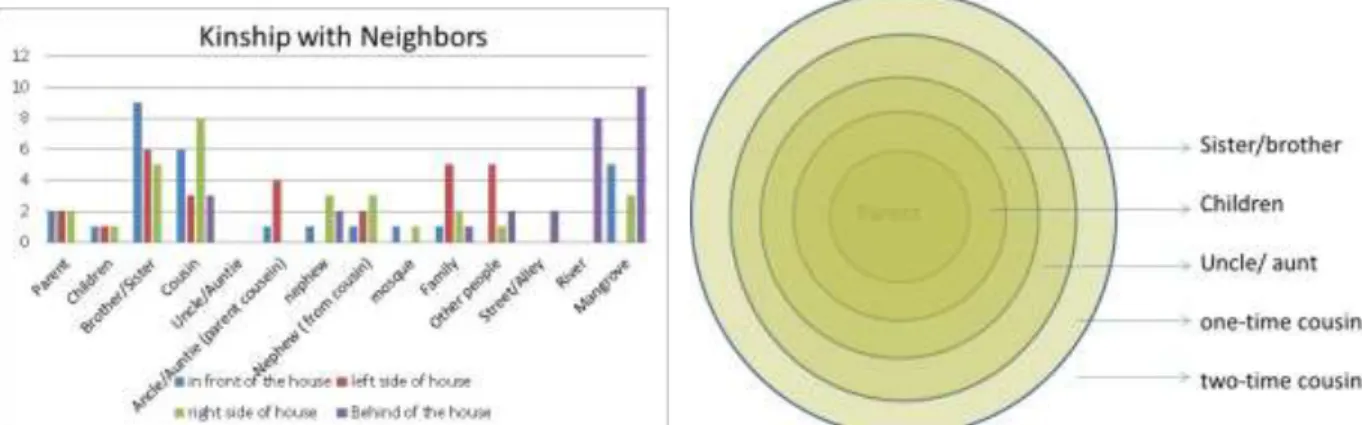
The resident of Ujung Kassi island in conducting interactions is also very intense, and almost all people know each other well. This is evidenced by the ability of respondents (93,3%) to know the long names and nicknames of community members who reside in the northern, southern, and surrounding of the mosque (the central part of the island). Only 6,7% of occupants remember the long names but not the nickname of their neighborhood. From the data collection, Figure 2 shows the relationship between the kinship quality of the people who are their closest neighbors.
20
Figure 2. Graphic and scheme of kinship relations in settlements
Figure 3. The series of women and men activities of in settlements
• • The distance of social space between women and men Communication between men and women is generally more space, especially if they do not have kinship relations. Talks between them are generally a minimum length of 1 m.
• The range of social space between women
Communication among women more closer, physical distance is very close and even physical contact often occurs (like activities to find fleas), especially of the same age.
Where most women's interactions occur in private and semi-private spaces. Women generally interact in casual time after doing domestic work.
• The spacing of social space between men
Communication looks familiar, especially at the same age. In general, interactions occur in the workspace or public places.
21 Discussion
1. Spacing between social space women and men in interacting
According to Emory S. Bogardus, social distance can be used to determine the emotional closeness between individuals and other individuals (Damanik, 2015). Based on field observations, it was found that women and men in interaction had a distance of more than 1m., in feet is in the range of 4-12 feet. When referring to the scheme of Hall (1966), the spacing is included in social space. Following this, the picture shows the informal distance distribution in the interpersonal communication carried out by Hall.
Figure 4. Person‟s Informal Distance
As for knowing the message and focal characters from these distances are described by Phethai Tulitatham (2011) as follows:
Table 1. Personal, social and public distance zone characters
Distance Distance Name Vocal Character Fill In The Message 0-6 inci Intimate distance
(close phase) Fine whispers Top secret
6-18 inci Intimate distance (far
phase) A whisper that can
be heard Very secret
1.5-2.5 feet Personal distance
(close phase) Smooth voice Personal problems
2.5-4 feet Personal distance (far
phase) Very soft voice Personal problems
4-7 feet Social distance (close
phase) Full voice Non-personal information
7-12 feet Social distance (Far
phase) The sound is full
but rather loud Public information that can be heard by others
12-25 feet Public distance (close
phase) A loud sound that
the group can hear Public information that can be heard by others
≥ 25 feet Public distance (Far
phase) The loudest sound call
22
At a distance of 4-7 feet (the conversation gap between men and women in settlements) is still within proximity of the social phase with full voice characters and the information delivered is non-personal. Social distance in the near phase takes place in settlements, this can occur because residents are still in kinship ties. This is evidenced in Figure 2, which shows family ties with neighbors. Different from the case when interacting with others who are just known, space is even further 7-12 feet (2,13-3,66 m), and the information presented is pulik information that can be heard and known by others.
2. The social distance between women
The women at Ujung Kassi are close to each other when communicating. Interactions between them look familiar and sometimes even in some activities physical contacts such as when looking for lice and belching. Closeness mainly occurs in women of the same age, but not for different ages. The interaction range is usually more lenient if different generations or with people from outside the village environment. The closeness of the distance between the same age is supported by Herlina (2013) that people with the same status make a closer gap between them compared to people who have different status ( in this case means an age, education, single or housewife).
The interaction closeness among women is in the circle of intimate space (0-1,5 feet / 0- 0457m) and personal space (1,5-4 feet /0,457-1,22 m), because women have a tendency to talk about personal problems and reveal intimate information, Tannen said that in terms of communication there are differences between men and women which are categorized into several sections as follows public speaking and private speaking. Women are more comfortable using private speaking to convey information, different from men who are more comfortable using public speaking or public discussion when delivering information (https://Communication expert/theory- gender- in- communication-understanding-concepts )
In addition to private speaking talks, the nature of the conversation is also more communal, Wright (2006) said, women's friendship is more intimate because they are more likely to be involved in more communal activities. Conversely, men are more instrumental. Another aspect of friendship according to Watson (2012), women's friendship tends to be broader and holistic than men who have more limited friendships. Also, Goleman (1995) in Khaterina and Lili Garliah (2012) said that women include emotional elements, show more empathy in their interpersonal relationships than men. A woman will reduce her personal space if her interlocutor is familiar, getting closer to the interlocutor, then her personal space is also getting smaller. Women generally have a smaller personal distance than men and tend to be close to fellow women ( Sesilia C. Monalisa F Gultom, 2009).
In early 1982, Paul Wright pointed to the style of interaction as the main difference between the women and men's friendship. He noted that women tend to engage with their faces while men usually interact side by side. Wright means that women communicate directly and verbally with each other to share themselves and their feelings (Khaterina and Lili Garliah, 2012).
Interpersonal communication through face to face has one advantage which involves nonverbal behavior, facial expression, physical distance, paralinguistic behavior that greatly determines social distance and intimacy (Liliweri, 1991).
23 3. The social distance between men
The picture shows of interaction among men are also close, both men and women prefer intimate friendships, but the topic of the conversation was different. Differences in the interactions types of men and women have with their friends. Women more often than men report that they value and prefer conversation and discussion about personal topics. Men, on the other hand, more often report preferences for pursuing activities (Elkins and Peterson, 1993). Similarly, Khaterina and Lili Garliah (2012) stated that speaking in men's companionship generally revolves around less personal topics such as sports, events, money, music, and politics. Talk between female friends tends to be personal and disclosive (Khaterina and Lili Garliah, 2012). Private space among men become big when they get along with men compared to women. A person's space usually increases with age but will decrease again at a certain age.
The same-sex fellowship is more common and takes longer than friendship for women and men in same and cross-sex relationships (https://doi.org/10.1177/0265407593104010)
Conclusion
Spacing interaction between women is closer to other women, sometimes even touching. Their conversation is dominated by secret matters and takes place in semi-public spaces with a long duration. Implemented after domestic work is complete. Men also have a close distance in communication but not as close as if communication occurs between women. Men's talks ranged from work, hobbies, politics, and matters related to village conditions. It takes place in semi-private to private. The two types of interactions between sexes take a long time.
Interactions between different sexes, women tend to keep a distance from the person they are talking to (male), the duration of the conversation is short, and the material for the discussion is something special relationships, and their influence on the distance of social space in gender life in fishing settlements. Interpersonal closeness is strongly influenced by age, gender, and kinship. The closer the kinship relationship the higher the intensity of the interaction and the closer the distance, even if it is of different sexes. But despite having a family relationship, the communication range to older people is a little further as a means of appreciation to the older.
References
Alo Liliweri. 1991. Memahami Peran Komunikasi Massa Dalam Masyarakat, Bandung:
Citra Aditya Bakti.
David C. Watson. Gender Differences in Gossip and Friendship. Sex Roles A Journal of Research. Volume 66. Numbers1/2, januar 2012. DOI 10.1007/s11199-012-0160-4.
Springers
Dedi Hantono). NALARs Jurnal Arsitektur Volume 18 Nomor 1Januari 2019: 45-56 https://doi.org/10.24853/nalars.18.1.45-56 p-ISSN 1412-3266/eISSN 2549-6832
Elizabeth Aries. Interaction Patterns and Themes of Male, Female, and Mixed Groups.
Article (PDF Available) in Small Group Research 7(1):7-18 · February 1976. DOI:
10.1177/104649647600700102. Published by sage.
Emawati, Ritual Baayun Anak dan Dinamikanya. AL MURABBI Volume 2, Nomor 2, Januari 2016 ISSN 2406-775X 163 . 158-179
Hall, Edward T. 1990. The Hidden Dimension. New York: Anchor Books.
24
Khaterina dan Lili Garliah. 2012. Perbedaan Kecerdasan Emosi Pada Pria dan Wanita Yang Mempelajari dan Yang Tidak Mempelajari Alat Musik Pian . Predicara Volume.1 Nomor.1 September 2012)
Leigh E. Elkins and Christopher Peterson . Gender Differences in Best Friendships. Sex Roles, Vol. 29, Nos. 7/8, 1993. 03604/025/93/1000--0497507.00/0 © 1993 Plenum Publishing Corporation
Linda L. Carli. Gender Differences in Interaction Style and Influence. Journal of Personality and Social Psychology 1989, Vol. 56, No. 4, 565-576. Copyright 1989 by the American Psychological Association, kic. 0022-3514/89/S00.75
Mark Gottdiener, Ray Hutchison (2006). The new urban sociology /. 3Rd.Ed. Boulder, Colo : Westview Press, 2006.
Phethai Tulitatham, 2011. Personal Space Perception of employees of various nationalities in international organizations during conversation at work in Thailand.
March 2011. A research paper submitted in partial fulfillment of the requireents for the degree of master of arts in English for careers. Language Institute, Thammasat university Bangkok Thailand.
Sandra Parker and Brian de Vries. 1993. Patterns of Friendship for Women and Men in Same and Cross-Sex Relationships. First Published November 1, 1993 Research Article by Sage. https://doi.org/10.1177/0265407593104010
S a n gr a J u l i a n o P . 2 0 1 5 . K o m u n i ka s i D a n G e n d e r : P e r b a n di n ga n G a y a K o m u n i ka s i D a l a m Bu da ya M a s ku l i n D a n F e m i n i m
J I P S i J u r n a l I l m u P o l i ti k da n Ko m u n i ka s i . V o l u m e V N o . I / J u n i 2 0 1 5
Sesilia C. Monalisa F Gultom, 2009. Wanita dan Ruang Public. UI skripsi 2009
Sugiyono, 2003. Metode Penelitian Bisnis. Bandung. Pusat Bahasa Depdiknas.
Ajmain Halta. 2015.
https://www.kompasiana.com/ajmainhalta/5518efec8133118c729de0da/pria-dan- wanita-menurut-syariat-islam-batasan-pergaulan.diakses agustus 2019)
Anisa Mansyur. Pola Interaksi Masyarakat Desa dengan Masyarakat Perumahan.
https://www.academia.edu/15525433/Pola_InteraksiMasyarakat_Desa_dengan_Masyara kat_Perumahan
Herlina. “Jarak dan Ruang”
http://file.upi.edu/Direktori/FIP/JUR._Psikologi/196605162000122herlina/Ip- Tm12_Jarak_Dan_Ruang.pdf (diakses pada Jumat, 14 November 2013).
Syurawasti Muhiddin, Sitti Shaqylla S., Hardyanti, Sukma Khasanah. Personal Space and Territory
(https://www.academia.edu/20289069/Personal_Space_dan_Territoriality_Psikologi_Ling kungan)
25 3. IPLBI. Medan 2019
Peran Lingkungan dalam suplay air bersih di daerah pasang surut
Abstrak
Air merupakan kebutuhan vital bagi manusia, di daerah yang pasang surut, kondisi sumur sedikit banyk akan dipengaruhi oleh lingkungan disekitarnya. Keberaadaan hutan bakau sekeliling pulau yang semakin menipis karena ulah masyarakat yang memperluas permukimannya tentunya akan berengaruh pada kualitas air sumur dalam permukiman tersebut. Pengukuran kebersihan air dilakukan dengan 2 cara yaitu insitu dan uji lab. Hal ini bertujuan untuk mengetahui kondisi air sumur dalam lingkungan permukiman apakah memenuhi standart mutu air bersih atau tidak dan bagaimana sikap masyarakat terhadap air sumur dalam memenuhi kebutuhan air bersih. Hasilnya adalah aair sumur memenuhi standart air bersih dan dapat ddikomsumsi, namun karena kuantitasnya yang rendah dan pengaruh psikologis masyarakat maka air tersebut tidak dikomsumsi untuk kebutuan minum dan amsak hanya untuk kebutuhan MCK di musim kemarau.
Kata kunci : Air sumur, air bersih, pasang surut, salinitas air, PH air
Latar Belakang
Perubahan cuaca dan peningkatan populasi di zona pantai jelas menentukan permintaan air yang lebih tinggi; di daerah gersang dan semi gersang dianggap sebagai sumber daya terbatas, dengan hampir semua sumber daya air tanah di bawah mendapat tekanan berat. Tuntutan masa depan tidak akan dipenuhi oleh sumber daya air tradisional seperti air permukaan dan air tanah untuk memenuhi kebutuhan masyarakat. Diperlukan jenis sumber air bersih lainnya seperti air PAM untuk pemenuhan air tersebut. Pada sisi lain, tuntutan akan ruang tempat tinggal mendorong seseorang atau kelompok orang mencari tempat hunian yang terkadang mengorbankan lingkungan sekitarnya sehingga terjadi degradasi lingkungan. Seperti halnya di permukiman pulau ujung kassi, pertambahan penduduk yang terus meningkat akibat kelahiran, perkawinan, dan urbanisasi menyebabkan lahan hutan mangrove dan bahkan badan air menjadi tempat mendirikaan rumah. Kegiatan tersebut tentunya akan mepengaruhi kualitas dan kuantitas air sumur. Berdasarkan hal tersebut, maka dianggap perlu untuk mengetahui peranan lingkungan dalam suplay air bersih di daerah yang dipengaruhi oleh pasang surut serta tanggapan masyarakat terkait hal tersebut.
Metode penelitian
Analisis Pengukuran Parameter Kualitas Air Tanah Analisa penelitian ini meliputi dua kegiatan, yaitu analisa sample di lapangan (in situ) dan di laboratorium.• Analisa sample in situ Dilakukan untuk parameter kualitas air yang sifatnya cepat berubah. Seperi salinitas dan PH•
Analisa Laboratorium Untuk mengetahui kandungan kimia dari air tanah yang tidak dapat
26
dilakukan secara langsung ( insitu ) maka air tanah dibawah ke Badan Penelitian dan Pengembangan Industri laboratorium peguji BBIHP untuk dilakukan analisa laboratorium. Hasil uji insitu dan laboratorium bertujuan sebagai material sekunder yang akan memperkuat alasan hipotesis pengunaan air sumur sebagai air minum.
Gambar 1. Peralatan yang digunakan dilapangan (insitu) Jaringan Air Bersih
Sumber air bersih didapat dari 3 sumber, 1. Untuk air bersih kebutuhan MCK pada wilayah Takalar diperoleh dari PAM yang masuk ke dalam permukiman melalui jaringan pipa, sedang untuk kebutuhan air minum dengan membeli air gallon. Untuk kebutuhan MCK masyarakat yang rumahnya berada di koa Makassar (barombong) menggunakan sumur gali dan untuk kebutuhan air minum dengan membeli air gallon.
Gambar 2. Sistem penyaluran pipa air bersih dan Masyarakat yang sedang menggunakan air bersih untuk mencuci dari air PAM
Pipa air bersih hanya disiapkan pada permukiman yang masuk dalam wilayah Takalar, sedang yang masuk dala wilayah kota Makassar tidak. Sumber air hanya dari sumur umum dan sumur warga. Sistem jaringan air bersih di kawasan ini berasal dari PDAM Takalar yang dialirkan melalui pipa induk yang berada dibawah paving block jalan yang kemudian dialirkan menggunakan pipa PVC Polyvinyl Chloride) 1” ke rumah-rumah masyarakat yang dibayar setiap bulannya tergantung pemakaian setiap rumah, sehingga masyarakat tidak lagi memakai sumur karena airnya yang sudah asin.
Dalam permukiman terdapat 5 buah sumur, kesemuanya digunakan ketika air dari PAM mengalami kemacetaan atau debit yang keluar sangat kurang terutama di musim kemarau.
Namun terdapat 2 sumur yang aktif digunakan. Adapun nilai salinitas dan PH air umur tersebut.