
ISSN 1907-2902
JURNAL KEPENDUDUKAN INDONESIA
Jurnal Kependudukan Indonesia merupakan media informasi, komunikasi, dan pertukaran pemikiran mengenai masalah-masalah kependudukan, ketenagakerjaan dan ekologi manusia. Jurnal ini merupakan peer-reviewed jurnal Pusat Penelitian Kependudukan, Lembaga Ilmu Pengetahuan Indonesia (P2 Kependudukan-LIPI) yang diterbitkan dua kali dalam setahun. Artikel dapat berupa hasil penelitian, gagasan konseptual, tinjauan buku, dan jenis tulisan ilmiah lainnya yang ditulis dalam bahasa Inggris atau bahasa Indonesia.
Penanggung Jawab Dra. Haning Romdiati, MA (Kepala P2K-LIPI) Pemimpin Redaksi Dra. Titik Handayani, MS
Dewan Redaksi Dra. Mita Noveria, MA Widayatun, SH, MA Dra. Ade Latifa, M.Hum Zainal Fatoni, MPH
Vanda Ningrum, MGM
Syarifah Aini Dalimunthe, M.Sc.
Andini Desita Ekaputri, MSE
Intan Adhi Perdana Putri, M.Si
Puguh Prasetyoputra, M.H.Econ
Puji Hartana, S.Sos
Mitra Bestari Prof. Gavin W. Jones, Ph.D., National University of Singapore-Singapore Prof. Haruo Kuroyanagi, Sugiyama Jogakuen University-Japan
Dr. Djoko Hartono, Konsultan World Bank
Dr. Deny Hidayati, MA., Lembaga Ilmu Pengetahuan Indonesia Prof. Terence H. Hull, Ph.D., Australian National University- Australia Sukamdi, M.Sc., Ph.D., Universitas Gadjah Mada
Dr. Semiarto Aji Purwanto, M.Si., Universitas Indonesia
Alamat Redaksi Pusat Penelitian Kependudukan, Lembaga Ilmu Pengetahuan Indonesia
Widya Graha LIPI, lantai X, Ruang 2127
Jl. Jenderal Gatot Subroto No. 10 Jakarta Selatan 12190-Indonesia Tromol Pos 250/JKT 1002,
Telp. +62 21 5207205, 5225711, 5251542 Pes/ext. 2106 Fax: +62 21 5207205
E-mail: [email protected] Website: www.kependudukan.lipi.go.id
Penerbit Pusat Penelitian Kependudukan, Lembaga Ilmu Pengetahuan Indonesia
Widya Graha LIPI, lantai X
Jl. Jenderal Gatot Subroto No. 10 Jakarta Selatan 12190-Indonesia Telp. +62 21 5207205, 5225711, 5251542 Pes/ext. 2106
Community Based Analysis on Mangrove Forest Changes in Rembang District,
Central Java Province
Mochamad Budi Purnomo, Dyah R. Hizbaron, dan Michiel Damen
Environmental, Demographic, and Socio-Economic Correlates of Access
to Improved Sanitation: Empirical Evidence from Papua and West Papua Provinces
Sri Irianti dan Puguh Prasetyoputra
Faktor-Faktor yang Mempengaruhi Pengeluaran Makanan, Pendidikan,
dan Kesehatan Rumah Tangga Indonesia (Analisis Data Susenas 2011)
Ratna Dewi Wuryandari
Pengembangan Wisata Agro: Peluang Kerja Masyarakat di Kawasan Poncokusumo
Kabupaten Malang, Provinsi Jawa Timur
Triyono dan Eniarti B. Djohan
Relevansi Lulusan Perguruan Tinggi di Indonesia dengan Kebutuhan
Tenaga Kerja di Era Global
Titik Handayani
Implementasi Kebijakan Kesehatan Reproduksi di Indonesia: Sebelum dan
Sesudah Reformasi
Zainal Fatoni, Yuly Astuti, Sari Seftiani, Augustina Situmorang,
Widayatun, dan Sri Sunarti Purwaningsih
L
EMBAGA
I
LMU
P
ENGETAHUAN
I
NDONESIA
ISSN 1907-2902
JURNAL KEPENDUDUKAN INDONESIA
Volume 10, Nomor 1, Juni 2015DAFTAR ISI
KATA PENGANTAR vii-vii
ABSTRAK/ABSTRACT ix-xiv
Community Based Analysis on Mangrove Forest Changes in Rembang District, Central Java Province
Mochamad Budi Purnomo, Dyah R. Hizbaron dan Michiel Damen 1-10
Environmental, Demographic, and Socio-Economic Correlates of Access
to Improved Sanitation: Empirical Evidence from Papua and West Papua Provinces
Sri Irianti dan Puguh Prasetyoputra 11-26
Faktor-Faktor yang Mempengaruhi Pengeluaran Makanan, Pendidikan, dan Kesehatan Rumah Tangga Indonesia (Analisis Data Susenas 2011)
Ratna Dewi Wuryandari 27-42
Pengembangan Wisata Agro: Peluang Kerja Masyarakat
di Kawasan Poncokusumo Kabupaten Malang, Provinsi Jawa Timur
Triyono dan Eniarti B. Djohan 43-52
Relevansi Lulusan Perguruan Tinggi di Indonesia dengan Kebutuhan Tenaga Kerja di Era Global
Titik Handayani 53-64
Implementasi Kebijakan Kesehatan Reproduksi di Indonesia: Sebelum dan Sesudah Reformasi
Zainal Fatoni, Yuly Astuti, Sari Seftiani, Augustina Situmorang,
Kata Pengatar
KATA PENGANTAR
Isu kependudukan yang dihadapi oleh Indonesia semakin beragam. Dinamika di wilayah pesisir terkait tekanan terhadap lahan, akses terhadap sanitasi yang layak yang belum dirasakan oleh sebagian masyarakat di wilayah timur negeri ini hingga tantangan daya saing penduduk terhadap pasar kerja global. Pada Volume 10, No, 1, Juni 2015 Jurnal Kependudukan Indonesia (JKI) mengetengahkan enam artikel yang membahas sebagian besar isu diatas.
Artikel pertama ditulis oleh Mochamad Budi Purnomo, Dyah R. Hizbaron, dan Michiel Damen dengan judul Analisis Komunitas Pada Perubahan Hutan Mangrove di Kabupaten Rembang, Provinsi Jawa Tengah, Indonesia. Penelitian ini mengungkapkan bahwa terdapat perubahan garis pantai di daerah penelitian, yang menginduksi hutan mangrove yang dinamis. Hutan mangrove yang dinamis mempengaruhi strategi adaptasi lokal, dan itu sesuai dengan intervensi pemerintah dalam program mangrove. Desa Pasarbanggi yang menerima berbagai program, baik dari pemerintah maupun pihak-pihak lainnya, dikombinasikan dengan partisipasi aktif masyarakat setempat dalam membangun mangrove, memiliki peningkatan area mangrove yang stabil dan tanpa mengalami gangguan signifikan dibandingkan dengan Tasikharjo dan Tunggulsari. Sejalan dengan situasi ini, responden memiliki respon yang berbeda terhadap perubahan hutan mangrove di daerah mereka.
Artikel kedua ditulis oleh Sri Irianti dan Puguh Prasetyoputra menulis Lingkungan, Demografi, Sosio-ekonomi ang Berkorelasi Dengan Akses ke Fasilitas Sanitasi yang Layak: Bukti Empiris dari Provinsi Papua dan Provinsi Papua Barat. Hasil analisis menunjukkan bahwa kecamatan, tempat tinggal, jenis dan lokasi sumber air rumah tangga, jumlah anggota rumah tangga, umur dan pendidikan kepala rumah tangga, dan tingkat kekayaan rumah tangga merupakan faktor-faktor yang berkorelasi secara signifikan dengan akses sanitasi layak. Hasil dari analisis memperkuat hasil penelitian sebelumnya dan lebih penting lagi, dapat dipakai sebagai bahan pembuatan kebijakan terutama di Provinsi Papua danProvinsi Papua Barat.
Artikel ketiga ditulis oleh Ratna Dewi Wuryandari berjudul Faktor-Faktor yang Mempengaruhi Pengeluaran Makanan, Pendidikan, dan Kesehatan Rumah Tangga Indonesia (Analisis data SUSENAS 2011). Penelitian ini bertujuan untuk menganalisis pengaruh variabel-variabel sosio-demografi, sosio-ekonomi dan wilayah tempat tinggal terhadap pengeluaran rumah tangga untuk makanan, pendidikan, dan kesehatan. Ditinjau dari analisis deskriptif ditemukan bahwa rata-rata pengeluaran rumah tangga di Indonesia sebagian besar masih digunakan untuk kebutuhan makanan dengan per bulan adalah Rp.1.332.615 dan rata-rata pengeluaran bukan makanan adalah Rp.1.011.086. Hasil penelitian menemukan rata-rata pengeluaran rumah tangga untuk pendidikan adalah Rp. 285.425, kesehatan adalah Rp. 203.600 serta rata-rata proporsi pengeluaran untuk makanan adalah 58 persen. Hasil ini menunjukkan dari sisi ukuran kesejahteraan diketahui secara umum rumah tangga Indonesia cenderung kurang sejahtera. Sementara berdasarkan pengeluaran pendidikan dan kesehatan, rumah tangga Indonesia belum memprioritaskan pengeluarannya untuk investasi modal manusia untuk meningkatkan kualitas hidupnya.
Artikel keempat ditulis oleh Triyono dan Eniarti B.Djohan membahas Pengembangan Wisata Agro: Peluang Kerja Masyarakat di Kawasan Poncokusumo Kabupaten Malang, Provinsi Jawa Timur. Kawasan Agropolitan Provinsi Jawa Timur, termasuk kepariwisataan, yang diharapkan dapat menciptakan lapangan kerja bagi masyarakat kawasan tersebut. Penelitian ini menunjukkan bahwa kegiatan kepariwisataan, khusus wisata agro, belum mampu memberi lapangan kerja secara optimal kepada masyarakat setempat. Permasalahannya adalah: 1) kegiatan pariwisata masih berjalan secara konvensional, 2) sarana prasarana yang dapat menunjang kegiatan kepariwisataan belum memadai sehingga kurang memenuhi kebutuhan wisatawan, dan 3) belum adanya dukungan dari berbagai pihak pemangku kepentingan terhadap kegiatan kepariwisataan di Poncokusumo.
Jurnal Kependudukan Indonesia | Vol. 10, No. 1, Juni 2015 | vii-viii
Artikel kelima ditulis oleh Titik Handayani menggaris bawahi Relevansi Lulusan Perguruan Tinggi di Indonesia Dengan Kebutuhan Tenaga Kerja di Era Global. Pada tahun 2030 Indonesia diperkirakan akan mengalami kekurangan tenaga kerja terdidik dan terampil, tetapi kelebihan pekerja non terampil. Sementara itu, pada saat yang sama antara tahun 2010-2035 Indonesia juga sedang mengalami periode di mana rasio ketergantungan penduduk mencapai titik terendah yaitu sebesar 46,9 pada tahun 2028. Hal ini memberikan peluang terjadinya bonus demografi yaitu suatu keuntungan ekonomi yang dapat menyejahterakan penduduk dengan prasyarat diantaranya SDM yang berkualitas dan kesempatan kerja yang layak. Berbagai prediksi dan peluang tersebut akan menjadi tantangan berat karena Indonesia masih dihadapkan pada realitas rendahnya kualitas SDM dan terbatasnya kesempatan kerja yang layak dan produktif. Artikel keenam ditulis oleh Zainal Fatoni, Yuly Astuti, Sari Seftiani, Augustina Situmorang, Widayatun dan Sri Sunarti Purwaningsih berjudul Implementasi Kebijakan Kesehatan Reproduksi di Indonesia: Sebelum dan Sesudah Reformasi. Hasil kajian LIPI menunjukkan ‘terputusnya’ kebijakan kesehatan reproduksi di tingkat global dan nasional dengan kebijakan yang sama di tingkat daerah (kabupaten/kota). Prioritas kebijakan pada stakeholders terkait juga belum dijalankan secara sinergis. Penerapan kebijakan otonomi daerah pada awal tahun 2000-an berakibat pada bervariasinya komitmen daerah untuk memprioritaskan kesehatan reproduksi. Desentralisasi BKKBN, misalnya, berdampak pada tercerai-berainya nomenklatur kelembagaan di tingkat kabupaten/kota serta tidak berfungsinya lagi ujung tombak petugas lapangan (PLKB). Sementara itu, uji coba implementasi PKRE Terpadu di puskesmas yang berdampak nyata juga menghadapi permasalahan keberlanjutan program yang tidak terjamin. Oleh karena itu, tulisan ini merekomendasikan perlunya upaya memadukan kembali kebijakan kesehatan reproduksi di tingkat global, nasional, dan daerah. Jika tidak, perkawinan usia muda, TFR, AKI, serta isu-isu kependudukan strategis lainnya akan semakin terabaikan.
Ucapan terima kasih kami sampaikan kepada Penulis yang telah berkontribusi pada terbitan ini juga kepada Mitra Bestari yang sudah bekerjasama dengan redaksi untuk menyampaikan saran dan reviewnya. Selamat Membaca!
Salam Hangat, Redaksi JKI
Abstrak
____________________________________________
DDC: 577. 307
Mochamad Budi Purnomo, Dyah R. Hizbaron & Michiel Damen
ANALISIS KOMUNITAS PADA PERUBAHAN
HUTAN MANGROVE DI KABUPATEN
REMBANG, PROVINSI JAWA TENGAH,
INDONESIA
Jurnal Kependudukan Indonesia Vol.10, No. 1, Juni 2015, Hlm. 1-10
Hutan mangrove secara luas dikenal sebagai sumber daya berharga yang menyediakan jasa lingkungan, serta fungsinya untuk melindungi kawasan pesisir dari erosi pantai dan mempromosikan sedimentasi. Penelitian ini bertujuan untuk mengetahui perspektif masyarakat terhadap perubahan dinamis dari hutan mangrove akibat perubahan garis pantai. Penelitian ini menyoroti dua hal, yaitu 1) deteksi garis pantai menggunakan interpretasi visual; 2) pengamatan masyarakat terhadap hutan mangrove serta menganalisis pengaruh perubahan hutan mangrove terhadap masyarakat termasuk aksi adaptasi mereka. Kuesioner semi-terstruktur digunakan sebagai instrumen pengumpulan data melalui survei. Pengambilan sampel dilakukan secara proporsional random sampling untuk menentukan 81 responden dari desa Pasarbanggi, Tasikharjo dan Tunggulsari.
Penelitian ini mengungkapkan bahwa terdapat perubahan garis pantai di daerah penelitian, yang menginduksi hutan mangrove yang dinamis. Hutan mangrove yang dinamis mempengaruhi strategi adaptasi lokal, dan itu sesuai dengan intervensi pemerintah dalam program mangrove. Desa Pasarbanggi yang menerima berbagai program, baik dari pemerintah maupun pihak-pihak lainnya, dikombinasikan dengan partisipasi aktif masyarakat setempat dalam membangun mangrove, memiliki peningkatan area mangrove yang stabil dan tanpa
mengalami gangguan signifikan dibandingkan dengan Tasikharjo dan Tunggulsari. Sejalan dengan situasi ini, responden memiliki respon yang berbeda terhadap perubahan hutan mangrove di daerah mereka. Tanggapan responden terhadap perubahan hutan mangrove berkorelasi dengan partisipasi mereka dalam program bakau dari pemerintah. Responden di Desa Pasarbanggi tampaknya lebih diuntungkan oleh perubahan hutan mangrove termasuk manfaat langsung dan tidak langsung dari hutan, dibandingkan dengan responden lain di Tasikharjo dan Tunggulsari .
Kata Kunci: Perubahan Hutan Mangrove, Perubahan Garis Pantai, Persepsi Masyarakat, Penyesuaian Masyarakat
____________________________________________
DDC: 360,613.644
Sri Irianti dan Puguh Prasetyoputra
LINGKUNGAN, DEMOGRAFI,
SOSIO-EKONOMI YANG BERKORELASI DENGAN AKSES KE FASILITAS SANITASI YANG LAYAK: BUKTI EMPIRIS DARI PROVINSI PAPUA DAN PROVINSI PAPUA BARAT
Jurnal Kependudukan Indonesia Vol. 10, No. 1, Juni 2015, Hlm. 11-26
Provinsi Papua dan Papua Barat adalah dua di antara provinsi-provinsi di Indonesia yang masih kekurangan akses terhadap sanitasi yang layak. Oleh karena itu tulisan ini menyajikan hasil analisis faktor-faktor yang berhubungan dengan akses sanitasi meliputi lingkungan, demografi dan sosio-ekonomi di kedua provinsi tersebut. Data dari Multiple Indicator Cluster Survey (MICS) 2011 dipakai untuk menentukan faktor-faktor lingkungan, demografi dan sosio-ekonomi yang berkorelasi dengan akses ke fasilitas sanitasi yang layak pada tingkat rumah tangga. Model-model regresi probit diaplikasikan pada data tersebut. Hasil analisis menunjukkan bahwa kecamatan, tempat tinggal, jenis dan lokasi sumber air rumah tangga, jumlah anggota
Jurnal Kependudukan Indonesia | Vol. 10, No. 1, Juni 2015 | ix-xii rumah tangga, umur dan pendidikan kepala rumah
tangga, dan tingkat kekayaan rumah tangga merupakan faktor-faktor yang berkorelasi secara signifikan dengan akses sanitasi layak. Hasil dari analisis memperkuat hasil penelitian sebelumnya dan lebih penting lagi, dapat dipakai sebagai bahan pembuatan kebijakan terutama di Provinsi Papua dan Provinsi Papua Barat. Kata Kunci: Sanitasi Dasar, MICS, Regresi Probit, Efek Marginal, Disparitas
________________________________________
DDC: 304.640
Ratna Dewi Wuryandari
FAKTOR-FAKTOR YANG MEM-PENGARUHI PENGELUARAN MAKANAN, PENDIDIKAN,
DAN KESEHATAN RUMAH TANGGA
INDONESIA (Analisis Data Susenas 2011)
Jurnal Kependudukan Indonesia Vol. 10, No. 1, Juni 2015, Hlm. 27-42
Penelitian ini bertujuan untuk menganalisis pengaruh variabel-variabel sosio-demografi, sosio-ekonomi dan wilayah tempat tinggal terhadap pengeluaran rumah tangga untuk makanan, pendidikan, dan kesehatan. Analisis regresi menunjukkan tahapan siklus hidup rumah tangga, jumlah anggota rumah tangga dan daerah tempat tinggal berpengaruh secara konsisten terhadap proporsi pengeluaran makanan, total pengeluaran pendidikan, dan total pengeluaran kesehatan. Semakin banyak jumlah ART meningkatkan proporsi pengeluaran makanan, pengeluaran pendidikan dan kesehatan. Rumah tangga anak dan rumah tangga tiga generasi berpengaruh paling besar terhadap masing-masing untuk pengeluaran pendidikan dan kesehatan. Sementara rumah tangga di perkotaan memiliki pengaruh paling besar terhadap proporsi pengeluaran makanan, pengeluaran pendidikan dan kesehatan. Ditemukan pula bahwa rumah tangga yang memiliki proporsi pengeluaran makanan terbesar tetapi pengeluaran pendidikan dan kesehatannya terkecil adalah rumah tangga yang KRTnya bekerja sebagai pekerja mandiri.
Kata Kunci: Pengeluaran Pangan, Pengeluaran Pendidikan, Pengeluaran Kesehatan, Tahapan Siklus Hidup Rumah Tangga
DDC: 333.711.
Triyono dan Eniarti B. Djohan
PENGEMBANGAN WISATA AGRO: PELUANG
KERJA MASYARAKAT DI KAWASAN
PONCOKUSUMO KABUPATEN MALANG,
PROVINSI JAWA TIMUR
Jurnal Kependudukan Indonesia Vol. 10, No. 1, Juni 2015, Hlm. 43-52
Artikel ini bertujuan untuk mengkaji keberadaan wisata agro di kawasan perdesaan dalam kaitannya dengan peluang kerja bagi masyarakat desa disekitarnya. Kajian ini menggunakan pendekatan social budaya dengan memperhatikan beberapa unsur pendukung kegiatan kepariwisataan. Tulisan ini merupakan hasil penelitian pada Desa Poncokusumo, Kabupaten Malang, Provinsi Jawa Timur, yang dilakukan pada tahun 2011. Desa ini sedang dikembangkan sebagai salah satu Kawasan Agropolitan Provinsi Jawa Timur, termasuk kepariwisataan, yang diharapkan dapat menciptakan lapangan kerja bagi masyarakat kawasan tersebut. Studi ini menggunakan metode kualitatif melalui wawancara mendalam, pengamatan dan kajian pustaka. Penelitian ini menunjukkan bahwa kegiatan kepariwisataan, khusus wisata agro, belum mampu memberi lapangan kerja secara optimal kepada masyarakat setempat. Permasalahannya adalah: 1) kegiatan pariwisata masih berjalan secara konvensional, 2) sarana prasarana yang dapat menunjang kegiatan kepariwisataan belum memadai sehingga kurang memenuhi kebutuhan wisatawan, dan 3) belum adanya dukungan dari berbagai pihak
pemangku kepentingan terhadap kegiatan
kepariwisataan di Poncokusumo.
Kata Kunci: Kepariwisataan, Ketenagakerjaan, Desa Poncokusumo, Kawasan Agropolitan
__________________________________
DDC: 107.378 Titik Handayani
RELEVANSI LULUSAN PERGURUAN TINGGI
DI INDONESIA DENGAN KEBUTUHAN
TENAGA KERJA DI ERA GLOBAL
Jurnal Kependudukan Indonesia Vol. 10, No. 1, Juni 2015, Hlm. 53-64
Pasar kerja global yang ditandai dengan terintegrasinya tenaga kerja antar negara juga disertai dengan munculnya ragam - jenis pekerjaan baru seiring dengan inovasi sains-teknologi maupun meningkatnya kreativitas untuk menjawab kompetisi yang semakin ketat. Untuk itu pendidikan tinggi semakin dituntut
Abstrak mampu merespon kebutuhan dunia kerja yang lebih
dinamis dan kompleks. Tulisan ini bertujuan mengkaji relevansi lulusan perguruan tinggi di Indonesia dan kebutuhan tenaga kerja di era global. Pendekatan yang digunakan adalah pendekatan kuantitatif menggunakan data sekunder dari berbagai sumber seperti Dirjen Pendidikan Tinggi-Kemendiknas, BPS, ILO dan Bank Dunia serta berbagai hasil kajian yang relevan.
Berdasarkan data makro menunjukkan bahwa di Indonesia saat ini terdapat kecenderungan banyak dibuka Perguruan Tinggi (PT) baru secara massif dan lebih berorientasi profit tanpa diikuti dengan penyediaan sarana prasarana yang memadai dan berkualitas, sehingga menghasilkan jumlah lulusan yang terus meningkat. Di sisi lain, kesempatan kerja produktif di Indonesia juga terbatas, sehingga penganggur terdidik relatif tinggi. Persoalan lain, prediksi McKinsey Global Institute (MGI) menunjukkan bahwa dalam pasar kerja global, pada tahun 2030 Indonesia diperkirakan akan mengalami kekurangan tenaga kerja terdidik dan terampil, tetapi kelebihan tenaga kerja non terampil. Adanya kesenjangan antara permintaan dan ketersediaan tenaga kerja berpendidikan juga didukung data ILO (2015) tentang tenaga kerja yang tidak memenuhi kualifikasi pendidikan dan ketrampilan yang proporsinya mencapai lebih dari separuhnya. Adanya permasalahan tersebut semakin mendesak untuk diatasi sejalan dengan pemerlakuan Masyarakat Ekonomi ASEAN maupun berbagai kesepakatan regional lain di tingkat global, karena kurangnya tenaga kerja terdidik dan terampil akan diisi oleh tenaga kerja asing. Dengan demikian kerjasama dan sinergi perguruan tinggi dengan dunia usaha dan dunia industri baik di tingkat nasional maupun internasional perlu ditingkatkan. Kata Kunci : Relevansi, Perguruan Tinggi, Tenaga Kerja, Pasar Kerja Global.
DDC: 321.613
Zainal Fatoni, Yuly Astuti, Sari Seftiani,
Augustina Situmorang, Widayatun, dan Sri Sunarti Purwaningsih
IMPLEMENTASI KEBIJAKAN KESEHATAN REPRODUKSI DI INDONESIA: SEBELUM DAN SESUDAH REFORMASI
Jurnal Kependudukan Indonesia Vol. 10, No. 1, Juni 2015, Hlm. 65-74
Kebijakan kesehatan reproduksi merupakan salah satu determinan penting pencapaian tujuan pembangunan kependudukan dan kesehatan di Indonesia. Angka Kematian Ibu (AKI), perkawinan usia dini, dan angka fertilitas total (Total Fertility Rate atau TFR) merupakan sebagian indikator yang menunjukkan pentingnya peran kebijakan kesehatan reproduksi tersebut. Tulisan ini mengkaji perjalanan implementasi kebijakan kesehatan reproduksi di Indonesia serta implikasinya terhadap perkawinan usia muda, TFR, dan AKI. Data dan informasi yang digunakan dalam tulisan ini terutama berdasarkan hasil review terhadap berbagai studi yang dilakukan tim peneliti Pusat Penelitian (P2) Kependudukan LIPI. Hasil kajian P2 Kependudukan LIPI termasuk: kebijakan kesehatan reproduksi dan otonomi daerah (2000-2005), desentralisasi BKKBN (2005), HIV/AIDS di wilayah perbatasan (2006-2009), serta implementasi Pelayanan Kesehatan Reproduksi Esensial Terpadu (PKRE Terpadu) di puskesmas (2007). Selain itu, metode desk review dilakukan untuk mempertajam analisis hasil studi P2 Kependudukan LIPI dalam konteks kekinian.
Hasil kajian P2 Kependudukan LIPI menunjukkan ‘terputusnya’ kebijakan kesehatan reproduksi di tingkat global dan nasional dengan kebijakan yang sama di tingkat daerah (kabupaten/kota). Pelayanan kesehatan reproduksi belum dipahami secara integral, masih dianggap ‘identik’ dengan kesehatan reproduksi remaja. Prioritas kebijakan pada stakeholders terkait juga belum dijalankan secara sinergis. Penerapan kebijakan otonomi daerah pada awal tahun 2000-an berakibat pada bervariasinya komitmen daerah untuk memprioritaskan kesehatan reproduksi. Desentralisasi BKKBN, misalnya, berdampak pada tercerai-berainya nomenklatur kelembagaan di tingkat kabupaten/kota serta tidak berfungsinya lagi ujung tombak petugas lapangan (PLKB). Sementara itu, uji coba implementasi PKRE Terpadu di puskesmas yang berdampak nyata juga menghadapi permasalahan keberlanjutan program yang tidak terjamin. Oleh karena itu, tulisan ini merekomendasikan perlunya upaya memadukan kembali kebijakan kesehatan reproduksi di tingkat global, nasional, dan daerah. Jika tidak, perkawinan usia muda, TFR, AKI, serta isu-isu kependudukan strategis lainnya akan semakin terabaikan.
Kata Kunci: Dinamika Penduduk, Kesehatan Reproduksi, Kebijakan, Otonomi Daerah
Abstract
____________________________________________
DDC: 577. 307
Mochamad Budi Purnomo, Dyah R. Hizbaron dan Michiel Damen
COMMUNITY-BASED ANALYSIS ON
MANGROVE FOREST CHANGES IN REMBANG
DISTRICT, CENTRAL JAVA PROVINCE,
INDONESIA
Jurnal Kependudukan Indonesia Vol. 10, No. 1, June 2015, Page 1-10
Mangrove forest is widely known as valuable resources, which provide goods and services as well as its function to protect coastal area from coastal erosion and promote sedimentation. This study aims to investigate community perspective towards dynamic change of mangrove forest due to coastline change. The research highlights two observations, i.e 1) coastline detection using visual interpretation; 2) community observation towards mangrove forest. Semi-structured questionnaire was applied to analyze the influence of mangrove forest changes to community as well as their adjustment. A proportional random sampling protocol was performed to determine 81 respondents from the village of Pasarbanggi, Tasikharjo and Tunggulsari. The research reveals that the research area exposes to coastline change, which induces mangrove forest dynamic. The dynamic mangrove forest influences local adaptation strategies, and it corresponds to government intervention within mangroves program. Pasarbanggi Village, which received various programs, both from government and other parties, combined with active participation of local people in establishing mangrove, has a stable increase of mangroves area between periods without significant disturbances compared to Tasikharjo Village and Tunggulsari Village. In line with this situation, respondents have different response toward the changes of mangrove forest in their area. Respondents’ response toward mangrove forest changes correlates to their participation in government mangroves program.
Respondents in Pasarbanggi Village are apparently more benefited by the changes of mangroves forest including the direct and indirect benefit from the forest, as well as from mangroves program, compared to another respondent in Tasikharjo Village and Tunggulsari Village.
Keywords: Mangrove Forest Changes, Coastline Changes, Community’s Perception, Community’s Adjustment
____________________________________________
DDC: 360,613.644
Sri Irianti dan Puguh Prasetyoputra
ENVIRONMENTAL, DEMOGRAPHIC, AND
SOCIO-ECONOMIC CORRELATES OF ACCESS TO IMPROVED SANITATION: EMPIRICAL EVIDENCE FROM PAPUA AND WEST PAPUA PROVINCES
Jurnal Kependudukan Indonesia Vol. 10, No. 1, June 2015, Page 11-26
Papua and West Papua provinces are two of many lagging provinces in Indonesia in terms of access to adequate sanitation. Hence, this paper aims to reveal determinants of access to improved sanitation by investigating the environmental, demographic, and socio-economic correlation in both provinces. Data from the 2011 Multiple Indicator Cluster Survey (MICS) were used to determine the demographic and socio-economic correlates of households’ access to improved sanitation facilities. Probit regression models were fitted to the data. The results suggest that district, place or residence, type and location of household water source, household size, age of household head, education of household head, and household wealth have significant correlation with access to improved sanitation. These corroborate previous findings and more importantly, it can be used to inform policy makers in Indonesia especially in Papua and West Papua Provinces.
Jurnal Kependudukan Indonesia | Vol. 10, No. 1, Juni 2015 | xii-xvi
Keywords: Basic Sanitation, MICS, Probit Regression,
Marginal Effect, Inequality
____________________________________________ DDC: 304.640
Ratna Dewi Wuryandari
DETERMINANTS OF HOUSEHOLD
EXPENDITURES ON FOOD, EDUCATION AND HEALTH IN INDONESIA USING THE 2011 SUSENAS DATA
Jurnal Kependudukan Indonesia Vol. 10, No. 1, June 2015, Page 27-42
The objective of this study is to analyze the effect of socio-demographic and socio-economic variables and location of residence on household expenditures for food, education, and health. Regression analysis shows that household life cycle stages, household size and residential areas have consistent effect on the proportion of food expenditure, education expenditure and health expenditure. Larger household size increases proportion of food expenditure, education expenditure and health expenditure. Stages child household and third generation household have the highest influence on education expenditure and health expenditure. Meanwhile, urban household has the largest impact on the proportion of food expenditure, education expenditure and health expenditure. It is also found that households with the highest proportion of food expenditure and with the smallest expenditures on education and health are the ones who have heads of household who are working as free labors or family workers.
Keywords: Food Expenditure, Education Expenditure, Health Expenditure, Household Life Cycle Stages
DDC: 333.711.
Triyono and Eniarti B. Djohan
AGRO TOURISM DEVELOPMENT:
EMPLOYMENT OPPORTUNITY IN THE
REGION PONCOKUSUMO, MALANG
REGENCY, EAST JAVA
Jurnal Kependudukan Indonesia Vol. 10, No. 1, June 2015, Page 43-52
This article aims to describe and assess the existence of agro-tourism in rural areas with regards to employment
opportunities for local villagers around the area. This study used a socio culture approach by observing the supporting elements of tourism activities. This article derived from a research in Poncokusumo village, Malang District, of East Java Province, done in 2011. This village is currently developed as one of the Agropolitan Region in East Java Province including tourism,which expected to create job opportunities for people living around the area. This study used qualitative methods in the form of indepth interviews, observation and literature review.
This study indicated that tourism, in particular agro tourism, has not been able to optimally provide employment opportunities for the local community. The problems, among others, were: 1 ) tourism activities are still run under conventional practices, 2) facilities and infrastructure needed to support tourism activities are inadequate, and 3) the absence of support from various stakeholders regarding tourism activity in Poncokusumo
Keywords: Tourism, Employment, Poncokusumo Village, Agropolitan Region
____________________________________________
DDC: 107.378 Titik Handayani
THE RELEVANCE OF GRADUATES OF
HIGHER EDUCATION IN INDONESIA WITH THE REQUIREMENTS OF LABOR IN THE GLOBAL ERA
Jurnal Kependudukan Indonesia Vol. 10, No. 1, June 2015, Page 53-64
Global labor market which marked by the integration of labor between countries is also accompanied by the emergence of variety kind of new job along with the science-technology innovation and also creativity improvement to answer the increasingly fierce competition. Therefore, the higher education are demanded more to be able to respond the workforce needs that more dynamic and complex. Based on those issues, this paper will examine the relevance of university graduates in Indonesia and labor requirement in the global era. The used approach is a quantitative approach using secondary data from various sources such as the Directorate General of Higher Education of the Ministry of Education, the Central Bureau of Statistics, ILO and the World Bank and several studies are relevant.
Abstract Based on the macro data, it shows that Indonesia
currently has a tendency in opened the new Higher Education (PT) massively and more profit oriented without being followed by the provision of adequate infrastructure and quality, and then resulting the increasing number of graduates. On the other hand, productive employment in Indonesia is also limited, so that the educated unemployed are relatively high. Another problem, McKinsey Global Institute (MGI) predicts that in the global labor market, in 2030 Indonesia is expected to experience a labor shortage of educated and skilled, but has excess in non-skilled labor. The gap between supply and demand in educated and skilled labor also supported by the ILO data (2015) about the labor who does not fulfill the education and skills qualification, which the proportion is more than half. Those issues are getting urgent to be solved, along with the implementation of ASEAN Economic Community and other regional agreement globally. This is because the lack of workforce will be immediately filled by foreign workers. Therefore, the cooperation and synergy between Higher Education (PT) and the world of business and industry, both national and international, need to be improved.
Keywords: Relevance, Universities, Labor, Global Labor Market
DDC: 321.613
Zainal Fatoni, Yuly Astuti, Sari Seftiani,
Augustina Situmorang, Widayatun dan Sri Sunarti Purwaningsih
IMPLEMENTATION OF REPRODUCTIVE
HEALTH POLICY IN INDONESIA: BEFORE AND AFTER THE REFORM ERA
Jurnal Kependudukan Indonesia Vol. 10, No. 1, June 2015, Page 65-74
Policy on reproductive health is one of the essential determinant to address the goals of population and health development in Indonesia. Maternal Mortality Ratio (MMR), teenage marriage, and Total Fertility Rate (TFR) are among the indicators that show the important role of reproductive health policy. This article discusses the progress of reproductive health policy implementation in Indonesia and its implication to early marriage, TFR, and MMR. Data used in this paper are mainly derived through desk studies from previous research conducted by the Research Center for Population – Indonesian Institute of Sciences. The studies consist of reproductive health policy and
regional autonomy (2000-2005), BKKBN’s
decentralization (2005), HIV/AIDS in border areas (2006-2009), and the implementation of integrated reproductive health services in primary health care (2007). Desk reviews are also used to analyze current studies from LIPI that are related to these issues.
LIPI’s studies showed that there is a gap between the implementation of reproductive health policy at the global and national level with the district level. The implementation of reproductive health services are not yet integrated as it is less popular than adolescent reproductive health policy. Policy priorities for relevant stakeholders have not been implemented synergically. The implementation of decentralization policy in early 2000’s created various commitments from the local government in prioritizing reproductive health programs. BKKBN’s decentralization, for example, has affected not only the structure of its institution at district level, but also the function of the family planning facilitator at village level. Meanwhile, pilot project implementation on the integrated essential reproductive health services in primary health cares that has significant contribution also faced uncertainty in terms of its continuation. Hence, this article suggests the importance of synergizing reproductive health policy at the global, national, and district level to meet the appropriate situation and needs at the local context. Otherwise, teenage marriage, TFR, and MMR as well as other population issues will be further overlooked. Keywords: Population Dynamics, Reproductive Health, Policy, Regional Autonomy
Community-Based Analysis on Mangrove Forest…| Mochamad Budi Purnomo, et al.
Jurnal Kependudukan Indonesia | Vol. 10 No. 1 Juni 2015 | 1-10
JURNAL KEPENDUDUKAN INDONESIA
p-ISSN : 1907-2902 (Print) e-ISSN : 2502-8537 (Online)
COMMUNITY-BASED ANALYSIS ON MANGROVE FOREST CHANGES
IN REMBANG DISTRICT, CENTRAL JAVA PROVINCE, INDONESIA
(ANALISIS KOMUNITAS PADA PERUBAHAN HUTAN MANGROVE
DI KABUPATEN REMBANG, PROVINSI JAWA TENGAH, INDONESIA)
Mochamad Budi Purnomo
1, Dyah R. Hizbaron
2, dan Michiel Damen
31 Graduate School of Gadjah Mada University, Yogyakarta and Faculty of Geo-Information and Earth Observation,
University of Twente.
2 Faculty of Geography, Universitas Gadjah Mada.
3 Faculty of Geo-Information and Earth Observation, University of Twente.
*Corresponding author: [email protected]
Abstrak
Hutan mangrove secara luas dikenal sebagai sumber daya berharga yang menyediakan jasa lingkungan, serta fungsinya untuk melindungi kawasan pesisir dari erosi pantai dan mempromosikan sedimentasi. Penelitian ini bertujuan untuk mengetahui perspektif masyarakat terhadap perubahan dinamis dari hutan mangrove akibat perubahan garis pantai. Penelitian ini menyoroti dua hal, yaitu 1) deteksi garis pantai menggunakan interpretasi visual; 2) pengamatan masyarakat terhadap hutan mangrove serta menganalisis pengaruh perubahan hutan mangrove terhadap masyarakat termasuk aksi adaptasi mereka.
Kuesioner semi-terstruktur digunakan sebagai instrumen
pengumpulan data melalui survei. Pengambilan sampel dilakukan secara proporsional random sampling untuk menentukan 81 responden dari Desa Pasarbanggi, Tasikharjo dan Tunggulsari. Penelitian ini mengungkapkan bahwa terdapat perubahan garis pantai di daerah penelitian, yang menginduksi hutan mangrove yang dinamis. Hutan mangrove yang dinamis memengaruhi strategi adaptasi lokal, dan itu sesuai dengan intervensi pemerintah dalam program mangrove. Desa Pasarbanggi yang menerima berbagai program, baik dari pemerintah maupun pihak-pihak lainnya, dikombinasikan dengan partisipasi aktif masyarakat setempat dalam membangun mangrove, memiliki peningkatan area mangrove yang stabil dan tanpa mengalami gangguan signifikan dibandingkan dengan Tasikharjo dan Tunggulsari. Sejalan dengan situasi ini, responden memiliki respon yang berbeda terhadap perubahan hutan mangrove di daerah mereka. Tanggapan responden terhadap perubahan hutan mangrove berkorelasi dengan partisipasi mereka dalam program bakau dari pemerintah. Responden di Desa Pasarbanggi tampaknya lebih diuntungkan oleh perubahan hutan mangrove termasuk manfaat langsung dan tidak langsung dari hutan, dibandingkan dengan responden lain di Tasikharjo dan Tunggulsari.
Kata Kunci: Perubahan Hutan Mangrove, Perubahan
Garispantai, Persepsi Masyarakat, Penyesuaian Masyarakat
Abstract
Mangrove forest is widely known as valuable resources, which provide goods and services as well as its function to protect coastal area from coastal erosion and promote sedimentation. This study aims to investigate community perspective towards dynamic change of mangrove forest due to coastline change. The research highlights two observations, i.e. 1) coastline detection using visual interpretation; 2) community observation towards mangrove forest. Semi-structured questionnaire was applied to analyze the influence of mangrove forest changes to community as well as their adjustment. A proportional random sampling protocol was performed to determine 81 respondents from the village of Pasarbanggi, Tasikharjo and Tunggulsari. The research reveals that the research area exposes to coastline change, which induces mangrove forest dynamic. The dynamic mangrove forest influences local adaptation strategies, and it corresponds to government intervention within mangroves program. Pasarbanggi Village, which received various programs, both from government and other parties, combined with active participation of local people in establishing mangrove, has a stable increase of mangroves area between periods without significant disturbances compared to Tasikharjo Village and Tunggulsari Village. In line with this situation, respondents have different response toward the changes of mangrove forest in their area. Respondents’ response toward mangrove forest changes correlates to their participation in government mangroves program. Respondents in Pasarbanggi Village are apparently more benefited by the changes of mangroves forest including the direct and indirect benefit from the forest, as well as from mangroves program, compared to another respondent in Tasikharjo Village and Tunggulsari Village.
Keywords: Mangrove Forest Changes, Coastline Changes,
Jurnal Kependudukan Indonesia | Vol. 10 No. 1 Juni 2015 | 1-10
Figure 1. Map of the north coast of Kaliori Sub-District and Rembang Sub-District, and the surveyed villages of Pasarbanggi, Tasikharjo and Tunggulsari (UTM WGS 1984 Zone 49 S in projection and datum).
INTRODUCTION
Coastline dynamic which represented by the occurrence of coastal erosion and sedimentation is highly corresponded to the dynamic of mangrove forest. Mangrove forest is believed could promote the sedimentation through its mechanism to trap sediments (Furukawa & Wolanski, 1996). On the other hand, Woodroffe (1992) proposed different perspective that mangroves are not the cause of sedimentation but only accelerate the sedimentation process which also depends on the other factors in surrounding areas. Human intervention such as disruption of sediments supply, coastal sand mining, removal of vegetation and natural protection (Mujabar & Chandrasekar, 2011) and construction of aquaculture pond (Thampanya et al., 2006) is another factor which affects the rate of coastal erosion and sedimentation. Mangrove establishment through natural and artificial regeneration is considered as one effort to enhance coastline protection. Local people-initiated plantation, government-initiated plantation, or combination between these efforts have resulted in both failure and successful in mangrove forest establishment (Amri, 2005).
Rembang District has been facing with these issues for recent years. Sedimentation and coastal erosion have been recognized as natural phenomenon along the coastline of Central Java Province (Wahyudi et al., 2012). Marine and Fishery Office (DKP, 2011) of Central Java Province described that North Coast area of Rembang District is affected by sedimentation and coastal erosion. Sunarto (1999) and Setiady & Usman (2008) in their research also explained that parts of Rembang District were affected by sedimentation process.
The changes of mangrove forest are considered could influence the surrounding community. For instance, the progression of forest due to the successful of mangrove plantation program could give advantages to
local community (Auliyani et al., 2013; Gamayanti, 2013; Amri, 2005). In line with the progression of mangrove forest area, local community also made a special adjustment to adapt to the situation (Gamayanti, 2013).
This study aims to provide community-based analysis on mangrove forest dynamic. To ensure, there are two method employs to investigate mangrove dynamics. Historical topographic maps, multi-temporal images of Landsat and Google Earth images were used as sources the investigate the dynamic of mangroves and coastline. The map and images provide different details analysis to be compared since the research area covers reasonably wide research area.
This study highlights the presence of community who live nearby mangrove forest by investigating their perception toward the influence of mangrove forest changes into their daily life, as well as benefit obtained. Government intervention in managing mangrove forest also plays an important role in the dynamic of mangrove forest. The deployment of various mangroves program is expected to increase mangroves extent as well as to promote an additional benefit for the community.
The study area was located in north coast of Rembang District, Central Java Province, Indonesia. The study focused on mangroves area which exists in the two sub-districts, Kaliori and Rembang.
The research employed quantitative and qualitative method/There are two types of data acquired. Secondary data consist of:
Landsat 8 path/row 119/65 acquisition date 20 June 2014
Landsat 7 ETM+ path/row 119/65 acquisition date 14 August 2002
Community-Based Analysis on Mangrove Forest…| Mochamad Budi Purnomo, et al. 1994(all landsat images downloaded from
http://earthexplorer.usgs.gov)
Topographic map year 1881 (downloaded from http://maps.library.leiden.edu)
Topographic map year 1943 (downloaded from http://maps.library.leiden.edu for Kaliori Sub-District and http://www.lib.utexas.edu for Rembang Sub-District
Tidal table (from Meteorological, Climatology and Geophysic Board (BMKG) of Semarang)
Google Earth images, imagery date 18 March 2009 and 15 July 2014
Topography map scale 1:25,000 included Sheet 1509-132 Year 1999 Juwana, Sheet 1509-141 Year 2000 Rembang, and Sheet 1509-142 Year 1998 Lasem as reference maps
Furthermore, field wok also conduct to collect primary data. Data collected as follows:
Coast slope
Respondents perception toward mangroves changes which encompasses knowledge, influence, adjustment/response, benefit from mangroves non-timber forest products (ntfp), acceptance on government program
Socio-economic characteristics of respondents A proportional random sampling was applied to determine the 81 respondents distributed in the three surveyed villages, those are Pasarbanggi, Tasikharjo and Tunggulsari. Semi-structured interview using open and closed questions was utilized to collect information from respondents.
Descriptive statistic was used to observe respondents perception toward the changes of mangrove forest, which included their knowledge on mangrove species, sedimentation, and coastal erosion. While chi-square test (p < 0.05) was applied to analyse if there was any significance difference between villages in: (a) perception toward the influence of mangrove forest changes (b) adjustment/response toward the changes of mangroves (c) benefit from mangroves ntfp, and (d) acceptance of government mangrove programs. Furthermore, multiple linear regression was executed to analyze factors which may contribute to (a) respondents’ perception of the influence of mangrove forest changes (b) respondents’ adjustment/response toward the changes of mangrove forest. Correlation test in form of contingency test was used to analyse the correlation between respondents’ perception toward
the influence and response due to the changes of mangrove forest, respondents’ response toward the mangrove changes and their perception on benefit from mangroves ntfp, and respondents’ response toward the changes of mangrove forest and their acceptance on government mangrove program.
GEOGRAPHICAL DESCRIPTION OF THE AREA
There are at least three section surveyed thoroughly during the research. Profile 1 located near the estuarine of Randugunting River, Kaliori Sub-District. The dominant landuse is fishpond/saltpan with scatered mangrove forest near the estuarine and pond, as well as along the dike. Profile 2 located near the estuarine of Tasikharjo River, Kaliori Sub-District. The dominant landuse is fishpond/saltpan with thin man-made mangrove forest along the coastline. Profile 3 located near the estuarine of Banggi River, Rembang Sub-District. Fishpond/saltpan also the dominant landuse in present days, covered with man-made mangrove forest along outside the pond embankment on seaward direction.
According to the spatial temporal analysis via topographic maps, the research reveals that the mangroves area cannot be easily identified. However, there are significant coastal changes detected using the topographic maps. As sedimentation was the dominant process in Profile 1 and Profile 2 during the last century, in profile 3, the coastline also shifted into seaward direction in small part of western area. Slightly different from the previous profile, coastal erosion was the dominant process during the same period in profile 3. The average of coastline changes in Profile 1, Profile 2 and Profile 3 during 1881 and 1943 were about +179 m, +106 m and -47 m, respectively.
COASTAL DYNAMICS AND SOCIO
ECONOMIC CHANGE
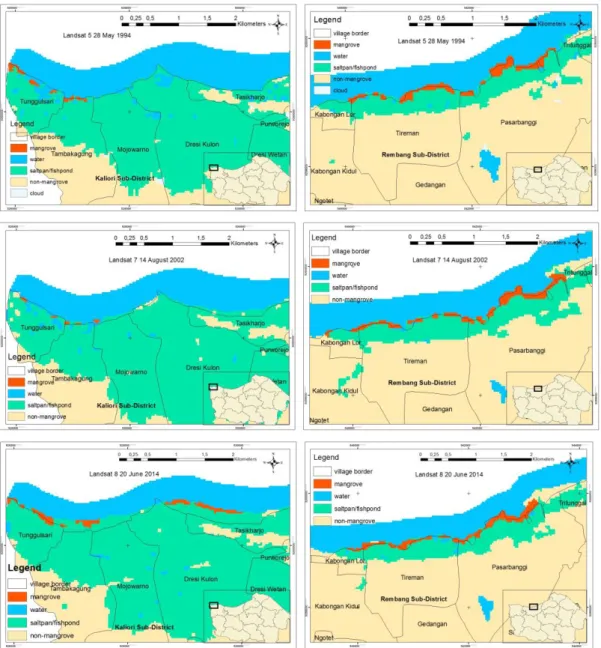
A supervised image classification using band composite resulted there was a decreases of 31 ha mangrove in 1994 into 27.9 ha in 2002. During this period, mangrove forest in Kaliori Sub-District decreased from 6.7 ha to 2.4 ha. The development of saltpan/fishpond contributed to the changes as much as 3.8 ha. Meanwhile, in Rembang Sub-District, the mangroves area increased from 24.3 ha to 25.5 ha. A total of 6 ha mangrove forest in 1994 has changed into saltpan/fishpond in 2002. The new establishment of mangrove area into seaward direction also occurred as amount of 3 ha and 5.9 ha in saltpan/fishpond area.
Jurnal Kependudukan Indonesia | Vol. 10 No. 1 Juni 2015 | 1-10
Figure 2. Coastline maps from topography maps year 1881 and 1943
Community-Based Analysis on Mangrove Forest…| Mochamad Budi Purnomo, et al.
Table 2. The changes of mangroves and coastline extracted from multi-temporal images of Landsat
Profile Period 1994-2002 Period 2002-2014
Mangroves changes (ha) Coastline changes (m) Mangroves changes (ha) Coastline changes (m) 1 2 3 4 1 2 3 4 1 -4.3 -3.5 +44 +28 +7.1 +6.4 +82 +90 2 0 0 +17 +14 +7.6 +7.3 +80 +70 3 +1.2 +2.0 +20 +13 +1.4 +1.3 +13 +20 Remark:
1. Supervised image classification using band composite
2. Supervised image classification using the image composite of difference between NDWI-NDVI, band ratio SWIR/NIR, and NIR band
3. Visual delineation of coastline using band composite 4. Visual delineation of coastline using binary slicing
In general, it can be observed that the shiftness of coastline into seaward direction followed by the increases of mangroves area. For instance in Profile 1, during period 2002-2014, coastline change as much 82 m (using band composite) or 90 m (using binary slicing) followed by the increases of mangroves area as much 7.1 ha (supervised image classification using band composite) or 6.4 ha (supervised image classification using band indices and band ratio).
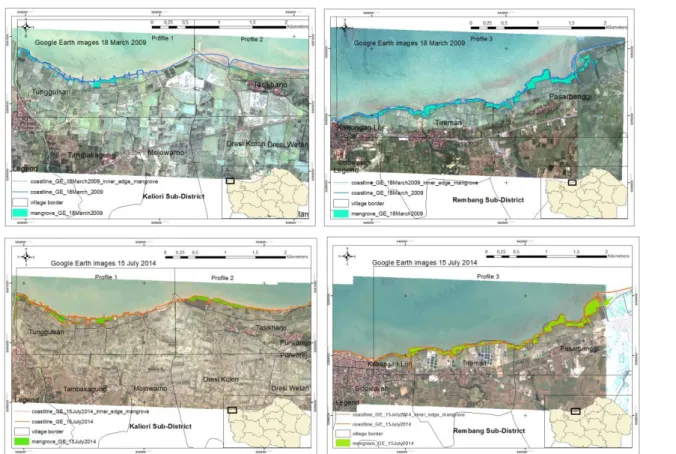
A total of 26.59 ha of mangroves area can be identified in 2009. This extent distributed 5.90 ha in Kaliori Sub-District and 20.69 ha in Rembang Sub-Sub-District. The extent of mangroves in Profile 1 increased from 5.25 ha in 2009 to 6.88 ha in 2014. In 2009, mangroves area in Profile 1 mainly distributed along the pond dike, as well as inside the pond and along outside the dike on seaward direction. The average of mangroves width was increased from 14 m in 2009 into 18 m in 2014. While in Profile 2, the extent of mangroves area was increased from 0.66 ha in 2009 to 5.22 ha in 2014. In 2009, the mangroves area was scattered on muddy flat along the outside of pond dike on seaward direction. The width of mangroves area was vary from 4-18 m, with average about 8 m. In 2014, the mangroves area expanded into a seaward direction along outside the pond dike on seaward direction. The width of mangroves area is vary from 9-60 m, with an average of width around 34 m. Unfortunately, the mangroves area in 2009 was replaced by the pond in 2014.
Furthermore, in Profile 3, there was an increases of mangroves area during 2009-2014. The extent has increased from 20.69 ha into 26.84 ha. The average on mangroves width was increased from 48 m to 66 m. There was also mangroves removal due to new establishment of new pond and river normalization on the eastern part of the area.
Meanwhile, the coastline in all profiles had a tendency to shift into seaward direction. In Profile 1, the coastline of the outer edge of mangroves shifted into seaward direction with an average of changes about 26 m. In line with this situation, the coastline inner edge of mangroves also shifted into seaward direction with an average of changes was about 18 m. Its mean that the movement of coastline into seaward direction also followed by the removal of mangroves area on landward margin.
While in Profile 2, the coastline has shifted into landward direction with a range 2-37 m during period 2009-2014. On the eastern part, the coastline also has shifted into landward direction with the range of changes about 5-27 m. In average, the coastline has shifted into a seaward direction about 25 m during this period. In Profile 3, there were no much changes of coastline between period 2009-2014. In average, the coastline of outer mangroves has moved into seaward direction as far as 4 m during 2009-2014. The coastline of the inner edge of mangroves also shifted into a seaward direction about 2 m.
According to the extracted mangrove forest and coastline year 2009 and 2014, in general, it can be observed that the dominant process in both three profiles was sedimentation followed by the expansion of mangrove forest into seaward direction. In profile 1, the average of coastline changes during this period was 26 m, then followed by the expansion of mangroves area as much 1.64 ha. While in Profile 2, the changes of 25 m of coastline followed by the increases of 4.57 ha of mangrove. Then in Profile 3, a slight 4 m changes of coastline followed by 6.15 ha increases of mangroves area.
Jurnal Kependudukan Indonesia | Vol. 10 No. 1 Juni 2015 | 1-10
Table 3. The changes of mangroves and coastline extracted from Google Earth period 2009-2014
Profile Mangroves (ha)
Coastline outer mangroves (m) Coastline inner mangroves (m) 1 +1.64 ha +26 m +18 2 +4.57 ha +25 m - 3 +6.15 ha +4 m +2
As the research comprehended with characteristics of the coastal dynamics using spatial-temporal approach, the mangrove change is identified thoroughly. Based upon the finding the research look through details on how community perception towards this changes. Predominantly, respondents indicated that mangrove forest near their villages had increased compare to 10 years ago. Mangrove plantation by local people and government were assumed as the main reason due to the increases (67 respondents) while some other interviewees (14 respondents) argued that mangrove plantation and natural regeneration as the main factor of the increases.
About sedimentation, the majority of respondents explained that sedimentation has taken place in their village for the last ten years. Some 14 respondents and 67 respondents described that sedimentation has taken place in their village since 5-10 years and > 10 years ago, respectively. The majority of respondents explained that sedimentation is not an adverse condition, with the assumption that sedimentation provides new land which can be used for some purposes such as mangrove plantation, land extension into sea direction and pond expansion.
Furthermore, there was 7 respondents who indicated that coastal area in their village has been affected by coastal erosion since 5-10 years ago. These 7 respondents argued that strong wave, particularly at peak season of west monsoon (locally known as musim barat) that usually takes place every January-February, as the main factor of this condition. Six respondents described that coastal erosion has negatively affected pond bank and mangroves stand. A number of 34 respondents (42%) indicated their agreement when they requested to indicate their perception wheter the changes of mangrove forest extent can affect their daily life. While 47 respondents (58%) disagree if the changes can affect their everyday lives. Out of 33 respondents in Pasarbanggi, 19 respondents explained that the changes of mangrove Figure 4. Mangrove forest and coastline extracted from Google Earth images
Community-Based Analysis on Mangrove Forest…| Mochamad Budi Purnomo, et al. extent have influenced their daily lives. The same
impression also showed by eight respondents in Tasikharjo and seven respondents in Tunggulsari. Overall, most of the respondents (47 respondents) argued that their daily life has never affected by the changes. Respondents’ perception toward the influences of mangrove forest change is not significantly different between the three villages (p-value 0.056 > 0.05).
Amongs the socio-economic factors which included gender, age, education, income, occupation, length of stay, distance between house-mangrove forest, and involvement in government program, only the factor of respondents’ participation in government mangrove program has the significance influence to those surveyed’ perception of the effects of mangrove forest changes to their life (significant value 0.001 < 0.05). The amount of 48 respondents described that they never made any particular adjustment related to the changes. While 33 respondents exclaimed that they have made adjustment toward the changes of mangrove forest. There is two type of adjustment which made by respondents, structural and economic. Amongst 33 respondents who made an adjustment, 12 of them generated structural adjustment in the form of planting mangrove. While 21 respondents have generated side job, as an economic adjustment to the changes of mangrove forest. There is some side job which owned by those interviewed, such as collecting and selling Avicennia fruit; collecting and selling crabs, shell, and oyster; establishing an own nursery and selling mangrove seedlings, and managing the parking area of mangrove park. Respondents’ adjustment/response toward the changes of mangrove forest is significantly different between the three villages (p-value 0.03 < 0.05).
Amongst the socio-economic factors of respondents, the factor of those surveyed’ participation in government mangrove program considered has a significant influence on those surveyed’ adjustment toward the changes of mangrove forest (significant value 0.000 < 0.05).
A total of 33 respondents experienced on utilizing mangroves ntfp in their daily life, mainly in utilizing the fruits of Avicennia. They collected the Avicennia fruits for some purposes, such as food (snack), seedlings and side income (selling into the market). Some respondents also explained that they are accustomed to collect propagules of Rhizophora as materials for seedlings in the nursery. Respondents’ perception of benefit obtained from mangroves top is
significantly different between three villages (p-value 0.000 < 0.05).
A total of 42 respondents indicated that mangrove programs can deliver benefit for them. While the other 39 respondents exclaimed that there are no significant advantages they can obtain from mangrove programs. Out of 33 respondents in Pasarbanggi Village, 27 of them expressed that they obtain advantages from mangrove programs. While only 13 respondents in Tasikharjo Village and two respondents in Tunggulsari stated the same impression. The respondents’ perception of benefit from government mangrove program is significantly different between villages (p-value 0.000 < 0.05).
Correlation between community’s perception toward the influences of mangrove forest changes and community’s adjustment/response toward mangrove forest changes is directly proportional and statistically significant (p-value 0.000 < 0.05 and contingency coefficient 0.698).
While the correlation between community’s adjustment/response toward mangrove forest changes and community’s perception of benefit from mangroves non-timber forest products is directly proportional and not statistically significant (p-value 0.656 > 0.05; contingency coefficient 0.054).
Furthermore, the correlation between community’s adjustment/response toward mangrove forest changes and community’s acceptance on government mangroves program is directly proportional and statistically significant (p-value 0.041 < 0.05; contingency coefficient 0.239).
COMMUNITY PERSPECTIVE TOWARDS
DYNAMIC CHANGE OF MANGROVE FOREST According to the extraction mangroves area and coastline using Landsat data and Google Earth images, in general, it can be observed that sedimentation was the dominant phenomenon along the study area, in line with previous study by Sunarto (1999), then followed by the increases of mangroves area. The utilisation of historical topography map year 1881 and 1943, tough could not presented the area of mangroves, at least could provide information on sedimentation and coastal erosion.
Sedimentation process in Profile 1 corresponds to the deposition of sediment materials from Randugunting Rivers in the western part of the area. While in Profile 2, the coastline has changed into seaward direction
Jurnal Kependudukan Indonesia | Vol. 10 No. 1 Juni 2015 | 1-10
correspond with the deposition of sedimentation materials from Tasikharjo River. The wave during west monsoon which moves from northwest to southeast direction, will bring the materials into east direction and deposit the materials in Profile 1. On the other hand, the coastline was not much change between periods in Profile 3. The waves during the peak season of east monsoon bring the sediments from east to west and deposit the materials in the form of sandspit in some parts in front of mangroves forest. Thus, the progression of mangroves area in all profiles corresponds to the deposition of sedimentation materials.
Furthermore, the anthropogenic factor might also contribute a significant role in progression or decreases of mangroves area, as well as the coastline dynamic. Mangrove plantation by local people with their initiative and government’s intervention through various programs are considered as the main contributor of the dynamic of mangroves area.
Local citizens in Pasarbanggi Village have started to establish mangrove plantation by their efforts around the 1970s. The government then started to assist local people to expand the forest through plantation program. Various government institutions have actively conducted mangrove plantation in this village, such as The Ministry of Forestry, The Ministry of Environment, Agriculture and Forestry Office (Distanhut), Environment Office (BLH) and Marine and Fishery Office (DKP). The Ministry of Environment has started to run a program called Rehabilitasi Pantai Entaskan Masyarakat Setempat/Rantai Emas (coastal rehabilitation to elevate local people) collaborated with female group of Kartini I and Kartini II. The pioneering stage of tourism activity also has been started in Pasarbanggi Village by BLH Rembang District which called rintisan taman mangrove (pioneering program on mangrove park). The succesfull of local people on establishing mangrove forest in Pasarbanggi Village apparently has attracted various parties to conduct mangroves program in this village. As the direct results, protection of the existing forest is getting better. There has been an increases of forest extent between periods without significant human disturbances.
Meanwhile, government-supported mangrove plantation program is the main contributor at the initial stage of mangrove forest establishment in Tasikharjo Village. The Ministry of Forestry, Distanhut, BLH and DKP have carried out mangrove plantation in this village. Another parties have also conducted plantation
which involving local people, such as BLH of Central Java Province, DKP of Central Java Province, army, NGOs and students. However, the intervention of local people on newly planted areas of mangroves has played an important role in mangroves dynamic in Tasikharjo Village. During 2009-2014, the newly planted areas of mangroves which resulted by government-supported program from previous period, was cleared by local people to be converted into ponds. However, the establishment of Kelompok Pelestari Mangrove (farmer group) is a prominent evidence to show their commitment to protecting the remaining forest. The village government which also supported by this group, has issued informal prohibition on mangrove disruption, includes collecting of Avicennia fruits.
A different condition might occur in Tunggulsari Village. Locally initiated of mangrove plantation by local people was the main factor of mangroves establishment in Tunggulsari Village. The pond farmers in Tunggulsari Village and surrounding area are accustomed to planting the wild seedlings of Avicennia marina and Rhizophora mucronata along the pond dyke at seaward margin to protect the earthen dykes and along the new water channel which built accross the coastline to trap the sediments. Unfortunately, the establishment of new mangroves area at seaward margin often followed by mangrove felling at the landward margin to be converted into a new pond. Mangrove plantation program as government intervention has introduced in Tunggulsari Village and its surrounding area. The Ministry of Forestry and local institutions such as Distanhut, DKP and BLH have initiated mangrove plantation program in this village. Mangroves dynamic in Tunggulsari Village and its surrounding area was higher compare to another villages in the study area which can be observed by the fluctuation of mangroves extent and the shiftness of coastline inner-edge mangrove into seaward direction.
The majority of respondents in Pasarbanggi Village exclaimed that they have been affected by the increases of mangrove forest. In contrary, the majority respondents in Tasikharjo Village and Tunggulsari Village argued that the increases of mangrove forest does not influence their daily life. Furthermore, respondents perception toward the influence of mangrove forest changes is highly correspond to their adjustment toward the changes of mangrove forest. In line with the previous statement, the majority respondents in Pasarbanggi Village explained that they have created certain adjustments toward the changes of mangrove forest. Respondents’ adjustment can be




![Uji sitotoksisitas ekstrak etanolik daun sirih merah [Piper crocatum Ruiz & Pav] terhadap kultur sel mieloma.](data:image/gif;base64,R0lGODlhAQABAIAAAP///wAAACH5BAEAAAAALAAAAAABAAEAAAICRAEAOw==)