STUDENTS’ ABILITY IN IDENTIFYING SUBJECT IN
ENGLISH SIMPLE AND COMPLEX SENTENCES IN
READING TEXT AT THE SECOND YEAR OF
SMA N 3 TELUK KUANTAN OF
KUANSING REGENCY
By
NURAZIZA SAIDA
NIM. 10614003465
FACULTY OF EDUCATION AND TEACHER TRAINING
STATE ISLAMIC UNIVERSITY OF SULTAN SYARIF KASIM RIAU
PEKANBARU
STUDENTS’ ABILITY IN IDENTIFYING SUBJECT IN
ENGLISH SIMPLE AND COMPLEX SENTENCES IN
READING TEXT AT THE SECOND YEAR AT
SMA N 3 TELUK KUANTAN OF
KUANSING REGENCY
Thesis
Submitted to Fulfill One of Requirements for Undergraduate Degree in English Education
By
NURAZIZA SAIDA
NIM. 10614003465
DEPARTMENT OF ENGLISH EDUACATION
FACULTY OF EDUCATION AND TEACHER TRAINING
STATE ISLAMIC UNIVERSITY OF SULTAN SYARIF KASIM RIAU
PEKANBARU
v
ABSTRAK
Judul penelitian ini adalah “Kemampuan Siswa dalam Mengenali Subjek Kalimat Simple dan Complex dalam Membaca Siswa Kelas Dua SMA N 3 Teluk Kuantan Kabupaten Kuantan Sungingi”.
Penulis telah menemukan beberapa gejala yang harus di diskusikan dan di investigasi sehubungan dengan mengenali jenis-jenis subjek kalimat simple and complex dalam membaca teks. Seperti siswa tidak bisa mengidentifikas subjek kalimat dalam membaca teks khususnya jenis-jenis subject dalam bentuk noun phrase dan gerund dan siswa tidak mengetahui posisi subject dalam kalimat.
Subjek penelitian ini adalah siswa kelas dua SMA N 3 Teluk Kuantan. Objek penelitian ini adalah kemampuan siswa dalam mengenali subjek kalimat compound-complex dalam membaca. Populasi penelitian ini adalah seluruh siswa kelas dua SMA N 3 Teluk Kuantan, jumlah keseluruhan populasi adalah 40 siswa. Sampel penelitian ini adalah seluruh siswa tersebut karena merupakan populasi yang kecil.
Untuk mengumpulkan data dari penelitian ini, penulis menggunakan tes untuk menemukan kemampuan siswa dalam mengenali subjek kalimat dengan cara menggarisbawahi subjek kalimat dalam bentuk noun phrase dan gerund dalam membaca teks.
Berdasarkan hasil penelitian, itu bisa dikatakan bahwa sebagian siswa tidak mampu dalam mengenali subjek kalimat simple and complex dalam membaca di kelas dua SMA N 3 Teluk Kuantan pada tingkat kurang 55.
v ABSTRACT
The title of this research is “Students’ Ability in Identifying the Subjects of English Simple and Complex Sentences in Reading of Second Year at SMA N 3 Teluk Kuantan of Kuansing Regency”.
The writer has found some phenomena that should be discussed and investigated dealing with identifying the kinds of the subject of simple and complex sentences in reading text, such as the students cannot find the subject of a sentence in a reading text especially the kinds of the subject in the form of noun phrase and gerund; and some the students do not know the position of the subject in a sentence.
The subject of this research was the second year students of SMA N 3 Teluk Kuantan, and the object of this research was students’ ability in identifying the subject of English simple and complex sentences in reading. The population of the research was all of the second year students of SMA N 3 Teluk Kuantan, the total number of the population was 40. The sample of the research was all of the students because it was a small population.
To obtain the data of this research, the writer used test to find out the students’ ability in identifying subjects of sentences by underlining the subject of the sentences in the form of noun phrase and gerund in a reading text.
Based on the result of the research, it can be said that most of the students are not able to identify the subjects of English simple and complex sentences in reading at second year of SMA N 3 Teluk Kuantan. It is classified into poor to average(55).
v
ا ا ه ع
ا
"
ط
ا
ا ع
ا ةر
ا ! ا "#
ا #ر $ %& ' ا ()* ا
ةءا , ا - آ ا
٣
ن 12ا آ ك ! 2
"
ا و و
رد
ا ضرا ا !
ا تأر
$ا % & ا عا (أ )* %+
ط- .
–
ا ةءا*1 ) 2 & ا
.
$ 4 - ا نأ %آ
ط- . $ا % & ا عا (أ ص .
ا ةءا*1 ) %& ا ع 8 9
: نور;
–
% & ا ) ع 8 % ا <1 ن )* $ 4 - ا و ر;=% ا > او 2 آ*
.
?=@ ا 4 -
ا ا4ه 9 ع 8 % ا
ا B
% ا ر;% +
& ا
٣
ن ا آ ك
.
ع 8 )* ) 4 - ا ةر;1
ا ا4ه ف;ه
ط- . $ا % & ا
–
ة ء ا* ا ) 2 آ* ا
.
4 - < %F
ا ا4ه ) ن &G ا
ن ا آ ك
& ا
ا B
% ا ر;% + ( ! ا ?=@ ا
,
ن &G ا %I
٤٠
ا4 %
.
نL 4 - ا < %F
ا ا4ه :
? 1 ن &G ا
.
ا ا4ه 9 ت ا <%M
,
ةر;1 9:
ا ر . $ا !
ا N ;
ا
?&I : % & ا ع 8 ; آO + *B+ % & ا ع 8 )* ) 4 - ا
ا ةءا*1 ) ر;=% ا > ا و % $ا ةر ا
ا ?P ا د
ا
,
4 - ا Q + نا ل
)* : نور; $
ط- .$ا % & ا ع 8
–
ر;% + ( ! ا ?=@ ا 4 - ةءا* ا ) 2 آ* ا
& ا
ا B
% ا
٣
1 ( ى G% ا ) ن ا آ ك
٥٥
.
v LIST OF CONTENTS SUPERVISOR APPROVAL ... i EXAMINER APPROVAL ... ii ACKNOWLEDGEMENT ... iii ABSTRACT ... v
LIST OF CONTENTS ... viii
LIST OF TABLE ... x
CHAPTER I INTRODUCTION A. Background ... 1
B. Problem ... 4
1. The Identification of the Problem ... 4
2. The Limitation of the Problem ... 5
3. The Formulation of the Problem ... 5
C. Reason of Choosing the Title ... 5
D. The Objective and Significance of the Research ... 6
1. The Objective of the Research ... 6
2. The Significance of the Research ... 6
E. Definition of the Terms ... 7
CHAPTER II THEORETICAL FRAMEWORK A. Overview of English Sentence ... 9
1. Kinds of Sentences ... 12
2. Definitions of Subject ... 15
3. The Characteristics of Subject ... 17
4. Simple Sentence Patterns ... 21
5. Head and Complete Subject ... 22
B. Relevant Research ... 23
C. Operational Concept... 25
CHAPTER III RESEARCH METHODOLOGY A. The Research Design... 26
v
C. The Subject and Object ... 26
D. The Population and sample ... 26
E. The Techniques of Data Collection ... 27
F. The Techniques of Data Analysis ... 28
CHAPTER IV PERSENTATION AND ANALYSIS A. The Data Presentation ... 30
B. The Data Analysis ... 35
CHAPTER V CONCLUSION AND SUGGESTION A. Conclusion ... 39
B. Suggestion ... 40 REFERENCES
APPENDICES
CHAPTER I INTRODUCTION
A. Background of The Problem
English has influenced the world today. It is an international language and holds a prominent role in our lives and it is used for various purposes, especially for developing sciences, technology and education. Syafi’i (2007:97) also points out that, nowadays, the mastery of English is a must if we do not want to be left out, especially in term of information and technology. English is also used for communication all over the world.
In teaching and learning process, English has an important role in improving the quality of education at school. Automatically, the students should know all four of English learning skills. There are four skills such as listening, speaking, reading, and writing. We must master all of them. According to Paulston and Bruder (in Syafi’I, 2007:97) there are four language skills such as listening, speaking, reading, and writing. In addition, there are several language components that students should master, one of which is grammar.
Grammar is one of the important components in learning the four language skills. They are listening, speaking, reading, and writing. According Martin H. Manser, (1991:182) grammar is rules for forming words and making sentences.
One of English Grammar sub topics is subject. Wren and Martin (2003:3) mention that subject is the part which names the person or thing we are speaking about. In addition, Michel and Mary (1995:40) state that the subject is the agent of the sentence in the active voice.
Subjects are very important to be learned by the students because almost all English sentences contain a subject and a verb (Azar, 1989:A1). So, the students need to identify subjects in sentences. Beside that by identifying subject, students are easy to understand sentences in texts and it will make the students are able to communicate fluently. This condition makes identifying subject very essential in learning English. So, it can be said that the students must learn subject.
For examples:
1. The teacher returned the homework after she noticed the error. 2. On the mouth of my village lies a mountain.
3. When he handed in his homework, he forgot to give the teacher the last page.
The third example above have subject, the main subject in the first example (teacher), the second example (a mountain) and the third example (he).
SMAN 3 Teluk Kuantan is one of the familiar schools in Teluk Kuantan. SMA N 3 Teluk Kuantan uses KTSP school-based curriculum in their teaching and learning process, it is based on the rules of government of Indonesia No. 20/2003 about the national system of education which is stated
by Karsidi (2007:1). Based on the syllabus BSNP, (2006:18) the basic competences of English are expressing the meaning and rhetorics in essays using written language accurately, fluently, and acceptable in meaningful context of daily life that involves noun phrase, adjective clause, narrative text, report text, analytical exposition text, because to understand meaning of functional text and simple essays in report, narrative and analytical exposition in daily life context and one of material teaching to access knowledge is noun phrase.
English is one of the compulsory subjects which is taught in this school. Even thought English has been taught in this school with various methods such reading method, and discussion, but some students still face many problems in identifying subjects of sentences in reading text. Ideally, students are able to identify subject of sentences in reading text, and it will make the students easy to understand text. Actually there are four kinds of sentences. They are simple, compound, complex and compound complex sentence. The writer just focuses on simple and complex sentence.
Based on the background above, the writer finds the symptoms as follows:
a. Some of the students do not know which one the subject is, and which one the verb of a sentence is.
b. Some of the students are not able to identify parts of speech such as noun, especially in a long sentence or simple and complex sentence.
c. Some of the students’ opinion the subject consists of a single word, while it can be a phrase.
d. Some of the students view the position of subject is always at the first word of a sentence, while in fact it can be inverted.
From the above symptoms, the writer is really interested in conducting a research entitled:
STUDENTS’ ABILITY IN IDENTIFYING SUBJECTS IN ENGLISH SIMPLE AND COMPLEX SENTENCES IN READING TEXT AT THE SECOND YEAR OF SMA N 3 TELUK KUANTAN OF KUANSING REGENCY.
B. Problem
1. The Identification of the Problem
Based on the background and phenomena above, the writer identifies the problem as follows:
a. What are the student’s difficulties in differentiating which one the subject, and which one the verb of a sentence is??
b. What factors make the students not able to identify parts of speech such as Noun, especially in a long sentence or simple and complex sentence?
c. Why do the students opinion the subject consists of a single word, while it can be a phrase?
d. Why do the students view the position of subject is always the first word of a sentence, while it can be inverted?
2. The Limitation of the Problem
Actually, there are many problems concerning this research which can be studied. Because of the limitation of the capabilities of the writer; time and finance, the writer needs to focus her discussion on analyzing students’ ability in identifying the subject in a sentence. The subjects are in the form of noun phrase and gerund in simple and complex sentence.
3. The Formulation of the Problem
From the limitation of the problem above, the writer formulates the research on how the students’ ability of the second year of SMA N 3 Teluk Kuantan in identifying the subjects of simple and complex sentences in reading text.
C. The Reason of Choosing the Title
The writer is really interested in doing research for the following reasons:
1. This study has never been researched yet.
2. This research is relevant to the writer as a student of English education.
3. This topic is important to be researched because it will give information to the students to solve the problem in identifying the subject as well as.
Hopefully, this research can give contribution to the teacher and the students of SMA N 3 Teluk Kuantan. The teachers who teach English are expected to improve the students’ ability in identifying the subjects of English sentences in reading. The students are also hoped to be able avoid unnecessary things in identifying the subjects of English sentences in reading.
D. The Objective and Significances of the Research 1. The Objective of the Research
The objective of the research is to obtain the student’s ability in identifying the subjects of simple and complex sentences in reading at second year of SMA N 3 Teluk Kuantan.
2. The Significances of the Research
1. As the writer’s contribution to education, especially about the students’ ability in identifying subjects of English sentences in reading at second year of SMA N 3 Teluk Kuantan.
2. Help the writer herself enlarge her knowledge.
3. To complete undergraduate degree (S1) at UIN SUSKA Riau. 4. To make the students familiar with subjects of sentences in
5. To help the students easier understand texts by identifying subject so, they can get information needed.
E. The Definition of the Terms
To make it easy for to the readers to understand, the title, the terms used in this research, definitions of the key terms is given as follows. They are:
1. Study
Study means the activity of learning or gaining knowledge either from books or examination think (Hornby, 1995:1187). In this research, study means a study of students’ ability to identify the correct subjects of sentences.
2. Ability
Manser, (1991:1) defines ability as skill or power. In this research, the ability means knowledge of the students of the nature subjects of sentences as reflected by their ability to choose the correct answer in underlining the correct subject of sentences.
3. Subject
Wren and Martin, (2005:3) define that subject is the part which names the person or thing we are speaking about. In this research, the subject means that more important elements of a sentence, so the students must be familiar to know the correct subject in a sentence.
4. A sentence
A sentence is a group of words that expressed a complete thought, (Veit, 1986:21). In addition, Wren and Martin, (2005:3) define that a sentence is a group of words which makes complete sense. In this research, sentence means that ability of the students in choosing the correct subjects of the sentences.
CHAPTER II
THEORETICAL FRAMEWORK
A. An Overview of English Sentences
According to Gaston Bachelar (in Marcel Danesi, 2006:1) there are some definitions about sentences:
1. A sentence is an organized series of words that allows you to make a statement, ask a question, express a thought, offer an opinion, and so on. In writing, a sentence starts with capitalized word and ends with a period, a question mark, or an exclamation mark. That woman is American.
Is that woman American?
I am absolutely positive that she is American!
2. A sentence is organized in relation to what you intend to say and how you are going to say it. You cannot put words in just any order!
Jumbled Organized
Woman that is American. That woman is American. American woman that is? Is that woman American?
3. Sentences have two basic parts: a subject and a predicate. The subject is the part of sentence that denotes the doer of an action or what is sentence is about. It is often the first element in a simple sentence such as a direct statement. The predicate is the part of a sentence that provides information about the subject. In simple sentence, it comes after the subject.
Subject Predicate
The woman is American.
Carmen is Studying French.
Your car consumes too much gas.
4. But be careful, the subject is not always the first element in a sentence.
Yes, Marisa is studying French.
Does your car really consume a lot of gas?
5. A sentence can have more than one subject and/or predicate.
Debbie thinks that you are Italian.
That woman is the American lady who lives near us 6. Each combination of subject and predicate is called a
clause. In sentences consisting of more than one clause, there is a main clause, called an independent clause, and one or more subordinate clauses, called dependent clause. The letter are usually introduced by words such as that, which, and so on.
Debbie thinks that you are Italian. Independent Dependent clause clause
7. A compound sentence made up of two or more sentence, noun clause, linked together by words such as and and
or called conjunction.
I speak English and my friend speaks Spanish.
8. When speaking or writing, you do not always need to use complete sentences. Parts of a sentence may be left out when they are clearly implied.
How are you? I am well, thanks.
9. Sentence can also be constructed to emphasize something. In writing, emphatic sentences have an exclamation mark at the end. One method of constructing such a sentence is to use the verb do in its appropriate form and change the main verb to the infinitive. Another method is to change the word order around, bringing the emphatic part to the front of the sentence.
Nonemphatic Emphatic
10.Sentence can also be active or passive. In an active sentence, the subject of the sentence is performing the action expressed by the verb; in a passive sentence, the grammatical subject has the action of the verb performed on it.
Active Passive
Marry reads the book. The book is read by Mary.
11.Some sentences are constructed to state quotation directly with a subordinate clause.
A sentence is a group of words that expresses a complete thought, (Veit, 1986:21). A sentence is essentially a grammatical unit. For instance, We
go to school everyday. That sentence shows a complete meaning. It is clear
that they go to school everyday. However, if we compare it with a segment; to
Australia next year, the group of words above will not be a sentence because
the meaning is not clear because there is no subject, and no predicate. It is different if the above segment added by the words I plan to go. So, the statement above become I plan to go to Australia next year has clear meaning. It is obvious that he plan to go to Australia next year.
When we talk about sentences automatically, we talk about subjects and verb as well. According to Martin (1980:7), the subject tells what or whom the sentence is about, it may be one word or more than one word. On the contrary, verb is the part which tells something about the subject.
On the other hand, Jack C, et al. (1992:330) state that sentence is the largest unit of grammatical organization within which parts of speech (e.g. nouns, verbs, adverbs) and grammatical classes (e.g. words, phrases, clauses) are said to function.
So, within a sentence, there are at least a subject or noun phrase and predicate or verb phrase.
1. Kinds of Sentences
According to Yate and Delaney (1984:58), there are four kinds of English sentences: a. Simple sentence b. Compound sentence c. Complex sentence d. Compound-Complex sentence a. Simple sentence
A simple sentence has two essential parts; one main subject and one main predicate, or it has a compound subject and a compound predicate, Kencana, (2006:66).
In addition, Wren and Martin (2005:169) also state that a simple sentence is one which has only one subject and one predicate. For instance:
1. Eric sang a song.
2. I always work hard every day.
3. I am going to study Japanese next year.
4. Jenny and Joni went to the shopping mall last night. 5. Rony goes to the library and reads everyday.
From the examples above, the fourth example has a compound subject (Jenny and Joni) and the fifth example has a compound predicate (goes and reads).
b. Compound Sentence
According to Jack C, et al. (1992:69), a compound sentence is a sentence which contains two or more independent clauses which are jointed by co-ordination.
Furthermore, Kencana, (2006:73) says that a compound sentence is a sentence that contains two or more simple sentences, usually joined by a connecting word. For instance:
1. Bob plays chess well; his young brother is learning the game. 2. Jhon like economics but Mary likes art.
3. My parents went to puncak for their vocation; my brother and I went to Bali for ours.
4. Rini and Rere are chitchatting by the door, Jhon is reading his book, Dodo is flattering Angelina on the class corner, but Didit is sleeping on his desk.
5. I had nothing to do last night, so I went out to see a movie by myself.
From the examples above, the fourth example “Rini and Rere are chitchatting by the door; Jhon is reading his book; Dodo is flattering Angelina on the class corner, Didit is sleeping on his desk” has four
independent clauses which are joined by clause connectors, either marked or unmarked clause connectors.
c. Complex Sentence
According to Jack C, et al. (1992:69), a complex sentence is a sentence which contains one or more dependent clauses, in addition to it is independent, or main clause. For instance:
1. When it rained we went inside.
2. I was studying English when my friend came.
3. Besides we have to study grammar, we must also know how to speak fluently.
4. Because I didn’t go to school last week, I didn’t know that there would be an exam today.
5. My dad bought this book, which has a hundred-page long, in Jakarta.
The five examples above have dependent clauses and independent clauses. In the first example, “When it rained” is a dependent clause and “we went inside” is an independent clause.
d. Compound - Complex Sentence
A compound-complex sentence is a combination of two or more independent clauses and one more dependent clauses. For instance:
1. I hate playing golf, but I enjoy playing tennis even though I am not very good at it.
2. Laura forgot her friend’s birthday, so she sent a card when she finally remembered.
3. Thought Mitchell prefers watching romantic films, he rented the latest spy thriller, and he enjoyed it very much.
From the examples above, the first example “I hate playing golf, but I enjoy playing tennis” has two independent clauses and “I am not very good at it “has one dependent clause.
2. Definitions of Subject
The subject is also normally the most important person, place, thing or idea in the sentence. It is usually a noun or pronoun. Sometimes, it is difficult to decide exactly what the subject is if the subject and verb are separated. There are two kinds of subject. They are simple and complete subject. Simple subject is the most important word in the subject, Martin, (1980:6). For instance, a dog with this pedigree is usually nervous.
The complete subject is a dog with pedigree, and as simple subject is dog. Very often if the subject and verb are separated, they will be separated by a prepositional phrase. The prepositional phrase has no effect on the verb.
Subject + (prepositional phrase) + verb.
Several theories on this subject have been proposed. The views of these disciplines vary from time to time. From example above, dog is the simple subject of that sentence. It is rather difficult to identify because a subject does not only consist of one word but more that two words.
The subject is one of the important elements in constructing a sentence. Usually the subject of a sentence is a person, place, thing, or idea. There are some definitions; According to Jack C, et al. (192:361), the subject in English grammar is generally the noun, pronoun or noun phrase which refers to something about which a statement or assertion is made in the rest of the sentence. On the other hand, Wren and Martin, (2005:3). Mentions subject is the part which names the person or thing we are speaking about. Furthermore, according to Azar (1992:70), subject is a noun, and Yates and Delaney (1984:58) defined the subject is the word or words that tell who or what about the verb, or predicate.
In addition Hornby, (1995:1190) says that the subject is a thing or person that is being discussed or described; a topic or theme. In accordance with definition about subject, Manser, (1991:413) defined subject as thing (to be) talked or written about. Furthermore, Michael and Marry (1995:40), the subject is the agent of the sentence in the active voice; it is the person or thing that performs or is responsible for the action of the sentences, and it normally precedes the verb.
Based on the explanations above, subject is one of the important elements to construct a sentence. It is important because a good sentence in English consists of at least a subject and a verb.
2. The Characteristics of Subject
1. Usually, the position of the subject at the beginning in a sentence but not always. For instance; (1) After her exam Tiwi takes a trip by boat.
(2) Sleeping early in the night is good for our health.
Bold types of the example function as the subject. In the first example Tiwi is the subject, it comes in the middle. In the second example,
sleeping early in the night is the subject, it comes at the beginning.
According to Michheal and Mary (1995:44), a noun phrase is a group of words that ends with a noun, like, On my table is a Dictionary. The word “a dictionary” of the sentence above functions as the subject, it comes at the end.
2. Subject agrees with the predicate. Such as: (1) Jhon and Mary are students of UIN-SUSKA. (2) Jhon is a student.
Both of the sentences above are simple sentence forms. They consist of single word like subject and predicate. Those sentences are singular and plural form. Singular form has a subject, and plural form has more than one subject. In the first example, Jhon and Mary functions as the subject, and are functions as the predicate. In the second example, Jhon functions as the subject, and is functions as the predicate.
3. Subject consists of Gerund, Noun phrase. a. Gerund
A gerund is a word formed from a verb, used as noun and ended with “ing”, (Izzan, 2007:115). On the other hand, Lingga (2007:155), gerund is also called as verbal noun that is a verb form that is used as a noun. Some verb can take another verb as the complement instead of a noun. Sometimes the verb functioning as the complement must be in the infinitive (to+verb) and sometimes it must be in the gerund (verb+ing) form.
According to Lingga (2007:155) the used of gerund in sentences is divided into some parts, namely:
(1). Gerund functions as a subject of a verb. Example: Teaching is a noble profession.
(2).Gerund functions as an object of a transitive verb or a direct object.
Example: They enjoy singing.
(3).Gerund functions as a complement of incomplete verbs or as a predicate noun after linking verb (especially “to be).
Example: The things which Wati enjoys are eating, drinking, and sleeping.
(4).Gerund functions as an object of a preposition Example: You must refrain from smoking.
Example: Her hobby, swimming, has helped to keep her healthy. (6).Gerund can be used as an absolute complement.
Example: Speaking the truth being his habit, we love him
(7).Gerund can be used as Infinitive substitute. (With change and no change in meaning)
Example: Teach me singing.
(it has no different meaning with “Teach me to sing”.) But : Likianto stops to smoke
(it has different meaning with “Likianto stops smoking”.) Note:
Some verbs can be followed by either the infinitive at the gerund, but the meaning changes. Those verbs are stop, remember, and forget.
Example: John stopped studying. (Jhon is not going to study anymore).
John stopped to study. (Jhon stopped doing something in order to study).
(8). Gerund functions as a common noun
Example: The paying of wages is impossible this month. (9).Gerund can be used either in active or passive sentences.
Compound gerunds are formed by putting together “being” or “having been” before past participle.
Having played the whole day, he was tired. (active) Having been scolded by his father, he was very upset. (passive) (10). Gerund can be used by using object.
Example: Plucking flowers is strictly prohibited (11). Gerund can be used after possessive case of nouns.
Example: He insisted on my paying the money
(12). Gerund can be used as adjectives to form compound nouns used with other nouns.
Example: Walking-stick (stick to help people walk), fraying pan, etc.
b.Noun phrase
Noun phrase is a quintessential part of every sentence. Even if it does not appear in the surface structure of a sentence as in stop. A noun phrase whose head is a noun or pronoun, optionally accompanied by a set of modifiers (http://en.wikipedia.org/wiki/nounphrase:2010)
Noun phrase is one of the important parts of a sentence because a noun phrase can function as a subject, an object or a compliment. According Sujatmiko (2007; 167) states that, a noun phrase is a phrase or a group of words with a noun as the center or head. Furthermore, According to Wren and Martin (2005:161), a noun phrase is a group of words that does the work of a noun. For instance: (1) Early to bed is a good maxim.
(2) His father wished to speak to the headmaster. The first and the second
examples of the bold types function as the subjects.
Noun phrases are always found in a text even in sentence. It consists of two or more words with a noun that is modified by other parts of speech, such as adjective, adverb, and noun. For instance:
(1). Beautiful girl (a noun modified by adjective) (2). English book (a noun that is modified by noun) (3). Bellow sentences (a noun that is modified by adverb)
In general, a noun phrase is a combination of two or more words that consider into noun or pronoun. Noun phrase is one of the important parts of a sentence. If it is not appear, the sentence is meaningless. In every reading, speaking, listening, and writing noun phrase is frequently found.
4. Simple Sentence Patterns
According to Kencana, (2006:66), a simple sentence has two essential parts; one simple subject and one simple predicate, or it has a compound subject and a compound predicate.
Such as:
I + sing + a song Subject Verb Object
Based on the example above, we can choose the subject “I”, because the subject of a sentence is a person or thing that we are talking about. Why? Because it is based on its pattern.
5. Head and Complete Subject
According to Jerome Martin, (1980:6), a subject tells what or whom the sentences is about. It represents a person, place, or thing that performs the action of the verb or expresses the condition or state of the verb. It is the topic about which the speaker or writer is speaking or writing. The predicate is the doing or being part of a sentence. It represents the action taken by the subject. Here are a few simple examples of both subjects and predicates; (1) Harried ran. (2) Factories pollute. (3) Igneous was tan. (4) Camels swim?
Each of these is a complete sentence because it contains a subject and a predicate. In the first sentence, the proper noun Harriet is the subject, and the verb “ran” is the predicate. Harriet performs the action of run. In the second sentence, the noun factories is the subject, and the verb Pollute is the predicate. Factories perform the action of the verb “pollute”. In the third sentence, the proper noun igneous is the subject, and the linking verb was and the subject complement tan forms the predicate. Igneous express the condition indicates by was. In final sentence, the noun camel is the subject, and the verb swim is the predicate. Camels perform the action of swim.
Not all sentences are as simple as the ones mentioned above. Most subjects and predicates consist of two or more words. In the subject, there is
always one word that names the entity spoken of this head subject. The head subject and its attendant modifiers together are called the complete subjects.
Subjects and predicates are often single words. If just one word, it constitutes a subject or a predicate, then that word alone is both the head and complete subject or the head and complete predicate. This is often the case with pronouns used as subjects and with verb phrases used as predicates.
We saw the eclipse.
From the example above, this is a single pronoun; we is the head subject and the complete subject.
Some sentences contain two or more subjects or predicates, each set is joined by a conjunction. Two or more subjects or predicates are joined by a coordinating conjunction. It is said a compound subject (Jerome Martin, 1980:11).
Jhon and George are funny guys.
B. The Relevant Research
As a matter on fact, there are several pieces of previous research regarding with students’ ability in identifying the subject of English sentences in reading. One of which was conducted by Ari Sabrijal (2007). In his research he focuses on the students’ ability in identifying subject-verb agreement in reading text.
He found that the students’ ability in identifying subject verb agreement in reading text is categorized into fail, based on the students’ score
in answering the best about subject verb agreement in reading text (43.54), and the factors that influence the students’ ability in identifying subject verb agreement in reading text is the students neglect the rules of subject-verb agreement when they learn English.
The almost similar research was conducted by Rita Fauziah (2004). Her title was Students’ difficulties in understanding subject-verb agreement at the second year students of English Education Department of Tarbiyah Faculty of UIN SUSKA RIAU.
She found that subject-verb agreement is difficult for the second year students of English Education Department; the percentage of the difficulty in general is 56%.The factors influence the students’ difficulties are internal and external factors. They are healthy obstacle, the subject-verb agreement material, the time allocation, the teaching method, and lack of facilities, less motivation, and little reference.
The similar research was conducted by Nora (2005). In her qualitative research, she emphasized on the students’ efforts in learning subject-verb agreement at the second year of English education department of faculty of education and teacher training of UIN SUSKA RIAU.
Based on her research the students efforts in learning subject verb agreement is classified as fair, at the level 68.05%, with the efforts that have been done by the second year students of English education department as follows: (1) The students prepare themselves to study before joining the class. (2) The students do not miss English grammar classes. (3) The students come
to the grammar classes on time. (4) The students pay attention during the teaching learning grammar process. (5) The students concentrate on teaching learning grammar process. (6) The students ask the material about subject verb agreement to the teacher. (7) The students discuss about subject-verb agreement with their friends.
Based on the third titles above, the writer wants to explain that will be done by the writer is not the same as the two pieces of research above, because in this study the writer focuses on the students’ ability in identifying the subject of English sentences in reading.
C. The Operational Concept
The operational concept is a concept, which is used to avoid misinterpreting and misunderstanding in scientific research. Because a concept is still operated in an abstract form, it must be operated in a concrete one.
The operational concept of this study can be seen in the following indicators: 1. Students are able to identify the kinds of the subject in the form
of noun phrases in simple and complex sentence.
2. Students are able to identify the kinds of the subject in the form of gerunds in simple and complex sentence.
3. Students can differentiate which one the subject and which one the verb of simple and complex sentences in reading.
4. Students should know the position of the subject in simple and complex sentences in reading.
CHAPTER III
RESEARCH METHODOLOGY
A. The Research Design
Gay (1987:11) says that the descriptive research involves collecting data to test hypothesis or to answer question concerning the current status of the subject of the study.
This research is a descriptive research that has just one variable. It is to investigate the students’ ability in identifying subject at the sentence on second year student of SMA N 3 Teluk Kuantan.
B. Time and Location of the Research
The location of this research is at SMA N 3 Teluk Kuantan. The time of this research was on March 2010.
C. The Subject and Object of the Research
The subject of this research was the second year of SMA N 3 Teluk Kuantan, and the object is students’ ability in identifying the subject of English sentences in reading.
D. The Population and Sample
Gay (1987:102) states that population is the group to which the result of the study are intended to apply. The population of this research is all the second year of SMA N 3 Teluk Kuantan. The population consists of two classes, they are class A (20 students) and class B (20 students) so, the total of
population is 40 students. The sample of this research 40 students. Arikunto (2002:112) says that if the amount of the subject is less than 100, it is better to take all the population. So, in this research the writer takes all the population.
Table 1
The population class A and class B
No Class Number of Students Population
1. A 20 20
2. B 20 20
Total sample 40
E. The Technique of Data Collection
The technique of data collection which is used by the writer in this research is a test. The form of test is underlining the correct subjects of sentences in reading text. The test items were taken from text book of senior high school and narrative text from genres of the text book.
The test was given to the students as the instrument of the research; the writer conducted the test:
1. Giving test to the students.
2. Explaining to the students what they should do. 3. The students must understand about the text.
100 × = N X M 4. Underline
in form of noun phrase and gerund.
F. The Technique of Data Analysis In order to find out the students’
the sentence, the writer scores the result of the test by using the following formula:
Where;
M = individual score X = correct answer N = number of items
The mean score is calculated by using the following formula:
Where:
m = Mean Score
= Total Score of Student
N = Number of The Student
Then, these scores are classified according 1974:134).
% 100
line the subjects of sentences in reading text, the subject in form of noun phrase and gerund.
Technique of Data Analysis
In order to find out the students’ ability in analyzing the subject of the sentence, the writer scores the result of the test by using the following
= individual score = correct answer = number of items
The mean score is calculated by using the following formula:
Mean Score
= Total Score of Student = Number of The Student
Then, these scores are classified according to the level of proficiency (
in reading text, the subject
ability in analyzing the subject of the sentence, the writer scores the result of the test by using the following
Table 2
The classification of Level Proficiency
NO. Score Classification of Mastery
1. 80-100 Good to excellent
2. 60-79 Average to good
3. 50-59 Poor to average
4. 0-49 Poor
Finally, to obtain the percentage of the classification of the students’ ability in identifying subjects in the sentences, the writer uses the following formula;
Where;
p = percentage
f = number of frequency
N = total number of responds
(Anas Sudijono, 1987:4) % 100 × = N f p
CHAPTER IV
THE DATA PRESENTATION AND DATA ANALYSIS
A. The Data Presentation
This research is focused on the descriptive study. In order to get the data that support this research, the writer use the test. The test refers to the students’ ability in identifying the subject of simple and complex sentence in reading text. Furthermore, in this chapter the writer presents the data about test which was given to the second year students of SMA N 3 Teluk Kuantan of Kuansing regency.
The result of the test was analyzed based on two categories of the subjects, namely: noun phrase and gerund, where it is focused on multiple-choice. In order to arrange the items of the test, the writer works based on the phenomenon as stated in Chapter I. For the students who are able to answer each item accurately, the writer gives score 1 for each item and for those who did not complete them get 0. Therefore, the students should answer all of the items as well as their own understanding about subjects of simple and complex sentences in reading text.
The result of the test of noun phrase can be seen as follows:
The Mean of the Students’ Score in Identifying Noun Phrase as the Subject of Sentence in Reading Text
Table 1
The Percentage of Students’ Ability in Identifying Noun Phrase as the Subject of Sentence in Reading Text
N0 Score Frequency Percentage Ability Level
1. 80-100 - - Good to excellent 2. 60-79 10 25% Average to good 3. 50-59 10 25% Poor to average 4. 0-49 20 50% Poor Total 40 100%
Based on the table about the percentage of students’ ability in identifying noun phrases as the subjects of sentences in reading text above, it can be seen that out of 40 students who took the test, there were no students in Good to excellent level, 10 students (25) % were in Average to good level, 10 students (25) % were in
Poor to average level, and 20 students (50%) were in Poor level.
N fx M =
∑
. 39 40 5 , 1562 = = MBased on of the mean score of the students, it can be concluded that the students’ ability in identifying noun phrase
level 39.06 (0-49). After score polygon. See figure below:
From the figure above, it can be seen th who get score 0-49, most of the students students are in poor level
reading text.
06 .
Based on of the mean score of the students, it can be concluded that the students’ ability in identifying noun phrases as the subjects of sentences is in
49). After scores are listed, the writer can construct a frequency of polygon. See figure below:
From the figure above, it can be seen that even though there are 20 students most of the students’ scores are around 0-49; it means that poor level to identify noun phrases as the subjects
Based on of the mean score of the students, it can be concluded that the of sentences is in poor are listed, the writer can construct a frequency of
at even though there are 20 students 49; it means that of sentences in
The result of the test of gerund can be seen as follows:
The Mean of the Students’ Score in Identifying Gerund as the Subject of Sentence in Reading text
Table 2
The Percentage of Students’ Ability in Identifying Gerund as the Subject of Sentence in Reading Text
No Score Frequency Percentage Ability level
1. 80-100 37 92.5% Good to excellent
2. 60-79 3 7.5% Average to good
3. 50-59 - - Poor to average
4. 0-49 - - Poor
Total 40 100%
From the table above, it can be seen that out of 40 students who took the test, 37 students (92.5%) were in Good to excellent level, 3 students (7.5%) were in
Average to good level, there were no students in Poor to average level, and there
were no students in Poor level.
M = N fx
∑
M = 80.5 40 3220 =Based on of the mean score of the students, it can be concluded that the students’ ability in identifying gerund
excellent level 80.5 (80-100). After score
frequency of polygon. See figure below:
From figure above, it can be seen that even though there are 37 students who get score 80-100, most of the students
students are in good to excellent to identify gerund reading text.
B. The Data Analysis
THE STUDENTS
Based on of the mean score of the students, it can be concluded that the students’ ability in identifying gerunds as the subjects of sentences is in
100). After scores are listed, the writer can construct a frequency of polygon. See figure below:
From figure above, it can be seen that even though there are 37 students most of the students’ scores are around 80-100; it means that students are in good to excellent to identify gerunds as the subjects
Table 3
THE STUDENTS’ ABILITY IN IDENTIFYING
Based on of the mean score of the students, it can be concluded that the of sentences is in good to listed, the writer can construct a
From figure above, it can be seen that even though there are 37 students 100; it means that of sentences in
THE SUBJECTS OF SENTENCES IN READING TEXT Students Correct answers Score Classifications Percentage
S2 8 61.53 Average to good 45% S5 8 61.53 Average to good S6 9 69.23 Average to good S10 8 61.53 Average to good S11 10 76.92 Average to good S15 9 69.23 Average to good S16 8 61.53 Average to good S17 9 69.23 Average to good S20 10 76.92 Average to good S21 8 61.53 Average to good S25 9 69.23 Average to good S28 10 76.92 Average to good S29 8 61.53 Average to good S31 8 61.53 Average to good S32 9 69.23 Average to good S33 8 61.53 Average to good S36 8 61.53 Average to good S37 10 76.92 Average to good S1 7 53.84 Poor to average 27.5% S9 7 53.84 Poor to average S12 7 53.84 Poor to average S14 7 53.84 Poor to average S18 7 53.84 Poor to average S22 7 53.84 Poor to average S23 7 53.84 Poor to average S30 7 53.84 Poor to average S35 7 53.84 Poor to average S38 7 53.84 Poor to average S39 7 53.84 Poor to average S3 4 30.76 Poor 27.5% S4 4 30.76 Poor S7 4 30.76 Poor S8 6 46.15 Poor S13 6 46.15 Poor S19 4 30.76 Poor S24 5 38.46 Poor S26 5 38.46 Poor S27 4 30.76 Poor S34 5 38.46 Poor S40 5 38.46 Poor 286 2199.78
The mean of the Students’ Score in Identifying the Subject of Sentence in Reading Text
Table 4
The Percentage of Students’ Ability in Identifying the Subject of Sentence in Reading Text
No Score Frequency Percentage Ability Level
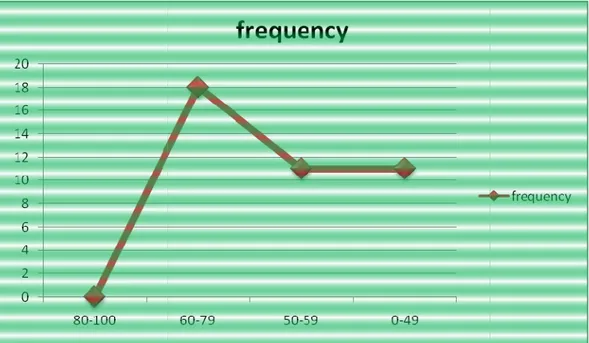
1. 81-100 - - Good to excellent 2. 60-79 18 45% Average to good 3. 50-59 11 27.5% Poor to average 4. 0-49 11 27.5% Poor Total 40 100%
From the table above, it can be seen that out of 40 students who took the test, there were no students in Good to excellent level, 18 students (45%) were in
Average to good level, 11 students (27.5%) are in Poor to average level, and 11
students (27.5%) were in Poor level.
To calculate the mean score of the students, the following formula is used:
M = N fx
∑
M = 55 40 78 . 2199 =Based on of the mean score of the students, it can be concluded that the ability of the second year students in identifying the subject
to average level 55 (50-59).
After scores are listed, we can construct a frequency of polygon. figure bellow:
From the figure above, It can be seen that even though there are 18 students who get score 60
means that students are at the level of a sentences in reading text.
From the presentation of the data, the writer can make an interpretation about the data of this research. After analyzing the data, the wr
ability of the second year students in identifying the subject text is in Poor to average
Based on of the mean score of the students, it can be concluded that the ability of the second year students in identifying the subjects of sentences is in poor
59).
are listed, we can construct a frequency of polygon.
From the figure above, It can be seen that even though there are 18 -79, most of the students’ scores are around 60 at the level of average to good to identify the subject
the presentation of the data, the writer can make an interpretation about the data of this research. After analyzing the data, the writer interprets that the ability of the second year students in identifying the subjects of sentences in reading
level.
Based on of the mean score of the students, it can be concluded that the of sentences is in poor
are listed, we can construct a frequency of polygon. See
From the figure above, It can be seen that even though there are 18 are around 60-79; it verage to good to identify the subjects of
the presentation of the data, the writer can make an interpretation iter interprets that the of sentences in reading
It can be seen from the table 4, event though there are 11 students who get score 50-59; it means that students are at the level of Poor to average to identify the subjects in the form of noun phrases and gerunds in simple and complex sentences in reading text, because the result of the mean score of students is around 55 and it means that the students are still confused to identify the correct subjects of simple and complex sentences in reading.
CHAPTER V
CONCLUSION AND SUGGESTION A. Conclusion
Based on the result of the study presented in chapter IV, the writer concludes that the ability of second year students of SMA N 3 Teluk Kuantan in identifying the subjects of simple and complex sentences in reading is in the category of Poor to average level (55). It means most of the second year students of SMA N 3 Teluk Kuantan are not able to identify the subjects of the sentences in the reading text.
The students’ score in identifying noun phrase as the subject of sentence is 39.06. The score shows that the students’ ability is in poor level. The students’ score in identifying gerunds as the subjects of sentences is 80.5. The score shows that the students’ ability is in good to excellent level.
From the detail above, it can be seen that the easiest subject for second year students of SMA N 3 Teluk kuantan is Gerund (80.5) and the most difficult one is noun phrase (39.06).
Briefly, the students’ ability in identifying the subject of sentence is still poor to average level (55). So the students’ ability of the second year students of SMA N 3 Teluk kuantan in identifying the subject of simple and complex sentence in reading text is still poor to average level.
B. Suggestion
After looking at the result of the research, the writer would like to offer some suggestions:
1. Suggestion for the Students:
a. The students should be able to identify subjects in order to increase their ability in reading text.
b. The students should do more exercises in identifying the subjects of sentences like; noun phrases and gerunds.
c. The students should understand the position of subject in a sentence of the text so, they can get information needed.
2. Suggestion for the Teacher/s
a. In teaching subjects of sentences, the teachers should be able to be more friendly and it will make the students understand the teaching material easily.
b. The teachers should use varied methods in teaching grammar, especially in teaching subject and must construct the good ways by adding more attention in reading text.
REFERENCES
Ahmad Izzan.2007. Basic English Grammar. Jakarta: Kesaint Blanch.
Ari Sabrijal. 2007. “The Students’ Ability in Identifying Subject Verb
Agreement in Reading Text at the Second Year of Madrasah Aliyah Diniyah Puteri Pekanbaru”.
Anas Sudijono. 2007. Pengantar Statistik Pendidikan. Jakarta: PT. Raja Grafindo Persada.
Azar, Betty Schrampter. 1989. Understanding and Using English Grammar. New Jersey: Englewood Cliffs.
Airasian,L.R Gay Peter.1987.Educational Research Competencies for Analysis
and Application Sixth Edition. The United Stated of America: Merrie
Publishing Company.
Harris,David. 1974. Testing English as a Second Language. Bombay: Goergetown University.
Heidi Platt, at all. 1992. Longman Dictionary of Language Teaching and
Applied Linguistics. Malaysia: Longman Group UK Limited.
Hornby. 2000. Oxford Advanced Learner’s. New York: Oxford University Press.
Karsidi. 2007. Model Kurikulum Tingkat Satuan Pendidikan (KTSP) SD dan
MI. Solo: PT, Tiga Serangkai Pustaka Mandiri.
Kencana. 2006. Improving Reading Skill in English. Jakarta: Prenada Media Group.
Lingga, Hotben D. 2006. Advanced English Grammar for TOEFL Preparation. Puspa Swara.
Manser, M. H. 1980. Oxford Learner’s Pocket Dictionary. New York: Oxford University Press.
Martin and Wren, 2003. English Grammar and Composition. Multicolour Edition: S. Chand and Company LTD.
Martin, Jerome. 1980. American Book English. USA: D.C. Heath and Company.
Nora. 2005. “The Students’ Efforts in Learning Subject Verb Agreement at
Second Year of English Education Department of Faculty of Education and Teacher’s Training of UIN Suska Riau”.
Rita Fauzia.2004. “Students’ Difficulties in Understanding Subject Verb
Agreement at the Second Year Students of English Education Department of Tarbiyah Faculty Uin Suska Riau”.
Suharsimi Arikunto. 2006. Prosedure Penelitian. Jakarta: Rineka cipta.
Syafii S, 2007.A Writing of English for Academic Purposes .Pekanbaru: LBSI. Pyle, Michel A and Mary Ellen Munoz Page. 1995. Cliffs TOEFL Preparation
Guide Test of English as Foreign Language. .USA: Nebraska.
Viet R.1986. Discovering English Grammar. USA: Houghton Mifflin Company.
Yate and Delaney. 1984. Basic Language Message and Meaning. New York Hogerstown San Francisco London.
LIST OF TABLES CHAPTER III
Table III.1 The Population ... 27 Table III.2 The Classification Of Level Proficiney ... 29
CHAPTER IV
Table IV. 1. The Percentage Of Students’ Ability Identifying Non Phrase As The
Subject Of Sentence In Reading Text ... 31 Table IV. 2 The Percentage Of Students’ Ability In Identifying Gerund As
The Subject Of Sentences In Reading Text ... 33 Table IV. 3 The Students’ Ability In Identifying Teh Subject Of Sentences
In Reading Text... 35 Table IV. 3 The Percentage Of Students’ Ability In Identifying The Subject
Of Sentences In Reading Text ... 36
ACKNOWLEDGEMENT
All praises belong to Allah Almighty, the Lord of the world and the creator of Universe. By guidance and blessing, the writer has completed this project paper entitled Students’ Ability in Identifying the Subject of English Simple and Complex Sentences in Reading at Second Year of SMA N 3 Teluk Kuantan of Kuantan Singingi Regency. Peace is upon to the greatest prophet, Muhammad SAW.
The writer realizes that there are some weaknesses on this study. In finishing this study, the writer gets many valuable helps and advice from many people. Therefore, constructions and suggestions are needed to improve this study and the writer wishes to express her sincere thanks for them.
I want to acknowledge and express my sincere gratitude to Allah and to the following people for their valuable contributions.
1. Prof. Dr. H. M. Nazir, the Rector of UIN Suska Riau and all staffs who have dedicated their time to increase this university development.
2. Dr. Hj. Helmiati, M.Ag, the Dean of Education and Teacher Training Faculty of UIN Suska Riau and all staffs for their kindness and services during my study.
3. Dr. Hj. Zulhidah, M.Pd, the Chairperson of Department of English Education, Faculty of Education and Teacher Training, UIN Suska Riau.
4. Rizki Fiprinita M.Pd, as the writer’s supervisor who has encouraged and motivated her to complete this project paper.
5. Drs. M. Syafi’i S, M.Pd., Drs. Promadi, M.A, Ph. D., M. Rasid Ritonga MA; Rizky Gushendra M.Ed., Dra. Riswani, M.Ed., Drs. Azwir Salam, M. Ag., and all of lectures of English Education Department of Education and Teacher Training Faculty of UIN Suska Riau.
Finally, I realize that this paper is still far from being perfect. Therefore, comments, critics and constructive suggestions are really needed and appreciated.
May Allah Almighty, the Lord of the Universe, bless you all, Aminn.
Pekanbaru, Sya’ban 16 1431 H
The writer
NURAZIZA SAIDA Nim.10614003465