LAPORAN PENELITIAN
Nomor: 002/Pen/LPPM-UKP/2012
MACRO INDICATORS IMPACT TOWARDS RESIDENTIAL ELECTRICITY CONSUMPTION IN INDONESIA
Oleh :
Yusak Tanoto, S.T., M.Eng. Maria Praptiningsih, S.E., M.Sc.F.E.
Dibiayai oleh : LPPM Universitas Kristen Petra Tahun 2011/2012
Sesuai Surat Pelaksanaan Hibah Penelitian Nomor : 002/Penelitian/LPPM-UKP/2011
JURUSAN TEKNIK ELEKTRO FAKULTAS TEKNOLOGI INDUSTRI
UNIVERSITAS KRISTEN PETRA AGUSTUS 2012
i
HALAMAN PENGESAHAN LAPORAN PENELITIAN
1. JudulPenelitian : Macro Indicators Impacts toward Residential Electricity Consumption in Indonesia
2. KetuaPeneliti
a. Nama Lengkap : Yusak Tanoto, S.T., M.Eng. b. Jenis Kelamin : Pria
c. NIP/Golongan : 04020/IIID d. Strata/Jabatan Fungsional : S2/Lektor
e. Jabatan Struktural : Kepala Unit Perbekalan UK Petra f. BidangKeahlian : Teknik Elektro g. Fakultas/Jurusan : FTI/TeknikElektro h. Perguruan Tinggi : Universitas Kristen Petra
i. Tim Peneliti :
No. Nama dan Gelar Akademik Bid. Keahlian Fak./Jurusan Perguruan Tinggi 1. Maria Praptiningsih, S.E., M.Sc.F.E. Ekonomi FE/ManBis UK Petra
3. Lokasi Penelitian : Surabaya
4. Jangka Waktu Penelitian : 8 (delapan) bulan
5. Pembiayaan
a. Biaya total yang diusulkan : Rp. 10,720,000 b. Biaya yang disetujui tahun 1 : Rp. 10,630,000
Surabaya, Agustus 2012
Mengetahui, Ketua Peneliti,
Dekan Fakultas Teknologi Industri
Ir. Djoni Haryadi Setiabudi, M.Eng. Yusak Tanoto, S.T., M.Eng.
NIP. 85-009 NIP. 04-020
Menyetujui, Kepala LPPM
ii
EXECUTIVE SUMMARY
Household electricity consumption has become the highest rank among other sectors in Indonesia over the past decade. Its consumption growth takes second place after industrial sector with 8.14% and 10.45%, respectively, during 2006-2010. In the other hand, the importance of achieving the predetermined electrification ratio, as it reflects part of millennium development goal, has been unavoidable. Macro indicators impact towards electricity consumption in the residential sector is then considered prominent to be investigated in relation to the energy policy planning. The research objective includes establishment of appropriate model containing macro indicators as the variables through the utilization of econometric method. The study period is 1990 – 2010. In addition, the forecasting model is also developed using econometric method. Factors decomposition is then used to obtain several types of effect contributed in the electricity consumption growth during 2000 – 2010.
From the econometric point of view,it is found that BI rate, GDP, inflation and population are not significantly affecting the total energy consumption in Indonesia. Meanwhile, electrification ratio and private consumption are significantly affecting to total energy consumption in Indonesia. In conclusion, total energy consumption has strongly influenced by the electrification ratio and private consumption. Moreover, the forecasting results found that the best model through ARIMA model in forecasting BI rate is ARIMA (0,1,1) or IMA (1,1); electrification ratio is ARIMA (1,1,0) or ARI (1); inflation is ARIMA (0,1,1) or IMA (1,1) and total energy consumption is ARIMA (0,1,1) or IMA (1,1). Similarly, the best model through ARCH/GARCH model in forecasting electrification ratio is ARCH (1) and GARCH (1); GDP is ARCH (1) and GARCH (1); Inflation is ARCH (1) and GARCH (1); and total energy consumption is ARCH (1) and GARCH (1).
iii
FOREWORD
This report is written based on a research work started in November 2011 and accomplished in Juli 2012. The research work itself is a manifestation as to live research activity as one of the aspect of “Tri Darma Perguruan Tinggi”. The research is focusing on the national power sector condition, particularly residential electricity consumption growth over the past decade. The topic is chosen considering its current impact and potential benefit toward the national power sector policy.
Macro indicators are believed having a strong impacts toward the residential and sub-residential sector in consuming electricity.The study to discover its impacts can be conducted through two methods, econometric and decomposition analysis. Therefore, the output of the research are some findings and recommendations related to the two selected methods which are going to be disseminated through conference and published under the relevant journal.In this work, a simple decomposition tool is developed in order to enable us working with the decomposition part.
The authors would like to express their gratitute to the Institute of Research and Community Outreach Petra Christian University for providing grant to conduct this research under the Contract No. 02/Sugas-Pen/LPPM-UKP/2011. In addition, the authors would like to convey their thankfulness to the utility and statistics office of The Republic of Indonesia for their valuable help in providing relevant data. Finally, the authors hope that this report and its published work will be found useful.
Surabaya, August 2012
iv
LIST OF CONTENTS
List of Tables v
List of Figures vi
Chapter I: Introduction 1
Chapter II: Literature Review 3
II.1. Modelling Using Econometric Method 3
II.2. Forecasting Using Econometric Model 5
II.3. Decomposition Analysis 5
Chapter III: Research Objectives and Benefits 8
Chapter IV: Research Methodology 9
Chapter V: Result and Analysis 13
V.1. Econometric Model 15
V.1.1. Correlation Test 15
V.1.2. White Heteroscedasticity Test 15
V.1.3. Serial Correlation LM Test 16
V.1.4. Normality Test 17
V.1.5. Estimation 17
V.2.Forecasting Model 20
V.2.1. ARIMA Model 20
V.2.2. ARCH/GARCH Model 21
V.3. Factors Decomposition for Total Residential Sector 22
V.4. Factors Decomposition for Residential Sub-sector 25
Chapter VI: Conclusion and Recommendation 28
References 30
v
LIST OF TABLES
Table 3.1. Research stages for Econometric model and forecasting development 10
Table 3.2. Research stages for Factors Decomposition Analysis 11
Table 5.1. The historical residential annual electricity consumption in Indonesia 13
Table 5.2.The estimation results 17
Table 5.3. Summary of ARIMA Model 21
vi
LIST OF FIGURES
Fig.1. Anatomy of econometric model 3
Fig. 5.1. Residential Electricity Consumption Growth Rate (1991 – 2010) 14
Fig. 5.2. Total residential and Residential sub-sector Electricity Consumption 14
Fig. 5.3. The Actual, Fitted, Residual Graph Result 16
Fig. 5.4. The Histogram-Normality Test Result 17
Fig. 5.5. The forecasting result of total energy consumption 20
Fig. 5.3. Entered and Calculated Data for Energy Decomposition for 22 Residential Electricity Consumption for AMDI and LMDI methods
Fig. 5.4. Result of AMDI (above) and LMDI (below) result for both additive 23 and multiplicative form
Fig. 5.5. Graphical illustration for AMDI and LMDI additive and
multiplicative form of Indonesia’s total residential electricity decomposition 24
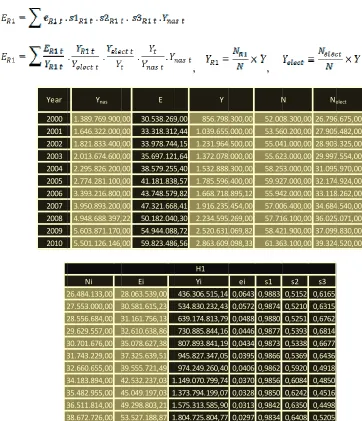
Fig. 5.6. Entered and calculated required data for R1-residential-sub sector 25 decomposition
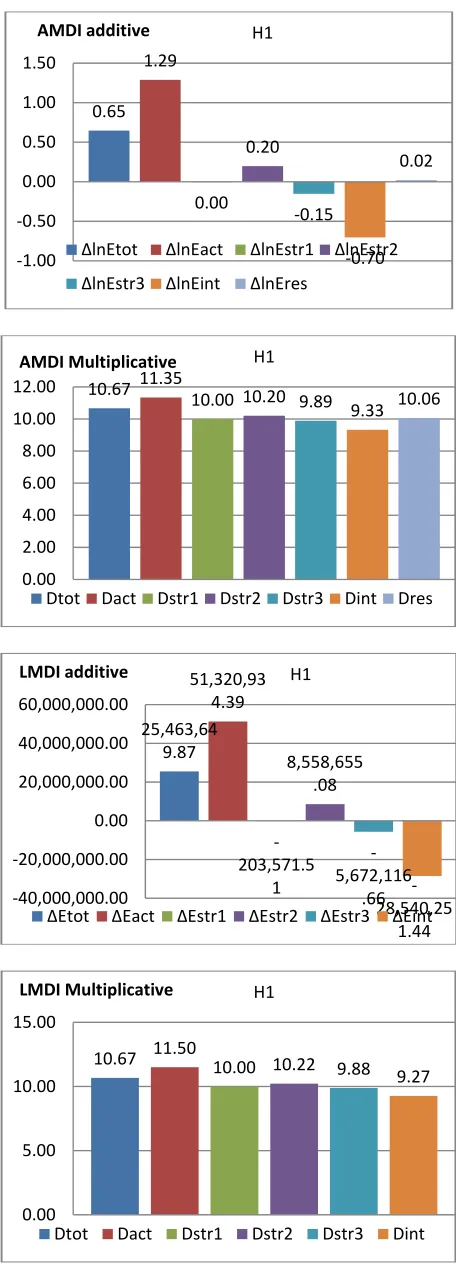
Fig. 5.7. AMDI and LMDI output of R1-residential sub-sector electricity 26 decomposition
CHAPTER I INTRODUCTION
Indonesian power sector consumer is divided into four major segments’, namely residential or household, industrial, commercial, and public sector. As reported by PLN on their 2010 annual report (PLN, 2011), commercial sector rank first with average growth of 10.45% on 2006 – 2010 electricity sales, followed by residential and industrial, with 9.14% and 3.86%, respectively. In 2010, the largest source of the electric power sales revenue still comes from the group of industrial and residential tariffs. In 2010 total revenue from electricity sales increased by 14.20% to Rp. 102,974 billion, from Rp. 90,712 billion in 2009. This increase was due to the increase of electricity tariff which came into effect on July 1, 2010. Based on this fact, the power sector management and its implications are believed to have strong interrelated between PLN as power sector operator and government as the regulator. Regarding to the economic growth impact towards power sector development, the electricity consumption growth at residential sector shall be seen to closely affect by it.
The needs of having a clear understanding on how sectoral electricity consumption developed in Indonesia is unavoidable due to global economic competition. Resources scarcity is one of prominent driving factor that spur efficiency in using resources on power sector. Regarding to this condition, there are at least two implications to follow; firstly, policy on power sector expansion should be made accordingly, by looking into other macro condition so that sectoral electricity growth can be controlled and matched with available resources. Secondly, the importance of achieving the predetermined electrification ratio, as it reflects part of millennium development goal, has been unavoidable. Hence, government should pay more attention to provide electricity across the country, particularly to areas unreachable by utility grid. In more extensive way, government has tried to meet the electrification ratio target by conducting development of small power generation plants spread out in the remote areas. Based on the Electricity Law No. 30/2009, private sector is encouraged to be involved in the power sector infrastructure provisioning, particularly in the generation sector. They are becoming a PLN partner to develop distributed generation for which the generated electricity is supplied to the PLN mini grid. The ultimate objective is to increase the electrification rate coming from rural areas contribution.
intensity, structural, and activity effect. In this research, factors decomposition is also performed using Aritmetic Mean Divisia Index method (AMDI) and it is then compared to the results obtained by LMDI in order to observe the benefit of LMDI over AMDI as mentioned in Lotz and Blignaut(2011). The study using factors decomposition method is focused on two broad objects, namely total residential sector and residential sub-sector. In the total residential sector, analysis is made up the household sector as one big sector nationwide whereas in residential sub-sector we considers residential sector with three group, based on the residential electricity tariff class, and analyze each sub sector’s factors decomposition in order to get more insight on how the various effect change the household electricity consumption in that particular sub sector.
CHAPTER II LITERATURE REVIEW
II.1. Modeling Using Econometric Method
Literally interpreted, econometrics means “economic measurement.” Econometrics is an amalgam of economic theory, mathematical economics, economic statistics, and mathematical statistics (Gujarati, 2004). Econometric analysis uses a mathematical model. A model is simply a set of mathematical equations.If the model has only one equation, it is called a single-equation model, whereas if it has more than one equation, it is known as a multiple-equation model. An anatomy of econometric modeling is given in Fig. 1 below.
Fig.1.1. Anatomy of econometric model (Gujarati, 2004)
Linear-regression model and Multiple-regression model are examples of econometric model. Multiple-regression model is derived from Linear-regression one. Up to today, regression analysis is the main tool of statistical techniques used to obtain the estimates (Gujarati, 2004). The model primarily explains the linear relationship between dependent variable and independent variable(s) or explanatory variable(s). In Multiple-regression model, the explanatory variable consists of more than one variable to affect to the changes of dependent variable. To construct the model mathematically, certain functional form should be specified in the equation, giving certain relationship between dependent variable and explanatory variable(s). Some types of Multiple-regression model according to its functional form are: Linear model, the Log-linear model, Lag-linear model, Reciprocal model, and the Logaritmic reciprocal model (Gujarati, 2004). Example on Linear model on Multiple-regression is given below.
where Yitis dependent variable for sector i in period t, c is constant of the model, β1, β2,…, βn is regression coefficient of explanatory variable(s), Xitis explanatory variable of sector i for period t, i is sector, t is period (e.g. year).
Regression analysis is dealt with with the analysis of the dependence of the dependent variable on the explanatory variable(s). The study evaluates some statistical indices to be measured in the regression model, involves measurement on how success the model in predicting the dependent variable and some testing. In the analysis, the term R-square or coefficient of determination measures the portion of explained total sum of square by dividing explained deviation by total deviation. In other word, it measures how much fraction of dependent variable can be explained by explanatory variable. The ratio closer to 1 meaning the model is better in fitting the available data. Meanwhile, the adjusted R-square is the corrected measure of R-square since R-square would remain the same whenever additional explanatory variable is added to the equation. The value of adjusted R-square can be less than that of R-square if any additional explanatory variable do not contribute to the explained deviation of the model.
Several testing can be performed to check validity of the model with specific purposes. Hypothesis testing is conducted to test whether there is any relationship between dependent and explanatory variable. The level of significance Tis the critical limit either to accept or to reject the null hypothesis. Another test is F-test of F-statistic, of which obtained from the hypothesis test for all of the slope coefficients, except the constant, are zero. Accordingly, the p-value or Probability (Fstatistic) is measuring the marginal significance level of the F-test. Comparing Tand pvalue, if Tis higher than p-value, then the null hypothesis should be rejected. T-test is performed to check the significance of independence variables that build up the model. Here, independence variable is said to be significant if the T-test value fall within the critical region based on αand degree of freedom used in the model.
There are four assumptions in the Least Squares Method which is utilized in The Multiple Regression (Stock and Watson, 2007). First, the conditional distribution of
research. We will provide the detail explanation on the next part (II.2.Forecasting using Econometric Model).
II.2. Forecasting Using Econometric Model
In this section, we consider forecasts made using an autoregression, a regression model that relates a time series variable to its past values. If we want to predict the future of a time series, a good place to start is in the immediate past. Autoregressive Integrated Moving Average (ARIMA) model is utilized only to forecast the dependent variable in the short run. This also called the Box-Jenkins (ARIMA) Methodology (Hanke and Wichern, 2005). Gujarati (2004) stated that if a time series is stationary (even in the first different), then we can construct the model in several alternatives.
Hanke and Wichern (2005) confirmed that models for nonstationary series are called autoregressive integrated moving average models and denoted by ARIMA
, , . Here indicates the order of the autoregressive part, indicates the amount of differencing, and indicates the order of the moving average part. Consequently, from this point on, the ARIMA , , notation is used to indicate models for both stationary ( = 0) and nonstationary ( > 0) time series.
Enders (2004) stated that conditionally heteroscedastic models (ARCH or GARCH) allow the conditional variance of a series to depend on the past realizations of the error process. A large realization of the current period’s disturbance increases the conditional variance in subsequent periods. For a stable process, the conditional variance will eventually decay to the long-run (unconditional) variance. Therefore, ARCH and GARCH models can capture periods of turbulence and tranquility.
Min et al (2010) worked with econometric method to develop statistical model of residential energy end use characteristic for the United States. The authors utilized Ordinary Least Square (OLS) method with predictor variables such as energy price, residential characteristics, housing unit characteristics, geographical characteristics, appliance ownership and use pattern, and heating/cooling degree days. Dependent variables of the four regressions were natural log values of per-residential energy use for heating, water heating, appliance, and cooling.
Aydinalp et al (2003) developed a model of residential energy consumption at the national level. Three methods were used to model residential energy consumption at the national level: the engineering method (EM), the conditional demand analysis (CDA) method, and the neural network (NN) method. The EM involves developing a housing database representative of the national housing stock and estimating the energy consumption of the dwellings in the database using a building energy simulation program. CDA is a regression-based method in which the regression attributes consumption to end-uses on the basis of the total residential energy consumption. The NN method models the residential energy consumption as a neural network, which is an information-processing model inspired by the way the densely interconnected, parallel structure of the brain processes information.
II.3. Decomposition Analysis
decomposition methodologies, namely the index decompositionanalysis (IDA) and the structural decomposition analysis (SDA) (Wachsmann et al. 2009). The main difference between these two methods is that SDA can explain indirect effects of the final demand by dividing an economy into different sectors and commodities, and examining the effects on them individually (Wachsmann et al. 2009), while IDA explains only direct (first-round) effects to the economy. The IDA applies sectoralproduction and electricity and the SDA requires data-intensive energy input-output analysis. Because of the data constraint concerning SDA, the IDA is generally perceived as the method of choice by a number of studies (Liu andAng 2007; Ang 2004; Ang and Zhang 2000).
From the researcher experience, the multiplicative and additive Log Mean Divisia Index method (LMDI) proposed by Ang and Liu (2001) should be the preferred method for the following reasons: it has a solid theoretical foundation; its adaptability; its ease of use and result interpretation; its perfect decomposition; there is no unexplained residual term; and its consistency in aggregation. Effects introduced in the LMDI can be in terms of activity effect, structure effect, intensity effect, energy mix effect, as well as emission factor effect. An example of LMDI effect could be explained as if the proportions of electricity-intensive sectors increased relative to those of less electricity-intensive sectors, the structural effect will be positive and hence the economic system will be considered more electricity intensive. Lastly, the effciency effect (also called either the intensity or technology effects in the literature) refers to the change in the level of intensity. A change in the effciency effect therefore refers to the weighted change in the level of electricity intensity.
Several recent research related with decompotition analysis particularly in residential sector is herein briefly discussed:
• Lotz and Blignaut (2011) worked on South Africa’s electricity consumption using decomposition analysis. The authors conducted a sectoraldecompotition analysis of the electricity consumption for the period 1993-2006 to determine the main drivers responsible for the increase. The result show that the increase was mainly due to output or production related factors, with structural changes playing a secondary role. The increasing at low rate electricity intensity was a decreasing factor to consumption. Another interesting finding also only 5 sectors’ consumption was negatively affected by efficiency improvement.
• Study on residential energy use in Hongkong using the Divisia Decomposition analyisis was done by William Chung et al (2011). Using data of 1990-2007, the study evaluated the respective contributions of changes in the number of residentials, share of different types of residential residentials, efficiency gains, and climate condition to the energy use increase. The analysis reveals that the major contributor was the increase of the number of residentials, and the second major contributorwas the intensity effect.
• Achao and Schaeffer (2009) worked with decomposition analysis to measure the activity, intensity, and structure effects of variations in residential electricity consumption in Brazil for 1980-2007. The authors applied the Logarithmic mean Divisia Index (LMDI) to electricity consumption of the Brazilian residential sector, to explain its evolution in terms of the activity, structure, and intensity effects. Among the main results is measurement of the impact of government programs for income transfer and universal service on variations in residential consumption.
CHAPTER III
RESEARCH OBJECTIVES AND BENEFITS
Regarding to the proposed research topic, there are no findings made publicly available under this topic for the case of Indonesia, to the researcher best knowledge. Hence, as this research observes residential electricity consumption trend in Indonesia, the study tries to obtain several findings on it as follows:
- Econometric based mathematic model which is suited to represent residential electricity consumption in Indonesia for 1990 – 2010.
- Forecasting on annual residential electricity energy consumption based on appropriate econometric model.
- Dominant contributors in terms of intensity, structural, and activity change which affect the residential electricity consumption in Indonesia for 2000 – 2010, through a factors decomposition analysis using Aritmetic Mean Divisia Index (AMDI) and Logarithmic Mean Divisia Index (LMDI), and compared the both methods. The analysis is performed through establishment of software tool that will be developed here as one of research activity. The analysis is taken into account total residential sector, i.e. factors decomposition for a whole residential sector and residential sub-sector, in which analysis is conducted for each residential tariff group to find the corresponding effect influencing electricity consumption in particular group.
CHAPTER IV
RESEARCH METHODOLOGY
This study can be classified into three broad stages, namely: preliminary stage, modeling stage, and reporting stage. Preliminary stage consists of: problem identification, problem definition and research scope, research objective, and literature review. Modeling stage consists of: data gathering, analysis and resultwhereas reporting stage will be covering conclusion, suggestion, and dissemination through publication. In this report, we seperate methodology based on two broad analysis. The first part discusses development of econometric model and forecasting whereas the second part involves factors decomposition analysis.
To begin working with both parts, relevant economic, social, and electrical data considered to have influence on constructing econometric model in the period of 1990 – 2010 are gathered as:
• Gross Domestic Product (GDP)
• Household expenditure as part of GDP
• Number of employment
• Bank Indonesia rate
• Inflation
• Number of residential
• Number of residential customer
• Electrification rate
• Total annual electricity consumption
Table 3.1 Research stages for Econometric model and forecasting development Research stages Activity and Expected Output Measurable Indicator Problem identification Observe residential electricity
consumption trend in Indonesia; observe its relationship with power sector as well as national macro indicators.
Increasing electricity consumption in residential sector can be presented; List of possible macro indicator thought to affect it.
Problem definition and research scope
Determine the suggested method to capture macro indicators that affect electricity consumption in residential sector,
Determine sufficient data time frame for analysis purposes, research target, and type of data
Mathematical model under Econometric method and a decomposition analysis
Indicative study time frame of 1990– 2010 to analyze residential electricity consumption in Indonesia Research objective Determine the appropriate model
for residential’s electricity consumption, determine the macro indicators that affect electricity consumption in residential sector mostly and forecast all the variables in the future
Econometric model using Multiple Linear Regression model, Autoregressive Integrated Moving Average (ARIMA) and Literature review Collect articles and relevant text
books that have appropriate method related to the typical problem, further study regarding to the selected method and analysis.
Articles and textbooks or discussess econometric analysis for energy sector
Data gathering Collect relevant data from PLN, BPS, Bank Indonesia, IMF as they will be served as final data
Availability of several macro indicators as they were appeared initially in earlier stage and have throughly been evaluated, for 1990-2010. Analysis and Result Develop an econometric model
representing residential electricity consumption for 1990-2010
Econometric testing for validating the model
Determine the best model in estimating and forecasting all
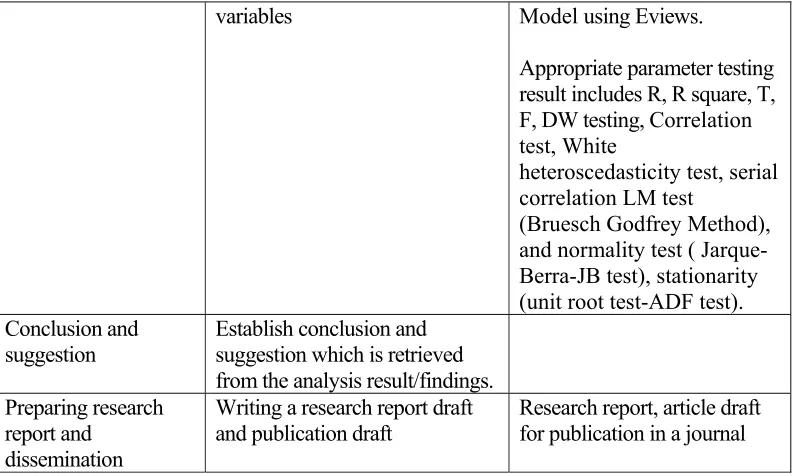
variables Model using Eviews.
Appropriate parameter testing result includes R, R square, T, F, DW testing, Correlation test, White
heteroscedasticity test, serial correlation LM test (Bruesch Godfrey Method), and normality test ( Jarque-Berra-JB test), stationarity (unit root test-ADF test). Conclusion and
suggestion
Establish conclusion and suggestion which is retrieved from the analysis result/findings. Preparing research
report and dissemination
Writing a research report draft and publication draft
Research report, article draft for publication in a journal
Table 3.2 Research stages for Factors Decomposition Analysis Research stages Activity and Expected Output Measurable Indicator Problem identification Observe residential electricity
consumption growth in Indonesia and analyze its relationship with Indonesian economic and power sector development
A graphical depiction of electricity consumption growth in residential sector during certain study period
Problem definition and research scope
Discussing evergrowing residential electricity
consumption and correlate its growth with the factors thought to contribute, determine research scope that can be studied considering available data and methods
Preliminary list of factors thought to contribute national residential electricity
consumption,
a certain period of year to be adopted as study period,
Reserach objective Research objectives are proceed through determine appropriate factors decomposition analysis through application of simple decomposition software tool that is developed in this research.
Several preliminary
decomposition methods that will be selected later as the working method,
establishment of a
decomposition software tool Literature review Reading, observing journal
articles, resources related to factors decomposition to highlight previous findings and study decomposition analysis methods and to select the most reliable/appropriate method.
decomposition using additive/multiplicative Log-Mean Divisia Index (LMDI), and to be compared to Arithmetic Mean Divisia Index (AMDI), obtain general decomposition equation and study further to modified the LMDI and AMDI equation model as the proposed model. Data gathering Collecting relevant data as
required for the purpose of decoposition analysis, in which capturing activity, intensity, and structural effect, considering the whole residential and residential sub-sector classification.
Sets of annual data collecting from PLN, BPS, and other sources during 2000 – 2010, which will be used for decomposition analysis for Residential and Residential sub-sector. The GDP data is based on constant price (2000) and current price.
Result and analysis Performing calculation / analysis through LMDI and AMDI methods using the selves-designed software tool,
conducting analysis to compare and describe the results.
Establishment of total residential decomposition of electricity consumption for 2000 – 2010 and residential sub-sector decomposition for the same period using LMDI and AMDI, result comparison of both methods, Lists of numerical index for AMDI and LMDI method, graphical presentation of the total residential and residential sub-sector index involve intensity, activity, and structural effect Conclusion and
suggestion
Establish conclusion and suggestion which is retrieved from the analysis result/findings.
Remarks to explain role of decomposition effect to the increasing residential electricity consumption in Indonesia.
Preparing report and dissemination
Writing a research report draft and publication draft
CHAPTER V RESULT AND ANALYSIS
In this chapter, results regarding to residential electricity consumption growth are presented in terms of appropriate annual electricity consumption model and corresponding forecasting model based on econometric method as well as decomposition analysis. Under econometric method, the study period is taken into account 1990 – 2010 whereas for the purpose of decomposition analysis, the study time frame is taken 2000 – 2010. The increasing historical total residential annual electricity consumption growth in Indonesia up to 2010, which is the focus of this research, is presented in below.
Table 5.1. The historical residential annual electricity consumption in Indonesia
Year
Toal Residential Electricity Consumption
(MWh)
GDP (Million Rupiah)
Private Consumption Expenditure (Million Rupiah)
1990 8.785.293 195.597.200 106.312.300
1991 9.766.337 227.450.200 125.035.800
1992 11.199.029 259.884.500 135.880.300
1993 12.537.109 302.017.800 158.342.700
1994 14.460.106 382.219.700 221.119.300
1995 16.927.060 454.514.100 279.876.400
1996 19.610.853 532.568.000 325.585.300
1997 22.764.024 627.695.400 387.170.700
1998 24.835.703 955.753.500 647.823.600
1999 26.853.883 1.099.731.600 813.183.300
2000 30.538.269 1.389.769.900 856.798.300
2001 33.318.312 1.646.322.000 1.039.655.000
2002 33.978.744 1.821.833.400 1.231.964.500
2003 35.697.122 2.013.674.600 1.372.078.000
2004 38.579.255 2.295.826.200 1.532.888.300
2005 41.181.839 2.774.281.100 1.785.596.400
2006 43.748.580 3.393.216.800 2.092.655.700
2007 47.321.668 3.950.893.200 2.510.503.800
2008 50.182.040 4.948.688.397 2.999.956.900
2009 54.944.089 5.603.871.170 3.290.995.900
2010 59.823.487 6.436.270.800 3.643.425.000
subsequent figure shows the increasing electricity consumption for total residential and sub-residential sector during 1990 – 2010. The residential sub-sector, which comprise of 3 group were classified started on 1998. However, for the purpose of decomposition analysis, the data taken into account started from 1990, which mean require data of 1989 in order to be involved in the calculation. Hence, residential sub-sector electricity consumption shown in the graph is started on 1989.
Fig. 5.1. Residential Electricity Consumption Growth Rate (1991 – 2010)
Fig. 5.2. Total residential and Residential sub-sector Electricity Consumption
As seen on Fig. 5.2., the total residential electricity consumption is primarily contributed by the R1 group, in which the biggest share of residential customer. Here, the main factors to influence electricity consumption in each residential group may not be the same as the consumption growth in fact are different one another.
As residential electricity consumption pattern is observed in two part, i.e. through econometric and decomposition analysis, the total residential electricity consumption model along with its forecasting model are analyze using econometric approach
‐20.00
‐15.00
‐10.00
‐5.00 0.00 5.00 10.00 15.00 20.00
1991 1992 1993 1994 1995 1996 1997 1998 1999 2000 2001 2002 2003 2004 2005 2006 2007 2008 2009 2010
Gr
o
w
th
(%
)
Residential
Electricity
Consumption
Growth
Rate
vs
GDP
Growth
Rate
in
Indonesia
Residential Electricity Consumption Growth (%) GDP Growth (%)
0 20,000,000 40,000,000 60,000,000 80,000,000
1990 1992 1994 1996 1998 2000 2002 2004 2006 2008 2010
MWh
Residential
and
Sub
‐
residential
Electricity
Consumption
in
Indonesia
(1990
‐
2010)
whereas factors to influence for both total residential as well as residential sub-sector are studied using decomposition analysis. Both parts are described belows.
V.1. Econometric Model
The first part of estimation, we constructed a multiple linear model given as:
Where:
: constanta; , , , , , , , , : intercepts; : error term : Total Energy Consumption
: Employment
: Residents
: Residential Customers : Total number of population : Private Consumption : Electrification ratio
: Bank Indonesia Rate
: Total Gross Domestic Product : Inflation Rate
The first model was the general model in multiple linear models. Therefore, the next part was to test whether each variables had a problem in least square assumption or known as classical assumption. The first indicator should be tested on each variables was the multicollinearity. As we stated earlier, that the data series should not have a collinearity to each other. If there is a collinearity between the past data and the current data, then this series might not be able as a regressor and the estimation result will not be BLUE (Best Linear Unbiased Estimator).
V.1.1. Correlation Test
To check whether all variables have a multicollinearity problem, we used the correlation test. The results found that employment, total residents, and residential customers have a problem of collinearity. This value of collinearity of those variables are greater than 0.8. Therefore, we cannot use these variables in estimating the model. Meanwhile, the BI rate, Electrification ratio, GDP, Inflation, Population, and Private Consumption had collinearity value less than 0.8. According to these results, we concluded that only BI rate, Electrification ratio. GDP, Inflation, Population, and Private Consumption can be use as regressors in order to estimate the impact on the total energy consumption. The detail results of correlation test are provided in appendix.
V.1.2. White Heteroscedasticity Test
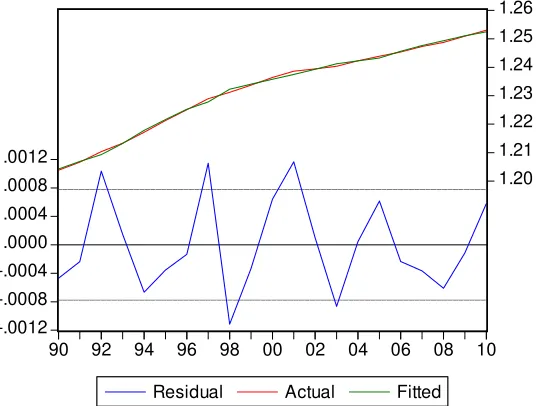
Fig. 5.3. The Actual, Fitted, Residual Graph Result
Figure 5.3 shows that the residual (blue line) is approximately constant and have no trend. This result confirmed us that there is no heteroscedasticity problem occurred in the model. Rather, all variables are homoscedastic. The second step, we applied White Heteroscedasticity which is provided by Eviews program. The results found that p value observation* = 0,348489. This p value is greater than 0,05 (95% level of confidence) and we should accept null hypothesis which is no heteroscedasticity. This result also confirmed us that all variables are homoscedastic.
V.1.3. Serial Correlation LM Test
In order to determine whether the variables or regressors have an autocorrelation, we applied two steps. Firstly, we checked t-statistic value, F-value, and Durbin Watson (DW) value particularly. From the estimation result (Table 5.2 below), we found that DW statistic is 1,892522 where is closely to 2 but still less than 2. This result confirmed that the problem of autocorrelation is might not be very significant because the DW statistic is almost 2. Secondly, we applied the Serial Correlation LM Test (Bruesch Godfrey Method). The result is p value observation* = 0,001362. This p value is less than 0,05 (95% level of confidence) and even 0,01. Therefore, we should reject null hypothesis that is no autocorrelation. In conclusion, the model had an autocorrelation problem.
Now we tried to redeem the autocorrelation problem. The first way was to re-construct the model into logarithm normal form. To do so, we changed the form of each variables into logarithm normal form and re-run the estimation testing. After we did the estimation, the result is given in Table 5.2 below. The DW statistic is a little bit higher than before which now is 1,965824. However, the value is still less than 2. The next way was to change the form of regressors into first difference. After we re-estimated and re-runed the first difference model, the result found that, there is no autocorrelation problem.
-.0012 -.0008 -.0004 .0000 .0004 .0008 .0012
1.20 1.21 1.22 1.23 1.24 1.25 1.26
90 92 94 96 98 00 02 04 06 08 10
V.1.4. Normality Test
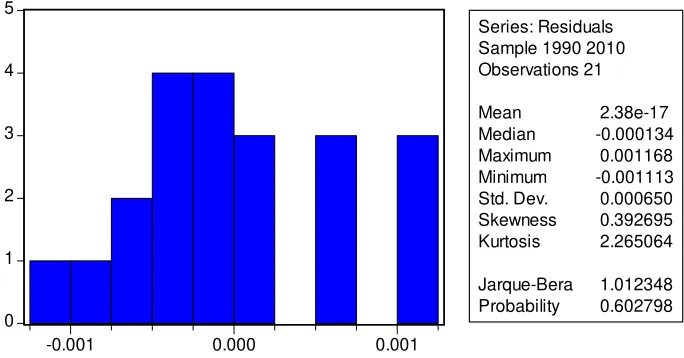
The research had a limitation on data period. We only had 21 observations, which are less than 30 observations (normaly number of observation). Therefore, we applied normality test in order to determine whether the error term is normaly distributed (least square assumption). To do the normality test, we utilized the Jarque-Bera Test and histogram. The result found that p value of Jarque-Bera Test is 0,602798 which is greater than 0,05 (95% level of confidence). Therefore, we cannot reject null hypothesis that is the error term has normaly distributed. In conclusion, the error term of the model is normaly distributed. The result given as seen on Figure 5.4 below:
Fig. 5.4. The Histogram-Normality Test Result
V.1.5. Estimation
After we determined all least square assumptions namely multicollinearity, heteroscedasticity, autocorrelation, and normality, the result confirmed that the research model is relatively become the best estimator in terms of estimating the total energy consumption using a regression method. Therefore, we provide the result of final estimation in Table 5.2 below.
Table 5.2. The estimation results
Variables Model 1 Model 2
C -5.707133
(-0.406615)
-0.339025 (-0.334382)
BI Rate -0.046825
(-1.281687)
-0.006906 (-1.529439)
Electrification Ratio 0.740182**
(5.543516)
0.158202** (5.964230)
GDP 0.104364
(1.401251)
0.152207 (1.583736)
Inflation 0.006798
(0.469427)
0.001049 (0.901230)
Population 0.734259
(0.937171)
0.786775 (0.936861) 0
1 2 3 4 5
-0.001 0.000 0.001
Series: Residuals Sample 1990 2010 Observations 21
Mean 2.38e-17
Median -0.000134
Maximum 0.001168
Minimum -0.001113 Std. Dev. 0.000650 Skewness 0.392695 Kurtosis 2.265064
Private Consumption 0.187530* (2.938624)
0.208004* (2.626346)
R-squared 0.998048 0.998151
Adjusted R-squared 0.997211 0.997359
Durbin-Watson stat 1.892522 1.965824
Akaike info criterion -3.838870 -11.22037
Schwarz criterion -3.490696 -10.87220
Prob(F-statistic) 0.000000 0.000000
** Significant at level 0.01 * Siginficant at level 0.05
According to the results, we found that the t-statistic of BI rate, GDP, Inflation, and population are less than 1,96 and the probability of these variables are greater than 0,05 (95% level of significance). These results indicate the acception of null hypotheses which is there is no different between BI rate, GDP, inflation and population to the total energy consumption. We concluded that BI rate, GDP, inflation and population were not significantly affecting the total energy consumption. Meanwile, the t-statistic of electrification ratio and private consumption were greater than 1,96 and the probability was less than 0,05 (95% level of significance). Therefore, we concluded that only electrification ratio and private consumption were significantly affecting to total energy consumption in Indonesia.
However, the R-squared of the model was very high which is 0,998151. It means that the model is the best predictor in estimating the dependent variable. In conclusion, total energy consumption had strongly influenced by the electrification ratio and private consumption. The final equation given as follows:
0,3390 0,0069 0,1582 0,1522 0,0010
0,7867 0,2080
Furthermore, when the total investment is high, it will also generate new investment in energy construction in order to expand the energy supply and its capacity. Finally, when the supply of energy increases it will affect the demand for energy to become increase. In terms of supply and demand analysis, when supply getting up the demand also move in the same way in order to keep the price in the same level. Therefore, these concepts are fitted with the research finding. However, BI rate found to be statistically not significant in affecting total energy consumption.
Secondly, the coefficient of electrification ratio found to be a positive relationship. Since the estimation results confirmed that, the electrification ratio was statistically significant in affecting the total energy consumption, therefore the relationship become more meaningful. The concept stated that the energy consumption would move up as the electrification ratio rose up. The demand for energy occurred when people were realized how important the electricity was in their daily life. When the number of customers increased relatively then it will push up the demand for energy consumption. The result finding was confirmed these concepts particularly.
Thirdly, a positive relationship founded in GDP and total energy consumption. According to the basic concept in consumer behavior, when total income tend to increase then it will moved up the total utility. Satisfaction occurred when the total number of product or services that we consumed is increase. John Maynard Keynes introduced this theory in terms of consumer behavior. GDP is the total income in such a country, which also identify as the total income of people in Indonesia as an aggregate concept. When GDP tend to increase, people will spend their additional income relatively in consumption activity rather than investment. Therefore, the consumption in total energy will tend to increase particularly. However, the result could not statistically confirm that GDP was significant in affecting total energy consumption.
Fourthly, there was a positive relationship between inflation and total energy consumption. The result was unexpected regarding to the basic concept and theory. The theory stated that inflation causes the declines in real income. Consumers could not afford to fulfill their consumption or daily needs. It will affect the declines in total consumption including total energy. Therefore, the expected result was a negative rather than a positiverelationship.
Fifthly, a positive relationship occurred between number of population and total energy consumption. It was clearly become the expected result regarding the basic theory. It is obvious that additional number of population will cause the shock in total consumption. However, the result could not statistically confirm it.
Sixthly, there was a positive relationship between private consumption and total energy consumption. This result also confirmed that households become one of the important parties in macroeconomics point of view. Private consumption is the household’s total consumption in terms of aggregate concept. Other consumptions are investments, government expenditure and international activity such as export and import. In conclusion, the result confirmed that private consumption was statistically significant in affecting the total energy consumption.
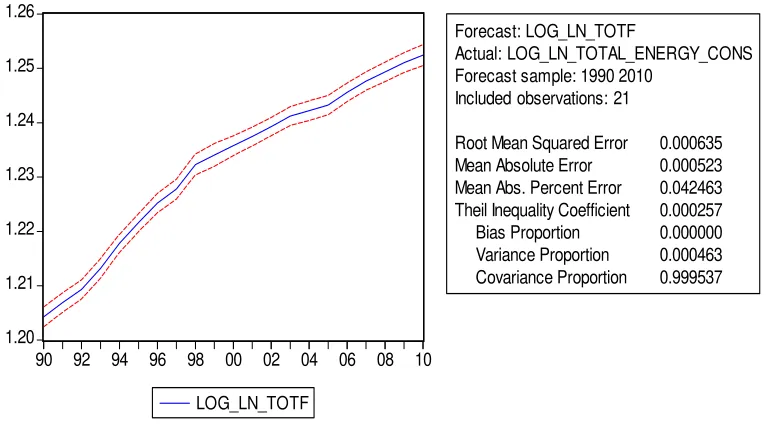
Fig. 5.5. The forecasting result of total energy consumption
V.2. Forecasting Model
V.2.1. ARIMA Model
The research used the Box-Jenkins method in order to forecast each variable in the model by itself. In forecasting, first we assumed that all variables could be forecasted by other variables not just by the variable itself. The second assumption was the current value of each variable could be affected by the past value of the variable. These two assumptions are known as the autoregressive distributed lag model (ADL model). Nevertheless, the paper had a limitation of data observation, which is stated earlier. Therefore, we could not utilize the autoregressive distributed lag model in order to estimate and forecast the total energy consumption. However, we continued to forecast by using the simple Box-Jenkins method that is autoregressive (AR) model, moving average (MA) model, and the integrated and combination of AR and MA model, namely ARIMA model.
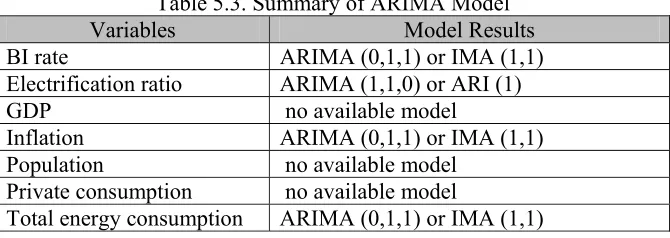
Firstly, we constructed the autoregressive (AR) model and moving average (MA) model. In order to construct the model, we had to check the stationarity of each variable by using the unit root test. We applied the Augmented-Dickey Fuller Test to test the stationarity of each variable. The result found that all variables, total energy consumption, electrification ratio, GDP, inflation, population, private consumption, and BI rate are stationary at first difference with trend and intercept (95% level of confidence). These results indicated that we could continue to forecast using the autoregressive dan moving average model.After we checked the stationarity, then we determined the lag of autoregressive (AR) model by using the correlogram test. The summary of the results given as follows:
1.20 1.21 1.22 1.23 1.24 1.25 1.26
90 92 94 96 98 00 02 04 06 08 10
LOG_LN_TOTF
Forecast: LOG_LN_TOTF
Actual: LOG_LN_TOTAL_ENERGY_CONS Forecast sample: 1990 2010
Included observations: 21
Table 5.3. Summary of ARIMA Model
Variables Model Results
BI rate ARIMA (0,1,1) or IMA (1,1)
Electrification ratio ARIMA (1,1,0) or ARI (1)
GDP no available model
Inflation ARIMA (0,1,1) or IMA (1,1)
Population no available model
Private consumption no available model
Total energy consumption ARIMA (0,1,1) or IMA (1,1)
Table 5.3 shows that the best model in forecasting each variable are choosen from many alternatives models. For example, we found that there are two best alternatives model for inflation. There are ARIMA (1,1,0) and ARIMA (0,1,1). In order to determine which model is the best one, then we should apply the residual test with correlogram Q-statistic to test the autocorrelation. The result was not significant or in other words that there is no autocorrelation. Further, we continued to check the error term by using the Schwarz-Criterion. The smallest value is preferable. The result confirmed that ARIMA (0,1,1) is the best model in forecasting inflation. The similar interpretation is applicable to all variables. The detail results of estimation are provided in appendix.
V.2.2. ARCH/GARCH Model
The research also utilized the ARCH/GARCH model in order to forecast each variable. The main assumption in forecasting through this model is ignoring the violation of homoscedasticity. In addition, if the data series found to have heteroscedasticity problem, then we can continue to forecast using the ARCH/GARCH model. According to one of our purposes that are, find the best model in forecasting, therefore we also applied this model into our estimation and forecasting. Firstly, we had to check the volatility of each variable. This volatility called as the ARCH effect. We used the residual test namely ARCH LM test. If the result found that the variable significantly proved had a volatility or ARCH effect then we continued to estimate the variable using the ARCH model. The summary of the results given as follows:
Table 5.4. Summary of ARCH/GARCH Model
Variables ARCH/GARCH
Effect
Model Results
BI rate No -
Electrification ratio Yes ARCH (1) and GARCH (1), α = 0,1
GDP Yes ARCH (1) and GARCH (1), α = 0,1
Inflation Yes ARCH (1) and GARCH (1), α = 0,1
Population No -
Private consumption No -
Total energy consumption
Yes ARCH (1) and GARCH (1), α = 0,1
V.3
d Data for Ener for AMD Decomposition of E
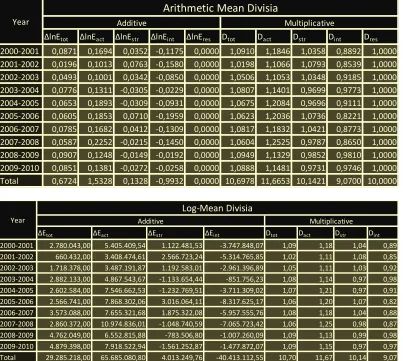
Fig. 5.4. Result of AMDI (above) and LMDI (below) result for both additive and multiplicative form.
Using LMDI additive-technique, we find total residential electricity consumption (ΔEtot)
in the period 1990 – 2010 became 29.285,2 GWh. The activity effect (ΔEact) which is
based GDP changes is the dominant factors contributing electricity consumption growth with 56.634,3 GWh. Insignificant contribution to the increasing electricity consumption was given by the structural effect (ΔEstr), changes in portion of household expenditure
to the GDP, with 3.217.9 GWh in aggregate. On the other hand, intensity changes (ΔEint) has consistently shown yearly negative value throughout the study period except
for 2005 – 2006. This reveals that the intensity change, which is considered to be due to efficiency improvements, has shown its contribution for a decrease of 30.567GWh. In multiplicative-LMDI, Dtot, which is the ratio of Et – Et-1 obtained from multiplication of
Dact, Dstr, and Dint can be observed without resulting residual variable. The method
confirms that the intensity changes is the lowest compared to other changes. Comparison of AMDI and LMDI method in graphical presentation in the period 1990 – 2010 are given in the followings.
∆lnEtot ∆lnEact ∆lnEstr ∆lnEint ∆lnEres Dtot Dact Dstr Dint Dres
2000‐2001 0,0871 0,1694 0,0352 ‐0,1175 0,0000 1,0910 1,1846 1,0358 0,8892 1,0000 2001‐2002 0,0196 0,1013 0,0763 ‐0,1580 0,0000 1,0198 1,1066 1,0793 0,8539 1,0000 2002‐2003 0,0493 0,1001 0,0342 ‐0,0850 0,0000 1,0506 1,1053 1,0348 0,9185 1,0000 2003‐2004 0,0776 0,1311 ‐0,0305 ‐0,0229 0,0000 1,0807 1,1401 0,9699 0,9773 1,0000 2004‐2005 0,0653 0,1893 ‐0,0309 ‐0,0931 0,0000 1,0675 1,2084 0,9696 0,9111 1,0000 2005‐2006 0,0605 0,1853 0,0710 ‐0,1959 0,0000 1,0623 1,2036 1,0736 0,8221 1,0000 2006‐2007 0,0785 0,1682 0,0412 ‐0,1309 0,0000 1,0817 1,1832 1,0421 0,8773 1,0000 2007‐2008 0,0587 0,2252 ‐0,0215 ‐0,1450 0,0000 1,0604 1,2525 0,9787 0,8650 1,0000 2008‐2009 0,0907 0,1248 ‐0,0149 ‐0,0192 0,0000 1,0949 1,1329 0,9852 0,9810 1,0000 2009‐2010 0,0851 0,1381 ‐0,0272 ‐0,0258 0,0000 1,0888 1,1481 0,9731 0,9746 1,0000 Total 0,6724 1,5328 0,1328 ‐0,9932 0,0000 10,6978 11,6653 10,1421 9,0700 10,0000
Year
Arithmetic Mean Divisia
Additive Multiplicative
∆Etot ∆Eact ∆Estr ∆Eint Dtot Dact Dstr Dint
2000‐2001 2.780.043,00 5.405.409,54 1.122.481,53 ‐3.747.848,07 1,09 1,18 1,04 0,89
2001‐2002 660.432,00 3.408.474,61 2.566.723,24 ‐5.314.765,85 1,02 1,11 1,08 0,85
2002‐2003 1.718.378,00 3.487.191,87 1.192.583,01 ‐2.961.396,89 1,05 1,11 1,03 0,92
2003‐2004 2.882.133,00 4.867.543,67 ‐1.133.654,44 ‐851.756,23 1,08 1,14 0,97 0,98
2004‐2005 2.602.584,00 7.546.662,53 ‐1.232.769,51 ‐3.711.309,02 1,07 1,21 0,97 0,91
2005‐2006 2.566.741,00 7.868.302,06 3.016.064,11 ‐8.317.625,17 1,06 1,20 1,07 0,82
2006‐2007 3.573.088,00 7.655.321,68 1.875.322,08 ‐5.957.555,76 1,08 1,18 1,04 0,88
2007‐2008 2.860.372,00 10.974.836,01 ‐1.048.740,59 ‐7.065.723,42 1,06 1,25 0,98 0,87
2008‐2009 4.762.049,00 6.552.815,88 ‐783.506,80 ‐1.007.260,09 1,09 1,13 0,99 0,98
2009‐2010 4.879.398,00 7.918.522,94 ‐1.561.252,87 ‐1.477.872,07 1,09 1,15 0,97 0,97
Total 29.285.218,00 65.685.080,80 4.013.249,76 ‐40.413.112,55 10,70 11,67 10,14 9,07
Year
Log‐Mean Divisia
Figg. 5.5. Graphicaal illustration fofor AMDI and L residential e
LMDI additive electricity deco
e and multiplic omposition
Out
MDI output of R
ial sub-secto
Fig. 5.8. AMDI and LMDI graphical output for R1-electricity consumption decomposition 0.65
1.29
0.00 0.20
‐0.15
‐0.70 0.02
‐1.00
‐0.50 0.00 0.50 1.00 1.50
H1
∆lnEtot ∆lnEact ∆lnEstr1 ∆lnEstr2
∆lnEstr3 ∆lnEint ∆lnEres
AMDI additive
10.67 11.35
10.00 10.20 9.89 9.33 10.06
0.00 2.00 4.00 6.00 8.00 10.00 12.00
H1
Dtot Dact Dstr1 Dstr2 Dstr3 Dint Dres AMDI Multiplicative
25,463,64 9.87
51,320,93 4.39
‐
203,571.5 1
8,558,655 .08
‐
5,672,116 .66 ‐
28,540,25 1.44
‐40,000,000.00
‐20,000,000.00 0.00 20,000,000.00 40,000,000.00 60,000,000.00
H1
∆Etot ∆Eact ∆Estr1 ∆Estr2 ∆Estr3 ∆Eint
LMDI additive
10.67 11.50
10.00 10.22 9.88 9.27
0.00 5.00 10.00 15.00
H1
Dtot Dact Dstr1 Dstr2 Dstr3 Dint
CHAPTER VI
CONCLUSION AND RECOMMENDATION
In this research, econometric model and forecasting model for Indonesia’s electricity consumption growth are constructed and analyzed. In addition, LMDI and AMDI techniques are used to decompose changes in residential electricity consumption in the period 1990 – 2010. Several findings related to the econometric and decomposition analysis in this study are as follows:
1. BI rate, GDP, inflation and population were not significantly affecting the total energy consumption in Indonesia.
2. Electrification ratio and private consumption were significantly affecting to total energy consumption in Indonesia.
3. Total energy consumption had strongly influenced by the electrification ratio and private consumption.
4. The best model through ARIMA model in forecasting BI rate was ARIMA (0,1,1) or IMA (1,1); electrification ratio was ARIMA (1,1,0) or ARI (1); inflation used ARIMA (0,1,1) or IMA (1,1) and total energy consumption utilized ARIMA (0,1,1) or IMA (1,1).
5. The best model through ARCH/GARCH model in forecasting electrification ratio used ARCH (1) and GARCH (1); GDP used ARCH (1) and GARCH (1); Inflation used ARCH (1) and GARCH (1); and total energy consumption used ARCH (1) and GARCH (1).
6. The AMDI method use an arithmetic mean weight function where as the LMDI use a log mean weight function.
7. The LMDI method is preffered than AMDI as using LMDI we can perform perfect decomposition without having residual term, of which accumulates over time in yearly decomposition. In addition, LMDI can work in the case of some available data are zero.
8. Using LMDI additive-technique for the case of total residential sector of Indonesia, we find total residential electricity consumption (ΔEtot) in the period
1990 – 2010 became 29.285,2 GWh. The activity effect (ΔEact) which is based
GDP changes is the dominant factors contributing electricity consumption growth with 56.634,3 GWh. Insignificant contribution to the increasing electricity consumption was given by the structural effect (ΔEstr), changes in portion of
household expenditure to the GDP, with 3.217.9 GWh in aggregate. On the other hand, intensity changes (ΔEint) has consistently shown yearly negative value
throughout the study period except for 2005 – 2006. This reveals that the intensity change, which is considered to be due to efficiency improvements, has shown its contribution for a decrease of 30.567GWh.
9. In the case of residential sub-sector, we find that ΔEtot is equal to ΔEtot(R1) +
ΔEtot(R2) + ΔEtot(R3). Increasing electricity consumption in all sub-sector are
Recommendations
1. According to the result that monetary variables such as Bank Indonesia (BI) rate and inflation rate were not statistically significant in affecting total energy consumption, we recommend to utilize other real sector variables rather than monetary variables in order to analyze the behavior of total energy consumption. In macroeconomics, there is monetary and real sector mechanism of transmission that should be running automatically. However, government and the central bank as the policy makers should be able to analyze the flow of mechanism. Furthermore, they should be achieving macroeconomic final objective that is inflation rate.
2. The result found that the total energy consumption had strongly influenced by the electrification ratio and private consumption, therefore we recommend pushing up the electrification ratio through expanding the electric capacity in Indonesia. This recommendation might be actualize through direct investment in electricity plant and also building a comprehensive infrastructure that can boost up the electrification ratio particularly.
3. According to the result of forecasting, we recommend to utilize all those alternatives models in order to policymaking in energy. The forecasting result also showed important findings in terms of supply capacity that should be prepared by the government. Furthermore, the government should be able to anticipate the risk that might be happen related to the energy policy in the future.
References
Achao, C. and Schaeffer, R. (2009), Decomposition analysis of the variations in residential electricity consumption in Brazil for the 1980-2007 period: Measuring the activity, intensity and structure effects, Energy Policy vol 37 issue 12, pp: 5208-5220, December 2009.
Ang, B.W. (2004), "Decomposition analysis for policymaking in energy: which is the preferred method?", Energy Policy, vol. 32, no. 9, pp. 1131-1139.
Ang, B.W. and Zhang, F.Q. (2000), "A survey of index decomposition analysis in energy and environmental studies", Energy, vol. 25, no. 12, pp. 1149-1176.
Aydinalp, M. et al (2003).Modelling of residential energy consumption at the national level. International Journal of Energy Research, vol 27 issue 4, pp: 441-453, March, 2003.
Chung, W., et al (2011).A study of residential energy use in Hong Kong by decomposition analysis, 1990-2007.Applied Energy vol 88 issue 12, pp: 5180-5187, December 2011.
Companies, 2004.
Enders, W. (2004), Applied Econometric Time Series, Second Edition, John-Wiley & Sons, Inc.
Farebrother, R.W. (1980), The Durbin-Watson test for serial correlation when there is no intercept in the regression. Econometricavol 48 no. 6, September 1980.
Gujarati, D. (2004), Basic Econometrics Fourth Edition. New York: The McGraw-Hill
Hanke, J.E. and Wichern, D.W. (2005), Business Forecasting, Eighth Edition, Pearson-Prentice Hall
Liu, N. andAng, B.W. (2007), Factors shaping aggregate energy intensity trend for industry: Energy intensity versus product mix., Energy Economics, vol.29, no.4, pp. 609-635.
Lotz, R. I. and Blignaut, J.N. (2011). South Africa’s electricity consumption: A decompotition analysis, Applied Energy vol 88 issue 12, pp: 4779-4784, December 2011.
Min, J., et al (2010).A high resolution statistical model of residential energy end use characteristics for the United States.Journal of Industrial Ecology.Vol 14 issue 5, pp: 791-807, October 2010.
P.T. PLN (Persero) (2011), 2010 PLN Annual report, Jakarta, 2011.
Pachauri, S and Muller, A. (2008), Regional decomposition of domestic electricity consumption in India: 1980-2005. Procceding of the Annual IAEE Conference, Istanbul, 20 June 2008.
APPENDIX
Data collected in this research
- Electricity
- Social
PERIOD Σ RESIDENTIALS Σ RESIDENTIAL CUSTOMERS
ELECTRIFICATION RATIO (%)
TOTAL RESIDENTIAL ELECTRICITY CONSUMPTION
(MWh)
R‐1 R‐2 R‐3 R‐1 R‐2 R‐3
1990 39.546.000,00 10.513.575,00 26,5857 8.785.293,00
1991 40.816.161,00 11.352.455,00 27,8136 9.766.337,00
1992 41.843.500,00 12.213.087,00 29,1875 11.199.029,00
1993 42.913.200,00 13.597.003,00 31,6849 12.537.109,00
1994 44.060.000,00 15.766.880,00 35,7850 14.460.106,00
1995 45.653.000,00 18.213.171,00 39,8948 16.927.060,00
1996 46.401.200,00 20.669.844,00 44,5459 19.610.853,00
1997 48.281.100,00 23.199.125,00 48,0501 22.764.024,00
1998 49.383.300,00 24.908.697,00 50,4395 24.625.376,00 200.330,00 47.093,00 22.393.105,00 1.596.077,00 846.521,00 24.835.703,00 1999 51.203.700,00 25.834.618,00 50,4546 25.541.032,00 220.645,00 46.055,00 24.657.704,00 1.408.343,00 787.836,00 26.853.883,00 2000 52.008.300,00 26.796.675,00 51,5238 26.484.133,00 242.766,00 47.851,00 28.063.539,00 1.614.772,00 859.958,00 30.538.269,00 2001 53.560.200,00 27.905.482,00 52,1012 27.553.000,00 266.570,00 51.261,00 30.581.615,23 1.798.548,88 938.148,33 33.318.312,44 2002 55.041.000,00 28.903.325,00 52,5124 28.556.684,00 282.227,00 53.929,00 31.161.756,13 1.851.990,42 964.997,60 33.978.744,15 2003 55.623.000,00 29.997.554,00 53,9301 29.629.557,00 301.640,00 57.846,00 32.610.638,86 2.047.804,13 1.038.678,65 35.697.121,64 2004 58.253.000,00 31.095.970,00 53,3809 30.701.676,00 325.519,00 63.197,00 35.078.627,38 2.288.798,74 1.211.829,28 38.579.255,40 2005 59.927.000,00 32.174.924,00 53,6902 31.743.229,00 356.221,00 71.430,00 37.325.639,51 2.511.107,99 1.345.091,07 41.181.838,57 2006 55.942.000,00 33.118.262,00 59,2011 32.660.655,00 377.770,00 76.689,00 39.555.721,49 2.708.754,47 1.484.103,86 43.748.579,82 2007 57.006.400,00 34.684.540,00 60,8432 34.183.894,00 413.617,00 84.763,00 42.532.237,03 3.107.544,49 1.681.886,89 47.321.668,41 2008 57.716.100,00 36.025.071,00 62,4177 35.482.955,00 450.335,00 90.498,00 45.049.197,03 3.346.539,18 1.786.304,09 50.182.040,30 2009 58.421.900,00 37.099.830,00 63,5033 36.511.814,00 491.182,00 95.850,00 49.298.803,21 3.740.222,35 1.905.063,16 54.944.088,72 2010 61.363.100,00 39.324.520,00 64,0850 38.672.726,00 523.180,00 126.970,00 53.527.188,87 4.144.214,81 2.152.082,88 59.823.486,56
NUMBER OF CUSTOMERS ENERGY CONSUMPTION BY TARIFF CATEGORY (MWh)
PERIOD POPULATION Σ EMPLOYMENT
1990 178.500.000,00 75.850.580,00
1991 182.226.619,00 76.423.179,00
1992 186.042.700,00 78.518.372,00
1993 189.135.600,00 79.200.542,00
1994 192.216.500,00 79.852.355,00
1995 194.755.000,00 80.110.060,00
1996 198.342.900,00 85.701.813,00
1997 201.353.100,00 87.049.756,00
1998 204.392.500,00 87.672.449,00
1999 206.517.000,00 88.816.859,00
2000 205.132.500,00 89.837.730,00
2001 207.995.000,00 90.807.417,00
2002 212.003.000,00 91.647.166,00
2003 215.276.000,00 90.784.917,00
2004 216.382.000,00 93.722.036,00
2005 219.205.000,00 94.948.118,00
2006 222.192.000,00 95.456.935,00
2007 225.642.000,00 99.930.217,00
2008 228.523.300,00 102.552.750,00
2009 231.523.300,00 104.870.663,00
- Economy
Formula Used in This Research
PERIOD
PRIVATE CONSUMPTION EXPENDITURE (MILLION
RUPIAH)
GDP (MILLION RUPIAH)
GDP GROWTH
(%)
BI RATE (%)
INFLATION (%)
1990 106.312.300,00 195.597.200,00 6,1588 18,830 9,917
1991 125.035.800,00 227.450.200,00 6,3186 18,470 9,611
1992 135.880.300,00 259.884.500,00 6,8465 13,500 4,993
1993 158.342.700,00 302.017.800,00 1,144 8,820 10,215
1994 221.119.300,00 382.219.700,00 1,610 12,440 9,633
1995 279.876.400,00 454.514.100,00 1,516 13,990 8,797
1996 325.585.300,00 532.568.000,00 5,608 12,800 6,362
1997 387.170.700,00 627.695.400,00 2,632 20,000 9,173
1998 647.823.600,00 955.753.500,00 ‐17,599 38,440 78,389
1999 813.183.300,00 1.099.731.600,00 4,517 12,510 1,654
2000 856.798.300,00 1.389.769.900,00 6,406 14,530 8,816
2001 1.039.655.000,00 1.646.322.000,00 1,643 17,620 12,643
2002 1.231.964.500,00 1.821.833.400,00 4,747 12,930 10,275
2003 1.372.078.000,00 2.013.674.600,00 4,212 8,310 5,547
2004 1.532.888.300,00 2.295.826.200,00 7,159 7,430 6,383
2005 1.785.596.400,00 2.774.281.100,00 5,107 12,750 17,793
2006 1.668.718.895,12 3.393.216.800,00 6,056 9,750 6,049
2007 1.916.235.454,00 3.950.893.200,00 5,849 8,000 6,395
2008 2.234.595.269,00 4.948.688.397,22 5,183 10,830 11,433
2009 2.520.631.069,82 5.603.871.170,00 4,500 6,500 2,780
38
Correlation Results
EMPL RES_CUS RESIDENTIAL BI_RATE ELECTR GDP GDP_GR INFL POP PRI_CON TOT_EN_CON
EMPL 1.000000 0.953906 0.949308 -0.662555 0.937326 0.979989 0.379168 -0.163452 0.987775 0.963323 0.973591
RES_CUS 0.953906 1.000000 0.980129 -0.572963 0.994608 0.973949 0.316993 -0.162063 0.970685 0.986525 0.994861
RESIDENTIALS 0.949308 0.980129 1.000000 -0.611469 0.954537 0.979106 0.343789 -0.109198 0.969766 0.992349 0.986598
BI_RATE -0.662555 -0.572963 -0.611469 1.000000 -0.540863 -0.644848 -0.083986 0.283792 -0.693559 -0.611687 -0.613944
ELECTRIFICAT 0.937326 0.994608 0.954537 -0.540863 1.000000 0.953276 0.291541 -0.184724 0.953332 0.966856 0.982408
GDP 0.979989 0.973949 0.979106 -0.644848 0.953276 1.000000 0.361632 -0.139270 0.988973 0.992618 0.990739
GDP_GROWTH 0.379168 0.316993 0.343789 -0.083986 0.291541 0.361632 1.000000 -0.223165 0.332751 0.361836 0.330817
INFLATION -0.163452 -0.162063 -0.109198 0.283792 -0.184724 -0.139270 -0.223165 1.000000 -0.160146 -0.158930 -0.150918
POPULATION 0.987775 0.970685 0.969766 -0.693559 0.953332 0.988973 0.332751 -0.160146 1.000000 0.978866 0.985972
PRIVATE_CONS 0.963323 0.986525 0.992349 -0.611687 0.966856 0.992618 0.361836 -0.158930 0.978866 1.000000 0.994474
Estimation Results
Dependent Variable: TOTAL_ENERGY_CONSUMPT Method: Least Squares
Variable Coefficient Std. Error t-Statistic Prob.
C -5.707133 14.03572 -0.406615 0.6904
BI_RATE -0.046825 0.036534 -1.281687 0.2208
ELECTRIFICATION_RATIO 0.740182 0.133522 5.543516 0.0001
GDP 0.104364 0.074479 1.401251 0.1829
INFLATION 0.006798 0.014482 0.469427 0.6460
POPULATION 0.734259 0.783484 0.937171 0.3646
PRIVATE_CONSUMPTION 0.187530 0.063815 2.938624 0.0108
R-squared 0.998048 Mean dependent var 17.08156
Adjusted R-squared 0.997211 S.D. dependent var 0.589862 S.E. of regression 0.031149 Akaike info criterion -3.838870 Sum squared resid 0.013584 Schwarz criterion -3.490696
Log likelihood 47.30814 F-statistic 1193.011
Durbin-Watson stat 1.892522 Prob(F-statistic) 0.000000
Dependent Variable: TOTAL_ENERGY_CONS Method: Least Squares
Variable Coefficient Std. Error t-Statistic Prob.
C -0.339025 1.013886 -0.334382 0.7430
BI_RATE -0.006906 0.004515 -1.529439 0.1484
ELECTRIFICATION_R 0.158202 0.026525 5.964230 0.0000
GDP 0.152207 0.096107 1.583736 0.1356
INFLATION 0.001049 0.001164 0.901230 0.3827
POPULATION 0.786775 0.839799 0.936861 0.3647
PRIVATE_CONSUMPTION 0.208004 0.079199 2.626346 0.0199
R-squared 0.998151 Mean dependent var 1.232278
Adjusted R-squared 0.997359 S.D. dependent var 0.015124 S.E. of regression 0.000777 Akaike info criterion -11.22037 Sum squared resid 8.46E-06 Schwarz criterion -10.87220
Log likelihood 124.8139 F-statistic 1259.716