• Tidak ada hasil yang ditemukan

Staff Site Universitas Negeri Yogyakarta

N/A
N/A
Protected

Academic year: 2017

Membagikan "Staff Site Universitas Negeri Yogyakarta"

Copied!
10
0
0

Teks penuh

(1)

*Corresponding author.

1*

Nugraheni, M.,

2

Santoso, U.,

2

Suparmo and

3

Wuryastuti, H.

1Departement of Education of Food Engineering, Faculty of Engineering,

Yogyakarta State University, Yogyakarta 55281, Indonesia

2Department of Food and Agricultural Product Technology, Faculty of Agricultural

Technology, Gadjah Mada University, Yogyakarta 55281, Indonesia

3Departement of Internal Medicine, Veterinary Clinical Center, Faculty of Veterinary

Medicine/Inter University Center for Foodand Nutrition, Gadjah Mada University, Yogyakarta 55281, Indonesia

Potential of

Coleus tuberosus

as an antioxidant and cancer

chemoprevention agent

Abstract: Coleus tuberosus is classiied as a local vegetable of the family Lamiaceae, the subfamily Nepetoideae and tribe Ocimeae. Ethanolic extract peel of Coleus tuberosus (EEPC) and ethanolic extract lesh

of Coleus tuberosus (EEFC) were evaluated for their antioxidant activities by using ferric thiocyanate (FTC)

and thiobarbituric acid (TBA) method. Cancer chemopreventive activities were evaluated by using human breast cancer MCF 7 cancer cells based on the MTT assay. The result showed that antioxidant activity of EEPC was higher than that of EEFC. Cancer chemoprevention of EEPC was higher than EEFC. The antioxidant and antiproliferative activities were in a dose-dependent manner. The antioxidant activities and cancer chemoprevention were related with oleanolic acid and ursolic acid content of both peel and lesh of Coleus tuberosus. These result indicated that EEPC and EEFC might be used as potential source of natural antioxidants

and as cancer chemopreventive agents.

Keywords: Peel, lesh, Coleus tuberosus, antioxidant, cancer, chemopreventive

Introduction

Every day human cells are exposed to reactive

oxygen species (ROS) of both endogenous and exogenous sources. When excessive amount of ROS is produced, a disturbance in pro-oxidat/antioxidant balance in favour of the pro-oxidant state may occur,

which may lead to oxidative stress and cell damage (Ramos et al., 2008). To prevent cell damage, human cells need intake diets that contain antioxidant compounds such as polyphenols, phenolic acid,

lavonoids and triterpenoids. These antioxidants are

to prevent chronic complication in part through their

interactions with ROS and ability to scavenge free radicals (Seifried et al., 2007).

ROS include free radicals such as superoxide

anion radicals (O2*), hydroxyl radicals (OH*) and non

free-radical species such as H2O2 and singlet oxygen (1O

2) (Manda et al., 2009). As a result increased

levels of these ROS which has the potential to lead to DNA damage and subsequently promote the mutation

that initiate to tumor progression (Waris and Ahsan, 2006). Human tumor cell lines in vitro have been

shown to produce ROS at a greater rate than that of non-transformed cell lines.

Breast cancer is the most common malignancy in the world. Approximately one-third of the women with breast cancer developed metastases and ultimately died of the disease. In 1970, the estrogen

receptor-positive MCF-7 cell line was derived from patient with metastatic breast cancer. Since then MCF-7 cell has become a prominent model system for the study of breast cancer as it relates to the susceptibility of the cells to apoptosis. Further, it has become increasingly important in the preventive or treatment of number of major solid tumors, particularly metastatic and drug-resistant breast cancer (Spencer et al., 1994).

Coleus tuberosus is tuber vegetables of the family Lamiceae. One of the characteristics of bioactive

compounds belonging to the family Lamiaceae

mainly in members of the subfamily Nepetoideae

is the presence of triterpenic acid. Two kinds of

triterpenic acid in Coleus tuberosus were ursolic acid and oleanolic acid (Nugraheni et al., 2010). There is

growing interest in the elucidation of the biological and pharmacologic roles of the plant-derived triterpenic acid compound in term of antioxidant

(Yang et al., 2007), hepatoprotectory and analgesic (Fai and Tao, 2009), antitumor (Feng et al., 2008)

and immunodulatory effect (Martin et al., 2007).

Investigation of Coleus tuberosus extracts, in mediating cancer cells and antioxidant are very limited. Coleus tuberosus shown strong in vitro

anti-tumor promoting activity when assayed using Raji cells (Mooi et al., 1999). The content of bioactive

compounds are mainly triterpenic acid with their

(2)

tumour promoter phorbol 12-myristate 13-acetate (PMA) and sodium n-butyrate (Hsum et al., 2008).

Antioxidant activity of lavonoid preparation from Solenostemon rotundifolius enhanced activities of

antioxidant enzyme in hyperlipidemic rats (Sandhya

and Vijayalaksmi, 2000). The active anti-tumor promoting compounds identiied are maslinic acid, stigmasterol, β-sitosterol and campesterol attributed to their ability as inhibition of the expression of EBV early-antigen in Raji cells (Mooi et al., 2010).

However, research on the determination

triterpenic acid in different parts of Coleus tuberosus

mainly in peel and lesh, antioxidant activity and potential as chemopreventive agent in human breast cancer has not been done. The objectives of this

work were to investigate the antioxidant and cancer

chemopreventive activities of ethanolic extract of lesh and peel of Coleus tuberosus.

Materials and Methods

Materials

Linoleic acid, 2-thiobarbituric acid, butylated hydroxytoluene (BHT), L-ascorbic acid, and ammonium thiocyanate were obtained from Sigma

Chemical Co. (St. Louis, MO, USA). Ursolic

Acid was from Santa Cruz Biotech Inc., 3-(4,5-Dimethylthiazol-2)-2,5-diphenyltetrazolium bromide (MTT), oleanolic acid, Dulbecco’s modiied eagle medium (DMEM), were purchased from Sigma-Aldrich. Fetal bovine serum (FBS) was purchased from Gibco NY., MCF-7 was obtained from ATCC. Ethanol and acetic acid were of HPLC grade. All other reagents and solvents were of analytical reagent

grade.

Preparation of crude extract

Coleus tuberosus obtained from a farmer in

Bantul district, Yogyakarta Special Region, Indonesia at commercial maturity, 3 month. Peel (±1 mm) of

Coleus tuberosus obtained by peeling using potato

peeler. Peel and lesh of Coleus tuberosus were cut

into small pieces and dried with a cabinet dryer at

40oC for 24 h, then ground into powders. Preparation

of the crude extract (Mooi et al., 1999), sample was

macerated with ethanol (1:5) at room temperature for a week. The crude extract were then iltered and dried with water bath and evaporated in a vacuum rotary

evaporator at 45oC. The extract was stored at -20oC

for further analysis. The ethanol peel and lesh from

Coleus tuberosus were named EEPC (ethanol extract

peel of Coleus tuberosus) and EEFC (ethanol extract

lesh of Coleus tuberosus).

Determination of triterpenic acid by high performance liquid chromatography (HPLC) analysis

Identiication of triterpenic acid in Coleus tuberosus was carried out as described by (Du

and Chen (2009) with minor modiication. HPLC analysis was performed on HPLC apparatus (Shimadzu Corporation, Kyoto Japan) equipped with an Eurospher 100-5 photodiode array detector.

Separation was carried out at 30oC on Eurosphere

100-5 C-18 column (5 micron, 250x4, 6 mm). The mobile phase consisted of a mixture, MeOH : 0.15% CH3COOH (90:10), monitored by wavelenght 210 nm, and the low rate was 1 ml/min. The extract was dissolve in 1 ml methanol, then iltered with millex ilter 0.45 µM and injected into an HPLC. The

samples and the standards were injected at a volume

of 20 μl each. Ursolic acid and oleanolic acid were identiied by comparison of their retention time (tR)

values and UV-visible spectra with those of known standards and were quantiied by peak areas from the chromatogram. Determination of ursolic acid, oleanolic acid content in EEFC and EEPC based on standard curve of ursolic acid and oleanolic acid.

Antioxidant assays

Ferric thiocyanate (FTC) method

The standard method described by Zahin et al.

(2009) was used. A mixture of (100-400 µg/ml) ethanolic extract of Coleus tuberosus, BHT, and

L-ascorbic acid (10-40 μg/ml) in absolute ethanol, 4.1 ml of 2.5% linoleic acid in absolute ethanol, 8.0 ml of 0.05 M phosphate buffer (pH 7.0) and 3.9 ml of

water was placed in a vial with a screw cap and then placed in an oven at 40oC in the dark. To 0.1 ml of this

solution was added 9.7 ml of 75% ethanol and 0.1 ml of 30% ammonium thiocyanate. Three min after the addition of 0.1 ml of 0.02 M ferrous chloride in 3.5% HCl, the absorbance was measured at 500 nm, each

24 h until 7 day. The mixture without plant sample was used as the negative control. All measurements

were carried out in triplicate. The inhibition of lipid peroxidation was calculated as follows:

% Inhibition =100 – [(A1/Ao) x 100]

Where Ao is the absorbance of the control reaction and A1 is the absorbance in the presence of the sample extracts.

Thiobarbituric acid (TBA) method

The TBA method was referred from Zahin et al.

(3)

and 2 ml of 0.67% 2-thiobarbituric acid were added to 1 ml of sample solution, as prepared in FTC method. The mixture was placed in a boiling water bath and, after cooling, the mixture was centrifuged at 3000 g for 20 min. The absorbance of the supernatant was measured at 552 nm. Antioxidant activity was based on the absorbance on the inal day of FTC method.

All measurements were carried out in triplicate.

Antiproliferation assay

Cell culture

Human breast cancer MCF-7 cells were obtained from ATCC. Cells were cultured in the DMEM, supplemented with 10% heat-inactivated Fetal Bovine Serum and penicillin (100 units/ml-streptomycin (100 µg/ml), using 75 cm2 lasks in a humidiied 37oC, 5% CO2 incubator.

Cell viability assay

An MTT assay was performed according to the method by Hogan et al. (2010) with slight

modiication. MCF-7 cells were plated into 96-well microtiter plates at a density of 1.5x10⁵/well in the

inal volume of 100 μl culture medium per well. The

cells were treated with EEPC and EEFC (700, 800,

900 and 1000 μg/ml), ursolic acid (5, 10, 15 and 20 µg/ml) and oleanolic acid (40, 50, 60,and 70 µg/ml)

and maintained at 37oC with CO

2 for 24 h. After the

incubation period, 10 μl of MTT labeling reagent (5 mg/ml) was added to each well. The microtitter plate was then incubated again for 4 h at 37oC with

5% CO2. Then, 100 μl of the solubilisation solution

was added into each well. The plate was allowed to

stand overnight in the incubator at 37oC and 5% CO 2.

The cell viability was measured using ELISA reader at 550 nm. The relative cell viability (presented as

percent) relative to control wells containing cell culture medium without samples was calculated using A550nm(sample)/A550nm (control) x 100. The

concentration of the extract causing 50% cell death known as the inhibition concentration (IC50) was

determined from a graph of percentage of cell death versus log concentration of samples.

Statistical analysis

The result were presented as the average and

standard deviation of three experiments. One-way ANOVA was used to analyze the mean differences between sample followed by Duncan’s multiple

comparison test was used to compare the mean values at P<0.05. A signiicant difference was considered to

be p<0.05. SPSS Version 16.0 was used.

Result and Discussion

Determination ursolic acid and oleanolic acid

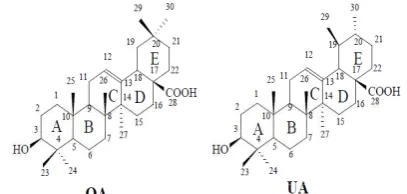
Ursolic acid and oleanolic acid (Figure 1) are

ubiquitous triterpenoids in plant kingdom, medicinal herbs and are integral part of the human diets. In the present study, the quantitative determination of

ursolic acid and oleanolic acid in ethanolic extracts

from Coleus tuberosus was performed by HPLC.

Using a standard curve of ursolic acid and oleanolic acid, the amount of ursolic acid and oleanolic acid in EEPC were calculated to be 13.78± 0.15, and, 19.75±0.30, respectively. EEFC had 3.41 ±0.04 µg/g sample, 3.71±0.06 µg/g sample, respectively.

Antioxidant activity assay in linoleic acid emulsion by ferric thiocyanate (FTC) method

The ferric thiocyanate method measures the peroxide value at the initial of the lipid peroxidation, where ferric ion is formed upon reaction of peroxide with ferrous chloride. The ferric ion then unites with ammonium thiocyanate producing ferric thiocyanate, a red-coloured substance. The darker the colour, the higher is the absorbance.

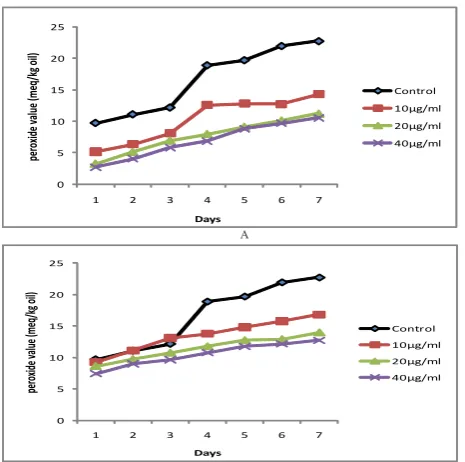
The effect of various concentration of EEPC and EEFC on lipid peroxidation of linoleic acid emulsion are shown in Figure 2A and B, ursolic

acid and oleanolic acid are shown in Figure 3 A and

B. Overall, peroxide value were the highest in the

control sample when compare to in the other samples at all time points. Although peroxide value increased with increasing storage time in all samples. Other have also reported increased peroxide value over time in products with or without antioxidant added.

Increased peroxide value of duct meatballs treated

with Cosmos caudatus, Polygonum minus, and BHT

over 21 days of storage (Nurul et al., 2010). Increased

peroxide value of water extract of selected Malaysian herbs (Cosmos caudatus, Centella asiatica, Murraya koenigir, Polygonum minus, Oenanthe javanica, and

BHT over 7 days of storage and peroxide value were higher in the control (Huda-faujan et al., 2007).

Inhibition of lipid peroxidation of EEPC at the concentrations 100, 200 and 400 μg/ml were

(4)

36.74%, 42.51%, and 43.40%, respectively. EEFC at concentration 100, 200, and 400 μg/ml were found to be 36.90%, 36.80%, and 39.17%, respectively. On the other hand, inhibition on peroxidation of linoleic acid emulsion of BHT and L-ascorbic acid at concentration 10, 20, and 40 μg/ml: 50.82%, 52.85%, and 56.02%, respectively and 36.01%, 39.80%, and 44.43%, respectively (Figure 4).

The results clearly showed that EEPC had

stronger antioxidant activity than EEFC, but lower than BHT and ascorbic acid. This result showed that the inhibition on peroxidation of linoleic acid emulsion was in a dose-dependent manner. The

higher antioxidant activity of peel than lesh from

Coleus tuberosus was related with the higher content

of bioactive compound such as ursolic acid and oleanolic acid in the peel than the lesh.

Ursolic acid had stronger antioxidant activity than

oleanolic acid, but lower than BHT and ascorbic acid. This result showed that the inhibition on peroxidation of linoleic acid emulsion a dose-dependent manner. Since both compounds are region-isomers, the differences in their potency may be attributed to their structural arrangement of the substituents. It is the

methyl group at positions 19 and 20, which makes a

difference in potencies of these compounds (Senthil

et al., 2007).

Ursolic acid and oleanolic acid has a good ability to inhibit peroxidation of linoleic acid compared with standard antioxidant compound that is quercetin, AA, and BHT. UA and OA are likely to lipophilic so that the evaluation of antioxidants using linoleic acid, showed that UA and OA can inhibit the occurrence of lipid peroxidation. This is consistent with research

Adhikari et al. (2006) which reported that the ursolic acid and oleanolic acid and other triterpenoids is an

eficient protector of lipid peroxidation.

OA and UA signiicantly retarded oil oxidation in sunlower oil. UA and OA, examined at a concentration 0.05% w/w oil, exhibit signiicant antioxidant

activity, with UA presenting higher antioxidant activity than OA (Assimopoulou et al., 2005). OA

and UA have protective effect against iso

proterenol-induced myocardial ischemia in rats. This activity is

related with the capability of OA and UA to block the induction of lipid peroxidation. Presence of different substituent at different position of molecule alters the antioxidant potency. Since both compounds were region-isomers, the difference in their potencies may be attributed to their arrangement of the substituents. It is the methyl group at position 19 and 20, which makes a difference in potencies of these compounds

(Senthil et al., 2007).

The higher antioxidant activity on EEPC than

0 5 10 15 20 25

1 2 3 4 5 6 7

Peroxide value (

meq /kg oil)

Days

Control

10μg/ml 20μg/ml 40μg/ml

A

B

Figure 2. FTC assay, peroxide value on treatment EEFC (A),

and EEPC (B) for 7 days. Data are presented as mean from three

independent experiments

0 5 10 15 20 25

1 2 3 4 5 6 7

peroxide value (

meq/kg oil)

Days

Control

10μg/ml

20μg/ml 40μg/ml

A

0 5 10 15 20 25

1 2 3 4 5 6 7

peroxide value (

meq/kg oil)

Days

Control

10μg/ml 20μg/ml 40μg/ml

B

Figure 3. FTC assay, peroxide value on treatment ursolic acid

(A), and oleanolic acid (B) for 7 days. Data are presented as mean from three independent experiments

Figure 4. Percentage of inhibition of lipid peroxidation of

(5)

EEFC agreed with related researches that investigated and compared antioxidant activities in the peel and

the lesh of fruits and vegetables. Extract of the peel of red pitaya have greater antioxidant activities than the lesh. (Wu et al., 2006). The peel of apple has

signiicantly higher antioxidant activities than the lesh (Wolfe et al., 2003). The mango peel extract

exhibited stronger antioxidant activity than mango lesh extract (Kim et al., 2010). Difference antioxidant

activity in peel and lesh from related researches associated with bioactive compounds content.

Coleus tuberosus contains triterpenic acid

(maslinic acid), phytosterol (stigmasterol, β-sitosterol

dan campesterol) Mooi et al. (2010). Bai et al. (2007)

states that treatment using some of root extract of A. deliciosa rich in oleanolic acid on rat liver injury by

CCl4 suppress the occurrence of lipid peroxidation

by decrasing numbers of peroxide. Buthanol extracts

which has the highest OA levels have the greatest

inhibitory capacity compared with other solvent

extracts.

The content of secondary metabolites such as maslinic acid, and phytosterol have an ability to inhibit the occurrence of lipid peroxidation. UA,

OA and maslinic acid included in the triterpenoid compounds, which in the study Adhikari et al. (2006)

sshows that the triterpenoid is an eficient protector

against lipid peroxidation. Ferreti et al. (2010)

reported that phytosterol (β-sitosterol, stigmasterol and campesterol) with various concentration (5-50 µM) can inhibit LDL lipid peroxidation induced by

Copper.

Ethanol extract of peel of Coleus tuberosus can

inhibit lipid peroxidation by decreasing the peroxide value greater than the ethanol extract of lesh of

Coleus tuberosus. This capability is related to the

content of triterpenic acid on the peel is greater than the lesh (Table 1) and other bioactive compounds. A difference in the ability of antioxidants is related to differences in content of bioactive compounds found in the peel and the lesh. Research by Cetkovic

et al. (2007) reported that the extracts n-buthanol Satureja montana L. subsp. Kitaibelii can inhibit

lipid peroxidation in sunlower oil which dinduksi 4,4 ‘-azobis (4-cyanovaleric acid) and ACVA-induced liposome 2,2’-azobis (2-amidino-propane) dihydrochloride) AAPH. Inhibition of n-buthanol extract is higher than inhibition by ethyl acetate extract; this is related to differences in content of bioactive compounds, especially phenol compounds. Levels of phenol compounds in n-buthanol 1358.14 µg/g while the ethyl acetate 969.43 µg/g. This is correlated with differences in content of bioactive compounds (phenol), ethyl acetate extract of 0127

µg/mg of GAE and chloroform 0089 µg/mg GAE.

Antioxidant activity determination in linoleic acid emulsion by thiobarbituric acid (TBA) test

FTC is used to measure the production of peroxide compounds at the initial stage of oxidation while TBA test is used to measure the secondary product of oxidation such as aldehyde and ketone (Huda-faujan

et al., 2007). The TBA test is a colorimetric technique

in which the absorbance of the red chromogen formed between TBA and malondialdehyde is measured (Hanachi, 2009). The irst step in lipid oxidation is the abstraction of a hydrogen atom from a fatty acid and subsequent oxygen involvement gives a peroxy

radical. Peroxide then gradually decomposes to lower molecular compound; mainly malondialdehyde during oxidation process and malondialdehyde can

be determined by TBA method. At low pH and high temperature, malondialdehyde binds TBA to form a red complex that can be measured at 532 nm. Generally, antioxidants suppress the hydrogen atom abstraction from fatty acid, which leads to the decrease of hydroperoxide formation. It is well known that

phenolic compound, triterpenic acid acts as hydrogen

donors in that reaction mixture and therefore, the formation of hydroperoxides were decreased.

The control sample (no antioxidant addition)

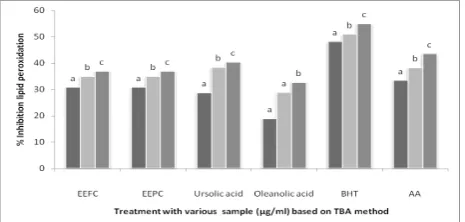
had higher TBA level than the sample that were subjected to treatment with EEPC and EEFC, BHT, and L-ascorbic acid. Figure 5 shows the percentage of inhibition of lipid peroxidation of EEPC, EEFC, UA, OA, BHT and ascorbic acid. All samples exhibit a dose-dependent antioxidant activity. It shows that the antioxidant activity of EEPC was greater than

EEFC. UA had stronger antioxidant activity than OA. The antioxidant activity in these studies increased,

as concentrations of the extract samples increased.

(Nagai et al., 2003). These results were in concordant with related research that investigated and compared

the antioxidant activities in peel and lesh of fruits and vegetables. Nara et al. (2006) reported that the

free and bound phenolics in the peel showed high antioxidant activity, while those in the lesh showed low activity. The apple peel extract exhibited stronger antioxidant activity than apple lesh extracts from

growing regions in Chile (Yuri et al., 2009).

(6)

50.93%, and 54.91%, respectively. The inhibition on peroxidation of linoleic acid emulsion of L-ascorbic acid at the concentrations of 10, 20 and 40 μg/ml were 33.41%, 38.20%, and 43.57%, respectively (Figure 5). The result of this study conirm that EEPC, EEFC and its bioactive compounds (UA and OA) can signiicantly delay lipid oxidation and reduce the risk presented by lipid peroxidation products. Antioxidant activity related with presence of the ursolic acid and oleanolic acid in the peel and lesh of ethanolic extract of Coleus tuberosus.

Ethanol extract of lesh and peel of Coleus tuberosus can inhibit lipid peroxidation. The ability

is related to the content of bioactive compounds

contained in the ethanol extract. Sadasivan et al.

(2006) reported that methanol extract of Hedyotis corymbosa (L.), which contain oleanolic acid, ursolic

acid and sitosterol can signiicantly reduce the MDA in rat liver induced by FeCl2-AA. This extract can

reduce the accumulation of lipid peroxidation in vitro

and depend on the concentration used, where at 25

µg/ml and 50 µg/ml concentrations can show the inhibition of 72.25% and 80%.

Coleus tuberosus besides containing oleanolic

acid, and ursolic acid, according to Mooi et al. (2010) contains maslinic acid and phytosterol. The content

of secondary metabolites such as maslinic acid, phytosterol have an ability to inhibit the occurrence of lipid peroxidation. Other secondary metabolites in

Coleus tuberosus such as beta-sitosterol contribute

to the ability of ethanolic extracts of lesh and peel of Coleus tuberosus in inhibiting lipid peroxidation.

Shanmugarajan et al. (2008) stated that methanol

extract of Ficus hispida Linn. rich in oleanolic acid

and β-sitosterol has a cardioprotective effect of cyclophosphamide in mice induced by lowering the level of MDA. Oleanolic acid and β-sitosterol has the ability sebagaai reported anti-lipid peroxidation.

Research Shanmugarajan and Devaki, 2008 reported

that methanolic extract of leaves of Ficus hispida

Linn containing oleanolic acid, β-sitosterol, hispidin

can inhibit the activation of lipid peroxidation Ethanolic extract of peel of Coleus tuberosus has

the ability to suppress lipid peroxidation inhibition of MDA formation is greater than the ethanolic extract of lesh of Coleus tuberosus. This is related to the

content of triterpenic acid on the peel than the lesh one (Table 1). Differences in antioxidant capability is related to differences in content of bioactive compounds found in the skin and the lesh. Azrina et al. (2010) demonstrated that the methanol extract of

the fruit peel of Canarium odontophyllum have the

greater ability to inhibit lipid peroxidation is than the parts of meat, (47.9 ± 0.00% and 11.61 ± 1.14%). These differences are associated with higher levels of bioactive compounds in the peel compared to the lesh (387.5 ± 33.23 mg and 267.0 ± GAE/100 g GAE/100 g 4:24 mg.)

Inhibition of human breast cancer cells proliferation

The anti-tumor promoting properties of Coleus tuberosus have been widely reported by various

research group, but antiproliferative activities of

Coleus tuberosus on cancer cells has not been done.

Signiicant anti-tumor promoting activities displayed by Coleus tuberosus suggested its potential to be

developed as chemoprevention. Ethanolic extract

of Coleus tuberosus (6.25-200 μg/ml) had strong

inhibition activity toward Eipstein Bar Virus (EBV) activation in Raji cells induced by phorbol 12-myristate 13-acetate and sodium-n-butirate by

dose-dependent manner (Mooi et al., 1999). Ethanolic

extract of Coleus tuberosus (12.5-400 μg/ml) were

able to suppress both early antigen diffuse (EA-D) and early antigen restricted (EA-R) by performing western blotting of treated Raji cells with human sera of nasopharyngeal carcinoma patients by

dose-dependent manner (Ali et al., 2000). Other related

research also showed that antiproliferative activity or cytotoxicity were in a dose-dependent manner

(Rahmat et al., 2003; Huang et al., 2005; Yuan and Walsh, 2006).

This study measured the amount of cell viability with the micro-culture Tetrazolium Salt (MTT) assay. The effect of EEPC and EEFC on the proliferation of human breast cancer cells was determined. The percentage of cell viability was measured by

comparing the optical density (OD) against the

control. The antiproliferative activity of EEPC and EEFC presents as a percentage of the cell viability versus concentration. Cells grown in 96-well tissue culture plate were incubated with yellow MTT solution for approximately 4 h. After this incubation period, purple formazan salt crystals were formed. These salt crystal were insoluble in aqueous solution,

Figure 5. Percentage of Inhibition of lipid peroxidation of

(7)

but may be solubilised by adding the solubilisation solution and incubating the plates overnight in a humidiied atmosphere (37oC, 5% CO

2). The

solubilised formazan product was quantiied spectrophotometrically using an ELISA Reader. An increase in number of living cells resulted in an increase in the total metabolic activity in EEPC and

EEFC sample. This increase directly correlated with

the amount of the purple formazan crystal formed, as monitored by the absorbance.

The antiproliferative activity of ethanolic extract of peel and lesh of Coleus tuberosus toward

growth of MCF 7 human breast cancer cells in vitro

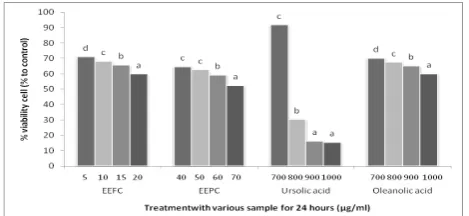
are presented in Figure 6. The ethanolic extract of peel of Coleus tuberosus showed relatively high

antiproliferative activities toward MCF 7 cells in a dose-dependent manner. The antiproliferative activity of EEPC and EEFC expressed as the median effective

dose (EC50), with a lower EC50 value signifying a

higher antiproliferative activity. The ethanolic extract of peel of Coleus tuberosus exhibited the highest antiproliferative effect (P<0.05) toward MCF 7 with the lowest EC50 : 1124.11 ± 35.19 μg/ml, followed

by ethanolic extract of lesh of Coleus tuberosus

1512.97 ± 50 μg/ml. Bioactive compounds, ursolic

acid has EC50 = 9.02 ± 0.12 , oleanolic acid EC50 136.27 ± 7.19. These results showed that EEPC

had the antiproliferative effect higher than EEFC

at all concentrations which corresponds with its

lower IC50. Its bioactive compound, ursolic acid had antiproliferative effect higher than oleanolic acid.

Ursolic acid and oleanolic acid as bioactive

compounds in Coleus tuberosus had strong inhibitory

the proliferation of MCF-7 cells in dose-dependent

manner compare with oleanolic acid, which

corresponds its lower IC50. Previous studies showed

that ursolic acid had strong inhibitory the proliferation

and induce apoptosis in cancer cells lines (Shan et al., 2009), but oleanolic acid, which the isomer of

ursolic acid have lower antiproliferative effect.

Shyu et al. (2010) indicated that oleanolic acid and

ursolic acid could inhibit the growth of HuH7 human hepatocellular carcinoma cells with IC50 100 μM

and 75 μM, respectively. Ursolic acid and oleanolic acid had antiproliferative effect on Jurkat cell line (T

cell lymphoma) were suggest that ursolic acid and

oleanolic acid have signiicant anti-tumor activity. Ursolic acid is most effective than oleanolic acid with IC 50 value : 75 μM and 150 μM.

The inhibition of cancer cell proliferation by ethanolic extract of peel and lesh of Coleus tuberosus

can be partially explained by the triterpenic acid

content mainly oleanolic acid and ursolic acid.

Oleanolic acid and ursolic acid was responsible for their antiproliferative activities. Presence of different substituents at different position of molecule alters

the cancer chemopreventive potency (Sun et al., 2006). Neto (2007) reported that ursolic acid in the

peel of cranberry fruits and apple was responsible for their antiproliferative activity and capability to inhibit growth of several leukemia cell lines and

A.549 human lung carcinoma.

He and Liu (2007) reported that that ursolic acid,

one of thirteen triterpenoid isolated from apple peels

show high potential anticancer activities against

human HepG2 liver cancer cells, MCF-7 breast cancer cells, and Caco-2 colon cancer cells. These results showed ursolic acid isolated from apple peels have potent antiproliferative activity and may be partially responsible for the anticancer activity of

whole apples. Ursolic acid and oleanolic acid are

ubiquitous triterpenoids in plant kingdom, medicinal herbs, and are integral part of the human diet. OA and UA have similar chemical structures but differ only in the position of the methyl group in ring E. OA has two methyl groups at its C-20 position while UA has a respective methyl group at C-19 and C-20

position. (Feng et al., 2009). OA and UA possesses as

anticancer in many cancer lines (Zhang et al., 2007;

Zhang et al., 2007)

Ethanol extract of lesh and peel of Coleus tuberosus can inhibit proliferation in MCF-7 cell

dose and time dependent manner. This ability related to the content of bioactive compounds, such as ursolic acid and oleanolic acid on lesh and peel of Coleus tuberosus. Zhang et al. (2007) that treatment of extract Fructus Ligustri Lucidi (FLL) rich oleanolic acid and

ursolic acid inhibit the proliferation of leukemia cells HL-60. FLL extract inhibited the growth of dose and

time dependent manner. Changes in morphology

indicate the occurrence of DNA fragmentation indicating apoptotic cell at concentration of 20 mg/

ml.

In addition to UA and OA, ethanolic extract of lesh and peel of Coleus tuberosus have other bioactive

Figure 6. Percentage of viability cells treatment with EEFC,

(8)

compounds such as maslinic acid, phytosterol:

stigmasterol, β-sitosterol and campesterol (Mooi et al., 2010). Maslinic acid which is included in the

bioactive compounds contained in Coleus tuberosus has an ability as anti-tumor by inhibiting nuclear factor-k B. Li et al. (2010) explains that the treatment with maslinic acid on pancreatic cancer cells can

inhibit proliferation and invasion depending on

concentration and treatment time (dose and time

dependent manner) through the inhibition of NF-KB. Maslinic acid also inhibit the expression of genes associated with cancer cell proliferation is cyclin D1, COX-2, Bcl-2 and Bcl-xl. Reyes-zurita et al. (2009)

reported that acid treatment of Olea europaea L.

which content maslinic acid can inhibit proliferation and induce apoptosis in colon cancer cells HT-29

dose dependent manner.

Phytosterol was reported to possessed the ability as an anti-cancer (Bardford and Award, 2007). Treatment with phitosterol can inhibit tumor growth,

reducing cell cycle progression, induces apoptosis

and inhibition of tumor metastasis. Jayaprakasha

et al. (2007) reported that treatment of HT29 colon

cancer with beta-sitosterol from the fruit of Poncirus trifoliate at concentration of 0.63 µM for 48 h to

inhibit proliferation and induce apoptosis. Similar research that evaluated and compare antiproliferative activity in different part of vegetables and fruits showed that peel extract of vegetables and fruits have higher antiproliferative activity than the lesh. Peel extract of mango (Mangifera indica L.) exhibited

signiicant antiproliferative effect in human hepatoma cell line, HepG2, compares to that of the lesh extract, in a dose-dependent manner (Kim et al., 2010). Apple

peels were also shown to more effectively inhibit the growth of HepG2 human liver cancer cells than the other apple component (Wolfe et al., 2003). The

antiproliferative study on B16F10 melanoma cells

revealed that the peel component was a stronger

inhibitor of the growth of B16F10 melanoma cancer cells than the lesh (Wu et al., 2006). This activity

associated with different content of the bioactive compounds in peel and lesh. This study showed that the growth of the MCF-7 cells was inhibited with EEPC, EEFC and its bioactive compounds (ursolic

acid and oleanolic acid).

Conclusion

The result from this study showed the level of

natural antioxidant and cancer chemopreventive on

ethanolic extract of peel and lesh Coleus tuberosus.

Ethanolic extract of peel of Coleus tuberosus showed

higher antioxidant activities and antiproliferatives

activities than ethanolic extract of lesh of Coleus tuberosus in a dose-dependent manner. Ursolic acid

and oleanolic acid that presence in Coleus tuberosus

may be partially responsible for the antioxidant and cancer chemopreventive agent of Coleus tuberosus.

Acknowledgment

Authors thank to the Directorate General of Higher Education Republic of Indonesia that has funded this research. The authors also thank to Prof. drh. R. Wasito, M.Sc., Ph.D; Prof. Dr. Ir. Mary Astuti, MS; Dr. Ir. Pudji Hastuti, MS for the suggestions that have been given to this research, and Tri Yuliati S.KM. for technical assistance during this research.

References

Adhikari, D. P., Schutzki, R. E., Dewitt, D. L. and Nair,

M. G. 2006. Effects of Amelanchier fruits isolates on

cyclooxygenase enzymes and lipid peroxidation. Food

Chemistry 97: 57–64.

Ali, A. M., Mooi, L. Y., Yih, K. Y., Norhanom, A. W., Saleh,

K. M., Lajis, N. H., Yazid, A. M., Ahmad, F. B. H. and Prasad, U. 2000. Anti-tumor promoting activity of some Malaysian traditional vegetable (ulam) extracts by immunoblotting analysis of Raji cells. Natural Product Sciences 6 (3): 147-150.

Assimopoulou, A. N., Zlatanos, S. N. and Papageorgiou, V. P. 2005. Antioxidant activity of natural resins and bioactive triterpenes in oil substrates. Food Chemistry 92: 721-727.

Azrina, A., Nurul Nadiah, M. N. and Amin, I. 2010. Antioxidant properties of methanolic extract of

Canarium odontophyllum fruit. International Food

Research Journal 17: 319-326.

Bai, X., Qiu, A., Guan, J. and Shi, Z. 2007. Antioxidant and protective effect of oleanolic acid-enriched extract of A. deliciosa root on carbon tetrachloride induced rat

liver injury. Asia Paciic Journal of Clinical Nutrition 16 (1): 169-173.

Bradford, P. G. and Award, A. B. 2007. Phytosterol as

anticancer compounds. Molecular Nutrition and Food

Research 51 (2): 161-170.

Cetkovic, G. S., Canadanovic-Brunet, J. M., Djilas, S. M., Tumbas, V. T., Markov, S. L. and Cvetkovic, D.

D. 2007. Antioxidant potential, lipid peroxidation

inhibition and antimicrobial activities of Satureja montana L. subsp. Kitaibelii extracts. International

Journal of Molecular Sciences 8: 1013-1027.

Du, H. and Chen, X. Q. 2009. Comparative study of the separation of oleanolic acid and ursolic acid in Prunella vulgaris by high performance liquid chromatography

and cyclodextrin-modiied micellar electrokinetic chromatography. Journal Iran Chemistry Society 6 (2): 334-340.

Fai, Y. M. and Tao, C. C. 2009. Literature review on

(9)

Proda Medica 2: 291-298.

Feng, J. H., Chen, W., Zhao, Y. and Ju, X. L. 2009. Anti-tumor activity of oleanolic, ursolic and glycyrrhetinic acid. The Open Natural Products Journal 2: 48-52. Ferreti, G., bacchetti, T., Masciangelo, S. and Bicchiega,

V. 2010. Effect of phytosterols on copper lipid peroxidation of human low-density lipoproteins. Journal of Nutrition 26 (3): 296-304.

Hanachi, P. 2009. Using HPLC to determination the

composition and antioxidant activity of Berberis vulgaris. European Journal of Scientiic Research 29

(1): 47-54.

He, X. and Liu, R. H. 2007. Triterpenoids isolated from apple peels have potent antiproliferative activity and may be partially responsible for apple’s anti cancer activity. Journal of Agriculture and Food Chemistry 55 (11): 4366-4370.

Hogan, S., Chung, H., Zhang, L., Li, J., Lee, Y., Dai, Y. and Zhou, K. 2010. Antiproliferative and antioxidant properties of anthocyanin-rich extract from acai. Food Chemistry 118: 208-214.

Hsum, Y. W., Yew, W. T., Hong, P. L., Soo, K. K., Hoon, L.

S., Chieng, Y. C. and Moo, L. M. 2008. Identiication and evaluation of potential anti-tumor promoting compounds from tubers of Coleus tuberosus.

International symposium on natural products in cancer therapy. 23-26 September 2008. Naples Italy.

Huda-Faujan, N., Noriham, A., Norrakiah, A. S. and Babji, A. S. 2007. Antioxidative activities of water extracts of some Malaysian herbs. ASEAN Food Journal 14 (1): 61-68.

Jayaprakasha, G. K., Mandadi, K. K., Poulose, S. M., Jadegoud, Y., Nagana Gowda, G. A. and Patil, B. S. 2007. Inhibition of colon cancer cell growth and antioxidant activity of bioactive compounds from Poncirus trifoliota (L.) Raf. Bioorg. Medical

Chemistry 15 (4): 4923-4932.

Kim, H., Moon, J. Y., Kim, H., Lee, D. S., Cho, M., Choi,

H. K., Kim, Y. S. Mosaddik, A. and Cho, S. K. 2010.

Antioxidant and antiproliferative activities of mango

(Mangifera indica L.) lesh and peel. Food Chemistry

121 (2): 429-436.

Li, C., Yang Z., Zhai, C., Qiu, W., Li, D., Yi, Z., Wang, L., Tang,, J., Qian, M., Luo, J. and Liu, M. 2010. Maslinic acid potentiates the anti-tumor activity of tumor necrosis factor a by inhibiting NF-kB signaling pathway. Molecular Cancer 73: 1-13.

Manda, G., Nechifor, M. T. and Neagu, T. M. 2009. Reactive oxygen species, cancer, and anti-cancer therapies. Current Chemical Biology 3: 22-46.

Martin, K. R. 2006. Targeting apoptosis with dietary

bioactive agents. Experimental Biology and Medicine 231: 117-129.

Mooi, L. Y., Ali, A. M., Norhanom, A. B., Mat Saleh, K., Murakami, A. and Koshimizu, K. 1999. Anti-tumor promoting activity of some Malaysian traditional vegetables (ulam). Natural Product Sciences 5 (1): 33-38.

Mooi, L. Y., Wahab, N. A., Lajis, N. H. and Ali, A. M. 2010. Chemopreventive properties of phytosterols

and maslinic acid extracted from Coleus tuberosus

in inhibiting the expression of EBV early-antigen in Raji cells. Journal of Chemistry and Biodiversity 7(5): 1267-1275.

Neto, C. C. 2007. Cranberry and its phytochemicals: a review of in vitro anti cancer studies. International

research conference on food, nutrition, and cancer. The Journal of Nutrition 137: 186S-193S.

Nugraheni. M., Santoso. U., Suparmo. and Wuryastuti, H. 2010. Triterpenic acid content and antioxidant ectivity

of ethanolic extract of Coleus tuberosus. Abstract

International Seminar Emerging issues and technology developments in foods and ingredients. Indonesian Association of Food Technologists (IAFT), Jakarta, Indonesia, September 29th-30th, 2010.

Nurul, H., Ruzita, A. and Aronal, A. P. 2010. The

antioxidant effect of Comos caudatus and Polygonum minus in refrigerated duck meatballs. International

Food Research Journal 17: 893-904.

Ramos, A. A., Lima, C. F., Pereira, M. L., Fernandes-Ferreira, M. and Pereira-Wilson, C. 2008. Antigenotoxic effect of quercetin, rutin and ursolic acid on HepG2 cells : evaluation by the comet assay. Toxicology Letters 177(1): 66-73.

Reyes-Zurita, F. J., Ruino-Palomares, E. E., Lupianez, J.

A. and Cascante, M. 2009. Maslinic acid, a natural

triterpene from Olea europaea L., induces apoptosis in

HT29 human colon-cancer cells via the mitochondrial apoptotic pathway. Cancer Letters 273 (1): 44-54. Sadasivan, S., Latha, P. G., Sasikumar, J. M., Rajashekaran,

S., Shyamal, S. and Shine, V. J. 2006. Hepatoprotective

studies on Hedyotis corymbosa (L.) Lam. Journal of

Ethnopharamcology 106(2): 245-249.

Sandhya, C. and Vijayalaksmi, N. R. 2001. Antioxidant activity of lavonoids from Solenostemon rotundifolius

in rats fed normal and high fat diets. Journal of

Nutraceuticals, Functional and Medical Foods 3(2):

55-66.

Seifried, H. E., Anderson, D. E., Fisher, E. I. and Milner, J. A. 2007. A review of the interaction among dietary antioxidants and reactive oxygen species. The Journal of Nutritional Biochemistry 18 (9): 567-579.

Senthil, S., Chandramohan, G. and Pugalendi, K. V. 2007. Isomers (oleanolic and ursolic acids) differ in their protective effect against isoproterenol-induced myocardial ischemia in rats. International Journal of Cardiology 119: 131-133.

Shan, J. Z., Xuan, Y. Y,, Zheng, S., Dong, Q. and Zhang, S. 2009. Ursolic acid inhibits proliferation and induced apoptosis of HT-29 colon cancer cells by inhibiting the EGFR/MAPK pathway. Journal of Zhejiang University of Science 10(9): 668-674.

Shanmugarajan, T. S. and Devaki, T. 2008. Ficus hispida

Linn. Leaf extract possesses antioxidant potential and abrogates azathioprine induced prooxidant and antioxidant imbalance in rat liver. International Journal of Pharmacology 4: 376-381.

Shanmugarajan, T. S., Arunsundar, M., Somasundaram, I.,

Krishnakumar, E., Sivaraman, D. and Ravichandiran,

(10)

Linn. On cyclophosphamide provoked oxidative

myocardial injury in a rat model. International Journal of Pharmacology 4 (2): 78-87.

Shyu, M.H. and Kao, T.C. 2010. Oleanolic acid and ursolic acid induce apoptosis in HuH7 human hepatocellular

carcinoma cells through a mitochondrial-dependent pathway and downregulation of XIAP. Journal of Agriculture and Food Chemistry 58 (10): 6110-6118. Spencer, C. M., Faulds, D. and Paclitaxel. 1994. A review of

its pharmacodynamic and pharmacokinetic properties

and therapeutic potenstial in the treatment of cancer. Drug 48: 794-847.

Sun, H., Fang, W. S., Wang, W. Z. and Hu, C. 2006. Structure-activity relationships of oleanane- and ursane type triterpenoids. Botanical Studies 47:

339-368

Waris, G. and Ahsan, H. 2006. Review: reactive oxygen species: role in the development of cancer and various chronic conditions. Journal of Carcinogenesis 5: 1-8. Wolfe, K., Wu, X. and Liu, R. H. 2003. Antioxidant

activity of apples peels. Journal Agricultural and Food Chemistry 51 (3): 609-614.

Wu, L. C., Hsu, H. W., Chen, Y. C., Chiu, C. C., Lin, Y. I. and Ho, J. A. 2006. Antioxidant and antiproliferative activities of red pitaya. Food Chemistry 95 (2):

319-327.

Yang, M., Wang, X., Guan, S. and Xia, J. 2007. Analysis of triterpenoids in Ganoderma lucidum using liquid

chromatography coupled with electrospray ionization

mass spectrometry. American Society for Mass Spectrometry 18 (5): 927-939.

Yuri, J. A., Neira, A., Quilodran, A., Motomura, Y. and Palomo, I. 2009. Antioxidant activity and total phenolics concentration in apple peel and lesh is determined by cultivar and agroclimtic growing regions in Chile. Journal of Food Agriculture and Environment 7: 513-517.

Zahin, M., Agil, F. and Ahmad, I. 2009. The in vitro

antioxidant activity and total phenolic content of four Indian medicinal plants. International Journal of Pharmacy and Pharmaceutical Sciences 1(1): 88-95 Zhang, P., Li, H., Chen, D., Ni, J., Kang, J. and Wang,

S. 2007. Oleanolic acid induced apoptosis in human leukemia cells through caspase activation

and poly(ADP-ribose) polymerase cleavage. Acta Biochimica et Biophysica Sinica 39 (10): 803-809. Zhang, D.M., Tang, P.M.K., Chan, J.Y.W., Lam, H.M.,

Au, S.W.N., Kong, S.K., Tsui, S.K.W., Waye, M.M.Y.,

Gambar

Figure 1. Chemical structure of oleanolic acid (OA) and  ursolic acid (UA)
Figure 4. Percentage of inhibition of lipid peroxidation of different concentration of EEFC, EEPCT, ursolic acid, oleanolic acid, BHT and AA by FTC method
Figure 5. Percentage of Inhibition of lipid peroxidation of different concentration of EEFC, EEPC, ursolic acid, oleanolic acid, BHT and AA  by TBA method
Figure 6.  Percentage of viability cells treatment with EEFC, EEPC, ursolic acid and oleanolic acid at variation of concentration, incubation 24 hours

Referensi

Dokumen terkait

ayat (1) dilakukan apabila kebutuhan dasar mustahiq telah terpenuhi. Pendayagunaan dana zakat untuk aktivitas-aktivitas produktif memiliki. beberapa prosedur. Dimana diatur dalam

amount of the asset’s cash -generating unit. Jumlah terpulihkan adalah jumlah yang lebih tinggi antara nilai wajar dikurangi biaya pelepasan dengan nilai pakainya. Nilai

Pengembangan sumber daya manusia dalam bidang penelitian telah berlangsung terutama sejak bergulirnya Program Studi S3 Ekonomi pada tahun 2000 yang diikuti.. oleh Program Studi

YANG DIUSULKAN UNTUK DI BANGUN Kepala SMPN 2 Toroh.. YANG DI USULKAN UNTUK

Tujuan dari penelitian ini adalah meng- identifikasi risiko-risiko yang mungkin terjadi dan identifikasi agen/penyebab risiko dalam kegiatan konstruksi bangunan gedung

menunjukkan skala nyeri. c) Pertahankan imobilisasi bagian yang sakit dengan tirah baring. Rasional: menghilangkan nyeri dan mengurangi dekstruksi pada send. kaki. d) Jelaskan

In November 2018, it announced that it took over Holcim Indonesia Tbk (SMCB); SMGR through the acquisition will be the biggest cement company in Southeast Asia

Seperti telah ditulis di depan bahwa nyamuk ini hanya ditemukan secara kebetulan (2 kali dalam 26 kali pengamatan yang intensif) maka perannya sebagai vektor di daerah