DEVELOPING THE LEVEL SIX PISA LIKE PROBLEMS FOR ENRICHMENT
PROGRAMME IN SECONDARY SCHOOL
Ambarsari Kusuma Wardani Sriwijaya University, Palembang
Abstract
Based on the results of the Programme International for Student Assessment (PISA) indicates most of Indonesian students are only able to solve low-level mathematics problems. Indonesia is one of the countries that have the lowest score in the latest PISA test. The level six problems have the significant contributions to the students’ low score in PISA result. Indonesian ministry of education respond this problem by developing a new curriculum what so called curriculum of 2013 in order to ensure that every student acquires the intended knowledge to be able to compete at the international level. Therefore, in the teaching and learning process in the new curriculum the PISA like problems should be embedded in most of the problems that solved by the students. Thus, the researcher developed the level six PISA like problems via enrichment program. The enrichment program is considered to be useful to provide a better experience for the students in solving high level mathematical problems. The aims of this study are to develop a valid and practical the level six PISA like problems for enrichment program In order to reach these aims, the researcher proposes the following research question: how to design a valid and practical the level six PISA like problems for enrichment program for secondary school? This is a design research using the type of development study with formative evaluation. The subjects were seventh graders from SMPK Frater Xaverius 1 Palembang. From the analysis of the documentation it can be concluded that this research has resulted a product the level six PISA-like problems for enrichment programme which valid and practical.
Keywords: development research, the level six PISA like problems, enrichment programme
INTRODUCTION
Widjaja (2011) stated that the analysis of PISA result from 2003 to 2009 showed that the performance of Indonesian students in solving high level mathematical problems especially level six problems is lower than most of the other participants. In addition,
according to Stacey , the percentage of )ndonesian students’ score in P)SA 9 in
experience for the students in solving high level mathematical problems (McAllister & Plourde, 2008).
THEORITICAL FRAMEWORK
Enrichment Programme
The enrichment programme can be interpreted as an experience or learning activity for students who achieve a passing grade earlier (Gentile & Lalley: 2003). Beecher and Sweeny (2008) claimed that the material in enrichment programme is deeper than material in regular teaching and learning process. Hence, the enrichment programme provides the students who have more intelligence with advance level learning to help students achieve better learning outcomes.
The goals of the enrichment programme by Renzulli dan Reis (2005), as follows: 1) Exposing students to various topics, area of interest and fields of study
2) Providing students with the skills and resources necessary to acquire advanced level content thinking skills
3) Creating opportunities for students to apply their skills in fields of study The Level Six PISA like Problems
The problems in PISA are divided into six levels. In each level, there are some criteria that describe the ability of the student. In the recent study, focus solely on the level five and six of PISA which is can be categorize in high level problems.
Table 1. Indicators of level 5 and 6 Level
6
Students can conceptualize, generalize, and utilize information based on their investigations and modeling of complex problem situations. They can link different information sources and representations and flexibly translate among them. Students at this level are capable of advanced mathematical thinking and reasoning. These students can apply their insight and understandings along with a mastery of symbolic and formal mathematical operations and relationships to develop new approaches and strategies for attacking novel situations. Students at this level can formulate and precisely communicate their actions and reflections regarding their findings, interpretations, arguments, and the appropriateness of these to the original situations.
(OECD, 2010)
METHOD
Expert
Fig 1. General sequence of formative evaluation types (Tessmer 1993, Zulkardi 2006)
In the preliminary stage, the researcher conducted an analysis of students, curriculum analysis, and analysis of PISA problems. Furthermore, researcher designs draft of prototype and other instruments of the prototype. The second stage of prototyping begins with self-evaluation stage. Then expert review and one-to-one are conducted simultaneously to test the first prototype. In the expert review phase, the content, construct, and language of the first prototype are validated by using walk-through by experts and peers. The researcher conducted one-to-one test to four students. The results of the expert review and revision of one-to-one produces the second prototype that will be tested at small group. Twelve students were involved in this phase. Students are required to solve the problems and then provide suggestions or comments to know about the practicality of the problems that has been done. The researcher carried out validity and reliability analysis of each items as well. The revision based on the result of small group phase produced the third prototype that will be tested in the field test. In the field test phase, twenty students worked on the third prototype.
RESULT AND ANALYSIS
In this part will be discussed about the results of the preliminary and prototyping stage of formative evaluation which includes self evaluation, expert review, a one-to-one, small group, and a field test.
1. Preliminary
At this stage, the researcher conducted preparation such as chose the subject and place of the research. After that, the researcher conducted an analysis of students to determine mathematical ability of the students as the subject of this study. Curriculum analysis and analysis of PISA problems done by the researcher acted as a foundation for developing the problems.
2. Prototyping
b. Expert Review
Expert review is qualitatively validation of the first prototype based on content, construct and language. The problems were consulted and examined to experts and peers who experienced in mathematics education as a validator. The validators are: (1) Prof. Kaye Stacey, professor of mathematics education at the University of
Melbourne, Australia. She is chairman of the Mathematics Expert Group (MEG) for the OECD PISA survey in 2012.
(2) Dr. Ross Turner, director of the Australian Council for Educational Research (ACER). He is the head of the team of experts in PISA.
(3) Prof. Dr. Ahmad Fauzan, M. Pd, M.Sc, professor and lecturer of mathematics education courses at Padang State University.
(4) Prof. Dr. Ipung Yuwono, M.S., M.Sc., professor and lecturer of mathematics education courses at Malang State University.
(5) Kamaliyah, M.Pd., peers who have been researching on the PISA like problems (6) Yuni, S.Pd. a mathematics teacher at SMP Frater Xaverius 1 Palembang, who
reviews the appropriateness of the problems to the enrichment programme. c. One-to-one
The researcher conducted one-to-one test to four students. Because the problems for enrichment programme, then the students who involved in this phase have to pass the standard achievement. The procedure in this phase is students solve the level six PISA like problems and after that the researcher interviewed students to ask for comments and suggestions about the problems. In one-to-one phase, the researcher focuses on the clarity of the problems, the practical aspect of the problems, and
students’ enthusiasm towards the given problem.
The results of the expert review and revision of one-to-one produces the second prototype that will be tested at small group.
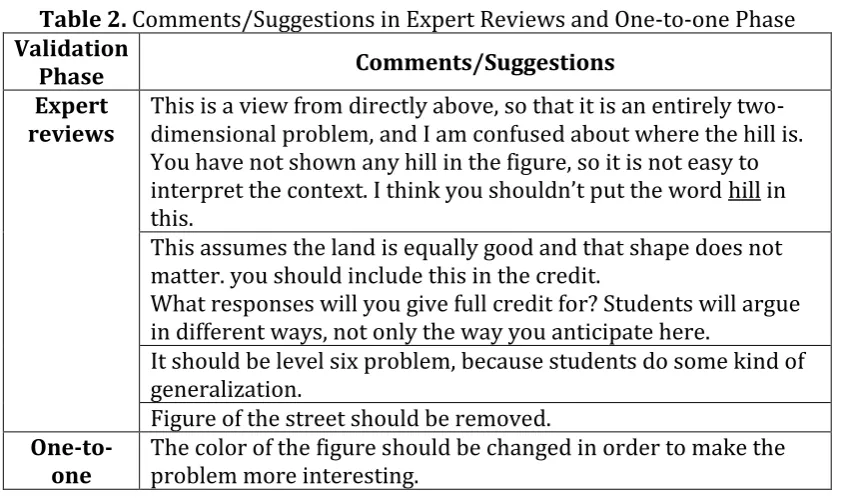
Table 2. Comments/Suggestions in Expert Reviews and One-to-one Phase
Validation
Phase Comments/Suggestions Expert
reviews
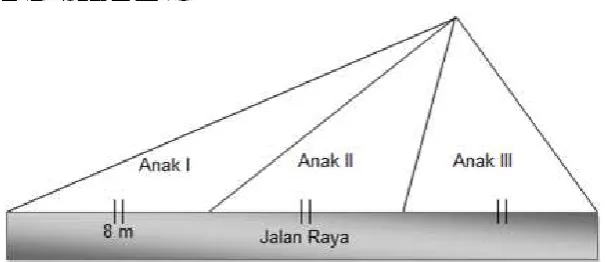
This is a view from directly above, so that it is an entirely two-dimensional problem, and I am confused about where the hill is. You have not shown any hill in the figure, so it is not easy to
interpret the context. ) think you shouldn’t put the word hill in this.
This assumes the land is equally good and that shape does not matter. you should include this in the credit.
What responses will you give full credit for? Students will argue in different ways, not only the way you anticipate here.
It should be level six problem, because students do some kind of generalization.
Figure of the street should be removed.
One-to-one
The color of the figure should be changed in order to make the problem more interesting.
Before Revision
d. Small Group
Twelve students were involved in this phase. After working with the problems, students filled out a questionnaire and followed up with an interview. The aim of the interview is
to ask students’ comments and suggestions in order to know about the practicality of the
problems. The researcher carried out validity and reliability analysis of each items as
well. The revision based on students’ comments and suggestion and the analysis of each items produced the third prototype will be tested in the field test.
e. Field Test
In the field test phase, the third prototype tested to the subjects of this study which consist of twenty students. In this phase, the researcher acted as an observer in order to figure out the difficulties that students encounter.
The level six PISA like problems were categorized qualitatively valid and practical. Qualitative validity is indicated from the results of the expert reviews. In the expert reviews phase, validators state that PISA like problems has been good based on the
content according to the P)SA’s characteristics , construct developing mathematical
literacy skill, according to the level of the students which is grade seven, inviting further development of concept) and language (according to the EYD, do not contain double interpretation, the limits of the question and answer is clear)
The following is the explanations about the level six PISA like problems based on some
students’ answer in field test.
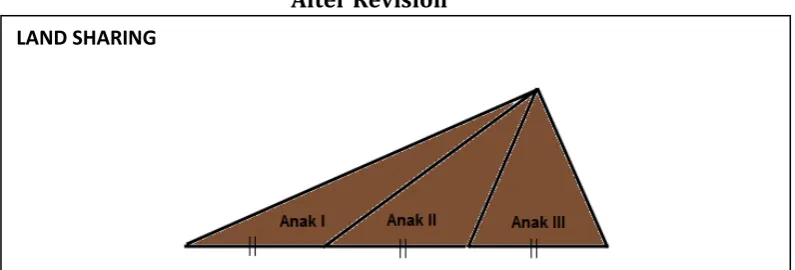
After Revision
Content : Space and shape
Context : Societal
Level : 6
Full credit :
Its fair, because the areas of each part of the land are the same (the bases and heights of the land triangles are the same) and the shape does not matter.
No credit : wrong answer and missing
The problem is about the concept of area of the triangle. This problem distracted the students by not providing any information beside the figure of the land. Nevertheless, the students who only remember the formula of area of the triangle without understanding the concept will difficult to give the right argument.
Based on the indicator of level 6, the students have to conceptualize, generalize, and use the information based on the investigation of the figure of the land. They also must be able to connect the source of information and different representations of the images provided and flexibly translate them if could be used to prove that the area of each part of the land is the same. The students have to formulate and communicate their
argumentation well in order to indentify the students’ mathematical thinking and
reasoning skill.
About 30% students could solve this problem with valid explanation. They were able to conceptualize, generalize, and use the information based on the investigation of the figure of the triangle land. The students also expressed their mathematical thinking and reasoning skill well in communicate the argument that the area of each part of the land is same in size. Moreover, some students demonstrated another strategy to prove that their answer by measured the based and the height of the land like Angle did (Figure 4).
LAND SHARING
Mr. Ahmad has an area of a land as shown in the figure above. He wants to share the land among his three children.
Fig 4.Angela’s answer for the third question
CONCLUSION
The result of this study is high level of PISA like problems for seventh grader of secondary school for enrichment programme. PISA like problems for enrichment program has been declared valid and practical. The prototype is valid qualitatively by experts. In addition, experts have also stated that prototype is practical problems for students in accordance with the results of the one-to-one and small group. It has also been tested to know the quantitative validity and reliability of each item. In field test phase, 20 students answered the prototype to determine whether these problems can be used on the actual situation.
REFERENCES
Beecher, M., & Sweeny, S. M. (2008). Closing the achievement gap with curriculum enrichment and differentiation: One school's story. Journal of Advanced Academics, 19(3), 502-530.
Kamaliyah. (2012). Developing the Sixth Level of PISA-Like Mathematics Problem for Secondary School Student. Journal on Mathematics Education (IndoMS-JME), 3(2), 169-188.
Kemdikbud. (2013). Materi Pelatihan Guru Implementasi Kurikulum 2013 SMP/MTs Matematika. Badan Pengembangan Sumber Daya Manusia Pendidikan dan Kebudayaan dan Penjaminan Mutu Pendidikan Kementerian Pendidikan dan Kebudayaan. Jakarta: Kemdikbud.
McAllister, B. A., & Plourde, L. A. (2008). Enrichment Curriculum: Essential for Mathematically Gifted Students. Education, 129(1), 40-49.
Novita, R., Zulkardi, Hartono, Y. (2012). Exploring Primary Student’s Problem-Solving Abillity. Journal on Mathematics Education (IndoMS-JME), 3(2), 133-150.
OECD. (2009). PISA 2009 Assessment Framework. Paris: OECD OECD. (2010). PISA 2012 Mathematical Framework. Paris: OECD
OECD. (2013). PISA 2012 Assessment and Analytical Framework: Mathematics, Reading, Science, Problem Solving and Financial Literacy. Paris: OECD
Renzulli, J., & Reis, S. (2007). A technology based program that matches enrichment resources with student strengths. International Journal of Emerging Technologies in Learning (iJET), 2(3).
Stacey, K. (2010). Mathematical and scientific literacy around the world.Journal of Science and Mathematics Education in Southeast Asia, 33(1), 1-16.
Widjaja, W. (2011). Towards mathematical literacy in the 21st century: perspectives from Indonesia. Southeast Asian mathematics education journal, 1(1), 75-84. Zulkardi. (2006). Development a Learning Environment on Realistic Mathematics