1
Relationship between the Degrees of Severity
Sequelae after Treatment with Quality of Life in
Patients of Pulmonary Tuberculosis Patients
Deddy Nur Wachid Achadiono1, Heni Retnowulan2,Tiara Putri Utami 3
1The Division of Rheumatology, Department of Internal Medicine, Faculty of Medicine, Universitas
Gadjah Mada, Dr. Sardjito General Hospital
2The Division of Pulmonology, Department of Internal Medicine, Faculty of Medicine, Universitas
Gadjah Mada, Dr. Sardjito General Hospital
3Bachelor Degrees, Department of Internal Medicine, Faculty of Medicine, Universitas Gadjah Mada,
Dr. Sardjito General Hospital
ABSTRACT
Background: Tuberculosis remains a global health problem, especially for developing countries. Tuberculosis can cause permanent deformity of the lung parenchyma, airways, pleura, mediastinum, chest wall, and vascular. This deformity is residual symptoms or sequelae. Tuberculosis sequelae may occur in most patients although has completed treatment. These sequelae can affect lung function and will ultimately influence patient’s quality of life.
Objective: This study aims to determine the relationship between the severities of sequelae after tuberculosis based index Willcox with patient’s quality of life.
Methods: The study design was cross-sectional at patients of outpatient clinic BP4 Yogyakarta from September 2013 until the samples are met. The relationship between the severities of the degree of sequelae after treatment with the quality of life in patients with pulmonary tuberculosis will be analyzed using t test. Relationship is significant if p <0.05 with 95% confidence intervals.
Results: The total of the subjects are 37 consist of 24 patients (64.9%) males and 13 (35.1%) women. Subjects who met the criteria will be examined the thoracic x-ray poster anterior (PA). Severity of tuberculosis sequelae will be assessed according to the index Willcox. Subjects also completed a SGRQ questionnaire as a tool for assessing their quality of life. There is a significant correlation between the severity of tuberculosis sequelae with the quality of life in the activity (ρ = 0.031) and total (ρ = 0.037) domain.
Conclusions: There is a relationship between the severities of the quality of life in patients with pulmonary tuberculosis sequelae.
Keywords: tuberculosis sequelae; tuberculosis; Willcox index; SGRQ; quality of life.
ABSTRAK
Latar Belakang: Hingga kini tuberkulosis masih menjadi masalah kesehatan global terutama untuk negara berkembang. Tuberkulosis dapat menyebabkan deformitas permanen pada parenkim paru, saluran pernapasan, pleura, mediastinum, dinding dada, dan vaskuler. Deformitas ini merupakan gejala sisa atau sekuele. Sekuele tuberkulosis dapat terjadi pada sebagian besar pasien meskipun telah selesai menjalani pengobatan. Sekuele ini dapat mempengaruhi fungsi paru dan pada akhirnya akan mempengaruhi pula kualitas hidup penderita.
2
Metode: Desain penelitian ini adalah potong lintang pada pasien-pasien rawat jalan poliklinik BP4 Yogyakarta dari September 2013 hingga sampel terpenuhi. Subjek yang memenuhi kriteria akan dilakukan pemeriksaan foto thoraks posteroanterior (PA). Derajat keparahan sekuele tuberkulosis akan dinilai dari foto thoraks menurut indeks Willcox. Subjek juga mengisi kuesioner SGRQ sebagai alat untuk menilai kualitas hidup. Hubungan antara keparahan derajat sekuele paska perawatan dengan kualitas hidup pada pasien tuberkulosis paru akan dianalisis menggunakan uji t. Hubungan bermakna bila p<0.05 dengan interval kepercayaan 95%.
Hasil: Didapatkan subyek penelitian sebanyak 37 pasien yang terdiri dari 24(64,9%) laki laki dan 13(35,1%) perempuan. Terdapat hubungan yang signifikan antara keparahan sekuele tuberkulosis dengan kualitas hidup pada domain activity (𝜌 =0,031) dan total (𝜌 =0,037).
Kesimpulan: Terdapat hubungan antara derajat keparahan dengan kualitas hidup pada pasien sekuele tuberkulosis paru.
Kata kunci: sekuele tuberculosis; tuberculosis; indeks Willcox; SGRQ; kualitas hidup
INTRODUCTION
Tuberculosis is an oldest chronic infection disease on the respiratory tract caused by Mycobacterium tuberculosis.1,2
This diseases could spread almost entire human body, especially the lungs.3 In 1993
declared TB a "global public health emergency" with infection of one-third of the world population.4 Tuberculosis still
being a global health problem, especially in the developing country where can be found 80% for total tuberulosis case in the world. Indonesia is a sequence hearts sign with fifth term highest tuberculosis sufferers in the World. The others come from India, China, South Africa, and Nigeria. Data Beginning in May 2010,
Indonesia recorded total 294.732
tuberculosis cases (MoH, 2011).
The history of eradication of tuberculosis began with the discovery of streptomycin in 1944, which was followed by the discovery of PAS (the amino salicylic acid). Not long after that successively reported the discovery of several drugs that until now the first-line treatment of tuberculosis, isoniazid, pyrazinamide, ethambutol, and rifampin5,6.
Handling management systems are getting
better enhances the success of the healing of pulmonary tuberculosis.
Recorded cure rate of new cases of smear positive pulmonary tuberculosis
increased in 2001-20097. However,
patients who have been declared cured of pulmonary tuberculosis still have a
permanent deformity as residual
symptoms or sequelae.8 Sequelae can be
described with caseating granuloma formation, liquefaction, and cavities.9
Sequelae that occur can cause damage to the lung structure and manifest in difficulty breathing until the cause of death. The manifestation of the severity of sequelae of tuberculosis varies widely depending on the location of the lesion.
3
Some studies suggest that the evaluation of lung function is not fully reflected the impact of the illness of a patient so should be analysis using a quality of life questionnaire 10. To analyze
the impact on the lives of patients with tuberculosis sequelae can be used SGRQ quality of life questionnaire. Research conducted by Mikhail Chushkin and his colleagues in 2011 showed that SGRQ reliable and valid to analyze the quality of
life of patients after pulmonary
tuberculosis.
The information about the quality of life in Indonesia is not robust. In addition, all the reports from the existing literature have not found a discussion of the quality of life of patients based on the severity of sequelae of pulmonary
The sample used post-treatment pulmonary tuberculosis patients who have finished running the program for at least 6 months of treatment, has been declared cured with smear negative, and had sequelae on chest x-ray examination. Samples were obtained from patients with pulmonary tuberculosis post-treatment visit in Lung Disease Clinic, Hospital Dr. Sardjito BP4 Yogyakarta. The study began in September 2013. Patients will be asked to answer a questionnaire to determine their quality of life. The severity of pulmonary sequelae determined using the index Willcox through chest x-ray radiographic examination results. At the beginning of the meeting, the patient will
fill out an informed consent. The samples obtained were 45 patients, but after only 37 patients were selected to be analyzed and appropriate inclusion and exclusion criteria.
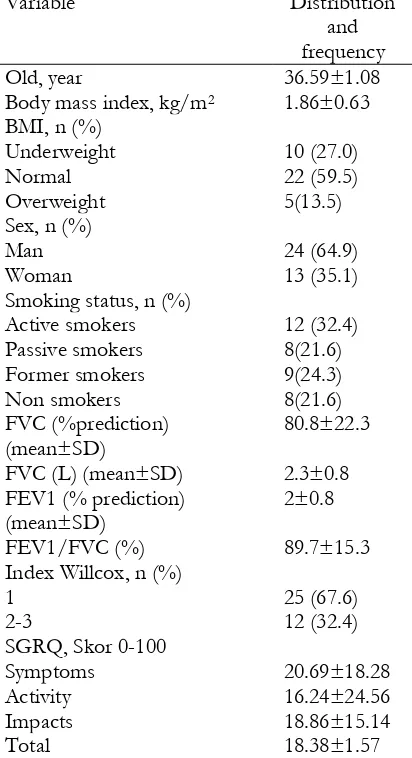
There were 37 patients aged 18-59 years of data that can be analyzed in this study. In Table 3 are shown the basic characteristics of the study subjects.
The severity of pulmonary (severe). The average score of the subject domain symptoms was 20.69 ± 18.28 points score. Symptoms domain scores range is 0-100 points maximum score.
Figures show the average score 20.69 20.69 maximum score of 100 points, which means that impaired quality of life that occurs is equivalent to 20.69%. This also applies to other domains (activity, impact and total).
The fourth domain of the SGRQ, symptoms had the highest score. This may imply that the post-tuberculosis patients tend to experience more interference in respiratory symptoms compared to the activity, as well as social Functions, and psychology (Table 3).
4
and frequency
Old, year 36.59±1.08
Body mass index, kg/m2 1.86±0.63
BMI, n (%)
Underweight 10 (27.0)
Normal 22 (59.5)
Overweight 5(13.5)
Sex, n (%)
Man 24 (64.9)
Woman 13 (35.1)
Smoking status, n (%)
Active smokers 12 (32.4)
Passive smokers 8(21.6)
Former smokers 9(24.3)
Non smokers 8(21.6)
FVC (%prediction)
(mean±SD) 80.8±22.3
FVC (L) (mean±SD) 2.3±0.8
FEV1 (% prediction)
(mean±SD) 2±0.8
FEV1/FVC (%) 89.7±15.3
Index Willcox, n (%)
1 25 (67.6)
2-3 12 (32.4)
SGRQ, Skor 0-100
Symptoms 20.69±18.28
Activity 16.24±24.56
Impacts 18.86±15.14
Total 18.38±1.57
Table 3 The Univariate analysis, the variables in the form of scale intervals and categorical. and Distribution and frequency characteristics of the subject
Smoking can decrease the FEV1, triggered respiratory tract obstruction progressively, increasing disability and symptoms such as sneezing, coughing, and shortness of breath.11, 12 States 90% of
COPD patients are smokers but only 15-20% of smokers who suffer from COPD. Smoking can also increase the risk of incident tuberculosis.13, 14
Tuberculosis can occur 3-4 times higher than women as well as men over 35 years old and smoked more than 20 rods per day. Never smoking with symptoms in people with tuberculosis such as coughs and dyspnea can increase. In radiology, tuberculosis to someone who never smoked is more likely to exhibit the existence of cavities, miliari, and the presence of pulmonary damage wider
5
pulmonary disease (COPD) in people with tuberculosis can be caused due to damage to the lungs of tuberculosis disease itself, but with the habit of smoking then the incidence of COPD can be increased.
Bivariate analysis, the relationship between Willcox indexes
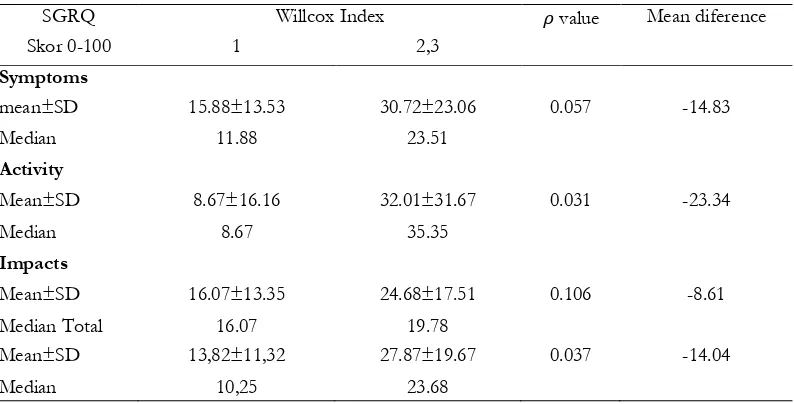
SGRQ score obtained an increase in the average score across all domains of SGRQ (symptoms, activity, impacts, and total) along with an increase in the degree of severity index Willcox. This can mean that a patient's quality of life post tuberculosis in every dimension of good activity, symptoms, effects, and overall will decline over time as the increasing degrees of severity of post-Easter possessed sequels tuberculosis. There is a decline in the quality of life in patients with interstitial lung disease.15 However, this data is
statistically significant only in the domains of activity and total (ρ < 0.05). The domain of the symptoms (0.057) and impact (0.106) was not statistically significant (table 4).
DISCUSSION
At the beginning of the study, the average test has done between Willcox index 1 (mild) and Willcox 2-3 indexes (weight) with the four outputs of the research. Exodus research here among other things, the symptom domains of activity, impacts, and the total of the SGRQ. In sequel tuberculosis, anatomical changes will occur on a permanent lung caseating granuloma formation, due to liquefaction, and cavities. Sequel caused tuberculosis not limited only in the parenchyma of the lungs, but can also attack the respiratory tract, pleura, mediastinum, chest wall, and vascular surgery. The result of this sequel will tend to cause disruption in breathing. This obstruction with restriction, 9/41 (22%) subjects with a decrease in volume of non-obstructive lung, and 10/41 (24%) subjects had normal lung function. Pulmonary disorder due to sequel tuberculosis also varies. The number of pulmonary restriction is more than obstruction.17 The incidence of pulmonary
restriction is recorded as much as 24%, obstructive disorders of 23%, and abnormalities of the mixture as much as 19%.
People with tuberculosis sequel and cavities found the incident light whereas the restriction in sufferers without cavities shows the normal functioning.18 Based on this data it can be
seen that the tuberculosis patient under treatment have a tendency to have a breathing disorder. This disorder can vary greatly based on the degree of severity of the sequel-owned sequel is getting worse because the more lung zones involved and the more the cavities formed.
Interstitial Pulmonary damage due to sequel will tend to result in disorders of the respiratory form of shortness of breath and can affect the amount of maximal O2 uptake (VO2 max). When interstitial damage occurs it will lower the total volume of the lung which resulted in lowering the number of VO2 max. Person with pulmonary tuberculosis after the devastating damage will lower VO2 max.19
6
SGRQ Willcox Index 𝜌 value Mean diference
Skor 0-100 1 2,3
Symptoms
mean±SD 15.88±13.53 30.72±23.06 0.057 -14.83
Median 11.88 23.51
Activity
Mean±SD 8.67±16.16 32.01±31.67 0.031 -23.34
Median 8.67 35.35
Impacts
Mean±SD 16.07±13.35 24.68±17.51 0.106 -8.61
Median Total 16.07 19.78
Mean±SD 13,82±11,32 27.87±19.67 0.037 -14.04
Median 10,25 23.68
Tabel 4. Bivariate analysis, variable in the form of interval scale. SGRQ score based on Willcox index.
Research conducted by Green, GM et al. 1976, against 25 patients with interstitial lung disease found that the intensity of the fibrosis associated with air exchange during a break or activity.20 Therefore, the more
severe damage to pulmonary tuberculosis, amid increasingly severe breathlessness suffered the more limited activity that can be done.
Respiratory disorders (Croup) and limitation of activities that can be experienced sequel tuberculosis sufferers will likely have an impact on an individual's social function because it cannot be the task and activity as readily. Plus a negative stigma in society about the disease tuberculosis cannot be avoided despite the sufferers already cured of his illness. These disturbances may also have an impact on mental health sufferers. So it can be said that sequel tuberculosis this harms the social and psychological functioning of sufferers. Ferreer et al. (1996, 1997) and Engstrom et al. (2001) in Wulan (2006) say that the worse the value of FEV1 then getting worse anyway psychosocial status of sufferers (ρ-0.37-(-0.38)).
Psychosocial disorders sufferers will vary depending on the motivation of your family and yourself as well as the severity of
sequel tuberculosis. The higher degree of tuberculosis sequel was the higher possibility of psychosocial disorders of the sufferer. A person's overall quality of life is affected by a variety of things like physical health, mental, and social functions. According the above explanation, in patients with tuberculosis will be obtained after the devastating decline in physical health in the form of interstitial lung damage sequel. This damage will have an impact on respiratory disorders, decreased activity, ability and
inclination disorders occurred in
psychosocial. It can therefore be concluded that the sequel tuberculosis can lower the quality of life of sufferers. This is in accordance with the research done 22the
quality of life in patients with chronic obstructive pulmonary disease decreases the occurrence of decline in FEV1. However, the study obtained a weak correlation between pulmonary function with quality of life.23 This difference can be caused due to
7
person, then it is likely also to mental health disorder. So it can be said that the higher the severity of tuberculosis under sequelae then the lower the quality of life. There is a decline in the quality of life in patients with interstitial lung disease24. There are
limitations in this study i.e. the researcher cannot follow the disease distribution of patient so patient's lung condition is unknown before experiencing tuberculosis. This is due to the design of this research is to cut the latitude so that backup data and observations done in one time only. This condition can allow the occurrence of bias on Lung examination results because patients may be worsening lung condition has happened since before suffering from tuberculosis as a result of the smoking habit. Smokers themselves have their risk factors for the onset of COPD, so bias can occur whether the severity of tuberculosis this is really due to tuberculosis or disease has been around since before the patient was suffering from tuberculosis.
CONCLUSION
There is a relationship between the degrees of severity of the devastating sequel of care with the quality of life of patients with tuberculosis sufferers.
BIBLIOGRAPHY
1. Longo, DL et al. 2012, Harrison’s
Principles of Internal Medicine, 18 edn, McGraw-Hill, United States of America.
2. Hegewald, E., Wolf, M., Keller, A.
Friedl, T. & Krienitz, L. (2010). ITS2 sequence-structure phylogeny in the Scenedesmaceae with special reference to Coelastrum (Chlorophyta, Chlorophyceae), including the new genera Comasiella and Pectinodesmus.
Phycologia 49(4): 325-335. Treatment of Active Progressive Caseous Pneumonic Tuberculosis’, Am Rev Tuberc, vol. 65, pp.402-28.
6. Amin, Z & Bahar, A., 2007,
‘Tuberkulosis Paru’, Dalam: Sudoyo A. W., Setiyohadi B., Alwi I., Simadibrata M.K., Setiati S., Buku Ajar IlmuPenyakitDalam, Jilid II, Ed IV, FKUI, Jakarta, pp. 988-1000.
7. Kementerian Kesehatan Republik
Indonesia 2011, Strategi Nasional Pegendalian TB.
8. Harada S, Harada Y, Kitahara Y,
Ishibashi T, Shinoda 1990,
‘Tuberculosis Seqeulae: Clinical Aspect’.
9. Pasipanodya, JG et al. 2007,
‘Pulmonary Impairment After
Tuberculosis’, Chest, vol. 131, pp.1817-1824. Pasipanodya, JG et al. 2007, ‘Using the St. George (Pasipanodya et al. 2010)
10. El Rhazi, K et al. 2006, ‘Validation of the St George’s Respiratory Questionnaire in patients with COPD or asthma in Morocco’, The
International Journal of
Tuberculosis and Lung Disease, vol. 10, no. 11, pp.1273-1278.
8
International Journal of COPD, vol. 2, no. 3, pp. 263–272.
12. Ikalius, Yunus F, Suradi, dan
Rachma N. 2007. Perubahan Kualitas Hidup dan Kapasitas Fungsional Penderita Penyakit Paru
Obstruktif Kronis setelah
Rehabilitasi Paru.Majalah Kedoteran Indonesia.Vol 57. No12: Desember. hal 447
13. Kolappan, C & Gopi, PG 2002,
‘Tobacco Smoking and Pulmonary Tuberculosis’, Thorax, vol. 57, no. 11, pp. 964-966.
14. Boon, SD et al. 2005, ‘Association
between Smoking and Tuberculosis Infection: A Population Survey in A High Tuberculosis Incidence Area’, Thorax, vol. 60, pp. 555-557.
15. Jacqueline a. Chang, j. Randall
‘Assessment of Health-Related
Quality of Life in Patients with Interstitial Lung Disease”, Chest, vol. 116, pp. 1175-1182.
Shaw, AR 1971, ‘Obstructive Airway Disease in Patients with Treated Pulmonary Tuberculosis’, Am Rev Respir Dis, vol. 103, no. 5, pp. 625-640.
18. Sepmeitutu, I 2013, ‘Perbedaan
Fungsi Paru Pada Berbagai Derajat Sekuele Tuberkulosis Paru’, thesis, Yogyakarta, Universitas Gadjah Mada.
19. Byoung h. Lee, Jae Hyung Lee,
Kyung Chan Kim, and Sang-hoon Kim (2007) Lee, BH, Kim, YS, Lee, KD, Lee, JH, Kim, SH 2008, ‘Health-related Quality of Life Measurement with St. George’s Respiratory Questionnaire in Post-
tuberculous Destroyed Lung’,
Tuberculosis and Respiratory
Diseases, vol. 65, no. 3, pp. 183-190.
20. Green, GM et al. 1976, ‘Correlated
Studies of Interstitial Pulmonary
Disease’, Chest, vol. 69,
no.2_supplement, dilihat pada
tanggal 4 Maret 2014, Derajat Keparahan Penyakit Paru Obstruktif Kronik Dengan Kualitas
Hidup, thesis, Yogyakarta,
Universitas Gadjah Mada
22. Stahl et al. (2005) Stahl, E et al 2005,
‘Health-Related Quality of Life Is Related to COPD Disease Severity’, Health and Quality of Life Outcomes, vol. 3, pp. 56.
Stahl et al. (2001), Stahl E, Wadbo M, Bengtsson T, Strom K, Lofdahl CG 2001, ‘Health Related Quality of Life, Symptoms, Exercise Capacity
and Lung Function During
Treatment for Moderate to Severe COPD’, Journal of Outcomes Research, vol. 5, pp. 11-24.
23. Jacqueline a. Chang, j. Randall