Wida Mulyanti, 2015
TRANSITIVITY SYSTEM IN EXPOSITION TEXTS FOR SENIOR HIGH SCHOOL NATIONAL EXAMINATIONS
Universitas Pendidikan Indonesia | \.upi.edu perpustakaan.upi.edu
TRANSITIVITY SYSTEM IN EXPOSITION TEXTS
FOR SENIOR HIGH SCHOOL NATIONAL EXAMINATIONS
THESIS
Submitted in partial fulfillment of the requirements for Master’s Degree in
English Education
By
Wida Mulyanti
1201327
ENGLISH EDUCATION PROGRAM
SCHOOL OF POSTGRADUATE STUDIES
INDONESIA UNIVERSITY OF EDUCATION
Wida Mulyanti, 2015
TRANSITIVITY SYSTEM IN EXPOSITION TEXTS FOR SENIOR HIGH SCHOOL NATIONAL EXAMINATIONS
Universitas Pendidikan Indonesia | \.upi.edu perpustakaan.upi.edu 2015
DECLARATION
I hereby certify that this thesis entitled “Transitivity System in Exposition Texts for Senior High School National Examinations” is completely my own work. I am fully aware that I have quoted some statements and ideas from various sources; all quotations have been acknowledged properly.
Bandung, July 2015
Wida Mulyanti, 2015
TRANSITIVITY SYSTEM IN EXPOSITION TEXTS FOR SENIOR HIGH SCHOOL NATIONAL EXAMINATIONS
Universitas Pendidikan Indonesia | \.upi.edu perpustakaan.upi.edu PAGE OF APPROVAL
TRANSITIVITY SYSTEM IN EXPOSITION TEXTS FOR SENIOR HIGH
SCHOOL NATIONAL EXAMINATIONS
By
WIDA MULYANTI 1201327
Approved by
Supervisor I
Iwa Lukmana, M.A., Ph.D NIP. 196611271993031002
Supervisor II
Wawan Gunawan, M.Ed., Ph.D NIP. 197209162000031001
Acknowledged by
Head of English Education Program of Post Graduate Studies Indonesia University of Education
Wida Mulyanti, 2015
TRANSITIVITY SYSTEM IN EXPOSITION TEXTS FOR SENIOR HIGH SCHOOL NATIONAL EXAMINATIONS
Universitas Pendidikan Indonesia | \.upi.edu perpustakaan.upi.edu ABSTRAK
Penelitian ini menganalisis sistem transitivitas dalam teks eksposisi untuk Ujian Nasional tingkat SMA. Hal ini bertujuan untuk menganalisis jenis proses yang umum digunakan dalam teks eksposisi untuk Ujian Nasional dari tahun 2006 sampai 2014. Hal ini juga bertujuan untuk mengeksplorasi bagaimana pemahaman jenis proses dalam teks eksposisi menginformasikan praktek pedagogis. Studi kasus kualitatif diterapkan sebagai metode penelitian. Data diperoleh dengan mengumpulkan semua teks eksposisi yang termasuk dalam Ujian Nasional dari tahun 2006 sampai 2014. Analisis data dilakukan dengan menganalisis sistem transitivitas dalam teks. Temuan menunjukkan bahwa jenis proses yang sering digunakan dalam teks-teks eksposisi adalah proses material, relasional-atributif, dan mental. Analisis transitivitas dilakukan dalam penelitian ini menunjukkan bahwa realisasi transitivitas dalam teks sesuai dengan prinsip dasar transitivitas dalam teks-teks eksposisi. Penelitian ini juga menyimpulkan bahwa pemahaman jenis proses dalam teks eksposisi memiliki beberapa manfaat untuk pendidikan, yaitu 1) mengarahkan siswa agar sadar akan tujuan penulisan teks 2) meningkatkan kemampuan siswa dalam memahami pertanyaan menyelidik dalam butir-butir soal yang berkaitan dengan teks, dan 3) mempertajam kemampuan siswa dalam berpikir kritis. Oleh karena itu, dianjurkan bahwa siswa mengenali fitur teks dengan bantuan teori sistemik fungsional linguistik dan pendekatan berbasis genre dalam proses pembelajaran. Juga dianjurkan agar guru mengikuti teori sistemik fungsional linguistik dengan pendekatan berbasis genre dalam proses pembelajaran agar siswa dapat mempelajari fitur teks eksposisi sehingga akan membantu mereka belajar membaca dan menulis teks eksposisi.
Kata kunci: sistemik fungsional linguistik (SFL), pendekatan berbasis genre (GBA),
Wida Mulyanti, 2015
TRANSITIVITY SYSTEM IN EXPOSITION TEXTS FOR SENIOR HIGH SCHOOL NATIONAL EXAMINATIONS
Universitas Pendidikan Indonesia | \.upi.edu perpustakaan.upi.edu ABSTRACT
This study analyzes the transitivity system in the exposition texts for Senior High School National Examinations. It aims to analyze the types of processes commonly used in the expositions as included in the National Examinations from 2006 to 2014. It also aims to explore how the understanding of process types in expositions informs pedagogical practices. A qualitative case study is applied as the method of the study. The data were attained by collecting all of the exposition texts included in the National Examinations from 2006 to 2014. The data analysis was done by analyzing the transitivity system in the texts. The findings show that the types of processes frequently used in exposition texts are material, relational-attributive, and mental processes. The transitivity analysis carried out in this study shows that the realization of transitivity in the texts corresponds to the basic prescription of transitivity in exposition texts. This study also concludes that the understanding of process types in expositions has some benefits for education, i.e. 1) leading students to the awareness of the purpose of text writer, 2) enhancing students’ ability in understanding the probing questions in the questions related to the text, and 3) sharpening students’ critical thinking. Therefore, it is recommended that students recognize the features of the texts with the help of systemic functional linguistics and genre-based approach to teaching and learning. Also it is recommended that teachers follow systemic functional linguistics genre based-approach to teaching to get students to learn the features of expositions, so that this will help them learn to read and write exposition texts.
Wida Mulyanti, 2015
TRANSITIVITY SYSTEM IN EXPOSITION TEXTS FOR SENIOR HIGH SCHOOL NATIONAL EXAMINATIONS
Universitas Pendidikan Indonesia | \.upi.edu perpustakaan.upi.edu C
COONNTTEENNTTSS
Page of Approval
Declaration ... i
Acknowledgments ... ii
Abstract ... iii
Contents ... vi
CHAPTER I INTRODUCTION ... 1
1.1 Background ... 1
1.2 Research Questions ... 3
1.3 Aims of the Study ... 4
1.4 Scope of the Study ... 4
1.5 Significance of the Study ... 4
1.6 Clarification of the Main Terms ... 5
1.7 Organization of the Paper ... 6
CHAPTER II THEORETICAL FOUNDATION ... 7
2.1 Systemic Functional Linguistics ... 7
2.2 Metafunctions of language ... 9
2.2.1 Ideational Metafunction and Its Realization ... 11
2.2.1.1 Experiential Meaning ... 12
2.2.1.2 Logical Meaning ... 14
2.2.2 Interpersonal Metafunction and Its Realization ... 16
2.2.3 Textual Metafunction and Its Realization ... 18
2.3 Transitivity System: The Grammar of Experiential Meaning ... 20
2.4 Processes, Participants and Circumstances ... 21
2.4.1 Material Process and Its Participants ... 23
2.4.2 Mental Process and Its Participants ... 27
Wida Mulyanti, 2015
TRANSITIVITY SYSTEM IN EXPOSITION TEXTS FOR SENIOR HIGH SCHOOL NATIONAL EXAMINATIONS
Universitas Pendidikan Indonesia | \.upi.edu perpustakaan.upi.edu
2.4.4 Verbal Process and Its Participants ... 34
2.4.5 Behavioural Process and Its Participants ... 36
2.4.6 Existential Process and Its Participants ... 37
2.5 Circumstances ... 38
2.6 Genre ... 44
2.7 Text ... 45
2.8 Definition of Exposition ... 45
2.9 Types of Exposition ... 46
2.9.1 Analytical Exposition ... 46
2.9.1.1 The Purpose of Analytical Exposition ... 46
2.9.1.2 The Schematic Structures of Analytical Exposition ... 46
2.9.1.3 The Lexicogrammatical Features of Analytical Exposition .... 47
2.9.1.4 An Example of Analytical Exposition ... 48
2.9.2 Hortatory Exposition ... 49
2.9.2.1 The Purpose of Hortatory Exposition ... 49
2.9.2.2 The Schematic Structures of Hortatory Exposition ... 50
2.9.2.3 The Lexicogrammatical Features of Hortatory Exposition... 50
2.9.2.4 An Example of Hortatory Exposition ... 51
2.10 Review of Previous Studies ... 51
2.11 Concluding Remarks ... 54
CHAPTER III RESEARCH METHOD ... 55
3.1 Research Direction ... 55
3.2 Research Design ... 55
3.3 Data Collection ... 56
3.4 Data Analysis ... 56
3.4.1 Validating the Data ... 56
3.4.2 Analyzing the Transitivity System ... 57
Wida Mulyanti, 2015
TRANSITIVITY SYSTEM IN EXPOSITION TEXTS FOR SENIOR HIGH SCHOOL NATIONAL EXAMINATIONS
Universitas Pendidikan Indonesia | \.upi.edu perpustakaan.upi.edu
CHAPTER IV FINDINGS AND DISCUSSION ... 59
4.1 Transitivity in Exposition Texts ... 59
4.1.1 The Exposition Texts ... 59
4.1.1.1 The Analytical Exposition Texts... 60
4.1.1.2 The Hortatory Exposition Texts ... 65
4.1.2 The Processes ... 71
4.1.2.1 General Findings ... 72
4.1.2.2 Material Processes ... 73
4.1.2.3 Relational-Attributive Processes ... 75
4.1.2.4 Relational-Identifying Processes ... 76
4.1.2.5 Mental Processes ... 78
4.1.2.6 Verbal Processes ... 80
4.1.2.7 Behavioural Processes ... 81
4.1.2.8 Existential Processes ... 83
4.1.3 The Pedagogical Implications of the Analysis ... 84
4.1.2.1 Leading Students to the Awareness of the Purpose of Text Writer ... 84
4.1.2.2 Probing Questions in the Questions Related to the Text ... 86
4.1.2.3 Sharpening Students’ Critical Thinking ... 90
CHAPTER V CONCLUSION AND RECOMMENDATION ... 92
5.1 Conclusion ... 92
5.2 Recommendation ... 94
Wida Mulyanti, 2015
TRANSITIVITY SYSTEM IN EXPOSITION TEXTS FOR SENIOR HIGH SCHOOL NATIONAL EXAMINATIONS
Universitas Pendidikan Indonesia | \.upi.edu perpustakaan.upi.edu APPENDICES
Appendix 1 Analytical Exposition 1
Boarding School Education ... 101 Appendix 2 Analytical Exposition 2
Address to the Jury ... 104 Appendix 3 Analytical Exposition 3
Should Children be Allowed to Stay in at Break Time? ... 108 Appendix 4 Hortatory Exposition 1
On School Discipline ... 113 Appendix 5 Hortatory Exposition 2
Faster Planes and Cheaper Flights ... 117 Appendix 6 Hortatory Exposition 3
Agriculture ... 122 Appendix 7 Hortatory Exposition 4
Tourism Benefit on Local People ... 125 Appendix 8 Hortatory Exposition 5
Skate Parks for Skateboarders ... 129 Appendix 9 Hortatory Exposition 6
Let’s Make the City Clean and Fresh ... 133 Appendix 10 Hortatory Exposition 7
Higher Education for Women ... 137 Appendix 11 Hortatory Exposition 8
1
Wida Mulyanti, 2015
TRANSITIVITY SYSTEM IN EXPOSITION TEXTS FOR SENIOR HIGH SCHOOL NATIONAL EXAMINATIONS
Universitas Pendidikan Indonesia | \.upi.edu perpustakaan.upi.edu CHAPTER I
INTRODUCTION
This study aims at analyzing expositions using transitivity system of SFL
related to its schematic structure and linguistic features. This chapter gives a brief
description of the whole content of the study. The information included in this
chapter covers: 1) Background, 2) Research Questions, 3) Aims of the Study, 4)
Scope of the Study, 5) Significance of the Study, 6) Clarification of the Main Terms,
and 7) Organization of the Paper.
1.1Background
The National Examination is held for all final year students in Indonesia. This
examination is held every year at the end of the school year. In Senior High School
level, English is one of the subject matters tested in the National Examination.
English language examination assesses listening and reading ability. Reading section
comprises some texts of various genres. This reading section test requires students the
ability to understand how text works in making meaning. Therefore, there are
required to have knowledge of the text types which is also called genre. As stated by
Gerot and Wignell (1995, p. 17), “a genre is defined as a culturally specific text-type
which results from using language (written or spoken) to help accomplish something”. With regards to the definition above, students should have knowledge about purposes, schematic structures, and lexicogrammatical choices of texts in order
to succeed in the examination.
One of the genres to be tested in the examination is exposition. Exposition is
one of the difficult texts to understand. Flood (1986, p. 784) emphasizes the difficulty
of expositions by saying that expositions are difficult task for students to
2
Wida Mulyanti, 2015
TRANSITIVITY SYSTEM IN EXPOSITION TEXTS FOR SENIOR HIGH SCHOOL NATIONAL EXAMINATIONS
Universitas Pendidikan Indonesia | \.upi.edu perpustakaan.upi.edu
they are lack of verbal process which makes the ownership of the arguments clear
(Emilia, 2005, p. 238). Meanwhile, the verbal process is important in strengthening
the opinion of the writer.
Exposition is important to master since it has the potential to improve students’ academic skills because exposition can stimulate students’ curiosity and critical thinking. It can help students to develop their knowledge and way of thinking
in postsecondary education as the university students (Departemen Pendidikan
Nasional [Depdiknas], 2003, 2006; Beck & Jeffrey, 2009). Further, expositions
belong to genre of arguing which is crucial in gaining students’ critical thinking. As
supported by Bizzel (1992), the ability of composing Expositions will enhance students’ critical thinking so that they are ready to compete in the real world, i.e. the expositions are an influential text to prepare students to be able to deal with many
aspects of life, such as the ability of reasoning, evaluating, and persuading. These abilities will enhance students’ participation in social life (Knapp & Watkins, 2005).
Considering the benefits of learning language of exposition, text should be
analyzed to provide students with the concepts of text structure and its language
features. One of the tools to analyze texts is using SFL in order to investigate
transitivity system. It examines the structure of clauses which are represented by
processes, the participants involved in these processes, and the circumstances in
which processes and participants are involved (Nguyen, 2012). Using transitivity
analysis, researchers have tried to reveal that language structures can produce certain
meanings and ideology which are not always explicit for readers. In other words, the
task of functional analysis, particularly transitivity analysis, is to discover the relation
between meanings and wordings that account for the organization of
lexicogrammatical features in a text. Therefore, the concept of transitivity has been
used by a number of linguists to shed more light on the use of language in texts.
Many studies concerning transitivity system have been carried out. Some
studies focus on analyzing the transitivity system itself as a tool of analysis (Yuli &
3
Wida Mulyanti, 2015
TRANSITIVITY SYSTEM IN EXPOSITION TEXTS FOR SENIOR HIGH SCHOOL NATIONAL EXAMINATIONS
Universitas Pendidikan Indonesia | \.upi.edu perpustakaan.upi.edu
(e.g. writing, advertisement, textbooks etc.) (Zheng, Yang & Ge, 2014; Song, 2013;
Afrianto, Indrayani, Seomantri, 2014; Brooks, 2010; Bustam, 2011; Caili, 2005;
Opara, 2012; Naz, 2012; Nguyen, 2012; Ginting, 2015). For example, Yuli and
Yushan (2012) compare the transitivity system in English and Chinese. On the other
hand, Zheng, Yang, and Ge, (2014)analyze transitivity in English-medium medical
research articles. The studies which focus on analyzing products can be categorized
into two: 1) the analysis of texts written for public consumptions, e.g. the texts which
derived from the newspapers, novels, the speech of the leaders, etc. and 2) the
analysis of texts written for or used in educational environment.
This study is intended to provide an insight to the transitivity system of the
texts used in educational environment, i.e. exposition texts included in the National
Examinations. Its purpose is to give contribution to the development of education in
Indonesia. This study attempts to contribute to students’ learning in preparing for the
National Examination since there are no studies specifically analyzing exposition
texts included in the National Examinations. However, it is important for teachers to
recognize the lexicogrammatical features of exposition texts, more prominently
transitivity system. Teaching transitivity system helps students understand and use in
writing effective verbs to achieve the purpose of the texts, i.e. expositions.
1.2Research Questions
The present study probes the following research questions:
1. What types of processes are dominant in exposition texts included in the 2006
to 2014 Senior High School National Examinations?
2. What are the pedagogical implications of the transitivity analysis undertaken
in this study?
1.3Aims of the Study
4
Wida Mulyanti, 2015
TRANSITIVITY SYSTEM IN EXPOSITION TEXTS FOR SENIOR HIGH SCHOOL NATIONAL EXAMINATIONS
Universitas Pendidikan Indonesia | \.upi.edu perpustakaan.upi.edu
1. To analyze the types of processes commonly used in the exposition texts as
included in the National Examinations from 2006 to 2014.
2. To explore how the understanding of process types in exposition texts has
some pedagogical implications.
1.4Scope of the Study
With regards to the problems and objectives of the study, the writer has to
limit the scope of the study. Therefore, this study concentrates on the analysis of
process types (transitivity system) in the exposition texts included in the Senior High
School National Examinations from 2006 to 2014. The reason the data taken started
from 2006 is because the implementation of genre-based approach in the National
Examination started from that year until recently (Budairi, 2015, p. 33). Meanwhile,
the reason why the data from the 2015 National Examination are not included is
simply because the scripts of the recent examination are not available for public yet.
1.5 Significance of the Study
This study is expected to offer some theoretical and practical contributions. In
term of theory, this study can hopefully enrich the literature about transitivity system
in exposition texts and also hopefully be useful for the readers who are interested in
studying the transitivity system in which it can help them to master English and to
understand the system itself. In addition, this study can hopefully be used as a
reference in the analysis of transitivity system.
Practically, the result of this study is expected to provide information for the
readers, especially teachers regarding the quality of the texts used in the National
Examinations so that teachers are able to select proper texts as examples. In addition,
this study will help teachers enhance their ability to analyze texts using transitivity
system. Thus, teachers will be able to help students gain their ability to create
5
Wida Mulyanti, 2015
TRANSITIVITY SYSTEM IN EXPOSITION TEXTS FOR SENIOR HIGH SCHOOL NATIONAL EXAMINATIONS
Universitas Pendidikan Indonesia | \.upi.edu perpustakaan.upi.edu 1.6Clarification of the Main Terms
To avoid misunderstanding, below are some terms clarified:
1. Systemic functional linguistics
Systemic functional linguistics (SFL) is a theory in linguistics which perceive
language not as a set of rules, but as a meaning-making resource (Halliday,
1994, p. 15; Eggins, 2004, p. 2; Emilia, 2005, p. 87).
2. Transitivity system
The concept of transitivity in Halliday’s grammatical system is a powerful
tool for the analysis of meanings expressed in clauses. Transitivity system
consists of various types of processes together with its structures that realize
these processes. Eggins (2004, p. 206) informs that transitivity system is used
to express experiential meaning in texts by selecting the process that is related
to participant roles and configurations. In this study, transitivity system is
referred to as the system of participants, processes, and circumstances within
analytical and hortatory expositions as included in the National Examinations.
3. Genre
Genre in systemic functional linguistics is explained as the recurrent
configuration of meanings that occurs and represents the social practices of a
culture (Martin & Rose, 2008, p. 6). The texts being studied, i. e. Expositions,
belong to the genre of arguing.
4. Expositions
Exposition is one of the genres in genre-based approach whose content has
purpose explain, analyze, interpret, speculate, evaluate, persuade, or reflect
6
Wida Mulyanti, 2015
TRANSITIVITY SYSTEM IN EXPOSITION TEXTS FOR SENIOR HIGH SCHOOL NATIONAL EXAMINATIONS
Universitas Pendidikan Indonesia | \.upi.edu perpustakaan.upi.edu
hortatory which are different slightly in the way they deliver the last stage of
generic structure. In this study, expositions refer to both analytical and
hortatory expositions included in the Senior High School National
Examinations from 2006 to 2014.
1.7 Organization of the Paper
This study pictures an exploratory case study which encompasses five
chapters. Chapter 1 elaborates the background of the study. The chapter also contains
research questions, aims of the study, scope of the study, significance of the study,
clarification of the main terms, and the organization of the paper. Chapter 2 discusses
the underlying theories of this study. The discussion goes through the literature of
systemic functional linguistics, expositions, and process types (transitivity system).
Chapter 3 gives a clear exposure about how the study is undertaken. It describes a
conceptual framework consisting research direction, research design, data collection,
and data analysis techniques. Chapter 4 presents the findings of the analysis and
discussion of the findings. The findings and discussion are adjoined and formed three
sections, i.e. the expositions, the processes, and the pedagogical implications. Chapter
5 presents the conclusion and recommendation based on the findings in Chapter 4.
The conclusion states the answer to the research questions regarding the transitivity
system in the exposition texts. Meanwhile, the recommendation states several
suggestions based on the findings of the analysis for both methodological and
55
Wida Mulyanti, 2015
TRANSITIVITY SYSTEM IN EXPOSITION TEXTS FOR SENIOR HIGH SCHOOL NATIONAL EXAMINATIONS
Universitas Pendidikan Indonesia | \.upi.edu perpustakaan.upi.edu CHAPTER III
RESEARCH METHOD
This chapter elaborates the method employed in this study. The chapter
comprises 1) Research Direction, 2) Research Design, 3) Data Collection Method,
and 4) Data Analysis Techniques. The research direction explains specifically what
this study attempts to learn or understand. The research design discusses the design
and approach used in this study. The data collection presents the data type and the
data collection technique. The data analysis techniques elaborate the procedure of
analyzing the data.
3.1Research Direction
This study was conducted to analyze the types of processes commonly used in
the Exposition texts as included in the Senior High School National Examinations
from 2006 to 2014. Generally, it reveals the dominant processes used in the texts
being studied. Specifically, it discusses the analysis of each processes. Moreover, this
study also explores how the understanding of process types in Expositions has some
pedagogical implications.
3.2 Research Design
The descriptive design is utilized in the study since this study is intended to
describe the transitivity system in the data being analyzed. According to Heigham
and Crocker (2009) and Creswell (2012), the descriptive design is intended to collect,
examine, analyze, describe and categorize textual data using interpretative analysis.
Moreover, the study uses a case-study design since the analysis provides detailed
description of a defined entity, i.e. the National Examination’s texts. As has been stated by Mackey and Gass (2005), that case study tends to provide detailed
56
Wida Mulyanti, 2015
TRANSITIVITY SYSTEM IN EXPOSITION TEXTS FOR SENIOR HIGH SCHOOL NATIONAL EXAMINATIONS
Universitas Pendidikan Indonesia | \.upi.edu perpustakaan.upi.edu
In terms of analysis, SFG textual analysis method is used in this study. SFG
textual analysis is used to examine a small scale and single case phenomenon,
generate a qualitative data, and provide an interpretive analysis of that data (Emilia,
2008).
3.3 Data Collection
The Senior High School’s National Examination scripts from 2006 to 2014
are the documents used in this study. All of the exposition texts included in the scripts
are taken as the data. There are eleven exposition texts, three of them are analytical
exposition texts and eight of them are hortatory exposition texts. These two type of
texts learned by students in the eleventh grade. The analytical exposition is taught in
the odd semester, while the hortatory exposition is taught in the even semester.
The reason why the scripts used as the data started from the 2006 National
Examination is because the genre-based approach in Indonesia is started that year.
According to Budairi (2015, p. 33), the use of genre-based approach has been placed
in Indonesia’s curriculum since 2004, nonetheless, the National Examination at that
time comes in a different format that it does not fully test what has been learnt
through the genre-based approach. Not until the implementation of the 2006 School
Level Curriculum that this adoption of the genre-based approach has fully integrated
including in the National Examination.
3.4Data Analysis
As mentioned earlier, the data are the documents of the Senior High School
National Examinations from 2006 to 2014. The processes of data analysis are:
3.4.1 Validating the Data
All the texts available in the scripts are validated before they are analyzed
using transitivity system. The texts are analyzed in terms of their schematic structure
57
Wida Mulyanti, 2015
TRANSITIVITY SYSTEM IN EXPOSITION TEXTS FOR SENIOR HIGH SCHOOL NATIONAL EXAMINATIONS
Universitas Pendidikan Indonesia | \.upi.edu perpustakaan.upi.edu
collected, the texts are categorized based on their exposition types. The texts that fit
the characteristics of analytical exposition are separated with the texts that fit the
characteristics of hortatory exposition since the schematic structure and
lexicogrammatical features of these two Expositions are slightly different.
This data validation analysis is exemplified in Chapter 4. The analysis of this
identification follows Gerot and Wignell (1995), Knapp and Watkins (2005), and
Emilia (2005; 2011; 2014).
3.4.2Analyzing the Transitivity System
The data are analyzed using Halliday’s Transitivity system. The aim of the
analysis is to find out the dominant processes used in the texts. The data are analyzed
by following the procedures below.
1. Breaking up each text into clauses.
2. Breaking up each clause into phrases or words which have one type of
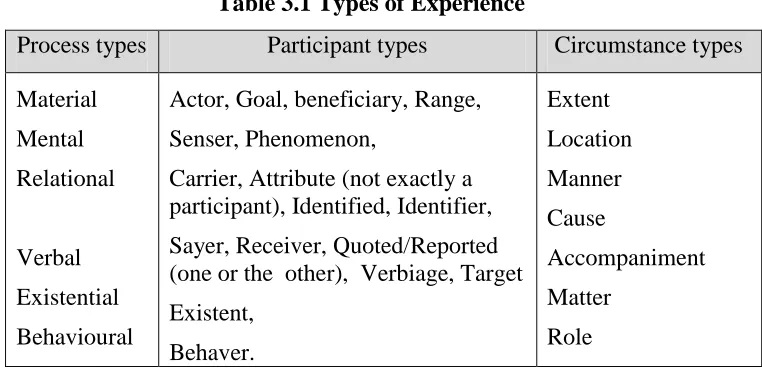
experience: participants, processes, and circumstances. The categorization is
[image:18.612.147.528.422.608.2]shown in Table 3.1 below.
Table 3.1 Types of Experience
Process types Participant types Circumstance types
Material Mental Relational Verbal Existential Behavioural
Actor, Goal, beneficiary, Range,
Senser, Phenomenon,
Carrier, Attribute (not exactly a participant), Identified, Identifier,
Sayer, Receiver, Quoted/Reported (one or the other), Verbiage, Target
Existent, Behaver. Extent Location Manner Cause Accompaniment Matter Role
(Adapted from Melrose, 1995; Bloor & Bloor, 1995)
58
Wida Mulyanti, 2015
TRANSITIVITY SYSTEM IN EXPOSITION TEXTS FOR SENIOR HIGH SCHOOL NATIONAL EXAMINATIONS
Universitas Pendidikan Indonesia | \.upi.edu perpustakaan.upi.edu
[3.1] The manners and social skills will help them Actor Pr:material Goal
3. Naming the clause based on its experiential process. The process in the clause
is the main element that determines the type of clause in terms of its
Transitivity. For instance, the process in clause [3.1] is material process. Thus,
the clause is called the material clause.
4. Stating the findings of the analysis by showing the numbers of the processes
found in the data including the percentages.
5. Discussing the findings generally and specifically.
a. In general, the discussion relates the findings of the processes with the
processes which include in the texts’ features.
b. In detail, each process is discussed separately.
3.4.3 Analyzing the Pedagogical Implications of the Analysis
The knowledge of this transitivity analysis has many benefits. The benefits or
the values of the use of each aspect of experiential grammar has been discussed by
the experts such as Butt et al. (2000), Droga and Humphrey (2003), Derewianka
(2011), Fang and Scleppegrell (2008) and Emilia (2014).
In this study, the values of the use of the analysis are discussed based on the
viewpoints of the scholars mentioned above by considering their view on the
importance of experiential grammar to lead students to be aware of the writers’
purpose, to be able to use and answer the probing questions, and to be able to think
critically.
92
Wida Mulyanti, 2015
TRANSITIVITY SYSTEM IN EXPOSITION TEXTS FOR SENIOR HIGH SCHOOL NATIONAL EXAMINATIONS
Universitas Pendidikan Indonesia | \.upi.edu perpustakaan.upi.edu CHAPTER V
CONCLUSION AND RECOMMENDATION
This chapter presents 1) Conclusion and 2) Recommendation. The conclusion
concludes the findings. The findings can be divided into two, the findings of
processes and the findings of the pedagogical implications of the analysis. The
recommendation offers some recommendation for methodological and practical
purposes.
5.1Conclusion
As stated in Chapter 1, the analysis focus on using transitivity system of SFL
in exposition texts included in the Senior High School National Examinations from
2006 to 2014 and exploring how the understanding of process types in expositions
have some pedagogical implications.
The transitivity system in the texts being studied encompasses all six
processes brought forward by Halliday and Matthiessen (2014). Among the
processes, the most frequent process being used is material process with 201
occurrences (56%), followed by relational process with 88 occurrences (25%), 76
occurrences for attributive process (21%) and 12 occurrences for
relational-identifying process (4%), continued by mental process with 47 occurrences (13%),
existential process with 10 occurrences (3%), behavioural process with 9 occurrences
(2%), and verbal process with 4 occurrences (1%).
In analytical expositions, the findings show that the material, relational and
mental processes are the three processes frequently used. The same findings are
shown in hortatory expositions, i.e. the material, relational and mental processes are
the processes frequently used. The material process represents the evidence of the
argument, relational-attributive process represents the description or the explanation
93
Wida Mulyanti, 2015
TRANSITIVITY SYSTEM IN EXPOSITION TEXTS FOR SENIOR HIGH SCHOOL NATIONAL EXAMINATIONS
Universitas Pendidikan Indonesia | \.upi.edu perpustakaan.upi.edu
occurrence of these three processes shows that the exposition texts included in the
National Examinations are considered as „simple expositions‟.
However, the use of „simple expositions‟ in the National Examinations needs
to be criticized because „simple expositions‟ do not challenge students to think
critically. For students to be critical thinkers, they should learn the „mature
expositions‟. Thus, the texts included in the National Examinations should be
„mature‟ or well-written.
For the expositions to be considered well-written, it should contain not only
material, relational, and mental processes, but also verbal process. The use of verbal
process in the exposition texts included in the National Examinations is still limited.
Most of the texts do not use verbal process. Verbal process is crucial to be used in
exposition texts because it presents the reference. Without the reference, the readers
can easily deny the writers‟ argument. Thus, it can be concluded that the texts in
Senior High School National Examinations need to be improved, especially in the use
of verbal process (indicated by the present of the proper name). In addition to that,
the other reasons the texts are not considered well-written texts are the text writers are
not written in the texts and some texts still lack of nominalization. The
nominalization in exposition texs is crucial to show that the texts are “written like”
(Emilia, 2011) and to make the arguments in the text undeniable.
Moreover, the pedagogical implications of the analysis are 1) leading students
to the awareness of the purpose of text writer, 2) enhancing students‟ ability in
understanding the probing questions in the questions related to the text, and 3)
sharpening students‟ critical thinking.
5.2 Recommendation
Based on the conclusion above, some methodological and practical purposes
are recommended as follows.
The methodological purposes concern the delimitation of the recent study and
94
Wida Mulyanti, 2015
TRANSITIVITY SYSTEM IN EXPOSITION TEXTS FOR SENIOR HIGH SCHOOL NATIONAL EXAMINATIONS
Universitas Pendidikan Indonesia | \.upi.edu perpustakaan.upi.edu
systemic functional grammar, i.e. experiential grammar (transitivity analysis of
exposition texts). Thus, it needs further research in other aspects of systemic
functional grammar, the logical grammar (the analysis of Taxis) is highly
recommended because the logical grammar and experiential grammar belong to the
same metafunction, i.e. ideational metafunction.
Furthermore, in terms of the data, it is highly recommended to use the other
texts included in the National Examinations as the data because the texts are usually
used as the materials in teaching activities.
Practical purposes are intended to teachers. For teachers, the knowledge of
experiential grammar helps them to teach students to respond to texts. In other words,
the transitivity system can be used as a practical source for students to gain their
ability to create well-written texts.
Moreover, this study is also expected to provide information for teachers
regarding the quality of the texts used in the National Examinations so that teachers
are able to select proper texts to be used as the materials. Thus, it is recommended for
teachers to select exposition texts which use not only material, relational, and mental
processes, but also mental process since the texts which belong to the argumentative
95
Wida Mulyanti, 2015
TRANSITIVITY SYSTEM IN EXPOSITION TEXTS FOR SENIOR HIGH SCHOOL NATIONAL EXAMINATIONS
Universitas Pendidikan Indonesia | \.upi.edu perpustakaan.upi.edu REFERENCES
Afrianto., Indrayani, L., & Seomantri, S. (2014). Transitivity analysis on
Shakespeare‟s sonnets. IOSR Journal of Humanities and Social Science.
19(1). 78-85. Retrieved from www.iosrjournals.org. on June 15th, 2015 at 08.30.
Al-Massri, I. (2013). Text, linguistics and translation: English-Arabic Machine
Translation Assessment. 1st Ed. CreateSpace Independent Publishing Platform. (ISBN-10: 1482352133; ISBN-13: 978-1482352139).
Anderson, M., & Anderson, K. (1997). Text types in English 2. Macmillan: South Yarra.
Andriyani, N. (2008). Transitivity process in worldview’s articles of Newsweek.
Unpublished thesis at University of North Sumatera. Retrieved from repository.usu.ac.id. on June 6th, 2015 at 11.00.
Arancón, P. R. (2013). The use of SFL genre theory for the analysis of students‟ writing skills in ESP. Volumen Monográfico. 245-252. Universidad Nacional de Educación a Distancia (UNED).
Bizzell, P. (1992). Academic discourse and critical consciousness. Pittsburgh: University of Pitsburgh Press.
Beck, S. W., & Jeffery, J. V. (2009). Genre and thinking in academic writing tasks.
Journal of Literacy Research, 41, 228-272. http://dx.doi.org/10.1080/1086296
0902908483.
Bloor, T., & Bloor, M. (1995). The functional analysis of English. 3rd Ed. Abingdon: Routledge.
Bloor, T. & Bloor, M., (2013). The Functional Analysis of English (Third Edition). London and New York: Routledge.
Brooks, J. (2009-2010). The growing absurdity of the South African apartheid:
transitivity in Christopher Van Wyk‟s „In Detention‟. Innervate Leading
Undergraduate Work in Studies, 2, 26-34.
Budairi, A. (2015). Revisiting the 2006 school level curriculum and the genre-based approach in the context of EFL curriculum development in Indonesia. Ahmad
96
Wida Mulyanti, 2015
TRANSITIVITY SYSTEM IN EXPOSITION TEXTS FOR SENIOR HIGH SCHOOL NATIONAL EXAMINATIONS
Universitas Pendidikan Indonesia | \.upi.edu perpustakaan.upi.edu
Butt, D., Fahey, R, S., Feez, S., Spinks, S., & Yallop, C. (2000). Using functional
grammar: an explorer’s guide. 2nd Ed. Sydney: National Centre for English Teaching and Research. Macquarie University.
Butt, D., Fahey, R, S., Feez, S., Spinks, S., & Yallop, C. (2003). 3rd Ed. Using
functional grammar: an explorer’s guide. Sydney: National Centre for English Teaching and Research. Macquarie University.
Bustam, M. (2011). Analyzing clause by Halliday‟s transitivity system. Jurnal Ilmu
Sastra. 6(1). 22-34.
Caffarel, A., Martin, J. R., & Matthiessen, M. I. M. (2004). Language typology: a
functional perspective. Amsterdam: Benjamins.
Caili, W. (2005). The process of transitivity in “weeping for my smoking daughter”.
Celea Journal. 28(1). 111-115.
Coffin, C. (2001). Theoretical approaches to written language: TESOL perspective. In A. Burns and C. Coffin (eds), Analysing English in a global context: A reader (pp. 93-122). London: Routledge.
Creswell, J. W. (2012). Educational research: Planning, conducting, and evaluating
quantitative and qualitative research. Boston: Pearson Education, Inc.
Depdiknas. (2003). Kurikulum 2004. Standar kompetensi. Mata pelajaran bahasa
Inggris. Sekolah Menengah Atas dan Madrasah Aliyah. Jakarta: Depdiknas.
Depdiknas. (2006). Standar isi. Mata pelajaran bahasa Inggris. Sekolah Menengah
Atas dan Madrasah Aliyah. Jakarta: Depdiknas. Retrieved from Badan standar
nasional pendidikan Indonesia. Retrieved from http://bsnp-indonesia.org/id/? page_id=103/ on June 17th, 2015, at 09.45.
Derewianka, B. M. (2011). A new grammar companion for teachers. (2nd ed.). Sydney: Primary English Teaching Association.
Derewianka, B. M. & Jones, P. (2013). Teaching language in context. Melbourne: Oxford University Press.
Droga L., & Humphrey, S. (2003) Grammar and Meaning: An Introduction for
97
Wida Mulyanti, 2015
TRANSITIVITY SYSTEM IN EXPOSITION TEXTS FOR SENIOR HIGH SCHOOL NATIONAL EXAMINATIONS
Universitas Pendidikan Indonesia | \.upi.edu perpustakaan.upi.edu
Dymock, S., & Nicholson, T. (2010). High 5! Strategy to enhance comprehending of expository text. The Reading Teacher. 64(3). 166-178. http://dx.doi.org/10. 1598/RT.64.3.2.
Eggins, S. (1994). An introduction to systemic functional linguistics. London: Printer Publishers, Ltd.
Eggins, S. (2004). An introduction to systemic functional linguistics. 2nd Ed. London: Printer Publishers, Ltd.
Emilia, E. (2005). A critical genre-based approach to teaching academic writing in a
tertiary EFL context in Indonesia. Volume 1. A PhD thesis submitted to the
Department of Language, Literacy and Arts Education, Faculty of Education, The University of Melbourne.
Emilia, E. (2011). Pendekatan Genre-Based dalam Pengajaran Bahasa Inggris:
Petunjuk Untuk Guru. Bandung: Rizqi Press.
Emilia, E. (2014). Introducing functional grammar. Bandung: Dunia Pustaka Jaya.
Fairclough, N. (2003). Analysing discourse. Textual analysis for social research. London: Routledge.
Fang, Z. & Schleppegrell, M. J. (2008). Reading in secondary content areas. A
language-based pedagogy. Ann Arbor: The University of Michigan Press.
Flood, J. (1986). The text, the student, and the teacher: learning from exposition in middle schools. The Reading Teacher. 39(8), 784-791.
Frawley, J. (2003). International Encyclopedia of Linguistics, Volume 3. Oxford University Press, New York: Alan McKee. http://dx.doi.org/10.4135/9780 857020017.
Fowler, W. S. (1985). New froficiency English. Book Three. Edinburg: Nelson.
Gerot, L., & Wignell, P. (1995). Making sense of functional grammar. Cammeray, NSW: Antipodean Educational Enterprises.
98
Wida Mulyanti, 2015
TRANSITIVITY SYSTEM IN EXPOSITION TEXTS FOR SENIOR HIGH SCHOOL NATIONAL EXAMINATIONS
Universitas Pendidikan Indonesia | \.upi.edu perpustakaan.upi.edu
Halliday, M.A.K. (1971). Linguistic function and literary style: an enquiry into the language of William Golding's 'The Inheritors'. In Seymor Chatman (ed),
Literary style: A symposium, 330-65. London: Oxford University Press.
Halliday, M.A.K. & Hasan, R. (1976). Cohesion in English. London: Longman.
Halliday, M. A. K. (1977). Text as semantic choice in social context. In T. A. Van Dyck & J. Petrofi (Eds.). Grammars and descriptions. Berlin: de Gruyter.
Halliday, M. A. K. (1978). Language as Social Semiotic: The Social Interpretation of
Language and Meaning. London: Edward Arnold.
Halliday, M. A. K. (1979) Modes of meaning and modes of expression: types of grammatical structure, and their determination by different semantic functions. In D. J. Allerton, E. Carney, and D. Holdcroft (eds.), Function and
Context in Linguistic Analysis: a Festschrift for William Haas. London:
Cambridge University Press, 57-79.
Halliday, M. A. K., & Hasan, R. (1985). Language, context, and text: aspects of
language in a social-semiotic perspective. Geelong, Victoria: Deakin
University Press. [Republished by Oxford University Press 1989].
Halliday, M. A. K. (1994). An introduction to functional grammar (2nd ed.). London: Edward Arnold.
Halliday, M. A. K., & Matthiessen, C. M. I. M. (2004). An introduction to functional
grammar. 3th Ed. London: Arnold.
Halliday, M. A. K. (2006). The language of science: collected works of M. A. K.
Halliday (Volume 5). London & New York: Continuum.
Halliday, M. A. K., & Matthiessen, C. M. I. M. (2014). An introduction to functional
grammar. 4th Ed. London: Routledge.
Heigham, J., & Crocker, R. A. (2009). Qualitative research in applied linguistics: A
practical introduction. New York: Palgrave Macmillan.
Huang, S. C. (2006). Semiotic view of information: semiotics as a foundation of LIS research in information behavior. In Grove, Andrew, Ed. Proceedings of the
99
Wida Mulyanti, 2015
TRANSITIVITY SYSTEM IN EXPOSITION TEXTS FOR SENIOR HIGH SCHOOL NATIONAL EXAMINATIONS
Universitas Pendidikan Indonesia | \.upi.edu perpustakaan.upi.edu
Knapp, P., & Watkins, M. (2005). Genre, text, grammar: technologies for teaching and assessing writing. New South Wales: University of New South Wales Press, Ltd.
Lipson, M. (2006) Exploring functional grammar. Bologna: Centro di Studi Linguistico-Culturali (CeSLiC), p. 138. DOI 10.6092/unibo/amsacta/871.
Machin, D., & Mayr. (2012) How to do critical discourse analysis: a multimodal
introduction. London: Sage Publication. Ltd.
Mackey, A., & Gass, S. M. (2005). Second language research: Methodology and
design. New Jersey: Lawrence Erlbaum Associates.
Mandasari, R. W. (2005). An Analysis of six types of transitivity process in Kangguru
radio English script. Unpublished thesis at University of North Sumatera.
Retrieved from repository. usu.ac.id. on June 15th, 2015 at 08.30.
Martin, J.R. (1985). Factual writing: Exploring and challenging social reality. Geelong: Deakin University Press.
Martin, J.R., Christian M.I.M. Matthiessen & C. Painter. (1997). Working with
Functional Grammar. London: Edward Arnold.
Martin, J.R. (1992) English text: system and structure. Philadelphia and Amsterdam: John Benjamins.
Martin, J. R. (1993). Genre and literacy: Modeling context in educational linguistics.
Annual Review of Applied Linguistics, 13, 141-172.
Martin, J.R., (1997). Analysing genre: functional parameters. In F. Christie & J. R. Martin (1997). (EDS). Genre and Institions. London: Continuum.
Martin, J.R. (2000). 'Beyond Exchange: APPRAISAL Systems in English', in
Evaluation in Text, Hunston, S. & Thompson, G. (eds), Oxford, Oxford
University Press.
Martin, J. R., & Rose, D. (2003). Working with discourse: Meaning beyond the
clause. London: Continuum.
Martin, J. R., & Rose, D. (2008). Genre Relations. Mapping Culture. London: Equinox. Martin, J.R., Christian M.I.M. Matthiessen & C. Painter. (1997).
Working with functional grammar. London: Edward Arnold.
100
Wida Mulyanti, 2015
TRANSITIVITY SYSTEM IN EXPOSITION TEXTS FOR SENIOR HIGH SCHOOL NATIONAL EXAMINATIONS
Universitas Pendidikan Indonesia | \.upi.edu perpustakaan.upi.edu
Melrose, R. (1995). The communicative syllabus: A system functional approach to
language teaching. London: Cassell.
Knapp, P., & Watkins, M. (2005). Genre, text, and grammar: Technologies for
teaching and assessing writing. Sydney: UNSW Press.
Naz, S. (2012). Political language of Benazir Bhutto: A transitivity analysis of her
speech „Democratization in Pakistan‟. Interdisciplinary Journal of
Contemporary Research in Business. 4(6). 125-141. Institute of Inter
disciplinary Business Research. Retrieved from ijcrb.webs.com. on May 25th, 2015 at 03.34.
Nguyen, H. (2012). Transitivity analysis of “Heroic Mother” by Hoa Pham.
International Journal of English Linguistics. 2(4). 85-100. Canadian Center of
Science and Education. http://dx.doi.org/10.5539/ijel.v2n4p85.
Olson, C. B. (2003). The reading/writing connection: Strategies for teaching and
learning in the secondary classroom. New York: Pearson Allyn & Bacon.
Opara, S. (2012). Transitivity systems in selected narrative discourse International
Journal of Arts and Commerce. 1(7). 109-121.
Painter, C. (2001). Understanding genre and register: Implications for language teaching. In A. Burns & C. Coffin, Analysing English in a global context: A
reader (pp. 167-180). London: Routledge.
Sasongko. (2011). Application of transitivity as discourse analysis instrument.
Orbith. 7(3). 349-354.
Sidabutar, H. E. (2014). An analysis of transitivity process and schematic structure of
news genre in’ Time’ online magazine. Unpublished thesis at English Literature Department, Faculty of Letters, University of North Sumatera. Retrieved from repository.usu.ac.id. on May 19th, 2015 at 06.30.
Song, Z. (2013). Transitivity analysis of a rose for Emily. Theory and Practice in
Language Studies. 3(12). 2291-2295. Academy Publisher. http://dx.doi.org /1
0.4304/ tpls.3.12.2291-2295.
Susanto, A. N. (2007). An analysis of material and mental process of three selected
George W. Bush's speeches. (Unpublished thesis). University of North
101
Wida Mulyanti, 2015
TRANSITIVITY SYSTEM IN EXPOSITION TEXTS FOR SENIOR HIGH SCHOOL NATIONAL EXAMINATIONS
Universitas Pendidikan Indonesia | \.upi.edu perpustakaan.upi.edu
Thompson, G. (1996). Introducing functional grammar. London: Arnold.
Yuli, S., & Yushan, Z. (2012). A comparison of transitivity system in English and Chinese. Cross-Cultural Communication. 8(4). 75-80. http//dx.doi.org/0.3968/ j.ccc.1923670020120804.2411.
Zheng, Shuyuan., Yang, An., & Ge, G. (2014). Functional stylistic analysis: transitivity in English-medium medical research articles. International
Journal of English Linguistics. 4(2). 12-18. Canadian Center of Science and