Adsorption of Linear Alkylbenzene Sulfonate (LAS) on Eggshell
Powder
I Made Wisnu Adhi Putra1)* and I Gede Widhiantara2)
1) Departement of Nutrition Science, University of Dhyana Pura 2) Departement of Conservation Biology, University of Dhyana Pura
Diterima 24 Mei 2015, direvisi 15 Juni 2015
ABSTRAK
Linear Alkilbenzena Sulfonat (LAS) merupakan komponen utama dari bahan aktif detergen. Beberapa efek negatif dapat dihasilkan jika senyawa ini memasuki lingkugan air dengan konsentrasi tinggi. Dalam penelitian ini, adsorpsi LAS pada serbuk cangkang telur ayam dipelajari pada waktu kontak, pH, dan konsentrasi awal yang berbeda. Pola isoterm adsorpsi juga dipelajari dalam dua model yang berbeda yaitu Langmuir dan Freundlich. Serbuk cangkang telur dikarakterisasi menggunakan FTIR, XRD, dan N2
sorption analyzer sebelum dilakukan uji adsorpsi. Jumlah maksimum LAS yang teradsorpsi pada cangkang telur dicapai pada waktu kontak 45 menit, pH 7, dan konsentrasi LAS awal 75 mg/L. Adsorpsi LAS pada cangkang telur ditemukan mengikuti isoterm adsorpsi Langmuir dengan kapasitas adsorpsi (b) = 1,6218 mol/g, konstanta adsorpsi (K) = 6,1660 x 10⁴ L/mol, dan energi adsorpsi (ΔG° ads) = 27,78 kJ/mol.
Kata kunci : linear alkilbenzena sulfonat, cangkang telur, adsorpsi, Langmuir, Freundlich
ABSTRACT
Linear Alkylbenzene Sulfonate (LAS) is the main constituent of the detergent active ingredients. Some negative effects may be appear if this compound enters the aquatic environment with high concentration. In this study, the adsorption of LAS on chicken eggshell powder was studied in different contact time, pH, and initial LAS concentration. The adsorption isotherm pattern was also investigated in two different models i.e. Langmuir and Freundlich. Eggshell powder was characterized using FTIR, XRD, and Surface Area Analyzer prior to adsorption test. The maximum amount of LAS adsorbed on eggshell powder was achieved at contact time of 45 minutes, pH of 7, and initial LAS concentration of 75 mg/L. LAS adsorption on eggshell powder was found to follow the Langmuir isotherm adsorption with the adsorption capacity (b) of 1.6218 mol/g, adsorption constant (K) of 6.1660 x 10⁴ L/mol, and the adsorption energy (ΔG° ads) of 27.78 kJ/mol.
Keywords : linear alkylbenzene sulfonate, eggshell, adsorption, Langmuir, Freundlich
INTRODUCTION
Linear Alkylbenzene Sulfonate (LAS) has been widely used as an active ingredient in detergent. This compound was used to replace Alkyl Benzene Sulfonate (ABS) which has been banned because its toxicity to the environmental and human life in the long term. Unfortunately, some researchers showed that LAS can be
harmful to the environment. Varsha et al. [1] suggested that high concentration of LAS can cause damage to the gills of the fish in a relatively short time. In human, LAS can cause irritation to skin and eyes and it is also toxic if ingested. Wasil and Dewi [2] revealed that LAS can produce chlorobenzene if treated with chlor in water purification process. Chlorobenzene was the basic ingredient of pesticides and herbicides. Thus, the presence of this substance in the body can be dangerous.
Various studies have been conducted in order to decrease the concentration of LAS in the environment. One of the most prominent
--- *Corresponding author:
was the bioremediation process by utilizing microbial fungi and bacteria as well as plant which was known as bioremediation. Bioremediation is broadly defined as a spontaneous process in which biological catalyst acting on pollutants, to improve or eliminate existing environmental contamination in water, wastewater, sludges, soil, or gas flow [3].
Hermawati et al. [4] showed that bioremediation using kayu apu plant can reduce
the concentration of LAS to 43%. Wulan et al. [5] studied the decomposition of LAS in detergent using Pseudomonas aeroginosa, Bacillus subtilis, Bacillus aglomerans, Bacillus cereus and Bacillus alvae. The results showed
that these bacterias can survive in the LAS environment with concentration up to 1500 mg/L and can degrade LAS into harmless compounds. Wignyanto et al. [6] conducted the bioremediation process of wastewater in tempe
industrial center, Sanan using Pseudomonas
aeruginosa, Pseudomonas stutzeri, Serratia liquefaciens and Kurthia zopfii. The
concentration of LAS in waste water was reported to drop to 46%.
Though bioremediation was very effective in reducing the concentration of LAS in wastewater, but there are some weaknesses that need a great attention. Bioremediation was a process that spends much time and also the use of microorganisms can produce toxic metabolites [7]. Thus, it is necessary to seek a faster and secure method in term of reducing the concentration of LAS in wastewater. One way that can be done is by adsorption using chicken eggshell powder. Eggshell is the outermost layer of the egg, which protects the egg from outside interferences. The largest component of eggshell (about 95%) is CaCO3 in the form of
calcite crystal [8]. In addition, the eggshell has thousands of pores served as a gas circulation [9].
There has been no report about the adsorption of LAS on eggshell until today. However, this material has tremendous potential as an adsorbent of wastewater pollutants. Ishikawa et al. [10] conducted adsorption of selenium and arsenic using chicken eggshell powder. The result showed that eggshell powder was proven to reduce concentration of selenium and arsenic up to 90%. Other studies that have been conducted by
researchers in order to reduce the concentration of pollutants in wastewater using eggshell powder were: the adsorption of Pb2+, Ni2+ and
Cd2+ metal ions [11]; Adsorption of reactive azo
dye [12]; adsorption of Cr3+ and Cr4+ ion [13];
adsorption of Pb2+ ion [14]; and adsorption of
lignosulfonate dyes [15].
This paper focused on the adsorption of linear alkylbenzene sulfonate (LAS) on chicken eggshell powder under different conditions, such as contact time, pH, and initial concentration of LAS. Eggshell powder was analyzed by FTIR, XRD, and N2 Sorption
Analyzer without any activation prior to analysis. Isotherm adsorption behaviour was also investigated on two different models, i.e. Langmuir and Freundlich.
METHODS
Materials. Eggshells were obtained from
bakery industrial wastes in Tabanan. Linear alkylbenzene sulfonate (LAS) and de-ionized water were purchased from PT. Brataco Chemica, Denpasar. Ethanol 95%, NaOH, blue methylene, sodium tetraborate decahydrate, phenolphthalein, and chloroform were provided by Merck KGaA (Darmstadt, Germany).
Instrumentation. Shimadzu X-ray
diffractometer (XRD6000), Shimadzu 8201 FTIR spectrometer and Quantacrome N2
Sorption Analyzer were used to characterize eggshell powder. The concentration of LAS before and after adsorption was measured using Spectrophotometer UV-Vis.
Preparation of adsorbent. Eggshells were
soaked and washed with warm water. Membranes were separated from the shells. The clean eggshells were dried and crushed into pieces. Subsequently, the eggshells powder were sieved using 200 mesh siever. The powder was then heated in oven at 110°C for 3 hours.
Effect of contact time. This experiment
measured by spectrophotometer UV-Vis using methylene blue method which was based on the method presented by Jurado et al. [16].
Effect of pH. This experiment was
performed to determine the optimum pH for adsorption of LAS on eggshell powder. For this purpose, an amount of 0.2000 g of adsorbent was mixed with 25 mL of 30 mg/L LAS solution at pH 7, 9, 11, and 13. The mixture was stirred using a magnetic stirrer during the optimum contact time obtained in previous experiment. Subsequently, the mixture was filtered and the final concentration of LAS was measured by spectrophotometer UV-Vis using methylene blue method which was based on the method presented by Jurado et al. [16].
Effect of initial LAS concentration. The
maximum amount of LAS adsorbed on eggshell powder was carried out by mixing 0.2000 g of adsorbent with 25 mL of LAS solution at various initial concentration of 5, 10, 15, 30, 45, 60, and 75 mg/L. The mixture was stirred using a magnetic stirrer during the optimum contact time and pH obtained in previous experiment. Subsequently the mixture was filtered and the final concentration of LAS was measured by spectrophotometer UV-Vis using methylene blue method which was based on the method presented by Jurado et al. [16].
Adsorption Isotherm study. Adsorption
isotherm was determined by Langmuir and Freundlich models. Langmuir isotherm was based on the assumption that the adsorption of LAS on eggshell occured in a single layer (monolayer). Langmuir isotherm equation for adsorption of solution on solids can be written as follows:
m e
m e
Q C K Q Q C
1 (1)
Where Q is the amount of LAS adsorbed on eggshell per gram adsorbent (mol/g), Qm is the
maximum monolayer adsorption capacity (mol/g), Ce is the concentration of LAS in
equilibrium (mol/L), and K is the Langmuir constant. Langmuir isotherm was determination by plotting the value of Ce/Q vs Ce. A straight line equation y = ax + b was then obtained. Where a = 1/Qm and b = 1/QmK. Adsorption
energy can be calculated using the equation E = RT lnK.
Freundlich isotherm was based on weak interaction on multilayer adsorption. Freundlich equation can be written as:
log Qe = log Kf + 1/n log Ce (2) Where n is the maximum adsorption capacity (mol/g), and Kf is the Freundlich
constant (L/mol). If log log Qe is plotted vs log
Ce, the straight line equation y = ax + b will be
obtained. Where a = 1/n and b = log Kf.
Adsorption energy can be calculated using equation: E = RT ln K [17].
RESULT AND DISCUSSION
Characterization of eggshell powder.
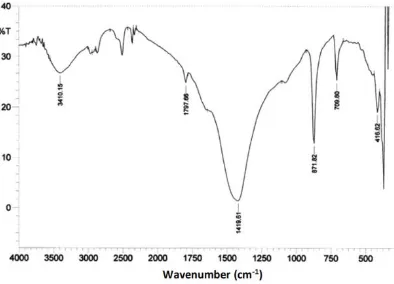
Figure 1 shows the FTIR spectra of eggshell powder. The three bands at 1419.61 cm-1,
871.81 cm-1, and 709.80 cm-1 are due to
asymmetrical stretching, out of plane bending, and in plane bending of CO32- respectively.
These results are agreeable with the results demonstrated by Jazie et al. [18]. The emergence of the CO32- bands indicate the
existence of calcium carbonate (CaCO3) in the
eggshell. The bands at wavenumber of 3410.15 and 1797.66 cm-1 are due to –OH stretching and
bending vibration of water molecules respectively. Water molecules were adsorbed by the eggshell during the washing process or contact with air.
Figure 1. FTIR spectra of eggshell powder
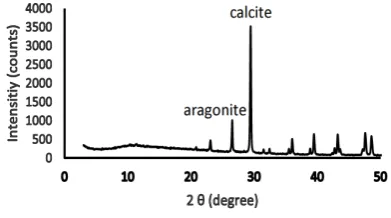
Figure 2 depicts the XRD pattern of eggshell powder. The highest peak at 2θ = 29.46o (d = 3.03 Å) is due to calcite mineral
aragonite mineral (JCPDS 5-453). The similar result was also showed by Krithiga and Sastry [19] who revealed that the calcite mineral appeared at 2θ = 29.30°. Calcite and aragonite are the mineral form of CaCO3. In the eggshell,
calcite dominates the mineral contents. This was evidenced by the high intensity of the calcite peak in the XRD pattern.
Figure 2. XRD pattern of eggshell powder
Characterization using N2 sorption analyzer
was aimed to determine the specific surface area of eggshell. The data obtained was then inserted into the BET (Brunauer-Emmett-Teller) equation. The specific surface area obtained from calculation using BET equation was 15.201 m2/g. The surface area is an important
characteristic in the adsorption process, because the adsorbent with high surface area will provide active sites for chemically and physically bonded adsorbates.
Effect of contact time. The experiments
were performed to determine the optimum contact time for adsorption of LAS on eggshell powder. Figure 3 shows the effect of contact time on LAS adsorption. The amount of LAS adsorbed on eggshell powder increased significantly for a short time and slowed gradually when equilibrium was approached. At the beginning of the adsorption process, the active sites of eggshell powder was fully free and ready to bind the adsorbates. As the contact time increased, the active sites of eggshell were covered by adsorbates until equilibrium. The equilibrium point was achieved in 45 minutes with the amount of LAS adsorbed on eggshell is 1.9543 mg/g. This result indicated that the available active sites of eggshell were saturated during the adsorption process and formed monolayer coverage.
Effect of pH. Figure 4 depicts the effect of pH on LAS adsorption. It can be seen that the
amount of LAS adsorbed on eggshell decreased as the pH of solution decreased. The maximum LAS adsorption on eggshell was occurred at pH 7. At this point, the concentration of H+ and OH
-ions in solution were in the same value and did not interfere the active sites eggshell surface. Thus, LAS can fully adsorbed on the surface of eggshell.
Figure 3. Effect of contact time on LAS adsorption
Figure 4. Effect of pH on LAS adsorption
When the pH of the solution increased, the OH- ions concentration in the solution was
greater than that of H+ ions. This resulted in
competition between OH- ions with the negative
charge of LAS molecules to fight for the active sites of eggshell. Kalyani et al. [14] revealed that the higher the pH of solution, the stronger the carbonate character in the eggshell. This impacted on the increase of negative charges of the eggshell surface. The repulsion was than occurred between eggshell surfaces with negatively charged of LAS molecules.
Effect of initial LAS concentration.
Figure 5 demonstrates the effect of initial concentration on LAS adsorption. It can be seen that the amount of LAS adsorbed on eggshell increased dramatically at concentrations of 5
mg/L to 45 mg/L. This indicated that the active sites of eggshell were still in large amount to bind LAS molecules. At remain concentrations (45 mg/L to 75 mg/L), the adsorption curve sloped gradually. It might be due to the active sites of eggshell were already filled and saturated with LAS molecules. Thus, there was no significant increase in the adsorption capacity when the concentration of LAS increased. The highest adsorption capacity was 4.0146 mg/g in initial LAS concentration of 75 mg/L.
Figure 5. Effect of initial concentration on LAS adsorption
Adsorption isotherm study. This study
was conducted to determine the adsorption properties. There were two widely used isotherms i.e. Langmuir and Freundlich adsorption isotherm. Langmuir isotherm was
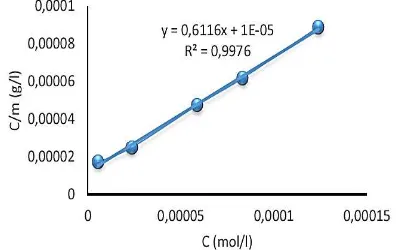
used to indicate the monolayer coverage where each active site can bind to an adsorbate molecule and no interaction between the adsorbate molecules with neighboring sites [20]. While the Freundlich isotherm gave the sense that there was no limit adsorption capacity, so the number of molecules adsorbed approaching infinite when its concentration increased [21]. The Langmuir isotherm of LAS adsorption on eggshell can be seen in Figure 6.
Figure 6. Langmuir isotherm of LAS adsorption on eggshell.
The equation of y = 0.6116x + 0.00001 with R2 = 0.9976 was obtained from this straight line.
Parameters such as the Langmuir adsorption capacity (b), adsorption constant (K) and adsorption energy (ΔGo ads) can be calculated
using the straight line equation. The detailed calculation can be seen in Table 1.
Table 1. Comparison of Langmuir and Freundlich isotherm parameters
Adsorption
isotherm Straight line equation R
2 b (mol/g) K
Figure 7 shows the Freundlich isotherm of LAS adsorption on eggshell. The straight line yielded equation y = 0.4652x + 2.0311 with R2
= 0.9243. Parameters such as the Freundlich adsorption capacity (b), adsorption constant (K) and adsorption energy (ΔG° ads) can be calculated using the straight line equation.
Table 1 shows the parameters of each adsorption isotherm. To determine whether the adsorption of LAS on eggshell followed Langmuir or Freundlich isotherm, can be done by comparing the value of R2 of each isotherm.
Freundlich isotherm (0.9243). It can be concluded that the adsorption of LAS on eggshell followed Langmuir isotherm with adsorption capacity (b) of 1.6218 mol/g, adsorption constant (K) of 6.1660 x 10⁴ L/mol,
and the adsorption energy (ΔG°ads) of 27.78 kJ/mol. The adsorption energy (ΔG° ads) of 27.78 kJ/mol can be classified as energy accompanying chemical adsorption or chemisorption [17].
CONCLUSION
The adsorption of LAS on eggshell powder was successfully performed on different contact time, pH, and initial concentration. Characterization using FTIR and XRD revealed that calcium carbonate was the main constituent of eggshell. The adsorption study showed that the maximum amount of LAS adsorbed on eggshell powder was achieved at contact time of 45 minutes, pH of 7, and initial LAS concentration of 75 mg/L. LAS adsorption on eggshell powder was found to follow the Langmuir isotherm adsorption with the adsorption capacity (b) of 1.6218 mol/g, adsorption constants (K) of 6.1660 x 10⁴ L/mol,
and the adsorption energy (ΔGo ads) of 27.78
kJ/mol.
ACKNOWLEDGEMENT
The authors are thankful to Directorate of Research and Community Service, General Directorate of Higher Education, Ministry of Education and Culture for financial support through its decentralization grant program in 2014.
REFERENCES
[1] Varsha, J., Mishra, K.D., Madhuri, S., and Govind, P., (2011). Linear Alkyl Benzene Sulphonate, A Detergent Induced Toxicity on the Gill of Puntius Ticto Fish, IRJP,
2(10), 76-78.
[2] Washil, A. and Dewi, D.C., (2009). Penentuan Surfaktan Anionik Menggunakan Ekstraksi Sinergis Campuran Ion Assosiasi Malasit Hijau dan
Metilen Biru Secara Spektrofotometri Tampak, Alchemy: Journal of Chemistry UIN Malik Ibrahim Malang, 1(1), 16-27.
[3] Alvarez, P.J. and Illman, W.A. (2006).
Bioremediation and Natural Attenuation. Process Fundamentals and Mathematical Models, New Jersey: John Wiley & Sons.
[4] Hermawati, E., Wiryanto and Solichatun (2005), Fitoremediasi Limbah Detergen Menggunakan Kayu Apu (Pistia Stratiotes L.) dan Genjer (Limnocharis Flava L.),
Biosmart, 7(2), 115-124.
[5] Wulan, P., Gozan, M., Anondho, W., Dianursanti, and Mahmud, S. (2006). Biodegradation Of Linear Alkyl Benzene Sulfonate By Bacterial Consortium,
Proceedings of the 1st International
Conference on Natural Resources Engineering & Technology 2006 Putrajaya, Malaysia, 104-111.
[6] Wignyanto, Hidayat, N., and Ariningrum, A. (2009). Bioremediasi Limbah Cair Sentra Industri Tempe Sanan Serta Perencanaan Unit Pengolahannya (Kajian Pengaturan Kecepatan Aerasi Dan Waktu Inkubasi), Jurnal Teknologi Pertanian.
10(2), 123 –135
[7] Boopathy, R. (2000). Factors limiting bioremediation technologies. Bioresource Technology,74, 63-67.
[8] Nys, Y., Gautron, J., Garcia-Ruiz, J.M., and Hincke, M.T. (2004). Avian eggshell mineralization: biochemical and functional characterization of matrix proteins, C. R. Palevol,3, 549-562.
[9] Vaclavik, V.A. and Christian, E.W. (2008). Essentials of Food Science. Third
Edition, New York: Springer Science Business Media, LLC, 208.
[10] Ishikawa, S., Sekine, S., Miura, N., Uyama, K., Arihara, K. and Itoh, M. (2004). Removal of Selenium and Arsenic by Animal Biopolymers, Biological Trace Element Research.102(1), 113-127.
[11] Otun, J.A., Oke, I.A., Olarinoye, N.O., Adie, D.B., and Okuofu C.A., (2006). Adsorption Isotherms of Pb(II), Ni(II) and Cd (II) Ions onto Powdered Eggshell, J. Appl Sci., 6(11), 2368-2376.
[12] Pramanpol, N. and Nitayapat, N. (2006),
[13] Ghazy, S.E., Asmy, A.A., and El-Nokrashy, A.M. (2008), Separation of chromium (III) and chromium (VI) from environmental water samples using eggshell sorbent. Indian Journal of Science and Technology,1(6), 1-7.
[14] Kalyani, G., Rao, H.J., Kumar, T.A., Mariadas, K., Vijetha, P., Kumar, Y.P., Kumaraswamy, K., Pallavi, P., and Sumalatha, B. (2010), Biosorption of Lead from Aqueous Solutions using EggShell Powder as Biosorbent: Equilibrium Modelling. International Journal of Biotechnology and Biochemistry, 6(6),
911–920.
[15] Zulfikar, M.A., Mariske, E.D., and Djajanti, S.D. (2012), Adsorption of lignosulfonate compounds using powdered eggshell. Songklanakarin. J. Sci. Technol,34(3), 309-316.
[16] Jurado, E., Fernández-Serrano, M., Núñez-Olea, J., Luzón, G., and Lechuga, M. (2006), Simplified Spectrophotometric Method Using Methylene Blue for Determining Anionic Surfactants:
Applications to the Study of Primary Biodegradation in Aerobic Screening Tests. Chemosphere. 65, 278–285.
[17] Al-ayubi, M.C., Barroroh, H., Diana Candra, D. (2010), Studi Keseimbangan Adsorpsi merkuri (II) pada Biomassa Daun Eceng Gondok (Eichhornia crassipes), Alchemy,1(2), 83-91.
[18] Jazie, A. A., Pramanik, H., Sinha, A. S. K., & Jazie, A. A. (2013), Egg Shell As Eco-Friendly Catalyst For Transesterification Of Rapeseed Oil: Optimization For Biodiesel Production, International Journal of Sustainable Development and Green Economics. 2(1).
[19] Krithiga, G. and Sastry, T. P. (2011), Preparation and characterization of a novel bone graft composite containing bone ash and egg shell powder, Bull. Mater. Sci.,
34(1), 177-181.
[20] Ruthven, D. M. (1984), Principles of Adsorption and Adsorption Processes,
New York: John Wiley & Sons, Inc. [21] Suzuki, M. (1990), Adsorption