REGISTER, Vol. 6, No. 1, June 2013 1
The Attitudes of Students from ESL and EFL Countries to English
Muhamad Hasbi
English and Foreign Languages University Hyderabad - 500 007, Andhra Pradesh, India [email protected]
Abstract
This research is to study the attitudes of English students from English as a Second Language (ESL) and English as a Foreign Language (EFL) country in English and Foreign Languages University (EFL University), Hyderabad to English. This is a descriptive-quantitative research with a survey method. The attitudes researched include those to listening, speaking, reading, and writing. The data was taken through questionnaire consisting of 20 questions. The findings of this study showed that the English students in EFL University have neutral-to-positive attitudes to Listening, positive attitudes to Speaking, positive attitudes to Reading, and poor attitudes to Writing. In addition, the English students from ESL country have better attitudes to Reading (positive) and Writing (neutral) and those from EFL country have better attitudes to Speaking (neutral-to-positive) and Listening (neutral-to-(neutral-to-positive).
Keywords: Attitudes, English as a Second Language (ESL), English as a Foreign Language (EFL)
Abstrak
2 REGISTER, Vol. 6, No. 1, June 2013 sebagai bahasa kedua (EFL) dan yang menggunakan bahasa Inggris sebagai bahasa asing (EFL) di Universitas Bahasa Inggris dan Bahasa Asing (English and Foreign Languages University/EFL University), Hyderabad terhadap bahasa Inggris. Penelitian ini adalah penelitian deskriptif-kuantitatif dengan menggunakan metode survey. Sikap yang diteliti termasuk sikap terhadap mendengarkan, berbicara, membaca, dan menulis. Data diperoleh melalui kuesioner yang terdiri dari 20 pertanyaan. Hasil penelitian ini menunjukkan bahwa mahasiswa di EFL University memiliki sikap netral ke positif terhadap mendengarkan, sikap positif terhadap berbicara, sikap positif terhadap membaca, dan sikap yang kurang positif terhadap menulis. Mahasiswa dari negara ESL memiliki sikap yang lebih baik terhadap membaca (positif) dan menulis(netral) dan mereka yang berasal dari negara EFL memiliki sikap yang lebih baik terhadap berbicara (netral ke positif) dan mendengarkan (netral ke positif)
Keywords: Sikap, Bahasa Inggris sebagai Bahasa Kedua, Bahasa Inggris sebagai Bahasa Asing
Introduction
Day to day, English becomes so familiar for people around the
world due to its role as a lingua franca and an international language used
in almost fields of life. International relationship, mass communication,
business, education, politics, and others are established primarily using
English. This condition then triggers people around the world to learn
English, either for academic or specific purposes.
Because of the reasons, English study has become a branch of
science with limitless knowledge discussed by linguists and learners.
English books have continuously been on the first rank publication of
language books for years back and predictably for years after. Therefore,
REGISTER, Vol. 6, No. 1, June 2013 3 learning of English becomes one of the major expert attentions so as to
make the English learning more successful and effective.
The teaching and the learning of English can never be aside from
the four language skills (reading, writing, listening, speaking) and two
language components (grammar and vocabulary). Teachers will have to
have a lot of efforts in designing and developing their teaching methods
and approaches to help students learn better. In addition, the learners will
have to have several efforts in doing classroom as well as independent
learning which are initially influenced by their own attitudes towards
English.
The attitudes towards English are considered as a very basic as well as crucial to the successfulness of students‘ learning. It is believed that the attitudes consisting of the way the learners think, feel, and
behave towards English, count for learners‘ intention, process, and so
result of English learning. Considering the importance of this
phenomenon, the writer intends to investigate how far the attitudes of
English contribute to the successfulness of their learning. Furthermore,
the writer also compares the attitudes of learners from EFL and ESL
countries since there are some universal differences in terms of their
accessibility, environmental and educational supports towards English
learning.
In this study, the writer would like to figure out these following
questions: (1) how far are the attitudes of English students in EFL
University to English? (2) how far are the attitudes of English students
4 REGISTER, Vol. 6, No. 1, June 2013 the attitudes of students from EFL country compared to those from ESL
country?
Attitudes
'Attitude' is defined as the way in which a person thinks
(cognitive component), feels (affective component), and intends to
behave(behavioural component) towards something (Rajecki, 1982:33).
It underlines the summation of the three components united as a package
of competence of a person who determines the successfulness of one‘s
addressed effort. Further, Wenden (1991) explains that the cognitive component is made up of the beliefs andideas or opinions about the
object of the attitudes; the affective one refers to the feelings and emotions that one has towards an object, 'likes' or 'dislikes', 'with' or
'against'; and finally, the behavioural component refers to one's consisting actions or behavioural intentionstowards the object.
Learning a language is closely related to the attitudes towards the
languages (Starks &Paltridge, 1996). English language learning,
similarly, is also an effort done by a learner towards the mastery of English for his or her intended purpose. In reference to Rajecki‘s definition, English learning attitudes will include learners‘ thinking, feeling, and behavior sprung during his English learning. Smit (1996)
adds that language attitudes can be defined as strong positive or negative
emotionsexperienced by people when they are faced with a choice
between languages in a variety of situations or a variety of language
learning.
REGISTER, Vol. 6, No. 1, June 2013 5 learning. Karahan (2007) avers that ―positive language attitudes let
learner have positive orientation towards learning English‖; inferring that
negative language attitude, in vice versa, will bear negative orientation.
In a further extension, this attitude can be broken down up to the
branches of English skills, i.e., listening, speaking, reading, and writing.
This means that a learner can actually has a various type of attitudes in each of the skills. This is because one‘s thought, feeling, and behavior towards a particular skill may be different, slightly or strongly, from the
other skills. Thus, it can be found that a learner probably has a good
attitude in reading and or writing but poor in speaking and or listening. At last, this phenomenon stimulates the writer‘s willingness to research deeper on learners‘ attitude to those four various skills, rather than generally to only English language.
English as a second language (ESL)
English as a second language (ESL) belongs to those whose
English is a secondary language used for a particular purpose and in a
particular situation. This English has a meaningful significance, yet, is
not used as primary spoken language in daily communication. The users
have their own language, either mother tongue or national language, used
in everyday speaking. India, for instance, has ESL.
English as a foreign language (EFL)
English as a Foreign Language (EFL) belongs to those whose
English is a foreign language used for a limit purpose and in a limit
6 REGISTER, Vol. 6, No. 1, June 2013 particular occasion, such as in English classroom, international
symposium, etc. The users have their own language to use in everyday
speaking. Countries such as Indonesia, Bhutan, Iran, Iraq, etc have their
English as EFL.
from research setting naturally and the researcher uses treatments for
collecting the research data. The treatments can be in the form of
questionnaires, tests, structural interviews, and the like (Sugiyono, 2008:
6). As Cohen, at.al. (2000) says,
Typically, surveys gather data at a particular point in time with the intention of describing the nature of existing conditions, or identifying standards against which existing conditions can be compared, or determining the relationships that exist between specific events. Thus, surveys may vary in their levels of complexity from those which provide simple frequency counts to those which present relational analysis.
The object of this research is the attitudes of English students
from ESL country and those from EFL country studying MA English
program in EFL University, Hyderabad. The attitudes researched include
those to listening, speaking, reading, and writing. The data was taken
through questionnaire consisting of 20 questions of which every 5
questions belonged to one particular category of the four English skills.
REGISTER, Vol. 6, No. 1, June 2013 7 sometimes, seldom, and never. There were 20 respondents; 10 of them
were students from ESL country, here India, and the other 10s were from
EFL country randomly chosen from Afghanistan, Bhutan, Indonesia,
Iran, Iraq, Oman, and Tajikistan.
The data was then analyzed descriptively. The answer frequency
of occurrence of the highest percentage determined to what attitude the
students belonged. The category of the attitude along with its mean
percentage range of answers follows this criterion:
- always
total sum of ‗always‘ and ‗often‘ answers is majority than the others; a neutral attitude is given if the total sum of ‗sometimes‘ answer is majority; and, a negative attitude is given if the total sum of ‗seldom‘ and ‗never‘ answers is majority compared to the others.
Discussion
The questionnaires filled by the 20 respondents, and they were
united to be recapitulated as a final data. Below are the final data together
with their analysis presented in four parts based on each language skill. Students’ attitude towards listening (question 1-5)
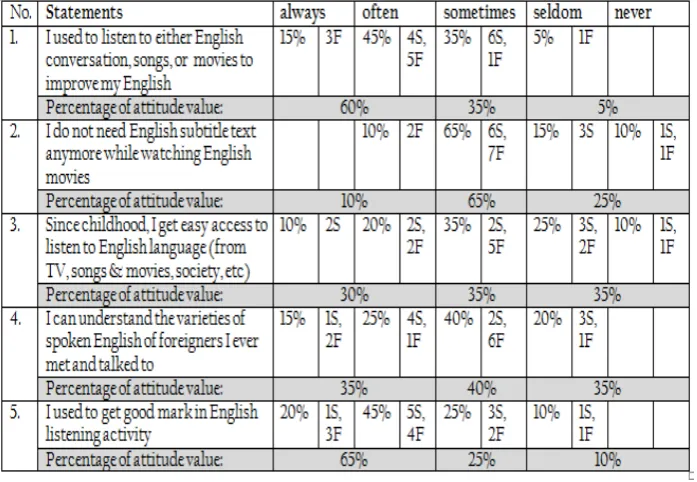
To investigate students‘ attitude to listening, the writer performed these 5 questions to be filled.These five questions were given to detect students‘ attitude in listening skill specifically on five elements indicating
‗positive attitude‘
8 REGISTER, Vol. 6, No. 1, June 2013 the attitude, including their habit (Q1), readiness (Q2), accessibility (Q3),
comprehension (Q4), and evaluation (Q5) toward English listening.
Table 1
Questionnaire Data Preview on Listening Skill
Using the criterion explained earlier in the research method, the
data show that generally students have positive habit (60%), neutral
readiness (65%), neutral-to-negative accessibility (35%-35%), neutral
comprehension (40%), and positive evaluation (65%) toward English
listening. Further, in comparison from the perspective of students from
EFL to ESL country, EFL students have better habit, better readiness,
lesser accessibility, similar comprehension, and better evaluation than
ESL students do. Thus, it is said that generally the students have
neutral-to-positive attitudes towards English listening, yet, EFL students‘ attitude
REGISTER, Vol. 6, No. 1, June 2013 9 From the table, it is seen that EFL students show higher interest in
using songs, movies, and videos to improve their English and many of
them do not really need subtitle although ESL students actually have
more access to them. Correlating to later finding in reading and writing
session, ESL students have better interest in English reading and writing,
this can probably be the reason why ESL students‘ interest in movies,
songs and videos does not really mean. However, they both have good
attitudes in evaluation to English.
Students’ attitude towards speaking (question 6-10)
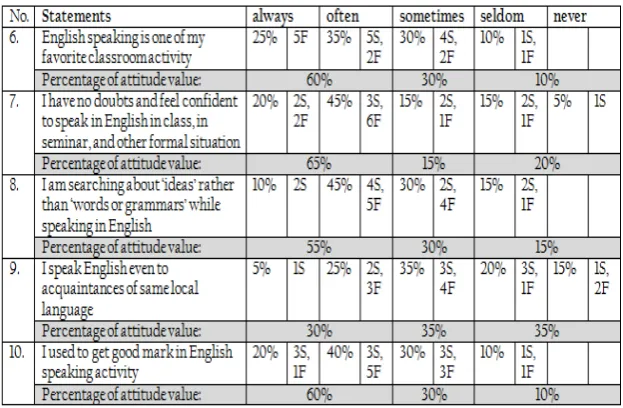
To measure students‘ attitudes to speaking, the writer gave these 5 questions to be filled. These questions aimed to know students‘ attitudes to speaking skill focusing on five components indicating the attitudes,
i.e., their fondness (Q6), confidence (Q7), meaningfulness focus (Q8),
commitment (Q9), and evaluation (Q10) toward English speaking.
Table 2
10 REGISTER, Vol. 6, No. 1, June 2013 Using the criterion explained earlier in the research method, the
data show that generally students have positive fondness (60%), positive
confidence (65%), positive meaningfulness focus (55%),
neutral-to-negative commitment (40%), and positive evaluation (65%) toward
English listening. Further, in comparison with the perspective of students
from EFL to ESL country, EFL students have better fondness, better
confidence, lesser meaningfulness focus, similar commitment, and
similar evaluation as ESL students do. Thus, it is said that generally the
students have positive attitude towards English speaking, with almost the
same level of attitudes of both ESL and EFL students.
As to explain, EFL students have better fondness in speaking
session (70%) and have no doubts to speak in English (80%) compared to
ESL students; though in average they also show good attitudes in this.
When speaking, half of them have confidence and think more ideas and half of them still think of ‗what and how to say‘ and have problems of confidence. The majority of both ESL and EFL students do not prefer to
use English to their acquaintances or relatives. However, many have
good mark in speaking evaluation (60%).
Students’ attitude towards reading (question 11-15)
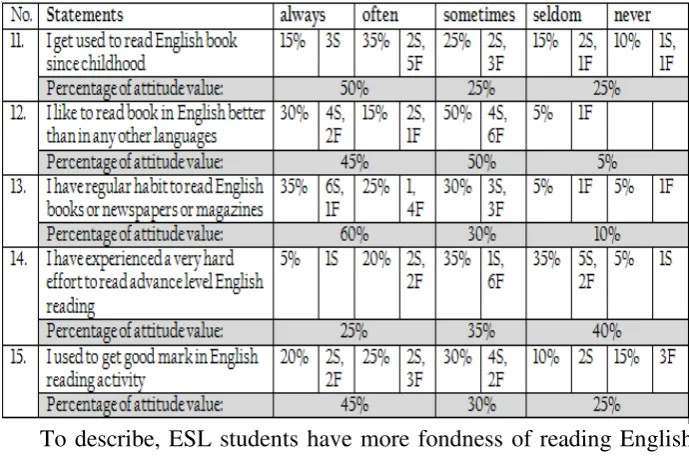
To measure students‘ attitudes to reading, the writer made these five questions to be filled. These questions were addressed to identify students‘ attitude in reading skill focusing on five indications, i.e., their habit (Q11), primary fondness (Q12), regular commitment (Q13), hard
REGISTER, Vol. 6, No. 1, June 2013 11 Using the criterion explained earlier in the research method, the
data show that generally students have positive habit (50%), neutral
primary fondness (50%), positive regular commitment (60%),
negative/poor hard effort (40%), and positive evaluation (45%) towards
English reading. Further, in comparison with the perspective of students
from ESL to EFL country, ESL students have similar habit, better
primary fondness, better regular commitment, better hard effort, and
better evaluation than EFL students do. Thus, it is said that generally the
students have positive attitudes towards English reading, but ESL
students have better attitudes than EFL students do.
Table 3
Questionnaire Data Preview on Reading Skill
To describe, ESL students have more fondness of reading English
(60%) than EFL students (30%). It shows similarly to the fact that most
12 REGISTER, Vol. 6, No. 1, June 2013 habit. Academically, both ESL and EFL students have been evaluated good in English reading, though 30% of EFL students said ‗never‘. In addition, both ESL and ESL students have few efforts in challenging
reading though 30% of Indians have good trials on that.
Students’ attitude towards writing (question 16-20)
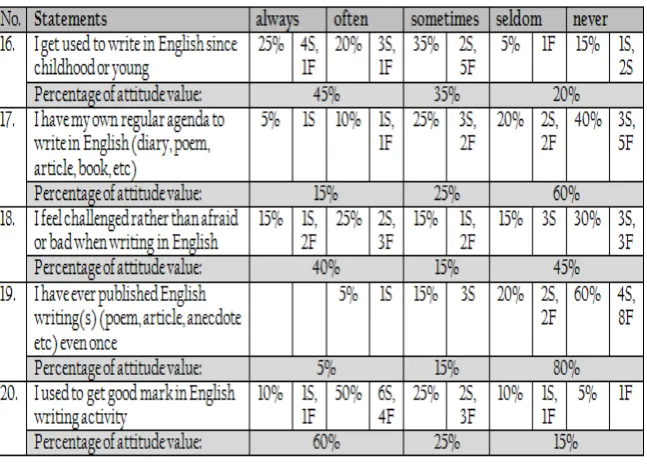
To detect students‘ attitude to writing, the writer used these following five questions. These questions were delivered to investigate
students‘ attitude in writing skill concerning with five elements, i.e., their
habit (Q16), regular commitment (Q17), challenged passion (Q18),
professional effort (Q19), and evaluation (Q15) toward English writing.
Table 4
REGISTER, Vol. 6, No. 1, June 2013 13 Using the criterion explained earlier in the research method, the
data show that generally students have positive habit (45%), negative
regular commitment (60%), negative challenged passion (60%), negative
professional effort (40%), and positive evaluation (60%) towards English
reading. Further, in comparison with the perspective of students from
ESL to EFL country, ESL students have better habit, better regular
commitment, lesser challenged passion, better professional effort, and
better evaluation than EFL students do. Thus, it is said that generally the
students have negative attitudes towards English writing, and ESL
students dominantly have better attitudes than EFL students do.
To add, the majority of ESL students, they are Indians, have gotten
used to write in English (70%) and even 60% of them experience
publishing their article, while only 20% of EFL students get used to write
and similarly only 20% have experience in publishing their English
writing. This is probably because, in India, English learning attempts
more on reading and writing and schools give more practice and task on
them. However, both ESL students and EFL students have good
evaluations in English. Other same things are few ESL and EFL have
regular habit on writing and feel challenged when writing English.
Conclusion
In conclusion, this study finally found that generally English
students in EFL University have neutral-to-positive attitude towards
English listening, positive attitude towards English speaking, positive
attitude towards English reading, and negative attitude towards English
14 REGISTER, Vol. 6, No. 1, June 2013 Reading and Writing, and vice versa, students from EFL country have better attitude in Listening and Speaking. This finding then recommends that English learners need to create good habit and attitude towards
English to make their English learning meaningful, effective and
applicable, since the heart of a language is not to be learned as a science,
but rather to be used in daily life, verbally and nonverbally.
References
Cohen, L., Manion, L., and Morrison, K. 2000. Research Methods in Education (Fifth Edition).London and New York: Routledge Falmer.
Karahan, F. 2007. Language Attitudes of Turkish Students towards the English Languageand Its Use in Turkish Context. Journal of Arts and Sciences Say, 7 May, 73-87.
Rejecky, D. W. 1982. Attitude Themes and Advances.Sunderland Snouer Associates Inc.
Smit, V. 1996.ANew English for a New South Africa: Language Attitudes Planning and Education. Vienna: Braumuller.
Sugiyono. 2008. Metode Penelitian Kuantitatif, Kualitatif dan R & D. Bandung: Alfabeta.