VOL. 2, NO. 2, pp. 32 – 36, May, 2012
TRADITIONAL RURAL WETLANDS IN HARYANA STATE OF INDIA
ARE CURRENTLY CONFRONTING MULTICORNERED THREATS
LEADING TO EXTINCTION SOONER THAN LATER
ROHTASH CHAND GUPTA1 AND TIRSHEM KUMAR KAUSHIK1*
1
Department of Zoology, Kurukshetra University
ABSTRACT
The most serious threat to traditional rural ponds in Haryana is associated with transformed societal behavioural patterns, ethics, values and life style, amongst several others. The siltation of ponds with adjoining areas, soil coming in with rain water is a very serious cause of stratification of rural ponds. Also contracting of village community land for sun drying of cow dung cakes inspires villagers to overload periphery of each pond with cow dung turning the premises into grave-yard of dung. This dung is the major source of polluting pond water into blackish water with high load of organic matter. Moreover, it leads to over excessive eutrophication. Building of major highways and connectivity roads have resulted into compartmentalization and degradation of village ponds. Inhabitation of peripheral village ponds boundaries by lower section of society for dwelling purposes is more threat to wetlands. The indifferent inclination of villagers towards silted ponds drenched in bad odour and blackish sludge is the story of 80% of the cases. The total blockage of run-off rainy water towards the natural age old rural ponds due to obstruction by way of human inhabitation has resulted into desertification of shallow water sheet in 90% of the cases. The oblivion of harvesting dried silt in summer for brick making has spelled doom for the ponds turning them into flat ground through successive decades and so on. The water quality in all ponds was overshooting the decaying stage due to the continuous mixing of cow dung drenched rainy water. Over excessive usage of ponds for bathing of cattle, dumping of cow dung and rotten vegetables waste has turned ponds into live sinks of dirt, gar bage and rural dairy wastes. Majority of village ponds are now out of existence or in deep black sludge laden or converted into Fish-Farming wetlands. The present studies have indicated that Winter migratory birds like Greylag Goose Anser anser, Bar-headed Goose Anser indicus, Mallard Anas platyrhynchos, Gadwall Anas strepera, Northern Shoveller Anas clypeata, Northern Pintail Anas acuta, Garganey Anas querquedula, Common Teal Anas crecca, Common Pochard Aythya ferina, Tufted Pochard Aythya fuligula, Common Coot Fulica atra, Little Ringed Plover Charadrius dubius, Kentish Plover Charadrius alexandrines, Spotted Redshank Tringa erythropus, Common Redshank Tringa tetanus, Marsh Sandpiper Tringa stagnatilis, Wood Sandpiper Tringa glareola and Pied Avocet Recurivirostra avosetta arrive in the extremely dilapidated rural ponds in Haryana from far off places including Russia, Siberia, China, and Caspian region, east Asia each winter season without any break. As such the extinction of ponds in Haryana directly thr eatens global avian biodiversity.
Keywords: Traditional Rural Wetlands, Perennial Rainy Water, Road Side Puddles, Land Filling, Commercial and Residential Construction, Highway reconstruction
INTRODUCTION
Haryana state in India stands for agriculture revolution and widespread economic growth
linked with govt. policies, peoples’ sense of
awareness, outsourcing of youth to abroad and *Corresponding address:
Tirshem Kumar Kaushik
Depertment of Zoology, Kurukshetra University, kurukshetra, Haryana
India 136119
Email : [email protected]
natural depressions to receive run-off rainy water in a self driven style. These ponds were the water sheets for the rural society of India since times immemorial. During lean period of availability of water (November to June), these ponds served as ready resource of water. Herds of cattle would drink and bath in these ponds. Tortoises, Pond herons, Cattle Egrets, Cormorants, Pelecypods, Gastropods, wide range of diatoms and vegetation will thrive in these ponds. During the summer season, the villagers used to excavate the silt for purposes like brick making and strengthening of Kuchha roof tops to secure against water leakage in rainy season was one self driven practice ensuring the proper maintenance of depth parameter thus leading to the perpetual existence of rural ponds – is now totally wanting. The present studies are actually a fall off of our endeavour to make an account of migratory birds in Haryana [1-16] During these surveys, we witnessed the holocaust being poured on village ponds in Haryana and hence the present study.
MATERIALS AND METHODS
The present studies are restricted to Haryana state (30044’N 76047’E / 30.730N 76.780E) in India having an approximate area of 44,212 km2 (17,070.3 sq mi) with 25,353,081 human population. Extensive survey was done by traveling National Highways (No.1, 73, 08) and state highways between Kurukshetra – Rohtak - Charkhi Dadri - Loharu; (ii)Kurukshetra – Ladwa –Yamunanagar - Ponta Sahib; (iii)Kurukshetra -Kaithal – Narwana - Hisar; (iv) Delhi –Faridabad – Ballabgarh – Palwal – Hodal -Mathura. In addition extensive survey was done in Thanesar, Pehowa and Ladwa blocks of Kurukshetra district. Similarly Nilokheri, Karnal, Nissing, Assand, Indri, Gharaunda blocks of Karnal district were surveyed extensively.
The entire state of Haryana was surveyed under one or the other pretext at random specially focusing attention on the studies of migratory wetland birds since 1985 onwards. Also various ponds across Haryana were visited to find out the status of tortoises in Haryana w.e.f. 2005 onwards. The state of Haryana was traversed on roads at random while undertaking several official obligations. During all these forays, ponds in villages were not only glanced at but were surveyed in entirety. The observations are casual, yet capable of addressing on issue in its entirely, as if hitting a nail on its head. The photographs have been taken with the help of
Camera Zenith 1986Model with Russian Made tele-lens. Above all, in totality the visits to the field are spread over two decades and on several occasions in a year without maintain strict mannerism or periodicity.
Gupta et al. [2] reported 63 species of wetland birds from Kaithal district in Haryana. At the same time, Gupta and Kaushik [5] recorded 66 species of Wetland birds from Kurukshetra district. Similarly, Gupta and Kaushik [7] observed 58 species of wetland birds from Yamunanagar district in Haryana (India).It is pertinent to mention that, all these birds which are coming from across the Himalayas are facing adverse conditions in their winter sojourn in rural ponds in northern Haryana.
Figure 1. Pictorial representation of scenario prevailing in rural ponds in Haryana
Winter migratory birds like Greylag Goose Anser anser, Mallard Anas platyrhynchos, Gadwall Anas strepera, Northern Shoveller Anas clypeata, Northern Pintail Anas acuta, Garganey Anas querquedula, Common Teal Anas crecca, Common Coot Fulica atra, Little Ringed Plover Charadrius dubius, Kentish Plover Charadrius alexandrines, Spotted Redshank Tringa erythropus, Common Redshank Tringa tetanus, Marsh Sandpiper Tringa stagnatilis, Wood Sandpiper Tringa glareola and Pied Avocet Recurivirostra avosetta are commonly seen in rural ponds in Haryana during winter season each year. At the same time, birds like Painted Stork Mycteria leucocephala, White-necked Stork Ciconia episcopus, Common Pochard Aythya ferina, Tufted Pochard Aythya fuligula, Spotted Greenshank Tringa guttifer, Comb Duck
Sarkidiornis melanotos, Black Ibis Pseudibis papillosa, Oriental White Ibis Threskiornis melanocephalus, Bar-headed Goose Anser indicus, and Eurasian Spoonbill Platalea leucorodia (Figure 2) are also observed from rural ponds in Haryana. These wetland birds are confronting with adverse conditions in these traditional rural ponds in Haryana.
The construction of national Highway No. 1 has dealt a severe blow to few very healthy age-old ponds across its 260 KMs length between Panipat and Jalandhar between 2009-11. Also the expansion of this very highway in its first phase (2004-08) between Delhi and Panipat has already wiped out several rural ponds. It is pertinent to mention that observations between 1984 to 2011
Figure 2. Photographic inventory of wetland birds observed at rural ponds in Haryana
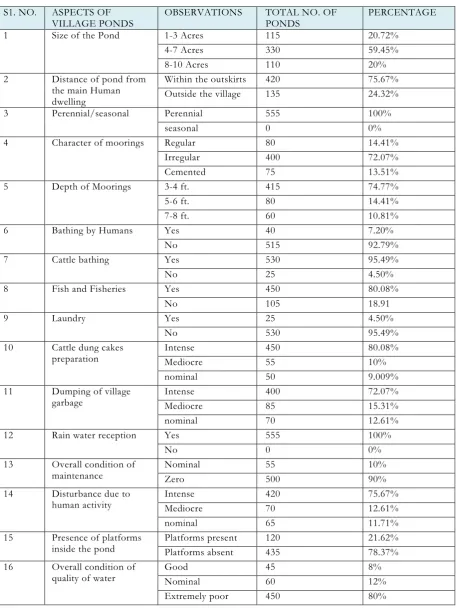
Table 1. The overall scenario prevalent in rural ponds in northern Haryana in context of winter migr atory wetland birds during 2005-11
S1. NO. ASPECTS OF
VILLAGE PONDS
OBSERVATIONS TOTAL NO. OF
PONDS
PERCENTAGE
1 Size of the Pond 1-3 Acres 115 20.72%
4-7 Acres 330 59.45%
8-10 Acres 110 20%
2 Distance of pond from
the main Human dwelling
Within the outskirts 420 75.67%
Outside the village 135 24.32%
3 Perennial/seasonal Perennial 555 100%
seasonal 0 0%
4 Character of moorings Regular 80 14.41%
Irregular 400 72.07%
Cemented 75 13.51%
5 Depth of Moorings 3-4 ft. 415 74.77%
5-6 ft. 80 14.41%
7-8 ft. 60 10.81%
6 Bathing by Humans Yes 40 7.20%
No 515 92.79%
7 Cattle bathing Yes 530 95.49%
No 25 4.50%
8 Fish and Fisheries Yes 450 80.08%
No 105 18.91
9 Laundry Yes 25 4.50%
No 530 95.49%
10 Cattle dung cakes
preparation
Intense 450 80.08%
Mediocre 55 10%
nominal 50 9.009%
11 Dumping of village
garbage
Intense 400 72.07%
Mediocre 85 15.31%
nominal 70 12.61%
12 Rain water reception Yes 555 100%
No 0 0%
13 Overall condition of
maintenance
Nominal 55 10%
Zero 500 90%
14 Disturbance due to
human activity
Intense 420 75.67%
Mediocre 70 12.61%
nominal 65 11.71%
15 Presence of platforms
inside the pond
Platforms present 120 21.62%
Platforms absent 435 78.37%
16 Overall condition of
quality of water
Good 45 8%
Nominal 60 12%
This paper attempts to focus attention on the ongoing, although undeliberate, destruction and elimination of rural wetlands in Haryana state in India. On one hand, we have a convention like Ramsar Convention (1971) and on the other hand, we have a situation where each and every wetland is facing grave multiple threats (Plate-1).
We should have to call “Spade-a-Spade”. We about the urgent need to save wetlands. Schools, Colleges and Universities syllabi should include wetland in Syllabus highlight their significance, importance, utility in the overall functioning of human society.
CONCLUSION
It is recommended that Panchayats be issued express Orders to harness efforts to rehabilitate the over deteriorated ponds in Haryana. The National Service Scheme (NSS) should singularly focus attention on village ponds to retrieve them as far as possible. Mahatama Ganghi National Rural Employment Gramin Rojgar Yojna (MNREGA) should target redressal of village ponds through its huge financial money. Indian Government must cooperate with concerned international concerned quarters (Ramsar Convention+ Wetland International) to evoke response and help which is lying on our door stays only considering their concern for rehabilitation of wetlands at global level.
ACKNOWLEDGMENTS
The authors are thankful to their respective better half for granting allowance of time for field surveys. The authors are grateful to authorities of Kurukshetra University, including chairman department of zoology for inspiring and extending cooperation.
REFERENCES
1. Gupta R C and T K Kaushik (2010A)
Determination of the domain of spectrum concerning diversity of endangered winter visitor wetland birds in Haryana. J Expt. Zool. India. 13 (2):349-354.
An account concerning arrival and departure time of few selected winter migratory birds in Haryana rural ponds. Environment conservation Journal. 11(1&2):1-9, 2010.
causative factors responsible for the pathetic plight of Yellow wattled Lapwing in Kurukshetra suburbs. J Natcon. 22(2):181-187.
7. Gupta RC, T K Kaushik (2010D) Determination
of spectrum of winter migratory birds in
Yamunanagar district in Haryana, India.
Environment conservation Journal. 11(3):37-43.
8. Gupta RC, T K Kaushik (2010E) Understanding
Rural Ponds’ Migratory Avian Diversity in
Panchkula District in Haryana, India. J Adv Zool. 31(2):117-123.
9. Gupta RC, TK Kaushik (2011A) On the fast
depleting trends of Cormorants in Kurukshetra wetlands in the last twenty five years. J Expt Zool India. 14(1):81-85.
10. Gupta RC, TK Kaushik (2011B) On the
fundamentatals of natural history and present threats to Red-wattled Lapwing in Kurukshetra environs. J Appl & Nat Sci. 3(1):62-67.
11. Gupta RC, M Parasher, TK Kaushik (2010)
Analysis of Avifauna of Chilchilla Bird Sanctuary in Haryana, India. J Adv Zool. 31(1):35-44.
12. Gupta RC, TK Kaushik, S Kumar (2009)
Analysis of winter migratory Wetland Birds in Karnal district in Haryana. J Adv Zool. 30(2):104-117.
13. Gupta RC, M Bajaj (1997) Preliminary
investigations into the migratory birds of Braham Sarower at Kurukshetra. Jeevanti. 15:29-41
Ecological and behavioral patterns of migratory
Shoveller (Anas clypeata) (Linnaeus) in certain
wetlands of Haryana. Jeevanti. 17:27-35.
16. Gupta RC, M Bajaj (2000) Preliminary
observation on a rare lapwing species,
white-tailed, (Vanellus leucurus) (Lichtenstein). J