Accredited SK No.: 81/DIKTI/Kep/2011
EFFECT OF TEMPERATURE AND STORAGE ON EFFECTIVENESS OF
Trichoderma viride
AS BIOCONTROL AGENTS OF
Rigidoporus microporus,
PATHOGEN OF WHITE ROOT ON RUBBER
Nurhayati Damiri*), Mulawarman and Mitra Mutiara
Department of Plant Pests and Diseases, Faculty of Agriculture, Sriwijaya University Jl. Raya Palembang-Prabumulih, Km 32, Ogan Ilir, Inderalaya 30662, South Sumatra, Indonesia
*) Corresponding author Phone: +62-711-580663 Email: [email protected]
Received: March 31, 2014 / Accepted: July 16, 2014
ABSTRACT
This research was aimed to study the effect of temperature and storage on effectiveness of Trichoderma viride to suppress Rigidoporus microporus development, the pathogen of white root disease on rubber. This research applied a randomized complete block design with five treatments and five replications. Each treatment contained two rubber plants (total of plants 50). There were five treatments i.e.: compost containing T. viride which was stored at 17oC for a
month ( A ), compost containing T. viride which was stored at 24oC for a month ( B ), compost
containing T. viride which was stored at 30oC for a
month (C), Triadimefon ( D) and R. microporus ( control Results showed that that T. viride compost which was stored for a month at various temperatures was able to suppress R. microporus development. Trichoderma viride compost which was stored at of 17o C for a month showed the
best result. It was was able to supress white root disease severity up to 70 percent and rhizomorph colonization up to 62 percent respectively. The treatment was also able to increase the plant height and stem diameters.
Keywords: effectiveness, Rigidoporus micropo-rus, storage duration, temperature, Trichoderma viride
INTRODUCTION
Indonesia is the second largest rubber producer after Thailand. There are 3.4 million ha spread over several provinces with the total production of 3.04 million tons (Anonymous, 2013). Rigidoporus microsporus is known as one of important pathogens which attacks
rubber plantation and causes low production (Jean and Albert, 2002; Jayasurija and Thennakoon, 2007; Situmorang et al., 2007; Jayasinghe, 2010).
Fungal mycelia of R. microsporus penetrate directly into the root tissue. Each rubber plant attacked by this pathogen will die if not immediately addressed. Died plant will be a source of inoculum for healthy plants in the vicinity. Loss of production due to this pathogen attack on rubber planting can reach 5-15 % annually (Guyot and Flori, 2001; Judawi et al., 2006).
Since long time, control over this disease has been emphasize more on the use of chemicals or fungicides, but it has been realized that the use of persistent chemicals can result in a negative effect on the environment. The use of chemical fungicides could adversely affect human health and the importance of microorganisms in the soil, pathogen resistance to chemicals, pollution, and it could leave residue in soil (Haggag and Mohamed, 2007; Kim and Hwang, 2007).
One step that can be developed potentially in the future is utilizing antagonistic microorganisms. Trichoderma spp has been well known to control many plant diseases including white root disease in the rubber plant, without causing negative effects on the environment. Some species of Trichoderma such as T. viride, T. koningii and T. virens are known to control the white root disease (Hightley, 1997; Jayasuriya and Thennakoon, 2007). In Indonesia, Trichoderma application in rubber is usually in the form of compost. Generally farmers do not directly use the compost but kept it for half to a month in the storage. Related to white root
aspects of temperature and storage periods on the effectiveness of Trichoderma. This research was aimed to study the effect of temperature and storage periods on the ability of T. viride compost to suppress the development of white root disease on rubber.
MATERIALS AND METHODS
This research was carried out in a green house, Inderalaya, Ogan Ilir Dstrict, South Sumatra, Indonesia from January to August 2012. The research used a completely randomized block design with five treatments and five replications and each treatment contains 2 rubber plants (total of plants were 50). The treatments were: T. viride compost stored at 17oC for a month (A), T. viride
compost stored at 24oC for a month (B), T.
viride compost stored at 30oC for a month (C),
Triadimefon (D) and R. microporus (control). Rubber seedlings used were clones of PB 260 aged 8 months from seed, which were grown in soil mixed with sand and cow manure (1:0.5:1). A total of one petri dish T. viride inoculum was propagated in the Glucose Yeast media and than put into 500 gr compost mix of sawdust, manure and rice bran ( 1:0.6:0.4 ). The mixture was then stirred until smooth then stored according to the treatment. Propagation of R. microporus was done by mixing as many as 5 pieces of cork drill R. microporus inoculum on root rubber sticks and than stored in sterile bottles.
Application T. viride was given by sprinkling about 2 grams of compost which contained T. viride surrounding the root rubber plant 15-25 mm in depth and then covered again with soil. Inoculation of pathogen was done by inserting 4 sticks of rubber roots containing R. microporus into the soil around the plant rubber 5 days after the application of Trichoderma compost. Observed parameters include the severity of the disease, colonization rhizomorph on the ground, plant height and stem diameter. Data were then analyzed by analysis of variance (ANOVA), which then was followed by Honestly Significant Difference Test (HSDT) comparison among means.
RESULTS AND DISCUSSION
Diseases severity
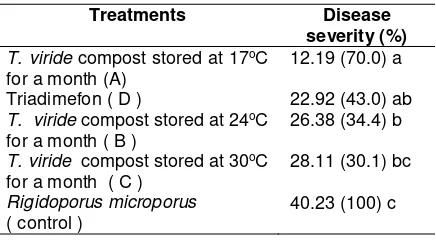
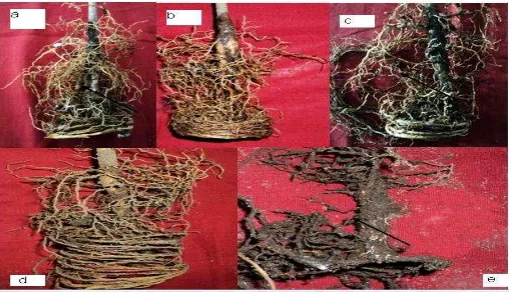
The results showed that the storage of T. viride compost at various temperatures affected the severity of white root disease of rubber plants (Figure 1). The effect of each treatment was very good when compared to the control, but the best treatment was T. viride compost that was stored at 17oC for one month. This
treatment wasn’t different from the results indicated by chemical treatment (Triadimefon) that were used as chemical control, a commonly used chemical by farmers in southern Sumatra, Indonesia for controlling white root disease in rubber.
Severity of the disease seen in the treatment of T. viride compost stored at 17°C for a month was significantly different from T. viride compost treatment stored at 24°C for a month and 30°C for a month as well as the control (Table 1). The lowest disease severity on the treatment of T. viride compost stored at17°C for a month was 12.19% and the highest 40.23% on control. This treatment was able to suppress the white root disease severity up to 70% compared to control.
Table 1. Effect of T. viride compost stored at various temperatures on white root disease severity on rubber
Treatments Disease severity (%)
T. viride compost stored at 17oC
for a month (A)
12.19 (70.0) a
Triadimefon ( D ) 22.92 (43.0) ab
T. viride compost stored at 24oC
for a month ( B )
26.38 (34.4) b
T. viride compost stored at 30oC
for a month ( C )
28.11 (30.1) bc
Rigidoporus microporus ( control )
40.23 (100) c
Figure 1. Effect of T. viride compost on R. microporus the pathogen of white root disease on rubber. a) T. viride compost stored at 17oC for a month, b) T. viride compost stored at 24oC for a month, c) T.
viride compost stored at 30oC for a month, d) Triadimefon and e) R. microporus (control).
The ability of T. viride in suppressing the white root disease severity was presumably triggered by the antagonist grown at temperature of 17oC, so it brought good
suppressing ability. According to Samuel et al. (2005), T. viride can grow well at the optimum temperature of 15oC–30oC. Trichoderma can
infect its host through direct growth, contacts, host recognition, attachment of trichoderma hyphae on the host hyphae, forming appressorium on the host surface, penetration and exit. Attachment of hyphae was facilitated by binding carbohydrates in the cell walls of Trichoderma fungi with lectins on the host (Whipps, 2001; Harman et al., 2004). Once it is in contact, Trichoderma produces antibiotic and toxins and cell wall enzymes destroyer (Kubicek et al., 2001; Harman et al., 2004). Trichoderma species not only has a variety of metabolites which are toxins, but also has a variety of enzymes such as exo- and endoglucanase, cellobiase, chitinase, cellulase and protease. These enzymes can destroy host wall structures (Fox, 2003).
Rhizomorph Colonization on Media
Trichoderma viride compost was significantly different from each other on R. microporus colonization on media (Table 2). Table 2 shows the effect of treatment on R. microporus colonization rhyzomorph on the media by Triadimefon (D), T. viride compost which was stored at 17°C for a month, which was not significantly different from T. viride compost stored at 24°C for a month. T. viride
compost stored at °C 24 was, however, significantly different from treatment of T. viride compost stored at 30°C for a month and control. T. viride compost which was stored at 17°C for a month was able to suppress the rizomorph colonization on media up to 62 % compared to control.
Trichoderma is antagonistic agent that has a capability to produce metabolic compounds, destroy, and inhibit other microorganisms. In addition, Trichoderma is able to compete with plant pathogen in nutrition uptake which causes the inhibition of plant pathogen such as R. microporus (Elad and Freeman, 2002). Trichoderma produces volatile substances such as gas (including acetaldehyde, n-propanol, propional, isobutanol, n-butyraldehyde, ethyl acetate, isobutyl acetate, acetone) which can inhibit the growth of R. solani, P. domesticum, M. hiemalis, P. ultimum. Several proteolytic enzymes produced by Trichoderma play an important role in the destruction of the fungus Sclerotium rolfsii. Trichoderma viride produces two antibiotics such as gliotoxin (toxic against R. solani) and gliovirin (toxic to Phytium spp) (Howell, 2003). This ability is believed to be able to inhibit rhizomorph colonization of R. microporus in soil.
Rubber Plant Height Stem Diameter
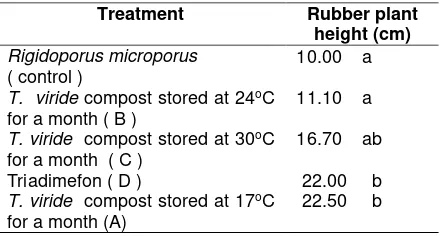
Composting T. viride on rubber plants affected plant height and stem diameter. The treatment of T. viride compost which was stored at 24o and 30oC in a month (B and C) was not
Triadimefon and T. viride compost stored in a month at 17oC (A) were significantly different
from control (Table 3 and Table 4).
Table 2. Effect of T. viride compost stored at various temperatures on R. microporus rizomorf colonisation on media
Remarks: numbers followed by the same letter are not significant different. Numbers in brackets are relative values compared to control
Table 3. Effect of T. viride compost on rubber plant height
Remarks: numbers followed by the same letters are not significantly different
Table 4. Effect of T. viride treatment on increasing rubber stem diameters
Treatment Stem have diverse control mechanisms, are excellent competitors in the rhizosphere, tolerant, or resistant to fungicides, strong aggressive against phytopathogenic fungi, and promote plant growth (Benítez et al., 2004). In addition, Trichoderma is known to promote the development of root which can increase the plants biomass and productivity, increase the ability to absorb nutrition, and have efficiency of nitrogen usage. Those abilities can also dissolve the nutrients in the plant tissues (Harman et al., 2004). According to Howell (2006), Trichoderma has the capacity to make rizospher colonization and promote plant growth.
CONCLUSIONS
Trichoderma viride compost stored for a month at various temperatures was able to suppress the development of R. microporus and accelerate the rubbers plant height and diameter significantly compared to control and traidimefon. The best treatment was T. viride compost which was stored at 17o C for a month
that was able to suppress the white root disease severity up to 70 percent and capable of suppressing the rizomorph colonization on media up to 62 % respectively compared to control.
REFERENCES
Anonymous, 2013. Agricultural investment opportunities in Indonesia. Directorate of Invesment and Business Development, Directorate General of Processing and marketing for Agricultural Product, Ministry of Agriculture. Republic of Indonesia. pp.10.
Benitez, T., M.A. Rincon., M.C. Limon and C.A. Codon. 2004. Biocontrol mechanisms of Trichoderma strains, Intenational Microbiology 7(4):249-260.
Fox, R. T. V. 2003. Managing Armillaria root. Food, Agricultural and Environment, 1 (1): 95-100.
Guyot, J. and A. Flori. 2001. Comparative study detecting Rigidoporus lignosus on rubber trees. Crop Protectio 21 (6): 461-466.
Haggag, W.M. and H.A.A. Mohamed. 2007. Biotecthnological aspects of microorganisms used in plant biological control. American-Eurasian Journal of Sustainable Agriculture 1 (1): 7-12. Harman, G.E., C.R. Howell, A. Viterbo, I. Chef
and M. Lorito. 2004. Trichoderma spesies - opportunistic, avirulent plant symbionts. Nature Review Microbiology 2: 43-56.
Hightley, L.T. 1997. Control of wood decay by Trichoderma (Gliocladium) virens I. Antagonistic properties. Material a organism 31 (2): 79-89.
Howell, C.R. 2003. Mechanisms employed by Trichoderma species in the biological control of plant disease: The history and evolution of current concepts. J. of Plant Disease. vol. 87 (1): 4-10.
Howell, C.R. 2006. Understanding the mechanism employed by Trichoderma spp to the effect biological control of cotton disease. Phytopathology 96 (2): 178-180.
Jayasinghe, C.K. 2010. White root disease of rubber tree: An overview. Paper presented in the proceeding of the International workshop on white root disease on hevea rubber. pp.1-8.
Jayasuriya, K.E. and B.I. Thennakoon. 2007. Biological control of Rigidoporus microporus, the cause of white root disease in rubber. Ceyon Journal of Sci-ence (Biology and ciSci-ence) 36 (1): 9-16. Jean, G. and Albert, F. 2002. Comparative
study for detecting Rigidoporus linosus on rubber trees. Crop Protection. 21(6) 416-466.
Judawi, S.D., L. Holomoan and R.B. Setyaningsih. 2006. A guide for plant pest and disease control on rubber plant. Directorate general of Estate, Ministry of Agriculture, Jakarta. Pp.1-3. Kim, B.S and B.K. Hwang. 2007. Microbial
fungicides in the control of plant diseases. Journal of Phytopathologi 155:641-653.
Kubicek, C.P., R.L. Mach, C.K. Peterbauer and M. Lorito. 2001. Trichoderma: From genes to biocontrol. J. of Plant Pathology. 83 (2): 11-23.
Situmorang, A., H. Suryaningtyas and S. Pawirosoemardjo. 2007. Current status of white root disease (Rigidoporus microporus) and the disease control management in rubber plantation. Pp. 27-33. in Pawirosoemardjo, S., B. Setyawan., H. Suryaningtyas., M. Supriadi. Proceeding of International Workshop on White root Disease of Hevea Rubber. Salatiga 28th – 29th
November 2006.