CHAPTER I
INTRODUCTION
1.1 Background of The Study
Language is the most important thing in communication. It is used to
transfer idea from one person to another that includes some verbal
communication like listening, speaking, reading, and writing. According to
Hornby (2000:721) language means “the system of communication in speech
and writing that is used by people of particular country”. It is clear that people
of a particular country use language in a particular time. In this case,
globalization makes a great effect in the usage of language, so we need an
international language as a language interface, which is English.
English as an international language has a great effect in the development
of modern technology and science. It is used in magazines, comics, newspaper,
novels, etc. as printed media. It is also used in television, radio, and internet as
electronic media. Those media spread around the world and cause main
problem.
The main problem faced by people with different language is languages
around the world are countless. That is why people need translators to transfer
messages from source language (SL) to target language (TL) and also need to
The other reason is some people choose reading as their media in learning.
Sometimes the message of written media is easier to understand than spoken one
because it is more structured. Therefore written language is more precise due to
the easier understandable level than the spoken one. On the other hand, not all
people can understand written language, and the writer does not have any
opportunity to clarify what s/he means to readers. That is why s/he do need
translation in order to understand so many spoken and written learning media.
Catford (1965:20) states “translation is the replacement of textual material
in one language (Source Language) by equivalence textual material in another
language (Target Language)”. Wills (In Pym, 1982: 38) also states the same
idea; “translation leads from a source language text to a target language text
which is as close equivalence as possible and presupposes an understanding of
the content and style of the original”. Both statements explain clearly about the
importance of source language and target language equivalence in translation. If
translator finds some new words in SL text, s/he has to get the idea and then
transfer it to TL text with the appropriate equivalence, that helps readers
understand the text and it will look the natural.
Various types of translation is described by Nababan (1999:29) as follows:
So he provides some kinds of translation like word-for-word translation,
free translation, literal translation, dynamic translation, aesthetic-poetic
translation, pragmatic translation, ethnography translation, linguistic translation,
communicative translation, and semantic translation. Furthermore, those kinds
of translation will also effect the naturalness on translation work.
All through the history of translation study, the concept of naturalness has
been changed by different definitions. There is no doubt that offering a natural
translation cannot be assumed to be an easy issue inasmuch as it can turn out to
be very troublesome in practice and needs very sensitive decision-making on the
part of both translator and reader within translation process and evaluation
because every language has its own rule and system. One-language rules do not
always fit with the other. Each language has its own linguistic devices that force
translator not to avoid those rules in translating the translation works. As stated
in the book entitled Teori Menerjemah Bahasa Inggris, Nababan (1999:54)
states as follows:
Sistem dalam setiap bahasa adalah polisistemik karena setiap bahasa mempunyai struktur sintaksis, sintagmatik, leksikal dan morfem yang berbeda dari sistem bahasa lainnya… Perbedaan-perbedaan dalam sistem bahasa itulah yang menyebabkan timbulnya kesulitan-kesulitan dalam pengajaran bahasa, terutama bahasa asing, dan dalam penerjemahan.
The statement above clearly explains how language system in any language will
affect to the naturalness of the translation work.
As the researcher said before, readers choose written language as their
learning media, for instance magazines, comics, newspaper, and novels. Novel
is one kind of literary books that can be used as a learning media because when
someone likes reading novels, s/he can pervade some new knowledge that
contained in it. Absorption of knowledge will go well when the contents
delivery of the translation work can be easily understood in accordance with the
natural way in target language. Therefore a translator has to produce the natural
work of translation that will help the target language reader understand the
messages.
Most of Indonesian people know English, but they do not really
understand the messages. They know English from a lot of movies played in
cinemas or books sell in book stores, but they just know that it is English and
they do not really understand the meaning and the message. If they want to
understand the messages, they should translate them into Indonesian first. For
some people who understand English, they do not have to think what’s the
meaning of the sentence or the conversation. The problem is that for some
others they have to think and translate it first, cause by not understand and
very important toward, not only the scientific and technology books, but also in
literary books.
From various types of literary books, the researcher chooses a fiction
novel entitled The Strange Case of Dr. Jekyll and Mr. Hyde by Robert Louis
Stevenson because it is a famous works. The author also has so many famous
work, for instance like Treasure Island, Prince Otto, The Strange Case of Dr
Jekyll and Mr Hyde, Kidnapped, The Black Arrow: A Tale of the Two Roses,
The Master of Ballantrae, The Wrong Box, etc. But the researcher chooses The
Strange Case of Dr. Jekyll and Mr. Hyde.
In pursuance of Wikipedia, retrieved on May 29th 2012, Robert Louise
Stevenson’s novel The Strange Case of Dr Jekyll and Mr Hyde was an
immediate success and is one of Stevenson's best-selling works.
The study focuses on unnaturalness in The Strange Case of Dr. Jekyll and
Mr. Hyde – Robert Louis Stevenson published by the Penguin Popular Classics,
which is translated into Indonesian version Dr. Jekyll dan Tuan Hyde – Kisah
Dua Sisi Kepribadian yang Menegangkan by Ary Kristanti, which is very
familiar novel in English literature study.
The main reason why unnaturalness in The Strange Case of Dr. Jekyll and
Mr. Hyde – Robert Louis Stevenson into Dr. Jekyll dan Tuan Hyde – Kisah Dua
Sisi Kepribadian yang Menegangkan by Ary Kristanti is chosen as a topic in
Indonesian work, especially when the naturalness characteristics are applied to
transfer the intended meaning in source language text. It may bring difficulties
in understanding the idea of the book or the real meaning of the sentence when
the translator steps aside the naturalness characteristics. The researcher wants to
know how a translator reproduces and finds the equivalence of these texts and
keeps the meaning constant so the messages can be communicative for the target
readers. Because sometimes the word choices do not fit the text technically,
embarking odd language styles and adapted the nature of the source text will
make the reader confused when they try to catch the meaning and the message.
1.2 Statement of The Problem
This research is designed to answer this question: what are the unnatural
translations found in the translation of Robert Louis Stevenson’s novel The
Strange Case of Dr. Jekyll and Mr. Hyde into Dr. Jekyll dan Tuan Hyde – Kisah
Dua Sisi Kepribadian yang Menegangkan by Ary Kristanti?
1.3 Scope of The Study
The scope of study is unnatural phrases, clauses, sentences, and utterances
dan Tuan Hyde – Kisah Dua Sisi Kepribadian yang Menegangkan based on
Sadtono’s criteria (2007:63) in Ngasbun Egar and Arso Setyadi’s book.
1.4 Objective of The Study
The aim is to find out the unnaturalness translation in the translation work
of Robert Louis Stevenson’s novel The Strange Case of Dr. Jekyll and Mr. Hyde
into Dr. Jekyll dan Tuan Hyde – Kisah Dua Sisi Kepribadian yang
Menegangkan by Ary Kristanti.
1.5 Significance of The Study
It is challenging to analyze a novel entitled The Strange Case of Dr. Jekyll
and Mr. Hyde – Robert Louis Stevenson published by the Penguin Popular
Classics, which is translated into Indonesian version Dr. Jekyll dan Tuan Hyde –
Kisah Dua Sisi Kepribadian yang Menegangkan by Ary Kristanti.
The result of the study is aimed to give some benefits to the researcher, the
translator, and the reader.
1. The researcher, who can use this as an exercise media to re-apply the
2. The public researcher, who are involved in translation and linguistic
research and need references especially about how a natural translation fit
to the target language.
3. The reader, who are interested in translation study that are curious to learn
and understand the message and story ideas of the author.
4. The translator, who will make this research results as a matter to improve
the quality of the translation.
5. Other students especially those of Dian Nuswantoro University, especially
for English department students in translation mainstream who can use the
result of this study as reference for their project.
1.6 Thesis Organization
Chapter I: Introduction. This chapter consists of background of the study,
statement of the problem, scope of the study, objective of the study,
significance of the study, and thesis organization.
Chapter II: Review of Related Literature. This chapter is arranged to
support and direct in analyzing the data of the problem. The theories used in
this chapter are: definition of translation, main principles in translation,
interference in translation, translation process, requirements to be a good
translators, naturalness in translation, naturalness characteristics, equivalence
Chapter III: Research method. This chapter consists of research design,
unit of analysis source of data, technique of data collection, and technique of
data analysis
Chapter IV: Data analysis. This chapter covers the analysis of the data. It
presents the research finding and discussion.
Chapter V: Conclusion and suggestion. It contains the conclusion of the
CHAPTER II
REVIEW OF RELATED LITERATURE
This chapter discusses the theories and ideas that are relevant to the
problem of the study. It will explain 1) Definition of Translation, 2) Main
Principles in Translation, 3) Interference in Translation, 4) Translation Process,
5) Requirements to be A Good Translators, 6) Naturalness in Translation, 7)
Naturalness Characteristics 8) Equivalence of Translation, and 9) Review of
Novel. Those relevant theories are used to analyze and support this study.
2.1 Translation
Nida and Taber (1974:12) pronounce, “translation consists of reproducing
in the receptor language the closest natural equivalence of the source language
message, first in terms of meaning and the second in terms of style”. Many
theorists describe translation in different way. Therefore, in reproducing a
translation work, not only transferring the meaning and the idea, but also the
style that will make a translation work looks natural in target text.
Savory (1969:12) states “translation is made possibly by an equivalence of
thought that lies behind its different verbal expressions”. It means although
every language has its own verbal expressions, but it might have the same
equivalent of thought that will help the reader easily understood a translation
process of finding target language equivalence for a source language
utterance”. He has the same idea with Savory; the aim of translation is a
process that consists of finding equivalence in target language for a source
language utterance or expression.
Catford (1969:20) also has the same idea with Savory and Pinchuck;
equivalent of thought, equivalent for source language utterance, and equivalent
of textual material are needed in making translation work. He denotes
“translation is the replacement of textual material in one language (source
language) by equivalent textual in another language (target language)”.
Brislin (1976:1) describes translation as follows:
Translation is the general term referring to the transfer of thoughts and ideas from one language (source) to another (target), whether the languages are in written or oral form; whether the languages have established orthographies or do not have such standardization or whether one or both languages is based on signs, as with sign languages of the deaf.
Based on this statement, it can be concluded that translation is the
diverting process of translator thoughts and ideas between two languages
(source and target) that includes all aspects; whether oral or written, the
languages have established orthographies or do not have such standardization,
and one or both languages is based on signs like deaf people do.
Hawkes (1991:13) states “translation involves the transfer of ‘meaning’
contained in one set of language through competent use of the dictionary and
This statement mean translation is a process that covers the entire process of
extra linguistic criteria like transfer of meaning which is contained in the
dictionary and grammar. Moreover in translating we need to know the main
principles in translation.
2.2 Main Principles in Translation
There are two main principles in translation based on Suryawinata and
Hariyanto (2003: 57-58); faithful translation to the original author and faithful
translation in the target language.
Yang dimaksud dengan terjemahan yang setia kepada penulis aslinya adalah terjemahan yang penerjemahnya berusaha mempertahankan ciri-ciri ekspresi atau gaya ungkap penulisnya… Penerjemah yang setia kepada pembaca teks Bsa akan berusaha menuliskan makna atau pesan teks Bsu di dalam teks Bsa dengan kata yang mudah dimengerti dan struktur yang enak dinikmati.
(My translation on statement above are: “faithful translation to the original outhor is that the translator tried to maintain the characteristics of expression or style of the author… faithful translator to the text the reader will try to write the meaning or text messages in source text to target text with word choises that is easy to understand and using the enjoyable target text’s structure.”)
That statement above mean in the first principle, a translator can bring his
fellow country a true and clear picture of the foreign author and foreign
circumstances, keeping strictly to the original. The second one s/he can treat the
foreign work as a writer treats his material, altering it after his own tastes and
convictions, so that it is brought closer to her/ his fellow. It means that a
that the reader can get the writer’s idea and information. Therefore interference
will appear in translation that causes problems in translating text.
2.3 Interference in Translation
As Mollanazar (2001) says “interference is a universal phenomenon in
translation and adjustment can somehow treat the problem”. Toury (1995)
reminds, “interference happens whenever translator fails to adapt translation to
target language”. In other word, differences between source and target
languages pattern may cause interference from source language. When a
translator does not understand source language culture well, it may bring some
difficulties to adapt and transfer the writer’s idea, and it will make some
misinterpretation on the target language text. It will confuse readers of the
target text. That is why a translator should follow some process.
2.4 Translation Process
When a translator is translating a source text, he/ she has to follow some
processes. Newmark (1988:19) describes the translating process; first it begins
with choosing a method approach. Secondly, when we are translating, we
translate with four levels more or less consciously in mind:
1. The source language text level; the level of language, where we begin and
2. The referential level; the level of objects and events, real or imaginary,
which we progressively havevisualize and build up, and which is an
essential part, first of the comprehension, then the reproducing process.
3. The cohessive level; which is more general, and grammatical, which
traces the train of thought, the feeling tone (positive or negative) and
various oresuppositions of the source language text. This level
encompasses both comprehension and reproduction: it presents an overall
picture, to which we may have to adjust the language level.
4. The level of naturalness; of common language appropriate to the writer or
the speaker in a certain situation. It is a generalized level, which
constitutes a band within which the translator works, unless he is
translating an authoritative text, in which case he sees the level of
naturalness as a point of reference to determine the deviation between the
author’s level he is pursuing and the natural level. This level concerns
with reproduction.
Finally there is the television procedure, which may be concentrated or
staggered according to the situation. This procedure constitutes at least half of the
complete process.
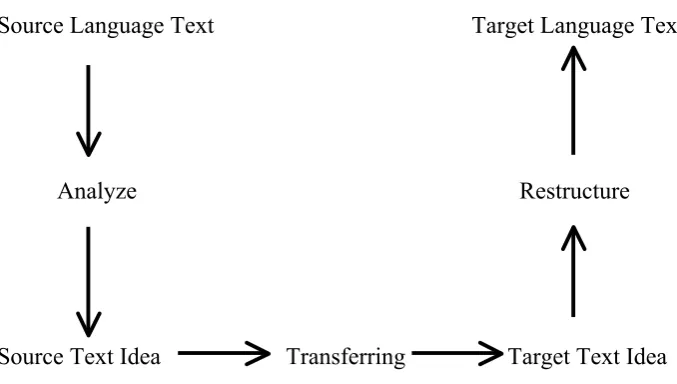
Nida and Taber (1969:33) have different perception of translation process.
Source Language Text Target Language Text
Analyze Restructure
Source Text Idea Transferring Target Text Idea
Figure 2.1 Nida and Taber’s translation process
From figure 2.1 it can be concluded that there are three stages of
translation; namely the analysing, transfering, and restructuring. In the analysis, a
translator analyzes the source language text in terms of relationship and the
meaning of the word grammatically, as well as a series of words to understand the
whole meaning or content. Then the results are transferred in the translator’s mind
from the source language fo target language. After that the reconstruction phase,
the meaning is written in the target language in accordance with target language
rules.
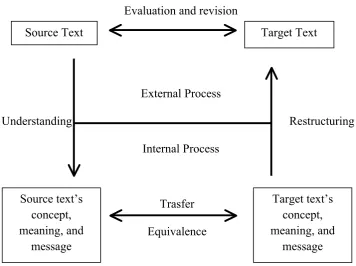
Based on that scheme, Suryawinata (1989:14) tries to explain it in the
easier way. He borrows the concept of inner-outer structure and Transformation
Evaluation and revision
External Process
Understanding Restructuring
Internal Process
Trasfer
Equivalence
Figure 2.2 Perfection of Nida and Taber’s translation process
Figure 2.2 can be described as follows:
1. Analyzing: sentences are analyzed according to grammatical relations,
meaning of the words or combinations of the words, textual and
contextual meaning. This is the reverse process of transformation.
2. Transferring: after analyzing the material and understanding the meaning,
the material are processed in translator’s mind then transferred from the
source language to target language. In this stage a series of words has not
been produced (all occurred in the inner interpreter).
Target Text
Source text’s concept, meaning, and
message
Target text’s concept, meaning, and
3. Restructuring: a translator tries to find the equivalent words, phrases, and
sentences structure that appropriate in the target language; so the contents,
meaning and message in the source language text can be delivered in the
appropriate way in the target language.
4. Evaluating and revising: after obtaining the results, then it is evaluate with
the original text. So if there is a perceived lack of worth, it may be revised.
A translator should have skill on translation procedures in order to make a
good translation. Therefore high-qualified translators who have good knowledge
of the source language and target language are required. This is in accordance to
Liat Kulwarski
(http://www.helium.com/items/750823-Nonprofit-Service-Sector):
The ideal translator is one who has a vast knowledge in a large variety of topics, as the translator often must integrate many different subjects. The more knowledgeable a translator is the better translation he/she creates… A good translator also has to be persistent (stubborn) in the search for the right word (or phrase, or idiom etc.) and not to give up easily.
A translator has to understand the cultural background and situation of the
text and transferring the source language (SL) into the target language (TL)
accurately.
As a further matter, a translator should know some requirements to be a
2.5 Requirements to be a Good Translators
Naturally, a translator has to know at least two languages. Most translators
will only translate into their native language. There are exceptions, especially
where a translator has been living abroad for many years. Generally, most
people only have native proficiency in, their native language.
However, if s/he wants to be a translator, s/he needs superior writing skills
in their target language. They need an excellent command of grammar and style.
If a company pays hundreds or thousands of dollars for a translation, the
document must be important to them and they will expect quality. Leila
Razmjou pronounces in (http://accurapid.com/journal/20edu1.htm) as follows:
A good translator should be familiar with the culture, customs, and social settings of the source and target language speakers. She should also be familiar with different registers, styles of speaking, and social stratification of both languages. This socio-cultural awareness, can improve the quality of the students' translations to a great extent.
From the statement above, a translator should have an excellent
comprehension of our second language. When s/he is translating, they hopefully
have access to lots of dictionaries and reference material. Keep in mind, that
having to look up a lot of words of the source text will severely reduce your
output and speed in translating. Lastly, it is good to have a broad education and
general knowledge of certain specialist fields. Translation agencies and clients
look for translators that are familiar with the topic of the translation. There is
Specializing in certain fields also gives you a more limited vocabulary you need
to master, especially concerning technical terms. A translator must fulfill certain
requirements.
A translator should know some requirements to be good translators; s/he
have to know and well understanding in source language, can control and able to
use language correctly and effectively well, know and understand the literary
appreciation of literature and translation theory, has a high sensitivity to
literature, has the cognitive and socio-cultural flexibility. Those requirements
are intended to help translator produce translation work that the shift meaning is
not too far from its original meaning.
Since a translator uses shift in translating a text or they want to keep the
message of the source language, fully or partially. It is common that some
chances and variations happened in translation.
Leonardi, in www.accurapid.com/journal retrieved on 7 June 2011, states
that, “this means that the act of translation can be analyzed along a range of
possibilities, which brings about a number of shifts in the linguistic, aesthetic
and intellectual values of the source text.”
This means that a translator should know the naturalness on translation to
have a good translation work that includes linguistic, aesthetic, and also
2.6 Naturalness in Translation
Lack of consensus can be considered as the major problem. Each of
translation studies’ scholars has offered their own definitions that will have been
rejected or taken under questions by another one. If the scholars consider a set
of criteria for their particular definition, it can be possible to depict a shared
platform for them. Naturalness is a reader-oriented approach and can be
checked at both macro and micro structural level (Lambert and Van Gorp,
1985). This means that a translator writes the target text just like the native
speaker does.
This is in accordance to English.StackExchange.com about native speaker
shown as follows:
A native speaker of English refers to someone who has learned and used English from early childhood. It does not necessarily mean that it is the speaker's only language, but it means having lived in a truly English-speaking culture during one's formative years, so that English has been absorbed effortlessly as by osmosis.
All languages have particular terminology, some of which are deeply
rooted in the culture of the speakers of the specific language; consequently, they
can pose unique difficulties in the comprehension of culture specific texts. To
evaluate naturalness of a translation, readers should be aware of these items that
are constituent of target culture norms.
Barnavel in his book Introduction to Semantic and Translation (1980)
Newmark (1988) believes “a translation which is written in ordinary language -
target language grammar, idiom and words - is the natural one”. In his
classification of different types of translation, communicative translation and its
subsets are nearer to this definition.
Nida and Taber (cited in Choliludin, 2005:3) consider a translation a good
one when it doesn’t show to be translation. They state “translating consists in
reproducing in the receptor language the closest natural equivalence of a source
language message, firstly in terms of meaning and secondly in terms of style”.
To be able to produce the closest natural equivalence, a translator has to master
the message in the original text, and then find the equivalence of that message in
the target language, and next he has to restructure it. Nida (1964:167) also has
outlined as follows:
A natural translation involves two principal areas of adaptation, namely, grammar and lexicon. In terms of grammar, the grammatical modifications can be made more readily adjusted since many grammatical changes are dictated by the obligatory structures of the receptor language. On the other hand, the lexical structure of the source message is less readily adjusted to the semantic requirements of the receptor language.
The naturalness in target language should be achieved in order to make
readers of the translated version do not realize that they are reading a translation
product. From the explanation of naturalness in translation above, the researcher
can conclude that translation should be natural in the forms of meaning and
the forms of meaning and grammar. S/he should do it in order to make readers
of the translated version do not realize that they are reading a translation
product. Naturalness is a nature of translation works that looks almost the same
as the writer’s work of his own; doesn’t reflect a work of translation. From those
theories above, a translator can see that naturalness characteristics are needed in
order to make a good translation work.
2.7 Naturalness Characteristics
Naturalness characteristics lead a translator to make a good translation
work because without these characteristics possible irregularities in the
translation work be even greater, and it will affect the result of the translation.
This is in accordance to Sadtono in Egar and Setyaji (2007:63):
A good translation work is a translation that does not adapt the nature of the source language into the target language. We also should not make big changes, such as translating historical news from the source language as happened ten years ago in an area near our recidence. Therefore the historical context in the source language is an important thing. In other words, a good translation work is a translation that does not translate culture does not translate "culture", but the translation "in terms of language". But it may also indicate the odd or awkward grammar and style. It means that translations should not addapt the nature of source language that makes errors in the delivering of the idea and meaning.
From that statement, it can be concluded that there are some naturalness
characteristics in translation. They are; not adapting the nature of source
grammar, not embarking odd language styles, word choices must fit with the
text (technically), exposure of implicit information, and the use of idioms that
cover cultural domains.
1. Not adapting the nature of source language
Each language has its own characteristics and features. The translator
should not ignore the characteristics in that language. If this is ignored by
the translator, the translation work will seem unnatural. For instance,
words classes are characteristic of each language, including nouns, verbs,
and adjectives. Therefore, the translator is not always able to translate the
source language noun with noun target language.
Example:
“a common thing” cannot be translated into “sebuah biasa benda”. The
real meaning is “sesuatu hal yang wajar”.
2. Not embarking major changes
Making major changes that are important, such as histories and facts, to
the language of the origin of a message is not allowed because it would
lead to deviations of real meaning or in other words not faithful to the
meaning.
Example:
It is not fair to translate “great depression” in America when equated with
The “great depression” was a severe worldwide economic depression in
the decade preceding World War II. The timing of the Great Depression
varied across nations, but in most countries it started in 1930 after the
passage of the United States' Smoot-Hawley Tariff bill (June 17), and
lasted until the late 1930s or middle 1940s. It was the longest, most
widespread, and deepest depression of the 20th century. But “krisis
ekonomi” in Indonesia began in mid-1997, the government took custody
of a significant portion of private sector assets through acquisition of
nonperforming bank loans and corporate assets through the debt
restructuring process. Since 2004, the national economy has recovered and
undergone another period of rapid economic growth.
3. Not preserving the unacceptable grammar
It is important because a grammar rule consists of binding rules in each
language, then the transfer of the source language message should pay
attention to the rules of both the source language and target language.
Example:
“The committee have been investigating the war crime for two years.” It
will be unnacceptable in Bahasa when we used, “Komisi telah sedang
menyelidiki kejahatan perang selama dua tahun.” The grammar looks
unnacceptable in target language, because it steps aside the target
4. Not embarking odd language styles
Translator should consider which aspects should take precedence, the
meaning of language or style, or finding the closest language style, but
still be maintained. Language style is important in translation, in addition
to news content. Sometimes there are a few things into consideration in
getting a good translation of the text. When a translator wants to maintain
the loyalty of meaning, then the style of language used to be weird.
Example:
The language style of poetry in the mean time will not be turned into
prose, and style of spoken language does not turn into a style of writing.
5. Word choices must fit with the text technically
When translating a text, word choices must consider to the type of the text
technically. It is a process of naming the physical or social reality through
nominalisation. Riyadi (2001: 125-126) calls this process as a non-lay
process, it is the assessment of natural or social phenomenon that is
relatively consistent, with a scientific paradigm as the understanding,
identification, and classification with different ways from ordinarry
people.
In this past perfect tense, “I had been living in Europe for five years”
cannot be translated into “Saya telah sedang tinggal di Eropa selama lima
tahun”. It is unacceptable in grammar of Bahasa.
6. Exposure of implicit information
Implicit information in the source language must be translated into the
target language because it is part of the overall message in the source
language.
Example:
Headlines news in Jakarta Post on Tuesday, July 10 2012, “Sriwijaya Air
spreads wings to eastern RI”. It will be unnatural if it used “Privately
owned Sriwijaya Air is expanding its flight services to Sulawesi and
Papua to tap into growing flight demand in eastern Indonesia”. The
readers will immediately stop reading to the news because of spending a
lot of time in reading the headlines’ fact that already known by them.
7. The use of idioms that cover cultural domains
It means the difference in the use of the idiom of one language with
another language greatly affects the translation. Translator will find many
idiomatic expressions when translating a text. Sometimes s/he translate it
literally because we do not know that it is an idiomatic expression. s/he
often find it difficult to translate when s/he cannot find it in the dictionary.
Example:
“He is cold hearted” when it is translated using word-for-word translation
it will become “Dia berhati dingin.” For those who know the idiomatic
meaning, it will seem unnatural because it has different meaning. It is
better to use “Ia tidak berperasaan”.
Besides knowing naturalness characteristics in translation, a translator
should take a look on the other aspect, such as equivalence.
2.8 Equivalence of Translation
The equivalence in translation works is also required; this means that a
work of translation must have the same quality of value and meaning. Nida and
Taber (1969:12) state that; “translation consists in reproducing in receptor
language (Target Language) the closest natural equivalence of the source
language (Source Language) message”. This means that translator has to find
the closest natural equivalence of the source language message for reproducing
the natural target language work.
Baker (1992:11-12) offers a more detailed explanation about equivalence
written as follows:
different languages and might be regarded as being a more complex unit or morpheme.
This means that a translator should pay attention to a number of factors
when considering a single word, such as number, gender and tense. In fact,
when a translator starts analyzing the ST s/he looks at the words as single units
in order to find a direct 'equivalent' term in the TL.
This is in accordance to Vanessa Leonardi on October 2000 in
http://translationjournal.net/journal/14equiv.htm:
The notion of equivalence is undoubtedly one of the most problematic and controversial areas in the field of translation theory. The term has caused, and it seems quite probable that it will continue to cause, heated debates within the field of translation studies. This term has been analyzed, evaluated and extensively discussed from different points of view and has been approached from many different perspectives.
The first discussions of the notion of equivalence in translation initiated
the further elaboration of the term by contemporary theorists. Even the brief
outline of the issue given above indicates its importance within the framework
of the theoretical reflection on translation. The difficulty in defining equivalence
seems to result in the impossibility of having a universal approach to this.
In another way Van Leuven Zwart (1990:227) says “equivalence was used
then in its strict scientific sense, to refer to an absolute symmetrical relationship
between words of different languages.” That is, the aim of the researcher to
exist between words from different languages, hence the proliferation of
equivalence studies.
Jacobson (1959: 114) stated “there is ordinarily no full equivalence
between code units… equivalence in difference is the cardinal problem of
language and the pivotal concern of linguistics.” There is no equivalence
between code units; there is only equivalence in difference that become the
major problem of language and in linguistics.
J. C. Catford (1965: 94) has his own statement about equivalence in
translation as shown as follows:
We can distinguish between situation features, which are linguistically relevant, and those, which are functionally relevant in that they are relevant to the communicative function of the text in that situation. For translation equivalence to occur, then, both source language and target language text must be relatable to the functionally relevant features of the situation. A decision, in any particular case, as to what is functionally relevant in this sense must in our present state of knowledge remain to some extent a matter of opinion.
When equivalent in translation appeared, both languages (source language
and target language) must be equally related to the situation and has similarity in
function. But in terms of determining what is functionally relevant, it is
translator responsibility which is based on her/his knowledge of both languages.
2.9 Review of Novel
Robert Louis Stevenson (13 November 1850 – 3 December 1894) is a
when he was in college, and that's where he met with people working in the
criminal world who later appeared in his novels. Caused of his illness, he moved
from one city to another in Europe. He then fell in love with an American
woman even go with him to California. After she divorced her husband,
Stevenson later married her. Finally, to improve his health condition, he went to
the South Pacific island, Samoa. Though he was sickly and his family objected,
Stevenson went on to become a writer.
Throughout his life, Stevenson was writing enthusiastically. His first
published work came when he was fifteen years old. In 1877 he switched from
writing essays to writing fiction. He wrote some novels like, The Hair Trunk or
The Ideal Commonwealth (1877); Treasure Island (1883) His first major
success; Prince Otto (1885); The Strange Case of Dr Jekyll and Mr Hyde (1886)
a novella about a dual personality much depicted in plays and films, also
influential in the growth of understanding of the subconscious mind through its
treatment of a kind and intelligent physician who turns into a psychopathic
monster after imbibing a drug intended to separate good from evil in a
personality; Kidnapped (1886); The Black Arrow: A Tale of Two Roses (1888);
The Master of Ballantrae (1889); and so on.
His work, Dr Jekyll and Mr Hyde had written only three days straight to
including a collection of short stories, novels, essays, books, travel stories and
poems.
The novel itself tells about Gabriel John Utterson, a lawyer in London,
who conducted the investigation into the strange events that befell his friend, Dr.
Henry Jekyll and Edward Hyde, a ruthless character. Utterson is concerned
because Jekyll has written a will that leaves all his money to his new partner Mr.
Hyde. Utterson has heard bad things of Hyde and disliked him at first sight. The
lawyer thinks his friend is being blackmailed. One day, the lawyer is asked to
identify the body of a murdered man, Sir Danvers Carew, one of Utterson’s
clients. Hyde is suspected of the murder, but he has disappeared. Jekyll swears
that he has not seen Hyde and has broken with him forever. The case remains
unsolved and Jekyll becomes more sociable than he had been.
In the later part of the novel, Jekyll locks himself in his laboratory.
Utterson is afraid for his friend, so he breaks down the door to save him. Upon
entering the laboratory, he finds Hyde, killed by his own hand. A letter, made
out in the hand of Jekyll, explains that the doctor had created a potion that
divided the two sides of a man's character, the good in him from the bad,
allowing a man to transform between the two. Hyde was the manifestation of
CHAPTER III RESEARCH METHOD
Research method is a systematic work plan in order to make its main
purpose easier to achieve. It discusses the research design, unit of analysis,
source of data, technique of data collections, and technique of data analysis.
3.1 Research Design
The method that was used in this research was descriptive-qualitative
method. “a descriptive method is a research method that used to describe a
phenomenon that actually happens under circumstances without making a
general conclusion” (Best, 1982:199). This method was arranged based on the
main problem of the research and the problem analyzed. Qualitative research
method was a research that did not use mathematical models, statistical, or
computer. The research process begun by establishing the basic assumptions and
rules of thinking that were used in the study. Assumptions and rules were then
applied to think systematically in collecting and processing data to provide
explanations and arguments. In a qualitative, study of information collected and
processed should remain objective and not influence by the opinions of
researchers themselves.
According to Lofland and Lofland (1984:47) “the main data source in
as documents and others.” So descriptive-qualitative method was a method that
described the source with words, sentences, and language not with numbers
because the data were text and the results were represented in a description
form.
The researcher used expert’s judgments that well understood the
unnaturalness criteria of translation work. She used some requirements for
choosing the expertise like; master in both source language and target language,
experienced in the translation, having the work of translation, having an
academic background in both languages, having reference and insight in both
languages, and also fluency in both languages. The first expert has produced
several works of translation like translating movie, legal documents,bussiness
documents, interpreting for some meetings, and translating book on custumer
service, etc; second expert has produced several works like translating folklore
and teching material; third expert has produced translation articles for
magazines, member of team translation books, abstracts of journal and research,
research reports, and other non-fiction documents; fourth expert has produced
translation works in official document, papers, and speeches; and the last expert
has produced some books in narrative handbooks.
This research aimed at analyzing the unnaturalness on the translation of
3.2 Unit of Analysis
In this research, the researcher discussed about any kind of phrases,
clauses, sentences, and utterances in the source text, The Strange Case of Dr.
Jekyll and Mr. Hyde and sentences in the target text, Dr. Jekyll dan Tuan Hyde –
Kisah Dua Sisi Kepribadian yang Menegangkan. Moreover, the writer analyzed
the phrases, clauses, sentences, and utterances that contained unnaturalness
characteristics in their usage.
3.3 Source of Data
The source of data that was used in this research was The Strange Case of
Dr. Jekyll and Mr. Hyde by Robert Louis Stevenson, published by Penguin
Popular Classics in 1886. It had been translated into Indonesia by Ary Kristanti
Dr. Jekyll dan Tuan Hyde – Kisah Dua Sisi Kepribadian yang Menegangkan,
published by Portico Publishing in 2009. It has 1127 sentences. For instance on
chapter 5 sentence number 2, “The doctor had bought the house from the heirs
of celebrate surgeon; and his own tastes being rather chemical than anatomical,
had changed the destination of the block at the bottom of the garden.” And the
translation is “Sang dokter telah membeli rumah ini dari seorang ahli waris
dokter bedah ternama; karena minatnya lebih cenderung pada bahan-bahan
kimia daripada anatomi tubuh, maka dia mengubah fungsi bangunan yang
3.4 Techniques of Data Collection
Before analyzing the data, the researcher collected the data as the media of
doing this research. Thus the researcher did the following text to get the data:
1. Searching the data from source text and target text. The researcher
searched the data in the bookstore and online bookstore.
2. Choosing and listing the appropriate data that were analyzed by the
experts. In this research the researcher used The Strange Case of Dr.
Jekyll and Mr. Hyde, a novel from Robert Louis Stevenson because the
sentences in the story contain unnatural sentences. Then the data of this
research were gathered from the sentences in the Robert Louis
Stevenson’s novel The Strange Case of Dr. Jekyll and Mr. Hyde and the
Indonesian translation Dr. Jekyll dan Tuan Hyde – Kisah Dua Sisi
Kepribadian yang Menegangkan.
3. Coding the data based on the title of the book, the page, the chapter, the
line, and the sentence.
Example:
No/ book’s title/ page/ chapter/ line/ sentence (001/SCJH/P10/C1/L7/S11)
No Source Text Target Text Unnaturalness
1. …the well known
3.5 Techniques of Data Analysis
After the data had been collected from The Strange Case of Dr. Jekyll and
Mr. Hyde by Robert Louis Stevenson and Indonesian version translated by Ary
Kristanti Dr. Jekyll dan Tuan Hyde – Kisah Dua Sisi Kepribadian yang
Menegangkan, they were analyzed into the following steps:
1. Reading both of the novels (SL and TL). The researcher read both of the
text to find out the unnatural phrases, clauses, sentences, and utterances.
2. Listing the sentences that contain unnatural sentences. The researcher
listed the sentence from both text and put it on a table.
3. Providing expertise’s opinion for the unnaturalness criteria. The
researcher asked for expert opinion about all the data and decided the
appropriate data that being analyzed.
4. Calculating the data that has been analyzed by experts by focusing on the
unnatural translations found in the translation of the novel. The researcher
analyzed the data that conduct from experts.
6. Drawing the conclusion of the analysis. The researcher took the
CHAPTER IV
DATA ANALYSIS
This chapter contains an analysis of unnaturalness in Robert Louise
Stevenson’s novel the Strange Case of Dr. Jekyll and Mr Hyde and its
Indonesian translation Dr. Jekyll dan Tuan Hyde – Kisah Dua Sisi Kepribadian
by Ary Kristanti. Some unnatural sentences found in the novel are categorized
into seven types based on E. Sadtono and Riyadi Santoso in Ngasbun Egar and
Arso Setyaji’s book; those are adapting the nature of source language,
embarking major changes, preserving the unacceptable grammar, embarking
odd language styles, word choices not fit with the text (technically), exposure of
implicit information, the use of idioms that cover cultural domains. In this
analysis the researcher use the sentences containing unnatural sentences in target
text, and belongs to what categories in unnaturalness.
4.1 Findings
Table 4.1 is the finding of the quantity of natural and unnatural translation
in translation work of Robert Louise Stevenson’s novel The Strange Case of Dr.
Table 4.1 The Quantity of Natural and Unnatural Translation in Translation Work of Robert Louise Stevenson’s Novel The Strange Case of Dr. Jekyll and
Mr. Hyde
No. Kinds of Sentences Quantity Percentage
1. Natural 1078 95,65%
2. Unnatural 49 4,34%
Total 1127 100%
Table 4.1 reveals that translation work of Robert Louise Stevenson’s novel
The Strange Case of Dr. Jekyll and Mr. Hyde contains of two kinds of
sentences; those are natural sentences and unnatural sentences. The quantity of
natural sentences is 95,65% and unnatural sentences is 4,34%.
In the table 4.1 the researcher found 49 unnatural sentences, which can
affect the naturalness of the translation work. It can be concluded that unnatural
sentences has a low frequency in translation work of Robert Louise Stevenson’s
novel The Strange Case of Dr. Jekyll and Mr. Hyde. The unnatural sentences
that are used assess the extent to which there is fairness in the translation of
novel.
Table 4.2 The Quantity of Criteria for Unnaturalness Translation in Translation Work of Robert Louise Stevenson’s Novel The Strange Case of
Dr. Jekyll and Mr. Hyde
No Criteria for Unnatural Sentences
Quantity Percentage
language
2. Embarking major changes 3 6.12%
3. Preserving the unacceptable grammar
Table 4.2 shows that translation work of Robert Louise Stevenson’s novel
The Strange Case of Dr. Jekyll and Mr. Hyde contains of seven criteria of
unnatural sentences; those are 15 data (30.61%) of adapting the nature of source
language, 3 data (6.12%) of embarking major changes, 2 data (4.08%) of
preserving the unacceptable grammar, 2 data (4.08%) of embarking odd
language styles, 16 data (32.65%) of word choices not fit with the text
(technically), 7 data (14.28%) of exposure of implicit information, and 4 data
(8.16%) of the use of idioms that cover cultural domains.
In the analysis, researcher gives some examples of the unnaturalness
characteristics in the translation work of Robert Louise Stevenson’s novel The
Strange Case of Dr. Jekyll and Mr. Hyde, and belongs to certain categories in
4.2 Discussion
According to the finding, the discussion shows the characteristics of
unnatural clauses and sentences. Those are adapting the nature of source
language, embarking major changes, preserving the unacceptable grammar,
embarking odd language styles, word choices not fit with the text (technically),
exposure of implicit information, the use of idioms that cover cultural domains.
4.2.1 Adapting the Nature of Source Language
It means each language has its own characteristics and features. The
translator should not ignore the characteristics in that language. If this is ignored
by the translator, the translation work will seem unnatural. There are 43
sentences that are included in this category.
Excerpt 1.
SL TL
…obviously under a weight of consideration.
(010/SCJH/P15/C1/L19/S72)
…tentunya dalam pertimbangan yang berat.
(010/JHDK/P14/C1/L12/S100)
Five experts state that this sentence is adapting the nature of the source
language. It is because the translation is too literal and maintains the structure of
translation follows it. The experts give some solution to the source text a weight
of consideration using: ‘...setelah mempertimbangkan matang-matang’ or
‘…tentunya dengan pertimbangan yang dalam/matang’. The translator did not
try to catch the main idea of the sentence and translate the sentence that is more
commonly used in the target language, that is why the target language looks too
adapting the nature of source language.
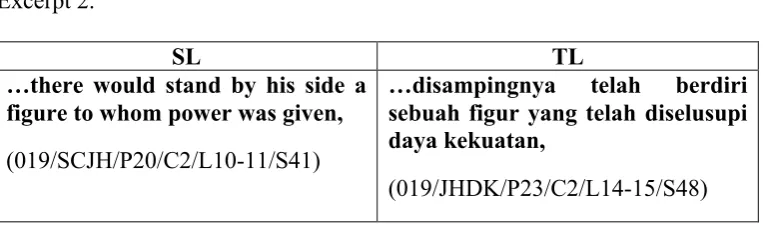
Excerpt 2.
SL TL
…there would stand by his side a figure to whom power was given, (019/SCJH/P20/C2/L10-11/S41)
…disampingnya telah berdiri sebuah figur yang telah diselusupi daya kekuatan,
(019/JHDK/P23/C2/L14-15/S48)
Three experts state that this sentence is adapting the nature of the source
language. The translation is too literal and word-for-word. It is translated as it is.
It would be better to use ‘disampingnya berdiri seorang yang amat marah’. It is
clear that translator did not find the equivalent word that is more reasonable and
frequently used in the target language.
Excerpt 3. approach of any passenger preceded
him by a long time.
(022/SCJH/P21/C2/L11-14/S53)
diketahuinya.
(022/JHDK/P25/C2/L18-22/S61)
Three experts state that this sentence is adapting the nature of the source
language. Domestic sounds in source text must not be translated to suara-suara
domestik in target text. It is better to find other words like ‘suara dari
lingkungan sekitar’ or ‘…suara-suara dari dalam/di sekitar penulis/pemeran’.
Translator translates the text as it is and makes it sounds unnatural.
Excerpt 4.
“…Tuhan memberkahiku, lelaki ini sepertinya jauh dari kesan manusiawi! Haruskah kita sebut sebagai makhluk troglodit?...” (026/JHDK/P30/L7-9/S105-106)
Three experts state that this sentence is adapting the nature of the source
language. The nature of source text is clearly adapted. Troglodit in target
language is not a common word. In bahasa troglodyte means pendeta. But the
writer refers to a member of any of various people (as in antiquity) who lived or
were reputed to live chiefly in caves. So it is better to use raksasa.
Excerpt 5.
“Your master seems to repose a great deal of trust in that young man, Poole,”
(030/SCJH/P24/C2/L28-29/S118)
“Tuanmu sepertinya memberikan kepercayaan penuh pada orang muda itu, Poole,”
(030/JHDK/P32/C2/L18-19/S126)
Four experts state that this sentence is adapting the nature of the source
language. It translates the text word by word, which is in target language will
seem unnatural and awkward in choosing diction. That young man in source text
must not be translated to orang muda itu. It would be better to use pemuda itu.
Sepertinya jalanan menjadi tidak biasa dilewati pelintas; karenanya Tuan Utterson menduga dia tidak pernah melihat bagian London yang begitu sunyi.
(038/JHDK/P79/C8/L22-23/S28)
Three experts state that this sentence is adapting the nature of the source
language. It translates the sentence word by word and it translates as it is.
Besides in source text is better to use sedangkan, not karenanya. It seemed to
have swept the street unusually bare of passengers in source text must not be
translated to sepertinya jalanan menjadi tidak biasa dilewati pelintas It could
Excerpt 7.
SL TL
… but such as I found it hard to reconcile with my imperious desire to carry my head high,…
(040/SCJH/P69/C10/L8-10/S2)
… namun aku sadar bahwa itu akan sangat sulit untuk disatukan dengan sifat angkuh yang bisa mengangkat kepalaku tinggi-tinggi,…
(040/JHDK/P119/C10/L10-12/S2)
Four experts state that this sentence is adapting the nature of the source
language. It adapts the nature if the source text and translates the sentence word
by word. The choice of word is also not proper; to carry my head high would be
better if use ‘dengan bangganya’ or ‘aku merasa bangga’.
Excerpt 8.
SL TL
… I was now confined to the better part of my existence;
(049/SCJH/P81/C10/L29-30/S115)
… kini aku dibatasi ke dalam bagian yang lebih baik dari diriku;
(049/JHDK/P144/C10/L8-9/S132)
Four experts state that this sentence is adapting the nature of the source
language. It is because the translation translates as it is. It is better to use bagian
sisibaikku in translating the better part of my existence rather than bagian yang
lebih baik dari diriku. It is also uses too long sentence that will make the reader
4.2.2 Embarking Major Changes
It means not making major changes that are important, such as history and
facts, to the language of the origin of a message is not allowed because it would
lead to deviations of real meaning or in other words not faithful to the meaning.
Excerpt 9.
SL TL
…on which he tossed to and fro until the small hours of the morning began to grow large.
(015/SCJH/P19/C2/L25-27/S36)
…diatasnya dia terombang-ambing kesana kemari hingga pagi menjelang.
(015/JHDK/P22/C2/L10-12/S42)
Three experts state this sentence is embarking major changes. It is because
the translation uses new or different meaning from the source text. It would be
better to use ‘dia gelisah tidak dapat tidur (sepanjang malam) hingga pagi
menjelang’ to translates he tossed and fro. The clause he tossed and fro and dia
terombang-ambing kesana kemari are different. The clause terombang-ambing
seem like he were in a boat. The translator also could write ‘di mana dia gelisah
dan membolak-balikkan badan sampai pagi menjelang’.
Excerpt 10.
SL TL
…and as he lay and tossed in the gross darkness of the night and the
curtained room,
(017/SCJH/P19/C2/L36-37/S39)
kamar bertirai,
(017/JHDK/P22/C2/L22-24/S45)
Three experts state this sentence is embarking major changes. It is because
the phrase terombang-ambing seems happening in the sea, but it was in bed, in
the bedroom. So it is better to use ‘sementara terbaring dan gelisah tidak dapat
tidur dalam kegelapan...’ in translating ‘tossed in the gross darkness of the
night...’
Excerpt 11.
SL TL
“It is as well we have met; and a propos, you should have my address.”
(023/SCJH/P22/C2/L20-21/S77)
“baguslah kita telah dipertemukan; dan a propos anda harus memiliki alamat saya.”
(023/JHDK/P28/C2/L7-9/S83)
Three experts state this sentence is embarking major changes. It is
embarking major changes because my address here refers to pendapat saya. And
4.2.3 Preserving the Unacceptable Grammar
It is important because a grammar rule consists of binding rules in each
language, then the transfer of the source language message should pay attention
to the rules of both the source language and target language.
Excerpt 12.
SL TL
“…one a little man who was stumping along eastward at a good walk,”
Only one expert states this sentence is preserving unacceptable grammar.
It is because the phrase tersaruk-saruk berjalan is not a common grammar style
in target text. It would be better if ‘…yang satu seorang laki-laki berbadan kecil
yang berjalan tersaruk-saruk sepanjang jalan menuju timur’.
Excerpt 13. ruangan yang paling menyenangkan di London.
(029/JHDK/P31-32/C2/L19-22&L1/ S119)
Two experts state this sentence is preserving unacceptable grammar. It is
because the word mengenainya is not acceptable structure. It would be better to
use biasanya berbicara mengenainya rather than biasa berbicara mengenainya
in translating wont to speak of it.
Excerpt 14.
SL TL
An act of cruelty to a child aroused against me the anger of a passerby, whom I recognized the other day in the person of your kinsman…
(045/SCJH/P76/C10/L31-33/S64)
Suatu aksi keji terhadap seorang anak menimbulkan kemarahan seorang pelintas melawan diriku, yang pada kesempatan lain aku mengenalinya sebagai kerabatmu…
(045/JHDK/P133/C10/L8-12/S84)
Two experts state this sentence is preserving unacceptable grammar. It is
because the translation tries to maintain the structure of source text and the
grammar seems unacceptable. The use of menimbulkan kemarahan seorang
pelintas melawan diriku is unacceptable in target language in translating
aroused against me the anger of passerby. It would be better to use
menyebabkan kemarahan seseorang yang sedang melintas kepadaku.
4.2.4 Embarking Odd Language Styles
It means translator should consider which aspects should take precedence,
the meaning of language or style, or finds a synonym for a style as close as
addition to news content. Sometimes there are a few things into consideration in
getting a good translation of the text. When a translator wants to maintain the
loyalty of meaning, then the style of language used to be weird.
Excerpt 15.
Only one expert states this sentence is embarking odd language styles. The
translation of theatrical to the eye to bahasa is unnatural, if it is translated into
sandiwara untuk ditonton mata. It is because our eyes will see a play that’s for
sure, but the phrase is used too convoluted. It will look natural if use ‘bagai
menonton sandiwara’ or ‘sandiwara untuk ditonton’.
Excerpt 16.
SL TL
He might see a reason for his friend’s strange preference or bondage (call it which you please) and even for the startling clauses of the will. untuk klausul yang mengherankan dalam wasiat itu.
Only one expert states this sentence is embarking odd language styles.
This sentence is too long that will make the reader does not want to read it. It
would be better if using ‘...menemukan alasan atas pilihan aneh atau
penghambaan kawannya (sebut saja... etc)’. And also the use of klausul yang
mengherankan in translating the startling clauses is improper, it would be better
to use kalimat aneh.
Excerpt 17.
SL TL
…and that I stuck no more reasonable spirit than that in which a sick child may break a play-thing.
(046/SCJH/P80/C10/L25-27/S103)
…dan bahwa aku diserang oleh spirit yang tidak lebih masuk akal dibandingkan dengan yang telah mendorong seorang anak merusak mainan.
(046/JHDK/P141-142/C10/L24&L1-3/S121)
One expert states this sentence is embarking odd language styles. The use
of spirit in translation text is too odd because it is rarely used in bahasa, it would
be better to use keinginan. Its better to used ‘… dan saya terjebak dengan
keinginan yang tidak masuk akal melebihi seorang anak yang ingin
4.2.5 Word Choices Not fit with the Text Technically
It means when translating a text, word choices must consider to the type of
the text technically. A technicality is a process of naming the physical or social
reality through nominalisation. Riyadi (2001: 125-126) called this process as a
non-lay process, it is the assessment of natural or social phenomenon that is
relatively consistent, with a scientific paradigm as the understanding,
identification, and classification with different ways from ordinarry people.
Excerpt 18.
Four experts state this sentence is using word choices that not fit the text
technically. It is because the translation is too long. It should not use a themselves and of each other, (014/SCJH/P18/C2/L28-29/S18)