Indones Biomed J. 2013; 5(1): 43-50 DOI: 10.18585/inabj.v5i1.50
R E S E A R C H A R T I C L E
Cost-Effectiveness Analysis of Pharmacotherapy for
Hematemesis-Melena Treatment in Hospitalized Patients with Hepatic Cirrhosis
Doddy de Queljoe
1, Amelia Lorensia
1,, Liana Widharta
1, Sugiarto Widjaja
21Pharmacy Faculty, Surabaya University, Jl. Ngagel Jaya Selatan 169, Surabaya, Indonesia 2Adi Husada Undaan Wetan Hospital, Jl. Undaan Wetan No.40-44, Surabaya, Jawa Timur, Indonesia
Corresponding author. E-mail: [email protected]
B
ACKGROUND: Acute variceal haemorrhageis a complication of cirrhosis that can be life threatening. It is a pharmacist’s duty to ensure therapeutic and pharmaceutical care which is not only safe and effective for the patient but also is cost-effective in order to attain improvement of the patient’s quality of life. Therefore, pharmacoeconomic evaluation especially cost-effectiveness analysis (CEA), which compares costs and consequences of drug therapy, is needed. This study was aimed to evaluate the therapeutic cost-effectiveness of hematemesis-melena treatment in hepatic cirrhotic patients.
METHODS: A total of 42 patients receiving vitamin K
and vitamin K-transamin were studied retrospectively from patients’ medical records in 2 years and analyzed with cost-effectiveness grid and average cost-effectiveness ratio (ACER) based on Child-Turcotte-Pugh (CTP) Score.
RESULTS: Cost-effectiveness grid was dominant for
vitamin K in patients with CTP Score A. ACER analysis showed a lower score for vitamin K in all patients included CTP Score classification. There was no significant difference in duration of cessation of bleeding treatment in patients with vitamin K compared with vitamin K-transamin in patients with CTP Score A and B, while significant difference was found in patients with CTP Score C.
CONCLUSION: Vitamin K appeared to be more
cost-effective as compared with vitamin K-transamin in all patients. The use of vitamin K had greater benefit than the combination with transamin in all patients and CTP Score classification, and thus should be considered as a primary therapy. Therefore, transamin addition as an alternative therapy for hepatic cirrhosis patients with
hematemesis-L
ATAR BELAKANG: Pendarahan varisesakut merupakan komplikasi sirosis yang dapat mengacam jiwa. Hal ini merupakan tugas farmasis untuk memastikan terapi dan pelayanan kefarmasian yang tidak hanya aman bagi pasien tetapi juga mempunyai biaya yang efektif yang bertujuan untuk memperbaiki kualitas hidup pasien. Oleh karena itu, diperlukan evaluasi farmakoekonomi terutama cost-effectiveness analysis (CEA) yang membandingkan biaya dan konsekuensi dari terapi hematemesis-melena pada pasien sirosis hepatik.
METODE: Total dari 42 pasien yang menerima vitamin
K dan vitamin K-transamin diteliti secara retrospektif dari rekam medik selama 2 tahun, dan dianalisis dengan cost-effectiveness grid dan average cost-effectiveness ratio (ACER) berdasarkan Child-Turcotte-Pugh (CTP) Score.
HASIL: Cost-effectiveness grid menunjukkan bahwa dominant untuk vitamin K pada pasien dengan CTP Score A. Analisis ACER menunjukkan nilai yang lebih rendah pada vitamin K pada semua pasien meliputi klasifikasi CTP Score. Tidak ada perbedaan bermakna untuk durasi dari penghentian terapi pendarahan pada pasien dengan vitamin K dibandingkan dengan vitamin K-transamin pada pasien dengan CTP Score A dan B, sedangkan perbedaan signifikan ditemukan pada pasien dengan CTP Score C.
KESIMPULAN: Vitamin K terbukti lebih efektif biaya
dibandingkan dengan vitamin K-transamin pada semua pasien. Penggunaan vitamin K memiliki keuntungan yang lebih besar dibandingkan dengan kombinasi dari transamin pada semua pasien dan klasifikasi CTP Score, sehingga seharusnya dipertimbangkan sebagai terapi primer. Oleh karena itu penambahan transamin sebagai terapi alternatif
The liver is a major site of metabolism of various drugs. In patients with liver disease the liver capacity for metabolism/ elimination of drugs may be disturbed.(1) Cirrhosis of the liver (hepatic cirrhosis) is one of the severe liver diseases that is chronic, irreversible, and causes high mortality(2), and this occupies the twelfth leading cause of death in the United States(3).
Hepatic cirrhosis is a diffuse process characterized by fibrosis and changes of the normal liver structure to abnormal nodule structure.(4) As a result, scar tissue is formed due to injury or long-term liver disease, and it causes the liver to fail its normal functions such as protein synthesis, cleaning process of the blood, resistance to infection, digesting foods, and energy storage.(5) The degree of severity of the liver disease can be divided into three categories with Child-Turcotte-Pugh (CTP) Score. CTP Classification is a system used to classify the degree of liver damage or development of liver disease in hepatic cirrhosis patients.(6,7)
There are some complications of cirrhosis such as ascites, hepatic encephalopathy (HE), hepatorenal syndrome, SBP (spontaneous bacterial peritonitis), and esophageal varices.(3) Fifty percent of patients with melena should be considered.
KEYWORDS: CEA, cost-effectiveness analysis,
Child-Turcotte-Pugh Score, hepatic cirrhosis, hematemesis-melena, vitamin K, transamin
Indones Biomed J. 2013; 5(1): 43-50
pada pasien sirosis hepatik harus dipertimbangkan.
KATA KUNCI: CEA, cost-effectiveness analysis, Child-Turcotte-Pugh Score, sirosis hepatik, hematemesis-melena, vitamin K, transamin
alcoholic cirrhosis will develop esophageal varices after 2 years after being diagnosed, and 70-80% patients in 10 years. About 25-35% patients with cirrhosis and large esophageal varices will experience variceal haemorrhage. Acute variceal haemorrhage is a complication of cirrhosis which has life threatening impact(2), and acts as a major cause of death in cirrhosis patients(8). The increase in portal pressure due to increased resistance to blood flow to the liver is largely due to the distortion of the liver structure to fibrous tissue and regenerative nodules and intra hepatic active vasoconstriction by 20% -30% of the increased intra hepatic resistance, and a decrease in endogenous production of nitric oxide.(9)
One of the functions of the liver is to produce several clotting factors (including prothrombin and fibrinogen) as well as to produce bile salts that are necessary for gastrointestinal absorption of vitamin K, which is needed to produce coagulation factor.(10) Deficiency in vitamin K can cause blood clotting disorders, to cause the patients to be prone to bleeding. On the other hand, transamin (tranexamic acid (TXA)), which is an antifibrinolytic agent, has proven useful for controlling bleeding in some conditions, especially is more favorable in small superficial lesions such as gastric erosion and in esophageal varices(11), and proven to provide cost-effectiveness in cirrhosis(12).
Neff et al. had examined the economic impact of
Introduction
1 2 3
Ascites None Slight Moderate / Severe
Encephalopathy None Slight / Moderate Moderate / Severe
Bilirubin (mg/dL) < 2.0 2-3 > 3.0
Albumin (mg/L) > 3.5 2.8-3.5 < 2.8
Prothrombin time (seconds, increased) 1-3 4-6 > 6.0
Parameter
Numerical Score Table 1. CTP Score.(6)
Total Numerical Score CTP Class
5-6 A
7-9 B
Indones Biomed J. 2013; 5(1): 43-50 DOI: 10.18585/inabj.v5i1.50
Methods
various regimens used for prophylaxis and treatment of cirrhosis-related complications, and found it necessary to evaluate the costs and complications of cirrhosis-related complications.(13)
Cost-effectiveness analysis(CEA) used in accordance to the study objectives in assessing relationship between cost and outcome, which in this case is clinical outcome, and CEA is an important instrument in setting priorities for strategic planning of therapy. By measuring and comparing cost and consequences of an intervention, efficient relationship could be assessed and the resources needed in the future could be estimated.(14)
This study was a non-experimental research and used the retrospective approach. Data were obtained from adult patients’ medical records which had major diagnosed hepatic cirrhosis cases.
In this study, the method used was CEA. Therapeutic cost and consequences of therapy were measured and compared.
Research variables
Dependent variables in this study were cost (cost of vitamin K and combination of vitamin K-transamin) and clinical outcome (duration of cessation of bleeding). Independent variables in this study were type of treatment and CTP score.
Population and sample
Population in this study was all the hospitalized hepatic cirrhosis patients with hematemesis-melena at Adi Husada Undaan Wetan Hospital, from January 2010 to December 2011. Patients were grouped based on their degree of liver disease with CTP score.
The number of samples was calculated based on formula(15):
N = p.q. (Z1/2a/b)
2
N = minimum sample number
p = percentage proportion in first population group q = percentage proportion in second population
group = 1-p
Z1/2α = degree of confidence coefficient in certain level of confidence (example 95 or 99%)
b = estimate percentage error possibility on number of sample determination (about 0.1 or 0.5)
Calculation of sample’s number in this study: N = p.q. (Z1/2a/b)
2 = 0.5 x 0.5 x (1.96/0.2)2 = 24 patients
Thus, the number of samples needed in each intervention group was 6 patients.
Inclusion and Exclusion Criteria
Inclusion criteria in this study were hepatic cirrhosis patients with hematemesis-melena, adult age ≥ 16 years (16), and patients treated with vitamin K or combination of vitamin K-transamin. Exclusion criteria were patients who went home before the bleeding stopped, had not improved their clinical outcome, or died; patients who had not recovered from bleeding; patients with another kind of disease like hepatoma, or used another medication (for example oral vitamin K or oral transamin), which could interfere the treatment studied and outcome relationship; incomplete patient’s medical record including diagnoses or clinical outcomes.
Data Analysis Techniques
Data obtained were analyzed with statistical method. First the normality of data was examined, then parametric (Anova one way, independent t-Test, and pooled t-Test) or non-parametric tests (Kruskal Wallis and Mann Whitney U test) were used to know the difference in duration of treatment until the bleeding stopped and the costs. Degree of significance used for the tests was 0.05 and the statistical program used was SPSS 17.0. Besides, conclusions were also made using effectiveness grid and average cost-effectiveness ratio (ACER) calculation.
Calculation of ACER
ACER was calculated based on the following formula(5) : ACER = cost / effectiveness.
Results
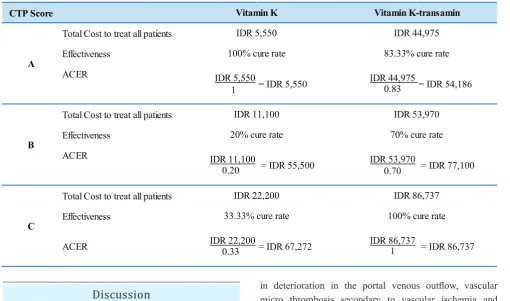
based on the length of treatment to get better. The higher the severity of liver cirrhosis, the longer the treatment will take and therefore contributes to the increasing number of drugs used to stop bleeding and will ultimately affect the cost of the used drugs. Based on calculation with ACER, it
showed that vitamin K was more cost-effective than vitamin K-transamin in all patients as well as patients with CTP Score A, B, and C.
At the test time difference of improving the treatment of the samples using parametric and nonparametric methods
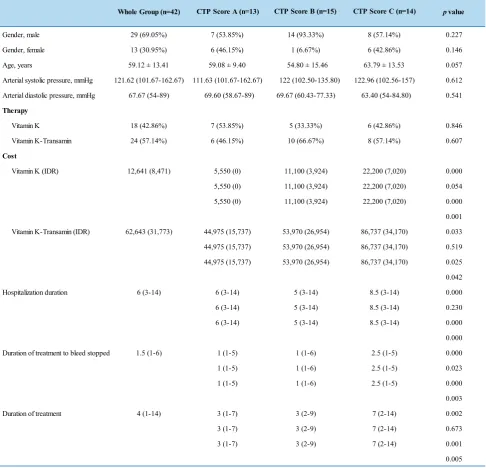
Table 3. Patients Cahracteristics
Data presented as mean + standard deviation. Significant difference if p ≤ 0.05.
Lower Equal Higher
Higher + (dominant) + +/- (trade off)
Equal + Arbitrary
-Lower +/- (trade-off) - - (dominated)
Cost of Alternative A Relative to Alternative B
Effectiveness of Alternative A Relative to Alternative B
Table 1. Cost-Effectiveness Grid for CEA.
Whole Group (n=42) CTP Score A (n=13) p value
Gender, male 29 (69.05%) 7 (53.85%) 14 (93.33%) 8 (57.14%) 0.227
Gender, female 13 (30.95%) 6 (46.15%) 1 (6.67%) 6 (42.86%) 0.146
Age, years 59.12 ± 13.41 59.08 ± 9.40 54.80 ± 15.46 63.79 ± 13.53 0.057
Arterial systolic pressure, mmHg 121.62 (101.67-162.67) 111.63 (101.67-162.67) 122 (102.50-135.80) 122.96 (102.56-157) 0.612
Arterial diastolic pressure, mmHg 67.67 (54-89) 69.60 (58.67-89) 69.67 (60.43-77.33) 63.40 (54-84.80) 0.541
Therapy
Vitamin K 18 (42.86%) 7 (53.85%) 5 (33.33%) 6 (42.86%) 0.846
Vitamin K-Transamin 24 (57.14%) 6 (46.15%) 10 (66.67%) 8 (57.14%) 0.607
Cost
Vitamin K (IDR) 12,641 (8,471) 5,550 (0) 11,100 (3,924) 22,200 (7,020) 0.000
5,550 (0) 11,100 (3,924) 22,200 (7,020) 0.054
5,550 (0) 11,100 (3,924) 22,200 (7,020) 0.000
0.001
Vitamin K-Transamin (IDR) 62,643 (31,773) 44,975 (15,737) 53,970 (26,954) 86,737 (34,170) 0.033
44,975 (15,737) 53,970 (26,954) 86,737 (34,170) 0.519
44,975 (15,737) 53,970 (26,954) 86,737 (34,170) 0.025
0.042
Hospitalization duration 6 (3-14) 6 (3-14) 5 (3-14) 8.5 (3-14) 0.000
6 (3-14) 5 (3-14) 8.5 (3-14) 0.230
6 (3-14) 5 (3-14) 8.5 (3-14) 0.000
0.000
Duration of treatment to bleed stopped 1.5 (1-6) 1 (1-5) 1 (1-6) 2.5 (1-5) 0.000
1 (1-5) 1 (1-6) 2.5 (1-5) 0.023
1 (1-5) 1 (1-6) 2.5 (1-5) 0.000
0.003
Duration of treatment 4 (1-14) 3 (1-7) 3 (2-9) 7 (2-14) 0.002
3 (1-7) 3 (2-9) 7 (2-14) 0.673
3 (1-7) 3 (2-9) 7 (2-14) 0.001
0.005
Indones Biomed J. 2013; 5(1): 43-50 DOI: 10.18585/inabj.v5i1.50
Vitamin K (n=7) Vitamin K-Transamin (n=6) p value
Gender, male 3 (42.86%) 4 (66.67%) 0,705 Gender, female 4 (57.14%) 2 (3.33%) 0,414 Age, years 64 ± 10.50 53.33 ± 2.50 0,034 Arterial systolic pressure, mmHg 130.33 (101.67-140.56) 114.9 (101.86-162.67) 0.860 Arterial diastolic pressure, mmHg 62.67 (58.67-75.22) 74.17 (61.71-91.12) 0,027 Hospitalized duration 4 (3-9) 4 (3-8) 1.000 Duration of treatment to bleed stopped 1 (1-1) 1 (1-2) 0.280 Duration of treatment 3 (1-7) 3.5 (2-6) 0,941 Cost 5,550 (0) 44,975 (15,737) 0,001
Vitamin K (n=5) Vitamin K-Transamin (n=10) p value
Gender, male 4 (80%) 10 (100%) 0,109 Gender, female 1 (20%) 0 (0%) -Age, years 52 ± 21.06 57.2 ± 12.97 0,323 Arterial systolic pressure, mmHg 109.87 (102.5-149.3) 129.59 (108.33-157) 0.170 Arterial diastolic pressure, mmHg 65.6 (62.37-69.6) 74.46 (60-84.8) 0,061 Hospitalization duration 6 (5-10) 5 (3-8) 0,107 Duration of treatment to bleed stopped 2 (1-3) 1 (1-3) 0,103 Duration of treatment 6 (5-9) 2.5 (2-6) 0,007 Cost 11,100 (3,924) 53,970 (26,954) 0,001
Vitamin K (n=6) Vitamin K-Transamin (n=8) p value
Gender, male 3 (50%) 5 (62.5%) 0.480 Gender, female 3 (50%) 3 (37.5%) 1.000 Age, years 62.67 ± 19.45 64.62 ± 8.23 0,801 Arterial systolic pressure, mmHg 109.88 (102.56-132.5) 129.31 (110.14-139.71) 0,022 Arterial diastolic pressure, mmHg 61.47 (54.93-78.36) 72.1 (60.17-80.43) 0,117 Hospitalized duration 11 (8-14) 8.5 (4-13) 0,134 Duration of treatment to bleed stopped 4.5 (2-5) 2.5 (1-3) 0.010 Duration of treatment 10 (7-14) 5.5 (2-9) 0,007 Cost 22,200 (7,020) 86,737 (34,170) 0,002
Patient Characteristics in CTP Score A
Patient Characteristics in CTP Score B
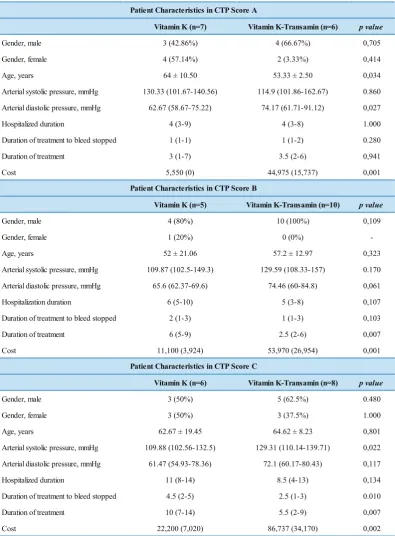
Patient Characteristics in CTP Score C Table 4. Patients Cahracteristics in CTP Score A, B and C
of analysis showed a significant difference (α=0.05) in comparison to the longer treatment improved in patients with CTP Score A, B and C (Table 4). Comparison of the lengths of time of treatment to improve in patients with vitamin K therapy in patients with CTP Score A and B were not significant, while comparison of the CTP Score A and C with B and C showed significant differences. The duration lengths of treatment to improve therapy in patients with vitamin K-transamin in patients with CTP Score A and B were not significant, while in comparison the CTP Score A and C with B and C it showed significant differences
Total Cost to treat all patients
Effectiveness
IDR 12,641 IDR 62,643 0.44 0.58
Vitamin K Vitamin K-transamin
= IDR 28,731 IDR 12,641
44.44%cure rate
= IDR 108,006 ACER
IDR 62,643
58.33%cure rate
Table 5. ACER in all patients.
CTP Score
Total Cost to treat all patients
Effectiveness
ACER IDR 5,550 IDR 44,975
Total Cost to treat all patients
Effectiveness
ACER IDR 11,100 IDR 53,970
0.20 0.70
Total Cost to treat all patients
Effectiveness
IDR 22,200 IDR 86,737
0.33 C
B A
IDR 86,737
100% cure rate IDR 5,550
100% cure rate
IDR 11,100
20% cure rate
IDR 22,200
33.33% cure rate
Vitamin K-transamin Vitamin K
83.33% cure rate IDR 44,975
IDR 53,970
70% cure rate
= IDR 5,550 = IDR 54,186
= IDR 55,500 = IDR 77,100
ACER = IDR 67,272 = IDR 86,737
1
1 0.83
Table 6. ACER in patients with CTP Score A, B and C.
in deterioration in the portal venous outflow, vascular micro thrombosis secondary to vascular ischemia and infarction may lead to the heart, with the loss of liver tissue (parenchymal extinction) being replaced by fibrotic tissue. (20) The incident is most commonly caused by portal PVT that can contribute to significant morbidity and mortality. Cirrhotic patients with PVT should be screened for varices and then anti coagulated with low-molecular-weight heparin for at least a 6-month period. Newer evidence suggests that prophylactic anticoagulation in patients with cirrhosis may have a role in clinical management with decreased incidence of PVT and improved survival.(21)
The patients characteristics can be seen in Table 3, while patients characteristics based on CTP classification can be seen in Table 4. p value indicates significant difference if p ≤ 0.05. In this study, there was one group with a number of samples less than 6, and it was CTP score B group using vitamin K with just 5 subjects. This was due to the limitation of hepatic cirrhosis patients with hematemesis-melena.
Discussion
One of the important pharmacist’s responsibilities in clinical pharmacy is to ensure good therapeutic outcome and pharmaceutical care which must not only be safe and effective, but also have a high value from economic and humanistic aspects. In fact, pharmacy profession would not succeed in their role to provide pharmaceutical care without economic knowledge.(17) Therefore, pharmaco-economic evaluation like CEA which compares cost and effectiveness of therapy is needed.(18,19) The cost of transamin is higher than the cost of vitamin K, and to know whether addition of transamin in vitamin K monotherapy is needed in clinical practice, cost-effectiveness evaluation is required.
Indones Biomed J. 2013; 5(1): 43-50 DOI: 10.18585/inabj.v5i1.50
The difference of liver severity will take effect on therapeutic effectiveness. The higher the liver damage, the lower the therapeutic effectiveness, due to decrease of liver function for coagulation factor synthesis (1,22), and if there is any hepatocellular disease or if the liver cell couldn’t synthesize blood coagulation factor, vitamin K given to patients wouldn’t be effective(23).
Beside CTP Score, there is another instrument used to classify the severity of the liver damage, which is a newer method called model of end stage liver disease (MELD). There are some benefits of MELD, like no subjective assessment like CTP score (ascites, hepatic encephalopathy), but hepatologists generally do not use MELD because not all laboratories use internationalized ratio (INR) which is one of MELD components as coagulation marker in hepatic cirrhosis patient, and there is no clear value limitation on MELD. Besides that, MELD scoring needs calculation, therefore quick and simple measurement couldn’t be applied.(24)
In Indonesia, the biggest risk factor as the cause of hepatic cirrhosis progression of hepatitis C and B infections followed by hemochromatosis(25) rather than alcohol, because of the difference between the amount of alcohol consumed by people in western countries than people in Indonesia. The development of hepatitis C to hepatic cirrhosis usually take years or decades, with average of 20 years.(26) Most of hepatic cirrhosis patients are elderly people, usually in the range of 52-69 years old due to hepatic cirrhosis development which takes years or decades. From this study it is known that hepatic cirrhosis symptoms appears averagely at the age of 51 years and culminates at the range of 52-69 years.
In this study bleeding mostly stopped at the first day after medication, although the patient had bled for days before hospitalized. This is in accordance with literature that claims when vitamin K is given parenterally, prothrombin time (PT) may need 12 to 24 hours to normal, although improvement may happen in 1 to 2 hours(27), whereas transamin has t1/2 = 2 hours(28). Therefore, it is most likely that patient’s bleeding could be stopped at the first day of treatment.
Anti-fibrinolytic therapy has been shown to be useful in controlling bleeding in some conditions, especially in patients with gastric erosion and also in esophageal varices. Anti-fibrinolytic effect is not associated with improved systemic fibrinolysis, but more due to the inhibition of local fibrinolysis in gastroduodenal mucosa.(10) Therefore, the use of transamin in addition to the use of vitamin K can be an option, but there is no sufficient evidence supporting a recommendation on the use of transamin in the treatment
Conclusion
The use of vitamin K therapy is more cost-effective than combination therapy of vitamin K-transamin in all patients with liver cirrhosis and hematemesis-melena, and in of gastrointestinal bleeding and bleeding from varices.(7) Regardless of the fact there is an evidence that transamin is a useful treatment for refractory bleeding due to gastric antral vascular ectasia in patients with cirrhosis.(29)
Comparative effectiveness based on
pharmacoeconomics reviews, performed by calculating the percentage of patients with cirrhosis of the liver with hematemesis melena ≤ 1 day in all patients and in patients with CTP Score A and B, as well as old treatment until the bleeding that stopped ≤ 3 days in patients with CTP Score C.
Data were analyzed using cost-effectiveness grid and ACER. From the cost-effectiveness in the table grid (Table 2) it can be seen that vitamin K has a dominant outcome in patients with CTP Score A and trade off on all patients as well as patients with CTP Score B and C. Consider further follow up on the results of the trade off is using ACER. From the dominant finding in the results, it can be seen that treatment with vitamin K have a lower cost with higher effectiveness than vitamin K-transamin, so it can be concluded that vitamin K is more cost-effective than vitamin K-transamin.
Based on the calculation of ACER (Table 5 and 6), it showed the value of vitamin K was smaller than the vitamin K-transamin, so it can be concluded that vitamin K is more cost-effective than vitamin K-transamin in all patients as well as in patients with CTP Score A, B, and C.
Acknowledgement
This research was supported by the Research and Community Service Institution of the University of Surabaya (Lembaga Penelitan dan Pengabdian Kepada Masyarakat Ubaya), Surabaya.
References
1. Kenward R, Tan CK. Penggunaan Obat pada Gangguan Hati. In: Aslam M, Tan CK, Prayitno A, editors. Farmasi Klinis-Menuju Pengobatan Rasional dan Penghargaan Pilihan Pasien. Surabaya: Elex Media Komputindo; 2003. p. 155-6.
2. Sease JM, Timm EG, Stragand JJ. Portal Hypertension and Cirrhosis. In: Dipiro JT, Talbert RL, Yee GC, editors. Pharmacotherapy A Pathophysiologic Approach, 7th ed. Berkshire: McGraw Hill Medical; 2008. p. 633-47.
3. Runyon BA. Management of Adult Patients with Ascites Due to Cirrhosis: An Update. American Association for the Study of Liver Diseases. All American Association for the Study of Liver Diseases. 2009; 49: 2087.
4. Crawford, James M. The Liver, Gall Bladder, and Billiary Tract. In Kumar V, Abbas AK, Fausto N, Mitchell R, editors. Robbins Basic Pathology. 8th ed. Philadelphia: Saunders Elsevier; 2007. p. 631-51. 5. National Institute of Health. Cirrhosis in Medline Plus (online). 2012. 6. Martin P, Friedman LS. Assessment of liver function and diagnostic
studies, In: Friedman LS, Keeffe EB, editors Handbook of Liver Disease. 2nd ed. Philadelphia: Churchill Livingstone; 2004. p. 1-15. 7. Scottish Intercollegiate Guidelines Network (SIGN).Management of
acute upper and lower gastrointestinal bleeding-A National Clinical Guideline. 2008.
8. Sadovsky R. Management of Patients with Incidental Esophageal Varices. Am Fam Physician. 2005; 7: 980-5.
9. Tsao GG, Sanyal AJ, Grace ND, Carey W, and the Practice Guidelines Committee of the American Association for the Study of Liver Diseases, the Practice Parameters Committee of the American College of Gastroenterology. Prevention and Management of Gastroesophageal Varices and Variceal Hemorrhage in Cirrhosis.
American Association for the Study of Liver Diseases Practice Guideline. 2007; 46: 924-5.
10. Vander AJ, Sherman J, Luciano DS. The Digestion and Absorption of Food, In: Vander AJ, Sherman J, Luciano DS, editors. Human Physiology: The Mecanism of Body Function 8th ed. Philadelphia: The McGraw-Hill Companies; 2001.
11. Biggs JC, Hugh TB, Dodds AJ. Tranexamic acid and upper gastrointestinal haemorrhage-a double-blind trial. Gut. 1976; 17:729-34.
12. Guerriero C, Cairns J, Perel P, Shakur H, Roberts I. Cost-Effectiveness Analysis of Administering Tranexamic Acid to Bleeding Trauma Patients Using Evidence from the CRASH-2 Trial. PLoS ONE. 2011; 6: e18987.
13. Neff GW, Kemmer N, Duncan C, Alsina A. Update on the management of cirrhosis-focus on cost-effective preventative strategies. Clinicoecon Outcomes Res. 2013; 12: 143-52.
14. UNAIDS. Cost-effectiveness analysis and HIV/AIDS: UNAIDS Technical Update. 1998.
15. Sari IP. Penelitian Farmasi Komunitas dan Klinik, GadjahMada. Yogyakarta: University Press; 2004. P.31.
16. World Health Organization. Global Strategy on Diet, Physical Activity & Health: Physical Activity and Adults (online). 2013.
17. Bootman JL, Townsend RJ, McGhan WF. Introduction to Pharmacoeconomics. In: Bootman JL, Townsend RJ, McGhan WF, editors. Principles of Pharmacoeconomics. 3rd. Cincinnati: Harvey Whitney Books Company; 2005. p. 1-10.
18. Skrepnek GH. Cost Effectiveness Analysis (CEA). In: Principles of Pharmacoeconomics. 3rd edition. Cincinnati: Harvey Withney Books Company; 2005. p. 83-112.
19. Bootman JL, Harrison DL. Pharmacoeconomics and Therapeutic drug monitoring. Pharm World Sci. 1997; 19: 178-81.
20. Ponziani FR, Zocco MA, Garcovich M, D'Aversa F, Roccarina D, Gasbarrini A. What we should know about portal vein thrombosis in cirrhotic patients: a changing perspective.World J Gastroenterol. 2012; 28:5014-20.
21. Congly SE, Lee SS. Portal vein thrombosis: should anticoagulation be used? Curr Gastroenterol Rep. 2013; 15: 306.
22. Kumar P, Clark M. Liver, Biliary Tract and Panreatic Disease. In: Kumar P, Clark M, editors. Kumar & Clark's Clinical Medicine. 7th ed, London: Saunders Elsevier; 2009. p.219 & 319-20.
23. Pagana KD, Pagana TJ. Blood Studies. In: Pagana KD, Pagana TJ, editors. Mosby's Manual of Diagnostic and Laboratory Tests. St. Louis: Mosby Elsevier; 2006. p.387-445.
24. Durand F, Valla D. Assesment of the prognosis of cirrhosis: Child-Pugh versus MELD. J Hepatol. 2005; 42: 100-7.
25. Ridwan M. Awas! Tiap Tahun 25 Ribu Orang Meninggal Akibat Sirosis Hati, PT. Lensa Indonesia Global Media (online). 2012.
26. Franciscus A. Disease Progression: What is Cirrhosis?,HCSP version 3.1.2010.
27. Bickert B, Witmer C. Coagulation Disorder. In Dipiro JT, Talbert RL, Yee GC, editors. Pharmacotherapy A Pathophysiologic Approach. 7th ed. Philadelphia: McGraw Hill Medical; 2008. p. 1665-1682. 28. Sweetman SC. Martindale the Complete Drug Reference 36th ed.
London: Pharmaceutical Press; 2009. p. 1081-996.
29. McCormick PA, Ooi H, Crosbie O.Tranexamic acid for severe bleeding gastric antral vascular ectasia in cirrhosis. Gut. 1998; 42: 750-2.
patients with CTP score A, B, and C. This conclusion should be regarded with caution due to its limitation and further research is needed.