The Need for Interim Forest
Finance to Meet Emission
Reduction Targets in Indonesia:
Case Study
1
Executive Summary
About the Interim Forest Finance project (IFF)The Interim Forest Finance (IFF) project is a collaborative initiative of the Global Canopy Programme (GCP), the Amazon Environmental Research Institute (IPAM), Fauna & Flora International (FFI), the UNEP Finance Initiative (UNEP FI), and the United Nations Ofice for REDD+ Coordination in Indonesia (UNORCID). The IFF project advocates a strategic intervention by donor country and tropical forest country governments, and public inancial institutions, to scale up public and private sector demand for REDD+ emission reductions, in the interim period between 2015 and 2020.
To contact the IFF management team, please write to [email protected]
Citation
Pareira, J., Hartley, J. and Cullen, Z., 2014. The need for interim forest inance to meet emissions reductions targets in Indonesia: a case study for the Interim Forest Finance Project. Written by Fauna & Flora International, Cambridge, UK. Published by Global Canopy Programme, Oxford, UK. © Global Canopy Programme 2014
Acknowledgements
Authors: Fauna & Flora International - Jeni Pareira, Jason Hartley, Zoë Cullen, Dorothea Pio, Iis Sabahudin
Input from: Darmawan Liswanto, Herovan Alvin Review by: Fitrian Ardiansyah
The authors would like to thank the representatives of the Indonesian government, the private sector and other stakeholders, who shared their views and helped shape the
indings of this report.
The Interim Forest Finance Project is funded by the
Norwegian Agency for Development Cooperation (NORAD). The views and interpretations in this report are those of the authors and do not necessarily represent those of NORAD.
The Global Canopy Programme (GCP)
The Global Canopy Programme is a tropical forest think tank working to demonstrate the scientiic, political and business case for safeguarding forests as natural capital that underpins water, food, energy, health and climate security for all.
GCP works through its international networks – of forest communities, science experts, policymakers, and inance and corporate leaders – to gather evidence, spark insight, and catalyse action to halt forest loss and improve human livelihoods dependent on forests. The Global Canopy Programme is a registered UK charity, number 1089110. www.globalcanopy.org
Indonesia faces signiicant impacts from climate change, and has set targets to reduce greenhouse gas emissions by 26% by 2020 through unilateral action, or by up to 41%1 with adequate
international assistance, while also achieving 7% economic growth. With the vast majority (about 87%) of Indonesia’s emission reduction targets expected to be met from forests and peatland, REDD+ will play a vital role in meeting either of these targets.
It is hoped that the 41% target will be met, rather than just the 26% target: the difference would mean losing an additional 1.158 million hectares of forest (an area 2.6 times the size of Jakarta) before 2020, constituting about 0.37 GtCO2 in additional emissions. Indonesia will need signiicant inance to implement activities that directly and indirectly suppor t the achievement of the country’s REDD+ emission reductions targets and the wider transition to a green economy; a transition that will assist Indonesia with its pro-growth, pro-job, pro-poor and pro-environment national development strategy. A range of approaches and sources of inance will be required.
Currently however, there is a signiicant lack of funding to pay for and incentivise REDD+ emission reductions, in comparison to that needed for Indonesia to achieve these targets. This gap, which also exists in other forest countries, is acknowledged by government and private sector actors in Indonesia as a key threat to the future of REDD+.
Conservative estimates suggest that US$5-10 billion will be required to pay for REDD+ activities to achieve Indonesia’s emission reductions targets before 2020, when a global climate change agreement is anticipated. Yet the only known source of inance committed for performance-based emission reductions in the country so far is US$800 million allocated by Norway. No inance has been committed beyond 2017.
Failure to address the demand shortfall in the interim period from 2015-2020 is damaging conidence in REDD+, reducing the incentive for investment, and storing up signiicant challenges for later, once the ‘readiness’ work has been completed and REDD+ needs to be fully implemented. It is widely acknowledged that the shortfall in demand cannot be met using public sector funds alone; one estimate suggests that US$7 billion will need The Amazon Environmental Research
Institute (IPAM)
The Amazon Environmental Research Institute (IPAM) is a non-proit, independent research, policy and outreach organisation that has worked over the past 16 years towards achieving sustainable development in the Amazon region in a way that reconciles people’s economic aspirations and social justice with the maintenance of the functional integrity of tropical forest landscapes. www.ipam.org.br
Fauna & Flora International (FFI)
Fauna & Flora International (FFI) is a biodiversity conservation organisation working in more than 40 countries around the globe, mostly in the developing world. Our vision is a sustainable future for the planet, where biodiversity is effectively conserved by the people who live closest to it, supported by the global community. Founded in 1903, FFI is the world’s longest established international conservation body and a registered charity. www.fauna-lora.org
UNEP Finance Initiative (UNEP FI)
The United Nations Environment Programme Finance Initiative (UNEP FI) was established in 1992 as a par tnership between policy makers and financial intermediaries. With over 200 members representing banks, insurers, and investors from the around the world, UNEP FI contributes the perspectives of financial institutions to the United Nations and global activities on sustainable finance. UNEP FI’s mission is to bring about systemic change in finance to suppor t a sustainable world by “Changing finance, financing change”. www.unepi.org
United Nations Ofice for REDD+ Coordination in Indonesia (UNORCID)
UNORCID (United Nations Ofice for REDD+ Coordination in Indonesia) is the UN System focal point for REDD+ in Indonesia, and serves as a coordinating body and knowledge institution. Building on the competitive advantage and domain expertise of eight UN Partner Agencies (UNDP, UNOPS, ILO, FAO, UNEP, UNESCO, WFP, and UNODC) and numerous civil society partners, UNORCID provides decision-makers and stakeholders at the national through local levels with relevant information and tools to support successful REDD+ implementation. UNORCID was inaugurated on 17 November 2011 by the UN Secretary General, following the signing of a Memorandum of Understanding (MoU) between the Republic of Indonesia and the UN System in September 2011. www.unorcid.org
to come from the private sector. Therefore, in addition to raising public inance, it is also important to ensure that it is deployed using mechanisms2 that can catalyse the involvement of the
private sector, which can both provide a source of demand and support the development of REDD+ activities.
Creating incentives
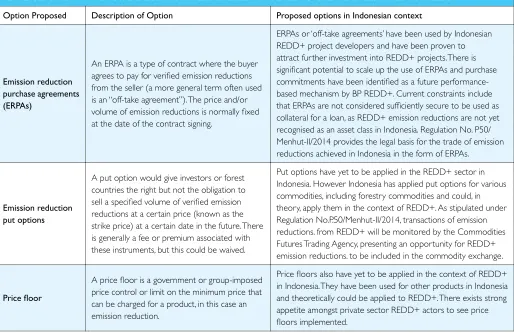
There is signiicant potential in Indonesia to scale up the use of emissions reductions purchase agreements (ERPAs), or ‘off-take agreements’, in which buyers agree to pay for veriied emission reductions from sellers, at a ixed price and date. There is a legal basis in Indonesia for the use of ERPAs for trading in emission reductions, and they have been used by REDD+ project developers, successfully attracting further investment.
Emission reduction put options would give the country, and investors, the right (but not the obligation) to sell a speciied volume of emission reductions at a ixed price and date. Put options contracts have been used in Indonesia for forest commodities, and could be used for REDD+.
Similarly, price loors (imposed limits on the minimum price that can be charged for an emission reduction) have been used for other products in Indonesia and could be used for REDD+. This mechanism is popular with private sector REDD+ actors.
Providing inance and risk management
Grants, although not directly impor tant for boosting interim inance, will continue to be needed in Indonesia to cover REDD+ star t-up costs and create enabling conditions for attracting private sector capital (such as building technical capacity).
Loans could be used for REDD+ in Indonesia, where they are the main form of climate inance, supporting sectors such as energy. However, it is currently hard for REDD+ project developers to access loans, and inancial institutions also lack capacity to assess loan proposals.
1These targets are reductions against the business-as-usual scenario.
2 3
Build support to address lack of demand and interim forest inance.
The serious implications of not addressing the lack of demand and inance need to be clearly communicated in Indonesia - where awareness is already rising - as well as in other forest and donor countries.
Clariication of the potential role of advance market commitments.
It is thought by many stakeholders that advance market commitments (AMCs) (e.g. options contracts) could provide an important stimulus to REDD+ in Indonesia in the critical period leading up to 2020. Greater detail is required, from the IFF project and other stakeholders, on how this could be achieved.
Loan guarantees would allow inancial institutions to extend credit or offer lower interest rates to borrowers they would otherwise not lend to, such as REDD+ project developers. There is a successful precedent for this in Indonesia.
Commercial and political risk insurance can protect investors against risks (such as forest ires or policy changes), which could affect a REDD+ project. It has been widely used in the business sector in Indonesia.
Providing technical assistance and advice
There is evidence that advisory and technical assistance would improve the capacity of REDD+ project developers in Indonesia to produce viable business plans and loan applications, and boost the capacity of inancial institutions to assess REDD+ loan applications.
There is interest amongst REDD+ stakeholders in Indonesia in investigating all of these mechanisms to catalyse investment in, and demand for, REDD+ - although government stakeholders tend to favour a subset of instruments with which they are more familiar.
Meanwhile, in order to enable these mechanisms to achieve the necessary scale of impact, Indonesia will need to achieve further regulatory reforms and progress on governance issues; systematic inancial measurement, reporting and veriication (MRV) for climate inance; the establishment of an institution to manage interim forest inance; greater clarity on land tenure; and further investment in subnational capacity to deliver REDD+ emission reductions.
The following actions are recommended:
Further work to establish an enabling environment for REDD+ in Indonesia.
Indonesia would beneit from continuing to focus on addressing outstanding enabling requirements, particularly governance issues and regulatory reform to enable a domestic carbon market to integrate with international mechanisms. While awaiting the legal reform needed to fully operationalise the Fund for REDD+ in Indonesia (FREDDI), a public-private partnership between a business entity and a public trust fund could be established to coordinate interim forest inance.
Clear pledges from donor countries of inancial and technical support in the interim period.
These would provide a strong incentive to tropical forest countries, and a signal that inding an interim solution is recognised as a priority. This could motivate the investment of social, political and inancial capital necessary to inalise the enabling conditions described above.
Greater engagement with the private sector in Indonesia.
Private sector inance is acknowledged as important for meeting Indonesia’s emission reduction targets. Greater engagement of relevant private sector actors in the design of national processes for REDD+ would help clarify their needs and identify appropriate measures to incentivise greater investment.
Communication within the UNFCCC of Indonesia’s position on the need for interim inance and the role of carbon markets.
Stakeholders in Indonesia, and the National REDD+ Strategy, recognise that a market-based approach should play a role in inancing REDD+. The strong communication of this view, and of a domestically agreed position on how such a market should develop, would help advocate for incorporating REDD+ into a compliance market for carbon.
Anticipated supply of REDD+ emission reductions in Indonesia compared to current known demand
Current known demand:
US$800 Million
Conservative estimate of total inance needed to achieve desired emission reductions:
US$10 Billion
Estimate of inance needed from private sector:
US$7 Billion
US$800 Million US$10 Billion
4 5
Section 1:
Introduction to the Interim Forest Finance project 6Section 2:
Overview of REDD+ and the wider political context in Indonesia 102.1 Indonesia’s emission reductions targets 10
2.2 REDD+ in Indonesia 12
2.3 Indonesia’s National REDD+ Strategy 12
2.4 Mainstreaming REDD+ into the national development plan 15
2.5 Current laws supporting REDD+ implementation in Indonesia 15
2.6 The forest moratorium 15
2.7 The One Map Movement 17
2.8 Presidential Regulation on the REDD+ Managing Agency 17
2.9 Measurement, Reporting and Veriication (MRV) System 17
2.10 Fund for REDD+ in Indonesia (FREDDI) 18
2.11 REDD+ at the subnational level 18
2.12 Non-governmental actors creating the enabling environment for REDD+ 18
2.13 Fiduciary safeguards for REDD+ 19
2.14 Analysis: Indonesia’s policies and targets, and the need for interim forest inance 19
Section 3:
Current strategies for inancing REDD+ in Indonesia 203.1 Indonesia’s REDD+ inancing needs 20
3.2 Existing sources of funding for REDD+ in Indonesia 21
3.3 The REDD+ inancing gap 24
3.4 Current mechanisms for inancing REDD+ in Indonesia 25
3.5. Emission reductions 30
3.6 Analysis: Interim forest inance in the context of current REDD+ inancing strategies in Indonesia 31
Section 4:
Mainstreaming REDD+ into the national development plan 324.1 Private sector players in Indonesia relevant to REDD+ 32
4.2 Indonesian government objectives for growth in the REDD+ market and stimulating private sector investment in REDD+
4.3 Barriers to market growth 34
4.4 Possible solutions, links and rationale for interim forest inance
4.5 Analysis: How could interim forest inance support growth objectives, and address potential market barriers
for REDD+ in Indonesia? 36
Section 5:
Scaling up inancing for REDD+ in Indonesia with interim forest inance 375.1 The Interim Forest Finance project’s proposed strategic intervention 37
5.2 Generation of capital 37
5.3 Providing incentives, inance and assistance 38
5.4 Options for capital management – potential solutions for implementation 45
5.5 Regulatory reform and deployment capacity needed to enable a market-based approach 45 5.6 Analysis: Options for interim forest inance to it with the local needs and context of Indonesia 46
Section 6: Conclusions
476.1 The need for interim forest inance in Indonesia 47
6.2 Applicability of the proposed options in the Indonesian context 48
6.3 Building the enabling environment for interim forest inance in Indonesia 49
6.4 Recommendations for next steps 49
Annex 1: Risk of not meeting the 41% emission reduction target from forests and peatland 52
Annex 2: Stakeholders consulted for this report 53
Annex 3: Laws and regulations supporting REDD+ implementation in Indonesia 54
Glossary
56References
57Contents
34
6 7
In order to achieve this, we are:
Examining ways to deliver the funding that has already been committed by donor country governments such that it helps to unlock private inance for and investment in REDD+, and increases demand for REDD+ emission reductions before 2020.
Investigating the need for additional public funding to leverage increased private inance for REDD+ and scale up demand for REDD+ emission reductions before 2020, in order to meet targets made under the UNFCCC for mobilising climate inance and preventing dangerous levels of climate change.
Reviewing the capital-raising options, deployment instruments and the institutional frameworks that can be used to achieve the above targets.
Potential deployment options
The IFF project has identiied a range of potential deployment options for interim forest inance that could be used to create a clearer signal of demand for REDD+ emission reductions, boosting conidence in REDD+ generally, and creating conditions that will encourage greater investment, particularly from the private sector.
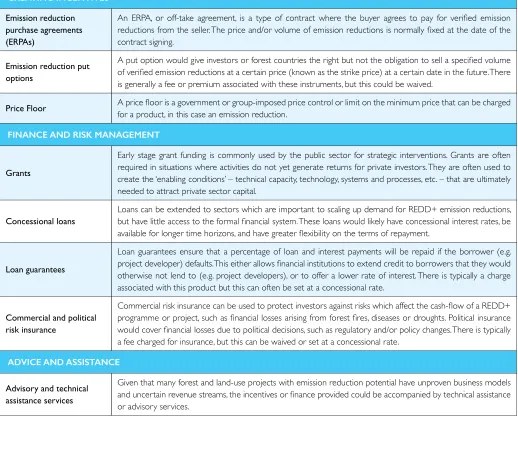
Table 1 describes the characteristics of the potential deployment options for interim forest inance, as identiied in the IFF project scoping study (GCP, IPAM, FFI UNORCID and UNEP FI, 2014).
Section 1: Introduction to the Interim
Forest Finance project
The IFF project aims to address the signiicant lack of inance and demand for REDD+3 emission reductions in the
lead-up to 2020, when a global climate change agreement is anticipated. This lack of inance for REDD+ activities and the gap between supply and demand4 for REDD+ emission
reductions risks eroding conidence in REDD+ at a critical time. We aim to facilitate agreement on a strategy for scaling up demand for, and investment in, REDD+ in the period up to 2020, by working with governments and the private sector to identify interventions that can be rapidly deployed in speciic jurisdictions. Our approach is grounded in the recognition that public sector inance alone will be insuficient to meet targets for reducing emissions or deforestation. As such, we advocate the deployment of strategic, targeted interventions that can leverage private sector investment and foster effective public-private collaboration on REDD+.
The problem:
anticipated supply of REDD+
emission reductions vastly exceeds demand
The successful implementation of REDD+, at the scale needed to help avert dangerous climate change, is threatened by a lack of demand for REDD+ emission reductions in the period between 2015 and 2020 – the ’interim period’.
The Fifth Assessment Report (AR5) from the Intergovernmental Panel on Climate Change (IPCC) warns that the world is on a dangerous trajectory towards warming of 4 degrees Celsius. In order to limit climate change to the safer level of 2 degrees, global deforestation levels need to be signiicantly reduced alongside other methods of generating emission reductions. The European Commission has proposed a global reduction in deforestation by 50% by 2020, which would constitute emission reductions of up to 9,900 million metric tonnes of carbon dioxide equivalent (MtCO2e) from forests and land use in the interim period.
This drop in deforestation, and the associated emission reductions, can be achieved through a combination of measures taken by tropical forest countries and the private sector, using (1) domestic policy and regulatory reform, (2) overseas
development assistance funding that contributes to the achievement of REDD+ emission reductions, and (3) payments in exchange for REDD+ emission reductions. The IFF project focuses on the third of these measures.
However, currently there are very few counterparties and no large-scale inancial mechanism that will pay for REDD+ emission reductions over the medium to long-term (15-25 years) time horizon required for investment in REDD+ activities. This limits the total potential demand for REDD+ emission reduction units for the 2015-2020 interim period, which currently stands at an estimated 253 MtCO2e – less than 3% of the total 9,900 MtCO2e emission reductions needed globally before 2020. This current scenario leaves tropical forest countries to ind other ways to achieve the remaining 97% (GCP, IPAM, FFI and UNEP FI, 2014).
Many of the 9,900 MtCO2e of REDD+ emission reductions will be achieved using domestic and regulatory reform and overseas development assistance (measures 1 and 2, above). If only 25% of the emission reductions are to be paid for by exchanging payments for REDD+ emission reductions (measure 3 above), e.g. through an international crediting mechanism, these are currently as much as 3-10 times the current demand. This means that demand is falling perilously shor t of what is needed to avoid dangerous climate change, which will increase the future costs for donor and forest countries of addressing climate change.
Demand is a key component that forest countries consider when planning their development pathways. Without long-term, credible and predictable economic incentives, they have little motivation to divert human, political and inancial capital away from economically viable ‘business-as-usual’ activities and to make the substantial inancial and socio-political investment required to create the infrastructure and enabling conditions for REDD+. There will also be little incentive for the private sector to invest in REDD+ activities.
There are high hopes that compliance regimes – whether subnational, national, or as part of a global climate change agreement – will be in place by 2020, and that they will provide
large-scale demand for REDD+ emission reductions from 2020 onwards. However, this depends upon the legal and inancial architecture being designed and tested well in advance of 2020, and on investment in REDD+ activities being signiicantly scaled up prior to 2020. Without this, it could take many more years to scale up REDD+. Such a delay could have a severe impact upon efforts to address climate change.
The solution:
stimulating demand for REDD+
emission reductions
A range of strategic interventions could stimulate demand primarily by offering greater certainty over the price and/or volume, of forest and land-based emission reductions. This would also help achieve investment-grade conditions and a track record for REDD+ activities. Importantly, it would also stimulate additional private sector investment in REDD+, utilising scarce public sector capital in a cost-effective way.
In addition, the intervention could offer inance (e.g. grants, equity or concessional loans) for the development of REDD+ activities (i.e. activities that can generate the emission reductions), in order to ensure an ongoing balance between the increased demand for emission reductions and their supply. Risk mitigation instruments, such as commercial and political risk insurance, could be used in parallel, as well as technical assistance and advisory services.
The Interim Forest Finance (IFF) project
The IFF project is working to raise donor country governments’ awareness of the problem, build a mandate from tropical forest countries and the private sector to address the problem, lay out a suite of potential solutions, and help to facilitate agreement on solutions.
What do we mean by ‘demand’?
REDD+ emissions reductions can be achieved by forest country domestic policy and regulatory reform, overseas development assistance, or payments in exchange for REDD+ emission reductions. When referring to ‘demand’ for REDD+ emission reductions, we mean the volume of carbon that potential buyers or funders of REDD+ emission reductions units are willing to pay for under voluntary or compliance regimes, i.e. payments in exchange for REDD+ emission reductions.
8 9
The tropical forest country case studies
In support of the aim of the IFF project, described above, detailed case studies have been developed for Indonesia and Brazil, with the objective of understanding and describing the need for interim forest inance from the perspective of two major tropical forest countries. This has involved seeking feedback on all elements of the IFF project approach, in particular the applicability of interim forest inance options identiied in the IFF scoping study (GCP, IPAM, FFI UNORCID and UNEP FI, 2014) in the national context.
Fauna & Flora International (FFI) led the research and consultation for the Indonesia case study. This report is the inal output of this research. It is the culmination of desk-based research and engagement with key government and private sector stakeholders between October 2013 and May 2014, through interviews and the Interim Forest Finance Roundtable event5, hosted on 13th February 2014. Input from civil society
representatives was also sought during the Roundtable.
Potential implementing institutions
The scoping study identiied a number of potential implementing institutions for interim forest inance. It was swiftly conirmed that of either donor or tropical country government stakeholders, leaving the following under consideration:
An existing multinational fund
The Green Climate Fund
Pilot crediting mechanisms
National REDD+ funds
Public-private partnerships
CREATING INCENTIVES
Emission reduction purchase agreements (ERPAs)
An ERPA, or off-take agreement, is a type of contract where the buyer agrees to pay for veriied emission reductions from the seller. The price and/or volume of emission reductions is normally ixed at the date of the contract signing.
Emission reduction put options
A put option would give investors or forest countries the right but not the obligation to sell a speciied volume of veriied emission reductions at a certain price (known as the strike price) at a certain date in the future. There is generally a fee or premium associated with these instruments, but this could be waived.
Price Floor A price loor is a government or group-imposed price control or limit on the minimum price that can be charged for a product, in this case an emission reduction.
FINANCE AND RISK MANAGEMENT
Grants
Early stage grant funding is commonly used by the public sector for strategic interventions. Grants are often required in situations where activities do not yet generate returns for private investors. They are often used to create the ‘enabling conditions’ – technical capacity, technology, systems and processes, etc. – that are ultimately needed to attract private sector capital.
Concessional loans
Loans can be extended to sectors which are important to scaling up demand for REDD+ emission reductions, but have little access to the formal inancial system. These loans would likely have concessional interest rates, be available for longer time horizons, and have greater lexibility on the terms of repayment.
Loan guarantees
Loan guarantees ensure that a percentage of loan and interest payments will be repaid if the borrower (e.g. project developer) defaults. This either allows inancial institutions to extend credit to borrowers that they would otherwise not lend to (e.g. project developers), or to offer a lower rate of interest. There is typically a charge associated with this product but this can often be set at a concessional rate.
Commercial and political risk insurance
Commercial risk insurance can be used to protect investors against risks which affect the cash-low of a REDD+ programme or project, such as inancial losses arising from forest ires, diseases or droughts. Political insurance would cover inancial losses due to political decisions, such as regulatory and/or policy changes. There is typically a fee charged for insurance, but this can be waived or set at a concessional rate.
ADVICE AND ASSISTANCE
Advisory and technical assistance services
Given that many forest and land-use projects with emission reduction potential have unproven business models
and uncertain revenue streams, the incentives or inance provided could be accompanied by technical assistance or advisory services.
Table 1: Potential deployment options for interim forest inance
10
Section 2:
Overview of REDD+ and the
wider political context in Indonesia
According to Indonesia’s National Council on Climate Change (DNPI), Indonesia is one of the largest emitters of greenhouse gas (GHG) emissions in the world and consequently a signiicant contributor to global climate change (DNPI, 2009). Indonesia is also vulnerable to the impacts of climate change. The Indonesian government has responded by setting targets to reduce its GHG emissions.
2.1 Indonesia’s emission reduction targets
In September 2009 at the G-20 summit in Pittsburgh, USA, President Susilo Bambang Yudhoyono announced Indonesia’s commitment to reduce its greenhouse gas emissions by 26%, by 2020 through unilateral actions or by up to 41% with adequate international assistance, compared to the business-as-usual scenario over the same period. President Yudhoyono set a parallel target of also achieving 7% annual economic growth.Meeting either of these targets will not be without challenges. Recent data indicate that Indonesia has recently surpassed Brazil, and now has the world’s highest rate of primary forest cover loss (Margono, B A, et al, 2014). These data contrast sharply with the Indonesia Government’s claims that deforestation has declined in recent years (Purnomo A, 2014).
In order to reach the targets, Presidential Regulation No.61/2011, the National Action Plan for Reducing Greenhouse Gas Emissions (RAN-GRK), was enacted. The RAN-GRK is a work plan document that provides the basis for various related ministries/institutions as well as the regional governments to implement activities that both directly and indirectly reduce GHG emissions in accordance with development targets (Republic of Indonesia, 2011 (1)).
To ensure the adjustment and application of national sectoral policies and instruments to local needs (as mandated under regulation No.61/2011), each of the 33 provincial governments has successfully coordinated, developed and submitted their Regional Action Plan to Reduce Greenhouse Gas Emissions (RAD-GRK) to Indonesia’s Ministry of National Development Planning (BAPPENAS).6
Emission reduction targets from forests
and peatland
Table 2 provides details of Indonesia’s emission reduction targets per sector, as stipulated in the RAN-GRK. Reduction targets from forests and peatland greatly exceed those of other sectors, with more than 87% of the total emission reductions target expected to be met through reductions from this sector (Republic of Indonesia (1)).
SECTOR EMISSION REDUCTIONS TARGET (GIGATON CO2 EQUIVALENT)
26% TARGET 41% TARGET
Forestry & Peatland 0.672 (87.6% of total) 1.037 (87.2% of total)
Waste 0.048 0.078
Agriculture 0.008 0.011
Industry 0.001 0.005
Energy & Transportation 0.038 0.056
Total 0.767 1.189
Table 2: Emission reductions per sector for 26% overall reduction target vs 41% reduction target
6 Information provided to the IFF project through communications with the RAN-GRK Secretariat, 2014. © A
nn
a R
oe
sin
ge
12 13
2.2 REDD+ in Indonesia
As noted above, the RAN-GRK includes signiicant targets for the reduction of emissions from forests and peatland. REDD+ will have a vital role to play in meeting these targets, through appropriate management of forest, peatlands and agricultural areas (REDD+ Task Force, 2012).
Beyond the climate change mitigation beneits of REDD+, it is also increasingly recognised that REDD+ has the potential to deliver a wider range of beneits, and to play a key role in the transition to a ‘green economy’. A green economy is characterised by sustainable economic growth, and by being low carbon, resource eficient and socially inclusive. REDD+ activities can be designed to increase land use eficiency and equitable income generation opportunities, while also preserving forest ecosystem services that are essential for continued human well-being and resilience to environmental changes (UNEP, 2014). The green economy agenda has been identiied as a priority at the national level in Indonesia, with funding for REDD+ viewed as a potential catalyst for green growth; meanwhile subnational green growth strategies are under development in Central and East Kalimantan Provinces (GGGI, 2013; UN-REDD, 2011).
Indonesia has made signiicant progress with its REDD+ Readiness development. Work has been underway to establish the necessary infrastructure to implement REDD+ since the REDD+ mechanism was adopted at the Bali COP13 in 2007. In June 2009 Indonesia had its Readiness Preparation Proposal (R-PP) accepted by the Forest Carbon Partnership Facility (FCPF) and was granted access to US$3.4 million in funding7 to undertake REDD+ Readiness activities (IGES, 2010). Since then Indonesia has worked with partners in various ields to further its preparations for REDD+. One of these has been the Government of Norway, which has been particularly instrumental in galvanising REDD+ development in Indonesia and assisting Indonesia in getting to the stage it is at today.
In May 2010, the governments of Norway and Indonesia signed a Letter of Intent (LoI). The LoI declared Norway’s intent to support Indonesia’s preparation and implementation of REDD+, and contribute to signiicant reductions in GHG emissions from REDD+, through the provision of US$1 billion (LoI, 2010). Of the US$1 billion promised by Norway, US$200 million was earmarked for Indonesia’s REDD+ Readiness programme and transformation phase, and the remaining US$800 million was
2.3 Indonesia’s National REDD+ Strategy
Indonesia’s National REDD+ Strategy was prepared by the Indonesia REDD+ Task Force and was released in June 2012.
The Strategy has been formulated with the following intent:
To prepare an effective institutional system to implement the REDD+ program
To provide a basis and direction for integrated governance and regulatory systems to ensure the implementation of REDD+
To develop systematic and consolidated processes and approaches to save Indonesia’s natural forests and the fauna and lora within them
To provide a reference for the expansion of investment in the use of forests and peatlands for the production of forest and/or agricultural commodities, and the provision of ecosystem services that include the conservation and accumulation of carbon stocks
Indonesia’s REDD+ Strategy - Mission:
To achieve the vision of sustainable management of natural forests and peatlands through an effective governance system by:
Enhancing the functioning of forest and peatland management institutions
Improving laws and regulations and strengthening law enforcement
Improving the capacity to manage forest and peatland resources
allocated for performance-based payments. To date US$40 million has been disbursed; US$30 million for the preparation period and US$10 million for the transition to phase 2 (Sari, 2014).
Under the LoI, Indonesia committed to take the following preparatory steps:
• Develop a National REDD+ Strategy;
• Establish a dedicated agency to implement the REDD+ strategy, including a system for measuring, reporting and veriication (MRV) of emission reductions and a inancial instrument for disbursing funds; and
• Develop and implement policy instruments and enforcement capability, including a two year suspension of all new concessions for conversion of peatland and natural forest areas to other uses (Murdiyarso, 2011).
Indonesia has also submitted a request for additional funding of US$5 million from the FCPF. The rather abstract notion of REDD+ Readiness and the fact that most REDD+ Readiness activities to date have been analytical or consultation based, with limited concrete activities on the ground, has created REDD+ “fatigue” amongst some stakeholders in Indonesia. The rationale for Indonesia’s request to the FCPF is that REDD+ needs to generate tangible beneits for actors at the local level, including local governments and other stakeholders, to maintain its credibility and really reduce deforestation. The request for additional funding aims to ensure that the objectives of the preparation phase to achieve REDD+ ‘readiness’ are met (Republic of Indonesia, 2014).
The great strides Indonesia has made in developing emission reductions targets and preparing for REDD+ in Indonesia have been driven in large part by the leadership of President Yudhoyono. The majority of policies and regulations supportive of climate change and REDD+ have been passed by the executive (presidential) branch of government. However, it is impor tant to note there is a need for stronger laws and regulations that are less likely to be changed or weakened, and will be easier to implement nationally, regionally and at the local level. This will require close collaboration with the Indonesian parliament (Luttrell et al, 2012).
The Indonesia National REDD+ Strategy - Goals:
Short-term goal (2012-2014) – The strategic improvement
of institutions and governance systems, as well as of spatial plans and the investment climate, in order to fulill Indonesia’s commitment to reduce GHG emissions while maintaining economic growth.
Medium-term goal (2012-2020) – The implementation of
governance systems in line with policies and procedures developed by forest and peatland management institutions, and their application to the spatial and inancial mechanisms developed and established under the short-term goal, to achieve the planned 26-41% reduction in emissions by 2020.
Long-term goal (2012-2030) – Indonesia’s forests and land areas become a net carbon sink by 2030 as a result of the implementation of appropriate policies for sustaining economic and ecosystem service functions of forests (REDD+ Task Force, 2012 (1)).
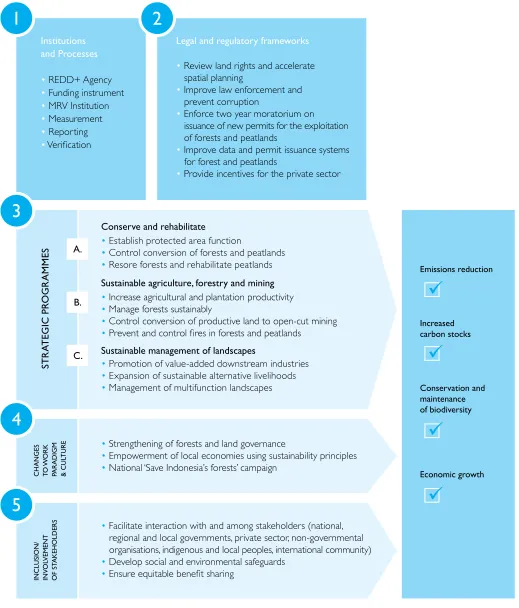
14 15 Figure 1. Five Pillars of the National REDD+ Strategic Framework (adapted from REDD+ Task Force, 2012(1))
2.4 Mainstreaming REDD+ into the national
development plan
The National REDD+ Strategy and its pillars must be integrated into the national and subnational development system, to ensure synergy rather than conlict between the objectives of REDD+ and other development agendas. This requires the mainstreaming of REDD+ into the national and subnational development programs (Government Annual Plan and Mid-Term National Plan) and into the Master Plan for the Acceleration and Expansion of Indonesia’s Economic Development, or ‘MP3EI’.
The National REDD+ Strategy needs to be elaborated into the National REDD+ Action Plan for adoption into the Government Work Plan and inclusion into the state budget, to ensure allocation of budget for the implementation of REDD+. Coordinated by the Ministry of National Development Planning, REDD+ was mainstreamed into the Government Work Plans for 2013 and 2014. To ensure the mainstreaming process will be conducted properly, the Ministry of National Development Planning in collaboration with the REDD+ Task Force, have issued a ‘Guideline for REDD+ Mainstreaming into the Development Planning System’ and a ‘Guideline for MP3EI Greening’. Capacity building for REDD+ mainstreaming into development planning and MP3EI has been held in the 11 REDD+ pilot (or ‘pioneer’) provinces in Indonesia.
Indonesia’s ability to achieve emission reductions from forests and peatland will also be heavily inluenced by a wide range of laws, regulations and policies across a range of sectors. For this reason, the National REDD+ Strategy carries with it the mandate to upgrade and harmonise existing laws and regulations as well as sector and non-sector institutions involved in governance and management of forests and other land-based resources (REDD+ Task Force, 2012 (1)).
2.5 Current laws supporting REDD+
implementation in Indonesia
There are numerous existing laws that impact and shape the implementation of a functioning REDD+ mechanism. Many pertain to forestry and natural resource management, including laws that stipulate how Indonesia’s forests should be managed and utilised; others concern the conservation of natural resources and ecosystem services. However, at present most of the regulation is either presidential or ministerial. The legal framework for REDD+ in Indonesia would be considerably
stronger if the regulations were made governmental or passed into law. Examples of relevant regulations include:
• Ministry of Forestry Regulation No. P.68/Menhut–II/2008 on the Implementation of Demonstration Activities for REDD.
• Ministry of Forestry Regulation No. P.30/Menhut-II/2009 on the REDD Mechanism.
• Ministry of Forestry Regulation No. P.36/Menhut-II/2009 on the Mechanism of carbon sequestration and/or carbon storage in forest production and forest protection.
• Ministry of Forestry Regulation No. P.20/Menhut-II/2012 on the Implementation of Forestry Carbon.
• Ministry of Forestry Regulation No. P. 50/Menhut-II/2014 on the trading of Indonesia’s certiied emission reductions.
The laws, and enforcement of them, are designed to support sustainable forest management. However, as for most tropical forest countries with a rich and valuable forest resource base, Indonesia faces well-documented challenges in ensuring effective law enforcement. The steps that Indonesia is taking to improve forest governance, including interventions such as the Forest Moratorium and the One Map Movement, described below, coupled with wider legal review and reform, continue to play a key role in strengthening the enabling environment for REDD+ implementation. Further details of current laws that support REDD+ implementation in Indonesia can be found in Annex 3 on page 57.
2.6 The Forest Moratorium
One of Indonesia’s commitments under the LoI was to enforce a moratorium on granting new licenses on primary forest and peatland in a variety of forest and area types. On 20 May 2011, the Indonesian President signed Presidential Instruction No.10/2011, putting into effect a two-year moratorium on new permits for utilisation of natural forest area and peatland, and improvement of forest governance. The purpose of the moratorium was to harmonise national economic development with efforts to reduce greenhouse gas emissions from land-based sectors, through the improved management of forests and peatlands (REDD+ Task Force, 2012 (1)).
Institutions and Processes
• REDD+ Agency • Funding instrument • MRV Institution • Measurement • Reporting • Veriication
Legal and regulatory frameworks
• Review land rights and accelerate spatial planning
• Improve law enforcement and prevent corruption
• Enforce two year moratorium on
issuance of new permits for the exploitation of forests and peatlands
• Improve data and permit issuance systems for forest and peatlands
• Provide incentives for the private sector
ST
R
A
T
EG
IC P
R
O
G
R
A
M
M
ES
CHANGES TO
W
ORK
PARADIGM & CUL
TURE
INCLUSION/ INV
OL
VEMENT
OF ST
AKEHOLDERS
Conserve and rehabilitate
• Establish protected area function
• Control conversion of forests and peatlands
• Resore forests and rehabilitate peatlands Sustainable agriculture, forestry and mining
• Increase agricultural and plantation productivity
• Manage forests sustainably
• Control conversion of productive land to open-cut mining
• Prevent and control ires in forests and peatlands Sustainable management of landscapes
• Promotion of value-added downstream industries
• Expansion of sustainable alternative livelihoods
• Management of multifunction landscapes
• Strengthening of forests and land governance
• Empowerment of local economies using sustainability principles
• National ‘Save Indonesia’s forests’ campaign
• Facilitate interaction with and among stakeholders (national, regional and local governments, private sector, non-governmental organisations, indigenous and local peoples, international community)
• Develop social and environmental safeguards
• Ensure equitable beneit sharing A.
B.
C.
Emissions reduction
Increased carbon stocks
Conservation and maintenance of biodiversity
Economic growth
ü
ü
ü
©
D
av
id G
ilb
er
t, R
ai
nf
or
es
t A
ct
io
n N
et
w
or
k
17 Attached to the Presidential Instruction was an Indicative Map
of New License Suspensions, to be revised every six months by the relevant government agencies (Republic of Indonesia, 2011 (2)). The indicative map provided the foundation for the One Map Movement (below) and has been revised four times to date. Meanwhile, the President instructed the extension of the moratorium period for a further two years through Presidential Instruction No. 6/2013.
During the moratorium period, reforms have been initiated to improve the governance and monitoring of licensing procedures for forestry, plantation and mining. For example, a Licensing Information System (SIP) is being developed to centralise management of license data. Meanwhile, a license audit is underway in Central Kalimantan, East Kalimantan and Jambi provinces, to help identify and address weaknesses in the licensing process. In both cases (as of May 2013), substantial progress has been reported in the Central Kalimantan Province, but with limited overall progress nationally (Austin et al, 2014).
2.7 The One Map Movement
In December 2010, the President of Indonesia issued a One Map Movement to support the improvement of forest governance. This policy aims to address the nationwide problem of inconsistent forest and land-use boundaries and over-lapping land claims, through creation of one map as the national reference for development of the forestry and land use sectors. The map will be a foundation towards better natural resource governance and bureaucratic reform (UKP4, 2012). It is a vital par t of the effor t to identify and suppor t resolution of land tenure conlicts, and to enable effective cross-sector land use planning, both of which are central to REDD+.
Although development of the One Map is complicated by weak coordination between government agencies, both vertical and horizontal, the One Map Movement is an effort to address this long-standing challenge and represents a signiicant milestone in Indonesian forest and land-use management (Austin et al, 2014). A signiicant achievement of the One Map Movement to date is the transparency of information and improvement of public participation that has come about as a result of the process. It is the irst time a government agency has made geo-referenced data available8 online and has accommodated public input into map development.
2.8 Presidential Regulation on the REDD+
Managing Agency
In September 2013 the President of Indonesia signed regulation No. 62/2013 formalising the Managing Agency for Reduction of Greenhouse Gas Emissions from Deforestation, Forest Degradation and Peatland, known as the REDD+ Managing Agency or ‘BP REDD+’.
The REDD+ Managing Agency is tasked to help the President in coordinating, synchronising, planning, facilitating, managing, monitoring, overseeing, and controlling REDD+ in Indonesia. The REDD+ Managing Agency will continue the tasks, functions, and programs previously carried out by the Task Force for the Preparation of the REDD+ Managing Agency.
Head of the REDD+ Managing Agency, Heru Prasetyo, has inancial and administrative rights and other facilities on a par with ministers.
In line with its tasks, the Agency is working to strengthen collaboration with other government agencies at all levels, as well as to strengthen monitoring of the forestry sector – a need that has been highlighted by many stakeholders, including the Deputy Chairman of the Corruption Eradication Commission (KPK) (Natahadibrata, 2013).
2.9 Measurement, Reporting and Veriication
(MRV) System
The REDD+ Managing Agency is facilitating the establishment of Indonesia’s MRV Institution. The MRV Institution is being established to develop standards and a functioning mechanism for measurement, reporting and veriication of REDD+ emission reductions that are in compliance with UNFCCC decisions. The MRV Institution operates independently under the coordination of the REDD+ Agency. The results from the MRV system provide the basis for determining remuneration to those achieving veriied REDD+ emission reductions (REDD+ Taskforce, 2012).
BP REDD+ continues to develop Indonesia’s MRV system in collaboration with the Ministry of Environment. REDD+ MRV implementation is being piloted in Indonesia’s irst pioneer province, Central Kalimantan Province, and will follow in the remaining 10 pioneer provinces. This will be followed by a rolling out of MRV systems across all of Indonesia’s 33 provinces.
18 19
2.10 Fund for REDD+ Indonesia (FREDDI)
As stipulated under the REDD+ National Strategy, the REDD+ Managing Agency has established the Fund for REDD+ in Indonesia (FREDDI).
It is not clear when FREDDI will be fully established, with all intended functions operational. At present, regulatory barriers stand in the way of the REDD+ Managing Agency having operational control of FREDDI, however there is a process underway to revise the regulation to enable full establishment of FREDDI and the National REDD+ Managing Agency remains conident it will be fully operational in the near future (Sari, 2014).
2.11 REDD+ at the subnational level
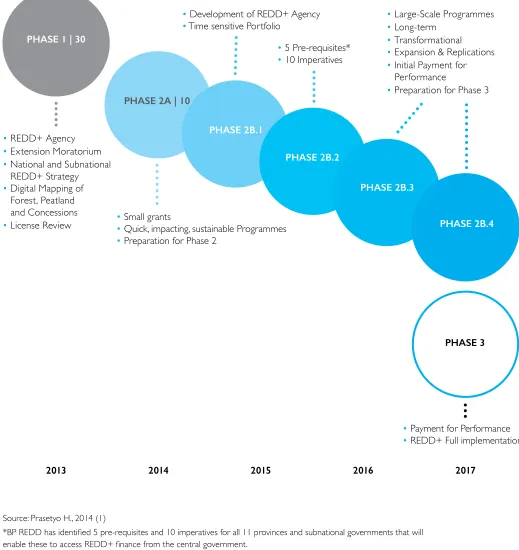
Like many countries, Indonesia is initiating development of a subnational or jurisdictional approach to accounting for REDD+ emission reductions. BP REDD+ is working with many organisations in Indonesia to develop its jurisdictional approach. As this approach develops it is likely that interim forest inance would low through the subnational architecture, focusing initially on Indonesia’s REDD+ pioneer provinces.
At the subnational level, the National REDD+ Strategy and National Greenhouse Action Plan are elaborated into the Strategy and Action Plan for the Regional Implementation of REDD+, for adoption into Regional Government Work Plans and Regional Budgets.
Each provincial government must create a REDD+ Institution to organise and implement its Regional REDD+ Strategy and Action Plan, developed from the National REDD+ Strategy. Districts also can establish REDD+ institutions to coordinate all aspects of district-level REDD+ activities and report results to the provincial level. BP REDD+ is creating guidance on the establishment of a subnational REDD+ Institution. The guidance aims to ensure that the institution effectively performs its function whilst also maintaining enough lexibility to be adopted at the local level.
The implementers of REDD+ programs/projects/activities are organisations which have fulilled speciic criteria and procedures to register and implement REDD+ activities with the National REDD+ Managing Agency upon the recommendation of a subnational REDD+ institution. Groups and bodies as diverse as business entities, civil society organisations, local government institutions, and community groups can function as implementers.
Donors, investors and indeed many NGO project developers are adopting an increasingly cautious stance to REDD+, in light of inancial pressures and uncertainties over the state of the carbon market and lack of demand for REDD+ emission reductions. This uncertainty is an increasing concern that threatens to negatively impact the momentum for scaling up REDD+ activities. In this context, there is a strong case for interim forest inance to be deployed in ways that will help sustain the momentum achieved by these actors, ensure that vital capacity does not leave the REDD+ sector, and provide an incentive for further scaling-up of REDD+ activities.
2.13 Fiduciary safeguards for REDD+
A range of safeguards are required to ensure all elements of REDD+ are implemented appropriately. This includes the inancial aspects of REDD+, which will depend on accountability and transparency. In this case, iduciary safeguards for REDD+ are essential to ensure that REDD+ inancial planning, management and monitoring does not become a new arena for corruption, collusion and nepotism (Steni, 2012). Indonesia’s safeguards framework (PRISAI) includes seven principles relating to iduciary issues (FORDA, 2012), which will require further guidelines to inform their implementation.
With regard to interim forest inance, it will be important to monitor the development of guidelines for iduciary safeguards under PRISAI to ensure that interim forest inance is effectively managed in line with Indonesia’s rules and regulations, and ensure that the implementation of REDD+ projects supported with interim forest inance will deliver beneits to the local communities and other relevant stakeholders. As part of this process the Ministry of Forestry has established an online Safeguards Information System (SIS-REDD+)9 to help share and gather information regarding the implementation of safeguards at various levels across Indonesia.
2.14 Analysis: Indonesia’s policies and targets, and
the need for interim forest inance
Indonesia’s policy on emission reductions, and associated targets, is highly supportive of, and dependent upon, REDD+. The scale of emission reductions expected from forests and peatland clearly illustrates the domestic and global signiicance of Indonesia’s efforts to reduce deforestation and forest degradation. It is also clear that the cost of transitioning The establishment of a REDD+ pioneer province was stipulated
in the agreement with Norway. This was considered important given the limited global experiences to draw on and the enormous challenges facing the implementation of a national REDD+ programme. The objective is to test various policies, programmes and approaches. Lessons learned from the pioneer province are being shared with other forested areas in Indonesia and brought to the national level. The government selected Central Kalimantan as the irst pioneer province (REDD+ Task Force and UNDP, 2012).
There are now ten further REDD+ pioneer provinces, which are currently receiving support for the development of their Provincial REDD+ Strategies and Actions Plans and mapping. These are: Aceh, Riau, West Sumatra, Jambi, South Sumatra, West Kalimantan, East Kalimantan, Central Sulawesi, Papua and West Papua (NRM, 2014).
With regards to supplying FREDDI with emission reductions, Central Kalimantan, East Kalimantan and Jambi will be prioritised. (Sari, 2014)
2.12 Non-governmental actors creating the enabling
environment for REDD+
The array of active non-governmental REDD+ practitioners in Indonesia is critically impor tant in developing the enabling conditions necessary for REDD+ to be implemented. These practitioners have a key role to play in supporting and providing valuable scrutiny over the REDD+ readiness process, and building the necessary capacity to implement REDD+ activities at scale and generate the supply of REDD+ emission reductions that interim forest inance would help to inance. Once operational, civil society organisations in particular stand to play an important role in supporting and monitoring the distribution of REDD+ beneits to help guarantee accountability, equity and adherence to safeguards. Meanwhile, the role of donors and the private sector (explored further in Section 4) is critical to bring more investment into REDD+ activities.
Despite the diversity of non-governmental actors in the REDD+ policy arena, there is high level of consensus on a range of issues, such as the importance of safeguards. However, some of the greatest differences of opinion concern inancing. NGOs tend to favour public funding, while other actors would like to see a variety of funding schemes including trust funds and private sector investments (Moeliono, 2013).
to improved forest governance and achieving the necessary alignment of economic development and environmental priorities will be signiicant and require substantial inance from a range of sources.
To achieve the 41% emissions reduction target with international assistance, it is essential that the anticipated supply of emission reductions from REDD+ can be met with suficient demand to pay for them. In this context, there is a strong case for interim forest inance to boost demand for REDD+ emission reductions during the period prior to 2020 when the global climate change agreement is anticipated to come into force.
This asser tion is fur ther suppor ted by the broad consensus amongst stakeholders consulted for this project that lack of demand for REDD+ emission reductions represents a signiicant issue and constraint to the full implementation of REDD+ if not addressed (IFF, 2014).
A range of outstanding legal reforms are necessary to enable a fully functioning REDD+ mechanism. Particularly relevant to the subject of interim inance is the regulatory reform required to fully establish FREDDI and enable the operation of a market-based model to pay for emission reductions from REDD+, which is discussed further in Sections 3 and 4.
Indonesia will need to implement REDD+ activities on a very large scale to achieve its emission reduction targets. How Indonesia plans to inance this process, and outstanding gaps, are explored in greater depth in Section 3. The role of private sector inance is acknowledged in the National REDD+ Strategy, and is explored further in Sections 4 and 5.
20 21
Section 3: Current strategies
for inancing REDD+ in Indonesia
3.1 Indonesia’s REDD+ inancing needs
Indonesia will need signiicant funding to implement activities that directly and indirectly suppor t the achievement of the country’s emission reduction targets, set out in the National Action Plan for Reducing Greenhouse Gas Emissions (RAN-GRK). Public policy and inance will play a crucial role in meeting the targets set for Indonesia’s major sectors (see Table 2, Section 2.1) (CPI, 2014).
As highlighted in Section 2, approximately 87% of Indonesia’s emission reductions are expected to come from forests and peatland. As such, REDD+ and sustainable land use have a critical role to play in enabling Indonesia to meet its targets. There is a range of estimates of how much inance Indonesia will require to meet its emission reduction targets from forests and peatland.
Meeting 87% of Indonesia’s emission reduction target from forest and peatland equates to 1.037 (GtCO2e) in real emission reductions. Estimates from the REDD+ Management Agency
on the inance required to meet that target range between US$5-10 billion by 2020 (REDD+ Taskforce, 2012) (Wulandari F, 2014). At least one of these estimates is based on a scenario where the necessary REDD+ readiness structures have been inanced, as has the wider enabling environment (REDD+ Taskforce, 2012). These can be considered conservative estimates, as other estimates from the National Council on Climate Change (DNPI) and the Ministry of Forestry, for example, assume a higher carbon price (MoE, 2010).
Most of the stakeholders consulted refer to the Ministry of National Development Planning (BAPPENAS) estimate that Indonesia will need US$28.07 billion to inance the implementation of RAN-GRK, of which US$5.83 billion would be required to inance emission reducing activities from forests and peatland between 2010 and 2020 (BAPPENAS, 2011 (1)). BAPPENAS is responsible for formulating procedures and planning for climate inance, coordinating climate change loans and grants, and is the agency responsible for mainstreaming climate change into national policies (Tanzler and Maulida, 2013).
3.2 Existing sources of funding for REDD+
in Indonesia
3.2.1 Domestic public sources of inance for
forests and peatland
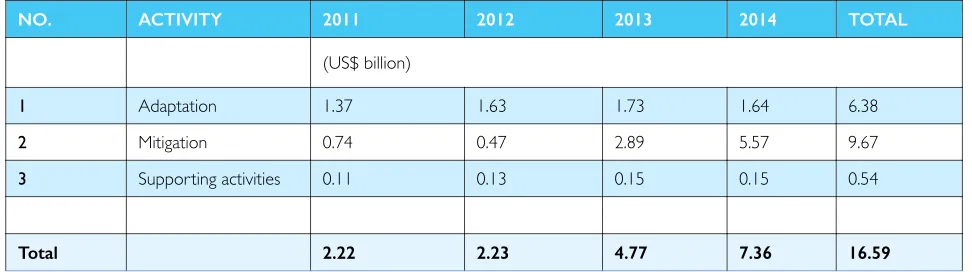
Data from Indonesia’s Ministry of National Development Planning (BAPPENAS) shows that following the issuance of the RAN-GRK, the Government of Indonesia allocated US$16.58 billion in the state budget for the Annual Development Plan 2011 – 2014, speciically for climate change activities (Murniningtyas, 2013). This is distributed into 16 ministries/ government agencies for the climate change adaptation program (US$6.37 billion), for the mitigation program (US$9.67 billion) and for other supporting activities (US$0.54 billion)
(Murniningtyas, 2013).
However, this budget has been broadly allocated across the climate change spectrum and as a result it is dificult to explicitly say how much state budget is allocated to REDD+. REDD+ is not recognised as a dedicated budget item, but as ‘cross-cutting issue’, therefore emission reducing activities from forests and peatland are classiied generically under mitigation and adaptation activities. Currently, state budget for REDD+ is allocated under the Cross-Sectoral Climate Change Mitigation Category. This makes it challenging to earmark inance that has been speciically allocated for REDD+.
Distribution of the funds in each year is presented in Table 3. A noteworthy upward trend is Indonesian government spending on mitigation from 2011-2014. The majority of this funding, particularly in the REDD+ sector, has focused on establishing the necessary enabling environment for REDD+ during the readiness phase.
Potential implication of Indonesia not receiving suficient international inance to reach its 41% emission reduction target
If Indonesia does not receive suficient international inance to enable it to reach its 41% emission reductions target, this could translate into a substantial loss of forest cover and, as a result, a signiicant release of GHG emissions. The difference between Indonesia meeting its 26% target versus its 41% target in actual emissions is 0.367 GtCO2. If these emissions cannot be avoided, due to insuficient international inance, a rough estimate based on average emissions per hectare of forest cover loss in Indonesia for the period 1990-2005 indicates that 0.367 GtCO2 emissions would be the equivalent of losing 1.158 million hectares of forest before 2020 (Finlayson, 2011), an area 2.6 times the size of Jakarta (Mongabay, 2008). Details of this estimate can be found in Annex 1 on page 50.
NO. ACTIVITY 2011 2012 2013 2014 TOTAL
(US$ billion)
1 Adaptation 1.37 1.63 1.73 1.64 6.38
2 Mitigation 0.74 0.47 2.89 5.57 9.67
3 Supporting activities 0.11 0.13 0.15 0.15 0.54
Total 2.22 2.23 4.77 7.36 16.59
Table 3: Indonesia budget allocation for climate change for 2011-2014
22 23
Meanwhile, analysis conducted in 2014 by the Indonesian Ministry of Finance’s Fiscal Policy Agency and Climate Policy Initiative stated that in 2011 the Government of Indonesia disbursed US$951 million of climate inance from public sources, of which 66% came from national sources and 34% from international sources. The bulk of this inance (60%) supported essential ‘indirect’ activities to create necessary enabling conditions and the remainder went to direct mitigation and adaptation activities, of which the majority was directed at the forestry sector (73%). The analysis also showed that the forestry sector beneitted from the highest share of direct and indirect climate inance of all sectors under the RAN-GRK, approximately 41%, or US$257 million (CPI, 2014).
It is worth noting the contrasting igures from BAPPENAS and the Ministry of Finance for 2011, of US$2.22 billion versus US$951 million respectively, with the latter also including international inance channelled through the state budget. One of the reasons for the disparity between the two is that the data presented in the Ministry of Finance’s Fiscal Policy Agency and Climate Policy Initiative report only captures actual realised expenditure, as opposed to total committed funds. This example shows the magnitude of domestic climate inance being allocated in Indonesia while also highlighting the challenge of interpreting data between ministries and the need for systematic inancial MRV for climate inance in Indonesia.
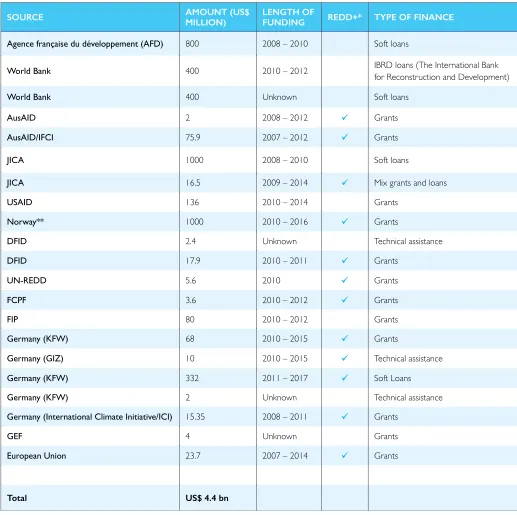
SOURCE AMOUNT (US$
MILLION)
LENGTH OF
FUNDING REDD+* TYPE OF FINANCE
Agence française du développement (AFD) 800 2008 – 2010 Soft loans
World Bank 400 2010 – 2012 IBRD loans (The International Bank for Reconstruction and Development)
World Bank 400 Unknown Soft loans
AusAID 2 2008 – 2012 ü Grants
AusAID/IFCI 75.9 2007 – 2012 ü Grants
JICA 1000 2008 – 2010 Soft loans
JICA 16.5 2009 – 2014 ü Mix grants and loans
USAID 136 2010 – 2014 Grants
Norway** 1000 2010 – 2016 ü Grants
DFID 2.4 Unknown Technical assistance
DFID 17.9 2010 – 2011 ü Grants
UN-REDD 5.6 2010 ü Grants
FCPF 3.6 2010 – 2012 ü Grants
FIP 80 2010 – 2012 Grants
Germany (KFW) 68 2010 – 2015 ü Grants
Germany (GIZ) 10 2010 – 2015 ü Technical assistance
Germany (KFW) 332 2011 – 2017 ü Soft Loans
Germany (KFW) 2 Unknown Technical assistance
Germany (International Climate Initiative/ICI) 15.35 2008 – 2011 ü Grants
GEF 4 Unknown Grants
European Union 23.7 2007 – 2014 ü Grants
Total US$ 4.4 bn
Table 4: Financial commitments to climate change
Source: Brown and Peskett, 2012. * Does not mean the entire fund is allocated for REDD+, but simply that REDD+ is one of the sectors that will be funded. ** US$200 million of this total is allocated for REDD+ readiness, and the remaining US$800 million for performance-based payments.
3.2.2 International sources of inance for forests and peatland
In addition to the government budget, Indonesia has, and continues to receive, substantial inancial commitments and pledges of inance for mitigation of climate change from donor countries and institutions.
24 25
3.2.3 Need for systematic monitoring of REDD+ inance
Table 4 provides data from 2011. At present we do not have access to more up-to-date information. However, the data highlights the variety of international sources that are providing REDD+ inance to Indonesia. It also indicates the types of inance made available. The majority is in grant or loan form aimed at readiness activities. Only the Norway commitment includes performance-based inance, or more speciically, performance-based payments for REDD+. Another limitation of the commitments shown is the time frame. Although disbursal rates of inance may go beyond project timeframes, there are currently no commitments beyond 2017 and very few after 2015.
One of the dificulties in tracking climate change inance, and more speciically REDD+ inance, in Indonesia is that there is no existing dedicated system that records either. Furthermore, the majority of climate change inance that Indonesia receives, from both multilateral and bilateral sources, typically does not deine speciic amounts to be allocated to REDD+. Most of these funds fall under broader umbrellas of environment, conservation or development programs in which climate change, and particularly REDD+, is one individual component. According to Indonesia’s Fiscal Agency, tracking grant funding is more complex than tracking loans. Grants received and spent by a number of parties in Indonesia have not been registered and reported systematically, particularly those managed by
non-government actors.
The Government of Indonesia recognises this as a challenge. The Ministry of Forestry is in the process of recording the levels of climate inance, including for REDD+, received by the Ministry of Forestry10. Meanwhile the Ministry of Finance is also in
the process of recording the level of climate inance received and disbursed by the Government of Indonesia.11
Ultimately what is needed is a systematic and comprehensive mechanism for monitoring and evaluation of all sources and types of climate inance in Indonesia. In line with the National REDD+ Strategy, Indonesia is in the process of establishing the Fund for REDD+ in Indonesia (FREDDI), which is expected to create a transparent system that records all inancial aspects
of REDD+ in Indonesia. It will be important to ensure that this effort integrates with those efforts of individual ministries. Further explanation about FREDDI is provided in Section 3.4.3 below.
Note that due to current limitations to the monitoring of climate inance, and more speciically REDD+ inance, funds available for REDD+ in Indonesia may be larger than presented in this report.
3.3 The REDD+ inancing gap
While it is dificult to calculate an exact igure for Indonesia’s REDD+ inance needs, the data gathered indicates a signiicant gap between estimates of what is required to inance emission reducing activities from forests and peatland, and the inance that is currently available from domestic and international sources. Only about 30 – 40% of the committed funds are for REDD+, and most are for readiness activities rather than payment for REDD+ emission reductions (Tanzler and Maulida, 2013), and therefore do not directly contribute to boosting demand for REDD+.
Lack of inance and demand to pay for Indonesia’s REDD+ emission reductions
It is dificult to give an exact igure of the inance gap to pay for REDD+ emission reductions. However, the only known source of performance-based inance in Indonesia committed for emission reductions from REDD+ is the US$800 million allocated by Norway under phase 3 of the Norway-Indonesia Letter of Intent. Contrast this igure with the conservative estimates that between $US5-10 billion is required to inance REDD+ up to 2020 (REDD+ Taskforce, 2012), and it is clear that the inance gap is substantial
According to Agus Sari, Deputy Head of the REDD+ Agency on Planning and Funding, while the US$1billion from the LoI between Indonesia and Norway is both generous and much welcomed, it is not enough for Indonesia to reach its targets. He also stated that “without additional inance there is no legal reform, no paradigm shift, no solution to tenure problems, and there is no conlict resolution” (Sari, 2014).
Although public and other domestic inance sources will certainly be channelled into meeting REDD+ emission reductions targets, and the wider transition to a green economy, it is fair to say that Indonesia still requires substantial additional inance to meet its emission reduction targets from REDD+.
However, it is also important to acknowledge that Indonesia still faces constraints to its absorptive capacity for REDD+ inance, which is an underlying cause of the slow rate of disbursal under some inance commitments. A simple comparison of REDD+ emission reduction targets versus available inance provides an important illustration of the inance gap in principle, but must be understood in the context of the signiicant progress still required before REDD+ can be implemented at the scale required to meet these targets.
3.4 Current mechanisms for inancing REDD+ in
Indonesia
Currently, there are several formal mechanisms for inancing REDD+ in Indonesia. This subsection provides a brief description of these mechanisms.
3.4.1 Indonesia Climate Change Trust Fund (ICCTF)
The Indonesia Climate Change Trust Fund (ICCTF) is a national trust fund that was established by the Ministries of Finance and National Development Planning in September 2009 to pool and coordinate funds from various sources such as state budget, international donors and the private sector, to inance Indonesia’s climate change policies and programs (BAPPENAS, 2011 (1)).
The ICCTF’s two main objectives are:
• To achieve Indonesia’s goals of a low carbon economy and greater resilience to climate change; and
• To enable the Government of Indonesia to increase the effectiveness and impact of its leadership and management in addressing climate change issues (ICCTF, 2012 (1)).
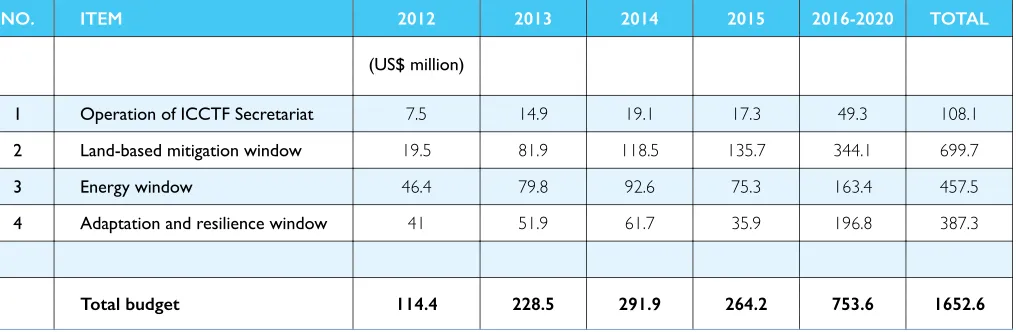
In total the ICCTF has received US$16.05 million from its four bilateral and multilateral contributors: the Department for International Development/UK Climate Change Unit (DFID/ UKCCU), Australian Aid (AusAID), the Swedish International Development Cooperation Agency (SIDA), and the German Ministry of Environment (BMU). The ICCTF estimates it will need approximately US$1,652.6 million to fund its mitigation and adaptation activities, including the operation of the ICCTF secretariat, between 2012 and 2020 (BAPPENAS, 2011 (2)).
The ICCTF budget plan is presented in Table 5.
26 27
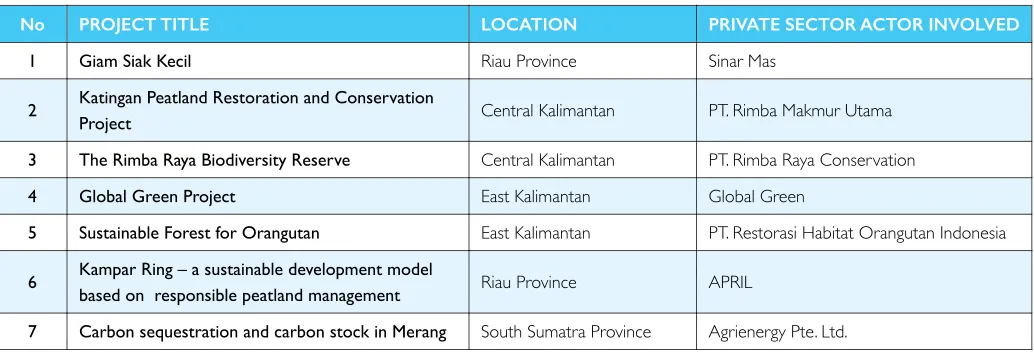
Based on the data above, around 45% (US$699.7 million) of the planned budget should be allocated for the land-based mitigation window, primarily to support Indonesia’s efforts in reducing emissions from deforestation and land degradation, and sustainable land-use planning. Currently, the ICCTF is supporting the implementation of several projects in Indonesia, such as sustainable management of degraded peatland in ive provinces to mitigate GHG emissions and optimise crop productivity (Thamrin, 2014). These projects