Marketing Communications
(Marcom)
Marketing Communications (Marcom)
Business-to-Consumer (B2C)
Business-to-Business (B2B)
Integrated Marcom B2C&B
Integrated Marketing Communication (IMC)
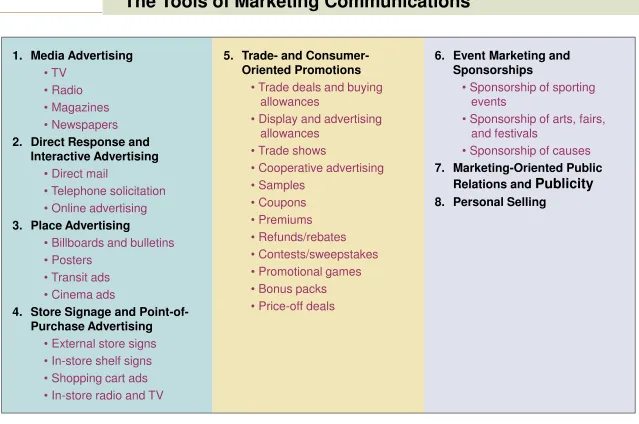
The Tools of Marketing Communications
Table 1.1
1. Media Advertising
• TV • Radio • Magazines • Newspapers
2. Direct Response and Interactive Advertising
• Direct mail
• Telephone solicitation • Online advertising
3. Place Advertising
• Billboards and bulletins • Posters
• Transit ads • Cinema ads
4. Store Signage and Point-of-Purchase Advertising
• External store signs • In-store shelf signs • Shopping cart ads • In-store radio and TV
5. Trade- and Consumer-Oriented Promotions
• Trade deals and buying allowances
• Display and advertising allowances
• Trade shows
• Cooperative advertising • Samples
• Coupons • Premiums • Refunds/rebates • Contests/sweepstakes • Promotional games • Bonus packs
• Price-off deals
6. Event Marketing and Sponsorships
• Sponsorship of sporting events
• Sponsorship of arts, fairs, and festivals
• Sponsorship of causes
The Integration of Marketing
Communications
•
Why Not Integrated?
Tradition of separation communication tools
Influence of specialized outside suppliers
Managerial parochialism
Fear of budget cutbacks
Loss of power and authority
Resistance of outside suppliers to broadening their functions
The Integration of Marketing
Communications (cont’d)
•
IMC and Synergy
Using multiple communication tools in conjunction with one another can produce greater results
And Now a Definition of IMC
•
Integrated Marketing Communications (IMC)
•Is a communications process for planning, creation, integration, and implementation of diverse forms of marcom delivered to a brand’s targeted customers and prospects
•Has as its goal influencing or affecting behavior of targeted audience
•Considers all touch points a customer/ prospect has with the brand as potential delivery channels for messages
•Requires that all of a brand’s communication media deliver a consistent message
Key IMC Feature # 1
•
The Consumer or Business Customer Must
Represent the Starting Point for All Marketing
Communications Activities
•
Takeaway:
Consumers in Control
Outside-in approach: learn the media preferences and
lifestyles of customers/prospects to know the best contexts to reach them with brand messages.
Reduced Dependence on Mass Media
Consumers are increasingly in control of their media choices
Selecting the Appropriate Marcom Tools
Identify Marcom Program Goals
Determine Best Way to Allocate Marketing Budget
Obstacles to Implementing IMC
•
Integration requires tight coordination among all
elements of a marcom program.
Few providers of marketing communication services have the diversity of skills required to execute an IMC program.
Direct-to-customer advertising is more difficult than a mass media campaign.
Marketing Communications
•
Marketing Communications’ Objective
To enhance brand equity by moving customers to favorable action toward the brand—trying it, repeat purchasing it, and becoming loyal toward the brand.
•
Brand Equity
The degree to which consumers favorably perceive the brand’s features and benefits as compared to
Making Brand-Level Marcom Decisions and Achieving Desired Outcomes
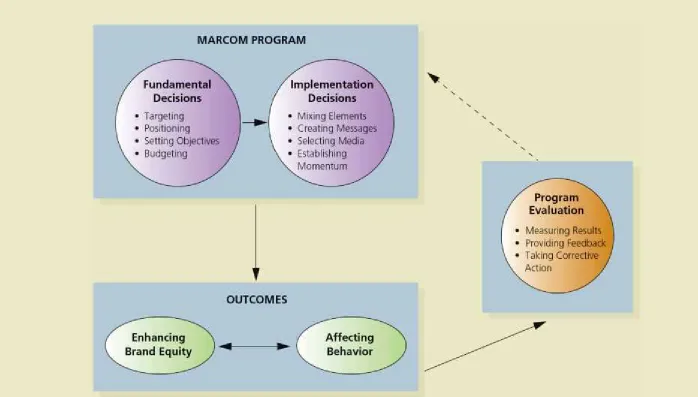
Fundamental Marcom Decisions
Targeting Positioning Setting
Objectives Budgeting
Fundamental Marcom Program
Fundamental Marcom Decisions (cont’d)
Top-down (TD)
Bottom-up/Top-down (BU/TD)
Top-down/Bottom-up (TD/BU)
Bottom-up (BU)
Fundamental Marcom Decisions:
Commit-to-Memory Mantra
1. Directed to a specific target market
2. Clearly positioned
3. Created to achieve a specific objective
All marketing
Marcom Implementation Decisions
Mixing Elements
Creating Messages
Selecting Media
Establishing Momentum
Marcom Program Implementation
Marcom Outcomes
Enhancing Brand Equity
Affecting Behavior
Basic IMC Issues
How to enhance brand equity
How to affect customer
behavior
How to justify marcom investments
How to demonstrate
financial accountability
Basic IMC Issues
•
What can marketing communicators do to
enhance the equity of their brands?
•
How can marketing communicators affect the
behavior of their present and prospective
customers?
•
How can marketing communicators justify their
investments in advertising, sales promotions,
and other marcom elements?
Brand Associations
Positive Attributes
Perceived Benefits
Favorable Attitude
Dimensions of Brand Personalities
Excitement
Sincerity
Ruggedness Sophistication
Ways of Enhancing Brand Equity
Speak-for-Itself Message-Driven Leveraging
Types of Branding for Leveraging
•
Co-Branding
A partnership between two brands
•
Ingredient Branding
What Benefits Result from Enhancing
Brand Equity?
•
Increased consumer loyalty
•
Long-term growth and profitability for the brand
•
Maintain brand differentiation from competitive
offerings
Measuring World-Class Brands
Quality Salience Equity
Evaluating
Characteristics of a World-Class Brand
• Delivers benefits consumers want
• Stays relevant
• Price equals value
• Good positioning
• Consistency
• Fits into brand portfolio
• Brand helps build brand equity
• Brand’s managers understand what the brand means to
consumers
• Support over long run
Measuring Marketing Investment
Performance
•
Return on Marketing Investment (ROMI)
Measures the effect of marcom, or of its specific
elements such as advertising, in terms of whether it generates a reasonable revenue return on the
marcom investment
•
Why Measure Marcom Effectiveness?
Demands for greater accountability on the marketing function
Measuring Marketing Investment
Performance
•
Difficulties in Measuring Marcom Effectiveness
Choosing an appropriate metric
Gaining agreement on measures
Collecting accurate data for marcom assessment
Difficulties in Measuring Marcom
Effectiveness: Choosing a Metric
Change in brand awareness
Improvement in attitudes
toward the brand
Increased purchase intentions
Larger sales volume
Difficulties in Measuring Marcom
Effectiveness: Gaining Agreement
• Finance Departments’ Measures of Success:
Discounted cash flows
Net present values of investment decisions
• Marketing Departments’ Measures of Success:
Measures of brand
Difficulties in Measuring Marcom
Effectiveness: Collecting Accurate Data and
Calibrating Special Effects
•
What exact sales figures should be used to
calculate sales?