A SYNTACTIC ANALYSIS ON VERSESFOUND INMECCAN AND
MEDINANSURAHS TRANSLATED BY SHAKIR
THESIS
Submitted as Partial Fulfillment as the Requirements for the Sarjana Degree of English Department Faculty of Arts and Humanities UIN Sunan Ampel
Surabaya
By:
Indra Fuji Rahayu
Reg. Number A03213026
ENGLISH DEPARTMENT
FACULTY OF ARTS AND HUMANITIES
STATE ISLAMIC UNIVERSITY SUNAN AMPEL SURABAYA
ABSTRACT
Rahayu, Indra Fuji. 2017. A Syntactic Analysis on Verses Found in Meccan and Medinan Surahs Translated by Shakir. English Department. Faculty of Arts and Humanities. The State of Islamic University of Sunan Ampel Surabaya.
Thesis Advisor : Endratno Pilih Swasono, M. Pd.
Key Words : The Tree Diagram, Quran, Meccan Verse, Medinan Verse, Muhammad Habib Shakir
This research focuses on the tree diagram on Meccan and Medinan verses on Shakir’s Quran English translation. This research includes in the field syntax. It uses Chomsky’s transformational generative grammar (1965). The objective of the study of this research is to describe the sentence structure portrayed in tree diagrams found on Meccan and Medinan verses of Shakir’s Qu’ran English translation and to find the differences between Meccan and Medinan verses of Shakir’s Qu’ran English translation. It applied content analysis to analyze the object.
INTISARI
Rahayu, Indra Fuji. 2017. A Syntactic Analysis on Verses Found in Meccan and Medinan Surahs Translated by Shakir. Sastra Inggris, Fakultas Adab dan Humaniora. Universitas Islam Negeri Sunan Ampel Surabaya.
Pembimbing : Endratno Pilih Swasono, M. Pd.
Kata Kunci : Diagram Pohon, Al-Qur’an, Ayat Makkiyah, Ayat Madaniyah, Muhammad Habib Shakir
Penelitian ini fokus pada diagram pohon pada ayat ayat Makkiyah dan Madaniyah dalam Al Quran terjemahan bahasa Inggris oleh Shakir. Penelitian ini tergolong dalam lingkupan sintaks. Penelitian ini menggunakan tata bahasa generatif transformasional oleh Chomsky (1965). Tujuan dari penelitian ini adalah untuk mendeskripsikan struktur kalimat yang digambarkan dalam diagram pohon yang terdapat pada ayat-ayat Mekah dan Medinah dari Al Quran terjemahan bahasa Inggris dan untuk menemukan perbedaan antara ayat-ayat Makkiyah dan Madaniyah dari Al Quran terjemahan bahasa Inggris ole Shakir's.Penelitian ini menerapkancontent analysisuntuk menganalisa objek.
TABLE OF CONTENTS
Inside Cover Page ... i
Inside Title Page... ii
Declaration Page ... iii
Motto ... iv
Dedication Page ... v
Thesis Advisor’s Approval Page... vi
Thesis Examiner’s Approval Page... vii
Acknowledgement... viii
Table of Contents ... ix
List of Appendices ... xi
Abstract ... xii
Intisari ... xiii
CHAPTER I INTRODUCTION 1.1 Background of the Study... 1
1.2 Research Problem... 5
1.3 Research Objectives ... 5
1.4 Significant of the Research ... 5
1.5 Scope and Limitation ... 6
1.6 Definition of Key Term... 6
CHAPTER II REVIEW OF RELARED LITERATURE 2.1 The Understanding of Syntax... 8
2.2.1 Word Classes... 9
2.2.2 Phrase ... 14
2.2.3 Clause... 15
2.2.4 Sentence ... 16
2.3 Tree Diagram ... 18
2.4 Quran... 19
CHAPTER III RESEARCH METHOD 3.1 Research Design... 20
3.2 Data Collection... 20
3.2.1 Data and Data Source... 20
3.2.2 Research Instrument... 21
3.2.3 Techniques of Data Collection... 21
3.3 Subject of the Research... 22
3.4 Data Analysis ... 22
CHAPTER IV FINDINGS AND DISCUSIONS 4.1 Findings... 28
4.1.1 The Tree Diagram ... 29
4.1.1.1 Meccan surah ... 29
4.1.1.2 Medinan surah... 36
4.1.2 The Difference between Meccan and Medinan verses ... 51
4.1.2.1 Types of Sentence ... 51
4.1.2.2 Phrases ... 63
4.1.2.3 Word Classes... 66
4.2 Diccussion ... 67
5.2 Recommendation... 70
REFERENCES... 72
APPENDICES
LIST OF APPENDICES
1. Table of Kinds of sentence
CHAPTER 1
INTRODUCTION
This chapter provided fundamental ideas of analyze the difference sentence structure portrayed between Meccan and Medinan surahs of Shakir’sQu’ran English translation. It consists of background of the study, research problem, research objectives, significance of the study, scope and limitation, and definition of key term.
1.1. Background of the study
2
unclear meaning.Thus, a sentence can be proved to be grammatically appropriate with the help of structure description.
Tree diagram consist of some contexts such as types of sentences, phrases, clauses, and word classes. Some other researchers have already done their study in various focuses of tree diagram, such as pronoun (Timothy, 2014), sentence (Nani, 2003), adverb (Muhammed, 2013), structures (Muhammad, 2012), noun phrase (Haryati, 2015), and types of sentences(Chandni, et.al, 2014). This present study has similar focuses as Chandni, et.al (2014) on analyze tree diagram focused on the types of sentence. The previous study has one object to be analyzed while this study present study aims at filling these gaps by comparing tree diagram in Qur’an English translation by Muhammad Habib Shakir between Meccan and Medinan surahs that focused on types of sentences and sentences elements. Types of sentence are: simple sentence, compound sentence, complex sentence, and compound complex sentence, while the sentences elements are: word, phrase, and sentence.
3
from the previous study, which is Qur’an English translation of Meccan and Medinan surahs. The specific objects of the research are 7 surahs of Meccan and 7 surahs of Medinan.
As the title suggest, this study analyzed tree diagram on Qur’an Arabic language that had been translated to English language. Some researchers analyze tree diagram in different focus of language. Yun (2009) the student of University of North Sumatera, analyze tree diagram using English language. Besides, Mohammed(2013) student of University of Malaya compareArabic language and English language using tree diagram theory. Then, it was continued by Chandni, et.al, (2014) on their research which was take Punjabi language as the subject.Furthermore, Timothy (2014) analyzed tree diagram on Nigerian language that focus on ‘Ahan’ language spoken on government. Following Yun (2009), this
present study analyzedtree diagram on Qur’an English translation by Muhammad Habib Shakir. Qur’an English translation by Muhammad Habib Shakir is chosen because the words choices on translating were identified on dictionary nowadays. In addition, Muhammad Habib Shakir well known as translator of Qur'an into English language published by TahrikeTarsile Qur'an. Thus, the researcher wants to use Shakir’s Qur’an translation to know what the difference between Meccan and Medinan surahs.
4
surahs on Qur’an using the word-size and word-length. They also discussed the dispersion and shapes of word-size and word-length of Meccan and Medinan surahs at other compositions of Surras as introduced by Quran Mufassirs and scientists.Based on finding and discussion, Muhammad and Munir (2008) found the constructional characteristics of the two types of surahs in the Holy Quran. He also discussed the dispersion and shapes of word-size and word-length of Meccan and MadniSurras at other compositions of Surras as introduced by Quran Mufassirs and scientists. From the explanation above, this study have similarity with the previous study by Muhammad and Munir which takes Meccan and Medinan as the data of the research. In addition, this present study found the differences between Meccan and Medinan surahs of Shakir’sQu’ran English translation using tree diagram by describing the sentence structure portrayed in tree diagrams on Meccan and Medinan surahs of Shakir’sQu’ran English translation.
5
1.2. Research Problems
Based on scope that was states previously, the problems to be analyzed in this thesis proposal are as follows:
1. How are the verses structure portrayed in tree diagrams found on Meccan and Medinan surahs of Shakir’sQu’ran English translation?
2. What are the differences between Meccan and Medinan verses of Shakir’sQu’ran English translation?
1.3 Research Objectives
To answer the previous questions, there are two objectives of the study aimed:
1. To describe the sentence structure portrayed in tree diagrams found on Meccan and Medinan versesof Shakir’sQu’ran English translation.
2. To find the differences between Meccan and Medinan verses of Shakir’s Qu’ran English translation.
1.4 Significant of the Research
6
especially about analyzing tree diagram on literary work. While for student, they can use this research in understanding and applying tree diagram that focus on analyze literary works or other studies. In addition, this research can be helped to understand the different types of sentences and finding the differences between Meccan and Medinan surahs onShakir’sQu’ran English translation.
1.5 Scope and Limitation
The scope of this research is focused on 5 Meccan surahs and 5 Medinan surahs on Shakir’s Qur’an English translation. The 5 Meccan surahs are “Asy-Syams”, “Al-Balad”, “Al-A’la”, “At-Thariq”, and “Al-‘Adiyat”, whereas the 5Medinan surahs are “At-Thalaq”, “At-Taghabun”, Munafiqun”, “Al-Jumu’ah”, and “As-Saf”. The researcher limits the analysis on the types of sentence and its elements. Types of sentence are: simple sentence, compound sentence, complex sentence, and compound complex sentence, while the sentences elements are: word, phrase, and sentence.
1.6 Definition of Key Terms
7
Qur'an (Arabic: ن آﺮ ﻘﻟا) is the Muslim sacred scripture, believed to be revealed by God to Prophet Muhammad through Jibril (Gabriel) during 23 years; the Prophet recited it to a group of his companions and scribes of revelation wrote it down under direct and constant supervision of the Prophet (Muhammad,2008).
Medinan surah is the term given to the verses or ayahs of the Qur'an were revealed in Medina or lowered after migrated of Prophet Muhammad from Mecca to Medina. A letter can consist of verses revealed in Medina as a whole, but can also be partially lowered in Mecca (Muhammad,2008).
Meccan surah is name of verses or ayahs that down before migrated of Prophet Muhammad from Mecca to Medina(Muhammad,2008).
CHAPTER 2
REVIEW OF RELATED LITERATURE
This chapter reviews some related theories and related studies that support the study.
2.1 The Understanding of Syntax
There are some definitions about syntax according to some linguists. Syntax is the study of the organization of words into phrases sentences (Maggie, 2011:1). Syntax is the grammatical tool that deals with how sentence are put together and the relationship between words. It has four level construction, they are: sentence, clause, phrases, and words. (Charles, 2009:112). Definition of syntax implies that start from what is regarded as the largest unit of syntactic description until at the smallest meaningful unit (Herman, 2004:10). Syntax is the rules of sentence formation and represents the component of the mental grammar that represents speakers’ knowledge of the structure of phrases and sentences (Chomsky, 1965:59).
9
2.2 The Basic Structure of English Syntax
1.2.1 Word Classes
According to Herman (2004:22) the definition of word refers to grammatical units which a speaker of a language can intuitively recognize. Besides, In order to form sentences, words must appear in a particular structural relationship and in a particular order. In addition, words can appear in the same context will be said to have the same distribution: they belong to the same word classes or distribution of word.From the explanation above, the researcher conclude that word is the basic element of syntax. Herman (2004:22) said that there are different kinds of words, they are: noun, verb, adjective, adverb, preposition, and conjunction. Whereas, Marjolijn and Kim (2000) have different arrangement of word classes on their book. They add interjection and preposition on their word classes which Herman (2004) does not have. To conclude the explanation above, the researcher takes pronoun, adjective, noun, conjunction, adverb, verb, interjection, and preposition as word classes or distribution of word.
1. Pronoun
10
a. Personal pronouns
Personal pronouns are always independent and refer to people or things: I/me, you, he/him, she/her, it, we/us,andthey/them.
b. Possessive pronouns
Possessive pronouns are related to personal pronouns and express ‘ownership’. There are dependent and independent ones. The dependent ones are my, your, his, its, her, our, their. The independent ones are mine, yours, his, hers, its, ours, theirs.
c. Reflexive pronouns
Reflexive pronouns are words like myself, himself, and so on and consist of a personal or possessive pronoun followed by self or selves. They are always used independently. They may be used as object to refer back to another noun or pronoun in the sentence, or they may be used to emphasize part of a subject or object.
d. Indefinite pronouns
11
2. Verb
Verb is a word that expresses an action. It should be agree with the subject of the sentence. Verb is generally divided into: lexical verb and auxiliary verb. Lexical verb verbs which function as the Head of a VP, and which as such can be the only verb in a sentence (Herman, 2004:42). It can be preceded by one or more auxiliaries. Auxiliaries cannot normally occur on their own, although in some cases the lexical verb functioning as the Head may have to be recovered from the context.
Further, another form of verb is verb based on object (Noel, 2011:70), verb based on form, and verb based on alteration (Elly, 2010:13). The explanation of other form of verb will be explained below:
a. Verb based on object is divided into: 1. Transitive verb.
Transitive verb is verb that should be followed by object. The example : borrow, water, eat, buy, etc.
2. Intransitive verb.
Intransitive verb is verb that does not need object to be followed. The example: go, come, arrive, sleep, sit, etc.
12
3. Third person singular. The example: goes, visits. 4. Past form. The example: went, visited.
5. Past participle. The example: gone, visited. 6. Present participle. The example: going, visiting. c. Verb based on alteration is divided into:
1. Regular verb.
Regular verb is the verb that changes from one to other form regularly. It usually has d/ed in the end of word.The example: invite-invited-invited-invited, study-studied-studied.
2. Irregular verb.
Irregular verb is the verb that changes from one to other form irregularly. It has no characteristics of changing.The example: see-saw-seen, speak-spoke-spoken.
3. Adverb
According to Herman (2004:60) adverb is a word that modifies a verb. Adverb is divided into comparative degree and superlative degree. Comparative degree begin with than whereas superlative degree followed by phrase. Both of degrees show the comparison.
4. Adjective
13
Example: beautiful, handsome, hungry, angry, and others
5. Noun
Noun is the word that refers to the name of a thing. Herman (2004:58) divides noun into singular noun and plural noun. In addition, Marjolijn and Kim (2000) divide noun into six types, they are: proper noun, common noun, concrete noun, abstract noun, countable noun and uncountable noun.
6. Conjunction
Conjunction is a word that the function to connect words, phrases, or clauses in a sentence (Herman, 2004:61). It is divided into:
a. Coordinate conjunction. It connect the words in a sentence like for, and, nor, but, or, yet, and so.
b. Correlative conjunction. There are four pairs of it, they are Not only… but also...
Both… and…
Either…or…
Neither…nor…
c. Sub-ordinative conjunction. It usually connects between sub clause and main clause. Like example: if, because, after and others.
7. Interjection
14
Example: Oh my God!, watch out!, ouch!, hay!, and others.
8. Preposition
Preposition divided into two, free preposition and bound preposition (Herman, 2004:61).
a. Free preposition is preposition that does not followed by verb. Example: on the table, in the school, at the room, and others.
b. Bound preposition is preposition that followed by verb and make new meaning.
Example: I am looking for my book.
2.2.2 Phrase
Marjolijn and Kim on his book (2010:118) said thata phrase is words that do not have a subject or verb in the formation. Jim (2002: 18) adds that phrasecan be occur on one or more words, or indeed in which other phrases can occur. It can stand alone as independent unit. Phrase may classified by the main head:
1. Noun Phrase. It is a phrase with a noun as its head. For example: the beautiful girl, a cute cat.
2. Verb Phrase. It is a phrase with a verb as its head. The example is jump up.
15
4. Adverb Phrase. It is a phrase with an adverb as its head. Example: very, and carefully.
5. Prepositional Phrase. It is a phrase that the centered on preposition (Elly, 2010). For instance: in the middle, at noon.
2.2.3. Clause
According to Marjolijn and Kim (2000:151) Clause is divided into: dependent clause and independent clause. Dependent clause is a clause that cannot stand alone. It must combine with independent clause. Independent clause is a clause that can stand alone as sentence. There two kinds of clause, they are noun clause and adverb clause.
a. Noun clause is clause that has function as subject, subject complement, direct object or object of complement in a sentence. It begins with relative pronoun (who, that, which, what, etc) and subordinating conjunctions (why, when, where, and how).
16
2.2.4 Sentence
Sentence is range of words which is perfect because it has verb. A sentence minimally consists of one subject and one verb (Marjolijn and Kim, 2000:33). There are kinds of sentence according to them that will be explained as follow:
1. Sentence base on its verb a. Verbal sentence
Verbal sentence is sentence that the verb is ordinary verb. For example: we get good scores.
b. Nominal sentence
Nominal sentence is sentence that the verb is to be auxiliary and the object is complement (adjective, noun, adverb).
For instance: her husband is a pilot. 2. Sentence base on its form
a. Positive sentence.
It is the common type to make statement.
The example is “I will go to college to collect my assignment tomorrow”.
b. Negative sentence
It is the negative form of positive sentence. The example is “I will not go to college to collect my assignment tomorrow”.
17
The example of the question is “when will you go to the college to college the assignment?”.
d. Interrogative negative.
It is the combination between negative and interrogative sentence. For instance: why do not you collect your assignment yesterday? e. Imperative sentence or command.
The example: please collect your assignment tomorrow before 12.00 AM!
3. Types of sentence
a. Simple sentence is a sentence that has only one subject-verb combination and expresses a complete though.
b. Compound sentence is a sentence that contains two or more than two independent clauses joined by coordinate conjunctions.
c. Complex sentence is a sentence that contains at least one full dependent clause and at least one independent clause with its own subject and predicate, which cannot stand alone. It followed by conjunction.
18
2.3 Tree Diagram
Tree diagram also known as hierarchy diagram is the analysis of sentence down to word it would also be possible to stop at phrase level, or to go beyond word level and indicate the morphological structure of each of the words (Herman, 2004: 10).
One of the popular linguists, Chomsky has the theory called transformational generative grammar. The term transformational generative grammar is Noam Chomsky’s theory about syntax. Transformational generative
19
2.4Qur’an
Kais, et.al, (2011) on his research said that the Holy Qur’anis the Muslim sacred scripture, believed to be revealed by God. Besides of Muslim sacred scripture it also as source of law in Islam learned and has high position for Muslim. According to oxford dictionary, Qur’an is the Islamic sacred book to be the word of God as dictated to Muhammad by the archangel Gabriel and written down in Arabic. These touch upon all aspects of human existence, including matters of doctrine, social organization, and legislation.
CHAPTER III
RESEARCH METHOD
This chapter consists of research design, research instrument, data and data source, data collection, subject of the research, and data analysis.
3.1 Research Design
This study used content analysis method because it analyzed the data descriptively based on theory of tree diagrams. In addition, the data of this study are sentences, phrase and words rather than numbers.
3.2 Data Collection
3.2.1. Data and Data Source
The data source of the research was literary work that is Qur’an English translation by Shakir. Meanwhile, the data of this research was verses on 5 Meccan Surahs and 5 Medinan surahs onShakir’s Qur’an English translation. The 5 Meccan Surahs are “Asy-Syams”, Balad”, A’la”, “At-Thariq”, and ‘Adiyat”, whereas the 5 Medinan surahs are “At-Thalaq”, “At-Taghabun”,
21
3.2.2. Research Instrument
The main instrument of the research was the researcher herself. She will be the only instrument that will collect and analyze the data. Additionally, she will also use some supporting tools such as: computer, papers, books, and so on.
3.2.3. Technique of Data Collection
The researcher uses some techniques to collect the data, as follows:
1. Browsing and downloading
The researcher collected the data by searching Qur’an English translation
by Muhammad Habib Shakir on internet in the PDF form. Here, the researcher downloaded at (www.qurandownload.com/english-quran-shakir-wb.pdf).
2. Selecting the surahs
After the Qur’an English translation was downloaded, the researcher then
chooses some surahs by comparing which surahs that have the most verse in surahs between Meccan and Medinan. Here, the researcher founds 11-20 verses that mostly use in a Qur’an. The researcher took the data of this research from 10
surahs: 5 Meccan Surahs and 5 Medinan surahs. The 5 Meccan Surahs are “Asy-Syams”, “Al-Balad”, “Al-A’la”, “At-Thariq”, and “Al-‘Adiyat”, whereas the 5
22
3.3 Subject of the Research
The subject of the research was Meccan and Medinan surahs on Qur’an English Translation by Muhammad Habib Shakir.The 5 Meccan Surahs are “Asy-Syams (15 verses)”, “Al-Balad (20 verses)”, “Al-A’la (19 verses)”, “At-Thariq
(17 verses)”,and“Al-‘Adiyat (11 verses)”.Whereas the 5Medinan surahsare “At-Thalaq (12 verses)”, “At-Taghabun (18 verses)”, “Al-Munafiqun (11 verses)”, “Al-Jumu’ah (11 verses)”, and “As-Saf (14 verses)”.The total of Meccan Surahs consist of 82 verses, whereas the total of Medinan verses consist of 66 verses. Total of Meccan and Medinan verses are 148 verses.
3.4 Data Analysis
The first step, the researcher analyzed each word and phrase of the sentence of Meccan Surahs. Then, the researcher concerned toMedinan surahs on Qur’an English translation by Muhammad Habib Shakir by coding for each word classes and phrases. In addition, the coding used abbreviations that indicated word classes and phrases. The figures below are the abbreviations and the example of coding the selected data.
S :Sentence Aux : Auxiliary
NP :Noun Phrase Adj :Adjective
VP : Verb Phrase Prep :Preposition
AP : Adjective phrase Adv :Adverb
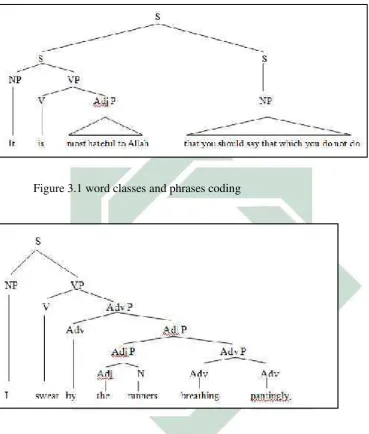
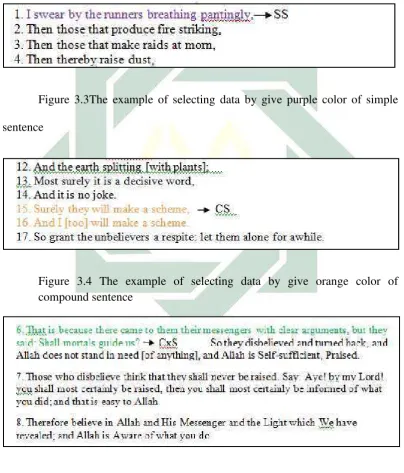
[image:33.595.116.486.114.549.2]
23
Figure 3.1 word classes and phrases coding
Figure 3.2 word classes and phrases coding
24
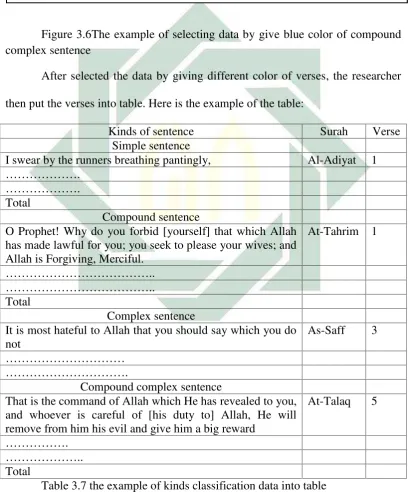
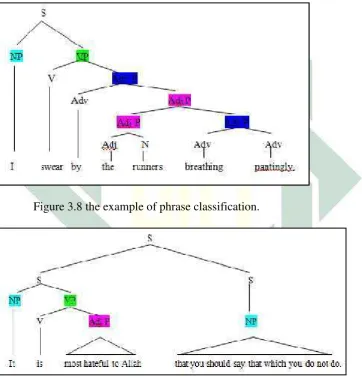
addition, the researcher used abbreviation to make simpler classified. The abbreviation SS was for simple sentence, CS was for compound sentence, CxS was for complex sentence, and CCS was for compound complex sentence. The selecting data were like the example below:
Figure 3.3The example of selecting data by give purple color of simple sentence
Figure 3.4 The example of selecting data by give orange color of compound sentence
[image:34.595.111.516.231.705.2]
25
Figure 3.6The example of selecting data by give blue color of compound complex sentence
After selected the data by giving different color of verses, the researcher then put the verses into table. Here is the example of the table:
Kinds of sentence Surah Verse
Simple sentence
I swear by the runners breathing pantingly, Al-Adiyat 1 ……….
………. Total
Compound sentence
O Prophet! Why do you forbid [yourself] that which Allah has made lawful for you; you seek to please your wives; and Allah is Forgiving, Merciful.
At-Tahrim 1
……….. ……….. Total
Complex sentence
It is most hateful to Allah that you should say which you do not
As-Saff 3 ………
……….
Compound complex sentence
That is the command of Allah which He has revealed to you, and whoever is careful of [his duty to] Allah, He will remove from him his evil and give him a big reward
At-Talaq 5
[image:35.595.108.519.233.726.2]………. ……….. Total
26
[image:36.595.116.479.222.601.2]After classified into table, the researcher compare and find the difference between Meccan and Medinan generally based on type of sentence and its elements such as phrase, and word classes. The researcher gave different color for each phrase, like the example below:
Figure 3.8 the example of phrase classification.
Figure 3.9 the example of phrase classification.
27
1. Meccan verse is simple sentence while Medinan verse is complex sentence.
2. Meccan verse consists of more phrases then Medinan verse. Most of Meccan verse uses adverb phrase and adjective phrase whereas most of Meccan verse use noun phrase.
3. Medinan verse consists of more sentences then Meccan verse.
4. Medinan verse has more word classes and complicated then Meccan verse.
Based on the example above, the researcher gave red color for noun phrase, green color for verb phrase, yellow color for adjective phrase, and purple color for prepositional phrase. For word classes, the researcher counted the word classes for each verse, which verse had more word classes in a sentence, means it has more words. Whereas for sentence, was the same of words.
CHAPTER IV
FINDING AND DISCUSSIONS
This chapter explains the finding data of the research and the discussion concerning the result of analysis. It deals with the sentence structure portrayed in tree diagrams found on Meccan and Medinan surahs of Shakir’sQu’ran English translation and the differences between Meccan and Medinan surahs of Shakir’sQu’ran English translation.
4.1 FINDINGS
29
4.1.1 The Tree Diagrams
4.1.1.1 Meccan Surahs
There are five Meccan Surahs that had analyzed by the researcher, they are: Al-Adiyat, Ash-Shams, Al-Balad, At-Tariq, And Al-Ala. Here the researcher explained one of surahs to be explained randomly. Here, the researcher showed the verse pattern of At-Tariq. It contains of seventeen verses in a surah that will be explained below:
Sura 86. At-Tariq (The morning star, the night comer)
1.I swear by the heaven and the comer by night;
S
NP VP conj
V PP NP
Prep NP NP NP Det N Det N prep N I swear by the heaven and the comer by night;
The verse above consists of independent clause, conjunction, and noun phrase. The independent clauseconsist of subject “I” and verb “swear” following with the other word classes that clarify the sentence itself. The conjunction “and” is
appears between noun phrases “the heaven” and “the comer”. This verse is not
30
2. And what will make you know what the comer by night is?
conj S
And what will make you know what the comer by night is?
The verse above consist of conjunction“and” anddependent clause “what will make you know what the comer by night is?”. The verse about is continuation with the first verse before.
3. The star of piercing brightness; NP
NP PP
Prep AdjP
adj N The star of piercing brightness;
The verse above consists of noun phrase “The star of piercing brightness”.
It does not include in a sentence because it has no verb. This verse is going concern with the following verse.
4. There is not a soul but over it is a keeper.
S adv P
NP VP conj adv NP VP V NP V NP
Det N det N There is not a soul but over it is a keeper.
The fourth verse called sentence because it has subject “a soul” and the verb phrase “is”. It also has a “but” as the conjunction and adverb “over it is a
31
5. So let man consider of what he is created: AdvP
Adv VP
V NP
N advp Adv PP
Prep NP
So let man consider of what he is created:
The verse above called adverb phrase because the head of the verse is on the word “so”, while the word “so” is an adverb. While the noun phrase “what he
is created:” will be clarified in the next verse.
6. He is created of water pouring forth, S
NP Aux VP
V PP
prep VP VP adv N V
He is created of water pouring forth,
The verse above include in sentence because it has a subject “he”,
auxiliary “is”, and verb “created”. The other word classes and phrases are clarified
the words “he is created”. The word “he” is reverse to the verse before. Even so,
32
7. Coming from between the back and the ribs. NP
NP PP Prep PP
Prep NP conj NP Det N det N Coming from between the back and the ribs.
The verse above consist of noun phrase “Coming from between the back and the ribs.” and conjunction “and”. This verse is tying on the verse before, so the subject of this verse is the same with the verse before, which is “he”.
8. Most surely He is able to return him [to life]. S
NP VP V PP
prep PP
V P
Most surely He is able to return him [to life].
This verse consists of the subject “most surely he” and the verb “is able”,
so that this verse is include in sentence. While the preposition phrase “to return
him” is clarify the verb.
9. On the day when hidden things shall be made manifest,
PP
Prep NP S
Det N
33
The ninth verse consist of prepositional phrase “on the day” and dependent
clause “when hidden things shall be made manifest”. This verse does not include
in a sentence because it does not have subject and object. In addition, this verse begin with the preposition that sentence cannot be arrange. The ninth verse is tying on with the following verse.
10. He shall have neither strength nor helper. S
NP VP conj N conj N He shall have neither strength nor helper.
The tenth verse is tying on with the ninth verse. This verse consists of subject “he” and verb “shall have”. It also have correlative conjunction
“neither…nor…”. It is include in sentence because it have a subject and a verb.
11. I swear by the raingiving heavens, S
NP VP
V NP
Prep NP
NP NP Det N N N I swear by the rain giving heavens,
34
12. And the earth splitting [with plants];
Conj NP
NP N Det N
And the earth splitting [with plants];
The verse above continuation from the verse before. This verse consist of conjunction “and” and noun phrase “the earth splitting”. Even so, this verse is tying on with the following verse, thirteenth verse.
13. Most surely it is a decisive word, S
NP VP V NP
Det NP N N Most surely it is a decisive word,
There is a “most surely it” as subject and “is” as verb on thirteenth verse.
So that, it is include in a sentence. While, the phrase “a decisive word” is clarified the verb. Even so, it is not complete sentence because in the end of the verse, it ends with comma.
14. And it is no joke. S
35
The verse above consists of conjunction “and”, noun phrase “it” and verb
phrase “is no joke”. This phrase is the continuation of the verse before.
15. Surely they will make a scheme,
S
NP aux VP V NP
Det N Surely they will make a scheme,
The fifteenth verse consist of noun phrase or subject “surely they”, auxiliary “will” and the verb phrase “ make a scheme,”. The verse above can be
called sentence if the end of the verse end with period.
16. And I [too] will make a scheme. S
Conj NP aux VP V NP
Det N And I [too] will make a scheme.
The verse above consist of conjunction “and”, noun phrase or subject “I”,
36
17. So grant the unbelievers a respite: let them alone for awhile. Adv P
Adv NP VP
N NP VP PP
NP NP VP adj prep adv Det N Det N V P
So grant the unbelievers a respite: let them alone for awhile.
The last verse above consists of adverb phrase “So grant the unbelievers a respite” and verb phrase “let them alone for awhile.”.
4.1.1.2 Medinan surahs
There were five Meccan Surahs that had analyzed by the researcher, they are: At-Talaq, At-Taghabun, Al-Munafiqoon, Al-Jumua, As-Saff. The researcher explained one of surahs to be explained randomly. Here, the researcher showed the verse pattern of At-Taghabun. It contains of eighteen verses in a surah that will be explained below:
Surah 64. At-Taghabun (mutual disillusion, haggling)
1. Whatever is in the heavens and whatever is in the earth declares the glory of Allah; to Him belongs the kingdom, and to Him is due [all] praise, and He has power over all things.
S S
NP VP conj NP VP
V PP V PP
37
VP V NP
NP PP Det N prep N declares the glory of Allah;
PP PP
PP VP conj PP VP Prep P V NP prep P V NP
det N adj N to Him belongs the kingdom, and to Him is due [all] praise,
S
Conj NP VP V NP
N AdvP
Adv NP
Det N And He has power over all things.
The first verse consists of dependent clause “Whatever is in the heavens” and “whatever is in the earth”, verb phrase “declares the glory of Allah”, prepositional phrase “to Him belongs the kingdom, and to Him is due [all] praise,”. The conjunction “and” in the noun phrase is appears between noun, while the conjunction “and” on the prepositional phrase appears between prepositional
38
2. He it is Who created you, but one of you is an unbeliever and another of you is a believer;and Allah sees what you do.
S
NP VP S
He it is Who created you,
S S
conj NP VP conj NP VP V NP V NP
det N det N
but one of you is an unbeliever and another of you is a believer; S
Conj NP VP S
and Allah sees what you do.
The second verse consist of “he” as the subject and “is” as the as the
object. It consists of two dependent clauses and three independent clauses. The dependent clause are: “Who created you” and “what you do”, while the dependent clause is “he it is”, “one of you is an unbeliever and another of you is a believer”, and “Allah sees”. It has two conjunction, they are “but” and “and”. The verse
above identified as complex sentence.
3. He created the heavens and the earth with truth, and He formed you,then made goodly your forms, and to Him is the ultimate resort.
S
NP VP conj NP S V NP NP PP conj NP VP
39
AdvP conj PP
Adv VP PP VP
V adv prep P V NP Adv NP NP N
P N det N
Then made goodly your forms, and to Him is the ultimate resort.
The third verse consist of subject “he” as noun phrase, “created” as verb.
There are three verbs in this verb: they are “created”, “formed”, “made”, and “is”.
The conjunction of this verse is “and”. There are three conjunction “and” on this verse. The fist conjunction connect nouns, the second and the third conjunction connect subject and verb. This verse is identified as simple sentence.
4. He knows what is in the heavens and the earth, andHe knows what you hideand what you manifest;and Allah is Cognizant of what is in the hearts.
S
S S
NP VP S conj NP VP S
He knows what is in the heavens and He knows what you hideand
and the earth, what you manifest;
S
conj NP VP
V N S
And Allah is Cognizant of what is in the hearts.
40
conjunction “and”. The three dependent clauses are: “what is in the heavens and the earth”, “what you hideand what you manifest”, and “what is in the hearts.”. Whereas, the tree independent clauses are two of “He knows” and “Allah is cognizant”.
5. Has there not come to you the story of those who disbelieved before, then tasted the evil result of their conduct, and they had a painful punishment?
S
aux NP VP
V PP
PP NP
Prep P NP PP S det N prep adj
Has there not come to you the story of those who disbelieved before, AdvP
Adv VP
V PP Conj NP VP NP PP V PP Det NP prep NP Prep NP
N N P N N N
then tasted the evil result of their conduct, and they had a painful punishment? The fifth verse consists of auxiliary “has”, noun phrase “there not”, verb
“come”, and other word classes that clarify the subject and the verb. The
conjunction “and” connect pronoun “they”. This verse is identified as simple
41
6. That is because there came to them their messengers with clear arguments, but they said: Shall mortals guide us?So they disbelieved and turned back, and Allah does not stand in need [of anything], and Allah is Self-sufficient, Praised.
S S
S Aux NP VP
Conj NP VP V P
That is because there came to them their but they said: Shall mortals guide us? messengers with clear arguments
S
Conj NP aux VP V PP Adv NP VP conj V prep N So they disbelieved and turned back, and Allah does not stand in need [of
anything], S
Conj NP VP
V adj V and Allah is Self-sufficient, Praised.
42
7. Those who disbelieve think that they shall never be raised.
Adj S
Those who disbelieve think that they shall never be raised.
The verse about does not stated as sentence because it does not have subject and verb but it consist dependent clause “who disbelieve think that they shall never be raised.”. Even so, this verse consists of one clause and one sentence. The sentence will be explained below.
Say: Aye! by my Lord! you shall most certainly be raised,then you shall most certainly be informed of what you did; and that is easy to Allah.
NP aux VP Adv V V N NP det adv
Say: Aye! by my Lord! you shall most certainly be raised, AdvP
Adv NP VP
V adjP
AdvP VP
Det adv VP PP aux V prep NP then you shall most certainly be informed of what you did;
Conj S
And that is easy to Allah.
43
8. Therefore believe in Allah and His Messenger and the Light which We have revealed; and Allah is Aware of what you do.
AdvP Adv VP
V NP Conj conj NP
Prep N P N det N S Therefore believe in Allah and His Messenger and the Light which We have
revealed; Conj NP VP
VP PP V adj prep NP and Allah is Aware of what you do.
The verse above consist of adverb clause “Therefore believe in Allah and His Messenger and the Light”, dependent clause “which We have revealed”, independent clause “Allah is Aware of what you do.”, and conjunction “and”. Even so, this verse cannot be identifies as sentence because it has no subject.
9. On the day that He will gather you for the day of gathering, that is the day of loss and gain; and whoever believes in Allah and does good, He will remove from him his evil and cause him to enter gardens beneath which rivers flow, to abide therein forever; that is the great achievement.
PP Prep NP
Det N S S
44
Conj NP VP
V NP conj VP prep N V N and whoever believes in Allah and does good,
S
NP aux VP Conj VP V PP VP PP
Prep NP V P PP PP P NP PP N
P N prep V
He will remove from him his evil and cause him to enter gardens beneath which rivers flow PP
PP advP
Prep V adv adv S
to abide therein forever; that is the great achievement.
45
10. And [as for] those who disbelieve and reject Our communications, they are the inmates of the fire, to abide therein and evil is the resort.
Conj S
And [as for] those who disbelieve and reject Our communications, S
NP VP
V NP
NP PP
Det N PP PP conj NP VP Prep NP prep VP V NP
Det N V AdvP det N They are the inmates of the fire, to abide therein and evil is the resort.
The verse above does not identify as sentence because it begins with conjunction. Nonetheless, it consist of a dependent clause “who disbelieve and reject Our communications” and a independent clause “they are the inmates of the fire, to abidetherein and evil is the resort.”.
11. No affliction comes about but by Allah's permission; and whoever believes in Allah, He guides aright his heart; and Allah is Cognizant of all things.
PP
46
S
S NP VP conj NP VP V NP
V PP N NP prep N P N and whoever believes in Allah, He guides aright his heart;
S
Conj NP VP
VP PP V N Prep NP
Det N And Allah is Cognizant of all things.
The verse above consist of “no affliction” as the noun phrase or subject,
“comes” as the verb and other word classes as the clarify of subject and verb. The
conjunction of this verse use “and”. This verse identified as simple sentence
because it has one subject and one verb.
12. And obey Allah and obey the Messenger, but if you turn back, then upon Our Messenger devolves only the clear delivery [of the message].
conj VP
Conj VP V NP
V N det N S
47
AdvP
AdvP VP
Adv PP V adjP prep NP Det adjP
P N det adjP
adj N
then upon Our Messenger devolves only the clear delivery [of the message]. This verse does not identify as sentence because the verse begin with the conjunction. The conjunction of the verse use “but” and “and”. The adverb phrase
“then upon Our Messenger devolves only the clear delivery [of the message].” clarify the dependent clause “if you turn back,”.
13. Allah, there is no god but He; and upon Allah, then, let the believers rely. AdvP
Adv VP
S V NP NP VP conj PP NP V
V N conj P prep N det N
Allah, there is no god but He; and upon Allah, then, let the believers rely. The verse above consists of noun phrase “Allah”, verb “is” and other phrases to clarify the subject and the verb. It use conjunction “and”. So that, the
48
14. O you who believe! surely from among your wives and your children there is an enemy to you; therefore beware of them; and if you pardon and forbear and forgive, then surely Allah is Forgiving, Merciful.
AdvP Adv PP
Prep PP
Prep NP NP
S P N conj P N
O you who believe! surely from among your wives and your children S
NP VP V NP
NP PP S
det N prep P
there is an enemy to you; therefore beware of them; S
Conj S NP aux V adjP And if you pardon and then surely then surely Allah is Forgiving, Merciful.
forbear and forgive,
The verse above consists of dependent clauses and three independent clauses. The three dependent clause are:“o you who believe” “therefore beware of them;” and “if you pardon and forbear and forgive,”.Whereas the independent sentences are “surely from among your wives and your children there is an enemy to you;”and“surely Allah is Forgiving, Merciful.”.
49
S
NP VP S
V adjP conj NP VP
Adj NP S
det N
Your possessions and are only a trial and Allah it is with Whom is a great
your children reward.
The verse above identify as compound sentence because it has two subject or noun phrase and two verb phrases followed by conjunction “and”. The first
subject is “your possessions and your children” whereas the second subject is
“Allah”. The first verb phrase is “are only a trial”, whereas the second verb phrase is “is”.
16. Therefore be careful of [your duty to] Allah as much as you can, and hear and obey and spend, it is better for your souls; and whoever is saved from the greediness of his soul, these it is that are the successful.
AdvP
Adv adjP
Adj PP
PP AdjP Prep N Adj VP
50
S
NP VP VP PP V Adj prep NP conj V conj V conj V P N and hear and obey and spend, it is better for your souls;
S
Conj NP aux VP
V PP
PP PP Prep NP prep NP
Det N P N NP VP NP And whoever is saved from the greediness of his soul, these it is that are
the successful. The verse above does not identified as sentence because it has no main noun phrase.
17. If you set apart for Allah a goodly portion, He will double it for you and forgive you; and Allah is the Multiplier [of rewards], Forbearing,
S NP VP
S V AdjP
AdjP PP VP
51
S conj NP VP
V NP
det N adj
andAllah is the Multiplier [of rewards], Forbearing,
The verse above consists of a dependent clause “If you set apart for Allah a goodly portion” and two independent clauses “He will double it for you and forgive you;”and “Allah is the Multiplier [of rewards], Forbearing,” followed by conjunction “and”. Nevertheless, this verse cannot identify as sentence because
the verse is end with comma. This verse is continuation with the following verse.
18. The Knower of the unseen and the seen, the Mighty, the Wise.
AdjP AdjP
NP det adj det adj The Knowerof the unseen and the seen, the Mighty, the Wise.
The verse above consist of noun phase that tying on with the verse before. The seventeenth and the eighteenth verse are one sentence, which is compound complex sentence.
4.1.2 The Difference between Meccan and Medinan Verses
4.1.2.1 Types of Sentence
1. Simple sentence
52
main clause or independent clause. The researcher found 18 simple sentences on Meccan and Medinan surahs. For further explanation, will be explained below:
a. Simple sentence on Meccan verse
A simple sentence that found in Meccan surah sometimes consists of one sentence in a verse or consists of one sentence in more than one verse or two verses. The simple sentences that found in the verse from Meccan Surahs are 10 sentences, 6 sentences on Al-Baladsurahs, 3 sentences on At-Tariq surahs, and 1 sentences on Al-Alasurahs. The researcher will take 5 sentences of the 10 sentences on Meccan Surahs translated by Shakir. The simple sentence of Meccan Surahs will be explained below:
Nay!I swear by this city.(Al-Balad:1)
He shall say: I have wasted much wealth. (Al-Balad:6)
Both of verse above shows simple sentence in a verse. The first verse has “I” as subject, “swear” as verb and the word “by this city” is as object of verb.
Whereas, the word “Nay!” is an interjection. The simple sentence above means
that the word I is refers to the creator, Allah. Whereas “this city” refers to Mecca because when that verse descend on Mecca.
The second verse with bold above shows that it is a independent clause, and the sentence after it is the explanation of the independent clause because it has bounded with colon. The subject of the sentence is “He” and the verb is “say”. In
53
Simple sentence usually consists of subject in the beginning of sentence then following by verb. Then, in certain occasion, simple sentence consists of word that is not subject, as the example below:
Thesearethe peopleof the right hand. (Al-Balad:18)
From the verse above, we can understand that the simple sentence above consist of subject and verb. The subject is come after verb if the sentence begins with the word “these”. The verb of the sentence is “are” and the subject of the
sentence is “the people” It usually also happen when the sentence begin with the
word “there”. Thus, from the explanation above we can get understand that the
verse above is simple sentence. The word “the people” above refers to Muslim. Qur’an believes that Muslim is the right way of religion.The following verses consist of one sentence in more than one verse:
HaveWenotgivenhim two eyes, And a tongue and two lips, And pointed out to him the two conspicuous ways? (Al-Balad: 8, 9,10)
I swearby the raingiving heavens, And the earth splitting [with plants]; Most surely it is a decisive word, And it is no joke. (At-Tariq: 11-14)
On the first sentence, clear that “we” as the subject, “have” as the auxiliary
“given” as the verb and “him” as the object. Whereas on the second sentence the
subject is “I” and the verb is “swear”. It clear that two sentence above is simple
54
been given human with many kinds of luxury. The second sentence, the word “it” refers to Quran. Quran is the decisive word that difference between bad and good.
b. Simple sentence on Medinan surahs
The researcher found 8 simple sentences on medinan surah, one sentence on surah Al-Munafiqoon, 4 sentences on surah At-taghabun, one sentence on surah Al-Jumua, and two sentences on surah As-Saff. The researcher takes 3 of 8 sentences on Medinan verses. A simple sentence that found in the surah sometimes consists of one sentence in a verse or one verse consists of more than two sentences as the data below:
Whatever is in the heavens and whatever is in the earthdeclares the glory of Allah; to Him belongs the kingdom, and to Him is due [all] praise, and He has power over all things.(At-Taghabun: 1)
Itis alike to them whether you beg forgiveness for them or do not beg forgiveness for them; Allah will never forgive them; surely Allah does not guide the transgressing people. (Al-Munafiqoon: 4)
O you who believe! be helpers [in the cause] of Allah, as~ Isa son of Marium said to [his] disciples: Who are my helpers in the cause of Allah? The disciplessaid: We are helpers [in the cause] of Allah.So a party of the children of Israel believed and another party disbelieved; then We aided those who believed against their enemy, and they became uppermost. (As-Saff: 14)
55
sentence and compound complex sentence. The complex sentence itself is the word with the underline forms. The first sentence means that all of living this in this world declares to their creator, Allah. Whereas the third sentence means that Quran believe that Muslim is the helper of all of living thing in this world.
2. Compound sentence
Compound sentence is a sentence that contains two or more than two independent clauses joined by coordinate conjunctions: for, and, nor, but, or, yet, and so. The compound sentence that found in the Meccan Surahs is 1 sentence and two compound sentences in the Medinan surah.
a. Compound sentence on Meccan verse
Sometimes, a compound sentence on Meccan surah consists of more than one verse. The compound sentence of Meccan Surahsthat found on At-Tariq surah will be explained below:
Surely they will make a scheme, AndI [too] will make a scheme. (At-Tariq:15, 16)
The Meccan verse above consist of two verses that have two subjects. The first subject of compound sentence is “they” and the second subject is “I” while,
56
a truly liar. They just want to shattered Islam by make a scheme, that is believe with Islam.
b. Compound sentence on Medinan verse
There are two compound sentences found in the Medinan surah. The first sentence found on At-Taghabun surah and the second sentence found on As-Saff surah. Both of compound sentences is on one verse, like the explanation below:
Your possessions and your childrenare only a trial, and Allah it is with Whom is a great reward. (At-Taghabun: 15)
Theydesire to put out the light of Allah with their mouths but Allah will perfect His light, though the unbelievers may be averse. (As-Saff: 8)
The first sentence on At-Taghabun surah has two subject and two verbs. The first subject is “your possessions and your children” and the second subject is
“Allah”. The first subject has “are” as the verb while the second subject has “is”
as the verb. The first sentence use “and” as the conjunction. the sentence above
means human’s health and possessions is only a trial for them. Their god just
wants to try human’s loyalty of their creator by give them much possession.
The second sentence also have two subjects and verbs. The first subject, “they” has “desire” as the verb and the second subject, “Allah” has “perfect” as
the verb following by conjunction “but”. Thus, the sentences above are compound
57
3. Complex sentence
Complex sentence is a sentence that consists of one dependent clause with one or more independent clause. A dependent clause starts with a subordinating conjunction, such as: if, because, that, although, so, where, which, and so on. The researcher found 20 complex sentence on Meccan and Median verses.
a. Complex sentence on Meccan verse
The complex sentence that found in Meccan Surahs are 7, one sentence on Al-Adiyat, Ash-Shams, Al-Ala and two sentences on Al-Balad and At-Tariq. A complex sentence that found in Meccan Surahs sometimes consists of one sentence in a verse or consists of one sentence in more than one verse. The researcher will take 4 sentences of the 7 sentences on Meccan Surahs translated by Shakir. The complex sentence of Meccansuras will be explained below:
Does he thinkthat no one has power over him? (Al-Balad:5)
Does he thinkthat no one sees him?(Al-Balad:7)
Based on the verses above, the words with the bold form are independent sentence and words with the bold and underline forms are dependent sentence. Both of dependent sentences use “that” as subordinating conjunction. Each
sentence also consists of one verse. Sometimes, complex sentence consist of more than one verse like the verses below:
58
Samood gave the lie [to the truth] in their inordinacy,When the most unfortunate of them broke forth with So Allah's messenger said to them [Leave alone] Allah's she-camel, and [give] her [to] drink. (Ash-Shams: 11-13)
The first sentence consist of one dependent clause and one independent clause followed by conjunction “and”. The independent clause is the word with
the bold form and the dependent clause is the word with the bold and underlines form. The subordinating conjunction of the first sentence uses “when” and
“what”. Whereas the subordinating conjunction of the second sentence uses
“when” and “so”. The second sentence consists of oneindependent clause and two dependent clauses. The first sentence consists of two verses than the second sentence consists of three verses. The first sentence means that after human die, there will a new life. Whereas the second sentence means that Samood give the lie of Allah’s messenger but he is still forgive them.
b. Compound sentence on Medinan verse
The researcher found 13 complex sentences on Medinan surahs. She found 2 sentences on surah At-Talaq, 3 sentences on surah At-Taghabun, 1 sentence on surah Al-Munafiqoon, 1 sentence on surah Al-Jumua, and 6 sentences on surah As-Saff. On Medinan surahs, a complex sentence sometimes consists of one verse in a sentence or more than two sentence in a verse. She will take 3 of 12 data to be explain below:
59
limits of Allah, and whoever goes beyond the limits of Allah, he indeed does injustice to his own soul.You do not knowthat Allah may after that bring about reunion.(At-Talaq: 1)
The first explanation, in a verse consists of more than one sentence. The verse above consists of three types of sentences, two sentences of compound complex sentences and a complex sentence. The complex sentence of the verse above is “You do not know that Allah may after that bring about reunion.”.it consist of a dependent clause and a independent clause. The dependent clause of the complex sentence is “that Allah may after that bring about reunion.”, whereas the independent clause is “You do not know”. The sentence above uses “that” as
the subordinating conjunction. The complex sentence below consists of one verse in a sentence:
That is Allah's grace;He grants it to whom He pleases, and Allah is the Lord of mighty grace.(Al-Jumua: 4).
They make their oaths a shelter, and thus turn away from Allah's way;surely evil isthat which they do.(Al-Munafiqoon: 2)
The first and second sentence consists of one independent l dependent clause. The dependent clause is those which have bold and italic form while the independent clause has bold and underlines form. Both of sentence on in a verse. The first sentence means that Allah give his grace on Muhammad, his messenger, he cannot read or write but he can easily to memorize Quran.
4. Compound complex sentence
60
conjunction. The researcher found 19 compound complex sentence on Meccan and Medinan verse.
a. Compound complex sentence on Meccan verse
A compound complex sentence that found in Meccan Surahs consists of more than one verse. The researcher found 4 compound complex sentences on Meccan Surahs translated by Shakir, they are: one sentence on Al-Adiyat, one sentence on Ash-Shams, and two sentences on Al-Ala. The researcher takes two compound complex sentence of Meccan Surahs will be explained below:
I swear by the runners breathing pantingly, Then those that produce fire striking, Then those that make raids at morn, Then thereby raise dust, Then rush thereby upon an assembly: Most surely man is ungrateful to his Lord. (Al-Adiyat: 1-6)
He indeed shall be successfulwho purifies himself, Andmagnifies the name of his Lord and prays. (Al-Ala: 14-15)
The first compound complex sentence above consists of two independent sentences and two dependent sentences. In addition, it consists of six verses that become one sentence. From two dependent clause, both of clause use subordinating conjunction “that”. Whereas, the second complex sentence above consist of two verses. In addition, it consist of two independent clauses and a dependent clause followed by conjunction “and”. It use subordinating conjunction
61
b. Compound complex sentence on Medinan verse
A compound complex sentence that found in Medinan surahs consists of one verse in a sentence or than one verse. Sometimes, in one Medinan verse consist of more than a sentence. The researcher found 15 compound complex sentences on Medinan surahs translated by Shakir. She found 5 compound complex sentence on At-Talaq, 3 sentences on At-Taghabun, 3 sentences on Al-Munafiqoon, two sentences on Al-Jumua, and two sentences on As-Saff.The researcher take 3 compound complex sentence of Medinan verses that will be explained below:
When the hypocrites come to you, they say: We bear witnessthat you are most surely Allah's Messenger;and Allah knowsthat you are most surely His Messenger, and Allah bears witness that the hypocrites are surely liars. (Al-Munafiqoon: 1)
The verse above is compound complex sentence that consist of one verse. It has three independent clauses and four dependent clauses. The dependent clause is those who has bold and underlines form whereas the independent clause has bold forms. The compound complex sentence above has two subordinating conjunction,they are “when” and “that”. The sentence above means that when the hypocrites are act like they trust of Islam but they wants to shattered Islam by giving lie oaths.
62
The sentence above consists of two verses in a sentence. It consists of three independent clause and three dependent clause. The dependent clause is those who has bold and underlines form whereas the independent clause has bold forms. The compound complex sentence above has two subordinating conjunction, they are “who” and “although”. The sentence above means that Muslim is luck because Islam is the right religion.
O Prophet! when you divorce women, divorce them for~ their prescribed time, and calculate the number of the days prescribed, and be careful of [your duty to] Allah, your Lord[1]. Do not drive them out of their houses, nor should they themselves go forth, unless they commit an open indecency; and these are the limits of Allah, and whoever goes beyond the limits of Allah, he indeed does injustice to his own soul[2].You do not know that Allah may after that bring about reunion.(At-Talaq: 1)
The verse above consists of the types of sentence: two compound complex sentence and a complex sentence. The sentence with the bold form is the sentence with the bold forms. While, the complex sentence of the verse above is “You do not know that Allah may after that bring about reunion.”. The first sentence consists of a dependent clause and a independent clause. The first dependent clause use “when” as the subordinating conjunction whereas the second
subordinating clause has “unless” as the subordinating conjunction. the verse above shows that when a man divorce women, they have to divorce them in the right time. Divorce women also forbid to out of their house until the appointed time.
63
sentence, and compound complex sentence. The difference between Meccan and Medinan sentences is on the dominant sentence. Meccan Surahs has simple sentence as the dominant sentence whereas Medinan surahs has compound complex sentence as the dominant sentences.
The similarity of Meccan and Medinansentences are: both of Meccan and Medinan verse consist of four types of sentence, they are: simple sentence, compound sentence, complex sentence, and compound complex sentence.
4.1.2.2 Phrases
The other difference between Meccan and Medinan surahs is phrases. The researcher found five kinds of phrases on Meccan and Medinan surahs on Qur’an English translation translated by Shakir, they are: noun phrase, verb phrase, adverb phrase, adjective phrase, and prepositional phrase. The reseacher found 1.152 phrases on Meccan and Medinan verses. Each of phrases will be clarified below:
a. Noun phrase
64
Talaq, 68 noun phrases on Al-Munafiqoon, 106 noun phrases on At-Taghabun, 45 noun phrases on Al-Jumua, and 71 noun phrases on As-Saff.
b. Verb phrase
The researcher found 297 phrases which is 72 verb phrases on MeccanMeccan and Medinan verses. On Meccan verses, the researcher found 72 phrases: 7 verb phrases on Al-Adiyat surah, 16 verb phrases on Ash-Shams surah, 19 verb phrases on Al-Balad surah, 16 verb phrases on At-Tariq surah, and 14 verb phrase on Al-Ala surah. Whereas on Medinan surahs, the researcher found 225 verb phrases: 62 verb phrases on At-Talaq, 46 verb phrases on Al-Munafiqoon, 60 verb phrases on At-Taghabun, 22 verb