• Tidak ada hasil yang ditemukan

The Emotional Construction of Morals Jan 2008 pdf

N/A
N/A
Protected

Academic year: 2019

Membagikan "The Emotional Construction of Morals Jan 2008 pdf"

Copied!
347
0
0

Teks penuh

(1)
(2)
(3)
(4)

The Emotional

Construction of Morals

JESSE J. PRINZ

(5)

Great Clarendon Street, Oxford 

Oxford University Press is a department of the University of Oxford. It furthers the University’s objective of excellence in research, scholarship,

and education by publishing worldwide in Oxford New York

Auckland Cape Town Dar es Salaam Hong Kong Karachi Kuala Lumpur Madrid Melbourne Mexico City Nairobi

New Delhi Shanghai Taipei Toronto With offices in

Argentina Austria Brazil Chile Czech Republic France Greece Guatemala Hungary Italy Japan Poland Portugal Singapore South Korea Switzerland Thailand Turkey Ukraine Vietnam Oxford is a registered trade mark of Oxford University Press

in the UK and in certain other countries Published in the United States by Oxford University Press Inc., New York

Jesse Prinz 2007

The moral rights of the author have been asserted Database right Oxford University Press (maker)

First published 2007

All rights reserved. No part of this publication may be reproduced, stored in a retrieval system, or transmitted, in any form or by any means,

without the prior permission in writing of Oxford University Press, or as expressly permitted by law, or under terms agreed with the appropriate

reprographics rights organization. Enquiries concerning reproduction outside the scope of the above should be sent to the Rights Department,

Oxford University Press, at the address above You must not circulate this book in any other binding or cover

and you must impose the same condition on any acquirer British Library Cataloguing in Publication Data

Data available

Library of Congress Cataloging in Publication Data Data available

Typeset by Laserwords Private Limited, Chennai, India Printed in Great Britain

on acid-free paper by Biddles Ltd., King’s Lynn, Norfolk

ISBN 978–0–19–928301–9

(6)
(7)
(8)

Preface

David Hume’sTreatise of Human Nature is divided into three books: ‘‘Of the Understanding’’, ‘‘Of the Passions’’, and ‘‘Of Morals’’. One might wonder how these disparate topics are related, other than by virtue of the fact that they have something to do with the mind. But the links become clear on reading the text. Hume develops a theory of concepts (or ‘‘ideas’’) in the first book and a theory of emotions in the second book, and then he integrates these in the third by arguing that our moral concepts have an emotional foundation. The project is also unified by Hume’s allegiance to empiricism. His theory of concepts is based on the premise that ideas are stored copies of sensory impressions, and his theory of emotions is designed to be compatible with this empiricist view (he defines emotions as impressions of impressions). Hume’s moral theory is empiricist too. Moral concepts seem especially problematic for an empiricist because there can be no image of virtue, no taste of goodness, and no smell of evil. By appealing to sentiments, Hume is able to argue that all concepts bottom out in impressions, after all. The concept of goodness consists in a feeling of approbation and the concept of badness consists in a feeling of disapprobation. The class of virtues has no common appearance, but good things just feel right; the class of vices would be impossible to paint, but each instance elicits a palpable pang of blame. In sum, Hume’sTreatise has a coherent structure, and the culminating moral theory can be read as the resolution of an apparent counter-example to his theory of concepts, or as the payoff for those who take the time to understand how the mind works. No matter where you place the emphasis, Hume’s theory of concepts and his theory of morals hang together, and passions are the glue.

(9)

I have three main goals in extending Hume’s project. The first is to provide empirical support for a theory that was first developed from an armchair. The second is to add some details to Hume’s theory, including an account of the sentiments that undergird our moral judgments, and an account of the ontology that results from taking a sentimentalist view seriously. My third goal is to show that this approach leads to moral relativism. Hume resisted relativism, and I argue that he shouldn’t have. I also investigate the origin of our moral sentiments, and I suggest that Nietzsche’’s genealogical approach to morality has much to contribute here. The resulting story is half Humean and half Nietzschean, but I take the Nietzschean part to fit naturally with the Humean part.

(10)

dozens of philosophical issues. The book is much better because of them, and it would have been better still had I been more successful in accommodating all of their suggestions. I will remain forever grateful. Of course, I would not have received such helpful feedback were it not for my patient and outstanding editor, Peter Momtchiloff. Peter has been a great source of support at every stage.

In writing this book, I also benefited from several institutions. I was a fellow at the Collegium Budapest and did some writing there. Tamar Gendler was instrumental in orchestrating that visit, and in assembling a wonderful group of summer colleagues. I also owe special thanks to the Center for Advanced Study in the Behavioral Sciences, in Palo Alto. CASBS is a magical place, and I finished this manuscript there. In so doing, I benefited from the abundant intellectual resources and the outstanding staff, who contribute to making it an ideal environment for research. I was able to go to CASBS because of a research leave from my home institution, the University of North Carolina at Chapel Hill. I am grateful to UNC for that, but also and especially to my students and colleagues. There is no better place to work.

(11)
(12)

Contents

Preamble: Naturalism and Hume’s Law 1

I. MORALIT Y AND EMOTION

1. Emotionism 13

2. Emotions: Non-moral and Moral 50

3. Sensibility Saved 87

4. Against Objectivity 138

II. CONSTRUCTING MORALS

5. Dining with Cannibals 173

6. The Genealogy of Morals 215

7. The Limits of Evolutionary Ethics 244

8. Moral Progress 288

References 309

(13)
(14)

Preamble

Naturalism and Hume’s Law

Morality is a normative domain. It concerns how the world ought to be, not how it is. The investigation of morality seems to require a methodology that differs from the methods used in the sciences. At least, that seems to be the case if the investigator has normative ambitions. If the investigator wants to proscribe, it is not enough to describe. As Hume taught us, there is no way to derive an ought from an is. More precisely, there is no way to deduce a statement that has prescriptive force (a statement that expresses on unconditional obligation) from statements that are purely descriptive. No facts about how the world is configured entails that you ought to refrain from stealing or killing or blowing up buildings. Hume’s Law is appealing because it makes morality seem special; moral truths are unlike the cool truths of science. But, on one reading, Hume’s Law is a recipe for moral nihilism. By insulating moral truths from scientific methods, it may imply that morality is supernatural. If so, morality should go the way of spirits and fairies. That is a path I want to resist.

Defenders of Hume’s Law acknowledge the viability of certain kinds of descriptive projects in morality. One can describe the moral convictions that obtain in a culture. One can describe the nature of the concepts that people deploy when they make moral judgments. One can say something descriptive about the nature of moral facts and how they relate to other kinds of facts. These questions will be my concern. But, I want to begin by discussing how the descriptive truths about morality bear on the prescriptive. The metaethical theory and moral psychology that I will be defending in the chapters that follow offers a way to cross the is/ought boundary.

(15)

This suggestion is difficult to square with the intuition underlying Hume’s Law. There is a nagging intuition that no empirically discoverable facts about our beliefs can entail that we ought to behave in a certain way. I do not want to trample on this intuition. Hume’s Law is true in one sense, and false in another. That is what I hope to show here. More precisely, I want to show how a thoroughgoing naturalist—one who is repelled by spirits and fairies—can find a place for the normative. I regard Hume as such a naturalist, and I will be defending a view of morality that is deeply indebted to Hume. The view that I favor preserves many of our intuitions about the moral domain, but not all. I reject nihilism, but embrace subjectivism, relativism, and arationalism. Morality is a human construction that issues from our passions. But that does not mean we ought to give it up.

0.1 FOUR KINDS OF NATURALISM

The term ‘naturalism’ is used in a variety of ways, sometimes with a derogatory intonation, and sometimes as a battle cry. I want to discuss four different species of naturalism, all of which I support. I will not argue for naturalism here. I will just pledge my allegiance.

One kind of naturalism, already suggested by my remarks about fairies and spirits, is best understood in contrast to supernaturalism. It is the view that our world is limited by the postulates and laws of the natural sciences. Nothing can exist that violates these laws, and all entities that exist must, in some sense, be composed of the entities that our best scientific theories require. This is a metaphysical thesis; it concerns the fundamental nature of reality. I will call it metaphysical naturalism.

(16)

A third kind of naturalism can be termed methodological. If all facts are, in some sense, natural facts (according to metaphysical naturalism), then the meth-ods by which we investigate facts must be suitable to the investigation of natural facts. Philosophers sometimes claim to have a distinctive method for making discoveries: the method of conceptual analysis. If metaphysical naturalism is true, this cannot be a supernatural method of discovering supernatural truths. Concepts themselves are natural entities, and they can be investigated using natural processes. Conceptual analysis is, like all legitimate investigatory tools, an empirical method. As empirical methods go, it is not especially powerful. Con-ceptual analysis proceeds through first-person access to psychological structures, or introspection. Introspection is error-prone, and there are methodological perils associated with drawing conclusions from investigation using a single subject (oneself). We can investigate concepts using the tools of social science. If concepts are natural entities, then they come about in natural ways. For example, concepts can be acquired through experience, and they can be revised through experience. They have no special status when it comes to revealing facts about the world.

Methodological naturalism, as I have defined it, is associated with Quine. In his (1969) critique of epistemology, Quine tells us that the investigation of knowledge should be pursued using the resources of the social sciences. In his (1953) defense of confirmation holism, Quine argues that all claims are subject to empirical revision. There is a further kind of naturalism associated with Quine’s holism. We are always operating from within our current theories of the world. In making theoretical revisions, we cannot step outside our theories and adopt a transcendental stance. To do so would be to suppose that we have a way of think-ing about the world that is independent of our theories of the world. If theories of the world encompass all of our beliefs, then no such stance is possible. Call this transformation naturalism, because it is a view about how we change our views.

Each form of naturalism has implications for normativity. Metaphysical natu-ralism entails that moral norms, if they exist, do not require postulating anything that goes beyond what the natural sciences allow. Explanatory naturalism entails that we can ultimately describe how any moral norm is realized by natural entities. Methodological naturalism entails that we should investigate norms using all available empirical resources tools. Transformation naturalism entails that we must investigate norms from within our current belief systems, and, as a result, the norms we currently accept will influence our intuitions about what norms we ought to uphold. If we chose to change our norms, we cannot do so by adopting a transcendental stance that brackets off the norms we currently accept.

0.2 BREAKING HUME’S L AW

(17)

just adduced. The world is as it is, and not any other way. If the world includes facts about what ought to be, those facts must be explicable in terms of how things are. Every ought must supervene on an is. Since naturalism does not entail reductionism, naturalism does not entail that prescriptive facts reduce to descriptive facts. Naturalism does, however, entail that prescriptive facts are descriptive facts in another sense. Every prescriptive fact must be realized by, or made true by, facts that can be described without use of prescriptive vocabulary. For every prescriptive fact there is some underlying descriptive fact that makes it true. As it happens, I think that naturalism does allow us to infer prescriptive facts from normative facts, and, thus, there is a way to break Hume’s Law. But naturalism does not entail that Hume’s Law is violable, for reasons that I will discuss in the next section.

First, I want to offer a quick and dirty argument for how to derive an ought from an is. A full defense of the argument would require a more labored excursion into the philosophy of language. My goal here is more modest. I want to indicate one way in which a naturalist might simultaneously regard moral facts as natural (hence entailed by descriptive facts), but also irreducible (and thus not so entailed). The arguments in this section and the next illustrate how that seemingly paradoxical pair of demands might be met.

To see how an ought might be derived from an is, we must first figure out what oughts are. The way to do that is to figure out what the word ‘ought’ means (here I restrict myself to the moral use of ‘ought’). What concept does that word express? To answer this question, we need to do some psychology (introspective or otherwise). We need to determine what people have in mind when they say that something is obligatory. Much of this book is about that question. For now, I want to sketch a very simplified version of the kind of answer that I will defend. On the theory I favor, when a person says that a course of action is obligatory, that judgment expresses what might be called a prescriptive sentiment. A prescriptive sentiment is a complex emotional disposition. If one has this sentiment about a particular form of conduct, then one is disposed to engage in that conduct, and one is disposed to feel badly if one doesn’t. One is also disposed to condemn those who don’t engage in that form of conduct. Suppose that Smith honestly judges that one ought to give to charity. Smith is expressing a sentiment that disposes him to feel badly if he doesn’t give to charity and angry if you don’t give to charity. This resembles the philosophical view called emotivism, but, as will become clear in chapter 3, my approach differs in important details.

(18)

Now we are in a position to try to get an ought from an is. I offer the following argument:

1. Smith has an obligation to give to charity if ‘Smith ought to give to charity’ is true.

2. ‘Smith ought to give to charity’ is true, if the word ‘ought’ expresses a concept that applies to Smith’s relationship to giving to charity.

3. The word ‘ought’ expresses a prescriptive sentiment.

4. Smith has a prescriptive sentiment towards giving to charity. 5. Thus, the sentence ‘Smith ought to give to charity’ is true. 6. Thus, Smith has an obligation to give to charity.

The conclusion of this argument is a prescriptive fact. The premises are descrip-tive. The word ‘ought’ is mentioned, but never used. Hume’s Law has been violated.

My argument contrasts with an argument defended by Searle (1964). Searle also pursues a metalinguistic strategy. Simplifying a bit, he says that, when a person utters a sentence of the form, ‘I promise to do X’, that person places herself under an obligation. This is part of the meaning of promising. Then Searle infers that a person who has placed herself under an obligation is under that obligation. I am not convinced by Searle’s argument. There may be trouble with both steps (for a more thorough critique, see, e.g., Downing, 1972). To promise is only to place oneself under an obligation if people ought to keep their promises. Thus, there is a suppressed normative premise. The move from placing oneself under an obligation to being under an obligation is also suspect. Pla-cing oneself under an obligation can be interpreted conventionally. It can be a matter of being regarded as falling under an obligation in the eyes of a community. The community can regard a person as having an obligation—can place her under an obligation—even if the person is not actually obligated.

(19)

0.3 SAVING HUME’S L AW

This is all a bit unsettling. First of all, there is an intuition favoring Hume’s Law. There seems to be a logical leap from premises about how things are to conclusions about how things ought to be. Second of all, the theory of norms given in premise 3 makes it too easy to derive obligations. A sadistic person might have a prescriptive sentiment towards making people suffer. The argument just presented would entail that the sadist is obligated to be cruel. Something must have gone wrong.

I think these concerns can be addressed. With regard to the first concern, I begin by noting that the argument that I have offered does not violate Hume’s Law. The argument does show how we can use descriptive premises to derive prescriptive facts, but the phrase ‘prescriptive fact’ turns out to be ambiguous. On one reading, a prescriptive fact is just a fact about what someone is obligated to do. But, a prescriptive fact can also be interpreted as a prescriptive judgment or, more succinctly, a prescription. Notice how the conclusion is expressed in the argument above. I said, ‘Smith has an obligation to give to charity.’ I did not say, ‘Smith ought to give to charity.’ Indeed, the argument itself shows why this conclusion could not follow. ‘Ought’ expresses a prescriptive sentiment. It can only be used truly by a speaker who has that sentiment. No premise in the argument entails that I, the author of the argument, have any disposition to react emotionally to charity. So no premise in the argument could entail, in my voice, that Smith ought to give to charity. If ‘oughts’ are prescriptions, then I have not shown how to derive an ought from an is. Premise 3, which gives the meaning of ought, shows why such a derivation won’t work. That premise does not abrogate Hume’s Law; it is the key to defending it.

In the end of the last section, I said that Premise 3 could be replaced with premises describing other naturalistic theories of normative terms. Other theories do not necessarily entail the result that I have just presented. They do not necessarily explain why there is no direct inference from obligation to ought. It is an advantage of the approach that I favor that it explains why Hume’s Law is so compelling. Normative claims seem as if they can’t be derived from descriptive claims, because there is no way to derive a prescriptive sentiment. Identifying normative concepts with prescriptive sentiments captures the truth in Hume’s Law.

(20)

We can always infer P from ‘P’ is true. Or can we? I think that the argument that I have presented is a counterexample to the principle of disquotation. This is not a bad bullet to bite, because there are other counterexamples. Suppose Smith utters the sentence, ‘I am Smith.’ That sentence is true. It does not follow that I am Smith. Disquotation is not always allowed when we use indexicals such as ‘I’.’ I believe that ‘ought’ is like an indexical in that its meaning is not exhausted by its contribution to a proposition expressed. I will argue for this conclusion in chapter 5. For now, the case of ‘I’ simply shows that disquotation has well-known exceptions. If ‘ought’ is an exception, and if it works like ‘I’, then my argument is sound.

The fact that we cannot derive oughts may come as cold comfort to some. Isn’t it bad enough that we can infer obligations? Inferring obligations from descriptive premises is a little bit disturbing, but I think we can now diagnose why. We are uncomfortable asserting that people have obligations that we do not endorse. We would not want to assert that sadists are obliged to be cruel. I think that this discomfort has a pragmatic origin. Ascriptions of obligations conversationally implicate prescriptive judgments. If I tell you that someone is obligated to give to charity, I probably have an interest in conveying how I feel. Asserting the existence of an obligation is a way of conveying that I think the person ought to do something. But ‘ought’ is a conversational implicature of ‘obligation,’ not a semantic entailment. To see that, notice that the inference from ‘obligation’ to ‘ought’ can be cancelled. It sounds utterly contradictory to say, ‘Smith ought to give to charity, though he ought not to give to charity.’ But it does not sound contradictory to say, ‘Smith has an obligation to give to charity, but he ought not.’ We say things like this quite frequently when talking about the moral values of other people. We might say that the Japanese soldiers of World War II had an obligation to sacrifice their lives as Kamikaze pilots, but they ought not to have done that. Likewise, I can consistently admit that sadists have an obligation to be cruel while insisting that they ought to refrain from cruelty. This addresses the second concern raised at the beginning of this section. Obligations can be deduced from descriptive premises, but they need not be endorsed by their deducers. Endorsements are merely implicated. They cannot be deduced. Believing that Smith ought to give to charity requires making a prescriptive judgment. To make a prescription, we need to be in a particular psychological state—we need to prescribe. That is the sense in which we cannot derive an ought from an is.

0.4 DEFENDING SUBJECTIVISM

(21)

in the chapters that follow will be to defend this claim, and to bring out some implications. I will focus on concepts such as and or  and (capital letters denote concepts). These, like the concept , essentially involve sentiments. Such concepts are fundamentallysubjective.

My goal will not be to derive prescriptions from descriptions. That is a normative project and, if the preceding arguments are right, it is not one that can be taken very far. But I will try to derive metaphysical facts from psychological ones. Right and wrong are the referents of our concepts of  andif they are anything at all. If the analysis of our concepts uncovers a strong connection to subjective responses, then these terms may refer to something subjective. Moral psychology entails facts about moral ontology, and a sentimental psychology can entail a subjectivist ontology.

If morality is subjective, then why should moral judgments matter to us? One answer, inspired by Hume, is that we can’t help caring about morality. There is something right about this, but it only pushes the question back a level. Why can’t we help caring about morality? This question may actually be harder to answer than the question of why wedocare. There is no single answer to the latter question. Moral systems serve various ends. They regulate behavior, they imbue life with a sense of meaning, and they define group membership. The question ‘Why does morality matter?’ is like the question ‘Why does law matter?’ or why does ‘Culture matter?’ People who feel uncomfortable with the idea that morality derives from us, should consider some other things that derive from us, such as medicine, governments, and art. The fact that art is a social construction does not deprive it of value. We don’t expect institutions of art to collapse upon discovering that art is a product of human invention.

The discussion ahead divides into two parts, corresponding to themes that emerged in this discussion. In part I, I argue that morality depends on emotions, and, in part II, I discuss what I take to be an implication of this view: the hypothesis that morality varies across cultures. If morality depends on sentiments, I argue, then it is a construction, and, if it is a construction, it can vary across time and space.

(22)

that this theory can cope with ten major objections that have been levied against sensibility theories. Chapter 4 addresses a further objection not addressed in chapter 3: sensibility theories are subjectivist, and many people assume that morality is objective. I argue against this assumption by distinguishing several kinds of objectivity and critically assessing leading ethical theories that purport to show that morality is objective in each sense of the term. I conclude that morality is thoroughly subjective.

I call the account developed in part I ‘constructive sentimentalism.’ The term sentimentalism refers to the role of sentiments, and the term ‘constructive’ refers to the fact that sentiments literally create morals, and moral systems can be created in different ways. Part II focuses on this implication of sentimentalism. More specifically, it explores the role of culture in shaping moral values. In chapter 5, I draw out the relativist consequences of my case against objectivism, and I respond to standard arguments against relativism. The sixth chapter concerns the genealogy of morals, in Nietzsche’s sense. I argue that historical anthropology can be used to explain why certain values persist, and why others have disappeared. I also assess the degree to which such analyses can be used to criticize morality. Chapter 7 turns from genealogy to genes. Even if some values are historical in origin, others may be biological. Evolutionary ethicists have been pushing this line in recent years. I argue that evolutionary ethics falls short of explaining any of our specific values. The only biologically based moral rules are too abstract to guide action, and their status as moral is epigenetic. Morality essentially involves learning. This conclusion bears on the prospect for moral progress, which is the theme in the final chapter. I discuss the nature of moral debates and argue that we can improve on morality. Moral improvement sometimes requires us to look beyond the categories of good and evil, but we should not attempt to abandon morality or replace it with another kind of normative enterprise.

(23)
(24)

PART I

(25)
(26)

1

Emotionism

1.1 AFFECTIVE MORALIT Y

1.1.1 Two Species of Emotionism

Judging that something is right or wrong is not like judging that 3 is a prime number or that trees photosynthesize. We can form those latter judgments without the slightest stirring of passion. We can be utterly indifferent to them. But moral judgments are anything but indifferent. They ooze with sentiment. We are passionate about our values. Consider the questions, ‘‘How do you feel about capital punishment?’’ An appropriate answer might be, ‘‘I feel it is completely unjustifiable.’’ This figure of speech is awkward outside the evaluative domain. We would not ask, ‘‘How do you feel about trees,’’ and answer, ‘‘I feel they photosynthesize.’’ Rightness and wrongness, unlike primeness and photosynthesis, are things we feel.

Of course, many ethical theorists are prepared to reject this contrast. No one can deny that we feel strongly about our moral values, but one can reasonably doubt whether such strong feelings are constitutive of what it is to value or to be valuable. One can agree that moral judgments stir up our feelings while denying that something’s status as a moral judgment depends on our having such feelings. One can admit that we feel strongly about moral facts while denying that those facts depend on our feelings. One can contend that there are things we ought to do and ought not to do, regardless of how we feel. The division between those theorists who think feelings are essential to morality and those who think emotions are incidental is perhaps the most fundamental rift in moral philosophy. I side with the members of the first camp. The claim that emotions figure into morality can be cashed out in various ways. I will use the term ‘‘emotionism’’ as an overarching label for any theory that says emotions are somehow essential. The term should not be confused with ‘‘emotivism,’’ which is a specific version of emotionism.

(27)

Metaphysical Emotionism

Moral properties are essentially related to emotions

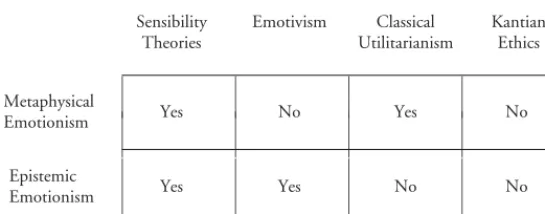
Defenders of this view are committed to moral realism, if we define moral realism as the view that there are moral facts. When a moral property is instantiated, there is a fact that consists in its instantiation. If one believes in moral properties, it follows that there are moral facts. The metaphysical emotionist embraces moral facts and claims that these facts depend on emotions. Some forms of utilitarianism qualify. Consider, especially, the classical utilitarianism of Bentham and Mill. They define the good as that which maximizes utility, and they define utility as happiness. There are moral facts, on this view, because there are actions that maximize happiness. And these facts are essentially emotional, because happiness is an emotion.

The term ‘‘realism’’ is sometimes reserved for a kind of mind-independence: the fact that a is F is real, on this interpretation, if a’s being F does not depend on our regardinga as F. Utilitarians are realists in this strong sense, about good. Call this external realism. Internal realism, in contrast, is the view that a’s being F is a fact, but that fact depends on our regarding a as F

(see Putnam, 1980). Internal realism is factualism without mind-independence. Some metaphysical emotionists are internal realists. Consider the view that moral properties are secondary qualities. Secondary qualities are response-dependent properties. According to Locke, colors, tastes, and smells fit into this category. Lemons are tart—that’s a fact—but they have this property only insofar as they cause a certain tart experience in us when we taste them. Accounts that develop the analogy between secondary qualities and morals have been dubbed ‘‘sensibility theories’’ (Darwall et al., 1992). The most influential recent versions we owe to McDowell (1985) and Wiggins (1987).

Sensibility theories descend from the ‘‘sentimentalist’’ theory of British moral-ists, such as Shaftesbury, Hutcheson, Hume, and Smith. Hutcheson tells us:

The wordmoral goodness. . .denotes our idea of some quality apprehended in actions, which procures approbation. . .Moral evildenotes our idea of a contrary quality, which excites condemnation or dislike. (1738: 67)

Hume goes further, explicitly drawing an analogy between morals and secondary qualities:

(28)

you have a feeling or sentiment of blame from the contemplation of it. Vice and virtue, therefore, may be compar’d to sounds, colours, heat and cold, which, according to modern philosophy, are not qualities in objects, but perceptions in the mind. (1739: III.i.i)

Hume’s moral theory has features that distinguish it from modern sensibility theories. One difference is that, in this passage, Hume can be read as implying that moral properties do not exist (the question of whether that was Hume’s considered view I leave to the scholars). It’s easy to arrive at a skeptical view about moral properties if you begin with an antirealist conception of secondary qualities. The Lockean conception of secondary qualities is different. According to Locke, sounds and colors are real, but relational (powers to cause sensations in us). If one is a realist about secondary qualities, one can adopt a realist analogue of Hume’s thesis. Contemporary sensibility theories tend to have that flavor. In modern parlance, sensibility theories are committed to perceptivism rather than projectivism (D’Arms and Jacobson, 2006). Perceptivists say that we perceive moral properties in virtue of having certain emotions, and projectivists say we do not perceive them, but instead project them onto the world. As perceptivists, sensibility theorists are committed to metaphysical emotionism.

I will have more to say about sensibility theories below, but I want to turn now to another feature of Hume’s moral philosophy. Hume emphasizes the priority of character over action. Being right or wrong is a function of causing certain emotions, but we must distinguish the emotions that matter to moral evaluation from those that don’t. The question of which emotions matter is analyzed by Hume as a question about whose emotions matter. Hume thinks that right and wrong are determined by the emotional responses of a person of character:

’Tis only when a character is considered in general, without reference to our particular interest, that it causes such a feeling or sentiment, as denominates it morally good or evil. ’Tis true, those sentiments, from interest and morals, are apt to be confounded, and naturally run into one another. It seldom happens, that we do not think an enemy vicious, and can distinguish betwixt his opposition to our interest and real villainy or baseness. But this hinders not, but that the sentiments are, in themselves, distinct; and a man of temper and judgment may preserve himself from these illusions. (1739: III.i.ii)

In this respect, Hume’s sensibility theory is also an example of another kind of theory: it is a virtue ethics. Some versions of virtue ethics qualify as forms of metaphysical emotionism. Consider the following view. An action is good if and only if it is that which a virtuous person would do. A virtuous person is a person who has certain character traits. Virtuous character traits are or include emotional dispositions. It follows that an action is good just in case it would be performed by an emotional agent.

(29)

moral properties are constitutively related to emotions, then it is reasonable to think that grasping moral concepts involves emotions in some way. For example, utilitarians might say you cannot understand what the good is unless you possess the concept of happiness. Thus, for classical utilitarians, moral concepts may be essentially related to emotion concepts. Sensibility theories generally make an even stronger claim. They generally say that moral concepts must be defined, not in terms of emotionconcepts, but in terms of emotionsthemselves. I will refer to this thesis as:

Epistemic Emotionism

Moral concepts are essentially related to emotions

To make this thesis plausible, it is important to draw a distinction between standard ways of possessing moral concepts, and deviant ways. Consider the analogy with color. There is a sense in which a congenitally blind person can grasp color concepts (see Crimmins, 1989). She might master the kinds of sentences that contain color words or she might even detect colors using a special apparatus that converts spectral information into another format. But this is not the way sighted people grasp color concepts. If colors are secondary qualities, we could say that a blind person is unable to grasp colors by their essential properties. A blind person cannot think about colors as such. Epistemic emotionism is supposed to be a thesis about our capacity to grasp moral properties in a standard way. The epistemic emotionist does not deny that there may be other ways of thinking about morality. A Martian without emotions could have deferential moral concepts, for example (‘‘Wrong is what Earthlings call ‘wrong’ ’’). I will have more to say about standard concepts below.

(30)

One can be a metaphysical emotionist without being an epistemic emotionist. Classical utilitarians are a case in point. One can also be an epistemic emotionist without being a metaphysical emotionist. Consider those who deny that moral properties exist. If moral realism is false, then metaphysical emotionism cannot be true. But a moral antirealist can defend epistemic emotionism.

Emotivism is a theory of this kind. Emotivists maintain that moral judgments do not describe the world; rather, they express our attitudes. Ayer (1952) says that the sentence ‘‘stealing is wrong’’ is equivalent to saying ‘‘stealing!’’ with a tone of horror. It does not ascribe any property to stealing money; it merely communicates a feeling. Stevenson (1937) defends a slightly different version of emotivism. He says that ‘‘stealing is wrong’’ does assert something, namely that I don’t like stealing, but does not merely assert that fact; it asserts it in a ‘‘dynamic’’ way that expresses my dislike emotionally and thereby enjoins you to share in that attitude. Thus, even though Stevenson admits that moral terms express facts (likes and dislikes), their primary function is to express and commend emotions. Emotivism has sometimes been dubbed the boo/hurrah theory, because its defenders sometimes compare moral terms to expletives. Saying that stealing is wrong is somewhat like saying ‘‘boo to stealing!’’ because both ‘‘wrong’’ and ‘‘boo’’ are principally used to convey and prescribe feelings rather than to report facts.

Recent authors have defended more sophisticated expressivist theories. Black-burn (1984) is close to traditional emotivism, but he emphasizes the projective nature of moral judgments. We talk about moral propertiesas if they were in the world, but do not take on any serious ontological commitment in so doing. Blackburn and the classical emotivists are epistemic emotionists, but they reject metaphysical emotionism. Blackburn’s account is often compared to another theory, called norm expressivism, which has been advanced by Gibbard (1990), but the two are importantly different. Gibbard claims that moral judgments express our acceptance of emotional norms. To say that stealing is wrong is to express acceptance of a norm that mandates feeling guilty when I steal and angry if someone else steals. Gibbard’s view is different from emotivism because moral judgments do not express emotions directly; rather they express norms that commit us to the appropriateness of emotions. Thus, Gibbard is not strictly an epistemic emotionist; on his view, one might say that moral judgments mention emotions (they express the attitude that I have the right to be angry), but they don’t use emotions (they don’t express anger).

(31)

and Van Hoesen (1983) describe a condition called akinetic mutism, in which patients who have sustained injuries to emotional areas of the brain lie motionless in bed; upon recovery, they report that they were fully conscious, but they felt no emotions, and hence, no inclination to act. Moral emotions may be especially important in motivating decent behavior. For example, there is evidence that guilt promotes helping. In one study, McMillen and Austin (1971) induced some subjects to cheat in an exam, and then they asked those subjects to help score some questionnaires; subjects who hadn’t been induced to cheat helped for only 2 minutes, but the cheaters helped for 63 minutes. If you feel guilty about doing something, you will try to make up for it, and if you anticipate feeling guilty about doing something, there’s a good chance you’ll resist the temptation to doing it. Therefore, if moral conceptscontainemotions, then moral judgments will promote behavior that aligns with those judgments.

In philosophical jargon, this means that epistemic emotionism may entail moti-vational internalism. Motimoti-vational internalists believe that there is a necessary connection between moral judgments and the motivation to act in accordance with those judgments (Brink, 1989): if one believes that stealing is wrong, one is thereby motivated to act in a certain way (e.g., to refrain from stealing or work to prevent others from stealing) even if, under some circumstances, those moti-vations get swamped out by other motivational demands on action. As the name ‘‘internalism’’ implies, motivational internalists think that moral judgments carry motivational force on their own, with no need for help from the outside. For example, if you believe that stealing is wrong, you don’t need an overarching desire to avoid the wrong in order to be motivated not to steal. But how might a moral judgment be intrinsically motivating? The answer is clear on an epistemic emotionist picture. Moral judgments contain moral concepts, and, epistemic emotionists claim that there is a necessary connection between moral concepts and emotions. Suppose that the necessary connection is such that tokening moral concepts always results in an emotional state. Empirical evidence demon-strates that emotions have motivational force. Thus, if this version of epistemic emotionism is correct, then moral judgments cannot occur without motivation. Motivational internalism is a controversial doctrine. My point here is that epistemic emotionists have an explanation of how it could be true. It must also be noted that different forms of epistemic emotionalism would entail different forms of motivational internalism. On the form that I hinted at in my example, motivational internalists claim that moral judgments are always

(32)

a corresponding form or motivational internalism. In each case, there is a link between moral concepts and states that are motivating.

1.1.2 Essential Relations

In the definitions just presented, I said that emotionists postulate an ‘‘essential relation’’ between emotions and things in the moral domain. What is it to be essentially related? I chose this phrase, rather than ‘‘necessarily related’’ because there can be some leeway between necessity and essence. Something A belongs to the essence of another thing B if one cannot specify what it is to be B without mentioning A. This formulation does not invoke necessity in a strong modal sense. It does not say that all Bs are necessarily As. Onemightconstrue essential relations in this strong way. It is not uncommon for philosophers to think of essences as necessary and sufficient for membership in a category. The kind of essentialism associated with modern philosophy of language has this tone. When Kripke (1980) says that ‘‘water’’ refers to H2O, he means water is H2O in every possible

world. This might give the impression that emotionists are committed to the view that emotions are present every time moral judgments or properties are present, just as oxygen in present in every sample of water. That impression is misleading. Fist of all, there are other ways of construing essences. For example, Boyd (1988) defines an essence as a homeostatic property cluster: a collection of properties that tend to co-occur and promote each other’s occurrence. On this view, some particular property could be part of the essence of some kind of thing even though it didn’t always occur in every instance of that kind.

Second of all, even on a Kripkean view of essences, the phrase ‘‘essentially related to emotions’’ does not entail that emotions are active whenever there is a moral property or judgment instantiated. Suppose, for example, that moral concepts are constituted in part bydispositionsto have emotions. Suppose, further, that such dispositions are essential to moral concepts in a Kripkean sense (in every token of a moral concept in every world, that token is constituted in part by an emotional disposition). It would follow that moral concepts are essentially related to emotions, because they are essentially related to emotional dispositions, and an emotional disposition is a relation to emotion. Essential relations are transitive. As long as the relations in question are not constitution relations, the emotionist can say that there is a strong modal connection between morality and emotion while conceding that emotions and morals are not always co-instantiated.

1.1.3 Strong Emotionism

(33)

Table 1.1. Species of emotionism

Sensibility Theories

Emotivism Classical

Utilitarianism

Kantian Ethics

Metaphysical Emotionism

Epistemic Emotionism

Yes No Yes No

Yes Yes No No

Kantians reject both forms of emotionism. Morally bad actions are those that I could not will as a universal law. This is not intended as an axiom about my passions or tastes. The bad is not that which I detest. Universalizability is a rational requirement on morality. Certain forms of conduct cannot coherently be universalizable. Kant (1785) gives lying promises as an example. If everyone lied when promising, the whole construct of promising would collapse. Promising makes sense only against a background where promises are generally reliable and honest. Kant sees a similar rational foundation to positive prescriptions. Helping the needy is morally required because one cannot universalize a lack of help for the needy. Everyone is needy or potentially needy some time, so it would be irrational for any one to will a world where no one helps the needy.

Kantians also reject epistemic emotionism, because conceptualizing something as right or wrong is a matter of forming a judgment about what is rational. Generally speaking, one can do that without being in any emotional state. Kant thinks, in making successful moral judgments, we would generally do well to ignore our passions.

Classical utilitarians agree with Kantians in denying epistemic emotionalism. They deny that moral concepts are essentially related to emotions. One could token a moral concept without having any disposition to experience an emotion. On the other hand, utilitarians think that metaphysical emotionism is true. The good is defined in terms of happiness. Emotivism is, in this respect, the inverse of utilitarianism. Emotivists claim that emotions are essential to moral concepts, but they reject the metaphysical thesis. They claim that there are no moral facts. Utilitarianism and emotivism can be called weak emotionist theories, because they entail one emotionist thesis and not the other. A strong emotionist theory would entail both. Sensibility theory is the most salient instance. Here is a schematic statement of the view:

(34)

(S2)Epistemic Thesis:The disposition to feel the emotions mentioned in S1 is a possession condition on the normal concept().

I think a theory of this kind can be defended. I endorse strong emotionism. Much of this book will be dedicated to justifying and elucidating that endorsement.

1.2 MIGHT EMOTIONISM BE TRUE?

Evidence from a variety of sources suggests that emotions are central to morality. In the remainder of this chapter, I will focus on evidence for epistemic emotion-ism, though I will offer some support for the metaphysical thesis at the end. I will add further arguments and responses to objections in the chapters that follow.

1.2.1 Moral Judgments Are Accompanied By Emotions

The most obvious reason for taking emotionism seriously stems from the mundane observation that moral judgments are often accompanied by emotions. It is hard to remain dispassionate when you read newspaper stories about child molesters, atrocities of war, or institutionalized racism. The intensity of our emotions is often a very reliable guide to the strength of our moral judgments. For example, crimes against children are often deemed worse than crimes against adults and they also seem to stir up stronger emotional responses.

The emotional impact of moral judgment is apparent from the fact that we tend to avoid bad behavior. Violating moral rules is often advantageous. If we steal things, we get to have them for free. If we cheat on our lovers, we can multiply our pleasures. Even killing can be advantageous; if you enter an essay contest, there is no better way to increase your chances of winning than to kill off the best writers in the competition. As it happens, we don’t make a habit of doing these things, even when we can get away with them. Why not? The obvious answer is that doing bad things makes us feel bad.

(35)

and that he could not collect as much data as Milgrim had requested. Rather than asking twenty people for their seats, he stopped at fourteen. The difficulty had nothing to do with the fact that people were uncooperative. On the contrary, the majority of people willingly gave up their seats. The assignment was difficult because it was emotionally painful to break a norm.

Milgrim discovered this for himself after losing patience with his reluctant graduate students and performing the study himself. This is how he describes the experience in a 1974 interview:

The words seemed lodged in my trachea and would simply not emerge. Retreating, I berated myself: ‘‘What kind of craven coward are you?’’ Finally after several unsuccessful tries, I went up to a passenger and choked out the request, ‘‘Excuse me sir, may I have your seat?’’ A moment of stark anomic panic overcame me. But the man got right up and gave me the seat. A second blow was yet to come. Taking the man’s seat, I was overwhelmed by the need to behave in a way that would justify my request. My head sank between my knees, and I could feel my face blanching. I was not role-playing. I actually felt as if I were going to perish. (Quoted in Blass, 2004: 174)

This anecdote illustrates an important fact about moral norms. When we do things that violate moral values, we incur emotional costs.

(36)

who innocently spits out food while choking at a dinner party. The social rule violations were associated with greater emotional activation.

The structures that are implicated in these studies include the insula, anterior cigulate cortex, the temporal pole, the medial frontal gyrus, and oribitofrontal cortex, which are all regular players in emotion studies (Phan et al., 2002). Moral judgments and emotions seem to coincide in the brain, just as epistemic emotionism predicts. A natural explanation of these findings is that moral judgments are constituted by emotional responses.

It must be conceded, however, that this is not the only explanation. The Milgrim anecdote and neuroimaging studies show that moral judgments have emotional costs, but that is consistent with two different models of how emotions relate to moral judgments: a causal model and a constitution model. The causal model says that moral judgments can have emotional effects. This is uncontroversial. Anyone who thinks we care about morality might be willing to say that moral judgments cause emotions. Music, sporting events, and sunny weather all cause emotions too, but they are not constituted by emotions. On a causal model, moral judgments occur prior to emotions, and are hence independent of emotions. On the constitution model, concepts such as andliterally contain emotions as component parts. This is what epistemic emotionists have in mind. The evidence so far cannot decide between these two possibilities. To support the constitution model, further evidence is needed.

1.2.2 Emotions Influence Moral Judgments

The emotionist can make progress showing that emotions actually influence our moral judgments. If moral judgments comprise emotions, then this influence can be explained. If the judgment that something is wrong contains indignation, then becoming indignant would promote that judgment. By analogy, suppose that the judgment that something is amusing contains amusement. More specifically, imagine that when we judge something to be amusing we are making a judgment of the form ‘‘that thing causes this state,’’ where ‘‘this state’’ is an inner demon-strative pointing to amusement. Becoming amused promotes the judgment that something is amusing by furnishing us with one of its constituent parts.

(37)

This idea can explain intuitions about trolley cases (Thomson, 1976). In these thought experiments, we are typically asked to compare two scenarios. In both, a trolley is heading toward five people who have been tied down to the tracks. You are not close enough to free them, but you can save them. In one scenario, you can do this by pushing a person off a footbridge into the trolley’s path, killing him, and causing the trolley to stop. In the other scenario, you can save the five by pulling a lever that switches the trolley to another track where you know that one person is tied down, instead of five. In both cases, your intervention would result in there being one death instead of five. Many people have the intuition that it is morally impermissible to intervene in the first case, and morally permissible to intervene in the second (Mikhail, 2000). Pushing someone in front of a trolley seems wrong, but it seems okay to divert a trolley away from five people and toward one. Why is this? A popular answer among philosophers is that killing a person is morally worse than letting someone die. In the pushing case, we are killing someone, but in the lever case we are merely allowing someone to die. Another explanation is that killing just stirs up more intense emotions. We don’t want to push anyone into the trolley tracks because doing so fills us with horror, and the negative feeling causes us to think that the action is wrong.

The philosophical answer is compatible with the emotional answer. On the philosophical story, we have two rules: one that says we should not kill and another that says we should save lives, and the former is stronger than the latter. We don’t have a rule against letting people die, or at least not a very strong rule. Thus, saving trumps letting die, and killing trumps saving. But what exactly are these rules, psychologically speaking? One answer is that they are grounded in emotions. We have negative feelings about killing, and positive feelings about saving lives, and few feelings about letting die. When considering dilemmas, the stronger feeling wins. This story makes two key predictions. One is that emotions should come on line when considering moral dilemmas, and the other is that our intuitions about what’s right should be influenced by changes in the emotional content of the scenarios we consider. If moral rules are grounded in emotion, then factors that alter our emotions should affect our application of those rules.

(38)

a somewhat weaker emotion-backed rule that it’s good to save lives. In the pushing case, we imagine killing in a very vivid way, and the emotional wallop packed by the ‘‘don’t kill!’’ rule overwhelms the weaker emotions associated with the ‘‘save lives!’’ rule. In the lever-pulling case, we don’t imagine the harm we are causing very vividly, so the ‘‘save lives!’’ rule can guide our actions. Here the numbers matter. We calculate that pulling the lever will result in more lives saved, and that results in an emotional preference for pulling the lever. The activations in working memory areas result from the fact that our decision depends on thinking about the numbers. We can coolly calculate which course of action will save more lives, but once we figure out that it’s morally best to pull the lever,that judgment may be backed by an emotional response. This is consistent with the data. Greene et al. found that emotions are active during both the pushing scenario and the lever scenario. Emotions are more intense in the pushing case, but that’s no surprise: pushing someone to his death is a very evocative activity.

If I am right, we deliberate about moral dilemmas by pitting emotions against emotions. Conflicting rules have different emotional strength, and the stronger emotions win out. If that’s right, then it should be possible to alter intuitions about trolley cases by changing the scenarios in emotionally significant ways. Here’s a prediction. When subjects say it is morally acceptable to pull the lever to save five people and kill one, they are imagining that the lever is far away from the tracks. Now suppose we tell subjects that the lever is just a few inches away from the person who would be killed if the lever were pulled. Imagine yourself in that situation. A man is tied down to the tracks right next to you. You cannot free him. He is writhing around and howling in terror. You know that there are five people on another track, which is some distance away, and you know that the trolley is heading that way. Would you sacrifice the person at your feet? Would that be morally acceptable? Here, I think intuitions would change. This is more like the pushing case. People who had not been exposed to many of these examples would, by default, have serious moral misgiving about sacrificing the life of someone inches away. The strong emotions elicited by proximity to the victim would, I predict, influence the judgment.

(39)

These examples suggest that we are not slaves to a principle that killing is worse than letting die. We normally adhere to such a principle, but a change in emotional intensity can lead us to endorse clear violations of it. Moreover, the principle itself may be partially underwritten by the fact that killing is usually more emotionally charged than letting die. Killing usually involves physically contacting another person and perceptually experiencing that person’s suffering. We can let someone die without any contact (as we so often do with distant crises around the world). I am not claiming that there is no moral difference between these cases (for that view, see Kagan, 1989). My point is that our moral intuitions about such cases are influenced by emotions.

Consider one more trolley case (for a more complete survey, see chapter 7 below and Prinz, forthcominga). When you refuse to push a person in front of a speeding trolley to save five lives, you are making a deontological moral judgment. You are siding with those moral philosophers who claim that intentionally killing a person is wrong regardless of the consequences. You must obey the principle of humanity: you cannot use a human being as a means, rather than as an end. But such deontological intuitions can, famously, be overridden by changing the numbers. Suppose that, instead of five people tied to the track, the trolley is filled with powerful explosives and heading toward a village where it will detonate, killing five hundred people. Now it seems that pushing the person into the tracks and causing the trolley to derail would be morally commendable. We shift from being deontologists to being consequentialists. This switch in intuitions is an embarrassment for philosophers who think that deontological theories and consequentialism are in competition. But suppose that neither theory is right. Suppose that the concept of the good is not the concept of bringing about the best consequences or the concept of strictly following rules that obey the principle of humanity. Suppose instead that the concept of the good is the concept of that which causes strong emotions of approbation. In some cases, the action proscribed by deontological principles causes approbation, and in other cases, we approve of the consequentialist demand. In the present example, that shift is explained by the fact that imagining five hundred deaths fills us with an acute sense of horror. The scale of the loss pulls on our heartstrings. The emotional difference between five lives lost and one is big, but not enormous. It is not big enough to outweigh the revulsion we would feel pushing a person into the path of a speeding trolley. But the enormity of loss in the explosives case trumps the revulsion of killing a single individual. I think our emotions are influencing our judgments.

These examples suggest that moral judgments are linked in an essential way to emotions. If emotions were merely concomitants of moral judgments, then they should not influence those judgments. The fact that we are influenced by our emotions is predicted by the hypothesis that emotions are the basis of our judgments and, perhaps, constituent parts.

(40)

might say, ‘‘It would fill me with unspeakable anguish to allow the decimation of a village, but it is still wrong for me to prevent that outcome by taking a human life.’’ Moral judgments and emotions seem to be dissociable in this way. Doesn’t this undermine the emotionist claim?

I will postpone serious discussion of this kind of objection until chapter 3. For now, I will mention four ways in which an emotionist theory could accommodate the deontologist who insists that it’s okay to decimate the village. First of all, the deontologist might be quite passionate about the principle of humanity. Her emotional investment in the principle that it is wrong to use one person as a means to save others might be strong enough to trump countervailing considerations. Second, moral judgments may depend on particular kinds of emotions, and not others. When the deontologist says it is right not to push the person into the tracks, she may be recognizing that she would feel guilty if she did. If she lets the villagers die, she might feel intense sadness but not guilt. The sadness may be more intense than the guilt she would feel if she pushed the person into the tracks, but it would be the wrong emotion. Non-moral emotions can fuel moral emotions, but careful deliberators can keep these apart. Third, the deontologist may be judging that our emotions are misplaced in this case. By analogy, imagine the anguished victim of a crime who condemns a falsely accused suspect. The anguish causes the condemnation, but it is directed toward the wrong person. Likewise, when we imagine five hundred villagers dying, the anguish causes us to look for a perpetrator, and we may condemn a person whose actions or inactions would seem blameless if we considered the scenario in a cooler moment, with all the facts in. Finally, the deontologist might be self-deceived. Suppose she allows five hundred people to die, and then feels intense guilt. She might continue to insist that she doesn’t believe the action was wrong, but we can challenge her self-assessment. We can say, ‘‘Clearly, you have moral misgivings about this action; clearly, it seems wrong to you.’’ We can claim that she is merely mouthing the words when she says her inaction was right. Or one might suppose that she correctly recognizes that the action was right in a non-moral sense (she did as reason demanded), while painfully recognizing that her inaction conflicted with her basic moral values.

(41)

they hear about a student in charge of scheduling discussions in school, who

often picks interesting topics. Subjects who are disgusted when they here the word ‘‘often’’ find this student morally suspect, though they can’t say why (‘‘He seems like he’s up to something’’). In another study, Schnall et al. (2005) asked subjects to make moral evaluations of stories while sitting at a desk that was either tidy or filthy. The filthy desk has an old greasy pizza carton next to it, a chewed up pencil, used tissues, and a dirty beverage cup. Subjects who are good at introspecting their emotions (as measured by a body self-awareness scale that is correlated with emotion awareness) responded differently. Those seated at the filthy desk judged the scenarios to be worse than subjects seated at the clean desk. For example, they gave higher wrongness ratings to a scenario describing a person who accidentally kills his pet dog and then eats it. These effects do not depend on disgust. Lerner et al. (1998) showed subjects film clips that were either neutral or evocative of anger. They were then asked to consider some unrelated vignettes that describe people who perpetrate relatively minor transgressions, such as selling a used car without disclosing a defect. Subjects who viewed the anger-inducing clips recommended harsher penalties for the perpetrators in these vignettes. In addition, some studies have shown that induction of sad moods can lead to more negative appraisals of people (Fogas and Bower, 1987). Conversely, physical attractiveness, which is known to induce positive affect, can promote positive appraisals of people, including appraisals of honesty and integrity (Dion et al., 1972). It has also been shown in jury studies that attractive or smiling defendants are treated more leniently (Darby and Jeffers, 1988).

Together such findings support the case for epistemic emotionism. They sug-gest that emotions can influence moral evaluations even when the emotions are induced by morally irrelevant factors. This is just what epistemic emotionism pre-dicts. Epistemic emotionism provides a natural explanation of the phenomenon: if moral concepts have an emotional component, then induction of emotions should influence application of those concepts. Compare: if the concept contains the emotion amusement, then covertly tickling people should increase their tendency to think that a joke is funny. If the tickling is too obvious, they will attribute amusement to the tickling and not the joke, but, if the tickling is subtle, they may rate the joke as more amusing than they otherwise would.

(42)

about whether the characters described in various vignettes are guilty. The guy who eats his pet dog is clearly responsible for his actions. So emotions cannot be affecting wrongness judgments by influencing the way people weigh evidence. Moreover, there are dissociations between the desire for punishment and judgments of wrongness. Compare a crazed axe murderer to a calculating murderer who uses a gun. Because of his insanity, we may think the axe murderer should be less harshly punished than the gun murderer, but, because axe murders are more gruesome, we may judge that his crimes are more wrong. This is just my intuition, but it would be easy to test.

Of course, the opponent of emotionism could devise other explanations for why emotions influence moral judgments if the desire for punishment doesn’t accommodate all the data. I think the main reason for preferring the emotionist explanation is that it fits better with findings that I am about to describe. If emotions were not constituents of moral judgments, but merely exerted a causal influence, then emotions would be neither necessary nor sufficient for regarding something as wrong. The wrongness concept would be something above and beyond the emotions, and hence independent of them. On the causal influence account, there should be cases in which people moralize without having emotions, and there should not be cases in which emotions alone are, on reflection, the sole basis of moral judgment. As we will see, these predictions of the causal influence account are incorrect. The view that emotions constitute our moral judgments fits better with the data.

1.2.3 Dumbfounding

The evidence adduced so far shows that emotions can sway our moral judgment. But epistemic emotionists make a stronger claim. They say that having a moral attitude is a matter of having an emotional disposition. If this is right, then someone should be able to have a moral attitude in the absence of any rational justification. Emotional attitudes should be sufficient for moral attitudes. There is empirical evidence supporting this prediction. People’s reflective moral judgments seem to have an emotional foundation. If we ask people why they hold a particular moral view, they may offer some reasons, but those reasons are often superficial and post hoc. If the reasons are successfully challenged, the moral judgment often remains. When pressed, people’s deepest moral values are based not on decisive arguments that they discovered while pondering moral questions, but on deeply inculcated sentiments.

(43)

To support this model, Murphy et al. (2000) studied moral attitudes toward consensual incest. They asked American college students to consider a case in which a brother and sister have sex. In the scenario, the siblings consent to intercourse, use contraception, enjoy the experience, and keep it a secret. Eighty percent of the subjects judged that the behavior was morally wrong, but they had great difficulty explaining why. Each time they came up with an argument to show that the siblings had done something immoral, the experimenters explained why the argument fails. Many subjects worried that the couple would have deformed children, but the experimenters reminded them that contraception was used. Some were worried about the effects on the community, but that worry is inapplicable, because the couple in the scenario did not tell anyone what they had done. Some subjects might have complained that the couple would be traumatized, but the scenario specifies that they actually enjoyed the experience and it strengthened their relationship. A few subjects suggested that incest is condemned in the Bible, but none could recall where (certainly not in the story of Lot and his daughters!). Subjects were presented with decisive counterarguments to every argument that they gave against consensual incest. They tended to concede that the counterarguments were successful, but only 17 percent changed their initial moral judgments. The others typically bottomed out in unsupported declarations and emotional exclamations. Incest is nasty! Incest is just wrong: it’s gross! Reasons fell by the wayside, but moral convictions and moral emotions were recalcitrant.

Murphy et al. (2000) found the same pattern of responses when they presented subjects with a scenario involving cannibalism. A woman working alone late one night in a medical pathology lab decides to cook and eat a discarded piece of a human cadaver that was donated to the lab for medical research. Once again, subjects say this is wrong, but they cannot articulate reasons sufficient to support that conclusion. They say that their moral appraisal of the case is based on a ‘‘gut feeing.’’

These dumbfounding results can be interpreted in several ways. One possibility is that subjects have good reasons for their views about incest and cannibalism, but these reasons operate unconsciously. After all, a lot of problem-solving is done unconsciously, and people have limited insight into how they arrive at judgments in other domains (Nisbett and Wilson, 1977; Moscovitch, 1995). Call this thehidden reasonsinterpretation.

(44)

reflection or education. Moreover, there is a straightforward explanation of how people arrive at their moral judgments that does not require postulation of hidden reasons. Incest and cannibalism have been emotionally tagged as repulsive and taboo. That fully explains the knee-jerk moral condemnations of perpetrators. And our tenacity in denouncing incest and cannibalism derives from the fact that reasons do not easily override the deeply entrenched emotional responses.

According to a second interpretation of the dumbfounding results, people always base their moral judgments on reasons, but those reasons are sometimes bad. After all, people do offer arguments against incest and cannibalism. It just turns out that their arguments are flawed. Murphy et al.’s results are consistent with the hypothesis that moral judgments derive from reason, rather than passion. The problem with this interpretation is that people usually don’t revise their moral assessment when their reasons are debunked. They recognize that the reasons are flawed but they dig in their heels about the wrongness of consensual incest and cannibalism. This suggests that the reasons they offer did not play a very central role in the formation or maintenance of their moral judgments.

Another possibility is that subjects do not really regard incest and cannibalism as immoral. Perhaps they are just saying these things are wrong because they recognize that to be the prevailing view. Endorsing a taboo behavior in public has serious social consequences, so subjects have good reason to make it appear as if they find incest and cannibalism bad.

This interpretation is also unconvincing. If taboos are powerful enough to make people say that they categorically oppose incest and cannibalism, then they should be strong enough to instill the corresponding beliefs. The issue could be tested by having people answer questions about consensual incest and cannibalism on an anonymous questionnaire. I would predict that subjects would continue to condemn.

A fourth possibility is that subjects haveno reasonsfor their moral judgments. They simply have a gut reaction that consensual incest and laboratory cannibalism are wrong, and a few post hoc rationalizations, which play no important role in driving those reactions.

Gambar

Table 1.1. Species of emotionism
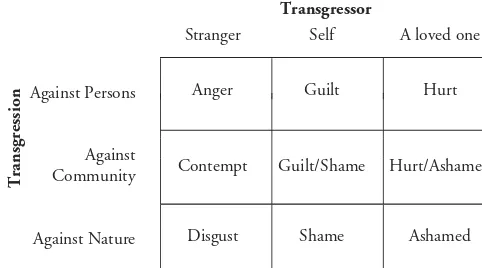
Table 2.1. Emotions of blame as function of transgression and transgressor
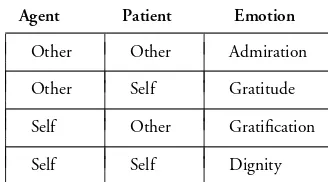
Table 2.2. Emotions of praise as a functionof who is the agent and patient
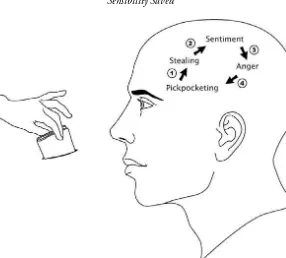
Figure 3.1. Information-processing stages that lead to a moral judgment. (1) A perceivedevent is categorized; (2) a rule is retrieved from memory, which activates a sentiment;(3) the sentiment elicits an emotion in a contextually sensitive way; (4) the emotion isassociated with the perceived action
+2

Referensi

Dokumen terkait

Thus, the LandformState consists of four nodes, the three DualStructures that represent the three LandformLayers and the outer (o). In general the outer represents the

Meskipun dokumen ini telah dipersiapkan dengan seksama, PT Manulife Aset Manajemen Indonesia tidak bertanggung jawab atas segala konsekuensi hukum dan keuangan

Bukti Setor Pajak Asli (SPT Tahunan dan Pajak 3 (tiga) bulan terakhir atau SKF).. Identitas (KTP/SIM) Asli yang masih

[r]

Pada hari ini Kamis Pukul 15.01 WIB tanggal lima belas bulan Juni tahun dua ribu tujuh belas , kami Kelompok Kerja Unit Layanan Pengadaan Kota Tangerang Selatan

3) Uji Banding Pretest dan Posttest Untuk mengetahui pengaruh model pembelajaran example non example berbantu media gaser terhadap keterampilan menulis deskripsi kelas IV SD

Diberitahukan bahwa setelah diadakan penelitian oleh Kelompok Kerja (Pokja) menurut ketentuan-ketentuan yang berlaku, Kelompok Kerja (Pokja) I Pekerjaan Konstruksi Unit

Dampak Manajemen Guru Pendidikan Dasar Terhadap Penuntsan Wajib Belajar Pendidikan Dasar .... Kebermaknaan Rencana Strategik Pendidikan