Site this Article As ……….
Paper Accepted : January, 26th 2018
Paper Published : March, 7th 2018 95
A FRAMEWORK TO IMPROVE ENVIRONMENTAL
PERFORMANCE IN SMES
Marudut Sirait
Department of Industrial Engineering, Faculty of Engineering, Universitas Brawijaya
Abstract
The aim of this study is to develop a conceptual framework to improve industrial waste, particularly in Small and Medium Enterprises (SMEs) . A conceptual framework is developed by integrating Life Cycle Assessment (LCA) tool and cleaner production method. LCA is utilized to evaluate and identify waste along the life cycle of product/services. On the other hand, cleaner production method is implemented to reduce the most significant waste along SMEs activities. By using LCA, the significant waste will be identified. Furthermore, cleaner production will be implemented to the significant waste to improve the environmental performance of SMEs activities. Cleaner production strategies such as product modification, Input substitution, technology modification, reuse/recycling, and good housekeeping are applied to prevent waste generation from SMEs. Furthermore, the integration between LCA tool and CP method significantly improve the environmental performance during the industrial activities. CP and LCA were successful to improve environmental performance in term of raw material saving, water saving, energy saving and wastewater reduction.Keywords: Life Cycle Assessment, Cleaner Production, Environmental Assessment, SMEs
1. Introduction
Since the Industrial revolution, the number of industries has increased significantly in the world in order to produce tools or products for human life. The growth of industries increase as a result of technological advances to cultivate and to utilize natural resources for improving human quality. As a result, the number of industrials raises up in each country in the world. In Indonesia, the growth of industries increase very impressive, in 2014 there were 23941 large-scale industries, while small and medium - scale reaching 3,220,563 [1]. On the other hand, the growth of industries requires huge natural resources such as raw materials, fuels, electricity and chemicals subtances to produce tools or products. Consequences, industrial activities generate huge waste, such as air emission, wastewater, soil pollution that will decline the environmental performance. [2] Stated that the world's waste is about 11 billion tons where manufacturing industries have the largest contribution by 60% of total world waste production, mining by 15%, oil / gas by12%,
* Corresponding author. Email : [email protected] Published online at http://Jemis.ub.ac.id
Copyright ©2017 JTI UB Publishing. All Rights Reserved
agriculture by 9%, municipal waste by 16% and other by 1.1%. The statement of (Bilatos and Basaly, 1997) is reasonable because the huge natural resources, such as raw materials, fuel/energy and technology for the manufacturing industry are required. Also, the excessive chemical substances for industrial processes are needed. As a result, the massive waste from manufacturing process is generated every year.
Site this Article As ……….
Paper Accepted : January, 26th 2018
Paper Published : March, 7th 2018 96
Moreover, waste treatment requires considerable additional cost, which drives obstacle for industry in managing waste, especially for small and medium scale industries (SMEs)[4]. This problem causes environmental pollution get worse when followed by weak law enforcement. It is therefore necessary to put environmental aspects into an integral part of SMEs activities, so that the environmental problem is no longer a separate part of the SMEs activities.
To respond this situation, it is important to find appropriate method and strategy in order to prevent waste generating during the industrial processing with low cost. Currently, the most method widely use to manage industrial waste management methods is the old paradigm with an end-of-pipe treatment approach. This method focuses on waste treatment and disposal management [5]. However, this method cannot provide solutions to solve existing environmental problems because environmental degradation is still exist. This concept raises many obstacles, such as this method can be implemented after the waste is formed [5].
To overcome the above problems, this study attempts to examine the prevention of industrial waste by approaching cleaner production (CP). Cleaner production is a preventive, integrated and continuously applied environmental management strategy for production, product and service to improve eco-efficiency, reducing risks to human health and the environment [6]. To optimize implement of CP, a comprehensive environmental impact assessment needs to be conducted in each cycle of industry activities. Hence, life cycle assessment is utilized to identify waste in each life cycle stages of SMEs. LCA tool is widely used to assess and identify environmental impacts along the supply chain of products in the world including in Indonesia, for example, LCA study of Liquid Computer Display (LCD) has done to identify the largest environmental impact during the production of LCD [7].
Therefore, the aim of this paper is to develop a conceptual framework in order to improve environmental performance of industries, particularly in SMEs.
2. Method
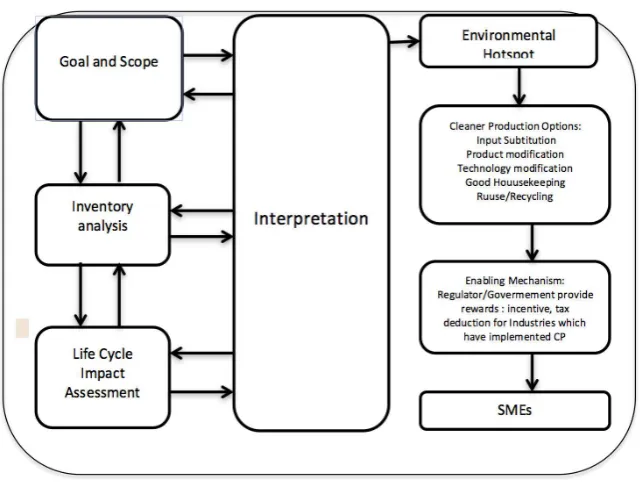
This section will discuss methods for assessing and mitigating environmental impacts on industrial activities, particularly for small medium-sized manufacturing. In this study will discuss the framework by integrating life cycle assessment tool and cleaner production method (CP) for improving environmental performance of SMEs activities.
2.1.Life Cycle Assessment
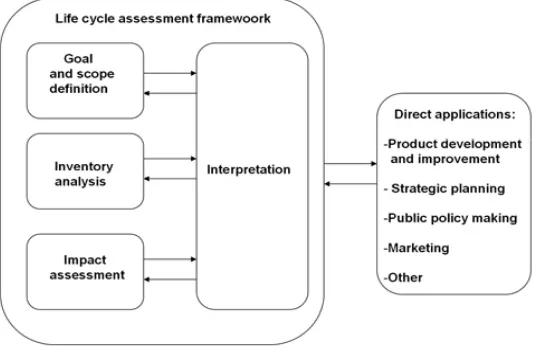
Life cycle assessment (LCA) is a tool to assess and evaluate environmental impacts during the lifecycle of a product or service ISO 14040, 2006 [8]. The LCA approach applies an international standard to assess and evaluate environmental impacts for products and services [9]. Thus, the LCA for assessing and evaluating environmental impacts is widely used in the world. LCA will assess the potential environmental impacts along the supply chain of product/ services, from raw material extracts, raw material process, manufacturing processes, distribution and transportation, and end of life product. The implementation of LCA is based on International standard ISO 14040, 2006 with the following steps; the first step is the determination of the goal and scope, the second step is to inventory analysis, the third step is impact Assessment and the last step is interpretation [7](Fig.1). The steps of LCA will discuss below.
a. Goal and Scope Definition
The first step of implementation LCA is to determine goal and scope definition. Boundaries and functional units should be determined to facilitate inventory analysis. b. Inventory Analysis
Site this Article As ……….
Paper Accepted : January, 26th 2018
Paper Published : March, 7th 2018 97
Figure 1. Life Cycle Assessment Framework
Source: Curran, M.A, (2013)
c. Life cycle impact assessment (LCIA) LCIA is conversion of inventory data into environmental impact potentials Impact categories, indication, and characterization. It is a step to assess the environmental impact after inventory analysis was conducted. Thus, inventory data is inserted into simapro software. Selection of environmental impact methods (eg, IDEP, eco-indicator 99) is required based on the goal and scope of the LCA.
d. Interpretation
The LCA phases, in which the findings of either the inventory analysis or the impact assessment, are combined consistent with the defined goal and scope in order to reach conclusions and recommendations.
2.2.Cleaner Production
Cleaner production is a preventive, integrated and continuously applied environmental management strategy for production, product and service to improve eco-efficiency, and reduce risks to human health and the environment [9]. Cleaner Production (CP) aims to prevent and minimize generating of waste or environmental pollutants throughout the stages of the production process. In addition, Cleaner production also involves efforts to improve the efficiency of the use of raw materials and energy throughout the production stage. By applying the concept of clean production, it is expected that natural resources can be more protected. Therefore, CP
method provides two advantages, such as minimizing waste generation that can protect environment. Another advantage is efficiency in the production process, so that it can reduce production costs. Furthermore, we discuss types of options that may consider for implementing cleaner production [10].
a. Input Substitution
Substitute input materials are implemented to reduce or eliminate hazardous and toxic materials. Hence, substitute input material can be implemented by less toxic material or by renewable materials or by adjunct material which have a longer service lifetime in production. [10]. It is important to assess the options through laboratory/bench scale studies and pilots, to ensure that the product quality is not change and/or is acceptable to the market.
b. Technology Change/Modification
Site this Article As ……….
Paper Accepted : January, 26th 2018
Paper Published : March, 7th 2018 98
Figure 2. Integrating LCA and CP Method
c. Good Housekeeping
The goal of good housekeeping is to take appropriate management and operations to prevent leakage, spillage. Good house keeping is one of the options for reducing resources, including procedural, administrative or institutional measures that can be used in companies to reduce waste generation.
d. Product Modification
Product modification can be conducted by re-design of products, processes and services be changes in products, processes and services to reduce its life cycle environmental impact. It can be carried out by three ways, such as product substitution, conservation of products and changing product composition. This can lead to benefit such as reduced consumption of natural resources, and reduced environmental risks. However, product modification is a major business strategy and may require feasibility studies and market survey.
e. Reuse/Recycle on site is reuse of the wasted material in the same process for another useful application within the company. In various forms including returned to the original process, substitute raw materials for other production processes, separated for
recovering useful parts, reprocessed as by-products.
Site this Article As ………. many benefits for improvement economic growth. On the other hand, industrial activities also produce waste that decrease the environmental performance, such as air emission, soil pollution and wastewater. Many tools and methods have carried out in order to reduce industrial waste. End of pipe method is the current concept and widely used to reduce industrial waste. However, this method has many disadvantages for reducing industrial waste. To overcome this problem, we need to find a method or strategy for reducing SMEs waste from the concept of reducing waste in to preventing waste generation. Currently, Cleaner production is a new concept to prevent generating waste with some options such as, good housekeeping, product modification technology change/modification, and reuse/recycling on site. This approach provides significant results to prevent generating waste and also providing economic benefits. Furthermore, to optimize of CP implementation, it is necessary to find the most significant environmental impact along the industrial activities. LCA will be utilized to identify the significant environmental impact. The integration LCA and CP develop a conceptual framework to assess and reduce SMEs waste in order to improve the environmental performance.
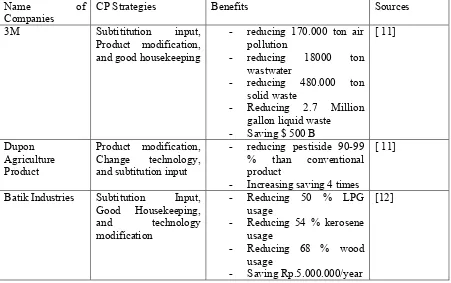
Many companies/ organizations have applied this concept successfully and gained many benefits, such as cost savings, improved environmental performance, increased productivity, improves work safety, enhanced product quality and reduced risks of accidents. Success story of CP implementation from international and national companies has discussed. 3M Company is one of the most successful companies for implementing Cleaner Production for pollution prevention. 3M undertake this pollution prevention program with strong commitment from all levels of corporate management. Moreover, one of the success factors of CP implementation of 3M is its ability and willingness to change the paradigm of the end-of-pipe approach to an up-the-pipe approach. The pollution prevention program of 3M is known as 3P (pollution,
prevention, pays), which was developed in 1975 - 1992. The two basic objectives of 3P are: eliminate pollution at the source. These efforts will reduce environmental costs, reduce energy use, and reduce the use of raw materials needed for production; and 3M take into account waste as raw materials / resources .
Another company/organization that applied CP is Du Pont Agriculture product (AG). AG has a business enterprise on agricultural products such as plant protective chemicals and biotechnology. With respect to the chemicals used for plant protection to be a hot issue for Du Pont product users, AG management was trying to develop new products through the use of natural materials. This program was conducted by identifying the various problems delivered from consumers associated with Du Pont products. Chemicals for protective plant (BKPT, Bahan Kimia Pelindung Tanaman) products are a concern of consumers, such as producing more efficient crops, water protection, soil protection, agricultural workers' safety, quantity and quality of pesticides established by government and food supplier. Furthermore, the cleaner production approach is applied by developing more effective BKPT products. Finally, the BKPT products are able to reduce the use of herbicides, reaching 90 % to 99% smaller than previous conventional products. As a result, Du Pont can increase revenue four times larger than before. In 1995, AG revenue reached USD 2.3 billion [11]. Another SMEs, which have succeed-implementing CP, is batik Industries in East Java. The SMEs have adopted CP strategies for improving environmental performance. The implementation of CP for batik industry has been successfully. The strategies and benefits of CP implementation can bee seen in table 1. Substitution input strategy was applied by using natural dye for batik coloring process. Reuse/recycling on site was done by reusing of rinsing water, reducing spillage during the process of batik.
Site this Article As ……….
Paper Accepted : January, 26th 2018
Paper Published : March, 7th 2018 100
Table 1. Different companies which have implemented Cleaner Production Strategies
Name of
Companies
CP Strategies Benefits Sources
3M Subtititution input,
- Increasing saving 4 times
[ 11]
Batik Industries Subtitution Input, Good Housekeeping,
Therefore, government/regulator have to support CP approach by promoting CP and also providing rewards, such as incentives and tax deduction to organizations/companies, which has implemented CP.
4. Conclusion
SMEs activities have clearly impacted not only economic and social impacts, but also have an impact on environmental degradation by using natural resources, electricity and fuel. As a result, it generates huge waste to the environment, such as air pollution, soil pollution and wastewater. Therefore, the environmental impact of industrial activities has become a global problem in the world. As consequence, each country has responsibility to reduce industrial waste in order to improve the environmental performance. Therefore, it is necessary to develop a comprehensive environmental impact prevention method with low investment. Currently one of the methods for waste prevention is Cleaner production. This method is powerful to prevent to generate waste with low cost. Furthermore, LCA will be used to evaluate environmental impacts during the production process of SMEs activities. Once the potential waste has a large contribution has
been identified, then CP will be implemented. Many companies has succeed in implementing CP to improve the environmental performance for industries and services in term of reducing raw material, energy, electricity and wastewater reduction.
Environment. New York: Taylor & Francis.
[3] De Hoo S, Brezet H, Crul M, Dieleman H. End-of-Pipe or Cleaner Production? An Empirical Comparison of Environmental
Innovation Decisions Across OECD
Site this Article As ……….
Paper Accepted : January, 26th 2018
Paper Published : March, 7th 2018 101
economic Reserch Discussion paper No.04-082.
[6] USEPA, (2008). Introduction to cleaner
production concept and proactice.
[7] Sirait, M 2016. Potensi dampak lingkungan
pada proses produski Liquid Cristal Displai komputer dengan pendekatan Life Cycle Assesment. Journal of Engineering and Management in Industrial System. Volume 4 No. 1.
[8] ISO 14040. 2006, Environmental
Management-Life Cycle Assessment-principe and Practice, CEN Europe.
[9] Curran, M.A, 2011. Life Cycle
Assessment: A review of the methodology
and its application to sustaianbility.”
Current Opinion in Chemical Engineering
2.3. p 273-277.
[10]UNEP (1994). Government strategies and
policies for cleaner production. Paris: United Nations Environment Programmed.
[11]Benefita, 2016. Beberapa Kisah Sukses
Pelaksanaan Produksi Bersih.
[12]Setiadi, T 2017. Penerapan Resource
Efficient and Cleaner Production (RECP) di Indonesia, Centre for Resource Efficient
and Cleaner Production Indonesia