Aspects of Applied Biology 77, 2006 International advances in pesticide application
Evaluation of various spraying equipment for effective
application of fungicides to control Asian soybean rust
1By H E OZKAN1, H ZHU2 , R C DERKSEN2 , H GULER1 and C. KRAUSE2
1
Department of Food Agricultural and Biological Eng., The Ohio State University, 590 Woody Hayes Drive, Columbus, Ohio 43210, USA
2
USDA-ARS Application Technology Research Unit, 1680 Madison Avenue, OARDC, Wooster, Ohio 44691, USA
Summary
Fungicides manufactured to control soybean rust are effective; however, successful control of this disease will mostly depend on proper application methods. Spray coverage and deposition from 10 application equipment/spray nozzles were analysed. In general, the spray treatments with air assistance were more effective in spraying rust fungicides than the treatments with the conventional boom sprayer. Spray performances from the boom sprayer with a canopy opener were very similar to the air assisted spray treatments, and were better than other treatments with the boom sprayer. Twin jet, Turbo Dual pattern and hollow cone nozzles produced lower spray performances than conventional flat fan nozzles. For treatments with the boom sprayer, medium spray quality provided higher spray coverage inside canopies than coarse and fine spray qualities. Future research will address how much fungicide inside canopies can be sufficient to control the soybean rust disease.
Key words: Asian soybean rust, spraying equipment, nozzles
Introduction
The Asian soybean rust (Phakopsora pachyrhizi) is a deadly disease. If not detected and treated immediately after its detection, this disease can cause complete defoliation of soybean plants within two weeks. Fungicides manufactured to control soybean rust are effective; however, successful control of this disease will mostly depend on proper application methods. Unfortunately the fungicide labels fail to clearly state the spray equipment and methods that are best suited for application of rust fungicides.
Soybean rust is a foliar disease which initially surfaced and stayed for many years in Asian countries such as Taiwan, Thailand, Japan and India and more recently South Africa, Paraguay, Brazil and Argentina. Phakopsora pachyrhizi is one of the fungal species known to cause soybean rust and is the most aggressive. Soybean rust causes premature defoliation leading to yield losses, fewer seeds per pod, decreased number of filled pods per plant and early maturity
(Dorrance et al. (2005)). Historical and most current soybean yield losses due to rust around the world vary from negligible to complete loss of crop depending on many factors including severity of the disease outbreak, timing of infection, selection of fungicides and their timely application using the most effective equipment. A conservative prediction indicated yield losses greater than 10% in nearly all the U.S. soybean growing areas with losses up to 50% in the Mississippi delta and southeastern costal states (Yeh et al. (1981)).
The Asian soybean rust reached southern U.S.A. in the fall of 2004, and has been moving gradually towards Northern States. An unusually high number of devastating hurricanes that arrived in the southern parts of the U.S. in summer and fall of 2005 have expedited the movement of this disease in the U.S. Within eight months after its first sighting in the U.S., it has reached states as far north as Ohio.
There are no soybean varieties currently available that have high levels of resistance to soybean rust. This leaves soybean producers with only one alternative option—be prepared to do as good a job as possible applying fungicides that are registered for protecting against or controlling this disease. Fungicides manufactured to control soybean rust are effective, However, success will largely depend on proper application done before the disease is detected. Mostly due to educational efforts by University Extension personnel and fungicide companies, and increased coverage of the disease in the media, soybean growers in the U.S. now know that there are fungicides available to take care of this problem as long as they are applied at the right time, and at the recommended rates. Soybean rust usually shows its first symptoms in the lower parts of the plant and works itself up towards the top of the plant. So, by the time producers notice the problem in the mid to upper canopy, it may be too late to spray any fungicide. Penetrating droplets inside the canopy of a fully grown plant is a much bigger challenge for soybean producers than the challenge they face for control of weeds and insects. Therefore spraying recommendations given for controlling weeds and some insects are not applicable to spraying for rust fungicides. Unfortunately the fungicide labels fail to clearly state the spray equipment and methods that are best suited for application of rust fungicides. Typically labels provide a general statement such as “apply this product in a manner that will allow penetration of droplets inside the soybean plant to provide a thorough coverage of the canopy”. Unfortunately, statements like these do not provide soybean growers with much guidance on selection of the best application strategy. The growers would like to know: a) what does "thorough coverage" mean, b) what type of equipment will provide good coverage, c) how can spray drift be reduced to a minimum while achieving maximum coverage, d) if travel speed and pressure have an effect on spray coverage, droplet penetration into the canopy and drift, and, e) what is the lowest, but still effective, spray application rate (L ha-1). The fungicide manufacturers are reluctant to give specific spraying recommendations for soybean rust because reliable research data is lacking in this area.
The principal objective of this study was to determine the most effective spray equipment and methods for applying fungicides to soybeans to control Asian Soybean Rust. Questions asked frequently by the soybean growers that were addressed in this study are: What is the best a) nozzle type (cone, flat-fan, low-drift, etc.), b) droplet size range, c) spray pressure, d) nozzle setup (directed, twin pattern, single nozzle), e) sprayer setup (conventional, air-assisted), and f) carrier application rate.
Materials and Methods
USA); two air-assisted sprayers, a pre-mixed air and liquid sprayer (AirJet), and an experimental boom sprayer called “canopy opener” equipped with conventional XR Flat-fan nozzles.
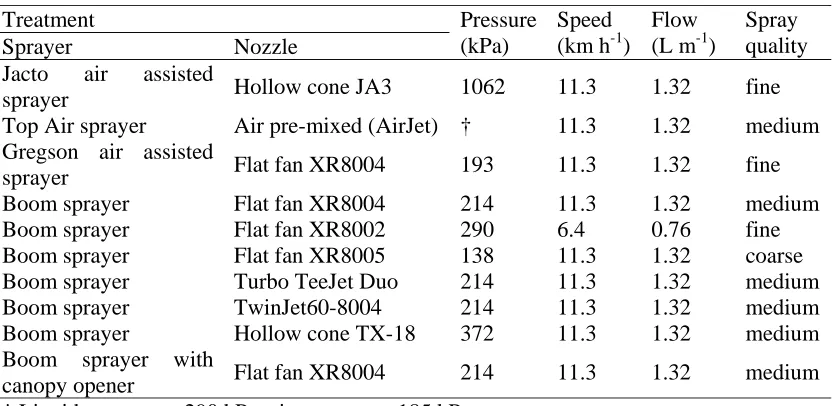
A second component of the study was to determine the effect of spray quality (fine, medium, coarse) on spray deposition and coverage using three different sizes (8002, 8004 and 8005) of XR type of a flat fan nozzle operated at different spray pressures. The application rate was kept constant at 145 L ha-1 for all the treatments. Table 1 gives detailed information on variables included in this study. A control plot was added to the experiment. Each plot was 46 m long and 4.6 m wide. Each treatment was replicated 4 times.
Table 1. Nozzles, sprayers and operating conditions used in field soybean rust spray tests
Treatment
Sprayer Nozzle
Pressure (kPa)
Speed (km h-1)
Flow (L m-1)
Spray quality Jacto air assisted
sprayer Hollow cone JA3 1062 11.3 1.32 fine
Top Air sprayer Air pre-mixed (AirJet) † 11.3 1.32 medium Gregson air assisted
sprayer Flat fan XR8004 193 11.3 1.32 fine
Boom sprayer Flat fan XR8004 214 11.3 1.32 medium Boom sprayer Flat fan XR8002 290 6.4 0.76 fine Boom sprayer Flat fan XR8005 138 11.3 1.32 coarse Boom sprayer Turbo TeeJet Duo 214 11.3 1.32 medium
Boom sprayer TwinJet60-8004 214 11.3 1.32 medium
Boom sprayer Hollow cone TX-18 372 11.3 1.32 medium Boom sprayer with
canopy opener Flat fan XR8004 214 11.3 1.32 medium † Liquid pressure = 290 kPa, air pressure = 185 kPa.
The two air assisted sprayers used in this study were the Jacto Model Advance 3000 (Jacto Inc., Brazil) and Gregson pull type agricultural sprayer (Gregson Technologies Inc, Canada). The Jacto sprayer had a 16 m long air bag along the entire length of the boom. The Gregson sprayer had a similar air bag along the 27 m boom. With both sprayers, the nozzles were located just behind the narrow air outlet which ran the entire length of the boom. The air jet from the Jacto sprayer was delivered at 58° angle toward the liquid spray pattern which had a vertical direction toward the soybean canopy. Nozzles in the Jacto sprayer were hollow cone JA3 nozzles (Jacto Inc., Brazil) mounted 10 cm behind the air jet outlet and were operated at 1062 kPa. Nozzles in the Gregson sprayer were conventional flat fan XR8004 nozzles (Spraying Systems Co., Wheaton, Illinois, USA) operated at 193 kPa.
The canopy opener consisted of a 3.5 m long conduit pipe with 3.2 cm outside diameter. The conduit was mounted 56 cm below and 25 cm ahead of the nozzles to open up the canopy as the sprayer travelled to achieve better penetration of spray into lower parts of the soybean plant, where the rust infection first starts. Only the flat fan XR 8004 nozzles were used for the test with the canopy opener.
The pre-mixed air and liquid sprayer (AirJet) was the Top Air model TA 1600 T-tank sprayer (Unverferth Equipment Co., Alliance Product Group, Kalida, OH). With this sprayer, the air and liquid are mixed in a chamber before being discharged from the nozzle orifice. The sprayer was operated at 290 kPa for liquid pressure and 185 kPa for air pressure.
tested with the boom sprayer (Table 1) were: three conventional flat fan nozzles (XR8002, XR8004 and XR8005) representing fine, medium and coarse spray qualities, a twin pattern nozzle (TwinJet60-8004), a dual nozzle (Turbo Duo) containing two pre-orifice flat fan tips (QJ90-2XTT11002), and a hollow cone nozzle (TX-18). The Turbo Duo nozzle was a two-tip assembly that produced two flat patterns; one at 45° angle forward, and the other at 45° backward from the sprayer travel direction.
Effectiveness of the variables listed above for control of soybean rust was determined using three different methods: a) spray coverage on water sensitive papers, b) spray deposition on metal artificial targets using a spray solution mixed with a tracer, and c) fungicide spray deposition on actual soybean leaves. Samples for these tests were taken at two plant heights: lower and middle parts of the canopy. For spray coverage and tracer deposit studies targets were arranged so that the quantity of potential spray deposit and coverage on both under side and upper side of leaves could be determined. The plots were also sprayed with the rust fungicide containing 23.6% pyraclostrobin (BASF company, Ludwigshafen, Germany) at a recommended dose. After spraying the plots with the fungicide, samples of leaves and stems were collected from the middle and lower part of the canopy. Fungicide deposits on these samples will be determined using a gas chromatography mass spectrometer (The analysis of the fungicide samples has not been completed at this time - results will be made available in a future publication). The experiment was conducted when soybeans were at R5 growth stage with a height of approximately 96 cm. It was planned to conduct an evaluation of efficacy level of the fungicide for control of soybean rust. This part of the study was not done because the field where this study was conducted did not have any soybean rust disease.
Three stakes holding artificial targets were placed 17, 23 and 29 m from the beginning edge of each plot. The artificial targets were 2.5 x 7.5 cm sheet metal plates and 5.0 x 7.5 cm water sensitive papers. The sheet metal plates were used to collect spray deposits inside the canopy while water sensitive papers were used to determine spray coverage on both upper and lower sides of leaves. The artificial targets were positioned at 30 cm and 60 cm above the ground, representing the bottom and middle parts of the canopy (Fig. 1), respectively. For the middle stake in each plot, two plates were used to collect spray deposits at each height. For the other two stakes and at each height, two plates were separately used to collect spray deposits, two water sensitive papers were separately used to determine the spray coverage on the upper side of leaves and another two water
sensitive samples were used to determine the spray coverage on the lower side of leaves. The artificial targets were mounted horizontally with their longer dimension normal to the stake and with 90° radial separation from each other at each height.
The application rate for all treatments was adjusted by either travel speed or flow rate to achieve 145 L ha-1 (Table 1), and nozzle height for all treatments was set at 30 cm above the top of the canopy. A spray mixture containing water and Brilliant Sulfaflavine (MP Biomedicals, Inc., Aurora, OH) at a concentration of 2 g L-1 was used for all treatments. Each treatment was repeated four times in four
46 m long and 4.6 m wide plots containing R5 stage soybean plants.
The artificial targets were collected 5 minutes after spraying. The plates were stored in 125-ml wide-mouth glass bottles in non-transparent boxes. The water sensitive papers were stored in plastic sandwich bags.
Spray deposits on metal plates were washed and dissolved in 20 ml of purified water. Then, a 4 ml sample solution was placed in a cuvette for determination of peak fluorescent intensity with a Model LS 50B Luminescence Spectrometer (Perkin-Elmer Limited, Beaconsfield, Buckinghamshire, England) at an excitation wavelength of 460 nm. Spray deposits on plates were then converted to a percentage of the 145 L ha-1 spray application rate.
The spray coverage on each water sensitive paper was analysed with a computer imaging system which includes a desktop computer, an HP Scanjet 5530 photo-smart scanner and a image software Imaging Tool Windows Version 3.00 (The University of Texas Health Science Center, San Antonio, TX). The resolution for the image analysis was 600 dpi.
Except for the Top Air sprayer, droplet sizes and velocities from nozzles used in the tests were measured with the VisiSizer particle/droplet laser image analysis system (Oxford Lasers, Oxfordshire, UK). During the droplet size and velocity measurement, the nozzles were oriented so that the spray sheet from every nozzle was perpendicular to the laser beam or vertically toward the floor. Droplet size distributions and velocities were determined 30 cm below the nozzle orifice across the centreline of the spray pattern width.
Following the measurement of spray deposition and coverage inside the canopy, leaf area index (LAI) of the soybean canopy was determined using an LAI-2000 plant canopy analyser (LI-COR®, Inc., Lincoln, Nebraska) with two sensor modes. Three small sections in each plot were randomly selected for the LAI measurement. For each small section, four measurements of LAI at four orientations in a square shape were conducted. The sky was fully covered by clouds at the moment of measurement. The LAI sensor was also calibrated under fully-cloudy conditions.
For the Jacto and Gregson air assisted sprayers, air velocities at four different locations near the air outlet, and at four different points 33 cm below the air outlet were measured with an air velocity meter (Model 8386A, TSI Inc., St. Paul, MN). The measurement points were evenly distributed across the boom length. The air velocity at each point was measured four times.
Results and Discussion
Without air assistance, the Jacto air assisted sprayer produced much smaller droplets than the Gregson air assisted sprayer (Table 2).
Table 2. Droplet sizes and resultant velocity at 0.3 m below nozzles used in the tests
Droplet size distribution Resultant droplet velocity Treatment DV0.1
(µm)
DV0.5
(µm)
DV0.9
(µm)
Relative Span[a]
Min (m s-1)
Max (m s-1)
Average (m s-1)
Jacto sprayer[b] 82 118 182 0.85 0.7 13.0 3.5
Gregson sprayer[b] 129 335 568 1.31 2.1 13.1 6.2
XR8004 122 321 549 1.33 2.1 13.3 6.3
XR8002 89 180 349 1.44 1.6 12.6 6.7
XR8005 144 384 632 1.27 2.2 12.6 6.7
Turbo TeeJet Duo 182 376 698 1.37 0.3 11.1 4.0
TwinJet60-8004 147 286 486 1.19 2.1 13.1 6.2
Hollow cone TX-18 129 171 302 1.02 0.3 12.4 3.0
Canopy opener 122 321 549 1.33 2.1 13.3 6.3
[a]
Relative span = (DV0.9- DV0.1)/ DV0.5 [b]
The average air speeds near the air outlet, and 33 cm below the nozzle were 33.1 and 9.8 m s-1, respectively for the Jacto sprayer; and 15.9 and 3.7 m s-1, respectively, for the Gregson sprayer. Because the air speeds discharged from the two sprayers were considerably different, the real droplet size of the Jacto sprayer should be much smaller than the Gregson sprayer. The nozzles evaluated with the boom sprayer produced values of volume median diameter (VMD) in the order from smallest to largest as hollow cone, XR8002, TwinJet60-8004, XR8004, Turbo Duo and XR8005 (Table 2).
In general, average spray deposits varied from 7.7 to 19.6% of the application rate at the middle part inside soybean canopies, and from 1.2 to 6.9% of the application rate at the bottom part of soybean canopies. The spray treatments with the air assistance provided higher spray deposition on targets at both the
middle and bottom of the canopy than the treatments with the conventional boom sprayer. The Jacto air assisted sprayer had the best spray performance of all 10 treatments. Twin jet, Turbo Dual pattern and hollow cone nozzles produced lower spray performances than conventional flat fan nozzles. Detailed results of spray deposits on artificial targets with the 10 treatments were given by Derksen et al. (2006).
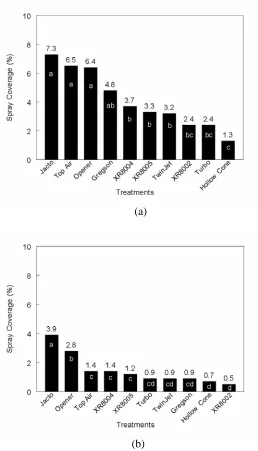
The average spray coverage at the middle part of the soybean canopy (or 60 cm above the ground) varied from 1.3 to 7.3% among the 10 treatments (Fig. 2(a)). The Jacto sprayer provided the highest spray coverage at the middle part of the canopy, followed by Top Air sprayer and the boom sprayer with the canopy opener. The boom sprayer with TX-18 hollow cone nozzles produced the lowest spray coverage at the middle part of the canopy, followed by Turbo duo, and then XR8002 nozzles.
The average spray coverage at the bottom part of the soybean canopy (or 30 cm above the ground) varied from 0.5 to 3.9% among the 10 treatments (Fig. 2(b)). Similarly to the coverage at the middle part of the canopy, the Jacto sprayer provided the highest spray coverage at the bottom part of the canopy, followed by the
(a)
(b)
boom sprayer with the canopy opener and then the Top Air sprayer. The boom sprayer with XR8002 nozzles produced the lowest spray coverage at the bottom part of the canopy, followed by hollow cone TX-18 nozzles. XR8002 flat fan nozzles and hollow cone nozzles had smaller VMDs than other treatments with the boom sprayer.
Compared to the boom sprayer with XR8004 nozzles, the canopy opener increased spray coverage at both middle and bottom parts of the canopy (Figs. 2 (a) and 2(b)). At the growth stage R3 to R5, most soybean leaves were at the top part of plants and these leaves covered most area of the field. The average
leaf area index of the soybean canopy at the time the experiments were conducted was 6.4. With such high canopy density, most spray droplets from nozzles were intercepted by the top leaves. With the help of the pipe on the canopy opener pushing the top part of the canopy forward and down, a higher spray deposition and coverage were achieved on targets at both middle and bottom parts of the canopy.
Among the three spray qualities (fine, medium and coarse), the medium quality spray provided the highest coverage and the fine quality spray provided the lowest coverage at both middle and bottom parts of the canopy (Figs. 2(a) and 2(b)).
Compared to the XR8004 flat fan pattern nozzles with medium spray quality, Twinjet, Turbo dual pattern nozzles and hollow cone nozzles provided very low coverage at the middle and bottom parts of the canopy. Droplets from Twinjet, turbo dual pattern nozzles and hollow cone nozzles had poor penetration capabilities because these droplets had horizontal velocities. The horizontal movement of droplets consumed kinetic energy and caused
droplets to easily settle on the top leaves. Also, the resultant droplet velocities from the three nozzles were lower than the velocity from XR8004 nozzles (Table 2). To increase the droplet penetration capability, all kinetic energy of a droplet should be used for increasing its vertical velocity. Therefore, with the same application rate, twin fan pattern nozzles could not perform the same spray delivery efficiency as other conventional fan pattern nozzles.
(a)
(b)
Figures 3(a) and 3(b) show the average number of droplets per square centimeter on water sensitive papers at middle and bottom parts of the canopy. The Jacto air assisted sprayer, perhaps because of the smaller droplets it was discharging, provided a much greater number of droplets on the targets than any other treatments. With the same operating conditions, the boom sprayer with the canopy opener had a greater number of droplets on the targets inside canopies than other treatments with the boom sprayer. The treatment with Turbo Duo nozzles, due to its larger droplet sizes and lower droplet velocity, had the lowest number of droplets deposited on targets both at middle and bottom parts of the canopy.
Acknowledgements
The authors greatly acknowledge the financial support provided for this study by Ohio Soybean Council, BASF Corporation, Corn and Soybean Digest Magazine, Gregson Technologies, Jacto Spray Equipment Company, Spraying Systems Co., and Unverferth Equipment Co.
References
Derksen R C, H Zhu, H E Ozkan, A E Dorrance, and C R Krause. 2006. Effects of
air-assisted and conventional spray delivery systems on management of soybean diseases. International advances in pesticide application, Aspects of Applied Biology 77, Robinson College, Cambridge, UK, 10-12 January 2006.
Dorrance A E, P E Lipps, D Mills, and M Vega-Sánchez. 2004. Soybean Rust. Ohio State
University Extension Publication AC-0048-04, Columbus, OH, USA.
Yeh C C, A T Tschanz, and J B Sinclair, 1981. Induced teliospore formation by Phakopsora