CLEVELAND STATE UNIVERSITY
Reuse of Urban Wastes
Policy Applications and Recommendations for
Sustainable Reuse of Vacant Buildings and Vacant
Lands for Cleveland
1
Contents
1. Introduction _____________________________________________________________ 2
2. Vacancy and City of Cleveland _______________________________________________ 3
2.1. Negative Impacts of Vacant Properties ___________________________________________ 3
2.2. Vacant Properties in City of Cleveland ___________________________________________ 4
2.3. Importance of Reclaiming Vacant Properties for Sustainable Development _____________ 6
3. Policies for Reclaiming Vacant Buildings _______________________________________ 7
3.1. General Policy Stages _________________________________________________________ 7
3.2. Policies for Cleveland and Land Banks ___________________________________________ 9
3.3. Major Policy Challenges ______________________________________________________ 12
4. Alternative Policies _______________________________________________________ 14
4.1. Vacant Properties to Green Spaces for City of Cleveland ____________________________ 14
4.2. Rehabilitation of Vacant Housing Units as Green Houses ___________________________ 17
4.3. Benefits and Challenges of Alternative Policies ___________________________________ 21
5. Conclusion ______________________________________________________________ 24
6. Appendix _______________________________________________________________ 26
2
1. Introduction
Vacant buildings are urban wastes and they can be used as new resources. Economic
depression and mortgage foreclosures have brought about vacant buildings throughout the City
of Cleveland. The appearance of vacancy causes economic, social, and environmental issues in
an urbanized area.
There are many policies and planning alternatives for fixing the problem of vacant
building.The actions for solving the issue of vacancy generally include two distinct approaches.
First approach is to prevention strategies from being vacant such as code enforcement. The
second approach is for reusing of vacant properties by using financing incentives (Hexter,
Greenwald, & Petrus, 2008).The existing policies are at local, state, and federal level and
generally based on economic incentives such as funds for regaining the vacant buildings.
The goal of this paper is to present two possible policy alternatives to reclaiming vacant
buildingsfor which the owner could not be ascendant about taking the economic responsibility of
the prosperity(Hexter, Greenwald, & Petrus, 2008, p. 4). The modification of vacant houses to
energy efficient counterparts (greenhouses) could be economically and environmentally
beneficial. This policy can also have an indirect outcome of green construction market and green
job opportunities. The destruction of vacant buildings causes vacant areas. As a sustainable
urban development practice, these areas can be converted to urban green spaces such as pocket
parks.
In the first section of the paper, the general background information and definitions about
3 North East Ohio Indicator Data (NEO CANDO).In the second section, the current actions and
policy actors are defined for City of Clevelandand their benefits and challenges are evaluated.
Final section of this project offers two recommended planning alternatives with their advantages
and disadvantages.
2.
Vacancy and City of Cleveland
2.1. Negative Impacts of Vacant Properties
The properties that are not in use and empty are called vacant properties. Owners of these
properties are not able to or not willing to pay their taxes and basic utility bills. Therefore these
properties are abandoned. Vacant, or abandoned properties may include industrial buildings;
residential buildings such as single family homes; and vacant lots (Alexander, p. 4).
Prof. James Q. Wilson articulated the Broken-Window theory to notice the vacant
property in a neighborhood can easily become a center of illegal acts: “If a window in a building
is broken and is not repaired, the other windows of the building will be broken”(Schilling, Ford,
Kildee, Lind, & Logan, Toledo at the Tipping Point, 2008, p. 12). Vacant buildings can also be
used as drug dealing centers that brings about crime and social issues.In Austin Texas, a study
focused on the crime rates in areas in vacant buildings showed that vacancy doubles the
incidence of crime (Alexander, p. 7).
Another issue of vacant buildings is neighborhood fires. Because of being uncontrolled,
an abandoned building is defenseless to burnout.This situationcould harm the whole
neighborhood. Twelve thousand fires in vacant buildings are reported by The US Fire
Administration and according to this annual report, the vacant property fires caused 70 millions
4 Vacant houses have a negative, indirect impact on cities in two economic perspectives;
taxes and surround property values.First, taxes cannot be collected from abandoned properties
but they achieve public services. Consequently, local governments lose their local sources of
money.And also they spend their current money for the issues that contribute to vacant
properties. Second, vacancy in a city or neighborhood reduces the current property values of
housing units or businesses. According to the Temple University Center for Public Policy
researchers found in 2001 that abandonment reduces the property values of other
surroundingbuildings(Temple University, 2001). Figure 1 shows the relationship among the
property value reductions based on the distances from vacant property in Philadelphia.
According to this study, the results show that the nearest properties to an abandoned property
affected most based on property values.
Figure 1 Reduction of Property Values
Source:Temple University, Blight Free Philadelphia, 2001, p. 22
2.2. Vacant Properties in City of Cleveland
Cleveland is a former industrial city and due to the population loss the problem of
vacancy for this city is inevitable. In 1950, Clevelandwas the sixth largest cityin the US.
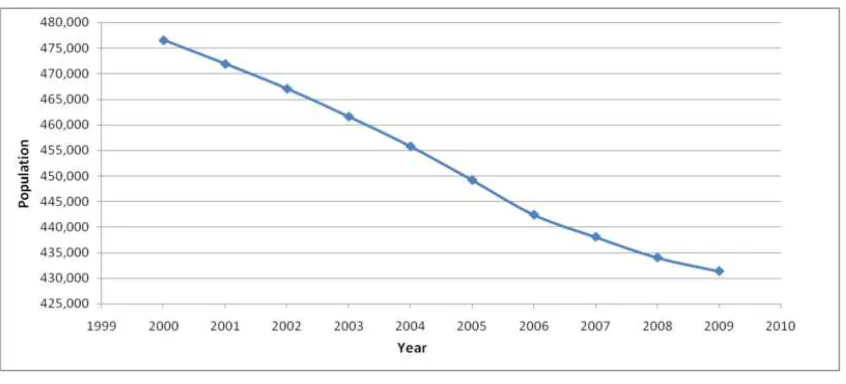
5 the breakpoint in the year of 2005 is noticeable. This point shows the steep decrease of
population due to the mortgage crisis. The foreclosures in Cleveland cause vacant buildings
throughout the city.Data source for Figure 2 was obtained from American Fact Finder-Annual
Population Estimates(American Community Survey, 2011).
Figure 2 Population Decline in Cleveland
Source: United States Census Bureau 2005-2009 American Community Survey 5-Year Estimates
Table 1 Occupancy and Vacancy Rates
Source: United States Census Bureau 2005-2009 American Community Survey 5-Year Estimates
Table 1 shows the numbers and changes of housing units based on their owner status. The
number of occupied housing units is lowest in year 2010. And also, again in this year the number
6 Moreover, the Appendix (section 6) provides a map that shows the distribution of vacancy and
occupancy in Cleveland based on census track boundaries(The U.S. Census Bureau, 2011),(NEO
CANDO, 2010).
2.3. Importance of Reclaiming Vacant Properties for Sustainable Development
Vacant properties offer new resources for the city. Rather than planning, reclaiming
vacant property isalsoimportant for protecting the unused land. Vacant properties are
community wastes and reusing them is an act of recycling. By recycling vacant properties, the
future land can be protected from unsustainable growth and also reclaiming vacant buildings
provide protection to nonrenewable resources (Walljes & Ball, 1997, p. 197).
The featured benefits of the reclaiming vacant units are generally economic advantages.
The reclaiming activities for vacant units can reform the real estate values of surrounding units.
At big scale, outcome could be the restoration of housing market at local levels (See Figure 1).
Another important economic benefit is the reduction of local government spending for fire
department, police department, and/or demolition practices(Treuhaft, Rose, & Black, 2009, p. 4).
In brief, reclaiming vacant properties important for sustainable development, in terms of;
Social Justice: Reuse of vacant properties can provide the distribution of taxes and public services equally and enhances the quality of life and social well-being.
Economic Development: Reclaiming policies and actions can provide new economic incentives, job opportunities and eliminates the unnecessary cost of new land use and
7
Environmental Quality: Reusing vacant properties can provide nonrenewable resource protection, improveair quality, and with the right choices of solutions such as providing
green spaces in vacant properties can reduce the urban run-off(Walljes & Ball, 1997, p. 197).
3.
Policies for Reclaiming Vacant Buildings
3.1. General Policy Stages
The implementation of policies about vacant buildings could be varying among the cities
because each city has its own culture and economic power. This distinctiveness can impact the
outcome of the policies for different cities. On the other hand, the study groups, researchers, and
experts have a consensus of the policy framework as it can be shown in Figure3 (Schilling, The
Revitalization of Vacant Properties, p. 20)
Figure 3 Revitalization CycleCourtesy of (Schilling, The Revitalization of Vacant Properties, p. 20)
Stabilization. Stabilization activities can be divided into two perspectives. The first
perspective is prevention activities for stabilizing vacant buildings.Enough information should be
given to mortgage borrowers for future possibilities of foreclosure. Lending institutions has an
important role for aiding people who are at the margin position of foreclosure (Schilling, Ford,
8 Second perspective is the activities for stabilization after the vacancy happened. An
inventory management for owners of vacant buildings can provide and evaluations of owner’s
financial conditions are also important for implementing further strategies. Enforcements and
abatements for disburden of owners are the initial strategies for combating the vacant buildings
in cities and neighborhoods (Schilling, The Revitalization of Vacant Properties, p. 21).
Rehabilitation Resources. These strategies provide various numbers of financial and
technical sources to owners of vacant buildings. With these aids, owners are able to revitalize
their vacant units. At local government level, credits for low income houses, state loans, and
community development block grants (CDBGs) can be provided for vacant building owners. On
the other hand, non-governmental organizations such as community development organizations
(CDCs) can buy the vacant building from the owner and own the responsibility for management
and resale of the building. Nonprofit organization could provide educational and technical
assistance to owners for rehabilitation practices (Schilling, The Revitalization of Vacant
Properties, pp. 21,28).
Property Transfers or Demolition. As a city wide condition, the vacancy problem could be
at excessive levels. Under these situations, demolition could be the only decision but this
decision could bring about new problem; vacant land. The transfers of the abandoned building to
the CDCs could create more efficient solutions for rehabilitation activities. After demolition
practices vacant parcels could be transferred to the land banks. These land banks operate the land
for reconstruction activities with nonprofit and profit seeking sectors. Today some county or city
land banks work with CDCs to rehabilitate vacant housing units such as Cuyahoga County Land
9
Long-term Revitalization. After demolition or during rehabilitation practices, city
authorities should consider the smart growth and sustainable development principles for the long
term results of the revitalization.(Schilling, The Revitalization of Vacant Properties, p. 22).
3.2. Policies for Cleveland and Land Banks
In 2008, Cleveland State University, College of Urban Affairs published a report that
presents alternative policy strategies and sustainable solutions for Cleveland’s vacancy problems.
Cleveland has a rate of vacant buildings at 11.7 % (Schilling, Ford, Kildee, Lind, & Logan,
Toledo at the Tipping Point, 2008, p. 8). The writers of the report point out that this problem
could be a chance to redevelop the city based on sustainable perspectives and more efficient
uses. And they offer a set of policy strategies based on three general captions; (1) preventing
abandonment and (2) gaining control (Hexter, Greenwald, & Petrus, 2008, pp. 3,4).
As being initial policy step for each city, preventing from abandonment could be the best
combat type for Cleveland for vacancy. Overlapping idea from the policy strategies for
abandonment is counseling for foreclosure avoidance and maintenance of untended structures.
Identification of the owners, who is at the edge of foreclosure, is the crucial policy frame. Next is
providing advices and solutions. These could be attained by direct help from non-profit or
quasi-governmental organizations. For maintenance practices, the Albany, NY model (Section 3.2)
could be useful and effective. Although, code enforcements designed by cities are not aggressive
solutions, with the presence of enforcements, the allocation of organizations and control of the
studies can be done easily (Hexter, Greenwald, & Petrus, 2008, pp. 5,7).
Opportunity Homes Project, was initiated in 2008, has a goal to change future of 321
homes with $20 million investment. This project provides new land use patterns for vacant lands
10 vacant structures.Opportunity Homes Project was designed by Neighborhood Progress Inc.,
Cleveland Housing Network, and CDC contains prevention, rehabilitation, and demolition
activities (see figure 4). The expected outcomes are rehabilitation of 150 homes, prevention of
300 houses from foreclosure risk, and demolition of 300 housing units. In April 2009, 26 housing
units have been reclaimed and 46 of housing units (Treuhaft, Rose, & Black, 2009, p. 52).
For low-income people, city has implemented Affordable Housing program. This
program provides, an opportunity for low-income residents to own a home, which is already
rehabilitated from a vacant structure. These homes are rented to people with lower costs butthe
obligation is that the residents need to live that home for 15 years (Hexter, Greenwald, & Petrus,
2008, p. 14).
Land banks are the key stakeholders for rehabilitation of vacant units. Today, land banks
generally have two major purposes. First, they can acquire a vacant home and transfer for
redevelopment and remarketing with the CDCs or other NGOs. Second, land banks can also
provide clear title or tax waving for improvements of the property. Finally, land banks can
provide maintenance and planning services. Demolition and renovation of the housing units are
the maintenance services that land banks can accomplish. For future development, land banks
can design new policies for vacant land after demolition practices(Sage Computing, 2009, p. 4).
Cuyahoga County Land Bank’s major duties are demolition activities, vacant lot reuse
policies, and house renovation activities. In order to prove demolition services, Cuyahoga Land
Bank initially identifies the vacant unit and transfers the demolition action to the related
construction companies. For vacant lots reuse, land bank provides three different policies. First
11 organizations. Second is combining parcels. This policy basically provides an option to parcel
owners, whose parcel is adjacent to the vacant lot, to buy the vacant lot. Third, Cuyahoga land
bank cooperates with local governments and private organizations to implement urban gardening
practices on agriculturally available vacant lots(Cuyahoga County Land Bank, 2011).
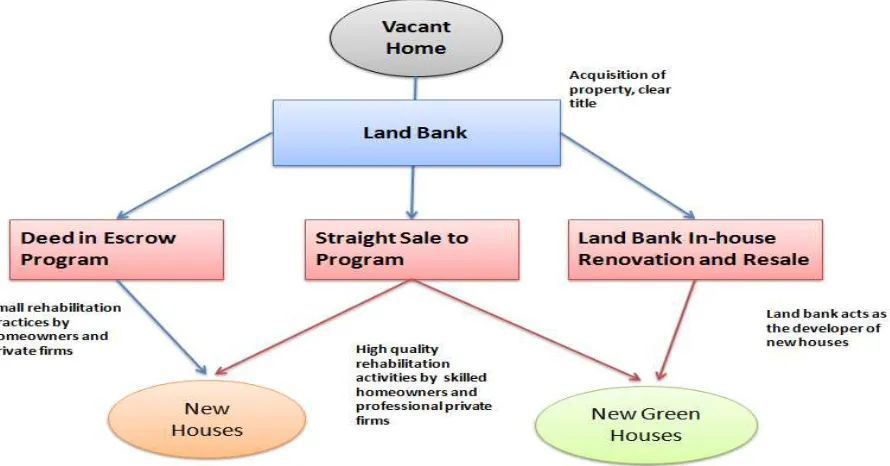
The housing policies provided by land bank includes modify, transfer, and sell policies at
three levels. The first level of the policy is to develop partnerships with low experienced firms
and homeowners for renovating the vacant unit. Second level of the policy that is followed by
land bank is direct selling of the vacant unit to professional rehabbers and homeowners that have
the rehabilitation skills. Final level of the policy is to rehabilitate the vacant property by the land
banks sources and workers and sell them to the individuals(Cuyahoga County Land Bank,
Housing, 2011).
Cleveland land bank has two different approaches for vacant properties. The land bank
differentiates the properties as buildable and non-buildable vacant properties. For non-buildable
properties the land bank provides yard extension program. By implementing this program land
bank transfers the property to the individuals. For buildable lots, individuals proposed their
construction projects that have not any controversy among the local housing codes and
regulations(City of Cleveland, 2004).
In Cleveland, each year, city demolishes its 1,000 vacant buildings. The vacant lands are
continually growing due to the demolition activities (Kent State University, 2008, p. 2).
Therefore, Kent State University along with Neighborhood Inc. and Cleveland City Planning
Commission had prepared city-wide strategies for reusing the land surpluses with green solutions
12 According to this report, many strategies had been introduced with sustainability
perspectives. Main goal of this project is to introduce implementable green infrastructures and
other reuse techniques and point out the ecosystem services and economic advantages of these
strategies. Additionally, this report introduced possible stakeholders and financial sources from
governmental funds and non-profit organizations.
The report suggested three important policy stages for reusing vacant land. According to
Kent State Land Lab, the initial policy is to provide financial incentives and regulations for
developing neighborhoods in order to stabilize vacancy. Second strategy is implement green
spaces such as community gardens for low-income neighborhoods. The report insists that the
urban agriculture will provide new job opportunities and will create local food market. Also the
unused land can be used as clean energy fields such as solar farms or wind energy. This strategy
can also generate green technology market and bring about new job fields. Final strategy relevant
to water quality control by expanding green spaces and redesign vacant lots near river cost lines
as storm water holding green infrastructures(Kent State University, 2008, pp. 31,34).
3.3. Major Policy Challenges
Reuse practices are generally is a hard and complex way as a sustainability policy for a city.
The complexity could occur in approval of clear titling actions. Obtaining approvals cause
inflexibility and slows down the decision processes of the policy actions because permissions are
needed from local governments and agencies. Rather than legislation inflexibility there are also
several challenges could occur. These challenges are identification of the property owners,
compliances with the city development plans,marketing the properties, and challenges in vacant
13 The problems during the policy implementation could occur in every frame of the action
plans for reusing vacant properties. The first challenge could occur at the very first step of the
policy that is creating inventory section. City authorities could not find the owners of the
property in order to initiate the policy implementation. The semi-solution for this challenge is to
sign-up programs. Such programs in Albany, NY are a good example and practice to collect data
and owner characterization. Another example to combat this problem is GIS operations. These
map-based applications are a good way to visualize and to store the data-sets. City of Baltimore
uses GIS operations to collect data and NEOCANDO has parcel based data for vacancy for
North East Ohio is another example for Cleveland data management program (Dewar, 2009, p.
7).
Another problem is the cities development plans and vacant property policies should overlap
in development plans. In Cleveland, the land bank’s main goal is to prove available vacant land
for reconstruction to increase the quality of current development pattern. In other words, city
increase the quality of current condition. In some cities, such as Detroit, one of the main goals of
the policies is profit making without giving any guarantee of full ownership (Dewar, 2009, p.
11).
Cleveland is an ex-industrial city and the housing market is not active due to the continual
population decline. Therefore, demolition is the default option for the city authorities. The city
focused more on the reuse of the vacant lot occurred from demolition actives. Such policies as
combining parcels and urban agriculture practices could also bring about new problems. In order
to implement an urban farm on a vacant lot the initial costs could be higher than expected. The
capital for a small farm could include equipment costs, employment costs, water usage costs, and
14 Monopolies in food market could not allow local farm products and cause inefficiency in profit
making. Especially for Cleveland, the growth season is limited and some products need certain
climate conditions, therefore the food variety will be limited. Finally, public health and
environmental problems could occurwhile the owners of the pocket farm seek profits. Use of
fertilizers and water for increasing the performance can bring about contaminated soils problems
and contaminated urban run-offs(Food Security, 2003, pp. 14,18).
A good way to emphasize finance could be done by measuring the capacity of the
non-profit organizations in a city. For instance, the capacities of the CDCs in Cleveland are at higher
levels. Because City of Cleveland has transferred its %25CDBG to the CDCs in order to raise the
capacity of the non-profit organizations. As a result of that, Cleveland has a high potential to
reuse vacant properties (Dewar, 2009, p. 10).
4.
Alternative Policies
Alternative policies are given as optional ideas that can be accompanied to the general
policies about vacancy in City of Cleveland. These policies could also be used to minimize the
size of the barriers for vacant property issues.The alternative policies offer city beatification and
present a new dimension for housing market.
4.1. Vacant Properties to Green Spacesfor City of Cleveland
Replacing vacant land as green infrastructure is known as right-sizing the land for future
generations. The term right-sizing means the usage of surplus land for new utilization, instead of
using new land parcels(Schilling & Logan, Greening the Rust Belt-A Green Infrastructure Model
for Right Sizing, 2008, p. 453). After demolition practices as a policy step in the revitalization
15 The policy implementation has three main perspectives that are identification, data
gathering, and providing land bank services. The first is to identify the location of the vacant
property to implement the greening policy. The identification of buildings that will be
demolished and the buildings that will be rehabilitated, are the crucial points. The choices should
be based on the socio-economic conditions of the city. The opinions of the residents in concerned
neighborhoods are also important (Schilling & Logan, Greening the Rust Belt-A Green
Infrastructure Model for Right Sizing, 2008, p. 457).
The data analysis methods could be varied. The policy makers can find data from
previous policies and implementations. For instance, people could find the right place for
demolition or establish green infrastructure by analyzing the owner characteristics. The greening
policies are mostly implementing for city owned properties. Another method for collect and sort
data is of course GIS operations. GIS operations are highly effective not only for identification of
the vacant lots, but also it is efficient for data management. Moreover, GIS tools such as area
calculations and model based analysis can help decision makers to find the efficient green
infrastructure for implementation.GIS tools can also be used for cost-benefit analysis to show
possible results of the policy.
Establishing land banks is another element for green infrastructure right-sizing practices.
According to this policy model, the lank banks must have a coherent structure that covers the
demolition, management, and reuse practices with other private or governmental organizations.
Finally, states or city authorities should create land bank legislation to protect and maintain
land-banking programs. Examples of these enactments can be seen in such states as Ohio, Georgia,
and Michigan (Schilling & Logan, Greening the Rust Belt-A Green Infrastructure Model for
16 The city of Buffalo, NY has a rigorous policy in order to handle vacant housing units. In
2007, 22,000 vacant housing units were identified in the city (Revitalizing Urban
Neighborhoods, Inc., 2007). The city consul implemented demolition policy for vacant buildings,
which cannot be rehabilitated or cannot be sold to private sector. After demolition, the main goal
ofthe city’s Urban Renewal Agency and Revitalizing Urban Neighborhoods Inc. (RUN Buffalo)
is to redesign green spaces for vacant lots. These green spaces could include community gardens
and pocket parks.
Cleveland could modify RUN Buffalo policy for the urbanized areas by establishing
pocket parks for beatification activities for combating urban decay. Before establishing this
policy Cleveland City Planning Commission and City of Cleveland Community Development
should identify the vacant units or lots cooperation with the NEO CANDO. The identification of
the parcel owner can be done by the online sign-up activities. Data analysis could be done by
NEO CANDO to identify the location of the possible vacant property that will be change into a
pocket park. The indicators for identification could be varied. An efficient survey based on
agricultural inefficiency, household incomes, the condition of housing market in the
neighborhoods, crime rates, and buildable, non-buildable conditions could be implemented for
identification of effective vacant properties.
Based on similar policies in other cities, CDCs prefer to use the CDBG to implement
green space activities. The city of Cleveland has already use 25% of the federal grant for
renovation activities and to use some portion for pocket parks could bring about effective
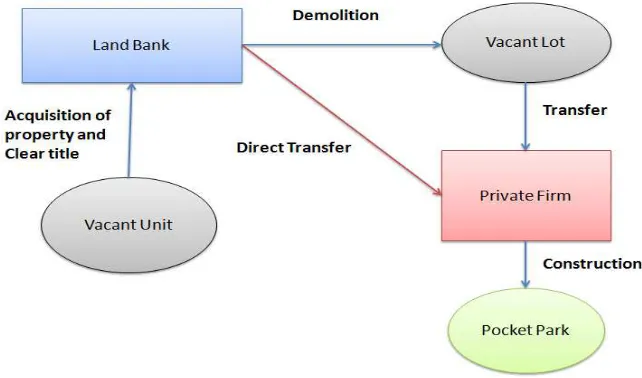
17 The key stakeholder would be the Cleveland Land Bank for obtaining of the property and
clear titleactivities with the coordination of the Cleveland Department of Community
Development.Next step in the policy frame is the demolition of the vacant unit. Demolition
activity could be done by land bank or private firms. Third, land bank could transfer the lot to a
private firm or a NGO to establish the pocket park. Additionally, Cleveland Land Bank can also
transfer directly, the property to a private company to convert the vacant lot to a pocket park with
all other responsibly (Figure 4)(Sage Computing, 2009, p. 4).
Figure 4 Policy Frameworks for Establishment of Pocket Park
Source: Cuyahoga County Land Bank, Demolition and Vacant lot Reuse
4.2. Rehabilitation of Vacant Housing Units as Green Houses
Another alternative policy is modification of vacant housing units as green houses.During
the last decade homes are the individual portions of ineffective energy usage due to the high
quality living style.The idea of green homes originated from the current construction industry
products to make them more energy efficient and environmental friendly. Today, construction
18 environmental qualities. At the same time by living in these green housing units people can save
money for reduction in their energy consumption patterns (Maczulak).
Green buildings and designers have three main goals in order to construct and
environmental friendly house. These goals are also known as 3Rs that refers to reuse, recycle,
and reduce. Regard to with these 3Rs the planners and owners could decide how the homes will
be look like. Some owners could choose being more energy efficient and disregard the materials
in use. Some owners could choose viceversa. This brings about a variety of different green
homes(Maczulak).Figure 5 shows basic features of a green home that has higher levels of all
3Rs.
Figure 5 Green Home Features
Source:Maczulak, Green Building Design, Science Online
Figure 5 shows somewhata hard-to-construct green house because according to today’s
green technology market. The instruments such as Earth-moderated temperature exchange
system have an approximate full system cost of $14,000 in 2008 dollars and replacement cost is
19 not have a geothermal energy source or could be very deep to install these instruments.On the
other hand some features of Figure 5 are affordable such as solar panels and isolation techniques.
Due to the flexible design and possible higher costs, there are certification programs that
help designers and local governments to find their own pattern of green building. In order to
create affordable green houses, Green Enterprise Communities offers aid to state and local
governments and also offer funds to developers and builders. Green Enterprise Communities
have published criterions in their web site. To obtain this certification, firstly the project should
consider low income residents or tenants (Enterprise Green Communities, 2011).
Another certification is provided by U.S. Green Building Council (USGBC) called
Leadership in Energy and Environmental Design (LEED). LEED certification provides solutions
for construction industries, local government for the challenges of green building constructions.
LEED use rating system and evaluate the project’s sustainability in water efficiency, energy,
recycling, and regional priorities (USGBC, 2011).
Green housing can be used for combating vacancy. The vacant home can be modified as
a green home and this strategy will bring about new housing market and also job opportunities.
In South Euclid, Ohio this transformation policy has been using for inner ring suburban
areas.With the total funds from Cuyahoga County and federal government grants are
approximately $1 million dollar, city started the Green Neighborhoods Initiative program (Love,
2010). The framework of policy of this program is quite simple. With the budgets, city will buy
the vacant homes and revitalize them with sustainable aspects of green housing techniques. Next,
20 Today, City of South Euclid has completed the transformation of four houses and three of
them are already sold.Table 2 shows the housing prices and general condition of houses. In the
Appendix (section 6) a map of South Euclid is provided to show the number of lowest income
homes and the locations of the green homes that have built. According this map the houses
wasconstructed in two regions where the highest number of low income homes is presented.
Table 2 Green Houses in South Euclid
Source: Ideal Homes, South Euclid
The Cuyahoga County Land Bank programs about housing have three different policies
(See Section 3.2.). The green housing construction program could be accompanied these
different policy levels. In order to implement an efficient green housing policy modification
method should be chosen before destruction practices. The initial policy frame is to identify the
vacant homes and their owners. Another important step is the identification of possible
modification level. The indicators for identification of right vacant home could include the
condition of the house, the condition of neighborhood housing market, household income
levelsand the population. Then the Cuyahoga Land Bank should seek partnerships with private
construction companies to provide a certificated green home modification. Cuyahoga Land bank
could also integrate the concept of green energy efficient houses for the current housing
renovation policies. Figure 6 shows the possible policy framework for implementing green
21 eliminated for new housing policy, the implementation of a green housing modification policy
could be used for Cuyahoga County land Bank two out of three current policies.
Figure 6 Integration of Green Housing Policy to the Current Policies
Source: Cuyahoga County Land Bank, Housing
4.3. Benefits of Alternative Policies for Sustainable Development
Most of the benefits have been explained in Section 3.2. Right-sizing based on green
infrastructure has economic and environmental benefits. The policies such as implementing
pocket parks have economic advantages for improving the city quality and directly impact the
quality of life. Green space is a good way to combat urban sprawling. With the presence of green
spaces, the cities become more attractive to live. Recreation areas such as parks enable people to
change their transportation patterns. After demolition of a vacant building, the surplus land could
be targeted as illegal debris areas. Therefore, the reuse of these lands offer high quality
22 Green building construction and selling could have a success in housing market. It can
accelerate the housing market and also it can create a new market of green products. Job training
programs for qualified staff can offer people new job opportunities. For Cleveland, demolition
practices are at higher levels and the materials from these practices can be used as recycled
materials for green construction. Green building techniques can be used in central south east
portion of the city (Appendix, Map1). By implementing new houses, city could become
attractive to residents and reuse policy can be switched to urban sprawl policy.
4.4. Challenges in Alternative Policies
Policy makers can encounter some challenges before and after the implementation of
right-sizing policies. The first challenge is of course funding. Without enough funds, the right-right-sizing
practices could not be initiated. Second challenge is lack of authority. Without enough legislative
powers decision makers could not manage the implementations. Some states, such as Ohio have
overcome this problem by legislating land-banking programs. After solving budgeting and
regulative problems, many states still need a leader organization or group to manage the policies
and create communication between relevant organizations(Schilling & Logan, Greening the Rust
Belt-A Green Infrastructure Model for Right Sizing, 2008, p. 467).
Due to the financing issues, in order to implement mini-park policy, voluntarism is needed.
The residents have willingness to have small sized parks instead of vacant lot; therefore
Cleveland city authorities can use this interest for implementation activities. Cleveland land bank
could transfer the vacant lots to NGOs or neighborhood development organizations for
transferring the financial burden(Geisler, Greenstein, Hu, Mithorn, & Munsell, 2009, p. 67).
Rather than financing issues, liability challenges could occur among stakeholders. In order to
23 the communication among the agencies and organizations. The city authorities could
designcodes that clear the roles about vacant lot greening activities. The legislation can speed the
policy activities(Carrera, 2002, p. 16).
The major challenge that Cleveland could possibly encounter is the building codes. However,
the recent project in Cleveland, the EcoVillage Project demonstrates that application of green
housing techniques is possible and could be part of the local building code of the city. A positive
outcome has been generated with the preparation an appendix for the Cleveland Residential
Code. This appendix consist of 49 chapters that identifies each part of a green building; its
heating and cooling systems, walls and walls coverings, roof coverings, electrical code, etc. The
main goal of this appendix is the elimination of possible barriers by reforming the current codes
as performance based codes that can clear the way of green building construction. The
application of this appendix by Cleveland would bring about a green construction market to the
city and the modification of vacant buildings as green houses such as in South Euclid will be
accelerated(Ecocity Cleveland, 2003).
There are also other possible challenges for policy makers for green building strategy. This
strategy has long term goals with slow pace outcomes. The main problem could occur with the
cities current development plans. Therefore, identification of the location of the innovative
housing units is important. Another problem could occur between city authorities and non-profit
organizations. The distribution of duties and a leader organization must be available. To solve
these problems cities should use these strategies for neighborhood levels instead of a city-wide
theory. Final challenge could be seen at financial level when appropriate funds could not be
found. To sum up, the best way to use this strategy is the unification of other strategies. For
24
5.
Conclusion
Each waste could be a resource for new implementation. Vacancy is both a problem and a
new chance to redevelop city or neighborhood for sustainable perspectives. By revitalizing
vacant properties cities can achieve more economic, socially fair, and high quality environments.
The main reason of vacancy is population lost and foreclosures due to the mortgage
crisis.Cities have implemented various policies and strategies to overcome the vacancy burden.
These policies include creating inventory and identification practices, finding funds for reuse of
vacant buildings, and regulatory practices for controlling the housing market and vacancy.
Cleveland and Cuyahoga County have already accomplished the establishment of land
banks for vacant properties. The main goal of this paper is to introduce two important
sustainability policies for vacant buildings before and after demolition for these land banks and
other ongoing projects.City of Cleveland can used the green space policy for vacant land that is
originated from demolition of vacant buildings. According to research study from Kent States,
there is enough available vacant land for green spaces with ecological benefits such as water
quality control. Second policy is an inspiration from City of South Euclid’s green building
program. Cleveland could use the same strategy as a back-up for ongoing or future policies and
26
6.
Appendix
Map 1
Courtesy of U.S. Census Bureau, NEO CANDO Data Sources
URL: http://www.census.gov/geo/www/cob/bdy_files.html
URL:http://neocando.case.edu/cando/fullDataReport/interface.jsp
27
28
7.
References
Alexander, F. (n.d.). Vacant Properties The True Costs to Communities. Retrieved October 10, 2011, from The United States Conference of Mayors:
http://www.usmayors.org/brownfields/library/vacantproperties0805.pdf
Carrera, J. M. (2002, September 12). Neighborhood Open Space Management: A Report on the Vacant Lot Restoration Program in Baltimore. Retrieved December 13, 2011, from Parks and People Foundation:
http://www.parksandpeople.org/files/resources/2577_Vacant%20Lot%20Restoration%20Progr am%20Report.pdf
City of Cleveland ,Land Bank Application. (2004, April 13). Retrieved December 11, 2011, from:
http://cd.city.cleveland.oh.us/forms/cdLandbankApplicantInfo.pdf
City of South Euclid,Green Neighborhoods Initiative. (n.d.). Retrieved October 05, 2011, from:
http://www.cityofsoutheuclid.com/building-housing/green-neighborhoods-initiative.html#top
Cummings, P. (2008, 23 6). Indiana Residential Geothermal Heat Pump Rebate Program Review. Retrieved November 1, 2011, from Indiana Government:
http://www.in.gov/oed/files/GHPProgramreport.pdf
Cuyahoga County Land Bank,Demolition and Vacant Lot Reuse. (2011). Retrieved December 11, 2011, from Cuyahoga County Land Bank: http://www.cuyahogalandbank.org/demolition.php
Cuyahoga County Land Bank ,Housing. (2011). Retrieved December 11 , 2011, from:
http://www.cuyahogalandbank.org/housing.php
Dewar, M. (2009, February). What Helps or Hinders Nonprofit Developers in Reusing Vacant, Abandoned, and Contaminated Property? Findings from Detroit and Cleveland.Retrieved October 20, 2011, fromUniversity of Michigan : http://closup.umich.edu/files/closup-wp-4-nonprofit-reuse-land.pdf
EcoCity Cleveland. (2003, May). Building Green in Cleveland (Draft). Retrieved December 13, 2011, from:
29 Enterprise Green Communities. (2011). Retrieved November 02, 2011, from Enterprise Green
Communities Certification: http://www.greencommunitiesonline.org/tools/certification/ Fabrizi, J. M. (2006, June). Combating Problems of Vacant and Abandoned Properties Best Practicies in
27 Cities . Retrieved 10 15, 2011, from The United States Conference of Mayors:
http://www.usmayors.org/bestpractices/vacantproperties06.pdf
Food Security. (2003, October). Urban Agriculture and Community Food Security in the United States: Farming from the City Center to the Urban Fringe. Retrieved December 12, 2011, from Food Security: http://www.foodsecurity.org/PrimerCFSCUAC.pdf
Friedman, E. (2003, january 18). Vacant Properties in Baltimore Strategies for Reuse. Retrieved October 04, 2011, from John Hopkins Institute for Policy Studies:
http://ips.jhu.edu/elements/pdf/ips/abell/ericabell.pdf
Geisler, N., Greenstein, S., Hu, C.-C., Mithorn, C., & Munsell, M. (2009, August). Adversity to Advantage: New Vacant Land Uses in Flint. Retrieved December 13, 2011, from Urban and Regional Planning Program, University of Michigan:
http://www.taubmancollege.umich.edu/planning/pdfs/adversity_to_advantage.pdf
Helliker, K. (2010, March 10). Cleveland Sees Plunge in Population. Retrieved October 10, 2011, from The Wall Street Journal:
http://online.wsj.com/article/SB10001424052748704629104576191021044682508.html
Hexter, K. W., Greenwald, C., & Petrus, M. H. (2008, October). Sustainable Resue Strategies for Vacant and Abandoned Properties. Retrieved October 01, 2011, from Maxine Goodman Levin College of Urban Affairs:
http://urban.csuohio.edu/publications/center/center_for_community_planning_and_developm ent/vacant_properties_final_10_08.pdf
Ideal Homes,South Euclid. (n.d.). Retrieved November 2, 2011, from:
http://idealhomescc.com/en-US/South-Euclid-Ohio.aspx
Kent State University. (2008, November). Re-Imagining A More Sustainable Cleveland Citywide Strategies for Reuse of Vacant Land. Retrieved October 31, 2011, from Neigborhood Progress:
30 Love, S. (2010, May 26). South Eculid Rehabs Homes to Draw Interest, Invester to Cleveland Suburbs.
Retrieved November 2, 2011, from Cleveland/Inside&Out:
http://www.cleveland.com/insideout/index.ssf/2010/05/south_euclid_rehabs_homes_to_d.ht ml
Maczulak, A. (n.d.). Green Building Design. Retrieved October 04, 2011, from Science Online Facts on File:
http://www.fofweb.com/activelink2.asp?ItemID=WE40&SID=5&iPin=GTRE0007&SingleRecord= True>.
NEO CANDO, Social and Economic Data. (2010). Retrieved October 11, 2011, from:
http://neocando.case.edu/cando/fullDataReport/interface.jsp
Perlman, D. L., & Milder, C. J. (2005). Practical Ecology for Planners, Developers, and Citizens. Washington DC: Island Press.
Revitalizing Urban NeighborhoodsInc. (2007). Retrieved from RUN Buffalo:
http://www.runbuffalo.com/
Sage Computing, Inc. (2009, August). Revitalizing Foreclosed Properties with Land Banks. Retrieved December 10, 2011, from HUD User:
http://www.huduser.org/portal/publications/landbanks.pdf
Schilling, J. (n.d.). The Revitalization of Vacant Properties. Retrieved October 04, 2011, from The United States Conference of Mayors:
http://www.usmayors.org/brownfields/library/Revitalization_of_Vacant_Properties.pdf
Schilling, J., & Logan, J. (2008). Greening the Rust Belt-A Green Infrastructure Model for Right Sizing. New York: journal of the American Planning Association.
Schilling, J., Ford, F., Kildee, D., Lind, K., & Logan, J. (2008, August 01). Toledo at the Tipping Point. Retrieved October 02, 2011, from LISC Toledo:
http://www.lisc.org/toledo/resources/publications_10881/tipping_10884.pdf
Temple University, Blight Free Philadelphia. (2001, Octover). Retrieved December 7, 2011, from:
http://astro.temple.edu/~ashlay/blight.pdf
31 Properties for Community Benefit. Retrieved December 8, 2011, from PolicyLink:
http://www.policylink.org/atf/cf/%7B97c6d565-bb43-406d-a6d5-eca3bbf35af0%7D/EDTK_FORECLOSED%20PROPERTIES_FINAL_8.26.09.PDF
United States Census Bureau,American Community Survey. (2011). Retrieved October 11, 2011, from:
http://factfinder.census.gov/servlet/DatasetMainPageServlet?_program=ACS&_submenuId=&_l ang=en&_ts=
United States Census Bureau,Cartographic Boundary Files. (2011). Retrieved October 11, 2011, from:
http://www.census.gov/geo/www/cob/bdy_files.html
USGBC. (2011). Retrieved November 2, 2011, from How to Achive LEED Certification:
http://www.usgbc.org/DisplayPage.aspx?CMSPageID=1991
Walljes, I., & Ball, R. (1997). Exploring the Realites of the SUStainable City Through the Use and Reuse of